(Above, From the New York Times story about why Mikhail Prokhorov and Bruce Ratner's Nets basketball team is going to China and Russia and making a deal with Russian vodka producer Stolichnaya. Fred Conrad Photo.)
A just-off-the-presses New York Times sports section story about how the Nets, Bruce Ratner's and Mikhail Prokhorov’s basketball team are traveling to “Moscow on Sunday on their way to China” begins by observing what it dubs an oddity:
The Nets might be an odd choice to be the N.B.A.’s ambassador overseas. With 12 wins last season, they are often a forgotten team even in New Jersey, where they fail to sell out their home games and live in the shadow of the cosmopolitan Knicks.
Yet the Nets are among the most active teams in courting international companies.
Though this lead-in to the article speaks in general terms about the Nets as the “N.B.A.’s ambassador overseas” “courting international companies” the article really addresses the Nets activities with respect to just two countries, China and Russia. While the Nets are headed off to both countries, between the two it is apparently China that is getting shorter shrift these days. Near the end of the article we are told that: “The Nets are creating a Russian-language Web site to better reach them, and have replaced a marketing specialist who spoke Mandarin with someone fluent in Russian.” The article also states that “Last year, six Chinese companies, including the electronics giant Haier, paid hundreds of thousands of dollars for courtside signs at the Izod Center, where Yi Jianlian played for the Nets” and then notes that Chinese-born Yi “was traded in the off-season, so the Nets are now focused on Russia.”
Shorter shrift maybe, but the Nets are nevertheless going to China and China and Russia are the only two countries the story discusses in terms of the Nets being ambassadors to, as the article’s title suggests: “The World.”
Casting Reasons Aside
Why are the Nets going, as the article reports, to China and Russia? Though the article pronounces it odd that they are going abroad and then spends most of its time tendering possible explanations, it passes up taking a crack at the possible explanations that would seem to be the most logical, but perhaps also the most impertinent to mention.
Norman Oder of Atlantic Yards Report specifically mentions this particular Times sports story (“The Sports section, however, is all over the Nets' trip to China.”) in writing about how the Times has avoided reporting on the scandalous sale of green cards in China by Ratner and Prokhorov to finance their nets arena. (Mr. Oder broke the story of the scandal. For our own commentary linking back to his see: Wednesday, October 6, 2010, Translation: Bruce Ratner Wants To Swindle 498 Chinese Millionaires? and Friday, October 8, 2010, Putting It Together: Who Should Be Selling Green Cards?.)
The sports section may be “all over the Nets' trip to China” except that it isn't reporting that the likely explanation as to why the Nets owners have made it a priority for the Nets to go to China is the EB-5 green cards the owners are selling to the Chinese, something the Times apparently doesn’t want to report about. Also not mentioned is that New York state and local government officials have been expecting to tag along with Ratner to sell the U.S. issued green cards with him in China.
China aside, also not mentioned is what would be the best-guess reason the team is going to Russia: That would be for the purpose of burnishing Mr. Prokhorov’s image there. Burnishing may not really be the right term notwithstanding that Mr. Prokhorov’s image that could use a big-league PR scrub job.
Taibbi on Prokhorov’s Reputation
Investigative reporter Matt Taibbi in a Men's Journal article not yet on the internet for us to link to gives us his view that Prokhorov bought his share of the Nets as a vanity project the purpose being in a manner “totally representative of the Russian oligarch class” to “show the suckers back home how much you’ve podnyalsya, or `risen up.'”Podnyalsya displays are the payoff that apparently makes irrelevant the public stain about how one has gotten their money, a subject about which Taibbi is caustically informative in providing information about Prokhorov as he details events he first covered in the mid-90s.
Prokhorov’s wealth came from the acquisition of “state-controlled Norilsk Nickel, one of the world’s largest metals companies” in what Taibbi describes as an auction that was “shamelessly, hilariously rigged.” with Prokhorov’s bank, Oneximbank, helping to run the auction in which it was itself “declared the winner after bidding $170 million to manage a 38 percent stake in a company then worth $1.2 billion” despite the fact that another firm had “bid twice as much.” Shades of the origin story for Ratner’s Atlantic Yards project! No wonder Prokhorov wanted to buy in! Taibbi reports how it turned out that the “bureaucrat who paved the way” for the deal “accepted $100,000 in the form of a `book deal’ from an obscure Swiss publishing firm with ties to Prokhorov’s bank.” (That’s Prokhorov’s deal being referred to, not Ratner’s Atlantic Yards, though Brooklyn Borough President Marty Markowitz was taking money from Ratner for his performance “charities”.)
Taibbi is also scathingly detailed about the almost incomprehensible pollution and labor layoffs that followed in the wake of Prokhorov’s acquisition of Norilsk, making it clear how in need of burnishing Prokhorov’s reputation was.
Not Exactly Voldemort
Taibbi reports that Prokhorov’s arrest in Lyon, France on the well-reported charges of importing a planeload of prostitutes “was apparently the last straw in Prokhorov’s already sticky relationship” with Vladmir Potanin and that he was consequently forced to cash out and sell his shares in Norilsk to Oleg Deripaska. About Deripaska, another “Russian Bogeyman,” Taibbi tells us that a Russian journalist friend of his refused to say his name “out loud even in the noisiest of bars, for fear the oligarch might hear.” This clear echo of Harry Potter’s Lord Voldemort as “he who must not be named” apparently applies only to Deripaska and not Prokhorov- At least for the time being. Nevertheless, when you read the Harry Potter series you are confronted by a world where almost nobody can be trusted, the highest public officials (those who head the Ministry of Magic) are on the wrong side and a sensation-seeking press routinely writes things that are quite untrue. The Harry Potter world sometimes seems ever so much like a thinly veiled metaphor for the world of New York real estate development, its weird indefensible politics, and Atlantic Yards.
Driven to Distraction?
So if the Times doesn’t report on the selling of the EB-5 green cards and the refurbishing fictions of Prokhorov’s reputation as being, respectively, the reasons that the Nets are going to China and Russia, what does the Times report might be the reasons the Nets are traveling to China and Russia?
Here is what they come up with:
• The fact that the Nets are making an effort to court international companies to sign advertising sponsorship deals may signify that they are having trouble attracting sponsors at home. (For instance, it mentions a five-year $2 million a year Stolichnaya vodka deal that Prokhorov helped arrange with the Russian company)
• Basketball is growing faster in popularity overseas than in the United States.
• The NBA’s goal is to grow the interest in basketball throughout the world. (Not just China and Russia.) Adam Silver, the deputy commissioner of the N.B.A., assisted the Ratner/Prokhorov cause by providing a quote for the Times article to this effect.
• More league players are being born overseas.
• The Nets plan to move to Brooklyn, which has a large Russian-born population so this will help build up the Brooklyn fan base. (There may be something to this but it also relates back to the fact that Prokhorov’s image needs scrubbing.)
A Timely Question: If Not Now, Then When?
We have a question for the Times: If, in their estimation, now is not the time to report on the EB-5 green card selling scandal and the dark not-so-secret back stories relating to Prokhorov’s wealth, then when will those things be discussed in the gray lady’s pages? Maybe it is just that the Times reporters, sports reporters and others, are not able to read Chinese. The answer then would be to hire a Chinese translator, which is what Mr. Oder did and the reason he has consequently been able to keep breaking new gripping stories in his series about the EB-5 scandal.
What are New Yorkers left to do when the Time sidelines itself this way? Here's one thing we can tell you: If, as the Times reports, “The Nets are creating a Russian-language Web site” then New Yorkers are all going to have to hope that Mr. Oder opens his wallet up one more time for another translator, a Russian one. If he doesn’t, with the Times asleep, we will probably miss out on some major news stories that matter a great deal to our city’s local politics.
Sometimes something dawns on us when we think about matters long enough and we make connections that were perhaps not so obvious at first. Now we an idea has come to us. Maybe it could really help the average New Yorker.
This is the way it started.
It kept gnawing at us: Why should this be something a private individual gets to do rather than its being the responsibility of the government? . . . Why should Bruce Ratner (and his partner Mikhail Prokhorov, a bloody Russian oligarch of all people!) get to go out and sell U.S. government-issued green cards to 498 Chinese millionaires and their families? . . . Why isn’t the issuance of green cards a government responsibility?
There is no question that Ratner is, indeed, selling the green cards. He’s selling them for an amount that we have calculated to be about $325,000 or more per recipient family! That means that for the total number of green cards going out to the members of the 498 families they are selling them to, Ratner and his Russian buddy Prokhorov get to pocket around $162 million or more. Though the Chinese are sometimes referred to as making an “investment” that sure ain’t the case: The Chinese give Ratner & Co.’s team some money ($538,000 per family) and, after some time (five years), the Chinese get less money ($500,000) back. There’s no interest either (in case you were wondering). Actually, as we wrote before, the Chinese will get even that reduced sum back only if they are lucky. Anyway, calculate your way through all this rigmarole and the value of what the Chinese have given up is about $325,000 or more per recipient family if they do get that reduced sum back.
Why should Ratner and a Russian oligarch hand out these green cards, deciding who gets them (and pocketing millions), rather than its being something the government does?*
(* Even if you consider the U.S. Immigration Service’s technical approval role, pro forma approvals of whatever the “Regional Center” cats drag in are meaningless to check privatization of the process. Also we will proceed to discuss in a bit, even the Service’s main criteria that immigrant deposits not be “illegally earned” can lead to unsatisfying murky ruminations about the extent to which the public good will really be considered.)
If the government were doing it, mightn’t it decide that the issuance of green cards should support public purposes and policies? Maybe, for instance, the government would decide that certain families were particularly worthy of receiving green cards and would be good families in certain specified ways to have visit the country? Maybe the government would look for a connection between the issuance of the green cards and the creation of jobs? That’s not something that is happening here: While nominally (and for PR purposes), the money Ratner and Prokhorov hope the Chinese will furnish will be attributed to the financing of the Brooklyn Nets basketball arena they have under construction, ESDC, the state agency responsible for that project, has confirmed that the EB-5 money “will not create any new jobs beyond those already forecast.” Actually there is a question as to whether the money goes to the arena already under construction; whether it goes to the arena plus the railyards Ratner is under contractual obligation to furnish to the MTA; or whether it goes just to those railyards. This issue is apparently being intentionally obfuscated to maximize risk for the Chinese. (There is also the issue that the Atlantic Yards project, crafted at every turn to put the developer’s interest ahead of the public’s, is simply a net public detriment in all respects.)
Sure, the government might be directed by a public purpose if it was the one handing out green cards but when the task is left instead to Ratner and a Russian oligarch what do you think they are going to do? Aren’t these guys, after all, motivated just by the profit they are pocketing and therefore choosing their path accordingly? Consider: Bruce and Mikhail could be selling their green cards to citizens of countries all around the world. Do you think the fact that they are going to China to sell these green cards is because that is where they can sell the cards at the highest price? It would seem so. . .
. . . Green cards are a scarce resource.* The total annual number that can be issued is strictly limited by U.S. Immigration law and it is limited in a way where the largest countries in the world like China and India (populations 1.34 and 1.19 billion respectively) are put at a disadvantage with a per-country quota system that says that no country can send more than 7% of the total worldwide immigration annually. That translates into 25,620 for each country no matter what the population. Meanwhile, a much smaller country like Nauru with a population of only 13,918 (although densely populated) has green card availability to send the same number of people. No wonder the Chinese are expected to be the highest bidders and Bruce and Mikhail are headed off there. (Were any of us thinking that Ratner was picking China because he thought that Norman Oder would be less likely to catch up with his antics if he had to translate fraudulent sales claims written in Chinese, or that he might be found out too fast in India because so many people there speak English?)
(* As we will discuss further on, the number of EB-5 green cards that can be issued is also a capped amount, a further factor in making them a scarce resource)
It is not that we are against Chinese or are against providing them with green cards. Quite the contrary. New York in particular has a history of thriving based on the industry of hard working and clever immigrants. But if scarce green cards for the Chinese go the way that Ratner and Prokhorov direct it means that more industrious Chinese families who have more to offer the U.S. and its economy won’t get green cards. Ratner’s green cards-for-cash program is actually the low-rent version of the program. The EB-5 program requires that immigrant families invest $1 million in the U.S. except that if, as is being done with the Ratner/Prokhorov setup, the money is run through an EB-5 Regional Center, the amount they are required to put up drops down to half that, only $500,000.
Presumably, the reason for scaling back the immigrant cash deposit requirements for the Regional Center offerings is that Regional Centers can, through their control and prepackaging, better ensure that the American public is properly benefitted. That is likely a regrettable assumption if you look at the credentials of the man at the head of the Regional Center involved in the Ratner/Prokhorov deal: In that regard you probably want to read more about Mr. Paul Levinsohn. The truth is that the Chinese who don’t have access to more profitable deals when they want to invest in the U.S. and whose best thought is to offer a highest-bidder price to Ratner/Prokhorov are those Chinese who likely have less to offer the U.S. in return for their green cards than those other Chinese to whom green cards could be offered as truly bona fide investors.
We Segue to MTA Cutbacks
As indicated earlier, it is our Noticing New York wont to put things together and make connections. That, for example, is something we did when the MTA started raising its fares and cutting back on its service. We pointed out that these cutbacks and fare increases might not be so necessary but for the fact that MTA officials were giving away the store to Atlantic Yards. (See: Friday, December 18, 2009, Big Picture Questions: Does MTA Chairman Jay Walder Comprehend Atlantic Yards Link to MTA Cutbacks?)
Yesterday’s news was that the MTA’s board voted to hike the cost of a monthly monthly MetroCard to $104 from $89. That’s a 16.9% increase. The MTA hiked other fares as well. It was the third round of increases since 2008 and the increase was after and despite the service cutbacks it enacted just months ago. Even worse, Andrew M. Saul, the board’s vice chairman said the fare increases approved on Thursday are “just the beginning.”
Tunnel Vision Cutbacks
To provide additional perspective, other headline news yesterday concerned New Jersey’s Governor Chris Christie scrapping the under-the-Hudson ARC (Access to the Region’s Core) tunnel that would shorten the average new Jersey commuters trip into New York by 40 minutes and for which work was already “under way and $3 billion of federal financing had already been arranged — more money than had been committed to any other transit project in America” because he said New Jersey could not afford an estimated $5 billion the state might have to pay in cost overruns on the project originally priced at $8.7 billion.
Christie’s estimate of an extra $5 billion exposure might have been exaggerated in support of justifying his announcement (overruns might actually be as low as $2.5 billion) and it should be noted that, since this project (which is entirely for New Jersey Transit’s own trains) is also being paid for with another $3 billion committed from the Port Authority (coming from its tolls), New Jersey wasn’t paying for that big a portion of its own project. Conceivably, Christie’s decision could have been prompted and backed by the highway lobby, but if Christie thinks he is going to get returned for local roads any of the $6 billion he is giving up from the federal government and the Port Authority, he is likely mistaken. What’s in store for New Jersey motorists is probably just greater increases in congestion.
Even though aspects of the ARC tunnel such as its poorly designed connection to Penn Station can be criticized, the ARC tunnel is a mass transit project that represents the creation of the kind of critical big-scale regional connections (like the Erie Canal) that have been an essential factor in the growth of our metropolis. The Times also writes about how the project was supposed to “provide jobs for 6,000 construction workers” and “raise property values for suburban homeowners.” In other words the ARC tunnel is the kind of mass transit infrastructure project that equitably confers benefit widely and stimulates development throughout the territory.
And the Tunnel Vision Associated With a Lack of Cutbacks
So what can we afford these days?
On one hand we have Christie portraying himself as courageous (whether he is making a blundering mistake or not*), deciding that New Jersey cannot afford the few billion it will cost to generally benefit everyone and stimulate development by increasing mass transit. But, conversely, on the other side of the river in New York, we have Governor Patterson and Mayor Bloomberg acting very differently. They without compunction continue to support the expenditure of $2-$3 billion in subsidies (with nowhere near the same level of matching funds from the Feds and none from the Port Authority), subsidies that are designed to confer only private benefit on Ratner and Prokhorov as the developers of Atlantic Yards. Rather than stimulating development, the subsidization of Atlantic Yards merely usurps the development opportunities of others. Rather than promoting development by building up the transit infrastructure like ARC, Atlantic Yards will additionally overtax New York’s existing mass transit thereby counterproductively dampening development impetus further.
(* latest reports are that Christie may be reconsidering.)
If the MTA Just Undertook Some Creative Financing of Its Own
So what can we afford? Here is the not-so-crazy idea we came up with when we put two and two together. Maybe we could afford a lot more if the government was the one out there handing out green cards to the high bidders. Did the MTA think they had cleverly accomplished something and squared away part of their capital budget needs when, in connection with the very low price Ratner is paying to acquire the Vanderbilt railyards from them for Atlantic Yards, they contractually obligated Mr. Ratner to build the replacement (albeit smaller and less adequate) railyard they were then going to need? By going to the Chinese Ratner isn’t the one paying to close that budget gap anymore; he’s simply passing his contractual obligation along to the Chinese. Gosh, Golly and Jumping Jehosaphat: The MTA could have gone to the Chinese directly, eliminating the middle man!
Let’s unprivatize the selling of green cards and put some money back in the government’s pocket by taking this function back! It could mean really big bucks.
Among other things the MTA would like to fill the hole created last December when the state removed $143 million of its transit funding out of the state budget. $143 million? If the MTA were selling green cards rather than Ratner and Prokhorov, then the $162 million or so that they are getting for equipping 498 families with green cards could easily fill that gap.
But wait, why stop there? The MTA has miles and miles of track and railyards to fix up, a whole multitude of worthy capital projects to tackle and under the EB-5 program there are 10,000 EB-5 visas available to qualified aliens each year with 5,000 of those annual visas for aliens whose money comes in through the “Regional Centers.” If Ratner and Prokhorov could get to sell 498 of those visas, why shouldn’t the MTA as a government agency with its truly worthy projects that are true fuel for the economy get to sell at least maybe 2,000 of those visas? That would bring in a cool $648 million. The MTA’s current deficit is less: $400 million. (It’s entire subsided operating budget is $7.2 billion with the fare increases intended to generate 7.5 percent more revenue.) If all the MTA wanted to do was hold the money for a while as an investment, 2000 visas would bring in $1 billion. Maybe the MTA would even agree to pay some sort of nominal interest on that amount.
Tripping Along
Alas, such opportunities are not being seized by the government for the benefit of the public. Instead, in what Norman Oder of Atlantic Yards Report has christened an “abdication of government” we find that government officials like Brooklyn Borough President Marty Markowitz and the Empire State Development Corporation head Peter Davidson simply assisting Ratner and Prokhorov arranging travel to willingly “flack Ratner's project in China” without requiring identification of any public purpose in the sale of the green cards. It certainly raises serious ethical issues about proper governance. Mr. Markowitz has since canceled his trip though reportedly there is a city conflict of interest board ruling saying he could go. (We haven’t seen the ruling but would love to see exactly what the board reasoned through to such a conclusion.)
Why would our public officials want to make such trips?* The answer could be as simple as that public officials just like to travel. In yet more of the headline news informing us yesterday the Times reported that former New York State Comptroller Alan Hevesi, pleading guilty taking kickbacks for approving a $250 million pension investment, admitted that the $1 million in kickbacks he accepted, “included hotel and travel accommodations for himself and his family during trips to Israel and Italy.” More specifically, according to two NPR reports, “Hevesi and his family got $75,000 worth of luxury travel and gifts”and“The trips involved first-class airfare for Hevesi and his family, luxury hotel suites, a helicopter tour, a car with a driver and a security detail.”
(*Having just come from seeing Inside Job the documentary dissecting the recent U.S. financial crisis, we note that its prologue informs you that one of the last roles performed by Icelandic government officials before that country’s major economic crisis was to travel abroad shilling for the banks that ushered in the their economy’s ruin.)
(Subsequent to this post going up Mr. Oder offered another likely explanation for why government officials would go on such trips: "Agency Capture." Actually, he offers two possible explanations in that post. The other, he suggests is a "hostage situation" something we have also written about. Click here and then you might want to look, in particular, for the heading "Beekman Blackmail." When it comes to the Beekman, Ratner blackmailed the unions on jobs and the local community board for more subsidy.)
Be Careful What You Import
Here is one final thought. Mikhail Prokhorov is also a foreigner. We were wondering whether he might be eligible to be a beneficiary of the EB-5 program. He has, after all, also given money to Ratner to put into Atlantic Yards. Researching the EB-5 visa program we read that one of its most important requirements of the program is that it must be documented that the money that qualifies the applicant immigrant for visa status was legally earned. . . .
. . . . And how did Prokhorov get his money?
Investigative reporter Matt Taibbi, who has an article coming out on the subject (and previously wrote about Goldman Sachs), spoke on a Fox Business interview show with Don Imus about how peculiar it is that the press is not paying more attention to the extremely controversial way in which Prokhorov acquired his wealth. Here, via Atlantic Yards Report, is what Mr. Taibbi said:
It's really funny--I lived in Russia for ten years, and one of the things I covered way back when was this scandal called 'loans for shares.
They privatized the jewels of Soviet industry into the hands of a few gangsters, basically, and I remember covering that story very well," he said, "and I remember how angry everybody was, that all this stuff that was public property was handed over to these guys who were friends of the president."
And then, ten, 15 years later, I come back to America and find out that one of them has become owner of the New Jersey Nets," Taibbi continued. "Prokhovov was part of this company called Norilsk Nickel. They basically won a rigged auction for one of the world's largest metals companies... Yet this guy is a hero here in the States because he's tall and he says some funny stuff on TV."
So did Prohorov acquire his wealth legally such that he would qualify for the green cards he is now selling? Taibbi, speaking about the fact that the NBA approved him as an owner, made the point that it all comes down to what the rules are that have to be observed (emphasis supplied):
They said they vetted him thoroughly. I can't speak for David Stern, [NBA Commissioner] but this guy, for Russians, he's sort of a symbol of this whole era when there were absolutely no rules and public wealth was just turned over to a bunch of insiders. It's unbelievable to me that he's being celebrated as this great guy.
So by that measure Prokhorov did make his money legally because there were no rules to break. But you know it can be interesting what gets imported along with the immigrants entering the country. Based on what we have seen of the handling of this EB-5 program we would suggest that Prokhorov (and his buddy Ratner) right now, here in the U.S., are very much a symbol of an era when there are absolutely no rules and public wealth is just being turned over to a bunch of insiders. Now that we’ve imported Russian practices to America it’s all happening again.
(Below is the Matt Taibbi Fox Business interview video.)
(Above, Norman Oder on September 29 at a meeting on the Barclays Center public plaza, trying to ask an avoidant Borough President Marty Markowitz questions about his potential trip to China to flog a cash for green cards scheme program being undertaken by Forest City Ratner. Photo (part of a set) by Tracy Collins from Atlantic Yards Report.)
We are agog at the profusion of stories that Norman Order has been writing in Atlantic Yards Report concerning the scam where Forest City Ratner’s Bruce Ratner wants to pervert an obscure provision in the U.S. immigration law known as EB-5 so that he (and his Russian oligarch partner Mikhail Prokhorov) can finance their Nets basketball arena by selling green cards to 498 Chinese millionaires and their families. Mr. Oder’s articles brim over with revelations of astounding facts. He couples the disclosures with the analysis that what is making this possible is an “abdication of government” as public officials like Brooklyn Borough President Marty Markowitz and the Empire State Development Corporation head Peter Davidson willingly “flack Ratner's project in China” without vouching for the public purpose of the green card sales.
Let Us Explain
The deal Ratner (with Prokhorov) is offering the Chinese millionaires is that they put up $538,000 apiece and, after five years, if they are lucky they will get $500,000 back. That’s right; they get back less money. So overall the Chinese lose and are out-of-pocket financially: They’re down that initial $38,000 difference; they’re down the presumed inflation loss on the money, perhaps another $55-60,000, and they are down the lost investment earnings on the original $538,000. At a mere 8.9% annually (not 17%, 11.7%, 11%, or 10.3%) the foregone annual investment earnings on $538,000 compounded annually for five years come to: $285,989. (A lower return or reduced final figure should probably be used to avoid double counting the inflation loss.)
(* It is also a pretty safe guess that the Chinese will not get any tax benefits from having their money finance the arena which is sometimes a compensating factor when taking a negligible or nonexistent investment return. Our guess is that any tax benefits, such as they may be, will all be assigned to other REAL investors.)
That means that, all tallied, each of these Chinese “investors” are walking away and leaving about $324,000 to 380,000 or more in the Ratner/Prokhorov pocket. It’s obviously not an “investment” at all and the Chinese are not “investors”; they are simply, merely, and nothing more than, the purchasers of green cards and if green cards are worth about $324,000 to$380,000 per each individual and their family then perhaps Mr. Ratner hasn’t swindled these Chinese millionaires . . . yet.
Translating a Swindle?
We were most interested in what came out when Mr. Oder hired a professional translator to translate what was on the Chinese web site that shills the program to the Chinese. As is probably evident from the headline for Mr. Oder’s story the Chinese site seems engineered to mislead those Chinese who might be turning their money over to Ratner. See: Monday, October 04, 2010, NYCRC misleads Chinese investors about project (erroneous, stale Schumer claim about jobs); also, investors would get no profit, just green cards. One thing in particular caught our eye: The Chinese investors might not get their money back at all; Ratner may get to keep it.
The deal is that maybe Ratner gives the money back, and maybe he doesn’t. If he doesn’t give the money back the Chinese are being furnished with “collateral” but the terms of that collateral are that Ratner gets to keep the money he got from the Chinese! Confused? Mr. Oder decodes the deal with a perspicacity of analysis as follows:
The collateral
What guarantees do the investors get?
The first collateral is the development rights to the 3,025,654 square-feet land the project will develop.
As far as I can tell, that's the development rights to Phase 2 (or a large portion of Phase 2) of the project, consisting of the site east of Sixth Avenue and Site 5, how home to Modell's and P.C. Richard.
While that may be valued at $542,375,000 (and the estimate approved by the Chinese embassy), that value would take a lot to unlock, notably the ability of the owners to get new subsidies for residential construction.
In other words, should Forest City Ratner fail to pay back the investors but instead give them a piece (or most, or all) of the development rights, the investors likely would have to get a partner--like Forest City Ratner--to actually fulfill those rights. It's a good deal for the developer.
Yep! If Ratner doesn’t return the their money the booby prize for the Chinese is that Ratner gets to keep their money!
(Below, screen shots showing two of the web pages Mr. Oder had translated, the first trafficking in visual razzle and the second engaging in over-stretched fudges to over-hype the projects benefits.)
A Familiar Scam
We realized that this booby prize scheme whereby those who have already given Ratner money find themselves forced to forgo their originally agreed upon return on investment and instead let Ratner get away with filching even more money from them sounds startlingly familiar. Why? With the complicity of the state and city public officials who consciously worked with Ratner notto negotiate a better or more public-protecting deal, Atlantic Yards was set up so that Ratner can blackmail the public for a better deal whenever he wants it: Extended completion schedules, more subsidies, worse project design, fewer public purpose requirements, etc. All this results from public officials structuring this deal as a 30 acre (no-bid) Ratner monopoly for which billions of dollars of public resources have been put at risk without specifying exactly what was to be delivered in return. So, as can be seen when Ratner went to the MTA for a better deal, Ratner’s penalty for not holding up his end of the bargain is that public gets the booby prize of anteing up more cash to put in his pocket. Welcome to the club, Mr. Chinese investor!
If the purpose of the immigration law’s EB-5 is to bring savvy investors and investment into the United States to create jobs, that isn’t happening here. This deal is not for “investors” nor is it for the savvy. Further, as Mr. Oder has amply demonstrated in his articles it is not about creating jobs. Is Ratner now seriously pretending that the arena under construction isn’t going to be built if private citizen Ratner and a Russian oligarch can’t sell green cards? Please! (ESDC has just admitted the EB-5 money “will not create any new jobs beyond those already forecast.”) Besides, the idea of creating jobs with the building of this arena always involved a shell game. Jobs have actually been lost. Many existing permanent jobs and the potential for more were destroyed for what, in the overall scheme of things, is a relatively few temporary construction jobs plus very few replacement permanent jobs expected to materialize after the arena is built. Meanwhile, Ratner’s overall mega-project is creating surrounding blight and vacant land that by his own admission will lie fallow for decades. Net net: The Nets arena means job losses for the community. The idea of creating jobs with the building of this always represented a shell game and with the advent of Ratner’s twisted use of EB-5 it has only become even more of one.
And the EB-5 Program Comes Courtesy of . . . Paul Levinsohn
If all of this isn’t unsavory enough, let’s go into the credentials of who is running this scheme. As Mr. Oder reported at length after we pointed it out to him:
Paul Levinsohn, one of two Managing Principals in the New York City Regional Center--the investment vehicle Forest City Ratner aims to use to raise $249 million (mainly) from Chinese millionaires--has a bit of a history as an operator, exploiting a legal loophole to get rich.
Detailed in Mr. Oder’s article is an account of insider self-dealing by Mr. Paul Levinsohn in his days as a public official which, while perhaps not necessarily illegal, exemplify his willingness to put his own private interest in quick-buck profiteering ahead of observing any trust he owed the public. Should we now consider it surprising that, once again, we find ourselves sorting out those same concerns in relation to Mr. Levinsohn’s more recent activities? In the end Levinsohn resigned from his public office as a result of his billboard operations described more throughly by Mr. Oder. Subsequently, Levinsohn’s boss, the New Jersey governor himself had to resign over another incident in which Levinsohn had earlier played a critical role.
Paul Levinsohn and Another Breach of Public Trust
Here is the New York Times commenting in an editorial on another breach of public trust. The breach concerned New Jersey's former governor, James McGreevey, who resigned in the midst of the scandal the Times editorial page was astutely commenting upon. Factoring into the scandal was the fact that McGreevey, threatened with a sexual harassment lawsuit by the man he appointed as the state’s homeland security advisor, had been secretly gay. That left the Times to carefully parse it thus (emphasis supplied):
''My truth is that I am a gay American,'' he said. If that had been the beginning and the end of the story, we would be celebrating Mr. McGreevey's candor, not assessing his resignation. But the story -- like Mr. McGreevey's statement -- was incomplete.
The governor's announcement was reportedly driven by the threat of a sexual harassment lawsuit by a former aide, Golan Cipel. Mr. McGreevey, who has two children from his two marriages and whose wife stood next to him during his press conference, acknowledged that he had committed adultery with another man. He did not say that the man in question had worked for his administration.
Gay or straight, that kind of relationship raises troubling questions, apart from the issue of whether it was consensual. Mr. Cipel was originally appointed as the governor's homeland security adviser, a job for which he had no discernable qualifications. If Mr. McGreevey put someone in that critical post because of a personal relationship, that would be an outrage, regardless of his sexual orientation.
Mr. Levinsohn was appointed Chief Counsel to Governor McGreevey in 2002. Levinsohn in his capacity as a lawyer signed and reportedly wrote a letter for McGreevey (around the time of McGreevey’s January 9, 2002 inauguration) with the goal of putting Golan Cipel in the homeland security advisor job notwithstanding the Time’s editorial page’s later assessment that Cipel had “no discernable qualifications” for that job. (Mr. Oder points out that “‘McGreevey's propaganda arm’ claimed Levinsohn was not working as deputy attorney general despite the title, he had during that time” Another source addressing this point says “Levinsohn listed his own title as assistant attorney general, a courtesy title the McGreevey administration said Levinsohn was given, and sworn-in to, during the transition period (which might also impact his state pension(s) and benefits).”)
Levinsohn’s Suspect History of Representations to Federal Immigration Officials. . .
The Aug. 22, 2004 Record, reports Levinsohn wrote to the federal Immigration and Naturalization Service: “Cipel, a foreign citizen, was coming to the state Department of Law and Public Safety, he wrote. He would need a work visa.” The U.S. Immigration and Naturalization Service, the INS, is now ICE, the US Immigration and Customs Enforcement- Interesting how this all comes back to immigration again. And it also apparently comes back to Mr. Levinsohn improperly representing the credentials of foreigners to qualify under applicable immigration law criteria.
The details of Mr. Levinsohn’s involvement in writing to the federal government to represent Golan Cipel as qualified for a job he actually wasn’t takes some sorting through of a thicket of reports that may be partisanly tinged. The New York Times didn’t write about it and primary sources aren’t readily available but the facts are apparently not pretty. Levinsohn may also have filed a letter with the U.S. Department of Justice in the summer of 2001 and supplied the US Department of Labor with an application, dated Jan. 9, 2001. It seems as if Freedom of Information Act requests to uncover matters were resisted.
About the nature of Levinsohn’s representations we found this account:
. . McGreevey’s lies regarding Cipel began even before his inauguration, in a letter he had his chief counsel, Paul Levinsohn, write to the Department of Labor on Cipel’s behalf. As Gannett’s Sandy McClure reported on December 12, 2002, “Using the terrorism attacks of Sept. 11 to justify the hiring, the governor's chief lawyer [Paul Levinsohn] wrote a letter to the U.S. Immigration and Naturalization Service on McGreevey's inauguration day, telling the federal agency that New Jersey wanted Cipel to coordinate increased security with all branches of government and that Cipel had the necessary ‘substantial experience’ in public security.”
In fact, no foreign national could qualify for the job, because no foreigner could get the security clearance required to read sensitive federal documents or attend FBI briefings. Since the New Jersey media had already pointed this out, Levinsohn tiptoed around such issues in his official letters. And Cipel had no security background, to begin with. Meanwhile, big names in security had applied for the job, including former FBI director Louis Freeh, who had offered to do it for free. McGreevey later lied about the contents of the Levinsohn letter. The Gannett chain had to file a Freedom of Information Act request, in order to see the letter, which had mysteriously disappeared from state files, before a copy surfaced -- at Paul Levinsohn’s home.
If Levinsohn represented that “Cipel had the necessary ‘substantial experience’ in public security” it was a representation that did not actually bear out in time as the Times later reported that Cipel:
. . . . Governor McGreevey's first homeland security advisor drew political fire, and some ridicule, over his lack of experience and qualifications. After federal officials said Mr. Cipel, an Israeli citizen, would not qualify for a high security clearance, the governor transferred him to another job.
All that brings us full circle to the representations Paul Levinsohn seems prepared to be involved in making to U.S. immigration officials in connection with Atlantic Yards. As we noted, there is no real “investment” being offered here to the Chinese at all: All they are really being offered is green cards at a hefty cost. But even if all they want is green cards, Chinese millionaires who want to avoid being swindled may want to think twice about whether the representations Levinsohn is offering to make to U.S. immigration officials on their behalf will stand the test of time. The rest of us, the American public and residents of New York and Brooklyn, would probably also like to avoid being swindled. What would that take? It would take public officials who don’t sell out public programs for the private gain of politically connected developers. It would take public officials willing to do their job keeping their public trust in mind. In Mr. Oder’s words, words we agree with, it would mean an end to unacceptable “abdication of government” by government officials.
(Above, the September 16, 2010 storm passing over Manhattan.) Get ready: This is going to be about New York and the environment in some very, very big-picture terms.
A Brooklyn Tornado, A First!
“Jeffrey M. Warner, a meteorologist at Penn State University, said that the tornado was the first one to hit Brooklyn since at least 1950, when modern record-keeping began.”
Was Mr. Warner talking about the September 16, 2010 tornado that tore through Park Slope with its sister storm taking a slice out of Flushing, Bayside and Forest Hills, Queens? Perhaps1000 trees were uprooted around the city in a few swift minutes, cars were crushed and a woman in one of those cars was killed. (An initial report by the Times cited an estimate by Adrian Benepe, the city’s parks commissioner “that as many as 2,000 of the 650,000 street trees had been killed or else so crippled that they would have to be cut down.”)
(Above, one of the exceedingly large trees that went down in Prospect Park during the storm. In Prospect Park alone, according to the Times: “40 trees went down, and almost 130 others were badly damaged.” Prospect Park was constructed 1866-1873. Might this old tree have gone back that far?)
Seeking Historical Context on the Weather
No, Mr. Warner, the Penn State University meteorologist, wasn’t talking about this month’s storm when he was identifying the first tornado “to hit Brooklyn since at least 1950, when modern record-keeping began.” The purpose of this article talking about the weather is to put things in a bigger historical (and possible future) context and we are quoting Mr. Warner for the purpose of doing that. Mr. Warner was talking about the August 8, 2007 tornado and storm that “raged through Sunset Park and Bay Ridge, ripping the roofs off five brick rowhouses, yanking thick trees out by their roots, turning cars sideways and shattering countless windows.” That means that in the last three years, on separate late-summer occasions, we have actually had the first TWO Brooklyn tornadoes since “modern record-keeping began."
In 2007, the Times reported how that first Brooklyn tornado “forced the evacuation of 20 buildings,” damaged another 50 buildings, killed one woman, involved 100 to 200 cars being smashed or hit by trees and was “the third time in seven months that a sudden downpour had brought the transit system to its knees.” Mr. Warner had more historical context about the unusualness of the weather:
It was the first tornado to hit New York City since 2003, when a weak tornado touched down in Staten Island, and only the sixth tornado recorded in the city since 1950, Mr. Warner said.
Welcome to the effects of global warming? There’s a good likelihood that’s what’s going on. While the United States has more tornadoes than any other part of the world, the conditions that make the Midwest ideal for their formation do not exist in Brooklyn, but August 17, 2007, not many days after the first Brooklyn tornado, NASA published a report based a climate model they had developed predicting that violent severe storms and tornadoes may become more common as earth's climate warms. (See: Global Warming Will Bring Violent Storms And Tornadoes, NASA Predicts, ScienceDaily, Aug. 31, 2007). We endorse the suggestion of replacing the term “global warming” with the term “global weirding” because it is more descriptive of what happens as global temperatures rise and the climate changes: There are all sorts of weather extremes, including violent weather events.
More on New York’s Historical, Once Cooler, Climate
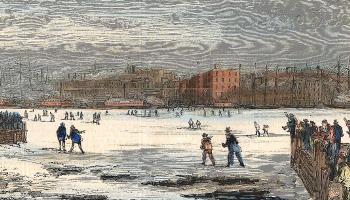
New York’s climate isn’t what it used to be. You don’t have to consider the advent of tornadoes to know that. Ric Burns’ 16-hour documentary film on the history of New York recounts how an impetus for the building of the Brooklyn Bridge (begun in 1870 and opened in 1883*) was the freezing over of the East River in January of 1867. The freeze locked up barges and ships and prevented ferry service for commuters between New York and Brooklyn, two separate cities at the time. Intrepid commuters could, however, walk across the ice if they dared. (Here is PBS video. Below is picture from The Brooklyn Bridge: a wonders of the world book By Elizabeth Mann, Alan Witschonke.)
(* It can be regarded, in part, as a great public work constructed mostly during the extended great depression of 1873)
In the 1800s the East River froze over often enough, regularly providing in ice bridge between Manhattan and Brooklyn, so that even the New York Times as paper of record seemingly couldn’t keep straight how often it happened. (The Times does make mistakes.) We found this March 14, 1888 article in the Times written at the time of the Great Blizzard of 1888. It tells us that in the 1800s the river had frozen over on “six other instances recorded during the present century”; solidly in early February 1813, for a few hours in February 1817, for two days in the last week of January 1821, solidly in January 20, 1851, from noon to 4:00 PM January 17, 1857, February 1875 between the 9th and the 13th and finally on March 13, 1888, the day of the Great Blizzard. Including the Great Blizzard that would make for seven instances in all except that the Times list leaves out the January 1867 freezing that was impetus for the building of the Brooklyn Bridge, which included would make eight such freezes.
We also found the print below on the Brooklyn Library’s site which it says was published Harper's Weekly in March of 1871. The library's post writes about the accompanying story as if it were contemporaneous coverage* but, unless it depicts a prior year's event, 1871 would bring the total for freezes to at least nine.
(* “According to the accompanying article, the changing tides forced the ice to break apart after only a few hours, leaving groups of people scrambling for safety. Those not quick enough to reach land in time were stranded on ice floats in the frigid water--a frightening end to a playful excursion.”)
Colorfully Cool
The 1888 Times article provides an account of that freeze that is quite something to visualize. The entrances to the Brooklyn Bridge were jammed with hundreds of people. “The ice was fully six inches thick and covered with two more inches hard pack snow.” On the Brooklyn side one enterprising young lad set up a ladder down to the ice and charged dedicated Brooklyn commuters two cents apiece to use it. On the other side between Fulton and Beekman another fellow assisted people back up off the ice for five cents apiece. Several hundred people reportedly crossed the ice before “Brooklyn Police authorities, fearful of catastrophe and loss of life” put an end to it. Then with some stragglers still crossing steel prowed tugboats came up from the Battery to ram the ice and “the startled pedestrians,” observing their approach and “comprehending aright their intention” “scattered and ran for the nearest shore.” Not everyone made it. The ice was broken apart with a “report like that of a small canon” and a dozen men remained on the ice floes in “despair” until thrown a rope and rescued by one of the tug “little the worse for their temporary peril and fright.”
The Times article also colorfully reports that during the 1857 freeze the Rev. Henry Ward Beecher made his way across the ice bridge with a young lady companion “asserting that it was not the wicked alone who could stand in slippery places.” I know what you are thinking: Didn’t the safe crossing of a river on an ice floe by Eliza escaping from the evil Simon Legree factor as a key element of the plot of Uncle Tom’s Cabin, the anti-slavery novel written by Beecher’s sister Harriet Beecher Stowe? The answer is yes but if you are thinking that this inspired Ms. Stowe that would not be the case since her book was published in 1852. Reputedly, the Ohio crossing was inspired by another true incident concerning the escape of a young slave woman in1838. Unless the Times got the date of Beecher’s crossing wrong it was more likely Beecher who was inspired by his sister Stowe’s book than vice versa. (I will resist at this time recounting how Beecher officiated in Brooklyn Heights over the marriage of my great-grandmother’s sister to the son of one of the nation’s most famous eccentrics.)
And the 1700s?
Clearly we have not been experiencing this kind of cold weather in New York since I was born in the middle of the 20th century nor the years of that century which preceded me. We have also not seen such cold in first ten years of the 21st century. What about the 1700s? On page 213 of Mike Wallace’s Gotham: A History of New York City to 1898 we see that the river froze over allowing people to walk to Brooklyn in the winter of 1772-73. Then during the Revolutionary War in 1780, the “coldest winter ever known on the North American Continent” the Hudson River froze over for five weeks (likewise a large part of Long Island Sound) with the ice being able to bear a man on horseback until March 17th. The British were able to move troops, two 2-ton cannons and eighty sleighs of provisions from Manhattan to Staten Island over the frozen river ice. (See: The New York Chronology: The Ultimate Compendium of Events, People, and Anecdotes from the Dutch to the Present, By James Trager.) (The British wanted to defend themselves against George Washington's troops who were in Morristown, N.J.)
Can anyone remember Staten Island ferry service ever being suspended for five weeks because the harbor was solid with ice eight or more inches thick? Yes, this weather in 1780 was not only very cold but also exceptionally cold even for those times. Unfortunately, it is time to move on from this subject rather than delve more deeply.
Weather We Were Inspired
(Above, from Wikipedia Park Place in Prospect Heights Brooklyn during the Blizzard of 1888.)
We shouldn’t, however, depart from the subject of the Great Blizzard of 1888 without mentioning that this severe weather event is also credited with inspiring a great public work. Just as the freezing of the East River in1867 is credited with spurring construction of the Brooklyn Bridge, so too is the Great Blizzard of 1888 credited with spurring the construction of the city’s underground subways, speedily constructed and opened in 1904.
One More Way to Destroy the City?
Most of the time we would like to avoid bothering our Noticing New York mind with the problems of global warming or weather weirding. Generally, we are content to preoccupy ourselves with the more traditional ways our local politicians vex us with much more mundane plans to destroy the city, such as the notion that we should be tearing down all the historic buildings in Coney Island while reducing its amusement area down to a minimal fraction.
We confess we found ourselves initially irritated by the “apocalyptic thinking” of the “Rising Currents: Projects for New York’s Waterfront,” show at the Museum of Modern Art (image above). (See Architecture Review: 'Rising Currents: Projects for New York’s Waterfront' Imagining a More Watery New York, by Nicolai Ouroussoff, March 25, 2010.) Its grand scale thinking made us uncomfortably ill at ease, reminding us of the kind of from-on-high it-is-easy-to-replace-everything planning arrogance* that is, for example, associated with Coney Island’s destruction.
(* Sure, its easy enough to tear down a portion of Prospect Heights, including newly renovated buildings, to construct the murkily unparticularized “Atlantic Yards” but the ability to actually fill in this hole developer Bruce Ratner created in the neighborhood becomes a theoretical maybe-someday exercise when the developer says of replacement construction: “it's really market-dependent as to when it will really be completed.”)
Then there is the question what can you do about global warming- what’s the old complaint?: Everyone talks about the weather but nobody does anything about it? That was funny in Mark Twain’s time when the weather wasn’t man-made. Now that our weather is essentially a product of mankind the perplexity of our responsibility tends to deflate the jest.
Bloomberg to the Rescue?
What if our most superpowerful local politician, Mayor Michael Bloomberg, were put on the case? Indeed, in what we would deem to be a product of Bloomberg’s wealth, corporate influence and ambitions for presidential office it was announced on September 21st that Bloomberg has been elected to “serve as chair of the C40 Climate Leadership Group, an association of major cities around the world committed to reducing carbon emissions and slowing climate change.” See the press release on the City’s web page. Is this good? Well, we did our own Noticing New York assessment of Michael Bloomberg’s environmental qualifications. See: Monday, November 2, 2009, On Your Way Vote, We Quizzically Ask: How “Green” Is Our Bloomberg? Our analysis? At best Mr. Bloomberg is a Johnny-come-lately and his heart isn’t really in it.
Burning Fossil Fuels
Mankind is continuing to blithely burn the fossil fuels that contribute to global warming. Basically, this involves removing from the earth and injecting into the atmosphere vast quantities of carbon that were sequestered underground for hundreds of millions or billions of years,* going back eons before mankind was a glimmer in the eye of the universe, (and even before the first trees). (Modernish mankind only goes back about 1.2 million years, divergence from the ape lineage is estimated to begin about 5 million years ago, most of the modern art and culture instincts that make us recognizable to ourselves didn’t begin to emerge until only about 70 thousand years ago.) The early earth’s atmosphere went through some gyrations but, simply put, before those vast quantities of carbons were mostly sequestered the world was an unrecognizably warm place that human beings would have found stifling.
(* Most coal was sequestered starting about 400 million years ago. Coals have been discovered in rocks as old as the Precambrian, but it was not until the Devonian Period (some 400 million years ago) that woody plants became abundant on land and peat deposits were able to accumulate enough to make a minable coal. The deposit of significant quantities of oil underground goes back even further, 2.5–2 billion years to the Archean-Paleoproterozoic transition. Then a radical modification in recycling of organic matter, and the Shunga Event—the accumulation and abundant deposition of unprecedented anomalously organic-carbon- rich-matter sediments forming petroleum source rocks and the inferred generation and migration of the oldest known significant volumes of oil/petroleum.)
Free Ride For the Fossil Fuels Industry
Continued burning of fossil fuels persists because it is attractive to the petroleum, gas and coal industry. It is attractive to them because these industries are highly subsidized. They are subsidized overtly with such things as steep tax breaks and, more important, they are subsidized by not having to pay for what they take from the public. The fossil fuel industry doesn’t have to pay for polluting the atmosphere with injected carbon, they don’t have to pay for the cost of higher sea levels, acidification of the oceans, or extreme weather events. They are also insulated, as in the case of the BP oil spill, from full legal liability for the damage done to the environment from spewing oil directly into the ocean.
Close to Home in New York, the Hydrofracking Example
In essence, the profit of the fossil fuels industry is predicated on what they are able to extract from the public and the public realm without paying for it. If anyone doubts the extent to which this can be the case we suggest a viewing of the documentary Gasland, about the bourgeoning hydrofracturing (hydraulic fracturing) industry. Gasland* has been aired on PBS and HBO, and has been in theaters. It is also viewable on DVD. This is the film where homeowners demonstrate how after nearby drilling water from their house faucets has suddenly become flammable. New Yorkers need to be conscious of hydrofracturing because it stands to put New York City’s watershed at risk together with risking most of the state’s above- and below-ground clean water resources. Accordingly, Gasland has scenes that take place in the City Council Chamber and on the steps of City Hall, including a press conference unattended by the City Hall reporters inside the building. If you don’t immediately go see the film we suggest that you at least listen the Terry Gross Fresh Air interview with filmmaker Josh Fox.
(* We went looking for the industry’s side of the story with respect to the Gasland film. You can judge for yourself but we found its quibbles troublingly hypertechnical and misleading in their arguments about what laws the industry is, or is not, partly subject to and whether drinking water is protected from industry practices. Is the film perhaps more Michael Mooreishly shrill than would be ideal to make its case? Given the fracking industry’s use of nondisclosure agreements we are unlikely ever to know.)
Beyond the fact that hydrofracturing as a fossil fuel extraction process represents the desequestration of ancient carbon material (in New York and other nearby states, Pennsylvania, Ohio, Maryland, West Virginia, New Jersey, even a small portions of Kentucky and Tennessee, it involves removal of gas from the Marcellus Shale Formation deposited almost 400 million years ago) the process entails multiple antisocial problems. Millions of gallons of water, chemicals and sand are trucked into a region and injected underground under high pressure to liberate, mix with, and force natural gas to flow up to the surface.
About half of what is pumped underground is removed afterward. The rest remains as underground contamination. The toxic mix that is removed goes into “flowback,” “frack water,” or “produced water” evaporation pits. It can seep back down into the earth and it is sometimes sprayed into the air to speed evaporation. Because of industry-sponsored legislation for which Dick Cheny and Halliburton are partly responsible there is secrecy about the chemicals used in hydraulic fracturing operations (which may vary from site to site) but the chemicals include toxins, known carcinogens and heavy metals.
The health effects of being around all this, including the effect on animals, are gruesome. Human beings (who are not drinking the contaminated ground water; nobody will, not even people form the industry or regulators) suffer neuropathies, deadened senses of smell and taste and brain damage. In other words the industry extracts health from the public without paying for it.
Fossil Fuels Industry: Bloomberg and the City’s Real Estate Industry
Noticing New York has written a lot about how under Bloomberg the public realm in New York City is habitually sold off to politically connected developers who do not pay value for it. (See: Monday, February 23, 2009, Un-funny Valentines Arriving Late: Your Community Interests at Heart.) The way in which the politically-wired fossil fuels industry treats the public commons is essentially another version of the same thing. We can and will at another time extend the analogy by explaining why practices in the hydrofacking industry known as “compulsory integration,” or “forced pooling,” where the government forces owners to give up rights to their land, are closely akin to eminent domain abuse but for the moment we hope the analogies are clear enough.
Let’s ask again: Is Bloomberg the man to take on the problems of Global Warming?
Global Warming and New York City
The problems global warming poses for the city are real and need to be thought through. Global sea levels are rising. Sea level is about a foot higher than it was a hundred years ago. The planners of Brooklyn Bridge Park say they have planned for a sea level rise of an additional three feet. That’s only what’s planned for and perhaps relatively near term. Sea levels could rise more than that. Even if sea level rises only another foot or so the intrusion of water into our underground subways will put a lot more stress on the pumping system that day-to-day keeps the subways dry.
The city is also exposed and vulnerable to more catastrophic events when sea level rises. New York is lucky in that the configuration of our coastline somewhat diminishes the overall odds of hurricanes hitting the city (less so Long Island) but there is still a significant chance a hurricane will hit. With weather weirding that storm could be extra strong. And with a sea level rise added into the bargain New York City faces a very significant increased risk from hurricane storm surge. The population is large, prime real estate assets on low-lying land prevalent and the logistics of evacuation are difficult. Damage to the city could be in the hundreds of billions.
Here from a March 23, 2006 report the State Assembly Committee on Corporations, Authorities, and Commissions under Assemblyman Richard Brodsky:
New York City and the Long Island region have been directly hit by 11 hurricanes over the last 120 years, for an approximate frequency of one hurricane every 10 years. The most severe hurricane to hit the New York coastal region has been a Category 3 hurricane. According to historical records, since 1815 there have been four Category 3 hurricanes that have hit the New York City region: 1815, 1821, 1893, and 1938.
Among other things, the storm of 1938, which mostly missed the city, hitting Long Island and more severely elsewhere, flooded Providence, Rhode Island.
On the prospect of vulnerability to storm surge damage the report said:
The City is especially vulnerable to storm-surge flooding because of the New York bight: the right angle formed by Long Island and New Jersey. The New York bight makes storm surge values in New York City higher than anywhere else along the eastern seaboard. New York Harbor and the surrounding rivers essentially act as a funnel, and the water will have nowhere to go but on land. While a Category 3 storm will cause a 12-13 foot storm surge in Florida, the same hurricane will cause a storm surge above 20 feet for most of New York City’s coast.
The first part of the above quote come from state and federal government agencies, the New York State Emergency Management Office, Federal Emergency Management Agency, U.S. Army Corps of Engineers. The second part estimating the storm surge height and what follows below is from a New York Press article by Aaron Naparstek, the founder of Streetsblog, for which Naparstek got information from Mike Lee at OEM.
Everything below Broome Street will be inundated, some parts under as much as 20 and 30 feet of water. Chelsea and Greenwich Village are completely flooded, with the Hudson spilling over all the way to 7th Avenue. Likewise, the East River and East Village become one, with ocean water surging all the way to 1st Avenue…A major hurricane will push ocean water down from the Long Island Sound into the Upper East Side, South Bronx and northern Queens, flooding those areas severely. Vast stretches of southern Brooklyn, Queens and Staten Island will be devastated.
Could a storm surge and damage really be as bad as described above? Maybe and perhaps not but how wrong can we afford to be?
Storm Surge Barriers?
I was at the New York City Council during little reported hearings where the possibility and expense of buildings storm surge barriers was discussed. It’s done in the Netherlands. The cost was estimated at $5 billion and possible because there are only a few choke points in the harbor that would need to be addressed. Naturally, any public work estimated to cost $5 billion will probably cost more: The Brooklyn Bridge (built during the reign of Boss Tweed) cost more than twice its original estimate. But $5 billion is not much more than all the public subsidies we are putting into the Atlantic Yards project; money spent on such barriers would be for infrastructure of benefit to all rather than subsidizing one development firm’s private profit at the expense of others and wouldn’t even $10 billion likely be a small cost compared to the cost of a catastrophic storm surge?
Here is another thing we wonder: Couldn’t the barriers be built with a second function in mind; the use of tidal energy to generate electricity? If that were so, wouldn’t their effective cost be greatly reduced? Or perhaps the barriers/generators would even pay for themselves? That would even more likely be the way the math works out if you consider the cost to society of using fossil fuels. Isn’t this a more reasonable expense to ask the public to bear than that of hyrofracking or off shore drilling and oil spills? As we noted before in this post, severe weather has in the past provided the impetus for great New York public works. This wouldn’t be the first.
A Personalized Noticing New York Experience of the Brooklyn Storm
My own personal experience of the September 16, 2010 Brooklyn tornado was not as dramatic as that of some others but I will tell it to you. I was not where the worst of storm was. (One friend of ours was biking through Park Slope and was admitted to very much needed shelter by someone she didn’t know when she climbed a stranger’s brownstone stoop as the worst of the storm hit dead on)
I was busy writing Noticing New York when I heard rolling thunder. I noticed that the roll of the thunder didn’t stop: There were no intermittent breaks as the lightening flashed. It was odd enough so that shortly thereafter I began to record the thunder (the recording is not that interesting as the sound of wind and thunder compete). I decided the sound of the thunder bore investigation and proceeded to the Promenade from where I was able to see that a storm covered the entire horizon over Manhattan and that the wort of it seemed to be a wall of water cascading down in the vicinity of Red Hook. It was later reported Red Hook was one area the storm hit forcefully. Raindrops were beginning to fall and I could tell that a sweep of more drenching rain was about to come. Waiting until almost the last minute I largely escaped it by sprinting ahead. It took just a few bounds before I was back inside my building’s small portico but by that time my back was completely soaked while the front of me was completely dry. Looking out from the vestibule above the stoop I saw torrents.
Below are videos of the arriving storm and then the torrents that followed. As I said, Brooklyn Heights was not subject to the worst of it.
Upstairs, I knew I recognized the pattern of the weather I’d seen. Suspecting that they would be talking about tornadoes I turned on NY1 and, indeed, they were announcing that there was at that moment a tornado in Brooklyn. Showing it on the map it was not immediately clear to me that I was out of range, which I was, but in a very few minutes it was over. My instincts were right; it was tornado weather over Brooklyn. If my instincts are right in some other respects discussed here, let’s hope we will be able to do something about the global weather weirding that has brought tornadoes to visit in Brooklyn for the first time ever.
NOTICING NEW YORK & NATIONAL NOTICE are both independent entities managed by Michael D. D. White of Hop-Skip Enterprises. Michael D. D. White is an attorney, urban planner and former government public finance and development official. *** Noticing New York covers New York development and associated politics. National Notice covers national policy and economic issues *** Contact: MichaelDDWhite(at)gmail.com

 (Above, From the New York Times story about why Mikhail Prokhorov and Bruce Ratner's Nets basketball team is going to China and Russia and making a deal with Russian vodka producer Stolichnaya. Fred Conrad Photo.)