Saturday, November 9, 2013

Oops! NYPL Documents The Blank Check Mentality of Certain Reliable Supporters of Library Sales and Shrinkage

NYPL's "Voices of Support" page for the nonexistent Central Library Plan starting off with praise from the Daily News editorial page
Gotcha!  Smile!  Say Cheese!  You’re on Candid Camera!   Caught in the act!

The NYPL (New York Public Library) has just documented the blank check mentality it expects from a cast of supporters it believes can be trotted out to reliably  . .  

. . . To reliably what? We’ll get to that in a moment.                   

The other day the New York Times ran a story letting us know that the NYPL is in bigger trouble than most probably suspected.  It won't be releasing the “new” version of the Central Library Plan (now AKAing as the “42nd Street Library Renovation Plan”) this fall as planned.  The plan’s obvious flaws are too difficult to paper over in the time frame they expected!  (See: New York Public Library Postpones Release of Revised Renovation Plan, by Robin Pogrebin, October 23, 2013.)

Just so everybody knows (pardon any repetition): The Central Library Plan (CLP) is the consolidating shrinkage of more than 380,000 square feet of library space down to just 80,000 square feet of space.  Two significant pieces of Manhattan library real estate would be sold, going the way of the 53rd Street five-story Donnell Library before them: the Mid-Manhattan and SIBL (Science, Industry and Business Library).  As part of the big squeeze, the research stacks of the 42nd Street Central Reference Library would be ripped out, the books banished.

Don’t expect the “new” version of the CLP to be anything more than the old version with a new veneer, its real estate sale and shrinkage goals still intact, still preeminent and still driving all the decisions being made.

What do you do in the interim if you are the NYPL and you are beset by such difficulties?  You dig your grave deeper by putting up a "Voices of Support" page for the nonexistent plan, thus having your “supporters” on record as supporting virtually anything and virtually nothing.

Here is my comment on the Times article:
Putting up a "Voices of Support" page for a nonexistent plan? All that exists of the plan that can be supported is a plan to sell off library real estate, shrink library space way down (from more than 380,000 squarer feet to 80,000) and exile books. Statements of support from a group like Urban Librarians Unite? Research the group and see what that means. A healthy antidote to these "Voices of Support" with lots of specifics can be found in the testimony that Citizens Defending Libraries delivered at the recent City Council hearings on the sell-off of public libraries around the city, available here:
Report on Monday, September 30th City Council Hearing On Sell-off of NYC Libraries Plus Testimony of Citizens Defending Libraries
    Michael D. D. White
    Citizens Defending Libraries
The Times article doesn’t mention that furtherance of the half-baked plan may have been impeded somewhat by the two lawsuits that have been brought against the plan, including the one in which Citizens Defending Libraries (I am a cofounder) is a plaintiff.  (The article doesn’t mention the lawsuits, but comments can.)  The timing of the article was somewhat luscious in that the NYPL’s announcement came just one day after Citizens Defending Libraries delivered its 16,000 plus signature petition (most of those signatures are online) to Mayor Bloomberg at City Hall.

Who are some of these supporters the NYPL feels can be depended upon to support, sight unseen, a plan for sale of library real estate, shrinkage of libraries and banishment of books?  Urban Librarians Unite, Kathy Wylde of the New York City Partnership and the Building and Constructions Trades Council of New York.
Kathy Wylde testifying for the Atlantic Yards megadevelopment at the MTA on Monday, June 22, 2009 after it had markedly degenerated
We’ve seen Ms. Kathy Wylde in this blank-check approval mode, before when she supported the Atlantic Yards mega-development.   At an MTA hearing Monday, June 22, 2009, after the proposal for the Atlantic Yards mega-development had been vastly changed to the detriment of the public Ms. Wylde testified to support the project, speaking in terms of the Partnership’s long-term support for it, virtually oblivious to the fact that the project was so much worse and less defensible than ever.  (See: Tuesday, June 30, 2009, The Partnership for New York City's evolving (and misleading) support for Atlantic Yards.)

In the case of the NYPL’s Central Library Plan, Ms. Wylde’s blank check support will be the inverse of Atlantic Yards: In the case of Atlantic Yards, supporting the megaproject from the beginning, Ms. Wylde continued her unswerving support as the megaproject degenerated profoundly; in the case of the CLP, she is now documented as supporting from day-one a plan so bad that its authors had to withdraw it out of embarrassment.  In either case, the minimum standard for her fixed support as things shift is a discernibly low bar.

Unfortunately, what we get from power-elite representatives like Ms. Wylde is the bottom line of wealth speaking to wealth, resulting in what many of us see as rigged deals, where the vagaries of any public benefit are relegated to afterthoughts to be primped up for public consumption afterwards. . 

Support from Urban Librarians Unite for a plan about which nothing is known except that libraries will be sold and shrunk and books banished may seem strange, until you closely consider that it is almost seems as if Urban Librarians Unite was created with such support being their primary purpose.  See: Saturday, June 8, 2013, Irony Of Ironies: Urban Librarians Unite, Holding A “We Will Not Be Shushed Read In June 8 & 9th! Sign Up Now!” Event, Wanted To “Shush” Citizens Defending Libraries About It.

Support by the Building and Constructions Trades Council of New York?  I have previously observed construction unions’ Pavlovian support for what creates construction jobs irrespective of public harm:
Construction unions are interested in the churn. They are not interested in what is in the public interest (hence their partnering with Ratner). Frank Lloyd Wright once facetiously proposed that all of Manhattan be leveled and replaced by just two phenomenally enormous tall towers. I often think that if such a plan were proposed today the construction unions would be out in droves to support it, not because it was in the public interest but because it would mean a huge amount of union jobs, both demolition and construction.
(See: Friday, March 18, 2011, The Real Question to Ask About the Ratner Bait-and-Switch Approach on Atlantic Yards.)

When it comes to libraries, this reflex on the part of construction unions hurts not only the public, but also other union workers as well.  As was mentioned at a forum at Barnard College this past week (For the Public Good: Public Accountability in NYC, A panel with Elizabeth Blackmar, Aaron Pallas, and J. Phillip Thompson, Thursday, November 7, 2013) the selling off and privatization of public assets like schools and parks is often intertwined with motivations of disenfranchising union workers.

The NYPL’s false step of bringing in the construction unions and creating this documenting gallery of automatic supporters, the likes of those above, arrayed together with others such as the soundly-defeated candidate for mayor City Council Speaker Christine Quinn is probably the first work of the Parkside Group, the NYPL’s expensive new lobbyist.  News of the hiring of the Parkside Group surfaced in the New York Times the day after it was announced that the NYPL wouldn’t be releasing its plans to the public this fall. (See: New York Public Library Hires Firm to Promote Renovation Plan, by Robin Pogrebin, October 24, 2013.) 

The hiring of the Parkside Group means that, in these maneuvers of arraying all these automatic supporters and others, library administration officials are prepared to divert huge amounts of public money and charitable donations into arguing for the sell-off of these public assets for the ultimate benefit of the real estate community.  (See: Wednesday, October 30, 2013, Conundrum For Those Wanting To Donate To Libraries: People Who Would Use Our Donations To Shrink and Sell Off Libraries.)

When will the NYPL be releasing the new edition of its plans?  According to the Times the NYPL said in a statement:
We now expect to unveil the new design sometime after the New Year.
Sometime after January 1st?  What’s important about that January 1st date?  That’s the date when Mayor-elect Bill de Blasio will take office at the city helm.  It would have been impossible for the NYPL to have released more bad plans during the mayoral race as de Blasio would have had to reject them, for the sake of his campaign’s consistency and to keep himself appropriately distinguished from his opposition.  (Candidate de Blasio had already stood on the steps of the 42nd Street Central Reference Library calling for a halt to the sale of New York City’s public libraries.)  (See: Sunday, November 3, 2013, Candidate Lhota's Flub!: He thinks library lovers don't read the Wall Street Journal!!- Checking In On Mayoral Candidates’ Library Positions, de Blasio vs Lhota.)

In addition, any bedraggled release of plans at the tail end of the Bloomberg administration would just associate a design rehash more firmly with the increasingly unpopular departing Bloomberg administration.  No doubt, what the NYPL will want to do is seek a willing collaborator in the de Blasio administration to make it somehow seem that they have a plan that can be considered as “new” and different and probably that the plan is even, in part, a response to Mr. de Blasio’s own high standards and insistence on improvement.  At that point they will trot out again the supporters now on record as supporting the old, discredited plan and hope that nobody will be keeping track.
Chiara de Blasio, candidate de Blasio's daughter vouching for her father about the the sell-offs of public assets we won't see if her father is elected.
Will de Blasio fall for it, or, acting in collaboration, expect that others will?  During the campaign his daughter, Chiara, gave us assurance about where her father stood respecting the sale of public assets.  In the end, the sale of NYC public libraries will remain at bottom what it is: real estate deals for the benefit of developers, not the public.  I don’t think de Blasio will fall for such an NYPL ruse and I certainly hope that when it comes to these matters he will steer his own unveering course.

Sunday, November 3, 2013

Candidate Lhota's Flub!: He thinks library lovers don't read the Wall Street Journal!!- Checking In On Mayoral Candidates’ Library Positions, de Blasio vs Lhota

"Libraries Not Luxury Condos"? Or "Hospitals Not Luxury Condos"- Same thing, really, although a little Photoshop magic helped this de Balsio campaign ad bridge the very small difference. 
Here is some bad news for New Yorkers who love their libraries (somewhat ameliorated) coupled with some good news, all courtesy of the Wall Street Journal.

The bad news is that Joe Lhota the Conservative Republican candidate for NYC Mayor and former NYC budget director, who ought to be a model of fiscal probity, loves the inanity of spending what could easily be around a half billion dollars on the NYPL's Central Library Plan (now redubbed “42nd Street Library Renovation.”) to sell and shrink NYC Libraries.  Lhota gave a quote to this effect for publication, apparently believing that library lovers don't read the Wall Street Journal.  Wrong!  Maybe Mr. Lhota believes that only real estate developers and Stephen A. Schwarzman's friends read the Journal.  This singular ineptitude handily illustrates why Lhota has virtually no chance of being elected mayor this year.  Library lovers can consider those odds the ameliorating factor.

The good news is that candidate de Blasio, through his spokesperson quoted in the Journal, sounds as firmly on the side of library lovers as ever.

Here is what's in the Journal about each of the candidate’s positions on that sell-off of libraries and consolidating shrinkage whereby the NYPL's Central Library Plan would cram the 300,000 square feet of space from the Mid-Manhattan and Science, Industry and Business Library (SIBL) into a very small amount of space in the Central Reference Library whilst ripping out its venerated and historic research stacks.   
Mr. de Blasio has called for a financial audit and review of the project and, according to his spokesman, "believes that it was made without enough forethought to the building's historical and cultural integrity."

As for Mr. Lhota?

"I love it," he said of the renovation. "We've got to make sure that our facilities change and evolve with the world around us."
(See: NY Culture- On Arts, Mayor 'a Hard Act to Follow'- New York's Cultural Institutions Are Wondering: What's Next? By Jennifer Maloney, Oct. 31, 2013.)

We should heartily thank the Wall Street Journal for this report.  What’s tragic is that no other local news organs have yet covered the split between the candidates on this issue, including, very importantly, the New York Times and WNYC.  The issue not being reported upon is actually much bigger. . .  The Central Library Plan is essentially an even larger scale version of the Donnell Library sell-off debacle.  .  Together, they are emblematic of citywide plans to sell and underfund libraries as the system is shrunk at a time of significantly increasing use.

Since the beginning of his campaign Mr. Lhota has been unwilling to supply Citizens Defending Libraries (a group I helped found) with a statement of his position about the sale and shrinkage of city libraries.   When Citizens Defending Libraries held its Mayoral Forum on Libraries August 30th Mr. Lhota’s campaign feinted  (declining to attend the forum), saying that Mr. Lhota soon wished to meet with Citizens Defending Libraries to supply his campaign postion on the sell-offs.  He never did.

Meanwhile, Mr. Lhota’s campaign posted the following on its website.  It is the only mention of libraries and it is a reference to selling public property, selling their air rights (emphasis supplied):
As mayor, Joe will:

    * * * *
Undertake a complete inventory of vacant and underutilized land in New York City to create more opportunities to develop affordable housing. For example, if a post office shuts down, we should use that land for affordable housing.

Undertake a complete inventory of available air rights from city-owned properties like schools, libraries and firehouses to create revenue for the city, while incentivizing developers to utilize the air rights to create low and middle income housing—housing that can be affordable for our teachers, firefighters, police officers and other civil servants.

]Utilize land-use planning studies of various neighborhoods to plan and target areas to upzone.  The goal is to permit large scale development where we can mandate low and middle income units as part of the rezoning.
It is a campaign stance (campaign stances are invariably tailored to sound good) and doesn’t actually say that the city’s libraries would be closed and shrunk when the development rights that go with them are sold off as is presently exactly what’s happening.  Instead of allowing that the sell-offs might result in top-of-the-market luxury condominiums, hotels or office towers which is what is, in fact, what’s actually happening now, it holds out the campaign-promise carrot of affordable housing.  Really?  What it describes sounds too uncomfortably close to what is presently happening.  Indeed, why does it fail to say that we won’t continue to sell libraries for shrinkage?  That’s suspicious, and if there is any doubt about where Mr. Lhota’s judgements might take him on these things he has cleared it up by giving his enthusiastic endorsement of the Central Library Plan to the Journal.

There is also the issue of how Mr. Lhota judgement when it comes to public-private partnerships brought into play for the selling of libraries and how this get confused and perceptions manipulated when it comes to who is actually benefitting from them, the public or the private "partner"?  (See: Wednesday, September 26, 2012, Promoting Obfuscation of What Government Does and Doesn’t Do To Give The Private Sector (Including Ratner) More Credit, but compare Monday, October 28, 2013, Across from arena, Lhota slams de Blasio (again) on Atlantic Yards, claims Ratner close to default on MTA railyard last year (video) .

Mr. de Blasio on the other hand has come out against the sell-off of public assets, libraries and other properties like hospitals and NYCHA public housing.  For more on Mr. de Blasio’s position calling for a halt to the selling off of public libraries see the following from Citizens Defending Libraries (two other candidates still on the ballot for Mayor, Randy Credico of the Tax Wall Street Party and Green Party candidate Anthony Gronowicz, heartily oppose the library sell-offs and shrinkages): Mayoral Forum on Libraries Held August 30, 2013 and PHOTOS & VIDEO & MORE- First half of July 2013: Two lawsuits against the Central Library Plan, Public Advocate Bill de Blasio Comes Out Against CLP.

Chiara de Blasio, candidate de Blasio's daughter vouching for her father about the the sell-offs of public assets we won't see if her father is elected.
The fact that Mr. de Blasio is prominently opposing the sale of public property across the spectrum provides important reassurance, as does the fact that he is likely to be kept in check by the new Public Advocate, Tish James, a fellow Democrat who comes into office after a crushing 60-40 defeat of her opponent during the primary run-off likely due in part to the fact that Ms. James opposed the selling off of libraries early and steadfastly.  (See: Monday, September 23, 2013, Sell-Offs Of New York City Libraries Gets Focus In Public Advocate Runoff Race Between James and Squadron.)

In one of Mr. de Blasio’s most frequently run campaign ads he features his daughter and his son with his daughter assuring the voters that her father would not sell off hospitals for “luxury condos.”  That’s basically the same as the library issue.  And his kids vouch for him on this!
In campaign ad candidate de Blasio's daughter vouches her father won't sell off public assets like hospitals
By the way, while we must thank the Wall Street Journal for covering the candidate split on this library issue, one of our readers commented about the Wall Street Journal that it seems to represent Mr. Bloomberg to be an important “philanthropist” (“As a philanthropist, he is believed to have given more than $200 million to arts and social-service organizations since 2002”) that isn’t really the case.  More on what’s really the case here:  Wednesday, March 6, 2013, Bloomberg’s Increasing Annual Wealth: 1996 to 2013, Plus Updates On His Annual “Charitable” Giving.

The reader is correct.  Credit is often given where it isn’t due.  This Monday night, on the eve of the election for the new Mayor, the NYPL will anomalously give its headline award at its annual fund raiser to Mr. Bloomberg, who as mayor is responsible for an unprecedented defunding of the city’s libraries (see below) while presiding over plans to sell them.  (See: Wednesday, October 30, 2013, Conundrum For Those Wanting To Donate To Libraries: People Who Would Use Our Donations To Shrink and Sell Off Libraries.)

That downward blue line on funding while use (upward lines) ascended is what Bloomberg did to the libraries just after his third term was won and just as he was blessing the sell-off of NYC libraries

Friday, November 1, 2013

Inspiration For The Non-Library: The Genesis Of The Design For The Space That Won’t Be Able To Replace The Donnell Library

Library?- The design to 'replace' Donnell
The bleacher/stairs can be used to show people David Niven movies in the daylight
Who knows what will serve as inspiration for the fertile imagination?  Or, as the case may be, for the not-so-fertile imagination.

Previously, it was once supposed that the design (above) for the largely underground and bookless “library” that is supposed to suffice (at less than one-third the size) as a replacement for the formerly magnificent and beloved Donnell Library (sold off to net only a fraction of its value to the public) was the design (below) for a very non-library space, a Prada store.  See: Friday, May 24, 2013, Previews Of The Proposed New Donnell Library: The NYPL Unveils Its Version Of The “Silk Purse” Libraries It Envisions For Our Future.
The Prada store the library design resembles
Close enough, I suppose, but now it turns out that there is a good chance that inspiration for the non-library design came from another source (see below), the Musashino Art University Museum & Library.
From A AS Architecture
From Flicker
The design for this space, part museum and art gallery (and part. . . what else?). . .  intentionally flaunts its absence of books as it ostensibly “proposes a new relation between the user and the books” (or, more precisely, the physical absence thereof).  (See: Musashino Art University Museum & Library / Sou Fujimoto, 28 Jun 2011. ArchDaily, accessed October, 31, 2013.


Going to the Architectural Daily link provided above you can hear architect Sou Fujimoto explain that while information technology has no concrete existence, people with physical bodies need to feel like they live in a real world (with the light shifting during the day and seasons being important!).  Apparently to give that sense of reality he filled this environment with its theme of empty bookshelves.  He’s quoted: “I imagined books, bookshelves, light and the atmosphere,” a “dreamlike” space “made from [empty] bookshelves.”

The concept of the “idea” of books filling in for actual books may explain a lot.  When the design for the new shrunken underground Donnell was presented to the local community board the architect was asked about one rendering involving many books that stood out amongst the multiple others that showed very few books: The rendering showed a high wall of books that was literally impossible because it would have violated codes, regulations together with basic practicality and safety itself (see below).  The architect explained that this was not a real depiction of books or the way that they would be.  The rendering was only intended to show that the idea of books is conceptually important, “just simply to say that books are important to us, the books are important to the library.”
A slide shown in both presentations showing what the books in the library won't really look like, but showing that having books in a library is conceptionally important 
That concept could have cribbed from the Japanese gallery meditation on books as a dreamlike theme suggesting reality rather than the real thing.

Is it just coincidence that NYPL’s design for what is to replace Donnell is so similar to the earlier Japanese one?  When asked, the architect for the NYPL design said that NYPL officials hadn’t specified anything in terms of a book count or a required square foot area for books.  But what if it was actually the reverse?  What if, instead of just neglecting to express an NYPL goal of having a minimum number of books on site, the library administration officials overseeing the project had instead expressed a goal of having some sort of  `library of the future' that would avoid physical books?  Wouldn’t the architects then, perhaps simply by Googling it up, have come across the bookless Japanese space whose empty shelves suggested the motif of books while actually dispensing with them?

It could have happened that way, or maybe the inspiration came from the fact that the shelves of New York City libraries are already actually beginning to look much like that sparse Japanese space as they are emptied in preparation for sales as the system is shrunk to manufacture real estate deals.  Compare the photos below of the Japanese space with the New York library shelves from the following article (where even more such photos can be found): Saturday, September 14, 2013, Empty Bookshelves As Library Officials Formulate A New Vision of Libraries: A Vision Where The Real Estate Will Be Sold Off.
The two above images are from ArchDaily
Mid-Manhattan Library, up for sale
Brooklyn Heights Library, RFP out for its sale

SIBL, Science, Industry and Business Library, being sold- more pictures of empty shelves in various libraries being sold here

However well the aspiration of having bookless libraries may fit in the goals that current library administrators have of vacating the library real estate they are preparing for sale, those administrators should give some thought to the fact that a recent Pew poll says that people still want physical books in the libraries, including the new young “tech-savvy” generation just as much as the old, if not more so.  (See: School Library Journal: Pew Study: Teens Still Love Print Media, ‘Traditional’ Library Services, by Karyn M. Peterson, June 25, 2013).

Before library administration officials rush to adopt new models that exile physical books from the premises perhaps they should read the Scientific American article this past month that tells us that our brains are probably hardwired to learn and retain facts better when reading physical books.  See: The Reading Brain in the Digital Age- Why Paper Still Beats Screens (Why the Brain Prefers Paper), by Ferris Jabr, November 2013.

If award-winning author Neil Gaiman were advising our library administration officials, he too would caution them about the criticality of retaining physical books.  In a speech he gave this month covered by Britain’s The Guardian he addressed the value of reading, the importance of defending libraries and spoke about the future of physical books saying, “I do not believe that all books will or should migrate onto screens” observing that:
a physical book is like a shark. Sharks are old: there were sharks in the ocean before the dinosaurs. And the reason there are still sharks around is that sharks are better at being sharks than anything else is. Physical books are tough, hard to destroy, bath-resistant, solar-operated, feel good in your hand: they are good at being books, and there will always be a place for them.   
(See: Why our future depends on libraries, reading and daydreaming, October 15, 2013.)

Let’s hope that one place where there will always be a place for physical books is in our libraries.

I want to thank the troops of Citizens Defending Libraries (petition here), a group I helped found to protect libraries from being sold off to benefit developers, not the public.  Without their help I might have overlooked the Musashino Art University Museum & Library design and some of the articles I have mentioned above.
Mock up of portion of Musashino

Wednesday, October 30, 2013

Conundrum For Those Wanting To Donate To Libraries: People Who Would Use Our Donations To Shrink and Sell Off Libraries

Reading Citizens Defending Libraries flyer before entering  Friends of Brooklyn Heights Branch Library October 21st fund raising gala- Author Evan Hughs enters captured by Jonathan Barkey's photography
A good place to start this article is with the deliberate underfunding of New York City libraries by New York Mayor Michael Bloomberg at a time of their greatly increasing use. . . 

At City Council budget hearings at the beginning of June, Anthony W. Marx and Linda Johnson, the respective heads of the New York Public Library and the Brooklyn Public Library, testified that they had a problem approaching donors asking that they give monies to fund the libraries because they cannot make a `credible’ case that any money given to the libraries by such donors will not be immediately subtracted out by Mayor Bloomberg in budget cuts to the system.  Citizens Defending Libraries (a group I helped found) followed up at that hearing with testimony that it was also not possible to make a credible case to potential donors that funds given to libraries would not be squandered in real estate deals as libraries like Donnell get sold off at a fraction of their value to the public.  (See: Testimony By Citizens Defending Libraries At June 5, 2013 City Council Committee Hearing On Library Budget Issues.)  Citizens Defending Libraries has also given similar testimony on more recent occasions.  (See: Testimony By Citizens Defending Libraries At June 27, 2013 State Assembly Committee Hearing On Selling New York City Libraries and Report on Monday, September 30th City Council Hearing On Sell-off of NYC Libraries Plus Testimony of Citizens Defending Libraries.)
  
Citizens Defending Libraries might have gone a step further in its testimony: Not only is it a concern that libraries paid for with taxpayer and charitable contributions will be wasted when libraries are sold; donors ought also be concerned that their donations will be directly used to sell, shrink and dismantle New York’s library system assets.

This was the concern raised by Citizens Defending Libraries when the Friends of Brooklyn Heights Branch Library held a fund raising gala event on October 21st that featured Evan Hughs, author of “Literary Brooklyn.”  See: ‘Literary Brooklyn’ gala celebrates 20 years of the Friends of the Brooklyn Heights Branch Library, by Samantha Samel & Mary Frost, Brooklyn Daily Eagle and Friends of Brooklyn Heights Branch Library to hold 20th Anniversary gala fundraiser, by Samantha Samel, October 17, 2013, Brooklyn Daily Eagle.

Why?   Because the Friends of Brooklyn Heights Branch Library holding the gala and taking donations from people wanting to “support” the library has been playing a key role in easing the path and moving forward the sale Brooklyn Heights library.  It has given cover to the Brooklyn Heights Association to similarly advance the probability of a sale with the BHA saying its is “simply supporting the position of the librarians and the Friends of the Library.” See: Saturday, April 13, 2013, Condoning The Sale and Shrinkage Of The Brooklyn Heights Library, Does The Brooklyn Heights Associations Think Of Friends Group As A Fig Leaf? It Should Think Again.

So it was that Citizens Defending Libraries handed out flyers to those entering the event, saying: “Please don’t allow your money be used to sell and shrink public libraries.”  

Citizens Defending Libraries flyer for event
It urged:
    •    Please donate money only on condition of its proper use-  Put the following restrictive endorsement on the back of the check for any donation you make: "This check may only be deposited on condition that the BPL not sell off libraries, The Brooklyn Heights and Pacific Libraries properties included."
And cautioned:
    •    If you give money to the Brooklyn Public Library and you do not make your gift upon such conditions you should assume that your money will be used to advance real estate deals that benefit developers, not the public.
The Friends group and the BHA take pains to distinguish that they are not supporting the sale and shrinkage of the library, asserting that they are only condoning or not opposing the sale, but that is a fine distinction that seeks to overlook the practical effect of their actions.  Meanwhile, there are attempts to represent that something quite the opposite is happening.  In its article about the gala the Brooklyn Eagle quotes Friends group president Deborah Hallen representing herself not as someone condoning the dismantling of the Brooklyn Heights Library but as a “watchdog” for the library:
Hallen said that FBHBL’s role is to be the best watchdog as possible for the Heights branch
My response as set forth in a comment to that Brooklyn Eagle article (some of which was also addressed in the flyer handed out that night):
President Hallen of FBHBL [the so-called “Friends” group] continues to play a duplicitous game when she  represents the “FBHBL’s role . . .to be the best watchdog as possible for the Heights branch.”

Ms. Hallen has never offered the clarification Citizens Defending Libraries has long requested: Does she believe that she and the FBHBL can oppose the BPL’s plan in any respect at all, or must she and the FBHBL support the BPL’s planned sale and shrinkage in all respects?   She has circulated guidance to the effect that the FBHBL cannot oppose the BPL’s plan in any respect at all, meaning that the FBHBL can’t complain about even the smallest detail of the BPL’s plans.  She has emailed her FBHBL trustees telling them in very emphatic and specific terms that they cannot oppose this sale-for-shrinkage of the library and that she wants resignations from any of the trustees who want to tell her “we need to stop the sale.”

It seems rather evident that Hallen favors the sale and looks for opportunities to drive it forward despite sometimes suggesting to people that she privately, in her personal capacity, opposes the sale and shrinkage but just can’t oppose it as part of the FBHBL group.  Why else would she seek to diminish reaction to the sale-for-shrinkage of the library by adopting and repromulgating the BPL’s talking point that the reduction from 63,000 square feet of space to just 20,000 square feet of space (one quarter of it underground) somehow won’t reduce the “usable” floor space?  Her careful parsing of language here, mimicking the BPL’s, is specifically meant to obfuscate for the casual reader that the planned sale-for-shrinkage envisions the eviction of the Business and Career Library portion of the library.  Thus she seeks to disregard what, even by her calculations, would be a 50% reduction of the library’s size.

The FBHBL’s role is obfuscation, not that of watchdog.  
Raising money for a library that is to be sold and shrunk?  It does seem odd.  The attempt to address the oddity came in the form of statements from Judy Stanton, Executive Director of the Brooklyn Heights Association, that the money was for “books.”  But this assertion takes on its own odd cast when you notice that books are disappearing from the shelves of the Brooklyn Heights library; The books that were previously there are not any longer as they make way for the pending real estate deal and shrinkage.  See: Saturday, September 14, 2013, Empty Bookshelves As Library Officials Formulate A New Vision of Libraries: A Vision Where The Real Estate Will Be Sold Off.

Just one of the many pictures in the linked to article of empty library shelves in the Brooklyn Heights library and in other NYC libraries being readied for sale
The Brooklyn Eagle said that at the event Mr. Hughs spoke about Norman Mailer’s “conviction that something important is always at stake in a book” and noted that “Libraries . . function with a similar standpoint.”  That said, with all the books that are disappearing and the dismantling of NYC libraries, a lot that is at stake is being lost.

There were reportedly 50 to 70 attendees at the Friends gala.  Many of them were appreciative of the points raised in the Citizens Defending Libraries flyer, with a fair number seeming surprised to think about the information and points presented.  A few attending were from Citizens Defending Libraries.  Outside, Citizens Defending Libraries may have collected more new signatures for its petition than there were people attending the event, though that wasn't the original intention of the evening.  Most people in Brooklyn Heights oppose the sale of their library, probably well over 95%, but there are still many people who still do not know that libraries are being sold off.  Even so, even as the gala was going on, you could look in the window of the library to see the empty shelves cleared of books.
The absence of books in the library can be seen from the street at night when the library is closed.  If and when the library is actually sold off to a developer for development will we look in to see worse?
It is not just giving money in Brooklyn that poses a concern.  Donated money and taxpayer dollars are being used to fund the efforts to sell off libraries in Manhattan.  The sale of the very important and beloved Donnell library paved the way for more library sales and shrinkage by the New York Public Library with the proposed consolidating shrinkage of its Central Library Plan, recently redubbed the “42nd Street Library Renovation.”  The plan is now in disarray with nothing workable currently before the public because activists were able to bring attention to how rushed and poorly conceived it was.  Nevertheless, the NYPL has hired a very high-priced lobbyists, the Parkside Group, to promote what currently is impossible to identify as anything but just a library sell-off and shrinkage. (See: New York Public Library Hires Firm to Promote Renovation Plan, by Robin Pogrebin, October 24, 2013)

One of the reader comments to the article:
I really hope it's not donor $$ that's being used for this PR campaign.
My response:
It is donor money. And taxpayer money too.
Citizens Defending Libraries testified at the City Council hearing on the selling off of the libraries about the impropriety of using such money for lobbying and compared it to situations where the New York State Attorney General has investigated in the past.  (See: Report on Monday, September 30th City Council Hearing On Sell-off of NYC Libraries Plus Testimony of Citizens Defending Libraries.)

Another reader, Susan Bernofsky, commented as follows:
What a shockingly poor use of the library's resources. At a time when our libraries are in crisis, NYPL is handing over a nice fat wad to a consulting firm that will not help improve the library in any way, it'll just help the Board of Trustees sugar-coat a plan that the community has been opposing because it's bad for the community. Vote of no confidence!
How much donor and taxpayer money will be directed to this high priced lobbyist?  The word is that the initial contract is structured to fly low on the radar screen stated to be apparently lower payments, but one suspicious reader providing a link says this:
$25,000? You know, that's just their retainer. Monthly.
The article doesn't make this fact clear.

Source:
http://www.gaebler.com/How-Much-Does-It-Cost-to-Hire-a-Lobbyist.htm

Powerful, politically-connected lobbying firms like the Parkside Group don't come cheap; you know that's one fat contract. As a retired PR professional, I'd put the Library's annual outlay for their services at a minimum of $1.5 - 2 Million --Likely more; even as high as 5M.

Do you remember the New York Public Library begging the public for contributions about six months ago? Now we know what they're spending our money on. It sure isn't on books, computers, librarians or longer hours at my branch.

This is truly a sad, sad state of affairs.
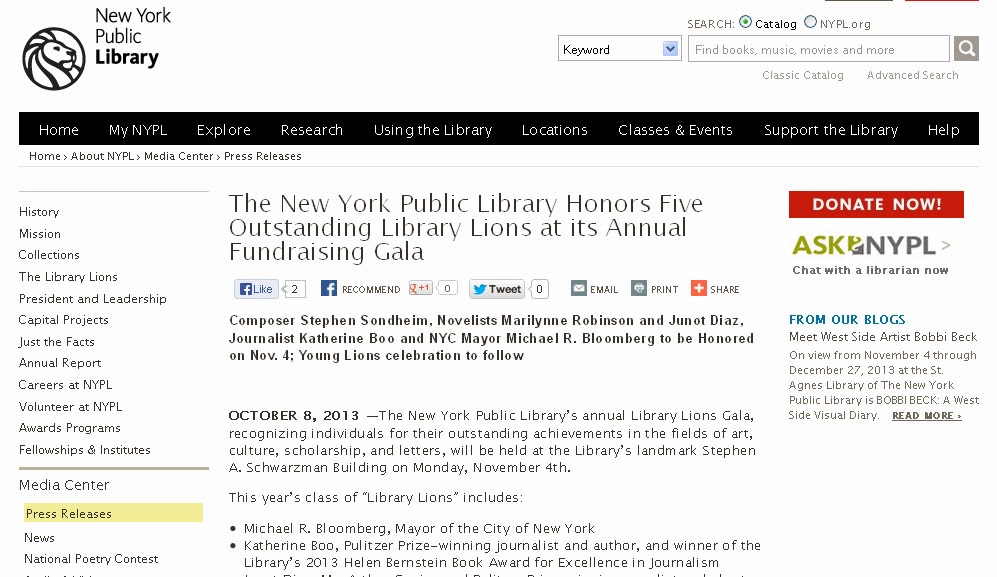
How outrageous can it get in tracing donations back to those who would put their efforts behind selling off New York’s libraries?  There is another evening gala fund raising event coming up on Monday, November 4th.  This one is held being held by the NYPL, its annual Library Lions Gala.   Most of the honorees like “Stephen Sondheim, Grammy, Oscar, and Tony award-winning composer and lyricist” are pretty noncontroversial, but the headliner for the evening is none other than “Michael R. Bloomberg, Mayor of the City of New York.”

Telling you to "DONATE NOW" the NYPL's webpage for the November 4th Library Lions event noting that it will be honoring library defunder Michael Bloomberg as the headliner above other honorees Katherine Boo, Helen Bernstein,  Junot Diaz, Marilynne Robinson and Stephen Sondheim
Remember how I said that Mayor Bloomberg’s deliberate underfunding of the libraries at a time of increasing use was good place to beginning this article?  Well it is also a good place to end this article.

Scott Sherman, in his recent article for the Nation (The Hidden History of New York City’s Central Library Plan- Why did one of the world’s greatest libraries adopt a $300 million transformation without any real public debate? August 28, 2013) was able to inform us, based his review of the NYPL’s minutes, that in the summer of 2007 (before Donnell was sold) the Bloomberg administration, including in the person of Bloomberg’s chief adviser and political strategist, First Deputy Mayor Patricia Harris, blessed the consolidating shrinkage of the library sales with indication of its enthusiasm.

It was afterwards that the mayor cut library funding way back to an astoundingly low level.  That low level of funding is now cited as a rationale for the selling off of New York City’s libraries.
From the pen of Mark Hurwitt
And now, at a fund raising event, an event where people will be asked to give money to support the libraries, the principal honoree will be Mr. Bloomberg himself, the defunder of libraries!  Does NYPL president Anthony Marx not remember the testimony he delivered before the City Council in June?  Does he not remember expressing how difficult it was to deliver potential donors ‘credible’ assurance that their money will be properly used?
Mayoral candidate de Blasio with Citizens Defending Libraries at 42nd Street library in July
The November 4th event is the evening before election day!  Presumably, the election of Bill de Blasio the next day will be viewed as a profound rejection of the Bloomberg legacy.  Mr. de Blasio has called for a halt to the sale of New York City's libraries.  See: PHOTOS & VIDEO & MORE- First half of July 2013: Two lawsuits against the Central Library Plan, Public Advocate Bill de Blasio Comes Out Against CLP.  The NYPL says it won't be producing any new plans to sell off and shrink libraries until after Mr. de Blasio takes office.
Author Evan Hughs enters to speak at the gala

Friday, October 25, 2013

Update On Cuomo Corruption Investigation’s Nonissuance of Subpoenas- More Subpoenas Are going Out, Just Not To REBNY

Earlier this month, October 14th, I wrote here in Noticing New York:
sometimes what is most important for you to know about government is not what’s being done, but what is not being done
I was writing about reports that New York Governor Andrew Cuomo was restraining the 25-member Moreland Commission he had created to investigate corruption and misconduct of Albany public officials from issuing subpoenas to investigate exactly what the commission was created to investigate.  See: Monday, October 14, 2013, Governor Andrew Cuomo Quashes Moreland Commission’s REBNY Subpoena and Other Follow-The-Money Subpoenas Hitting Too Close To Home.

Well, I am going to say it again: There is an update to the situation I reported on back then, but it is still true that sometimes what is most important for you to know about government is not what’s being done, but what is not being done.

At almost the exact same time I put up my Noticing New York analysis of the situation the New York Times ran a Michael Powell column similarly assessing the situation.  See: Gotham-Governor’s Crusade Against Corruption Comes With Too Many Asterisks, October 14, 2013.

Mr Powell observed how the representations that the commission would be the “the best, the grandest ever” and that “Anti-corruption, campaign finance, transparency and courage would be its watch words” came with too many undermining asterisk exceptions when tested against the reality being delivered.  Powell noted, as had Noticing New York, the Governor’s interference with the issuance of the following subpoenas:
    •    “the Real Estate Board of New York, which helped lobby for multimillion-dollar special tax abatements” apparently, “a rude step too far”

    •    “the state Democratic Party committee, which represents the politicians who control two and a half of the three wings of New York government.”  Mr. Powell observed that, by contrast, the investigation “will scrutinize accounts belonging to the Senate Republican campaign committee and Independence Party.”
In addition, Powell (not Noticing New York) noted the absence of a subpoena for:
    •     “the governor’s Committee to Save New York, the fund-raising vehicle by which the state’s larger corporate, real estate and gambling barons raised $17 million to express their adoration and support for Mr. Cuomo’s efforts to cut taxes and promote casino gambling. Purely by chance, this committee shut down its operations less than two months ago, which means there is no longer an organization to subpoena. `We felt our mission was accomplished,’ the committee’s director said.”
Noticing New York (but not Powell) noted the absence of a subpoenas for the:
    •    Ethics Commission and the Legislative Ethics Commission- (This subpoena employed the smart strategy of looking for prior complaints against legislators as pointers to what needs to be looked into).
A lot of good investigative reporting work pursuing the trail of the quashed subpoenas has been done by Ken Lovett, Albany bureau chief for The Daily News, a fact alluded to in Powell’s column.  The last Noticing New York article on this subject included a very good interview of Mr. Lovett by WNYC’s Brian Lehrer.  Even Mother Jones jumped onto reporting bandwagon.  See: Andrew Cuomo's Much-Touted Corruption Watchdog Is Beginning to Look Like a Joke, by Andy Kroll, Oct. 8, 2013.

In addition, (previously overlooked here) the New York Times editorial board weighed in the day before the excoriating Powell column: Editorial- Will New York’s Political Watchdog Pass the Test? By The Editorial Board, October 13, 2013.

All this reporting and focus may have gotten a reaction from the Governor.  The day after the Noticing New York and Powell pieces ran the Commission reconsidered and decided to move forward in issuing the subpoena for the State Democratic Party that Cuomo was previously reported to have suppressed, together with “subpoenas to some businesses that employ legislators.”   (See: Panel to Investigate State Democratic Party, by Thomas Kaplan, October 15, 2013.)

According to the Daily News:
The actions by the commission took place just hours after Attorney General Eric Schneiderman--who deputized the 25 members of the commission--told public radio that the panel should not be interfered with when asked about the Cuomo reports.

"To succeed, the commission has to be independent and has to follow the money wherever it goes," Schneiderman said.
(See:EXCLUSIVE: Anti-Corruption Commission Sending Subpoenas To Gov. Cuomo-Tied Entities- Gov. Cuomo’s anti-corruption commission has reversed itself and will now send subpoenas to the state Democratic party and other entities tied to the governor, the Daily News has learned, by Ken Lovett, October 15, 2013.)

All of this is well enough, but as I began by saying, what is likely most important to look at is what is not happening, and that is the subpoena to REBNY, the Real Estate Board of New York.    Said the New York Times in its October 13th editorial:
What’s distressing about this news is that the commissioners got off to a good start. They were investigating developers of high-end apartments to find out how lucrative tax breaks were mysteriously slipped into budget bills. Then, suddenly, the commission stalled.
The Times went on to worry that the commission’s Cuomo-induced omissions would:
destroy the confidence of an already wary public that anything meaningful can be done to curb the way money corrupts politics in Albany.  
The previous, more in depth, Noticing New York article noted speculations about where a REBNY subpoena would lead: very important places, including possibly to Assembly Speaker Sheldon and maybe Senate Republican Leader Dean Skelos, among others.  The multi-million dollar tax exemptions that were granted are a massive money trail.

The latest?  As of the beginning of this week Cuomo was dressing himself up as a hero with respect to the subpoenas the commission has issued, predicting they would be fought by an antagonized legislature.  See: Gov. Cuomo Expects Challenges To Anti-Corruption Commission Subpoenas, by Ken Lovett, October 21, 2013.

So, with the latest news the commission is investigating and subpoenaing the State Democratic Party, the Senate Republican campaign committee and the Independence Party, but still not REBNY.  By taking our cues from what is not being done, does that mean that REBNY, the Real Estate Board of New York, as the last untouchable, is more powerful than the Democratic, Republican and Independence parties?  Surprise, surprise!  There are, after all, those who would have always maintained that the way things are run in New York REBNY must be the real power in charge.