Showing posts with label April 1st. Show all posts

Wednesday, April 1, 2026

Reimagining The Public Approval Process For Big NYC Projects- Mamdani Endorses


The public approval process for big NYC projects is about to be reimagined; those projects, or most of them that previously had to go through a laboriously tedious ULURP (Uniform Land Use Procedures Process) public process will now be subject to a much more streamlined process.  Mayor Mamdani who is endorsing the streamlining has pointed out that the streamlining process is can be entirely justified because the results of the streamlined process will be the same and just as predicable as the laborious and tedious kind of review as before.
                
. . . And Mamdani has described the new approach as “dreamy,” boasting that he had a lot to do with dreaming it up.  One activist, hearing that, Theodore Grunewald, known for fighting to preserve historic libraries and much other great historic design and relics quipped that “Zohran’s imagination must have been soaring.”            

The new streamlined review process is simple and straightforward and so obvious it probably could have, and should have, been thought of a long time ago.  It eliminates the tiresomeness of a lot of senseless repetition.  Or, more to the point, by observing a superfluity of repetition producing the same results, it takes advantage of the opportunity to collapse that repetition so as to avoid it in the future.

The new “Imagine That!” process (IT for short, already a shorter acronym) reimagines public approvals as follows.  It allows a developer to cite a similar public review that has taken place for another project in the past that allows the developer to imagine what the public review of a new project would consist of, so that by imagining from that previous earlier review what the public reaction would be the developer’s own new project, that imagined review (or reimagining review?) can replace an actual new duplicative and repetitious review.

Developers imagining public response to their projects way in advance to the public's hearing about them will no doubt be more sensitive to the needs, wants, and desires of the public. 

Mamdani says that, today, with his announcement of these reimaginings, the new approach will only be implemented by his authority as mayor on a trial basis to projects that include imagining affordable housing as a public benefit, but that on the one year anniversary of today, April 1, 2027, he expects reimagination approach to be available universally.

Tuesday, April 1, 2025

Restaurants Lining The Gowanus Canal? It’s The Thought That Counts!

Looking at multiple new developments underway along Brooklyn's Gowanus Canal

You can’t help noticing all the development in Brooklyn’s Gowanus or everything that is being built that lines the once notoriously infamous Gowanus Canal. But before there was that development there had to be a rezoning to permit it, and, for that, there had to be a vision to boost that rezoning into reality.

And when that vision was offered, one thing that was touted was that the Gowanus Canal could become Brooklyn’s “Riverwalk,” the bustling area that helps identify San Antonio, Texas as a beckoning city with a distinctive destination that serves as a draw for tourists and everyone else.

Well, as they say, if your gonna “talk the talk” you gotta “walk the walk.” Which means if you're gonna do your Texas, San Antonio River-talk, you gotta do your Riverwalk too, for real, or sort of for real, or, at least as real as its gonna get in New York.

The scale of the San Antonio River along which you find Riverwalk’s 2 ½ mile 30 foot wide, boat-accommodating developed stretch is reasonably comparable to the Gowanus Canal’s similarly 100 foot wide, boat accommodating 1.8-mile length now being developed.  That’s probably why comparisons were generated.

But some things are different; not just the climate.

Riverwalk is promoted as having some of San Antonio's most spectacular hotels, night clubs, bars, shopping centers and businesses . . . and—

San Antonio’s Riverwalk is lined with more than a score of restaurants, two baker’s dozens is the higher number that approaches accuracy.

Riverwalk Restaurants promoted

So to “Riverwalk” the Gowanus you would think that the Gowanus would need a few restaurants, in fact to be similarly lined with restaurants– Wouldn’t you?

Well here’s the plan to bring the canal's "Riverwalk" up to snuff with San Antonio given the caveats that apply.

Gowanus Canal Restaurants: A Practical Plan

The caveats relate to the fact that Gowanus is a superfund site.  That phrase uses the word “super” in not a good or complimentary way.  For many memorable years the Gowanus waterway was famous for its noxious stench.  Maybe it immediately made people about the legends of the canal being used as a dumping ground for dead bodies by the likes of the mob.  But the putrid stink probably had more to do with the build up of healthy organism-slaying toxins from the years of industrial use and garbage dumping.

The original idea when the Gowanus Creek was transformed into a man-made canal was that a continual flow of water would cleanse and keep the whiff of rot from building up.  A ship’s propeller was installed at the head of the canal to pump water through a tunneled pipe from Buttermilk Channel, the tidal strait that is the span of water between Brooklyn and Governor’s Island.

The water became stagnant when that propeller soon broke and went unfixed for years.

A better flow of canal water?

With development of the canal in the offing, there have been fixes. In 1999 it was fixed and the direction of the tunnel's flow was reversed so that its water flows in from Buttermilk Channel, rather than the other way.  In 2014 the configuration was changed to three pumps in the Flushing Tunnel Pumping System replacing the propeller and increasing the flow.

But that’s not all that’s needed for relief from the effects of the canal’s toxic history.  The toxins are settled in the canal bed way down deep.  They are settled so deep that the thinking is that no  amount of dredging to remove them all is economically possible.  You can’t go deep enough.  The plan is to dredge and dredge somewhat deeply, and then cap the still toxic floor of the canal remaining with sand.

Of course there is some worry that with a huge hurricane, like the hurricane that Superstorm Sandy started out to be, the tumult would rip up and down below all the nice clean sand, stirring up and distributing what was laid down.  Sandy, which was reported to have had the lowest barometric pressure ever recorded for a North Atlantic storm brought in a storm surge wall of water from the harbor fourteen feet above what is normally ever the very highest.  Luckily, in some ways, it was all relatively serene as when Sandy actually arrived, its winds, a mere 17 miles an hour, weren’t anything comparable to a hurricane’s.


From Gothamist

No doubt, the dredging does good, but there is more than an economic price to be paid.  Last fall, the spirited Gowanus Dredgers Canoe Club Boathouse Jam crew was gathered to play its Blue Grass music sessions on the waterside promenade by the new, already built buildings alongside the canal.  (They gather Wednesday evenings April through October.)  At the same time, several hundred feet away a barge was there to do dredge work.  Not only was there conversation amongst the gathered musicians about how powerfully awful the smell being pulled up from under the shallow bottom was, there were expressions of sincere concern about how healthy it was to breathe and for how long.

Blue Grass jam: Gowanus Dredgers filling the air with spirited music where sometimes the air is filled with evil aromas.

Restaurants along the canal?  It’s not yet been zoned for restaurant.  And apparently the NYC Health Department has some objections and is not going to change its mind.

The answer?: A practical one. . .

Big television screens are going to be the answer.  Even if you are just a general consumer, really big television screens are now readily available- Even in 2019 you could get an LED screen 292 inches wide measured diagonally– In other words 24 feet.

Right now the biggest TV screen in the world is on the edge of the Las Vegas strip, in the Venetian Resort entertainment complex.  It’s 515 feet by 367 feet.     
 
What’s called for to serve the Gowanus is simpler.  The walk will be lined with screens that show you, full scale, the fronts of attractive restaurants.   A range of cuisines will be represented.

Motion detectors will detect when a passerby comes close to the projected door of any imaged restaurant.  At that point, a change in the computer-generated image will activate and a beckoning figure will come to the door of the restaurant.  It may be a sultry young woman with curves if you are a man (or we are mindfully told by city officials, if you “identify as one”), or an invitingly mysterious young man in a dark suit may appear if you are a woman.  That figure will hold out their hand to you with a scannable QR code in its palm . . .        

. . . scan the QR code with your phone and you will be supplied with a map and walking directions to go up the hill to a restaurant as depicted that will serve you a delicious meal on nearby Smith Street (two blocks away) or Court Street (three blocks away).     

A demonstration (to be held for city officials, restaurant chain executives, and members of New York’s key real estate families) of the prototype TV screens that will be used to accomplish the replication of San Antonio’s Riverwalk on Brooklyn’s Gowanus Canal is scheduled for today, April 1st, at one of the Gowanus Canal construction sites. 


Monday, April 1, 2024

Good News For NYC’s WBAI 99.5 fm? Possible Financial Rescue As Pacifica Foundation, Which Runs Parent Pacifica Network, Will Get Infusion of Cash By Corporately Monetizing Historic Archives

Malcolm is super, Mr. Dylan is super, and we've always known that radio is super, and that's not just a fantasy!

Great news coming up in a minute. .  Stay “tuned” as they say in radio!

WBAI Radio, 99.5 fm is New York City’s only truly listener supported radio station.  (WNYC when its financial statements were last checked is 70% corporate capture.)

WBAI and the entire Pacifica network, of which it is a part, have been on the financial ropes for a while now.  That is partly due to an overall decline in radio listening.  Not surprisingly, that flows partly out of the “creative destruction” of the internet; the internet, which is seemingly free to its users, as it data-scrapes everyone and steers you with algorithms is insanely easy to access.  In many ways it is much easier to access now than terrestrial radio.  Of course, here at Noticing New York and National Notice, we’ve admonished that “The internet giveth and that the internet taketh away.”  Things on the internet can change in an instant and anything there can be snuffed out in an instant, as easily as blowing out a candle.

So the internet may draw you in, but then leave you high and dry.  For instance, the new TikTok legislation isn’t what many people think.  Many people think it’s about one more Big Tech company data scraping, but this time objectionable because of having ties with China.  And that’s why the legislation is rearing its head?  Some say!  Or is it because “Free Palestine” is one of the highest trends on TikTok and the head of the Anti-Defamation League (in a leaked audio) is saying that they have a “TikTok problem” with Gen Z?  Actually, let’s just get real, it’s probably the bigger picture long range plan . . . . the so-called (misnamed) “TikTok bill” allows the government, the executive branch to exercise its `discretion’ to eliminate any website or even internet hosting service.

WE REPEAT: “The internet taketh away”!

That’s why terrestrial radio stations like WBAI and the other four stations with terrestrial signals that the Pacifica network owns are an important back stop or insurance policy against greater internet censorship and manipulation.  Terrestrial radio cannot be shut down and censored in the same way as the internet or as easily.  

That’s why there is great news about how WBAI and Pacifica will likely now be saved by an infusion of cash by monetizing the Pacifica historic archives.  It will give WBAI and Pacifica another go at being the happening place for important alternative narratives.  Legacy media, the corporate, commercial media is hemorrhaging audience, driving away especially the younger audiences as they earn everyone’s distrust and as they bore everyone with establishment narratives that seem increasingly far fetched and removed from reality.

Unfortunately, Pacifica and its stations haven’t been the obvious beneficiaries of the audience shift to alternative media sources (found taking place almost exclusively on the internet).  One reason may be that Pacifica has been too stuck in the past, too tied to its heritages; it hasn’t moved fast enough to keep pace with and help make sense of the rapidly changing world.  

But now that PAST with all its troublesome ties may be what saves Pacifica.  And the answer seems to come from untying those ties. . .

Pacifica’s past and with it, WBAI’s past going back to 1960 when the station became a part of the Pacifica Network and even years back in the 50's before activist philanthropist Louis Schweitzer entrusted the station to the Pacifica network, involves a huge amount of significant activist, political, alternative media narrative, and antiwar history.  It incorporates and has embedded in it the icons of the movements that, over those years, challenged the establishment and ripped away at the propaganda that was being used to perpetrate wars and perpetuate the military establishment and the control of this country by elites dedicated to class division.

And this rich history is preserved to be delved into in the Pacifica Archives, essentially the library of the network’s preserved history, replete with performances and recorded events that can be revisited, as if by time travel.

Since New York City, WBAI’s home, was so central to the nation as a cultural, news, financial, and political capital and hub, much of the most important material in the Pacifica archive, perhaps the greatest preponderance, things like visits by Bob Dylan or coverage of Malcolm X, come from and are WBAI’s history.      

The informative history in the archives is valuable in so many ways.  It can also be monetized to infuse Pacifica with needed cash, and that is the plan.

That is the plan.

Disney has put what is understood to be a very significant sum on the table to acquire from Pacifica the rights to be able to add that history and those events so as to have them join in the collection family of Disney franchises and properties.

Pacifica has been exploring ways to infuse much needed cash.  That has involved considerations of how to capitalize on its assets in various ways.  Nevertheless, insiders familiar with the talks that brought the deal about said that it was actually Disney corporation executives who first conceptualized what was possible.  Reportedly, it came after Disney’s terrific success with the first “Black Panther” 2018 film coming of Disney’s ownership of the Marvel comic book franchise.

When the film succeeded beyond expectations, Disney execs had apparently already been grappling with the question of how to recognize, incorporate and monetize identity politics in the Disney universe, which may have been part of what put them on the path to thinking about Pacifica and its archives, as that kind of politics is something that has come up as affecting Pacifica, a concern dealt within its environment.  But the clincher was that it’s hard to think about a “Black Panther” without thinking of the Black Panther Party, coverage of which definitely has been a part of the Pacifica history.        

The archives will be added the long list of what Disney owns and controls, giving it enormous cultural reach: The original well-known Disney characters and resorts by reason of which its often referred to as the “house of mouse,” Marvel Entertainment and all its characters, Lucasfilm which is the Star Wars and Indiana Jones franchises, The Muppets, Pixar, which is the Toy Story franchise and more, the Winnie the Pooh Franchise, the Chronicles of Narnia Franchise, National Geographic and its history, ABC Entertainment (include news), ESPN, 21st Century Fox, and more recently the rights to Lin-Manuel Miranda’s “Hamilton.”
                                    
That’s only a partial list.  Unfortunately, providing an exhaustive list would be exhausting and hardly possible.

Disney has indicated it wants to get more involved in presenting more historical, less fantastical stories.  Disney has always presented a vision of America’s past, say with its theme park’s “Main Street America,” or “Tom Sawyer’s Island,” but the idea is to be more involved in the actual tales that are to be told about America or the world, something it did with its 1995 Pocahontas film.  “The Hunchback of Notre Dame,” (1996) presented a version of France’s past and politics, but was much too complicated to tell a good historical tale. Lin-Manuel Miranda’s ethically appealing “Hamilton” (on Disney 2020) is a better example of where the company wants to head.

Lin-Manuel Miranda’s “Hamilton” affords the possibility of an expanded franchise, since the United States has many founding fathers or seminal icons of equal stature, “George Washington,” “Benjamin Franklin,” “Teddy Roosevelt,” etc.  Lin-Manuel Miranda who comes from a politically involved, local newspaper owning family in NYC’s Washington Heights is likely melodically on board for future installments.

Lin-Manuel Miranda provided the songs that musicalized Disney’s animated “Moana” film
(2016- more in the franchise coming, both animated and a conversion to live action) structured around Polynesian-styled characters involved in a Disney version of Polynesian history.

Disney executives have let it be known that owning Pacifica’s archives will help it contextualize histories more easily, for instance, about certain founding fathers where there have been past Pacifica programs about native first American history critical of such figures as George Washington and Abraham Lincoln.

Disney says it knows where to go to partner for strengthened narratives about the United States when it works on productions that it hopes will be the fruit of the Pacifica archive.  One example is where the Pentagon helped with myriad script revisions of the 2008 Iron Man film (part of the Marvel franchise) to make it friendly to, and United Stated military supporting, rather than critical of the war industrial complex as was the basis of the original script.

The Mattel toy company is waiting to fashion its Barbie bodies into whomever will be the next Disney princesses. Maybe a young Mrs. Malcolm X?

The archive acquisition is being announced as taking effect, lock stock and barrel, today, April 1st.

Saturday, April 1, 2023

Macy’s Thanksgiving Parade Will Be Taken Over By Consortium of The City’s Real Estate Families and The New York City Partnership

Whatever "floats your boat"-  Will the public be happy with big real estate industry families and the New York City Partnership taking over the Macy's Parade?
 

The Macy’s parade must go on!  It’s a tradition.  Just like “The Show Must Go On” tradition.  In fact, it’s the same tradition.  In the early 1990's when Macy’s Department store first filed for bankruptcy, one of the first things the bankruptcy court judge clarified was that the Macy’s parade would still be held.  In fact, later as Macy’s, through its acquisition by Federated was coming out of bankruptcy that bankruptcy judge, Burton R. Lifland, wanted a guarantee “etched in some form of stone” that Macy's traditional Thanksgiving Day parade would continue.  And its Fourth of July fireworks too!  The parade is viewed as an essential “gift to the people of New York,” a matter of vital “public interest.”

The Macy’s parade, approaching its centennial has been held every year since 1924, except for two years during World War II when there was a helium shortage.

In the 1990's the decisions were being made reactively to quell the suspense by issuing assuring  announcements that the parade would continue despite any financial difficulties on Macy’s part.  Now action is being taken prospectively and proactively so that the city will never be in suspense about the holding of the parade again.  A group of real estate families is banding together and forming a working alliance with the Partnership Fund for New York City to take over the parade so as to assure that the parade will continue no matter what happens to Macy’s.

The real estate families banding together to take this responsibility with the partnership are the Ross family (Related Companies), the Roth family and the Zenkendorfs.  Speaking for the Real Estate parade families in an interview, Steve Roth of Vornado said the following:

You have to be looking ahead on these issues and we have been looking at Macy’s with a caretaking eye about the future for sometime now.  And the future does not always stay the same; it can shift a lot.

In 2007 our family members, Stephen M. Ross of Related Companies and Steven Roth of Vornado Realty Trust were negotiating with Macy’s to improve the prospects for the future by, abandoning its landmark building so that we could build for it a new home in a state-of-the-art mall on 33rd street, just across from its 34th street location.  That was to allow Macy’s to put behind it the drawbacks of age and inefficiencies associated with the musty old hodgepodge structure it’s been in for far too long.  It’s much the same reasoning as applies to why we advocate the sale with real estate project rebuilding of our libraries.

That sale and mall creation deal is not what happened in 2007.  It may have been a good thing.  The days of big brick and mortar retail stores may be numbered.  The ultimate future for Macy’s increasingly looks like maybe none at all.  Now, as is also inevitably pointed out (also with libraries-while we are on the subject), we have Amazon.  Also, it’s to be remembered that Macy’s is exactly in the vicinity of our Vornado Penn Station redevelopment rezoning plan to replace the existing neighborhood with new towers.  Those will be Class A office towers extending the gorgeous glass skyscrapers of the Hudson Yards complex to the east around Penn Station and Madison Square Garden.  As you know, this will be done in the name of honoring history with a faithful recreation of the fabled old Penn Station that was destroyed with a beautiful rebuilding to summon it back from history’s graveyard.

The real estate families thought about acting on a broader more collective base through REBNY, the Real Estate Board of New York, but acting through such an association would have limited opportunities for swiftly capitalizing on opportunities arising in the future and confuse claims of branding and ownership.   Mr Roth said that they would nonetheless be looking out for everyone’s real estate interests: For instance, Broadway, with its theater ownership chains and the hotels filled by performance hungry tourists, are a big part of the city real estate scene.  The parade annually features enticing Broadway Show performances as a big part of what it offers and will continue to do so.

The broadening of who is represented with the new management and responsibility for the parade, and ensuring that the public interest will be represented, will come from the signing on of the Partnership Fund for New York City and its participation in the events.  Next year and for the immediately foreseeable future the parade will be retitled as the “Macy’s and More Parade.”

Why is Macy’s turning the parade over to this set of new interests?  While the parade obligation can be viewed as an expensive liability, it is also can, and does, make money.  But who knows how much it actually makes or loses when factored into Macy’s overall profit and loss statements?  Speculation is that the transfer of the parade is a side deal with respect to some other real estate transaction Macy’s has been involved in.  As observed in a Citizens Defending Library post noting that Jeff Gennette- Jeffrey Gennette, named president of Macy's, Inc., in March 2014, was on the board of the Brooklyn Public Library- Macy’s is:

a player when it comes to real estate.   It sold it's Downtown Brooklyn Fulton store (the former Abraham and Strauss) plus parking facility to Tishman Speyer summer 2015 while signing a major Long Island City lease.  In June 2015, the Wall Street Journal reported (similarly Fortune and Reuters) how Macy’s “owns some of the world’s most valuable property and is being urged by investors to unlock that value.”  That language sounds strikingly similar to that being used about libraries, and the Wall Street Journal article noted how such a move could be harmful to Macy’s core retail mission.

Roth said that letting the public be assured, starting now, about the real estate industry’s continued shepherdship of the parade will probable help acclimate the public and quell dissent if there is any subsequent shutdown of Macy’s 34th Street and takeover of its property for real estate development in the future.

Under the new plans, the real estate industry families are looking to the new Co-Chair of the Partnership Fund for New York City, Pfizer CEO Dr. Albert Bourla, to serve as the new Grand Marshall of the parade and its official public relations face.  Roth said this should boost the advertising profile of the parade since “Pfizer and its sister pharma companies already buy 70% of the advertising putting news on the national airwaves.”

Pfizer head Bourla will be Grand Marshal of future parades

NYS Attorney General Tish James is looking at whether there could be antitrust violations involved in the new arrangements.  It may be that she is not impressed by what’s being proposed, and it is not clear that she was serious in how she responded being told about Dr. Bourla’s role in the parade.  She said:

Bourla is a veterinarian. There are a lot of animals in the Thanksgiving day parade, not just The Care Bears, but a whole slew.  I’m sure that Dr. Bourla will be making sure that they are all anatomically correct.  After all, somebody heading Pfizer shouldn’t be involved in selling fantasies.
Roth said that the future parade would promote the glories of New York real estate development more directly.  One plan underway is for there to be a balloon float of the beloved Empire State Building tower.  It will point (it will have to pass through the street somewhat lying on its side) to a “star in the sky,” which will be another float proceeding ahead of it, a bigger grander version of the Macy’s star. . . .

. . . But this new float will be one of the parade’s most attention getting new technological innovations.  Using holographic technology and an interior projection capability the float will be able to transform itself, back and forth, before the spectators’ eyes: One moment it will be the 102-story 1931 Art Deco skyscraper pointing to a star, and the next moment it will be a Pfizer Covid Shot needle chasing after the shape of a spiked Covid virus ball. 

Proof of concept prototype rendering

Next year’s parade will also have several new floats to promote Amazon.

The future of the Macy’s parade having been determined, the future of Macy’s fireworks is still being worked on.  It won’t be handled the same way as the parade.  Started in 1976, as the nation's bicentennial was being celebrated, the fireworks run up an expensive bill.

Dr. Albert Bourla and Pfizer are apparently ready to provide the answer.  It not just based on the fact that Pfizer is awash in cash.  In his own interview Bourla said:

The annual fireworks, the explosions, the smell of gunpowder propellant in the air, its accompaniment by big band marching music,  obviously works supremely well as its intended promotion of our military, how our soldiers fought to achieve this nation’s independence and how, now, how our military works hard to assure that other countries around the world are run by the Democratic or otherwise better regimes we think they should be run by.

The military has tons of money.  It’s utterly appropriate that the military is offering to work with Pfizer to fund this annual event.  By this time, everybody should know that Pfzier has a lot of experience working with the U.S. military and being a conduit for joint operations.  Pfizer’s Covid vaccine shots (like Moderna’s) were financed as countermeasures by the Pentagon and by USAID (a not officially acknowledged extension of the CIA).  It helped our business tremendously that the gain of function research to create a Covid virus was also funded by the Pentagon and by USAID and makes complete sense that all of this was done at the same time going back to 2013. . .

People know and understand that the contract we signed with the United Sates to deliver the Covid shot countermeasures was signed with the Department of Defense as a military procurement contract under the “Other transaction authority” associated with DOD contracts ( OTAs) that exempt the arrangements from that standard laws that could hamper military operations.  The military, for instance, made itself available to handle the logistics of distribution of our shots. And we are good at working with our government agencies when things need to be classified as national security issues.  That's why it was no problem for us to be involved on the inside when, in March 2020 was the decision made to classify Covid information as a national security secret.

If nothing else, let’s give us credit for this: We’ve worked closely with Tony Fauci and he’s the head honcho in charge of bioweapons research funded by the Pentagon, I mean since 2002 when the Pentagon started by funneling $2.2 billion through NIH after the PATRIOT Act, Fauci, with the 68% raise he got from the Pentagon for that purpose, has been the highest paid official in government, the highest ever.
Professor of Law Ana Santos Rutschman, whose name was offered to bolster Bourla’s credibility about Pfizer’s close relations with the military,  confirmed that the DOD’s contracting mechanism, known as “other transaction authority,” or OTA, allows the department to purchase items or services thus enabling the government to move faster.  Moreover, she assured that “DOD is always very involved in vaccine R&D,” so such use of the OTA’s is hardly unprecedented.  She said that deployed American troops must be understood to be inevitably and always at risk in their service to the country when necessary, which is the reason for the military to be involved in such R&D.


Expecting these financing arrangements may go through, a new corporation, the Improved Truth Corporation is being set up to enter OTAs with the military and serve as the conduit for funds.  Wulf Matador, new president of the Improved Truth Corporation, says it is, appropriately, getting the seed money to get quickly underway from the Koch Brother Foundation for Improving Truth and the George Soros Truth Improvement Foundation

Mayor Eric Adams will be holding a rare Saturday press conference today, April 1, 2023, with Boula, Roth and the other involved participants to more fully brief the press and answer questions about the status of the plan for the parade and the fireworks' future.

Friday, April 1, 2022

New Demonstration Program Now Approved By NYC Landmarks Commission: Related Companies and Vornado Will Use Public’s Love of Historic Districts To Spur Development Working With Disney


It’s history in the making!  Not since New York City’s Landmarks laws and programs and Landmarks Commission were ushered in back in the early 1960s has anything new and exciting been done in this area.  Looking back, it’s always be more of the same old, same old, or, put another way, more of the same old, save old.


But that is not to say that the public doesn’t love its landmarks and historic districts; it absolutely does!  And that love of the quaint, the old and the curious that acquaints us with our past and where we came from is about to be harnessed by two giant developers of real estate, Related and Vornado, who have gotten the go ahead from the city’s Landmarks Commission (LPC- Landmarks Preservation Commission) to show what they can do working with another company that is expert about what the public loves and should love about its history and its past.  That company they will be working with is Disney.

The intention of the new demonstration program will be more and better development in the city while the public will, at the same time, be more deeply, efficiently and broadly connected with its sense of history and with the continuity that informs our city populace of where it came from as reflected by the ever evolving range of architecture that has resplendently bedecked NYC over past decades and centuries.

The public loves its landmarks and its historic districts; it’s one of the city’s most terrifically popular programs.  And the way that New York is imbued with a rich history that can still be observed and absorbed by viewing many parts of the city is one thing that attracts tourists. The attraction of tourists drives an important city industry.  However, the real estate professionals appointed by the mayor who serve on New York City’s Landmarks Commission have noted that landmarks and historic districts pose problems for the public.  They, therefore, invited some of New York’s premiere developers to consult and see what could be suggested using some of the industry’s infamously creative cleverness.

One problem with historic districts is who gets to enjoy them. Partly because they are so desired and sought after as places to live, they have a notorious proclivity to become enclaves for the wealthy.  Because they freeze and preclude further development and density, they also preclude expansions to invite additional populations in to enjoy residing there.  Another problem the professionals on the Landmarks Commission were eager to solve is that this locked-in low density is often, due to history, in central areas of the city from out of which other areas of the city grew.  Those central areas are often, in the professionals opinions, exactly the wrong areas to have low density.  Moreover, historic districts such as Brooklyn Heights and Greenwich Village often sit atop transportation hubs and the confluence of subway and bus lines around which it is important to gather greater density and development.

The Related Companies/Vornado demonstration program will address these issues by working with Disney plus, introduce into historic districts and landmarks benefits not possible when creaky old structures cannot be retrofitted with new technology.  The program will involve relocating a number of landmarks and historic districts to more optimal areas.  Actually, a better word for what these relocations will involve is `re-creations’ of what gets moved to new areas.  The programmatic term that Vornado and Related have decided to use to describe the transfers to new locations is “reestablishments.”  The reestablishments will allow leeway for there to be significant improvements integrated into them at the new locations.

“None of what we are talking about is without precedent,” said Landmarks Commission Chair Sarah Carroll, “for instance, in Staten Island, we have the Historic Richmond tourist and visitors museum site.  This involves historic structures brought to that location from all over the island to form the full collection of its 40 structures.”  And she noted that, in practice, with the passage of time, most buildings in historic districts transition from being what was once actually at a site to being de facto recreations of what was previously there: Facades have to be redone (brownstone, while soft and easy to quarry and carve, is an exceptionally short-lived material that is never actually replaced with the same dark sedimentary, often riverbed, sandstone), cornices need to be replaced and such ornamental replacements are most typically done more safely with fiberglass design duplications.  In Brooklyn Heights, 123 Joralemon Street, one of the historic district’s most conspicuous historic buildings, a carriage house, is not historic at all; looking circa 1880, it’s a 1993 replacement (designed as if servicing an adjacent mansion) for a 1952 ranch house that looked like it belonged in Queens.  So, in this case, what’s really historic?  

123 Joralemon Street- The historic 1952 house is on the left

 123 Joralemon is an example and lesson in how tastes change and how the flexibility of new construction can accommodate this.  The exterior of the building fits in exactly the way people currently think it should to comport nicely with the rest of the historic district.  When built it was built in 1993, the interior of the structure felt like it fit in with the district that way too, but since then the entire interior has been extensively renovated by a new owner to be the most modern thing imaginable, lots of glitz and glass that’s straight out of the Jetsons. . . But stick a gaslight outside and who would suspect!

Side by side- Will the real Joralemon Street imposter please stand up?

The demonstration program may start small while thinking big, hoping to get its legs under it and to give the developers a chance to prove to the real estate professionals at Landmarks that they are entertaining the right notions in green lighting this program: The candidate historic real estate location that is up for selection for the first relocation is just one single block length’s worth of buildings, 19th Street’s Block Beautiful in the Gramercy Park neighborhood, between Third Avenue and Irving Place.  Where will it be moved to?– That’s where they are thinking big!: Sunnyside Yards in Queens.  In Sunnyside Yards there will be room for many future additional relocations.

The "Block  Beautiful"

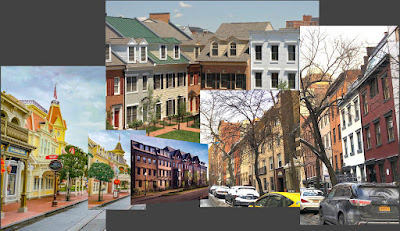
The “Block Beautiful” relocation gives Disney the opportunity to show off a transformational talent for which it thinks it is especially suited in a way that will superbly advantage the new program.  The “Block Beautiful” is cited as one particular example of changing fashions: “destoopification.”    No, that is not a typo for “de-stupefaction,” that is, instead, a name for a phenomena where buildings in New York City with the traditional style of front building stoop, inherited from the old Dutch designs, became déclassé and townhouse owners all over the city modernized by removing the stoops and creating new entrances on the lowest floor.  That also allowed extra flexibility creating more rooms if separate apartments were created in the building.  But with stunning architectural whiplash, things have changed again in areas like Brooklyn Heights were once-removed stoops are being put back again as hedge-funders gussy up purchased buildings that are again owned and occupied by one wealthy family.

In the dusk of architectural history, stoops can sometime be a `sometimes you see it, sometimes you don't' proposition.

What Disney with its technology will be able to do is teach the history of architectural fashion change by having the same established historic section display different era facades on different days of the week. To an extent this can be accomplished by projections overlaying different lighting changes, but it will also require storing things like stoops that will have to be rolled out and locked into place certain days.  In this regard the reestablished areas will have the advantage of large areas that will be in taller back structures that, with clever design, will not be readily observable.  Says Ms. Ona Lott, a Disney executive and representative about its design capabilities, “at our Florida Epcot center, the new modern, futuristic and big, may be cheek by jowl with our ancient Moroccan Casbah, but you don’t notice the former when you are enveloped in and looking at the latter.”

Putting stoops back in place when they are no longer grandfathered normally can raise all sorts of property line issues, but this won’t be an issue in the reestablished areas as the Vornado, Related, Disney joint venture will privately own the entirety of all the land, including all streets, sidewalks, park and green areas.

Another advantage the reestablished areas will have is there will be well thought out technology using the same sort of tunnels and unnoticed passageways that Disney uses at its theme parks for its Disney characters to appear where and only where they are supposed to.  This will make sanitation and garbage removal a far more aesthetic proposition.  Think of the way things are now says Ms. Lott, the Disney exec: “You have a row of buildings all from the 1800s and outside people are throwing away their 50' flat screen TVs as they graduate to bigger 4K, 8K (or soon 16K) models.  That plus a tangle of discarded routers and USB wires and flavored vodka seltzers is just not very historic.”  Now, in reestablished areas, such trash will head out to the landfills via hidden tunnels that nobody thinks about.  In place of the missing trash, Disney will periodically manifest historically appropriate trash depicted on its own ultra-realistic large flat screens.  And there will be no garbage smell to go with it unless you press the accompanying scent button.

Back at 19th Street, between Third and Irving, it will now be possible to put up a series of new towers like those that have been going up on Third Avenue for some time now.  Proving that a good job can be done reestablishing the “Block Beautiful” at its new Sunnyside Yards location will make it possible to move on to the next goal of reestablishing Gramercy Park at Sunnyside.  “The reestablished Gramercy Park will be quite an attraction, so much so that we are thinking we might actually make it just a fraction larger,” say Ms. Lott, “We will surround it, as before, with a hotel and most certainly the Players Club and the National Arts Club (formerly the mansion with enormous library of Samuel Tilden).” Meanwhile, Vornado and Related will have a whole city block to build on where Gramercy Park formerly stood.


Gramercy Park as seen from above at its current location- one whole city block!

Things will lead one to another.  A reverter clause affecting Gramercy Park’s chain of title and deed means that when that park property is built on, Union Square will again be privately owned. “It’s complicated real estate stuff,” Related VP David Chablis explained.  So Union Square will also be reestablished as one of the linked greenways of the Sunnyside Yards history learning center.  Visitors to the reestablished Union Square will again get to visit the old S. Klein’s department store on its border, because, with the restablishments, it will be possible to rewind the historical clock to any time that’s desired. . .

. . .  But, wait, Union Square, wedged between the Greenwich Village and Gramercy Park historic districts is not a historic district, right?  That’s another advantage to the program; how with more flexible modification, historic destructs can be more easily created and expanded, even retroactively.

Nobody living in what are currently historic districts will be required to sell what they now own, but they will be entitled to first dibs discount acquisitions on properties in the reestablishments.  If they do sell, they may make hefty profits.  Moreover, if they exercise their first dibs options, they and the heirs taking reestablishments property from them will all have continual access to the reestablishment areas without ever having to pay a perimeter fee.  For its maintenance and upkeep and the teaching and education that will be provided in the reestablishments Disney will be paid a fee financed with perimeter fees paid using people’s phones much the way that new York metropolitan area drivers have been using E-ZPass® to pay for bridge and highway tolls.  The areas will be designated with barely noticeable circumference wires rather like certain Jewish neighborhoods have set out the eruv perimeters for Jews observant of the Sabbath in this way.

Vornado, Related and Disney will be working with New York’s three public library systems to research historical accuracy.  This can be useful, because, in Brooklyn, for instance, the Brooklyn Library has taken over the Brooklyn Historical Society, and, now having subsumed it, has renamed it the Center for Brooklyn History* (there is thought of adjusting the name further to “The Center of Brooklyn History”).  Vornado and Related said the fact that the boards of the city’s library systems have been filled with people from the real estate industry and people who work for content control companies like Disney will help ensure the needed corporation in adhering to the desired historical narratives to be communicated.

(* The Center for Brooklyn History is currently closed, physically closed, to the public, but is providing virtual access to some history, plus is providing a “grab-and-go” history supply service in its lobby.)

Mixed in with the reestablishments of New York’s well known historic districts, the Disney company will be integrating duplicates of some of its Disney theme park history re-creations like its Disney Main Street (some building may be done by Alexandria, Virginia and Potomac, Maryland Builder/Developer EAY).  The city is expected to benefit terrifically in that the new historical areas that can be visited and the much more efficient way that they can be taken in are expected to be a huge draw from tourists in the future.

Work by Alexandria, Virginia and Potomac, Maryland Builder/Developer EAY
 

Because the reestablishment areas will be evolved with the special Disney touch, thinking and creativity, the areas can be copyrighted.  Said Dr. Kols, Disney’s Director of Historical Affairs, “The old adage that `history is written by the winners’ has the corollary that `those who get to write our history, get to own it, . . ahem, . .  copyright it.’”  “Of course, any such copyright ownership is subject to ‘fair use’ commentary” said Dr. Kols. . . , “as determined by the courts reading our lawyers’ briefs.”

Mayor Eric Adams is exceptionally happy with the proposed demonstration program.  In fact, without Adams the program would not be happening. The program’s legalities would be exceptionally tricky, even likely tripping up on various Constitutional prohibition entanglements, except for the New York State provisions (Executive Law Chapter 18, Article 2-B) that allow Adams, as mayor, to suspend laws and do what he wants pursuant to his declaration of the Covid emergency.  Adams says that if the New York City Public Advocate wants to use his standing to challenge any of his actions, the Advocate will have the opportunity to do so with the statute of limitation for a mandamus challenge commencing with the actions that Adams is taking as of this April 1st.

Thursday, April 1, 2021

Legal Eagle Arthur Schwartz, Attorney Skilled In Opposing Privatization, Says He’ll Stop Mayor de Blasio’s Even Worse Scheme To Leverage“Covid Emergency Streeteries* Declaration” Into More Real Estate Development

Double height streetery - Fifth Avenue in Park Slope- last spring it was single height.

(* Also spelled 'streateries')

Mayor Bill de Blasio, (“Build de Blasio” as he is affectionately known by some in the real estate development community) has an even worse plan with respect to his use of “Covid emergency” declarations for a privatizing takeover of public space to enhance private real estate ownership in New York.  It’s an even worse plan and attorney Arthur Schwartz of Advocates for Justice says that he’s going to fight and defeat it.  Mayor de Blasio's plan is that he wants to turn property owners’ street occupation rights into even more development rights than previously imagined.

Schwartz noted how he had already sued when the City Council unilaterally decreed the Open Restaurants Program permanent and he confidently predicted that he would not let this new, expanded and even worse version of that “Covid emergency” based declaration get one wit further.   Respecting Schwartz’s earlier legal action see: The Village Sun (Real News For The Community)- Locals to sue city over ‘illegal’ Open Restaurants program, by Lincoln Anderson, March 9, 2021

Schwartz previously attacked the de Blasio and the City Council for using the “Covid emergency” as an excuse to make `Open Restaurants Program’ permanent by passing a law (Intro 2127-A), November 15th of last year, that gave the mayor’s Department of Transportation and whatever any other agency the mayor designated unfettered power to create a permanent program to give the streets away for ‘restaurants.’  In the lawsuit Schwartz brought pro bono (representing an ad hoc coalition of community groups under the umbrella name “New Yorkers for Safe Open Streets” a.k.a. S.O.S.) Schwarz pointed out that this extensive delegation of power to the mayor and his agencies  amounted to “unconstitutional” changes to the city’s zoning laws bypassing community input and  “totally ignoring” the City Charter’s Uniform Land Use Review Procedure (ULURP), a process that specifically requires zoning change review by community boards, the borough presidents, the City Planning Commission and the City Council.

Schwartz said that the permanent long-term giveaway of streets to neighboring properties was a privatizing handout to landlords, and that:    

basically, property owners would be able to charge higher rents due to the permanent availability of the parking lane for use for additional seating.
In other words, with higher rents being charged, there would be no benefit to restaurants or restaurant owners.

Ultimately, the community activist attorney* said, the Open Restaurants program post-COVID would not benefit restaurants, only landlord property owners who would be able to charge higher rents due to the permanent availability of the parking lane for use for additional seating.  “You can’t be doing this without any parameters at all,” says Schwartz adding to his objections, “there isn’t even the slightest framework to hem in the mayor and his agencies from doing absolutely anything they want or can imagine.”

(* NOTE: Arthur Schwartz is the same community activist attorney who successfully represented WBAI free speech radio, "Radio for the 99.5%," the only truly listener supported public radio station in New York City, in fending off a potentially privatizing attack on the station that involved the surreptitious and illegal shutdown of the station in October 2019.)                       
The Village Sun article includes this overview analysis by Schwartz, “speaking to The Village Sun,” he said:

what is currently being seen with the Open Restaurants diktat is part of a wider problem of community disenfranchisement perpetrated by City Hall.

“To me,” he said, “it’s part of an approach taken by the city that is also reflected in the recent proposal by [Council Speaker] Corey Johnson to create a ‘zoning czar’ that would shorten the ULURP process, where decision making on land use is getting more and more centralized and less involving the affected communities. This is imposing the will of the mayor on communities without their having a say.”

Those of us who have been watching the effect of Covid on city real estate are worried that this will also compound consolidating ownership: Are we are going to be seeing greater consolidation of property ownership in a city where a limited number of real estate families already dominate excessively given the squeeze of high property high taxes from a stressed city in need of income while store fronts are vacant as Mom and Pops close because of the virus?  Mom and Pops, unlike the big box stores, don’t have a parallel web-sales presence to help carry them through.  Big real estate owners also seem to have an affinity for big-box chain stores where they can replicate deals over swaths of property. . . All this in a city where City Hall has been handing out huge acreage swath to single owners, like the Atlantic Yards (now “Pacific Park”) project, Hudson Yards, Willets Point, the Columbia takeover of West Harlem, etc. often with the aid of eminent domain abuse seizures of property from smaller owners. And now public streets and sidewalks will be consolidated in that ownership.

Mayor de Blasio has defended making the `Open Restaurants Program’  permanent saying that assuring that permanence will induce the construction of sturdier outdoor enclosures to accommodate restaurant patrons.  He notes that many of the streeteries initially built last spring were ramshackle affairs, thrown up often so improvisationally that they constitute unsettling eyesores to the community.  "Knowing that you can keep, rather than quickly scrap what you build, will generate investment in far lovelier enclosures as people think in terms of a future and build with that in mind," said de Blasio.  

Irving Place is one of the streets where sturdy streeteries are expected to be greatly expanded under the new de Blasio permanence program.


Mayor de Blasio’s new edition of the `Open Restaurants Program’ is supposed to be initially be launched mostly by new regulations issued by the mayor. Ideas for it started to get generated when Evan Moore a Department of Transportation Deputy Director was conferring and trading expertise and thoughts with Max Tolstoy of the Department of Buildings.  With the streeteries built last year becoming more permanent and with the continuing need for such legal “outdoor” spaces to accommodate patrons given the prospective bans on indoor restaurant space, a number of the streeteries were informing the city that they were going with the expedient of building second stories to their “outdoor” space.

Moore and Tolstoy quickly realized there were implications to be considered.   For instance: `Should staircases meet any prescribed code standards?’  This led to trying to think through possibilities through on a more integrated basis.  `Should second stories only be permitted for those who had built sturdier structures making use of the outdoors, for instance, those with locking doors, and operable glass windows?’ Then it was realized that with outdoor staircases possible, maybe even lifts and sidewalk elevators being used, especially if wheel chair access is to be nondiscriminatorily provided, why not consider putting some of the new outdoor space structures on the roofs of shorter buildings?

Irving Place is a good small street to see in microcosm many solid doors and sturdy operable windows on streeteries.

Thinking multidimensionally this way, and thinking of building upwards in general, Moore and Tolstoy realized they had a tool to work with that they hadn’t been thinking about, known to those who understand the zoning code and regulations as "FAR," for Floor to Area Ratio.  The FAR concept, already in the code and thus already available, prescribes that how much and how tall you can build in terms of total square footage will be determined as a multiple of the dimensions of the real estate you own absent any structures.  Thus, formally recognizing the right to permanently occupy what was parking lane space as the addition to the owned property that it actually is, means that all building owners with such space attached have additional FAR with which to build higher and more real estate.

Mr. De Blasio, immediately blessed this concept with the caveat that any new space built with the additional FAR coming available would have to be deemed “outdoor” space for a period of time, a period of time that would also have to have some conceptual relation to the period of time that people think that Covid, at least as a crisis, is expected to be around.  Furthermore, the space would also have to be deemed restaurant space throughout that period.  De Blasio further specified that, somewhat along the lines of some of the legal concepts of `adverse possession’ or `possession is nine-tenths of the law,’ the Moore Tolstoy Open Restaurants Program should henceforth start requiring that parking lane street acquisitions and everything built under the program should be built with a certain level of sturdiness and meet certain minimums of protected enclosure in order to be considered certifiably consummated.

On 19th Street and Park Avenue, one of the city's streeteries is now rebuilding in a sturdier fashion planning to take advantage of de Blasio program loans for structures of greater permanence.


“But you can’t just expect that people will be able to do all this building under the program with insufficient resources to do so,” said de Blasio.  That is why eligible owners applying to City Hall for approval will be able to take out loans from the city, “Sturdier Construction Underwriting Motivation” loans.  Modeling the program on the federal Covid program Paycheck Protection Program (PPP) loans, these loans will likewise be forgiven if the structures built are sturdy enough to stand for one year.  The loans will be funded by tax-exempt bonds issued by Goldman Sachs.  The City’s former deputy mayor for housing under de Blasio, Alicia Glen will get a finder's fee for the bond transaction.  Although Glen is not now with Goldman, she came to work for de Blasio as Deputy Mayor for Housing from her previous position with Goldman where she led Goldman Sachs’s Urban Investment Group.  Glen said that it required a lot of thinking, `to whom the loans should go,' but that Goldman was advising that loans should, for logical reasons, go to the property owners, not the restaurant operators.  She said this was the advice the city was going to go with.

Most of the streeteries on Fifth Avenue in Park Slope, the neighborhood from which de Blasio originally hails, are expected to go to two story editions

Because most of the loans are expected to be forgiven rather than repaid, the source of funds for bond repayment will have to come form another source.  Goldman has decided the bonds will be tax-increment bonds.  Instead of any repayment funds having to come from the real property owners acquiring new properties and building rights under the program, the bonds will be paid off by higher taxes (tax-increments) that the rest of each neighborhood’s properties will pay. This is justified, says Glen, by the additional value and overall uplift the new building and dining spots will add to the neighborhoods.  To encourage their acquisitions, the street property acquiring owners will be exempt from real estate taxes for five years.

Arthur Schwartz says he will fight the new Moore Tolstoy Open Restaurants Program for all the same exact reasons he brought his lawsuit against de Blasio’s initial Intro 2127-A version of the program prior to these new expansive interpretations, and he emphasizes that this version has all those same faults, flaws and unconstitutionalities, while at the same time "being ten times worse" . .  Schwartz says he is absolutely confident he will prevail. . .

. . . Nevertheless, mayor de Blasio is set to boldly announce, in a press conference today, the Moore Tolstoy Open Restaurants Program along with Goldman's imminent issuance of its tax-increment bonds for  the“Sturdier Construction Underwriting Motivation” ("SCUM") program loans.  That should make a lot of restaurant landlords happy, this first day of April, April 1st.


Another streeterie in Park Slope that just went to two stories in March.

And one more

Wednesday, April 1, 2020

Brooklyn Public Library President Linda Johnson, Now Poised To Additionally Become Head of Brooklyn Historical Society, Says “Following The Money [The Othmer Funds] Convinced Us History Is Too Precious To Be In The Hands Of Those Not Writing It.”

Brooklyn Public Library President Linda Johnson is poised to take on new responsibilities holding her position as BPL head.  It will occur with a merger that will make the Brooklyn Historical Society in Brooklyn Heights a junior subcomponent of the Brooklyn Public Library, which will now assume the role of the “parent institute” of the Historical Society.  This combination was announced by the BPL’s press release, February 27, 2020.

As the plans are solidifying, Ms. Johnson sat down in an interview to describe how the merger plan had come about, and why these plans will be good the BPL’s overall plans and partnership expansions and why it will be good for the history that people will remember.  “Our eye first landed on the Brooklyn Historical Society as an institution that we should attend more to when we were making plans for the consolidating shrinkage plans involving the shrink-and-sink sale of the Brooklyn Heights Library across the street and a few yards down” said Ms. Johnson.  The Brooklyn Heights Library was being replaced by a luxury tower as a result of the real estate deal that Ms. Johnson steered through the BPL.  It was once Brooklyn’s second biggest library, the Business, Career and Education Library and a federal depository library to boot.

Ms. Johnson said that when the BPL was selling that library it needed a small temporary library to replace it for a time until a planned reduced size library could be built under the luxury tower that was planned.  “We considered putting the small temporary library in the Brooklyn Historical Society,” said Ms. Johnson, “we actually talked to them about that.”  Johnson pointed out that the Brooklyn Historical Society is a library itself, which she said might have allowed them to argue the temporary arrangement involved a bigger aggregate book count.  Johnson pointed out that consolidating shrinkages like what the BPL was doing with the real estate deal sale of the Brooklyn Heights library, with its theoretically sending books and functions to the Grand Army Plaza BPL library, didn’t have to involve just an institutional consolidation of BPL or NYC libraries, like with the New York Public Library’s proposed Central Library Plan.

“These consolidating shrinkages can also be inter-institutional,” said Ms. Johnson.  “That’s what we would have had if we had used Brooklyn Historical Society space for the interim library, and it is the kind of thing we are doing where we are moving the Brower Park Library into the Prospect Heights Children’s Museum to reduce the museum’s previously expanded space,” said Ms. Johnson.

Ms. Johnson, smiled, very pleased with herself, as she then got to the subject of the Othmer money, funds left to Brooklyn institutions by a quiet unassuming Brooklyn couple nobody knew had become superwealthy after they invested with their friend Warren Buffett.  Said Ms. Johnson:
We were talking to the Historical Society about these possibilities back when we were making plans in 2013.  Given the timing, we were almost forced to notice then, due to certain commonalities, something else we needed to think about.  The Historical Society was one of the institutions that was among those Brooklyn institutions famously benefitting, receiving millions of dollars, from the surprise bequests of Donald and Mildred Othmer.  2013 was also the mayoral election year when another such institution benefitting from such Othmer bequests was being shutdown: Long Island College Hospital.  With gifts during their lives and then thereafter from the wills of the two Othmers, Long Island Collage Hospital received a phenomenal endowment from the Othmers, more than $135 million.

It would have been impossible to reach that money and make better use of it- so the hospital could be turned into real estate transactions- were it not for that fact that Long Island College Hospital was convinced to merge with a series of other health institutions, first with Continuum Health Partners and then with SUNY Downstate Medical Center.  It involved intricate dealings, but this allowed the endowment funds to be posted as security, something the New York State Attorney General’s office was convinced to pre-approve, (as if they didn’t see what was coming), and
Voilà . . .   
“Real estate deals and no money sitting around going to waste in troublesome ways that might pull towards different priorities!” emphasized David Woloch a Brooklyn Public Library executive vice president and spokesperson who had joined Ms. Johnson to help her with her interview.  “Activists were actually helping to make sure that we didn’t let the connection go unnoticed,” said Mr. Woloch, “because the activists were pointing out the similarity of how libraries and hospitals were both public assets similarly up for sale.”

Ms. Johnson said that money that came into various Brooklyn institutions from the Othmers pre-9/11, in the later 1990s was almost totally unforeseen.  “It came out of nowhere,” said Ms. Johnson, “it was something of a `money bomb.’”   “And when a bomb hits your house throwing things into disarray,” said Ms. Johnson, “you want to do some cleaning up and vacuuming.”  The good thing though said Ms. Johnson is that, while the money came in unexpectedly, it has been a useful tool, a tracer, to spotlight institutions that might need “independence adjustments.”  “That’s certainly true with Historical Society,” which deals with “history,” which is “precious.”
    
Johnson mentioned that when David C. Chang, Polytechnic's president, learned that his engineering school was going to receive more than $175 million- nearly $200 million- from the Othmers he said: “We start from being one of the have-nots and go to being one of the very well-endowed schools.”  The blare of that unusual Brooklyn brightness has since been somewhat adjusted via Polytechnic's subsequent merger celebrated in 2014 with Manhattan-based NYU.

Ms. Johnson also described how things were faring at Brooklyn Botanic Garden, another institution given money from the $750 million estate of a Brooklyn Heights Othmer couple.  And she explained that people should watch for new connections between the BPL and the garden.

Ms. Johnson that, despite the infusion of the Othmer funds, the Botanic Garden’s basic trajectory, including shorter hours, higher user fees and its increasingly privatized closures for fashionable weddings (the BPL also advertises its spaces for fashionable weddings).  She noted that the Botantic Garden had been able to sell off its science research building that was on its outside perimeter.  At the same time, Ms. Johnson said that it is important that the Botantic Garden board has behaved in an amendable and basically welcoming way to the towers and proposed development that, with zoning change reversal, will be set up along its borders blocking sunlight.

Ms. Johnson noted that the BPL will be implementing a plan that gets “gets Oohs and Ahs” connecting the BPL’s Grand Army Plaza central library to the shadier and more pleasant Botantic Garden space.  The GAP library “will connect with Mount Prospect Park to create a Central Brooklyn green campus that includes the library, park and Botanical Gardens.”  Mount Prospect Park is a public park (with the second highest promontory in Brooklyn) which sits between the library and the Brooklyn Botanic Garden.  BPL's plan involves altering space within the library “dramatically opening up the exterior of the library” to facilitate a new restaurant space within the library building that would unfold to include outdoor café space in the park. 

“All in all,” said Ms. Johnson, “I think the infusions of the Othmer money to the institutions in Brooklyn have met the kind of response they deserve.”  Ms. Johnson acknowledged that not absolutely everyone agreed.  It’s known that Dr. Donald Othmer himself drafted much of the meticulous detail for the bequests in his own will and that of his wife Mildred’s.  Warren Buffett, the friend who handled their investments and made them wealthy told the Wall Street Journal, speaking about what happened with the depletion of the Othmers’ Long Island College Hospital endowment, that if the Othmer’s were alive, “I would think...they would feel betrayed.”
                               
Johnson doesn’t see it that way:
We have something called the cy-près doctrine.  It’s a legal concept.  The concept basically recognizes how inappropriate, essentially impossible it is for dead people to rule from the grave.  The dead don’t know what is going to be what after they die.  Lots of things are going to be unexpected and unforeseen.  The cy-près doctrine dictates that instead of doing what dead people wanted, you should do what you know dead people would have wanted if they had known better.  For instance, do you think the library systems could ever be doing everything they are doing in terms of turning libraries into real estate deals, providing a venue for society weddings, exiling books, and cutting back to much shorter hours, if they had to do exactly what dead people who made the donations to set up the libraries wanted?
Johnson said this was an especially important concept when it came to how precious the possession of history is.  History, she maintains, is too far too precious not to be kept in the hands of those who are supposed to write it.  Ms. Johnson said that was why it was so important for the BPL and the Historical Society to combine into a single unit for historical record custody.  “The history of the last several decades is one that I am proud to be a part of,” said Ms. Johnson, “The overarching truth to that history is that it has been a history of the victories of privatization– I’ll remind you that it’s axiomatic that history is supposed to be written by the winners.”  Ms. Johnson said that as Churchill knew history is to be written by those that command the reins of power.  As Churchill is famously quoted: “History will be kind to me, for I intend to write it.”

Ms. Johnson said that it was relatively easy for the board of the BPL and the board of the Historical Society to reach agreement about the merger.  “We’re mostly all the same kind of people,” said Ms. Johnson, maybe there is one person on the BHS board who cares about the previous old fusty ideas that people used to promote about what history is, but basically, Ms. Johnson said the BHS board, like the BPL board, is a complement of the kind of people who know what needs to be written and preserved in terms of history: corporate lawyers (good at things like white collar defense for those charged with accounting fraud), mega-bankers and some real estate people.  “Nevertheless,” said Ms. Johnson, “we can improve through the merger and have better control; our BPL board composition is more refined and fine-tuned in terms of what it needs to be in ensuring everything reflects the private partnership goals and this to be respected.”

Ms. Johnson offered an example of what it means to be keeping things on track or not in terms of history that needs to be written.  Recently, Brooklyn For Peace donated its archives to the Historical Society,  over 25 linear feet of organizational records, event ephemera and recordings, and subject files dating back to 1983.  “This is the kind of history people want to write?” scoffed Johnson, Brooklyn For Peace has been around since 1983/1984— If history is supposed to be written by winners, how does that work?  We have more wars now than ever.  These people are real losers!  These space usurping records are prime candidates for culling.”
 
Similarly in the vein of what makes good historical fodder Ms. Johnson spoke of killing two Othmer birds with one stone: the BHS might also remove records that showed that there were once plans that the 500 beds of LICH were to have been used as a designated isolation hospital in the event of a pandemic.
   
Ms. Johnson said she could anticipate acquisition of the Historical Society would be a boon for all sorts of goals important to her.  She said the beautiful landmark building the BHS was in would be another great place for wedding and society events without her people eager to mingle at such events needing to Uber any further than Brooklyn Heights.  People would not have to go to Grand Army Plaza.  She noted that the New Times had already let the news out that the plan would start “with the eternal New York City preoccupation” of managing all the real estate dollars that could be involved.  Ms. Johnson noted how, in connection with the revealed merger, the BPL has pronounced itself to be “on a space grab,” but that the BPL had not yet decided to characterize this as actual space growth or part of its demonstration of its flexibility exercises allowing it to jettison space.  Mr. Woloch opined that the BPL could always go back and forth on these characterizations; that there was no need lock itself in respecting these things.  He noted that the BHS space might, for certain purposes and at certain times, be nominally cited as an ancillary part of the library space to be tucked nearby David Kramer’s luxury build replacing the Business, Career and Education library.

As Brownstoner notes, important to the “timeline for the merger,” will be necessary that the BPL and BHS are currently having discussions “with the City of New York regarding funding necessary for combining the institutions.”  This is obviously important with respect to Othmer endowment funds has BHS converts into joining the city’s family of libraries and its tradition of creatively underfunding them.

Ms. Johnson said that there would be no “sweeping changes,” respecting the BHS mission, but that she was particularly eager to take on and engage in a “rebranding” for the BHS with a new “less  fusty-sounding” name to proclaim the BPL’s ambition for everyone to understand that the institution would be democratically opened up.  “It used to be even more fusty-sounding,” said Ms. Johnson, “The Long Island Historical Society.” Ms. Johnson said, “when we took the Business and Career Library out of Brooklyn’s downtown, we updated the name; we now call it a `center,’ the `Business Career Center’; we dropped the fusty-sounding `L-word.”  Johnson said “center” sounded modern and distinguished it from the “Commons,” the “Leon Levy Information Commons” that it is above and from which it will be otherwise indistinguishable.

Johnson said the “rebranding” should also make use of some more of the naming rights that the private partnership building the BPL has been engaged with allows, like the BPL’s partnering with the Nets and the Barclays Center celebrated at its last gala in May 2019 where the Nets and Barclay’s center were honored.  “If we put the name `Barclays’ on the landmark Brooklyn Heights building that rules out calling it another ‘center’; you can’t have two ‘Barclays Centers,’ in Brooklyn” said Johnson, “but we might call it something like the ‘Barclays Historical Information Outlet,’ then it would be distinguished and not fusty-sounding at all.”

Ms. Johnson said that she wanted to point out the overall pattern of convergences that she said the merger of the BHS into the BPL was just a one incidental part of: Libraries are also being subjected to consolidating shrinkages while the library is also essentially merging with private sector interests though its private-public partnerships.  She described the converging as going in the direction of a “supremacy singularity.”  Ms. Johnson proudly pointed out to how this convergence even extended to her own personal life and how she was now living in her own personal partnership with Forest City Ratner’s Bruce Ratner, a personal partnership that paralleled the BPL Barclays/Nets partnership.

Ms. Johnson opined that Bruce Ratner was a great man who had contributed mightily to the history of Brooklyn.  She said that people had actually called the struggle that Bruce Ratner’s won to bring Atlantic Yards and the Barclays Center to Brooklyn the second “Battle For Brooklyn.”  Ms. Johnson said there was too much Brooklyn history that the Brooklyn Historical Society had not covered adequately.  She said that this would start to be remedied in a year’s time when the merged BHS would mount a major exhibition of the writings that Churchill created about what a great man he was.  “It is time that people realized Churchill’s intimate connections with Brooklyn,” said Ms. Johnson.  His mother, Jennie Jerome, was an American, a Brooklynite born in 1854 just blocks away from the landmark BHS building, 197 Amity Street, in 1854.  She said the exhibit would be in two parts, the second part drawing parallels between Churchill as a great wartime leader and Bruce Ratner fighting to bring the future to Brooklyn. 

Ms. Johnson said that the exhibit was slated to open in a year, on the first of April 2021, which was why it was being announced today, April 1st 2020.
PS: The shrunk-and-sunk library space that will be in the David Kramer’s luxury building at the sight of the former Business, Career and Education Library is next to and part of the same zoning lot, real estate development parcel as Forest City Ratner’s One Pierrepont Plaza. The underground BPL library parts can connect to the underground Ratner building parts.  The BHS has its own underground parts that are just a few feet away underground from the Ratner building.  The Ratner organization has been excellently adept at acquiring, through political machinations, private ownership of public streets adjacent to its properties.  The Ratner organization is now looking at doing that for the street between it and the BHS building.  If it succeeds (and it may join the buildings with an underground tunnel), it would put the air and development rights to the BHS building in play as part of the Ratner development and zoning parcel.