Showing posts with label Bill Maher. Show all posts

Sunday, February 21, 2016

NYS Attorney General Eric Schneiderman Is Taking Political Donations From Those He Could or Should Be Investigating- Despite a (Playboy) Model Being Involved This Is NOT A Model That Serves The Public Well

WNYC and News News 4 New York have partnered to report on Attorney General Eric Schneiderman’s office taking contributions from the potential targets of his investigations
You probably don’t come to read stories at Noticing New York for shallow analysis.

WNYC and News 4 New York have partnered to produce a pair of stories about how New York State Attorney General Eric Schneiderman’s office is often taking political donations from those they are investigating.  Although I don’t know what to think when not-for-profit news organizations increasingly “partner” with for-profit news organizations, these articles ought to grab public attention.  (Note: The more sensationally presented News 4 New York story had to conclude with a disclaimer of ownership relations between NBC and companies mentioned in their investigative story.)
    •    WNYC: Could Some Political Donations to New York's Attorney General Be a Conflict of Interest? Interview by Jami Floyd, February 18, 2016

    •     News 4 New York: I-Team: Why Did Former Playboy Playmate Donate $65K to Attorney General Eric Schneiderman?  By Chris Glorioso and Ann Givens, February 18, 2016
Both stories state that Attorney General Schneiderman isn’t being accused of any wrong doing.  Both stories also note statements from a Schneiderman spokesman that Schneiderman has investigated his own political donors, and in the WNYC report, Chris Glorioso states that the Attorney General’s office says this “evidence that he is unbiased and not swayed by these political contributions.”  According to Glorioso, the spokesman also said that in cases where donors stand to benefit from investigations that “those investigations began from the ground up, they began from New Yorkers who may have been wronged in one way or another, or from whistleblowers who called out wrong doing in the financial sector.”

Is the investigation of an Attorney General of his own donors evidence of a lack of bias, a lack of problems with receipt of the money received?

An uncle of mine was in the public relations business in the 1970s and there is a story I was privy to growing up told as a cautionary tale in my family about a fabled, wealthy publicist of the time.  I found it fascinating.  I won’t use names because I have never been able to find anything anywhere documenting the allegation although I did read that records that might have said something one way or another about the facts were burned after the publicist’s death.

The story was that when clients came to the publicist he told them that it was his job to tell the public everything good about the client, everything the client would want the public to know and everything it was the goal of the client to put out to enhance the client’s name and brand, but that he also needed to know what he would need to steer around. He explained that he needed to know all the client's secrets, the skeletons in the closets.  This man was recognized as being an exceedingly good publicist and did a good job for his clients, but if there ever came a time when a client thought about abandoning the use of his services, or if they began to think his fees verged on being too much, the situation could become uncomfortable. . .

. . . Was there reason for the client’s to be uncomfortable?  Was there ever an instance of private confidences having been breached?   I don’t know that there ever was.  I only know that the feelings of discomfort were part of the story that was told and that everyone knew from his flamboyant life style that the man’s fees were high.

I tell this story because it reminds me of another seeming paradox that might bring people up short when they first think about it.  Campaign finance reform expert and advocate Lawrence Lessig has written about how elected officials across the spectrum, both Democrat and Republican, “have an interest in extending the reach of regulation, because by increasing the range of regulated interest, you increase those who have an interest in trying to influence . .regulation.”  (This quote is from Lessig’s book, “Republic Lost.”)

Why do electeds benefit from regulation?  Is Lessig’s view that they necessarily want to enforce regulation?  No, it is that, as gatekeepers who get to collect political contributions in the money-in-politics “gift economy” that Lessig writes about, it’s good to have lots of “targets for fund-raising.”   Lessig tells us how federal lawmakers seek to be on certain “cash cow” committees which because of their regulatory power “primarily because members of those committees are able to raise large amounts of campaign money with little effort.”

Professor Lawrence Lessig appearing in the documentary, “The Internet's Own Boy: The Story of Aaron Swartz.”  Mr. Lessig's preface to the second edition of "Republic Lost" is a lamentation of our loss of activist Aaron Swartz.
In other words, Lessig quoting the work of Peter Schweizer and his book “Extortion,” describes an “extortion game.”  “What if politics is really largely about fund-rasing and making money,” is one of the quotes Lessig picks up from Schweizer.    

Later in analyzing what causes the campaign contributions, whether it originates with the hopes of the donor, or with the politicians and electeds soliciting contributions, and how much blame to put in the system itself Lessig writes:
Think about a more pedestrian version of this sort of extortion: We wouldn’t look to the failure of a local Mafia to give the victims of its extortion benefits as proof that there is no extortion. The victims are trying to avoid penalties; they’re not seeking special favors.
It’s particularly uncomfortable to apply this analogy to a state attorney general, because as Glorioso stressed in his WNYC interview:
Prosecutors are not just politicians, they are law enforcement officers.  They have subpoena power.  More than a law maker or a governor they can act unilaterally to penalize an entity, or to force an entity to cough up information.  So particularly here in New York where the Attorney general’s Office has been called the “Sherif of Wall Street,” a subpoena or a decision to investigate can have tremendous consequences in the market place.   
While, on one hand, there is a question of how things may turn out when there is competition between various moneyed interests, there is a bigger problem when you are the public with no money to pony up in the game.  Then you lose out entirely, in practical terms dropping off the face of the political earth.

Near the end of the NBC story Lawrence Norden of the Brennan Center Democracy Program says: “As a general matter there is political science out there that says that the donor class has more influence over policy than the general public.”
Bill Maher on his Friday, February 13th Real Time showing speaking about how the average American has "only a minuscule, near zero, statistically non-significant impact upon public policy."
That is essentially what Bill Maher said in far more blunt terms on his last show a week ago:
Bill Maher: I just want to read one thing I read before on the show, it's a study, I am sure you are familiar with it, by two Princeton professors who said this is an oligarchy:
The preferences of the average American appear to have only a minuscule, near zero, statistically non-significant impact upon public policy.
 . . And they wonder why there's a revolution!
The professors Maher referred to are Martin Gilens and Benjamin I. Page (from from Princeton University and Northwestern University) and their report, Testing Theories of American Politics: Elites, Interest Groups, and Average Citizens, uses in some cases some very academic sounding language to say these things; while they speak of “U.S. government policy” you can readily believe that with money in politics the way it is locally and in New York it is also true of New York City politics:
Multivariate analysis indicates that economic elites and organized groups representing business interests have substantial independent impacts on U.S. government policy, while average citizens and mass-based interest groups have little or no independent influence.
A summarizing preview was published (Oligarchy, not democracy: Americans have `near-zero' input on policy - report, April 15, 2014) containing these extracted quotes:
"Despite the seemingly strong empirical support in previous studies for theories of majoritarian democracy, our analyses suggest that majorities of the American public actually have little influence over the policies our government adopts,". . 

While "Americans do enjoy many features central to democratic governance, such as regular elections, freedom of speech and association," the authors say the data implicate "the nearly total failure of 'median voter' and other Majoritarian Electoral Democracy theories [of America]. When the preferences of economic elites and the stands of organized interest groups are controlled for, the preferences of the average American appear to have only a minuscule, near-zero, statistically non-significant impact upon public policy."
If you are involved in a political fight and want something that a considerable portion of the moneyed elite with influence and access also want, you might have a chance of winning it. . .  And there are some good things that the elite might also want to pass.  There are no reasons why the elite shouldn't be almost equally on the same sides of certain social issues such as abortion or gay marriage.  A goodly portion of the moneyed elites might also not want there to be fracking in New York State where the NYC water supply could be poisoned or the environment of vacations homes surrounding the city ruined.

The influence of money has certainly been a problem when it comes to how the fossil fuels industry has frustrated appropriate measures to head off climate change.  That includes all the money spent on climate science denial.  Even so, there must to be a certain portion of the elite, a large one, that don’t want their children and grandchildren to live in world that perishes, ceasing to exist as we know it because of severe climate change.

Notwithstanding, Lessig in his book (where in the updated edition he also writes about the Gilens and Page study) cites issue after issue with documenting polls showing that the policy the government follows is what the elite, the top 1%, want, not what the majority of Americans want.

We normally think in terms of going to our elected officials to get government to do what we want it to.  But maybe that doesn’t make sense at all. Instead of beseeching and lobbying our elected officials, the public probably ought to be at the doorstep of the moneyed elites trying to influence their viewpoints given the documentation (and Lessig includes graphs in his book) that “as the percentage of the elite supporting a proposal goes up, the probability of that proposal raises,” but “as the percentage of average voters show support an idea goes from 0 percent to 100 percent, the probability that idea will be adopted doesn’t change.”
$65,100.00 from 2010 Playboy Playmate of the Year tops Schneiderman's contribution list?
The WNYC and News 4 New York stories pointed out mysteries and lack of public access to information about what was going on with the contributions coming in.  The hook for both the stories was to ask the question why a former Playboy model from Texas, Hope Hope Dworaczyk, now Hope Smith, the 2010 Playboy Playmate of the Year, contributed $65,100.00 to become the largest political donor to Attorney General Schneiderman this January.

Ms. Dworaczyk recently married private equity billionaire Robert Smith who has contributed a lot of money, $150,000.00,  to Schneiderman over the years with much of the cash contributed to Schneiderman after he launched a probe, and then closed that probe, into the fees that private equity firms charge their clients.  The print version of the News 4 report explained that Smith is “the founder of Vista Equity Partners, a private equity fund that has attracted nearly $1 billion in investments from the New York Common Retirement Fund, a public pension, over the last seven years.”

Compounding the problem of mystery and its deepening the appearance of impropriety, News 4 interviewed James Tierney, a former Maine attorney general, now directing Columbia University's National State Attorneys General Program who, News 4 said explained that:
hedge funds and private equity firms are not transparent about their investments. That means the funds can allege some sort of wrongdoing about another company - and it is impossible for prosecutors to know if a resulting investigation could be seen as posing a conflict of interest.
Would you like to consider yet one more layer of complexity?  With all the money and ownership interests affecting the press there is, similar to the situation with elected officials including Attorneys General such as Schneiderman, the question of what gets investigated by the press . . .

Part of the News 4 story related how Schneiderman has investigated and now halted in New York the Fantasy Sports Gambling industry (See the Frontline Report: The Fantasy Sports Gamble,
February 9, 2016).  NBC’s investment in this industry necessitated disclosure in its report, but there is money on both sides of the deal because NBC reported that Schneiderman has also taken money from the local regulated gambling industry which competes with fantasy sports gambling.

As noted, the WNYC and News 4 New York reports both make clear that, when all is said and done, the Attorney General’s office, despite how troubling all of this must necessarily be, is not being accused of any wrong doing.  Indeed, while part of the purpose of this article to deepen the analysis points out that it is simplistically naive to believe the assertion of Attorney General’s office when it says that Scheiderman’s investigation of his own “political donors” is “evidence that he is unbiased and not swayed by these political contributions,” that doesn’t change that fact that nothing written here concludes that Schneiderman doesn’t strive to do the right thing in a troublingly warped and problematic system.

We can note in more detail here the questions about how elected officials including state attorneys general are essentially gatekeepers to benefit that can be politically derived, essentially collecting tolls, but one would expect or hope that, because an attorney general's office is comprised of attorneys with the licenses and personal integrity on the line, it would ensure that the office operates within legal bounds and mostly according to Hoyle.
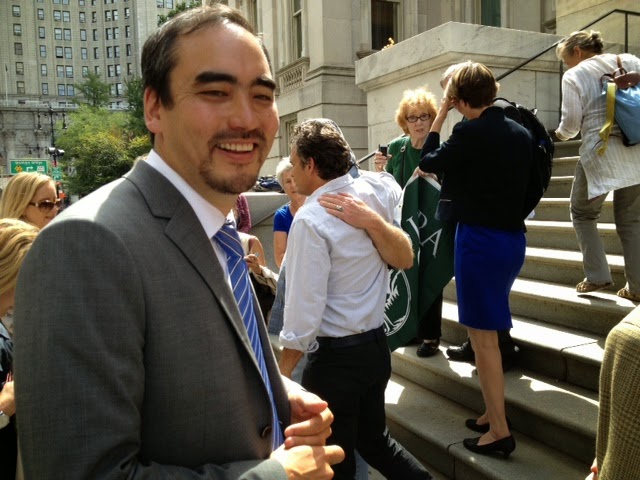
Tim Wu during the Teachout/Wu campaign for Governor and Lieutenant Governor from this Citizens Defending  Libraries gallery of events page.
Further, it must certainly serve as an inherent check and balance on the office that so many attorneys working there have no doubt gone to work in the office precisely because they hope it is a place where they can do the right thing and accomplish idealistic objectives they likely came equipped with.  A recent case in point is that, this fall, Tim Wu, the Columbia Law Professor and highly influential open internet advocate (and Tweeter par excellence), joined the Eric Schneiderman’s office.  Mr. Wu is also recently famous by virtue of his political foray to become lieutenant governor as running mate of Zephyr Teachout.  It was a campaign that was startlingly effective.  Ms. Teachout is a protégée of Lawrence Lessig and a central tenet of the Teachout/Wu campaign was the overriding need for the kind of campaign finance reform that this article is about.

Still, in the final analysis, how does our warped system serve or not serve the public?  When it comes to moneyed interests being on the scene does Schneiderman stand on the side of the public if all the money is on the side of private moneyed interests?   Or does our state attorney general fulfill predictions of professors Gilens and Page that the actual interest of the public will have “only a minuscule, near zero, statistically non-significant impact upon public policy”?

Here is a perfect test case with a now escalating profile.  The New York State Attorney General regulates charities and is supposed to "to police fraud and abuse" and, for instance, the office was recently even given additionally clarified  powers “to bring judicial proceedings to unwind interested-party transactions."
A complaint about such fraud and abuse by the Brooklyn Public Library was recently filed by a newly formed group, Love Brooklyn Libraries, representing the public interest.  There is, however, a lot of private industry money on the other side, particularly real estate interest money that would like to see Brooklyn public libraries sold for a pittance, far less than their value to the public.  Part of the problem is that the composition of the board of the Brooklyn Public Library is extremely ill-suited to upholding the public interest with far too many competing agendas at odds to the public’s.  This is exactly what the Scheiderman’s office is supposed to be regulating.  He is supposed to prevent and insulate the public from exactly that kind of harm.
Read about the composition of the board of the Brooklyn Public Library and competing agendas at odds to the public’s.
Point of disclosure: I am a co-founder of Citizens Defending Libraries which has similarly brought such matters to the attention of the Attorney General’s office, not only with respect to the BPL and its trustees, but also with respect to the NYPL and, for instance, its sale of the Donnell Library.

Now if one were plotting it on one of those professorial graphs we talked about, it is important to know that the public almost universally opposes the sale and shrinkage of our libraries, the elimination of books and librarians and the deliberate underfunding of libraries in a time of plenty being being used as an excuse to do so.
The breaking headline news now escalating the status of this story: The New York Post has just come out with an eviscerating story about the sweetheart details of de Blasio's giveaway of the Brooklyn Heights library.  The developer to whom the de Blasio administration and the BPL trustees regulated by Schneiderman’s office wasn’t the highest bidder; his bid was 20% lower than another of the two bids that surpassed him.  It was an inferior bid in other respects as well.  See:  New York Post: Developer with ties to de Blasio scores job, despite being outbid, By Aaron Short, February 21, 2016.

The new facts in the Post article are further evidence of what Scheiderman needs to be investigating.  But even this needs to be put in context: David Kramer (of the Hudson Companies) was the low bidder for a library that should not even be sold.  Kramer and the other developers were only bidding for the value of the library site as a vacant lot.  There were being asked by the BPL and its trustees to bid only for the “tear-down” value of the library.  These bids were in no way related to the value of the library to the public from the public’s perspective, because de Blasio and the BPL trustees were selling off the library with no appraisal of the value of the library from the public’s perspective.  And it is important to remember that what we are speaking of is a recently enlarged and fully upgraded library that would cost more than $120 million to replace.

So that is the test case that the New York Post has now given an escalating profile: What Schneiderman does in this instance, a matter that the public cares about intensely, will tell us much about exactly how worrisomely warped our system is.
Citizens Defending Libraries on Thursday night outside an event where Mayor de Blasio and economist Paul Krugman were to discuss income inequity in NYC.

Wednesday, November 2, 2011

Big Politically-Connected Real Estate Projects: Ignoring The Public Majority With Futile “Participatory Democracy” Hearing Process

(Above, Daniel J. Kaplan, senior partner with the architectural firm of FX Fowle presenting the Rudin/St. Vincent's project at the September 15th Community Board 2 hearing.)

When I heard Bill Maher on his Real Time show a week ago offer his thesis about the futility of the forms of participatory democracy into which we are routinely channeled by those with the political upper hand I couldn’t help but think of the public hearing process in New York City with respect to big real estate projects. . . I am not thinking about all real estate projects, but the “done deals,” the “wired deals” involving those you know are the politically connected heavyweights.

Maher On the Wish of Plutocrats: Channel The Opposition To Do It THEIR Way So They Will Lose, Outgunned By the Plutocrats’ “Lobbyists and Suits.”

(Bill Maher, above, commenting on futility of plutocratically-preferred process.)

Maher was speaking about the complacent assurance of plutocrats that they’ve cornered the political market and therefore can expect to have the Occupy Wall Street 99% boxed in, just so long as the opposition movement can be channeled into the regular and routine forms of civic contest. Then plutocrats know that the 99% “will lose” if they can be channeled into the normal ways of doing political battle, says Maher, because “the other side [the plutocratic side] has all the lobbyists and all the suits.” Or, as Rachel Maddow observed in the same conversation, when the 99% does it the way the plutocrats would like, an out-gunned 99% can be ignored.

That’s why, says Maher, the plutocrats are intent on having the opposition do it THEIR way. (See: Wednesday, October 26, 2011, Bill Maher: Right Wing, Wanting It THEIR Way, Yearns To Get Occupy Wall Street On THEIR Unlevel Playing Field of Lobbyists and Suits.)

Maher didn’t say the “plutocrats”; he said the “right wing” but he was clearly talking about those who want the Occupy Wall Street 99 percenters not to have any power. The reason I substituted “plutocrats” instead of “wealthy” in my paraphrase is that, just because you are one of the wealthy doesn’t mean that you believe that wealth should rule; it’s the “plutocrats” who promote that belief.

Chris Hedges on OWS Charlie Rose Show: Try Voting Against Goldman Sachs and You Will Be Ignored

What Maher was saying sounds like what Chris Hedges said discussing Occupy Wall Street on an edition (October 24) of Charlie Rose where he and Amy Goodman were guests. Hedges, it should be noted, contributed his “No excuses left. It’s now or never” essay to the first issue of the Occupy Wall Street Journal, an unofficial house organ of the protest.


(Click above to watch the video of the Charlie Rose program discussion.)

On the Rose program Hedges described a world where it “doesn’t matter what the citizens think,” where what Goldman Sachs wants, Goldman Sachs gets because: “There is no way to vote against the interest of Goldman Sachs.” Hedges was saying that “There is no way to vote against the interest of Goldman Sachs” by way of specific example speaking about the 100-to-1 phone calls in opposition to the Wall Street bailout but his remark can also be taken as a central metaphor. He didn’t mean, I don’t think, that you actually can’t “vote against the interest of Goldman Sachs”: We still have a system where people certainly can vote. What he almost certainly meant was that if you “vote against the interest of Goldman Sachs” your vote will simply be ignored because, as Bill Maher might analyze it, your vote doesn’t count in a system where “the other side has all the lobbyists and all the suits.”

Atlantic Yards Not the Best Example

Atlantic Yards is probably the fist mega-politically-connected-project that comes to mind when thinking about big New York real estate projects where the public’s wishes will be ignored but it is not the best example of what I am talking about. In the case of Atlantic Yards the public processes of participatory democracy, public comment and review were changed, substantially eliminated and strangled via the intervention of the state’s Empire State Development corporation to override local zoning and public review procedures such as the city’s ULURP (Uniform Land Use Review Procedures) process. Note that the state ESDC (now, in a continuing PR shift of names calling itself just “ESD”) never comes in uninvited by the locality's chief executive officer. That means that Mayor Bloomberg bears substantial responsibility for the ESDC override too.

While Atlantic Yards is not the best example of the public being channeled into conventional participatory processes so they can then be ignored, it is a good example of the tinkering around the edges that occurs as things are engineered when the powers-that-be want a preordained result. Had those in power not had some appreciation of how massively objectionable to the public the Forest City Ratner project was likely to be they might not have decided to override standard public review process to deliver the deal to Ratner.

Example Set By Columbia’s Takeover of West Harlem

The Columbia University takeover of West Harlem, so similar in so many ways to the Atlantic Yards aggregation of monopolistically owned acres, is a better example of how the routines of participatory democracy can be followed while those in the political driver's seat feel safe that the public, to the extent that it could not be manipulated, can be ignored.

It isn’t quite that the public is entirely ignored. Measures are taken (I referred to the `tinkering around the edges’) to tailor presentations and produce a project aura as acceptable to the public as can be managed. That is so there will not be an unnecessary expenditure of political capital, but the bottom line is that, whatever precautionary analgesics are administered in the process, when push comes to shove the intent is to ignore the public and shove the deal through.

Other examples of tailoring projects for the interests of the real estate industry abound: the Coney Island rezoning, the Willets Point eminent domain abuse, the DUMBO Walentas Dock Street project, the faltering of the vision to overhaul Penn Station as the proposed new Moynihan Station, and the list goes on.

Current Example: Rudin/St. Vincent’s Hospital Project

Notwithstanding the magnitude of the Atlantic Yards and Colombia West Harlem takeover insults, the project that was most on my mind recently in terms of ignoring the community in order to shove through a connected deal is the Rudin/St. Vincent’s (formerly Hospital) project.

I attended the Thursday, September 15th Manhattan Community Board 2 public hearing on the St. Vincent's/Rudin Rezoning Plan, at the LGBT Community Center at 208 West 13th Street. What was remarkable about the hearing was that the proposal being considered at that hearing remained on the table at all. The Rudin Management real estate corporation was seeking a substantial upzoning of a portion of Greenwich Village, the former St. Vincent’s campus east of 7th Avenue so as to build a larger residential development than the Greenwich Village zoning permits.

To review the history, the way this preferential upzoning, an example of spot zoning, even got on the table all had to do the community previously being told to expect an improved St. Vincent’s Hospital in return for the sacrifice of accepting it. It’s complicated but, essentially, the old St. Vincent’s Hospital was participating in a manipulation to leverage its nonprofit or 501(c)(3) status into the creation of extra real estate rights (density and zoning override) for the benefit of a private real estate developer looking to build a very large project on some of the city’s most valuable real estate.

I would say that the deal was all about the real estate benefit for the private developer, not about tending to, sustaining, or managing the community asset of the hospital.

What happened? Before the convoluted real estate deal that was in the works for the Rudin organization could be completed St. Vincent’s Hospital was suddenly declared bankrupt.

One might think that with the bankruptcy of the hospital the elaborately complicated deal being careful shepherded through many city agencies, (the Landmarks Commission, the City Planning Commission, the City Council, and as herein mentioned, Community Board 2) would evanesce. To the chagrin of the community all that disappeared was the one element of the deal that was at all attractive to any of its community, the notion that in exchange for the community’s sufferance of a big new luxury real estate development it would get a hospital providing quality health care.

Public Opposition, And Nothing But, At Rudin/St. Vincent’s Hearing

The strangeness of this state of affairs was compounded by the additional strangeness or surrealism of the hearing. It was announced at the outset of the hearing that 24 people had signed up to speak against the project. Slightly more actually wound up speaking against it although not everyone signed up to speak against it was actually there to speak when called (including attorney Al Butzel) and one person at the end of the evening passed on her opportunity. Most spoke with great passion. Nobody spoke in favor of the proposed special upzoning for the Rudins. In fact, at the hearing’s conclusion, when checking if there were any additional people in the room wishing to testify it was perfunctorily asked whether there was anyone who wanted to make a statement in favor of the Rudin proposal. “Do you think anyone would dare to?” the community board member presiding asked after a pause, and the audience twittered at the patent absurdity of the question.

Notwithstanding this universal and passionate opposition to the project there was a thoroughgoing expectation amongst virtually all that the upzoning was going to be granted anyway. This was not only the expectation of the frustrated members of the community speaking to the board, it was also the expectation of some of the politically savvy board members seemingly in the know. (They confided this to me.)

Despite this expectation of approval some of the community board members put the real estate professionals representing the developer on the spot with some excellent questions for which they did not have good answers. Those questions essentially boiled down to different variations of why?: Why was there any reason at all to give the special benefit of a different and inappropriate zoning for a luxury residential project providing no community benefit, the land for which, bought out of the bankruptcy, was probably obtained at a discount with full understanding of the traditional zoning that has always applied?

The two real estate professionals there to represent the developer were Melanie Meyers, a partner practicing in the area of land use with the law firm of Fried, Frank, Harris, Shriver & Jacobson LLP and Daniel J. Kaplan, senior partner with the architectural firm of FX Fowle.

( Melanie Meyers at the hearing above.)

The frustration of the public in attendance was so high that the entire hearing and board meeting almost broke down a number of times.

It’s true that not all those speaking against the approval focused on why specifically an upzoning was bad. Many instead were justifiably riled by the lack of focus to restore a community hospital. When speakers veered to this subject they were reminded by board members that the hearing was about the upzoning not about the hospital but the missing hospital was the unexorcizable ghost in the room. To be fair though, wasn’t the concept of having hospital inextricably entwined in the all details of the devilishly complex deal that had been originally proposed?

Still, maybe the board members were absolutely correct: The upzoning and the provision a hospital should be kept separate, and had that admonition been heeded all along this presumptiously proposed override of Greenwich Village’s zoning, ignoring the community’s clear consensus, would never have gotten a foothold. And there’s another thing: If these things had been kept separate perhaps the community would still have a hospital. This was raised in Noticing New York’s testimony provided at the hearing which we will get to in a moment.

Up Against the Wall Street Journal Spin?

In case it might have been unclear what the public gathered at the meeting that day were up against or who could be expected to listen to whom, that very same day an article appeared in the Wall Street Journal to which many of those giving testimony referred: September, 2011 St. Vincent's Site Moves On: Rudin Family Obtains Financing for New Complex on Former Hospital's Property. That article, very supportive of the project, was about how the Rudin project had “obtained $525 million in construction financing” observing complimentarily that the “project's success at obtaining financing is unusual in today's market.”

Without any mention that the community view might be that the demise of the bargained for hospital ought to be a game-changer the article is heavily structured around several ornamenting quotes from William Rudin, chief executive of Rudin Management, about how the Rudin family is inclined to “resist efforts” to cut back the project size or make other changes, like including affordable housing. Together the quotes and the article imply that the Rudins have reached the end of a protracted process that was all about giving in to the community. Mr.Rudin’s quotes: “It's been an interesting saga, to say the least” . . . “We think that we have responded in a very positive way to all the concerns that have been expressed to us before,” (before the hospital was subtracted out?) . . . “We believe that this project should move forward as proposed.”

One of the community members testifying said he could tell that the article had been written by the PR firm SKD Knickerbocker. Funny. SKD Knickerbocker has also been involved promoting Atlantic Yards. There’s more available on that and their activities in general.

To Whom Do You Address Your Remarks At A Hearing Where Those In Authority Will Ignore You?

By the time I got up to deliver my Noticing New York testimony a procedural question had clearly been raised several times by the cries of the crowd in attendance. To whom would I address my remarks, the community board member or to the crowd directly? Several of the previous speakers had already been chided by the attending audience for not speaking directly to them. It is an interesting conundrum: Speak to those you feel are destined to ignore you or speak instead to those willing to take your words to heart but don’t have the power to do anything about it. . . and you will be preaching to the choir. The attending crowd had not been granted the formal power that the community board members had to vote and pass along its recommendation to the City Planning Commission and the City Council. Nor did the crowd have the power not to be ignored, but then that is power that the community board didn’t have either.

Community boards are comprised of board members accountable to local politicians.* Buy the local politician to whom a board member is accountable, buy the borough president, and you have almost bought the board member. I say “almost” because there can be a difference but consider the meaningfulness of it: Community boards, responding to their communities voted against the Yankee Stadium project and against the Atlantic Yards megadevelopment. They were responding to their communities but then afterwards they suffered vengeful purges of their members, respectively, by Bronx Borough President, Adolfo Carrión Jr. and Brooklyn Borough President Marty Markowitz.

(* Community boards consist of up to 50 unsalaried members selected and appointed by the Borough Presidents for two year terms with half of the appointees nominated by council members representing the district. Additionally, city council members whose council districts cover part of a community district are non-voting, ex-officio board members.)

So if you were a Community Board member confronting a wired deal what would you do?: Vote conscientiously to represent the community’s interest or give it up and live, instead, to fight another day? Would your spine be stiffened, would your decision be any different thinking of the Occupy Wall Street protesters in Zucotti Park?

As for the local politicians, the public present at the community board meeting the night of that hearing was getting an interesting message which they were swift to remark upon, taking their own roll call to enforce the point: The local politicians usually so quick to present themselves at meetings where important issues came up were all AWOL that night. Though several speakers made remarks pleading that their representatives not succumb to the lobbying of real estate interests the elected representatives were not there to hear them. It was noted that Laura Morrison, chief of staff for State Senator Tom Duane was there and the city council representative, Christine Quinn, president of the council had representatives who were booed with an especially raucous loudness, much louder than any that signified disfavor or other politicians not in attendance. Quinn and Duane had both delivered statements in favor of the original Rudin/St. Vincent’s proposal, critically instrumental in getting that ball rolling.

In other words, oughtn't those politician now be taking corrective action for their own past deeds?

Jane Jacobs: Arrested For Her Demonstration In Protest When Those At a Hearing Were Destined To Be Ignored

To whom to address one remarks at a public hearing such as this figures prominently in a famous story about how activist and urbanist Jane Jacobs was arrested when she protested because it was clear that a hearing respecting one of the iterations of the proposed Lower Manhattan Expressway was going to be merely pro forma, or worse, and that those testifying were destined to be ignored. There are multiple versions of this story. The one that I initially knew was that Jane Jacobs, because she knew those testifying at the hearing were being ignored and not listened to, intentionally unspooled the tape the stenographer was making of the hearing.

This version appears in the book, “Shaping the City: New York and the Municipal Art Society” (1995) by Gregory F. Gilmartin wherein the author also notes the incident of Jacobs’ arrest was the reason the Municipal Art Society refused to give Jacobs an award for her life’s work (although it now honors others with the award of Rockefeller Foundation “Jane Jacobs Medals”) (p.392):
In a celebrated incident Jacobs appeared at a public hearing and unwound the stenographer’s tape: without a record of the proceedings, the city was forced to schedule another hearing. . . .

. . . . Jacobs act was prompted by desperation and she had concluded that since the city had no intention of actually listening to the opposition, guerrilla tactics were fully justified.
That version is elegant in the simplicity with which it makes the point that when you’re engaged in a process the purpose of which is to ignore you, it is appropriate to step outside the box and call into question the process itself, perhaps even with some well-targeted civil disobedience. I think, however, I will accept as much more authoritative the more nuanced version I read in Roberta Brandes Gratz’s excellent “The Battle for Gotham: New York in the Shadow of Robert Moses and Jane Jacobs” (2010) where, in an appendix to the book, the details respecting Jane Jacobs’ arrest is described at length in Jacobs’ own words transcribed from tapes of conversation she had with Ms. Brandes Gratz.

In Ms. Jacobs' words (although this is edited way down to convey only the essential gist from the full account in the Brandes Gratz book):
A very curious thing was occurring. I was used to hearings at the Board of Estimate where the microphone for the speaker faces the people holding the hearing, the ones going to make the decision. The speaker’s back was always to the audience. At this hearing, however, the microphone was directed the other way. . . . The speaker’s back was to the officials. This was symbolic. The hearing was being held with the idea that it was necessary for people to let off steam, not that would have anything that would be instructive or informative for the hearing officers whose minds were plainly made up. . .

* * * *

So I decided that at least I would send them back to Albany with the message that we really didn’t like this, and since talk would never be that kind of a message, since they didn’t hear anything, I planned to walk across the stage and let them know that I was not content to remain down there talking to my fellow citizens, that I wanted to give them an immediate message. And I said, anybody who wants to come with me, come along . . .

* * * *

. . . And pretty nearly all the audience got up and began to follow me as I walked across the stage. That’s all I was going to do, walk across the and down the other steps. And this threw them into the most incredible tizzy. [Ms. Brandes Gratz notes that Jacobs laughed “with obvious enjoyment of the memory.”] . . . You never saw people so frightened. . . .

* * * *

As I came up on the stage with I guess pretty nearly all the audience coming along too, everything was quiet, absolutely quiet, except the chairman, a state engineer, kept yelling, “Officer, arrest this woman! Arrest this woman!”

* * * *

[Then with Jacobs sitting down and the chairman blocking the traffic on stage. . ] The woman with the stenotype had jumped up in alarm— nobody was even making an ugly face— and her tape was all running out, and she grabbed her stenotype So people began picking up this tape that was all around now and sort of tossed it around. That was all that was happening, and this eerie silence and sort of leisurely kind of confetti, it was surrealistic, because nobody was tearing it up or doing anything violent, just wafting this paper and the engineer was yelling, “Arrest this woman! Arrest this woman!”
The Jacobs account goes on with ensuing details about her arrest (She says to the policeman, “They’ve got their minds made up; they’re just trying to do us in,” to which he understandingly responds “Aren’t they though.”). There is great confusion about what to charge Ms. Jacobs with but at her arraignment the prosecuting authorities try hard for and fail to get “what they wanted most”: “They wanted the judge to order that I could not address any meeting or take part in activities until my trial.” Her lawyer successfully argued that Jacobs could not be “enjoined from exercising my normal, peaceful civil rights.”

Ms. Jacobs’ account does not say the record of the hearing was destroyed. Instead she says that the authorities wanted to deceptively fib that there had been damage to the stenotype machine, but they were problematically faced with the need to minimize “what was destroyed of the record”:
They couldn’t make a big thing out of that because it would not have been a valid hearing. And actually, very little of that paper was gone, obviously, because they still had a big transcript.
(Ms. Brandes Gratz’s book states that the above description of Jacobs’ arrest is supposed to be put up on the web at: Center for the Living City (centerforthelivingcity.org), though it does not seem to have been posted there yet.

Speaking When You Will Be Ignored: The Validity of Process

It is hard to think what is appropriate to do at a hearing when it is clear that the hearing is being held with no intent that your testimony will be listened to or even heard. What do you do when those holding a hearing tell you that your remarks will not be transcribed, that those holding the hearing don’t know who the decision makers are, what will be done with your testimony and how it would be used, or how, if the testimony was not transcribed, it could be part of the record. This was what happened to me at a recent hearing on whether Forest City Ratner could add to the size of their 50+ acre mega-monopoly via the seizure of additional street space alongside the Prokhorov/Ratner (Barclays) basketball arena. These are such elemental defects of process that they ought to call into question the very validity of such odd hearings. (See: Wednesday, October 5, 2011, Mayor Michael Bloomberg In the Regalia of Queen Elizabeth I? Noticing New York’s Testimony at the DOT Hearing on Atlantic Yards Bollard Plan.)

Noticing New York Testimony at the Rudin/St. Vincent’s Community Board Hearing

In presenting my testimony at the community board hearing on the Rudin/St. Vincent’s project I tried to handle the question of whom to speak to and whether I would be be listened to as best I could. Making a reference to “theater in the round” I tried to stand where I would be addressing everyone, both the community board members and the audience. I said, “I'd like to do a 360 here but I also know that the decision makers, those who are going to make a decision for which they are going to have be responsible are the members of the community board.” and so it was to them I principally directed myself.

Here are my testifying remarks:
• Why do we even need to be here to consider this question?

• The Rudin/St. Vincent’s real estate deal was a very complicated shell game designed to cash in using the hospital’s 501 (c) (3) status in order to upzone (and essentially sell off) a portion of historic Greenwich Village for the benefit of a private real estate developer. That was a bad thing and you certainly wouldn’t have wanted other 501(c)(3)s to follow suit notwithstanding that there were some who favored this as a way to subsidize the hospital at the expense of the integrity of the zoning code and landmark preservation law.

• The shell game failed when St. Vincent’s failed. One lesson that can be taken away from that failure is that with all the complicated rigamarole and professional energy being put into that subterfuge the eye had been taken off the ball- - In basic terms, the hospital for whom all this bending of the rules was being done was not being properly managed.

• The moral is to stick to basics, to keep your eye on doing right what needs to be done. In this case, it’s a question of proper and consistent enforcement and administration of the zoning code. You can’t get pulled off course by shenanigans.

• If Greenwich Village needs to be upzoned then thought needs to be given to doing that in a thoughtful way throughout the community as a whole.

• You can’t hand out a special up-zoning as a consolation prize when a developer fails to pull off what was a fairly nefarious deal to begin with.
On Being Ignored: Noticing New York’s Recommendation

It is frustrating to be ignored. That’s why the Occupy Wall Street demonstrations commanding attention at Zucotti Park are so inspiring. But what do you do when you believe you will be ignored. The noticing New York position on this is not to cease participating in available process, not to stop voting. But there is a need for a greater ferocity of outrage and commitment when confronted by such situations, a need to drink in and internalize some of the energy of protest one sees at Occupy Wall Street. That extends to calling into question the very validity of participatory processes when the game is rigged, when the other side ignores the rights of the majority, complacently assuming it will inevitably and easily win because they have all the lobbyists and all the suits.

Do Bill Maher's Most Recent Remarks Present Any Insights About What To Do?

(Above, Maher on Friday night with Ron Christie reacting to his remarks.)

This past Friday night Bill Maher returned to repeat his point once again (as he was talking with Republican author Ron Christie about 40 minutes into the program):
My point I was trying to make last week is that the Republicans don’t want them in the streets, the people, because they would like them to fight the way THEY fight, with lobbyists, where they will lose.

* * * *

When the original Red Coats. . . didn’t like it when George Washington and his troops were fighting behind trees, you know, not fighting in a straight line with red coats where they can be SHOT– It’s the same thing with these people. They’re not fighting FAIR in the way they will LOSE by going to Washington and getting a lobbyist: They’re in the streets! It’s the same way you guys are all saying about Obama, “Oh, he’s out campaigning. He’s not governing!” Yeah, he’s not sitting in Washington giving you guys bills that you’ll crumple up and throw away. He’s taking his case to the people. Is there something wrong if you are not winning with one tactic . . . . Is it so wrong to try the other tactic where you might be able to WIN?

What tactics might actually work? I’m not sure I know. But I do know it is remarkably strange to be sitting around having frustrating conversations about the tactics that will work to win, or even simply avoid being channeled into processes where you are destined to be completely ignored, when you are the majority, you are the 99%.

The 99%? At least in terms of our relative economic standing and, in the case of the Rudin/former St. Vincent’s project hearing, there was nobody at that community board hearing wanting to make a statement supportive of the project, unless you count the two`suits’ in the employ of the developer.

Guess what?: On October 20th Community Board 2 voted against the Rudin/St. Vincent’s project. That’s not what was predicted. (See: Rudin's St. Vincent's plans get rejected by community board, October 21, 2011, The Real Deal.) Now it remains to be seen if the City Council and the City Planning Commission will ignore the community board as was the situation with Yankee Stadium and Atlantic Yards.