Showing posts with label Brooklyn Historical Society. Show all posts

Friday, April 1, 2022

New Demonstration Program Now Approved By NYC Landmarks Commission: Related Companies and Vornado Will Use Public’s Love of Historic Districts To Spur Development Working With Disney


It’s history in the making!  Not since New York City’s Landmarks laws and programs and Landmarks Commission were ushered in back in the early 1960s has anything new and exciting been done in this area.  Looking back, it’s always be more of the same old, same old, or, put another way, more of the same old, save old.


But that is not to say that the public doesn’t love its landmarks and historic districts; it absolutely does!  And that love of the quaint, the old and the curious that acquaints us with our past and where we came from is about to be harnessed by two giant developers of real estate, Related and Vornado, who have gotten the go ahead from the city’s Landmarks Commission (LPC- Landmarks Preservation Commission) to show what they can do working with another company that is expert about what the public loves and should love about its history and its past.  That company they will be working with is Disney.

The intention of the new demonstration program will be more and better development in the city while the public will, at the same time, be more deeply, efficiently and broadly connected with its sense of history and with the continuity that informs our city populace of where it came from as reflected by the ever evolving range of architecture that has resplendently bedecked NYC over past decades and centuries.

The public loves its landmarks and its historic districts; it’s one of the city’s most terrifically popular programs.  And the way that New York is imbued with a rich history that can still be observed and absorbed by viewing many parts of the city is one thing that attracts tourists. The attraction of tourists drives an important city industry.  However, the real estate professionals appointed by the mayor who serve on New York City’s Landmarks Commission have noted that landmarks and historic districts pose problems for the public.  They, therefore, invited some of New York’s premiere developers to consult and see what could be suggested using some of the industry’s infamously creative cleverness.

One problem with historic districts is who gets to enjoy them. Partly because they are so desired and sought after as places to live, they have a notorious proclivity to become enclaves for the wealthy.  Because they freeze and preclude further development and density, they also preclude expansions to invite additional populations in to enjoy residing there.  Another problem the professionals on the Landmarks Commission were eager to solve is that this locked-in low density is often, due to history, in central areas of the city from out of which other areas of the city grew.  Those central areas are often, in the professionals opinions, exactly the wrong areas to have low density.  Moreover, historic districts such as Brooklyn Heights and Greenwich Village often sit atop transportation hubs and the confluence of subway and bus lines around which it is important to gather greater density and development.

The Related Companies/Vornado demonstration program will address these issues by working with Disney plus, introduce into historic districts and landmarks benefits not possible when creaky old structures cannot be retrofitted with new technology.  The program will involve relocating a number of landmarks and historic districts to more optimal areas.  Actually, a better word for what these relocations will involve is `re-creations’ of what gets moved to new areas.  The programmatic term that Vornado and Related have decided to use to describe the transfers to new locations is “reestablishments.”  The reestablishments will allow leeway for there to be significant improvements integrated into them at the new locations.

“None of what we are talking about is without precedent,” said Landmarks Commission Chair Sarah Carroll, “for instance, in Staten Island, we have the Historic Richmond tourist and visitors museum site.  This involves historic structures brought to that location from all over the island to form the full collection of its 40 structures.”  And she noted that, in practice, with the passage of time, most buildings in historic districts transition from being what was once actually at a site to being de facto recreations of what was previously there: Facades have to be redone (brownstone, while soft and easy to quarry and carve, is an exceptionally short-lived material that is never actually replaced with the same dark sedimentary, often riverbed, sandstone), cornices need to be replaced and such ornamental replacements are most typically done more safely with fiberglass design duplications.  In Brooklyn Heights, 123 Joralemon Street, one of the historic district’s most conspicuous historic buildings, a carriage house, is not historic at all; looking circa 1880, it’s a 1993 replacement (designed as if servicing an adjacent mansion) for a 1952 ranch house that looked like it belonged in Queens.  So, in this case, what’s really historic?  

123 Joralemon Street- The historic 1952 house is on the left

 123 Joralemon is an example and lesson in how tastes change and how the flexibility of new construction can accommodate this.  The exterior of the building fits in exactly the way people currently think it should to comport nicely with the rest of the historic district.  When built it was built in 1993, the interior of the structure felt like it fit in with the district that way too, but since then the entire interior has been extensively renovated by a new owner to be the most modern thing imaginable, lots of glitz and glass that’s straight out of the Jetsons. . . But stick a gaslight outside and who would suspect!

Side by side- Will the real Joralemon Street imposter please stand up?

The demonstration program may start small while thinking big, hoping to get its legs under it and to give the developers a chance to prove to the real estate professionals at Landmarks that they are entertaining the right notions in green lighting this program: The candidate historic real estate location that is up for selection for the first relocation is just one single block length’s worth of buildings, 19th Street’s Block Beautiful in the Gramercy Park neighborhood, between Third Avenue and Irving Place.  Where will it be moved to?– That’s where they are thinking big!: Sunnyside Yards in Queens.  In Sunnyside Yards there will be room for many future additional relocations.

The "Block  Beautiful"

The “Block Beautiful” relocation gives Disney the opportunity to show off a transformational talent for which it thinks it is especially suited in a way that will superbly advantage the new program.  The “Block Beautiful” is cited as one particular example of changing fashions: “destoopification.”    No, that is not a typo for “de-stupefaction,” that is, instead, a name for a phenomena where buildings in New York City with the traditional style of front building stoop, inherited from the old Dutch designs, became déclassé and townhouse owners all over the city modernized by removing the stoops and creating new entrances on the lowest floor.  That also allowed extra flexibility creating more rooms if separate apartments were created in the building.  But with stunning architectural whiplash, things have changed again in areas like Brooklyn Heights were once-removed stoops are being put back again as hedge-funders gussy up purchased buildings that are again owned and occupied by one wealthy family.

In the dusk of architectural history, stoops can sometime be a `sometimes you see it, sometimes you don't' proposition.

What Disney with its technology will be able to do is teach the history of architectural fashion change by having the same established historic section display different era facades on different days of the week. To an extent this can be accomplished by projections overlaying different lighting changes, but it will also require storing things like stoops that will have to be rolled out and locked into place certain days.  In this regard the reestablished areas will have the advantage of large areas that will be in taller back structures that, with clever design, will not be readily observable.  Says Ms. Ona Lott, a Disney executive and representative about its design capabilities, “at our Florida Epcot center, the new modern, futuristic and big, may be cheek by jowl with our ancient Moroccan Casbah, but you don’t notice the former when you are enveloped in and looking at the latter.”

Putting stoops back in place when they are no longer grandfathered normally can raise all sorts of property line issues, but this won’t be an issue in the reestablished areas as the Vornado, Related, Disney joint venture will privately own the entirety of all the land, including all streets, sidewalks, park and green areas.

Another advantage the reestablished areas will have is there will be well thought out technology using the same sort of tunnels and unnoticed passageways that Disney uses at its theme parks for its Disney characters to appear where and only where they are supposed to.  This will make sanitation and garbage removal a far more aesthetic proposition.  Think of the way things are now says Ms. Lott, the Disney exec: “You have a row of buildings all from the 1800s and outside people are throwing away their 50' flat screen TVs as they graduate to bigger 4K, 8K (or soon 16K) models.  That plus a tangle of discarded routers and USB wires and flavored vodka seltzers is just not very historic.”  Now, in reestablished areas, such trash will head out to the landfills via hidden tunnels that nobody thinks about.  In place of the missing trash, Disney will periodically manifest historically appropriate trash depicted on its own ultra-realistic large flat screens.  And there will be no garbage smell to go with it unless you press the accompanying scent button.

Back at 19th Street, between Third and Irving, it will now be possible to put up a series of new towers like those that have been going up on Third Avenue for some time now.  Proving that a good job can be done reestablishing the “Block Beautiful” at its new Sunnyside Yards location will make it possible to move on to the next goal of reestablishing Gramercy Park at Sunnyside.  “The reestablished Gramercy Park will be quite an attraction, so much so that we are thinking we might actually make it just a fraction larger,” say Ms. Lott, “We will surround it, as before, with a hotel and most certainly the Players Club and the National Arts Club (formerly the mansion with enormous library of Samuel Tilden).” Meanwhile, Vornado and Related will have a whole city block to build on where Gramercy Park formerly stood.


Gramercy Park as seen from above at its current location- one whole city block!

Things will lead one to another.  A reverter clause affecting Gramercy Park’s chain of title and deed means that when that park property is built on, Union Square will again be privately owned. “It’s complicated real estate stuff,” Related VP David Chablis explained.  So Union Square will also be reestablished as one of the linked greenways of the Sunnyside Yards history learning center.  Visitors to the reestablished Union Square will again get to visit the old S. Klein’s department store on its border, because, with the restablishments, it will be possible to rewind the historical clock to any time that’s desired. . .

. . .  But, wait, Union Square, wedged between the Greenwich Village and Gramercy Park historic districts is not a historic district, right?  That’s another advantage to the program; how with more flexible modification, historic destructs can be more easily created and expanded, even retroactively.

Nobody living in what are currently historic districts will be required to sell what they now own, but they will be entitled to first dibs discount acquisitions on properties in the reestablishments.  If they do sell, they may make hefty profits.  Moreover, if they exercise their first dibs options, they and the heirs taking reestablishments property from them will all have continual access to the reestablishment areas without ever having to pay a perimeter fee.  For its maintenance and upkeep and the teaching and education that will be provided in the reestablishments Disney will be paid a fee financed with perimeter fees paid using people’s phones much the way that new York metropolitan area drivers have been using E-ZPass® to pay for bridge and highway tolls.  The areas will be designated with barely noticeable circumference wires rather like certain Jewish neighborhoods have set out the eruv perimeters for Jews observant of the Sabbath in this way.

Vornado, Related and Disney will be working with New York’s three public library systems to research historical accuracy.  This can be useful, because, in Brooklyn, for instance, the Brooklyn Library has taken over the Brooklyn Historical Society, and, now having subsumed it, has renamed it the Center for Brooklyn History* (there is thought of adjusting the name further to “The Center of Brooklyn History”).  Vornado and Related said the fact that the boards of the city’s library systems have been filled with people from the real estate industry and people who work for content control companies like Disney will help ensure the needed corporation in adhering to the desired historical narratives to be communicated.

(* The Center for Brooklyn History is currently closed, physically closed, to the public, but is providing virtual access to some history, plus is providing a “grab-and-go” history supply service in its lobby.)

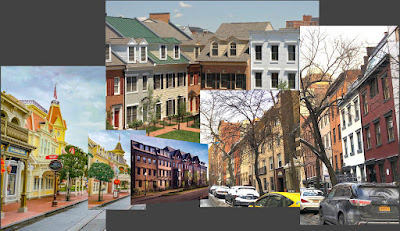
Mixed in with the reestablishments of New York’s well known historic districts, the Disney company will be integrating duplicates of some of its Disney theme park history re-creations like its Disney Main Street (some building may be done by Alexandria, Virginia and Potomac, Maryland Builder/Developer EAY).  The city is expected to benefit terrifically in that the new historical areas that can be visited and the much more efficient way that they can be taken in are expected to be a huge draw from tourists in the future.

Work by Alexandria, Virginia and Potomac, Maryland Builder/Developer EAY
 

Because the reestablishment areas will be evolved with the special Disney touch, thinking and creativity, the areas can be copyrighted.  Said Dr. Kols, Disney’s Director of Historical Affairs, “The old adage that `history is written by the winners’ has the corollary that `those who get to write our history, get to own it, . . ahem, . .  copyright it.’”  “Of course, any such copyright ownership is subject to ‘fair use’ commentary” said Dr. Kols. . . , “as determined by the courts reading our lawyers’ briefs.”

Mayor Eric Adams is exceptionally happy with the proposed demonstration program.  In fact, without Adams the program would not be happening. The program’s legalities would be exceptionally tricky, even likely tripping up on various Constitutional prohibition entanglements, except for the New York State provisions (Executive Law Chapter 18, Article 2-B) that allow Adams, as mayor, to suspend laws and do what he wants pursuant to his declaration of the Covid emergency.  Adams says that if the New York City Public Advocate wants to use his standing to challenge any of his actions, the Advocate will have the opportunity to do so with the statute of limitation for a mandamus challenge commencing with the actions that Adams is taking as of this April 1st.

Wednesday, April 1, 2020

Brooklyn Public Library President Linda Johnson, Now Poised To Additionally Become Head of Brooklyn Historical Society, Says “Following The Money [The Othmer Funds] Convinced Us History Is Too Precious To Be In The Hands Of Those Not Writing It.”

Brooklyn Public Library President Linda Johnson is poised to take on new responsibilities holding her position as BPL head.  It will occur with a merger that will make the Brooklyn Historical Society in Brooklyn Heights a junior subcomponent of the Brooklyn Public Library, which will now assume the role of the “parent institute” of the Historical Society.  This combination was announced by the BPL’s press release, February 27, 2020.

As the plans are solidifying, Ms. Johnson sat down in an interview to describe how the merger plan had come about, and why these plans will be good the BPL’s overall plans and partnership expansions and why it will be good for the history that people will remember.  “Our eye first landed on the Brooklyn Historical Society as an institution that we should attend more to when we were making plans for the consolidating shrinkage plans involving the shrink-and-sink sale of the Brooklyn Heights Library across the street and a few yards down” said Ms. Johnson.  The Brooklyn Heights Library was being replaced by a luxury tower as a result of the real estate deal that Ms. Johnson steered through the BPL.  It was once Brooklyn’s second biggest library, the Business, Career and Education Library and a federal depository library to boot.

Ms. Johnson said that when the BPL was selling that library it needed a small temporary library to replace it for a time until a planned reduced size library could be built under the luxury tower that was planned.  “We considered putting the small temporary library in the Brooklyn Historical Society,” said Ms. Johnson, “we actually talked to them about that.”  Johnson pointed out that the Brooklyn Historical Society is a library itself, which she said might have allowed them to argue the temporary arrangement involved a bigger aggregate book count.  Johnson pointed out that consolidating shrinkages like what the BPL was doing with the real estate deal sale of the Brooklyn Heights library, with its theoretically sending books and functions to the Grand Army Plaza BPL library, didn’t have to involve just an institutional consolidation of BPL or NYC libraries, like with the New York Public Library’s proposed Central Library Plan.

“These consolidating shrinkages can also be inter-institutional,” said Ms. Johnson.  “That’s what we would have had if we had used Brooklyn Historical Society space for the interim library, and it is the kind of thing we are doing where we are moving the Brower Park Library into the Prospect Heights Children’s Museum to reduce the museum’s previously expanded space,” said Ms. Johnson.

Ms. Johnson, smiled, very pleased with herself, as she then got to the subject of the Othmer money, funds left to Brooklyn institutions by a quiet unassuming Brooklyn couple nobody knew had become superwealthy after they invested with their friend Warren Buffett.  Said Ms. Johnson:
We were talking to the Historical Society about these possibilities back when we were making plans in 2013.  Given the timing, we were almost forced to notice then, due to certain commonalities, something else we needed to think about.  The Historical Society was one of the institutions that was among those Brooklyn institutions famously benefitting, receiving millions of dollars, from the surprise bequests of Donald and Mildred Othmer.  2013 was also the mayoral election year when another such institution benefitting from such Othmer bequests was being shutdown: Long Island College Hospital.  With gifts during their lives and then thereafter from the wills of the two Othmers, Long Island Collage Hospital received a phenomenal endowment from the Othmers, more than $135 million.

It would have been impossible to reach that money and make better use of it- so the hospital could be turned into real estate transactions- were it not for that fact that Long Island College Hospital was convinced to merge with a series of other health institutions, first with Continuum Health Partners and then with SUNY Downstate Medical Center.  It involved intricate dealings, but this allowed the endowment funds to be posted as security, something the New York State Attorney General’s office was convinced to pre-approve, (as if they didn’t see what was coming), and
Voilà . . .   
“Real estate deals and no money sitting around going to waste in troublesome ways that might pull towards different priorities!” emphasized David Woloch a Brooklyn Public Library executive vice president and spokesperson who had joined Ms. Johnson to help her with her interview.  “Activists were actually helping to make sure that we didn’t let the connection go unnoticed,” said Mr. Woloch, “because the activists were pointing out the similarity of how libraries and hospitals were both public assets similarly up for sale.”

Ms. Johnson said that money that came into various Brooklyn institutions from the Othmers pre-9/11, in the later 1990s was almost totally unforeseen.  “It came out of nowhere,” said Ms. Johnson, “it was something of a `money bomb.’”   “And when a bomb hits your house throwing things into disarray,” said Ms. Johnson, “you want to do some cleaning up and vacuuming.”  The good thing though said Ms. Johnson is that, while the money came in unexpectedly, it has been a useful tool, a tracer, to spotlight institutions that might need “independence adjustments.”  “That’s certainly true with Historical Society,” which deals with “history,” which is “precious.”
    
Johnson mentioned that when David C. Chang, Polytechnic's president, learned that his engineering school was going to receive more than $175 million- nearly $200 million- from the Othmers he said: “We start from being one of the have-nots and go to being one of the very well-endowed schools.”  The blare of that unusual Brooklyn brightness has since been somewhat adjusted via Polytechnic's subsequent merger celebrated in 2014 with Manhattan-based NYU.

Ms. Johnson also described how things were faring at Brooklyn Botanic Garden, another institution given money from the $750 million estate of a Brooklyn Heights Othmer couple.  And she explained that people should watch for new connections between the BPL and the garden.

Ms. Johnson that, despite the infusion of the Othmer funds, the Botanic Garden’s basic trajectory, including shorter hours, higher user fees and its increasingly privatized closures for fashionable weddings (the BPL also advertises its spaces for fashionable weddings).  She noted that the Botantic Garden had been able to sell off its science research building that was on its outside perimeter.  At the same time, Ms. Johnson said that it is important that the Botantic Garden board has behaved in an amendable and basically welcoming way to the towers and proposed development that, with zoning change reversal, will be set up along its borders blocking sunlight.

Ms. Johnson noted that the BPL will be implementing a plan that gets “gets Oohs and Ahs” connecting the BPL’s Grand Army Plaza central library to the shadier and more pleasant Botantic Garden space.  The GAP library “will connect with Mount Prospect Park to create a Central Brooklyn green campus that includes the library, park and Botanical Gardens.”  Mount Prospect Park is a public park (with the second highest promontory in Brooklyn) which sits between the library and the Brooklyn Botanic Garden.  BPL's plan involves altering space within the library “dramatically opening up the exterior of the library” to facilitate a new restaurant space within the library building that would unfold to include outdoor café space in the park. 

“All in all,” said Ms. Johnson, “I think the infusions of the Othmer money to the institutions in Brooklyn have met the kind of response they deserve.”  Ms. Johnson acknowledged that not absolutely everyone agreed.  It’s known that Dr. Donald Othmer himself drafted much of the meticulous detail for the bequests in his own will and that of his wife Mildred’s.  Warren Buffett, the friend who handled their investments and made them wealthy told the Wall Street Journal, speaking about what happened with the depletion of the Othmers’ Long Island College Hospital endowment, that if the Othmer’s were alive, “I would think...they would feel betrayed.”
                               
Johnson doesn’t see it that way:
We have something called the cy-près doctrine.  It’s a legal concept.  The concept basically recognizes how inappropriate, essentially impossible it is for dead people to rule from the grave.  The dead don’t know what is going to be what after they die.  Lots of things are going to be unexpected and unforeseen.  The cy-près doctrine dictates that instead of doing what dead people wanted, you should do what you know dead people would have wanted if they had known better.  For instance, do you think the library systems could ever be doing everything they are doing in terms of turning libraries into real estate deals, providing a venue for society weddings, exiling books, and cutting back to much shorter hours, if they had to do exactly what dead people who made the donations to set up the libraries wanted?
Johnson said this was an especially important concept when it came to how precious the possession of history is.  History, she maintains, is too far too precious not to be kept in the hands of those who are supposed to write it.  Ms. Johnson said that was why it was so important for the BPL and the Historical Society to combine into a single unit for historical record custody.  “The history of the last several decades is one that I am proud to be a part of,” said Ms. Johnson, “The overarching truth to that history is that it has been a history of the victories of privatization– I’ll remind you that it’s axiomatic that history is supposed to be written by the winners.”  Ms. Johnson said that as Churchill knew history is to be written by those that command the reins of power.  As Churchill is famously quoted: “History will be kind to me, for I intend to write it.”

Ms. Johnson said that it was relatively easy for the board of the BPL and the board of the Historical Society to reach agreement about the merger.  “We’re mostly all the same kind of people,” said Ms. Johnson, maybe there is one person on the BHS board who cares about the previous old fusty ideas that people used to promote about what history is, but basically, Ms. Johnson said the BHS board, like the BPL board, is a complement of the kind of people who know what needs to be written and preserved in terms of history: corporate lawyers (good at things like white collar defense for those charged with accounting fraud), mega-bankers and some real estate people.  “Nevertheless,” said Ms. Johnson, “we can improve through the merger and have better control; our BPL board composition is more refined and fine-tuned in terms of what it needs to be in ensuring everything reflects the private partnership goals and this to be respected.”

Ms. Johnson offered an example of what it means to be keeping things on track or not in terms of history that needs to be written.  Recently, Brooklyn For Peace donated its archives to the Historical Society,  over 25 linear feet of organizational records, event ephemera and recordings, and subject files dating back to 1983.  “This is the kind of history people want to write?” scoffed Johnson, Brooklyn For Peace has been around since 1983/1984— If history is supposed to be written by winners, how does that work?  We have more wars now than ever.  These people are real losers!  These space usurping records are prime candidates for culling.”
 
Similarly in the vein of what makes good historical fodder Ms. Johnson spoke of killing two Othmer birds with one stone: the BHS might also remove records that showed that there were once plans that the 500 beds of LICH were to have been used as a designated isolation hospital in the event of a pandemic.
   
Ms. Johnson said she could anticipate acquisition of the Historical Society would be a boon for all sorts of goals important to her.  She said the beautiful landmark building the BHS was in would be another great place for wedding and society events without her people eager to mingle at such events needing to Uber any further than Brooklyn Heights.  People would not have to go to Grand Army Plaza.  She noted that the New Times had already let the news out that the plan would start “with the eternal New York City preoccupation” of managing all the real estate dollars that could be involved.  Ms. Johnson noted how, in connection with the revealed merger, the BPL has pronounced itself to be “on a space grab,” but that the BPL had not yet decided to characterize this as actual space growth or part of its demonstration of its flexibility exercises allowing it to jettison space.  Mr. Woloch opined that the BPL could always go back and forth on these characterizations; that there was no need lock itself in respecting these things.  He noted that the BHS space might, for certain purposes and at certain times, be nominally cited as an ancillary part of the library space to be tucked nearby David Kramer’s luxury build replacing the Business, Career and Education library.

As Brownstoner notes, important to the “timeline for the merger,” will be necessary that the BPL and BHS are currently having discussions “with the City of New York regarding funding necessary for combining the institutions.”  This is obviously important with respect to Othmer endowment funds has BHS converts into joining the city’s family of libraries and its tradition of creatively underfunding them.

Ms. Johnson said that there would be no “sweeping changes,” respecting the BHS mission, but that she was particularly eager to take on and engage in a “rebranding” for the BHS with a new “less  fusty-sounding” name to proclaim the BPL’s ambition for everyone to understand that the institution would be democratically opened up.  “It used to be even more fusty-sounding,” said Ms. Johnson, “The Long Island Historical Society.” Ms. Johnson said, “when we took the Business and Career Library out of Brooklyn’s downtown, we updated the name; we now call it a `center,’ the `Business Career Center’; we dropped the fusty-sounding `L-word.”  Johnson said “center” sounded modern and distinguished it from the “Commons,” the “Leon Levy Information Commons” that it is above and from which it will be otherwise indistinguishable.

Johnson said the “rebranding” should also make use of some more of the naming rights that the private partnership building the BPL has been engaged with allows, like the BPL’s partnering with the Nets and the Barclays Center celebrated at its last gala in May 2019 where the Nets and Barclay’s center were honored.  “If we put the name `Barclays’ on the landmark Brooklyn Heights building that rules out calling it another ‘center’; you can’t have two ‘Barclays Centers,’ in Brooklyn” said Johnson, “but we might call it something like the ‘Barclays Historical Information Outlet,’ then it would be distinguished and not fusty-sounding at all.”

Ms. Johnson said that she wanted to point out the overall pattern of convergences that she said the merger of the BHS into the BPL was just a one incidental part of: Libraries are also being subjected to consolidating shrinkages while the library is also essentially merging with private sector interests though its private-public partnerships.  She described the converging as going in the direction of a “supremacy singularity.”  Ms. Johnson proudly pointed out to how this convergence even extended to her own personal life and how she was now living in her own personal partnership with Forest City Ratner’s Bruce Ratner, a personal partnership that paralleled the BPL Barclays/Nets partnership.

Ms. Johnson opined that Bruce Ratner was a great man who had contributed mightily to the history of Brooklyn.  She said that people had actually called the struggle that Bruce Ratner’s won to bring Atlantic Yards and the Barclays Center to Brooklyn the second “Battle For Brooklyn.”  Ms. Johnson said there was too much Brooklyn history that the Brooklyn Historical Society had not covered adequately.  She said that this would start to be remedied in a year’s time when the merged BHS would mount a major exhibition of the writings that Churchill created about what a great man he was.  “It is time that people realized Churchill’s intimate connections with Brooklyn,” said Ms. Johnson.  His mother, Jennie Jerome, was an American, a Brooklynite born in 1854 just blocks away from the landmark BHS building, 197 Amity Street, in 1854.  She said the exhibit would be in two parts, the second part drawing parallels between Churchill as a great wartime leader and Bruce Ratner fighting to bring the future to Brooklyn. 

Ms. Johnson said that the exhibit was slated to open in a year, on the first of April 2021, which was why it was being announced today, April 1st 2020.
PS: The shrunk-and-sunk library space that will be in the David Kramer’s luxury building at the sight of the former Business, Career and Education Library is next to and part of the same zoning lot, real estate development parcel as Forest City Ratner’s One Pierrepont Plaza. The underground BPL library parts can connect to the underground Ratner building parts.  The BHS has its own underground parts that are just a few feet away underground from the Ratner building.  The Ratner organization has been excellently adept at acquiring, through political machinations, private ownership of public streets adjacent to its properties.  The Ratner organization is now looking at doing that for the street between it and the BHS building.  If it succeeds (and it may join the buildings with an underground tunnel), it would put the air and development rights to the BHS building in play as part of the Ratner development and zoning parcel.