The power elite of Brooklyn Heights may be about to conclude that having prevailed in a very important battle they are about to lose a more critical, much bigger war. Noticing New York has previously written about how, during the planning of the design for Brooklyn Bridge Park, it became a fundamental precept that views from the Brooklyn Heights promenade would consist of bucolic and green vistas* and that all the planned development associated with the park would be aggregated into concentrations of bulk and density to the immediate north and south. This had the effect of preserving, undisturbed, the tranquility and breadth of the harbor views enjoyed by the expensive homes along the promenade. This is what the influential Brooklyn Heights Association fought for, and perhaps, not by coincidence, it may be noted that many of those individuals connected with and having a powerful sway over that organization live in those homes. (See: Monday, May 24, 2010, Looking a Gift Horse in the Mouth? An Examination of Brooklyn Bridge Park in Terms of the Politics of Development, Part I and Part II.)
(* It should be noted that while these park areas will be sylvan and pristine to look at, the park design presents an unresolved problem about how noisy they will be for those strolling around in these stage sets replicating a natural setting because the highway noise from the BQE will be bounced directly into these closely adjacent areas.)
Now it turns out the views once thought to have been ensured by such careful negotiation by the Brooklyn Heights Association soon stand to be lost. As one more of the many gifts Mayor Bloomberg intends to bestow upon the real estate industry before he leave office (which critics are referring to as a fire sale), Bloomberg and his administration are implementing a plan proposed by Vishaan Chakrabarti, the head of the Center for Urban Real Estate at Columbia University, to landfill and connect Governors Island to Lower Manhattan. See: The Brian Lehrer Show, LoLo: Imagining New New York, Wednesday, December 14, 2011 and New York Times, Visions of a Development Rising From the Sea, by Julie Satow, November 22, 2011.
Click below to hear what is planned to be implemented discussed on the Brian Leher show.
Mr. Chakrabarti was well qualified to spearhead the Bloomberg initiative by making the proposal now being implemented: He is a former director of the Manhattan office for the Department of City Planning and before taking up his position at Columbia he was, according to the Times:
an executive vice president at the Related Companies, the large developer, where he helped oversee the Hudson Yards project and the redevelopment of Moynihan Station. He still serves as a consultant to the company and continues to advise on the projects.
He moved to the position at Columbia to finalize and release the proposal* because, according to Bloomberg spokesperson Marc La Vorgna, as an academic institution Columbia is above the fray and can be counted upon to exercise impartial good urban planning judgment since it is not connected to the “pull of real estate industry interests and the recognized attraction of the lucre that industry generates.”
(* Chakrabarti trial-ballooned his idea in November 2011 roughly the same time that Brooklyn Public Library Head Linda Johnson similarly trial-ballooned her proposal in October to sell off libraries from the system with an accompanying shrinkage of the system and underfunding to justify the proposal.)
The Chakrabarti plan is viewed as a simple and logical extension of the New York City’s historic pattern of growth through landfill extensions of Manhattan. However, for reasons Mr. La Vorgna went on to explain, this is not being viewed as an extension of Manhattan to include Governors Island, but instead an extension of Governors Island to include Manhattan.
Notwithstanding, the new real estate created will be called “LoLo” which stands for Lower Lower Manhattan which Mr. Chakrabarti said market tested with realtors very well, much better, he said, than “HiGo” or “GIGUp” which would be, respectively, “Higher Governors” or “Governors Island Go Up.”
The Municipal Arts Society, the group formed as watchdog for good urban design, is thoroughly on board with the proposal, one reason that Mayor Bloomberg felt confident about proceeding with it quickly. Said Vin Cipolla, president of the Municipal Arts Society, as quoted in the Times:
“Vishaan is thinking globally. . . and is unabashed about looking at the kind of things that will move regions like ours forward.”
The trustees of the Brooklyn Heights Association, however, have announced that they are quite chagrined that the views from Brooklyn Heights and the famous promenade will now involve seeing much less of an expanse of water and that tall towers will soon be crowding inward as the East River is constricted down to narrow northern extension of what is known as Buttermilk Channel, the waterway that now flows between Brooklyn and Governors Island.
The zoning that will apply to the towers will be the new-stye, greater-density zoning being implementing around the city, similar to the Mid-town rezoning Bloomberg wants to put through, also before his term is out. The Mid-town rezoing will permitted density in a swath around Grand Central Terminal that will be nearly double what is there now.
The BHA trustees sad that they had been aware that the Bloomberg administration has been engineering a number of give-aways to the real estate industry on its way out, including the: sales and shrinkage of the library system’s assets, sale of schools to developers and, similarly, the sale of the public housing playgrounds as sites for luxury housing. Nevertheless, their spokesman said while the BHA trustees were not opposing these things, not even the sale and shrinkage of the Brooklyn Heights library with the underfunding of the entire library system as a prelude to that, they had not expected that Bloomberg would be taking any action in his give-aways that would affect anything that they actually cared about. This new move by Bloomberg, they said, was truly shocking.
In the fall of 2011 the Times said that the major impediment to the project was “there are strict regulations on building with landfill.” That problem has been neatly sidestepped, obviated by clever engineering by Bloomberg officials during the waning days of Governor Paterson’s administration when, in a little-noticed maneuver, Bloomberg was handed exclusive jurisdiction over both Governors Island and Brooklyn Bridge Park, using a structure the interposes Bloomberg owned and controlled corporations created by the Empire State Development Corporation. This gives Bloomberg the power to proceed without any involvement from the City Council. It also invokes all of ESDC’s exemptions from zoning and any such troubling regulations.
It is for this reason that Bloomberg is proceeding with this project as an expansion of Governors Island and not Manhattan. Bloomberg released a statement disclosing that he has a legal opinion joined in by both the City’s Corporate Counsel’s office and lawyers from Bloomberg, L.P. that any part of the expanded Governors Island will be under Bloomberg’s corporate control. The opinion says that when landfill makes the final connecting link to Manhattan, so that the circumference of Governors Island can be described as including that island too, Bloomberg’s jurisdictional control can be considered to expand accordingly. The opinion also indicates that the authority will be personal to Bloomberg rather than residing in the office of mayor.
Otherwise unprepared and unmobilized to fend off such a previously unenvisioned eventuality, the coalition of Brooklyn community groups represented by Brooklyn Speaks and Develop Don’t Destroy Brooklyn ventured, ad hoc, to speak for Brooklyn residents on this matter as well, even though that was not the purpose for which their coalitions were originally formed. “This is another arrogant land grab!” they said in a hastily prepared joint press release.
“This is no land grab,” huffed the mayor’s spokesperson, “this is a water grab!”
The proposal presents extreme engineering challenges but these have been thought through and anticipated by the Bloomberg administration. The new land bridge would divert 11,375,177,142 gallons per hour from the shipping channel, about 11.4 billion gallons per hour diverted into the already 3 knot flow of Buttermilk Channel. Before the land bridge was completed a sizable portion of that immense flow would be flowing through the current shipping channel that the land bridge would be in the process of damning up as it was filled. In addition, an extension of subway service would have to flow to Governors Island and the new land with the new subway tunnel challenged by this immense fast flow.
If the fast-flowing waters washed away silt, unburying the subway tunnels there is danger the buoyant tunnels could float to the surface. Things might be especially precarious in the event of another storm with strong tides like Superstorm Sandy.
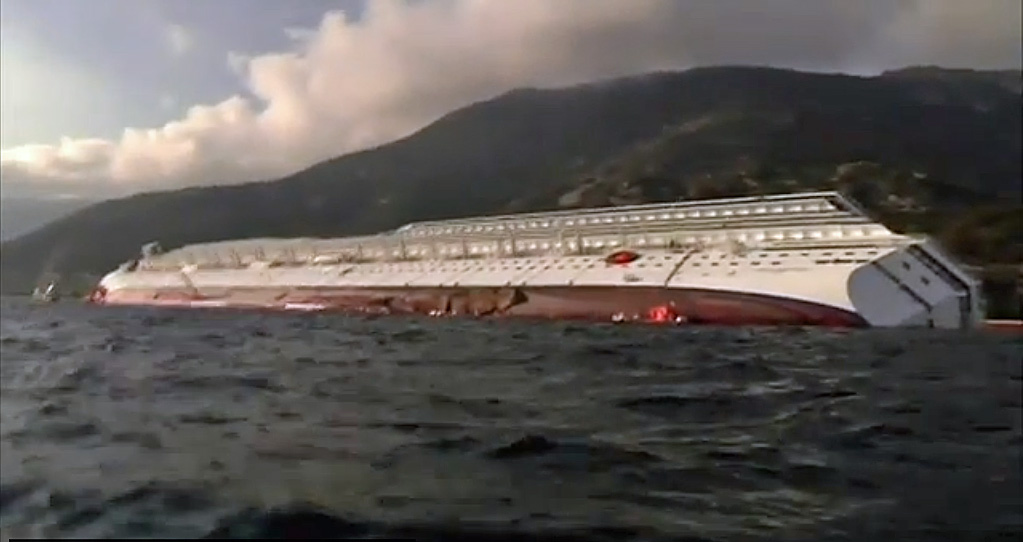
Costa Concordia
Part of the inspired engineering answer is that Bloomberg administration is buying the salvaged hulk of the Costa Condordia, the Italian cruise ship that ran aground at Isola del Giglio, Tuscany, on January 13, 2012. New tunnels will be run through the ship’s body. Meanwhile, a world-wide surplus of shipping tankers has tremendously reduced the cost of adding other ships to the chain.
Bloomberg says, however, he may be thinking bigger than that. He noted that the recently built Oasis of the Seas is five times the size of the Titanic and that it was built to give its 6,300 passengers the opportunity of having “a Coney Island kind of experience” with a “boardwalk” neighborhood with an ice cream shop, a doughnut shop, a life-size carousel with horses and tigers and rabbits, all of which were hand-carved for the ship. The Coney Island area of the large ship may actually be larger than the original Coney Island that the Bloomberg administration has shrunken down.
According to the Bloomberg press there could be great advantage to buying the Oasis of the Seas for incorporation into the land bridge in several respects. Coney Island could be moved closer to Manhattan. It would free up the land out at the old Coney Island for development. It has always been a problem that the attraction of the outdoor amusements at Coney Island was seasonal so there would be an advantage to moving them inside a ship. Lastly, buying the ship would clear up any dispute about who owns the licensing rights to Coney Island: “Coney Island was never just land or a neighborhood, or a community,” said Bloomberg, “it’s a spirit that can be trademarked and licensed. This helps us lock that license up.”
Bloomberg also said that exclusively buying cruise ships for the linkages allowed for the possibility of maintaining and continuing over in the conduiting transit pipes the stratification features for different classes incorporated into the ships' design. Said a spokesman, “We are alert for how any of this could work like a substitute for congestion pricing.”
The final thing noted in the press release was that almost all cruise ships have small libraries. The Bloomberg administration might keep some of these libraries in place and functional as a replacement for the libraries it is selling throughout the city, including the Central Reference Library behind the lions Patience and Fortitude at 42nd Street in Manhattan where Bloomberg wants to rip out the research stacks this summer in furtherance of the planned sell-off of real estate to developer beneficiaries.
These ship libraries are very small, much smaller than people have been used to, but the libraries will all be along easy-to-get-to subway lines and libraries these days don’t have to be “anywhere as big as they were in that past,” says Bloomberg:
“. . . because people don’t need to know as much as they used to. Today we have press releases. And the beautiful thing about press releases is that they can always be updated to tell people what they need to know today, instead of allowing them to get confused with what they might accidentally remember from yesterday.”
Given what things have come to in this city as we arrive at this first day of this spring month, what is truly extraordinary is that so much of what was once might have been presumed to be fanciful is actually absolutely true. Check it out using the links supplied.
(Above: Michael R. Bloomberg has created a plethora of self-laudatory faux websites, "Mike.com, "Mike.org," and "Mike.gov"- more about that here. It seemed fitting that one more be added to that Pantheon, happily supplied by NNY above, in light of recent news stories: "Mike.mismanage.gov". Click to enlarge.)
Come on, quit it. Enough already. I am not looking to do another Noticing New York story on this. But, here it is. It can’t be avoided. Noticing New York has some new links for you.
If Bloomberg is supposed to have brought any expertise with him from the private sector other than self-salesmanship it would theoretically be that he knows how to manage a computer information empire. And if Bloomberg were to push anything to the forefront for consideration and public admiration about the top priorities and goals focused on by his administration it would likely be improvement of the city public school system.
Computers, schools.
It seemed as if Noticing New York had adequately dispensed with the subject of how inadequately the Bloomberg administration was doing in these touchstone areas, computers and schools with several pieces in the wake of two scandals recently in the news: the early forced resignation of Schools Chancellor Cathie Black and the $80 million fraud in the CityTime payroll and time sheet computer automating scandal where some of the core of fraud ironically involved falsification of time sheets.
Another Story Computer Fraud (Affecting Schools) Undetected By Bloombergian Management
No sooner had these articles put to bed what ought to have been a convincing case that Bloomberg overrates his own expertise when we get yet another revelation in this vein. And what does it pertain to? You got it, computers and schools, specifically another fraud during the installation of a new computer system, this time one for the city school system. Again it involves work that was contracted out to the private sector. According to the New York Times whose headline for their coverage was a summing up of this point, the work being done seemed suspicious to those on the sidelines (IBM contractors) as far back as 2002, a date when Bloomberg was newly in office and reportedly giving great scrutiny to the city computer systems (January 2002) and schools (March 2002). Selections from the opening of the Times story:
Sometime in 2002, a manager at I.B.M., which was working on a large project to wire New York City schools for the Internet, noticed something unusual about payments the company was making for some workers.
The manager asked a colleague if this was proper . . . The colleague said others at I.B.M. were also concerned, with one saying he “did not trust Lanham.” But Mr. Lanham . . . assured I.B.M. that he had spoken with a supervisor at the Education Department, who “was O.K. with it,” and the matter was taken no further. . . .
It was the first of several warning signs about Mr. Lanham, whom investigators have accused of stealing $3.6 million from the city through marked-up billings using a complex scheme of contractors and subcontractors . . . .. But because of Mr. Lanham’s unchecked power over the project, which the city was paying him $200,000 a year to oversee, virtually all of the suspicions came to naught.
It seems appropriate that Noticing New York provide an update. But it is also helpful to hearken back to put it in context because, otherwise, the busy reader might just wind up thinking they were reading the same story over again- “Oh, yeah, yeah, I’ve read that one already.” But you haven’t read this one before and while it's similar and amounts to piling on of more of the same, it’s a different story, something you might not realize from glancing over the Times Story or its headline until you get to this language buried in the middle:
The case, which comes on the heels of an $80 million fraud prosecution involving consultants on another city project, the CityTime automated payroll system, illustrates again the vast amounts of money the city is spending on technology, and the trust it was putting in independent consultants.
The Times story neglected to mention that these scandals are both in the area of the mayor’s vaunted expertise, computer data system management.
Policing the Police With Computers
Meanwhile, the Bloomberg administration is reassuringly selling computerization as the cure for the Police Department ticket-fixing scandal in the news the last few weeks. (See: April 22, 2011, Bloomberg Says Computers Will Cut Ticket-Fixing, By Diego Ribadeneira.)
And One More Story of Waste and Inefficiency Involving Bloomberg Bringing Computers to the City Schools
The foregoing stories about Bloomberg’s failures with respect to computer data system management also have to be distinguished from this other new story from WNYC, again involving a computer data management system for the city’s schools: Bloomberg By the Numbers: $80 Million School Data System Still Evolving, Thursday, March 24, 2011. Although this account involving “ARIS” (the Achievement Reporting Innovation System) doesn’t involve allegations of fraud it does involve allegations of disappointing waste and inefficiency.
Here’s how the WNYC report begins, together with a few excerpts from what ensues:
If there's one over-arching principle Mayor Michael Bloomberg has brought to city government, it's accountability through data. If you can measure something you can manage it better.
In 2007, the Bloomberg administration launched a new computer system for the city schools called ARIS, the Achievement Reporting Innovation System. The goal was to put information about test scores, attendance and student histories all in one place to help principals and teachers do a better job of reaching their students and improving performance. But the $80 million system hasn't yet achieved its full potential — even at schools that use it heavily.
* * * *
If ARIS is struggling to keep up with changing demands of teachers, that's partly because it had a difficult roll-out. IBM had to turn over most of the work when it fell behind schedule. The project was handed over to a subcontractor, the Brooklyn-based Wireless Generation (now owned by Rupert Murdoch's News Corp, which also hired former Chancellor Joel Klein as a vice president for educational technology).
Sources said this wasted time and money. Plans to make the system more user-friendly for teachers to share information with one another got put on the back burner and so were plans to allow more regular updates of school-by-school data. But Suransky said ARIS should be able to add some of those features in by the fall with a feature called ARIS Local.
Troublesome Focus on Management by Troublesome Statistics
If you spend time absorbing the whole report (which is not all negative) you can form your own impression of whether Bloomberg’s constant emphasis on “data” and computerization makes managerial sense. It is possible that all this technology can just be a wall between real people and that in education the answers are really more about how real people interact with each other.
Also, sometimes Bloomberg data is just wrong and self-serving even as it goes unquestioned. Consider his statistics about the presumed growth of the city, or this respecting the Bloomberg administration’s statistics on: 1.) school test score improvements, 2.) addition of affordable housing units (as many were being lost as created), 3.) the lack of job creation and quality job creation, and 4.) police statistics. (On the presumed growth of the city see also this excellent piece summarizing a Francis Moronne Historic Districts Council address from Atlantic Yards Report: Friday, April 29, 2011, PlaNYC 2030, the questionable estimate of 1M more people, Morrone's history of erroneous NYC predictions, and the preservation movement.)
Bloombergian "Start From Scratch" Grandiosity
When you are questioning the reliability Bloomberg’s management expertise and the extent to which his statistics reflect a real world versus Bloomberg’s desire for an exulting edifice-complex oriented headline, the statement the in the Times about Bloomberg’s “big push” for an applied sciences school (“envisioned as one of the largest development projects in the city’s history” - What? Bigger than the Atlantic Yards mega-monoploy handed to Bruce Ratner?) has more ominous resonance:
William A. Zajc, chairman of Columbia’s* physics department, said the idea for an applied sciences school was a “field of dreams venture.”
(* Is this gripe just because Columbia doesn’t want competition for its takeover of West Harlem?)
Critics have deplored the city’s willingness to offer incentives at a time of economic distress.
* * * *
“In a period of economic crisis, when we are so tight with our budget, we should not be giving incentives to private institutions,” City Councilman Ydanis Rodriguez of Manhattan said.
* * * *
The idea is one of the more imaginative proposals to come out of Mr. Bloomberg’s City Hall, but it may also be among the riskiest.
* * * *
Some have faulted the city for not clearly articulating how it might recover some of its investments if the school does not turn out to be the economic engine that the mayor expects.
The Times story also includes criticism that the mayor should, instead, be thinking in terms of deploying the city capital (“the city has pledged to offer capital [$100 million or more] and public land”) to build upon and expand existing resources and programs rather than these grandiose plans to “start from scratch” which NYU’s proposal to the mayor dares to criticize:
“A ‘start from scratch’ approach that parachutes a new player into New York without the requisite ingredients that lead to success has the potential to be a waste of resources.”
Willlets Point, Atlantic Yards, Coney Island, even the Columbia expansion into West Harlem (potentially competing with the mayor's applied sciences school vision): Where else have we been hearing about the mayor’s intoxication with wiping the slate clean in order to “start from scratch” before building anything?
Yet, as the Times story notes, “Mr. Bloomberg has taken a strong personal interest in the project, embarking on a campaign-style effort to lobby university leaders and business executives” for his start from scratch approach.
Maybe Bloomberg is not serious about this new proposal. Maybe it is just that talking about parachuting “a new player into New York” just gives Bloomberg a better chance to roam around the country talking to power players on the national stage as he toys with the idea of replacing Donald Trump as the multi-billionaire Republican candidate to challenge Barack Obama in the next presidential election.
Net Net: When you read the Bloomberg stories in the news, they all have to be remembered and read together.
(Above, form the New York Times: A map drawn by Steve Lanset and Ralph Braskett showing their plan for an extension of the No. 7 subway line to Secaucus, also available on their website.)
Just out is the news that the Bloomberg administration is considering a further extension of the Number 7 subway sine all the way to New Jersey as a replacement for the proposed trans-Hudson ARC railway tunnel that New Jersey Governor Chris Christie just killed. Christie killed the ARC tunnel theoretically to save money even though:
. . . the ARC tunnel is a mass transit project that represents the creation of the kind of critical big-scale regional connections (like the Erie Canal) that have been an essential factor in the growth of our metropolis. The Times also writes about how the project was supposed to “provide jobs for 6,000 construction workers” and “raise property values for suburban homeowners.” In other words the ARC tunnel is the kind of mass transit infrastructure project that equitably confers benefit widely and stimulates development throughout the territory.
Extension of the Number 7 subway line to New Jersey is an exciting idea to think about although its serious contemplation is so new that it has not yet received the vetting of valuable, nay essential, public debate. The key to making it attractive is that it would be cheaper (it’s hoped) than the ARC tunnel. That’s because starting at 11th Avenue and going west from there, (rather than the Penn Station/Macy’s location between 7th and 8th Avenues) it would avoid “the costly proposition of boring a tunnel under Manhattan to Herald Square.” * (See: Mayor Bloomberg Explores Extending Subway to New Jersey, November 16, 2010, by Andrea Bernstein.) Further: “The line would also instantly take riders to Grand Central station, a holy grail of the ARC project” though commuters would have to switch trains in Secausus. The switch means there will be time lost in what will not be a “one-seat ride.”
(* At about “half the cost,” $5.3 billion, according to a supposedly “closely guarded,” (?)- now widely quoted- four-page Hudson Yards Development Corporation memorandum to which New York Times reporters got access.)
Extension of An Extension
For those who are not following closely, service on the Number 7 line currently goes as far west as Broadway and 7th Avenue at Times Square but, partly in preparation for the development of the far West Side and Hudson Yards, new tunnels extending it are in place all the way to 11th Avenue and considerably south from there. Those tunnels are expected to be put into service fairly soon in infrastructure-time terms. (See image from the New York Times on side: Click to enlarge.)
Official Acceptance of an Idea Taken Out of The Gift-Wrapped Box Community Activists Presented It In
It would be particularly thrilling to see the idea implemented because, according to a story in today’s New York Times, this idea, like the creation of the High Line, was one that officialdom first rejected and ignored when it was identified and promoted by grassroots members of the community. (See: Extend a Subway Line Under the Hudson? For Two Men, It’s Hardly a New Idea, by Patrick Mcgeehan, November 17, 2010.)
The Times reports about how two collaborators, Steve Lanset and Ralph Braskett, had set up a website (Subway to Secaucus) to promote the idea of such a subway line extension for which they received a lot of “abuse” and “very little praise.”Now, according to the Times:
On Wednesday, Mayor Michael R. Bloomberg attributed the idea to recent “thinking totally out of the box” by Robert Steel, his new deputy mayor for economic development.
We gather from this that in the Bloomberg administration “thinking totally out of the box” constitutes listening to community suggestions. Paging Jane Jacobs: She would have gotten such a good guffaw over this one. What is it about the far West Side? Where does it get its mojo that initially rejected suggestions by community activists would finally have been listened to twice in such quick succession: First the suggestion to create the High Line, and now this extension?
They Could Do It Again
If the Bloomberg administration wants to listen there are plenty more community activists willing to offer “thinking” that is “totally out” of the Bloomberg administration’s “box.” The Coney Island community is suggesting that many more amusement area acres be preserved at Coney Island* along with historic buildings that define the area’s heritage. And wouldn’t it be nice, as activists suggest, to see the sun and feel the sea breeze when arriving at the Coney subway station? Then there is the community’s UNITY plan for development of Vanderbilt Yards where, instead, the Bloomberg administration is allowing free rein (free reign?) to the developer-centric notions of Atlantic Yards developer Bruce Ratner that he should have a 30-acre, 40-year mega-monopoly. Among other things the UNITY plan calls for the development of this area to be split up and properly bid out to multiple developers. Back to this thought momentarily.
(* If more acres were preserved maybe historic boardwalk businesses would not now be getting evicted. In our eyes, recent Coney evictions proclaim that the amusement district was made too small, given that there is no space to share with authentic Coney Island history. And what sense does it make in terms of “economic development” to throw out time-tested and resilient businesses in the middle of an economic recession? A petition on the subject available here.)
Secaucus 7 or The Big Chill?
Some cold water is being thrown on the idea of the extension. It is put forth mainly in terms of whether the kind of federal funds mustered for the ARC tunnel could be redirected to such an extension. (See: Experts say plans to extend 7 line subway to New Jersey are a dead end, feds won't fund it, by Adam Lisberg and Pete Donohue, Daily News Staff Writers, November 18th 2010.) That criticism seems potentially surmountable while not addressing either the basic practicality of the suggestion or the essence of its merit. It might also be wondered whether the highway lobby would like people to believe that these funds can’t be redirected this way because they would prefer that funds be rerouted into automobile-related subsidies.
If, ultimately, upon debate and reflection the idea remains a good one and can be effected, it appeals to us on principle. Noticing New York favors an “infrastructure first” investment in mass transit. In particular, because of the broad benefit it affords and development it encourages, investment in infrastructure is to be favored as an approach to stimulating development that is superior to direct subsidies to private developers for projects they will privately own . . .
. . . There is just one big Oops associated with the proposed new plan for this subway extension and that is not with respect to what the city envisions doing going forward: It is with respect to what the city has already done. It has to do with the inadvisability of mega-developments.
The Inadvisability of Hudson Yards (and Other Development) as Mega-development
We have written before about reasons it was ill-advised to develop Hudson Yards as a one-developer mega-development. The principles also apply to other proposed mega-developments such as the 30-acre, 40-year Atlantic Yards mega-monopoly and the approximately 75-acre Willets Point single developer concept.
• “Retailing” parcels increases developer bids, increasing funds the public will collect
• The absence of economies of scale for megadevelopment
• Avoidance of the four “M”s: Megadevelopment, (Mega-) Monopoly, Monoculture and Monotony
• The benefits of keeping the role of government and developers distinct when it comes to the provision of infrastructure (it should be the government’s job), particularly as it relates to working within economic cycles and the investment of stimulus to spur the economy in bad times.
Taking the last point first, it was easy to point out with respect to Hudson Yards:
If the government (as opposed to a private developer) was preparing the site it would not be necessary to postpone the site’s preparation at this time. Site preparation during the current economic downturn might even be cheaper. As it would be a public work, it would arguably be in the running for funding through federal stimulus, an important part of that being that the prepared parcels would later be bid out. But stimulus money cannot be given to a private developer already signed onto the deal because it would totally change the equation based upon which the developer bid to pay the public a low amount for the site. Used that way, the money would eliminate the risk developer assumed and constitute an award of enormous private benefit to the developer without bid.
In other words, if the city hadn’t farmed out all of Hudson Yards as a 26-acre mega-deal (which the city had to restructure for the developer’s benefit, see: Tuesday, April 27, 2010, Surprised? MTA Restructures the Hudson Yards Deal; Developer Cherry Picks More Benefit While Public Keeps the Risk) the city would have maintained substantially more latitude to deal fluidly with the economic crisis. Further, if the city had then stepped in to invest in the infrastructure associated with developing Hudson Yards, then New York citizens would have recouped a much greater amount upon a retail selling off individual parcels to multiple developers. Conversely, doing what it did- giving up its rights to the acreage first-, the city set itself up for a problem: If the city invested in infrastructure after already having sold these 26 acres to a single developer it would, as we wrote, “constitute an award of enormous private benefit to the developer without bid.”
Adding An "Extension" to the Concept Just Expressed
What we didn’t foresee when we wrote about there being an “enormous private benefit to the developer without bid” if the city invested in infrastructure after having already sold these 26 acres to a single developer was this new proposal to extend the Number 7 line.
This proposed extension is just such an investment in infrastructure, and guess what?: The developers love it.
How joyously are developers about embracing the concept of this new infrastructure? The rather developer-oriented Crains had a whole story devoted to it. We provide quotes below, beginning with its first paragraph:
A proposed expansion of the No. 7 subway line into New Jersey would be a boon for New York City real estate developers.
* * * *
“Every developer I've spoken to thinks it's a terrific, simple idea,” said Steven Spinola, president of the Real Estate Board of New York. “They all think it will be wonderful.”
This was part of the Times article announcing the idea (emphasis added):
And the project would almost certainly serve as a boon for the planned $15 billion Hudson Yards residential and office development, to be built on platforms over the West Side railyards. That project has been stymied by the recession and an absence of demand for new residential and commercial space.
The embrace by developers of the idea’s obvious benefit to them was also being discussed by WNYC reporter Andrea Bernstein (and director of the Transportation Nation blog) on Brian Lehrer yesterday. Available at: The Brian Lehrer Show, Subway to Secaucus, Wednesday, November 17, 2010.)
The Big Oops on the Extension
What does all this developer enthusiasm about the extension of the Number 7 line mean? It means that in a world where this potentially ingenious plan goes forward there would be one more very significant reason why the city and the MTA could have gotten a lot more money and a lot better deal had the 26-acre Hudson Yards property been retained and sold to multiple developers as individual development parcels after the area’s infrastructure improvements were made. That option is now precluded because the Bloomberg administration, as is its bias, elected instead for a mega-development, mega-monopoly transfer of the property.
(Above, the September 16, 2010 storm passing over Manhattan.) Get ready: This is going to be about New York and the environment in some very, very big-picture terms.
A Brooklyn Tornado, A First!
“Jeffrey M. Warner, a meteorologist at Penn State University, said that the tornado was the first one to hit Brooklyn since at least 1950, when modern record-keeping began.”
Was Mr. Warner talking about the September 16, 2010 tornado that tore through Park Slope with its sister storm taking a slice out of Flushing, Bayside and Forest Hills, Queens? Perhaps1000 trees were uprooted around the city in a few swift minutes, cars were crushed and a woman in one of those cars was killed. (An initial report by the Times cited an estimate by Adrian Benepe, the city’s parks commissioner “that as many as 2,000 of the 650,000 street trees had been killed or else so crippled that they would have to be cut down.”)
(Above, one of the exceedingly large trees that went down in Prospect Park during the storm. In Prospect Park alone, according to the Times: “40 trees went down, and almost 130 others were badly damaged.” Prospect Park was constructed 1866-1873. Might this old tree have gone back that far?)
Seeking Historical Context on the Weather
No, Mr. Warner, the Penn State University meteorologist, wasn’t talking about this month’s storm when he was identifying the first tornado “to hit Brooklyn since at least 1950, when modern record-keeping began.” The purpose of this article talking about the weather is to put things in a bigger historical (and possible future) context and we are quoting Mr. Warner for the purpose of doing that. Mr. Warner was talking about the August 8, 2007 tornado and storm that “raged through Sunset Park and Bay Ridge, ripping the roofs off five brick rowhouses, yanking thick trees out by their roots, turning cars sideways and shattering countless windows.” That means that in the last three years, on separate late-summer occasions, we have actually had the first TWO Brooklyn tornadoes since “modern record-keeping began."
In 2007, the Times reported how that first Brooklyn tornado “forced the evacuation of 20 buildings,” damaged another 50 buildings, killed one woman, involved 100 to 200 cars being smashed or hit by trees and was “the third time in seven months that a sudden downpour had brought the transit system to its knees.” Mr. Warner had more historical context about the unusualness of the weather:
It was the first tornado to hit New York City since 2003, when a weak tornado touched down in Staten Island, and only the sixth tornado recorded in the city since 1950, Mr. Warner said.
Welcome to the effects of global warming? There’s a good likelihood that’s what’s going on. While the United States has more tornadoes than any other part of the world, the conditions that make the Midwest ideal for their formation do not exist in Brooklyn, but August 17, 2007, not many days after the first Brooklyn tornado, NASA published a report based a climate model they had developed predicting that violent severe storms and tornadoes may become more common as earth's climate warms. (See: Global Warming Will Bring Violent Storms And Tornadoes, NASA Predicts, ScienceDaily, Aug. 31, 2007). We endorse the suggestion of replacing the term “global warming” with the term “global weirding” because it is more descriptive of what happens as global temperatures rise and the climate changes: There are all sorts of weather extremes, including violent weather events.
More on New York’s Historical, Once Cooler, Climate
New York’s climate isn’t what it used to be. You don’t have to consider the advent of tornadoes to know that. Ric Burns’ 16-hour documentary film on the history of New York recounts how an impetus for the building of the Brooklyn Bridge (begun in 1870 and opened in 1883*) was the freezing over of the East River in January of 1867. The freeze locked up barges and ships and prevented ferry service for commuters between New York and Brooklyn, two separate cities at the time. Intrepid commuters could, however, walk across the ice if they dared. (Here is PBS video. Below is picture from The Brooklyn Bridge: a wonders of the world book By Elizabeth Mann, Alan Witschonke.)
(* It can be regarded, in part, as a great public work constructed mostly during the extended great depression of 1873)
In the 1800s the East River froze over often enough, regularly providing in ice bridge between Manhattan and Brooklyn, so that even the New York Times as paper of record seemingly couldn’t keep straight how often it happened. (The Times does make mistakes.) We found this March 14, 1888 article in the Times written at the time of the Great Blizzard of 1888. It tells us that in the 1800s the river had frozen over on “six other instances recorded during the present century”; solidly in early February 1813, for a few hours in February 1817, for two days in the last week of January 1821, solidly in January 20, 1851, from noon to 4:00 PM January 17, 1857, February 1875 between the 9th and the 13th and finally on March 13, 1888, the day of the Great Blizzard. Including the Great Blizzard that would make for seven instances in all except that the Times list leaves out the January 1867 freezing that was impetus for the building of the Brooklyn Bridge, which included would make eight such freezes.
We also found the print below on the Brooklyn Library’s site which it says was published Harper's Weekly in March of 1871. The library's post writes about the accompanying story as if it were contemporaneous coverage* but, unless it depicts a prior year's event, 1871 would bring the total for freezes to at least nine.
(* “According to the accompanying article, the changing tides forced the ice to break apart after only a few hours, leaving groups of people scrambling for safety. Those not quick enough to reach land in time were stranded on ice floats in the frigid water--a frightening end to a playful excursion.”)
Colorfully Cool
The 1888 Times article provides an account of that freeze that is quite something to visualize. The entrances to the Brooklyn Bridge were jammed with hundreds of people. “The ice was fully six inches thick and covered with two more inches hard pack snow.” On the Brooklyn side one enterprising young lad set up a ladder down to the ice and charged dedicated Brooklyn commuters two cents apiece to use it. On the other side between Fulton and Beekman another fellow assisted people back up off the ice for five cents apiece. Several hundred people reportedly crossed the ice before “Brooklyn Police authorities, fearful of catastrophe and loss of life” put an end to it. Then with some stragglers still crossing steel prowed tugboats came up from the Battery to ram the ice and “the startled pedestrians,” observing their approach and “comprehending aright their intention” “scattered and ran for the nearest shore.” Not everyone made it. The ice was broken apart with a “report like that of a small canon” and a dozen men remained on the ice floes in “despair” until thrown a rope and rescued by one of the tug “little the worse for their temporary peril and fright.”
The Times article also colorfully reports that during the 1857 freeze the Rev. Henry Ward Beecher made his way across the ice bridge with a young lady companion “asserting that it was not the wicked alone who could stand in slippery places.” I know what you are thinking: Didn’t the safe crossing of a river on an ice floe by Eliza escaping from the evil Simon Legree factor as a key element of the plot of Uncle Tom’s Cabin, the anti-slavery novel written by Beecher’s sister Harriet Beecher Stowe? The answer is yes but if you are thinking that this inspired Ms. Stowe that would not be the case since her book was published in 1852. Reputedly, the Ohio crossing was inspired by another true incident concerning the escape of a young slave woman in1838. Unless the Times got the date of Beecher’s crossing wrong it was more likely Beecher who was inspired by his sister Stowe’s book than vice versa. (I will resist at this time recounting how Beecher officiated in Brooklyn Heights over the marriage of my great-grandmother’s sister to the son of one of the nation’s most famous eccentrics.)
And the 1700s?
Clearly we have not been experiencing this kind of cold weather in New York since I was born in the middle of the 20th century nor the years of that century which preceded me. We have also not seen such cold in first ten years of the 21st century. What about the 1700s? On page 213 of Mike Wallace’s Gotham: A History of New York City to 1898 we see that the river froze over allowing people to walk to Brooklyn in the winter of 1772-73. Then during the Revolutionary War in 1780, the “coldest winter ever known on the North American Continent” the Hudson River froze over for five weeks (likewise a large part of Long Island Sound) with the ice being able to bear a man on horseback until March 17th. The British were able to move troops, two 2-ton cannons and eighty sleighs of provisions from Manhattan to Staten Island over the frozen river ice. (See: The New York Chronology: The Ultimate Compendium of Events, People, and Anecdotes from the Dutch to the Present, By James Trager.) (The British wanted to defend themselves against George Washington's troops who were in Morristown, N.J.)
Can anyone remember Staten Island ferry service ever being suspended for five weeks because the harbor was solid with ice eight or more inches thick? Yes, this weather in 1780 was not only very cold but also exceptionally cold even for those times. Unfortunately, it is time to move on from this subject rather than delve more deeply.
Weather We Were Inspired
(Above, from Wikipedia Park Place in Prospect Heights Brooklyn during the Blizzard of 1888.)
We shouldn’t, however, depart from the subject of the Great Blizzard of 1888 without mentioning that this severe weather event is also credited with inspiring a great public work. Just as the freezing of the East River in1867 is credited with spurring construction of the Brooklyn Bridge, so too is the Great Blizzard of 1888 credited with spurring the construction of the city’s underground subways, speedily constructed and opened in 1904.
One More Way to Destroy the City?
Most of the time we would like to avoid bothering our Noticing New York mind with the problems of global warming or weather weirding. Generally, we are content to preoccupy ourselves with the more traditional ways our local politicians vex us with much more mundane plans to destroy the city, such as the notion that we should be tearing down all the historic buildings in Coney Island while reducing its amusement area down to a minimal fraction.
We confess we found ourselves initially irritated by the “apocalyptic thinking” of the “Rising Currents: Projects for New York’s Waterfront,” show at the Museum of Modern Art (image above). (See Architecture Review: 'Rising Currents: Projects for New York’s Waterfront' Imagining a More Watery New York, by Nicolai Ouroussoff, March 25, 2010.) Its grand scale thinking made us uncomfortably ill at ease, reminding us of the kind of from-on-high it-is-easy-to-replace-everything planning arrogance* that is, for example, associated with Coney Island’s destruction.
(* Sure, its easy enough to tear down a portion of Prospect Heights, including newly renovated buildings, to construct the murkily unparticularized “Atlantic Yards” but the ability to actually fill in this hole developer Bruce Ratner created in the neighborhood becomes a theoretical maybe-someday exercise when the developer says of replacement construction: “it's really market-dependent as to when it will really be completed.”)
Then there is the question what can you do about global warming- what’s the old complaint?: Everyone talks about the weather but nobody does anything about it? That was funny in Mark Twain’s time when the weather wasn’t man-made. Now that our weather is essentially a product of mankind the perplexity of our responsibility tends to deflate the jest.
Bloomberg to the Rescue?
What if our most superpowerful local politician, Mayor Michael Bloomberg, were put on the case? Indeed, in what we would deem to be a product of Bloomberg’s wealth, corporate influence and ambitions for presidential office it was announced on September 21st that Bloomberg has been elected to “serve as chair of the C40 Climate Leadership Group, an association of major cities around the world committed to reducing carbon emissions and slowing climate change.” See the press release on the City’s web page. Is this good? Well, we did our own Noticing New York assessment of Michael Bloomberg’s environmental qualifications. See: Monday, November 2, 2009, On Your Way Vote, We Quizzically Ask: How “Green” Is Our Bloomberg? Our analysis? At best Mr. Bloomberg is a Johnny-come-lately and his heart isn’t really in it.
Burning Fossil Fuels
Mankind is continuing to blithely burn the fossil fuels that contribute to global warming. Basically, this involves removing from the earth and injecting into the atmosphere vast quantities of carbon that were sequestered underground for hundreds of millions or billions of years,* going back eons before mankind was a glimmer in the eye of the universe, (and even before the first trees). (Modernish mankind only goes back about 1.2 million years, divergence from the ape lineage is estimated to begin about 5 million years ago, most of the modern art and culture instincts that make us recognizable to ourselves didn’t begin to emerge until only about 70 thousand years ago.) The early earth’s atmosphere went through some gyrations but, simply put, before those vast quantities of carbons were mostly sequestered the world was an unrecognizably warm place that human beings would have found stifling.
(* Most coal was sequestered starting about 400 million years ago. Coals have been discovered in rocks as old as the Precambrian, but it was not until the Devonian Period (some 400 million years ago) that woody plants became abundant on land and peat deposits were able to accumulate enough to make a minable coal. The deposit of significant quantities of oil underground goes back even further, 2.5–2 billion years to the Archean-Paleoproterozoic transition. Then a radical modification in recycling of organic matter, and the Shunga Event—the accumulation and abundant deposition of unprecedented anomalously organic-carbon- rich-matter sediments forming petroleum source rocks and the inferred generation and migration of the oldest known significant volumes of oil/petroleum.)
Free Ride For the Fossil Fuels Industry
Continued burning of fossil fuels persists because it is attractive to the petroleum, gas and coal industry. It is attractive to them because these industries are highly subsidized. They are subsidized overtly with such things as steep tax breaks and, more important, they are subsidized by not having to pay for what they take from the public. The fossil fuel industry doesn’t have to pay for polluting the atmosphere with injected carbon, they don’t have to pay for the cost of higher sea levels, acidification of the oceans, or extreme weather events. They are also insulated, as in the case of the BP oil spill, from full legal liability for the damage done to the environment from spewing oil directly into the ocean.
Close to Home in New York, the Hydrofracking Example
In essence, the profit of the fossil fuels industry is predicated on what they are able to extract from the public and the public realm without paying for it. If anyone doubts the extent to which this can be the case we suggest a viewing of the documentary Gasland, about the bourgeoning hydrofracturing (hydraulic fracturing) industry. Gasland* has been aired on PBS and HBO, and has been in theaters. It is also viewable on DVD. This is the film where homeowners demonstrate how after nearby drilling water from their house faucets has suddenly become flammable. New Yorkers need to be conscious of hydrofracturing because it stands to put New York City’s watershed at risk together with risking most of the state’s above- and below-ground clean water resources. Accordingly, Gasland has scenes that take place in the City Council Chamber and on the steps of City Hall, including a press conference unattended by the City Hall reporters inside the building. If you don’t immediately go see the film we suggest that you at least listen the Terry Gross Fresh Air interview with filmmaker Josh Fox.
(* We went looking for the industry’s side of the story with respect to the Gasland film. You can judge for yourself but we found its quibbles troublingly hypertechnical and misleading in their arguments about what laws the industry is, or is not, partly subject to and whether drinking water is protected from industry practices. Is the film perhaps more Michael Mooreishly shrill than would be ideal to make its case? Given the fracking industry’s use of nondisclosure agreements we are unlikely ever to know.)
Beyond the fact that hydrofracturing as a fossil fuel extraction process represents the desequestration of ancient carbon material (in New York and other nearby states, Pennsylvania, Ohio, Maryland, West Virginia, New Jersey, even a small portions of Kentucky and Tennessee, it involves removal of gas from the Marcellus Shale Formation deposited almost 400 million years ago) the process entails multiple antisocial problems. Millions of gallons of water, chemicals and sand are trucked into a region and injected underground under high pressure to liberate, mix with, and force natural gas to flow up to the surface.
About half of what is pumped underground is removed afterward. The rest remains as underground contamination. The toxic mix that is removed goes into “flowback,” “frack water,” or “produced water” evaporation pits. It can seep back down into the earth and it is sometimes sprayed into the air to speed evaporation. Because of industry-sponsored legislation for which Dick Cheny and Halliburton are partly responsible there is secrecy about the chemicals used in hydraulic fracturing operations (which may vary from site to site) but the chemicals include toxins, known carcinogens and heavy metals.
The health effects of being around all this, including the effect on animals, are gruesome. Human beings (who are not drinking the contaminated ground water; nobody will, not even people form the industry or regulators) suffer neuropathies, deadened senses of smell and taste and brain damage. In other words the industry extracts health from the public without paying for it.
Fossil Fuels Industry: Bloomberg and the City’s Real Estate Industry
Noticing New York has written a lot about how under Bloomberg the public realm in New York City is habitually sold off to politically connected developers who do not pay value for it. (See: Monday, February 23, 2009, Un-funny Valentines Arriving Late: Your Community Interests at Heart.) The way in which the politically-wired fossil fuels industry treats the public commons is essentially another version of the same thing. We can and will at another time extend the analogy by explaining why practices in the hydrofacking industry known as “compulsory integration,” or “forced pooling,” where the government forces owners to give up rights to their land, are closely akin to eminent domain abuse but for the moment we hope the analogies are clear enough.
Let’s ask again: Is Bloomberg the man to take on the problems of Global Warming?
Global Warming and New York City
The problems global warming poses for the city are real and need to be thought through. Global sea levels are rising. Sea level is about a foot higher than it was a hundred years ago. The planners of Brooklyn Bridge Park say they have planned for a sea level rise of an additional three feet. That’s only what’s planned for and perhaps relatively near term. Sea levels could rise more than that. Even if sea level rises only another foot or so the intrusion of water into our underground subways will put a lot more stress on the pumping system that day-to-day keeps the subways dry.
The city is also exposed and vulnerable to more catastrophic events when sea level rises. New York is lucky in that the configuration of our coastline somewhat diminishes the overall odds of hurricanes hitting the city (less so Long Island) but there is still a significant chance a hurricane will hit. With weather weirding that storm could be extra strong. And with a sea level rise added into the bargain New York City faces a very significant increased risk from hurricane storm surge. The population is large, prime real estate assets on low-lying land prevalent and the logistics of evacuation are difficult. Damage to the city could be in the hundreds of billions.
Here from a March 23, 2006 report the State Assembly Committee on Corporations, Authorities, and Commissions under Assemblyman Richard Brodsky:
New York City and the Long Island region have been directly hit by 11 hurricanes over the last 120 years, for an approximate frequency of one hurricane every 10 years. The most severe hurricane to hit the New York coastal region has been a Category 3 hurricane. According to historical records, since 1815 there have been four Category 3 hurricanes that have hit the New York City region: 1815, 1821, 1893, and 1938.
Among other things, the storm of 1938, which mostly missed the city, hitting Long Island and more severely elsewhere, flooded Providence, Rhode Island.
On the prospect of vulnerability to storm surge damage the report said:
The City is especially vulnerable to storm-surge flooding because of the New York bight: the right angle formed by Long Island and New Jersey. The New York bight makes storm surge values in New York City higher than anywhere else along the eastern seaboard. New York Harbor and the surrounding rivers essentially act as a funnel, and the water will have nowhere to go but on land. While a Category 3 storm will cause a 12-13 foot storm surge in Florida, the same hurricane will cause a storm surge above 20 feet for most of New York City’s coast.
The first part of the above quote come from state and federal government agencies, the New York State Emergency Management Office, Federal Emergency Management Agency, U.S. Army Corps of Engineers. The second part estimating the storm surge height and what follows below is from a New York Press article by Aaron Naparstek, the founder of Streetsblog, for which Naparstek got information from Mike Lee at OEM.
Everything below Broome Street will be inundated, some parts under as much as 20 and 30 feet of water. Chelsea and Greenwich Village are completely flooded, with the Hudson spilling over all the way to 7th Avenue. Likewise, the East River and East Village become one, with ocean water surging all the way to 1st Avenue…A major hurricane will push ocean water down from the Long Island Sound into the Upper East Side, South Bronx and northern Queens, flooding those areas severely. Vast stretches of southern Brooklyn, Queens and Staten Island will be devastated.
Could a storm surge and damage really be as bad as described above? Maybe and perhaps not but how wrong can we afford to be?
Storm Surge Barriers?
I was at the New York City Council during little reported hearings where the possibility and expense of buildings storm surge barriers was discussed. It’s done in the Netherlands. The cost was estimated at $5 billion and possible because there are only a few choke points in the harbor that would need to be addressed. Naturally, any public work estimated to cost $5 billion will probably cost more: The Brooklyn Bridge (built during the reign of Boss Tweed) cost more than twice its original estimate. But $5 billion is not much more than all the public subsidies we are putting into the Atlantic Yards project; money spent on such barriers would be for infrastructure of benefit to all rather than subsidizing one development firm’s private profit at the expense of others and wouldn’t even $10 billion likely be a small cost compared to the cost of a catastrophic storm surge?
Here is another thing we wonder: Couldn’t the barriers be built with a second function in mind; the use of tidal energy to generate electricity? If that were so, wouldn’t their effective cost be greatly reduced? Or perhaps the barriers/generators would even pay for themselves? That would even more likely be the way the math works out if you consider the cost to society of using fossil fuels. Isn’t this a more reasonable expense to ask the public to bear than that of hyrofracking or off shore drilling and oil spills? As we noted before in this post, severe weather has in the past provided the impetus for great New York public works. This wouldn’t be the first.
A Personalized Noticing New York Experience of the Brooklyn Storm
My own personal experience of the September 16, 2010 Brooklyn tornado was not as dramatic as that of some others but I will tell it to you. I was not where the worst of storm was. (One friend of ours was biking through Park Slope and was admitted to very much needed shelter by someone she didn’t know when she climbed a stranger’s brownstone stoop as the worst of the storm hit dead on)
I was busy writing Noticing New York when I heard rolling thunder. I noticed that the roll of the thunder didn’t stop: There were no intermittent breaks as the lightening flashed. It was odd enough so that shortly thereafter I began to record the thunder (the recording is not that interesting as the sound of wind and thunder compete). I decided the sound of the thunder bore investigation and proceeded to the Promenade from where I was able to see that a storm covered the entire horizon over Manhattan and that the wort of it seemed to be a wall of water cascading down in the vicinity of Red Hook. It was later reported Red Hook was one area the storm hit forcefully. Raindrops were beginning to fall and I could tell that a sweep of more drenching rain was about to come. Waiting until almost the last minute I largely escaped it by sprinting ahead. It took just a few bounds before I was back inside my building’s small portico but by that time my back was completely soaked while the front of me was completely dry. Looking out from the vestibule above the stoop I saw torrents.
Below are videos of the arriving storm and then the torrents that followed. As I said, Brooklyn Heights was not subject to the worst of it.
Upstairs, I knew I recognized the pattern of the weather I’d seen. Suspecting that they would be talking about tornadoes I turned on NY1 and, indeed, they were announcing that there was at that moment a tornado in Brooklyn. Showing it on the map it was not immediately clear to me that I was out of range, which I was, but in a very few minutes it was over. My instincts were right; it was tornado weather over Brooklyn. If my instincts are right in some other respects discussed here, let’s hope we will be able to do something about the global weather weirding that has brought tornadoes to visit in Brooklyn for the first time ever.
(Above, a picture of Cedar Grove from the Historic District Council’s site.)
The Village Voice has a new must read article about Staten Island’s small summer community of Cedar Grove (brought to our attention by the Historic Districts Council) that provides much food for thought. See: "Poor Man's Bermuda" in Staten Island? Not anymore, By Elizabeth Dwoskin Sep 15 2010. Though the story concerns itself with a community of just 41 families it manages in microcosm to provide perspective on a superabundance of important issues, far more than arise in a typical public development story: eminent domain, the unreliability of public officials and their vision, parks, privilege, municipal budgeting, and finally historic preservation. (For ease of reference we shall be enumerating them when we get further into the discussion below.)
(Above, the Cedar Grove colony houses and beach and just above some of the New Dorp beach. Click any image in this article to enlarge.)
The Historic Districts Council is involved championing the cause of the 41 families who are trying not to be evicted from this summer bungalow colony by calling attention to the fact the New York State Historic Preservation Office has determined that the Cedar Grove Beach Club is eligible for listing on the National Register of Historic Places as a historic district and is concurrently raising some other very persuasive arguments. Does it make sense for the eviction to be occurring now? As the Historic District Council phrases it: the community residents “had their property taken from them by the city 50 years ago for one scheme that was never built, should not lose their family’s bungalows for another city project that will likely never be built.”
At first blush it might seem like a simple story pretty much the way City Parks Commissioner Adrian Benepe wants to tell it: That this private community (and club) is on public park land and its residents have been able to be there only because the Parks Department has let them occupy their premises at an exceedingly low rent. Ahem: It ain’t that simple.
The now singularly historic community (it was established slightly over a hundred years ago as a beach campground around 1907 with the existing bungalows were according to HDC “largely built between 1920 and 1940") has always been essentially a private one (though the beach is public) for all its hundred plus years. The picture became more complex when Robert Moses took the land through eminent domain in 1958. Ostensibly, he was taking the private land to create a public park, “a second Jones Beach” according to the Voice article. In actuality, his intention was to build a four-lane highway (what we euphemistically were in the habit of calling “parkways” in that era) along the length of Staten Island’s extensive southeastern shore from the site of the Verrazano Bridge (construction of which began August 13, 1959) all the way down to New Jersey over the Outerbridge Crossing near Staten Island’s southernmost tip; his proposed “Shore Front Drive.”
(Above, Village Voice rendering showing where Moses’ highway was to go along the Staten Island in relation to Cedar Grove and the rest fo the shoreline. Below, where Cedar Grove lies on the entirety of the Staten island Shoreline. Click to enlarge.)
Dealt with in terms of its unveiled actual goals Moses’ highway project ultimately failed when it was defeated in the early 1970s. The federal government opposed it and Mayor Lindsay relieved Moses of his position as the city's arterial coordinator. The original ostensible goal of using the land taken to create a “second Jones Beach” was also abandoned. The Cedar Grove community managed to survive because when the highway wasn’t built the city leased back the land to the property owners from whom they took it in an arrangement that while it could have been more short-lived has now lasted a full 50 years, one half century. The survival of the community and perhaps the initiation of this lease arrangement probably had something to with the fact that the community fought the condemnation in court from 1962 to 1964.
Quite pointedly, the Cedar Grove community has brought attention to the fact that while they have maintained and improved their beach beautifully, the adjacent beach immediately to the north is an unmaintained trash-strewn wasteland. This city-owned shoreline to the north is associated with the New Dorp community where the city demolished other beach cottages that were similarly lining the shoreline before their seizure by eminent domain.
Here is some of what we find ourselves thinking about reviewing this story:
1. That when the city pursued eminent domain against this property the public was furnished with ostensible goals for the seizure of the land rather than revealing the goals public officials were truly pursuing.
2. That the resort to employing pretext prevented the kind of public debate and consideration of the plans that might have led to more valuable outcomes.
3. That when public officials’ true purposes were unveiled the project failed for lack of a practical fully worked out plan for its funding and lack of public support.
4. That you can never remind people often enough how ill conceived Robert Moses car-oriented mega-urban planning projects often were. This is especially important these days given how there has been a conscientious effort to rehabilitate Moses’ image so that the public maybe more willing to swallow the idea that other mag-planning projects like Atlantic Yards, the Columbia University expansion into West Harlem, Willets Point or Coney Island should be pursued despite the fact that all of these projects are predicated upon an initial decimation of neighborhoods that exist. Creation of a second Jones Beach on Staten Island is a valuable idea but yet another shoreline highway would have precluded proper use of the shoreline as a valuable asset. In the early 1990s, the southeastern shore of Staten Island, particularly Midland Beach just to the north of Cedar Grove, was an extremely popular vacation and resort area easily accessible to city residents. With pollution it became less pristine but the Clean Water act has since significantly cleaned up the Hudson and this area has extraordinary long-term potential.
5. Government far too often undercalculates how long eminent domain will lay waste to an area before government acts to replace the commerce, use and activity of the private sector thriving before property was taken by eminent domain.* The land in question at Cedar Grove and the New Dorp community to the north has been the subject of desuetude under the shadow of and as a result of eminent domain for 50 years except to the extent that the effect has been mitigated by renting the land back to the Cedar Grove beach club. If the Cedar Grove residents are finally evicted there is no guarantee that a proper and fulfilling economic use will finally be made of these properties, but we do know that the mitigating effect on this lack of use will thereupon end.
(* Similarly, thirty-five years passed before the city replaced a bungalow community it leveled 310 in Far Rockaway “in a fit of optimism” “not removing blight in the Rockaways but actually creating blight”. Watch the upcoming September 22 broadcast of the Bungalows of Rockaway on PBS.)
6. The private sector left alone to operate naturally and unimpeded by government often makes better use of resources than those governments that step in claiming they can be better stewards to manage such resources.
7. It turns out that for the fifty years that New York City never used the Cedar Grove community’s land for the public park purposes for which the city used eminent domain seize, the city government never thought of giving that land back. We like the comment Paul Jones offered on New York Times coverage. He wondered about whether this is right. Mr. Jones wrote:
Ironic that the property only belongs to the City because it was condemned – for a highway that was never built. Would not logic suggest that the property should have been given back? Or at least offered back?
In fact, there are supposed to be some applicable concepts about the use of eminent domain pertaining to this. We suggest that you read the City Room New York Time article and particularly direct your attention to the comments section. We are with the remark in comment #63 “Interesting article and even more interesting comments.” (See: August 11, 2010, For Beach Residents, a Summer Nearly a Century Long Winds Down, by Corey Kilgannon.)
8. Articulating a concept that others have picked up on elsewhere, the Village Voice coverage describes the low rent paid by the Cedar Grove residents as a “sweet deal”:
Cedar Grove Beach residents say they pay the city $134,000 a year to lease the property for the entire summer season. Divided among 41 families, that's less than $4,000 per family for the entire three months—a sweet deal. (They also pay the salary of a full-time custodian, José, whose family lives in a bungalow year-round.)
$4,000 for three beach bungalow summer months is certainly way below market. The low rent would certainly seem unfair unless one remembers that the community owners were probably way undercompensated when their land was first taken and that with pretextual taking and failure to make actual public use of the property there was significant unfairness associated with the taking in the first place. (We have covered the issue of such inadequate compensation in prior articles.) HDC’s post on the subject contains the observation of one resident that “the Beach Club now pays more in rent in a year than the City paid for the bungalows.”
Bill Dugan, a Cedar Grove resident quoted by the Times calculates the cost of renting at a higher amount than the Village Voice article author:
Mr. Dugan said the club paid the city about $140,000 a year, plus the cost of maintaining the property. It winds up costing $6,000 to rent a cottage, from the middle of May to October.But then there is the sweat equity. Residents say the property has been improved by decades of their labor and improvements. They hire a full-time caretaker, and each family volunteers for chores for the summer. It is their tractor that shores up the beach and sifts the sand, digs out the place after hurricanes and maintains its roads.*
(* We can’t vouch for the information but one comment, #45, at the New York Times sites says that residents paid $100,000 to reconstruct the bulkhead to the south of the beach.)
It should be noted that the beach the community has maintained is a public one to which the public has access even if there are issues about whether the public feels comfortable accessing what feels a bit like a private beach.
9. If the rent is currently too low, surely it could be raised. Even if there are valid arguments that low rents constitute an augmentation alleviating the inadequacy of the original compensation that was paid perhaps now, fifty years later, the time has come to raise the rents closer to market. And if the rents were raised it would change the equation and bring into even starker relief the question of why now should be the time for city to be destroying historic properties with value when it hasn’t even started to maintain immediately adjacent comparable property. We quote another comment (#62) in the Times article:
For example, doesn't seem strange that with the worst fiscal crisis in recent years currently in full swing, that the Parks Department would chose now as the time to evict these families? When the Parks Department does not have the funds to properly maintain properties they currently manage, where is the money coming from to destroy this historic village? With every local politician opposing the planned destruction why would Parks still move forward?
. . . Benepe even says in this article that they don't even have the requisite approval from necessary agencies to go forward with his supposed plan . . .
We note that in June of 2007 (before the 2008 economic downturn) the Regional Plan Association released a report, Balancing Public and Private Responsibilities on the Waterfront, questioning whether the city will be able to pay for the planned 55 miles of waterfront parks. The report issued weeks after Mayor Bloomberg announced his citywide green parks initiative estimated the operational cost of the waterfront parks at $100 million annually (almost one-third of the park department’s $355 million budget) at a time when the city itself had not yet estimated those costs. (See: Planned Parks May Cost City Too Much, Group Warns, by Timothy Williams, June 14, 2007.) As the Times mentions the report also got into something that intertwines with the next point we will discuss:
The report criticized some of the new arrangements, particularly financing formulas that may allow wealthier neighborhoods to have better maintained parks than poor areas, and parks where operations and maintenance have been left to developers.
10. The Times article commenter last quoted above segues into another issue: What’s being done with other Parks Departments property and whether it is being preferentially sold off elsewhere to the privileged or the well-connected. That raises some issues of class that deserve to be spotlighted, together with the question of who may be subject to some insider benefits. Robert Caro in is epic biography of Moses, The Power Broker, wrote about how Moses, particularly in his earliest days as an actual public official (just after his reformer days), acted symbolically as liberator of property that had been privatized by the wealthy. In this vein Moses’ Jones Beach was a publicly accessible in contrast to the beaches on Long Island had been gated and otherwise made inaccessible by the wealthy almost as far out as Smithtown. Similarly, Mayor Jimmy Walker’s expensively elite Tavern on the Green was remodeled into something more generally affordable by the rest of the public. That was way back then; the pendulum, it appears, can swing back.
One commenter (#63) alleges invidious treatment in a very analogous situation concerning a co-op at One Sutton Place South (with residents at various times such as Winston Churchill Guest and wife C. Z. Guest, Bill Blass, Sigourney Weaver; John Fairchild, George Gould, Amy Phipps, Janet Annenberg Hooker, Carl H. Tiedemann, Carolyne Roehm and Marietta Peabody Tree the patrician, activist, socialite and staple of gossip columns, who reportedly had affairs with Adlai E. Stevenson and John Huston). The co-op has been renting back for $1 a year property for its backyard garden that was taken by a 1939 eminent domain seizure. With that lease now expired the city and the Parks Department has an interest in using the property for a public promenade. In a lawsuit against the city the co-op charged that “the city has failed to take the proper steps required by the City Charter to develop the park.” Notwithstanding the commenter’s assertion of unfairness, our research indicates the dispute is not yet resolved and remains outstanding. However, the point that it is an analogous situation is quite well taken. (See: In Sutton Place's Backyard, Private Oasis on Public Land, by Charles V. Bagli, December 31, 2003, A Co-op on Sutton Place Sues to Keep Its Backyard, by Charles V. Bagli, June 19, 2007, A Park? Not With My Backyard, by Charles V. Bagli, January 9, 2005, The Penthouse Solution, by Josh Barbanel, January 16, 2009.)
Essbee, in comment #14, apparently sensing some hypocritical favoritism, expresses concern about privatization of the parks by the city’s elite:
So – the Parks Department wants to evict families, demolish 41 historic bungalows because suddenly they have an “issue” with a private group having a lease on a park? What about the Central Park Conservancy or the Prospect Park Alliance or the situation with Randall’s Island where a bunch of Upper East Side prep schools were going to have exclusive use of public facilities during prime hours?
We don’t know if the Central Park Conservancy or the Prospect Park Alliance should be subject to such flat-out suspicion, but we understand the point about favoring private prep schools with superior access.
Another commenter, Jamie (#24) zeros in incisively on Parks Commissioner Benepe’s disparate treatment respecting Brooklyn Bridge Park:
Adrian Benepe: “This is public land, it belongs to the public, and we want to return it to the public.”
Isn’t this the guy who insisted we needed private development of condos in Brooklyn Bridge Park? Let me see if I can understand this. Regular ordinary people cannot benefit from using public land, even if they have been doing so for 75 years. But rich elites can benefit from using public land?Adrian Benepe: “There aren’t any other parks in New York City with private residences on them, especially on prime waterfront.”He says this while at this very moment they are planning to put luxury housing in Brooklyn Bridge Park!
Probably the "Poor Man's Bermuda" title of the Village Voice is intended to implicitly acknowledge the importance of the issue of class in this story. For those paying attention to governance of the city it immediately brings to mind that our city’s most iconic “Rich Man,” Mayor Michael Bloomberg himself, reportedly arranges his regular schedule to accommodate early morning departures every Friday so he can have long weekends in Bermuda. (For more of analysis of Bloomberg as our “offshore” mayor see: Monday, May 24, 2010, Looking a Gift Horse in the Mouth? An Examination of Brooklyn Bridge Park in Terms of the Politics of Development, Part I.)
The issue of class drove the heated passion of a great many of the comments to the Times story. We were, for instance, surprised to see the Cedar Grove resident referred to as “scoundrels” apparently because they had been privileged to have the poor man’s version of Bermuda. Obviously, not everyone was on the same page respecting who was specially privileged.
11. Adding to the above comments in a somewhat similar vein we’d like to ask this: If the City is so desperate for more recreational shoreline why is the city simultaneously just on the other side of Lower Hudson Bay drastically shrinking the public amusement areas of Coney Island once protected by zoning in order to deliver a vast amount of acreages into the hands of private developers for other uses unrelated to public outdoor seaside recreation? (See: Wednesday, July 1, 2009, Noticing New York’s Testimony at Today's City Council Hearing on Coney Island.)
12. Setting aside the possibility of subsequent inappropriate privatization, the creation of public parks is clearly a normally appropriate use of eminent domain. It entails both actual public ownership and actual public use, unlike the essentially private benefit schemes for which eminent domain has been recently commandeered, Atlantic Yards and the Columbia University expansion into Harlem being glaring examples. We can readily support eminent domain’s use for park purposes and to create access so the the public can make a continuous uninterrupted circuit around the city’s shorelines. But we still have to ask a couple of things first.
a. Why is the eviction of this community now appropriate? Commissioner Benepe likens this taking to the piecemeal opening of the Hudson River Park waterfront, but the Parks Department is surely doing itself a severe perceptual disservice by taking the community’s land before it has addressed the trash-strewn New Dorp beach for which the city is currently responsible. Clues to the city’s progress and overall intentions can be seen in annual evolutions (or lack thereof) of the city’s Department of Transportation bike map. In the 2004 edition the completed bike path along the Staten Island shore went as far south Sea View. In 2007 it went about another mile further south to the Gateway National Recreation Area. Since that time no other incremental progress has been made although the next link of the path was about to get to that infamous complained-about New Dorp beach. Thereafter the path is slated to go along the shore next to Cedar Grove. Interestingly, the change in maps after 2004 also shows that for some reason plans to connect that path to other bike paths northwestward (and ultimately the northwestern shore) are being dropped. Shouldn’t at least these minimal next steps of extending the bike path and cleaning up New Dorp beach be taken before the Cedar Grove residents are evicted?
(Above, excerpt from 2004 DOT bike map)
(Above, excerpt from 2007 DOT bike map)
(Above, excerpt from 2010 DOT bike map)
b. Can’t there be a solution that is consistent with preserving the history and assets these bungalows represent? Wouldn’t the city be more interesting by virtue of their preservation? It would tell a story and connect us all to our history, including reminding us how essential it is to remain skeptical of public officials. It is, after all, a short length of shoreline. The public would continue to have access and accessibility can be enhanced. We see no reason historic preservation need be incompatible with other plans, even the bike path. Public accessability however must be key. Preservation of landmarks is, after all, something that is supposed to be undertaken with the benefit to the public in mind.
13. In comment #29 to the Times story DY expresses concern about the oddness of how the city is proceeding and speculatively ponders: “Why would Parks want to destroy historic properties that sit on their land? There must be some other agenda here.”
Indeed, why is the city rushing on this right now? It would be a shame to rush and then find out that, just as was the case in 1958, there was “some other agenda.” The issues and options here are richly deserving of further discussion and further research. Wouldn’t at least one more season of debate be in order?
NOTICING NEW YORK & NATIONAL NOTICE are both independent entities managed by Michael D. D. White of Hop-Skip Enterprises. Michael D. D. White is an attorney, urban planner and former government public finance and development official. *** Noticing New York covers New York development and associated politics. National Notice covers national policy and economic issues *** Contact: MichaelDDWhite(at)gmail.com