Showing posts with label Free Speech. Show all posts

Friday, January 29, 2016

So You Are Looking To Make Sense of The World And Want To Get That Same Book From The Library “To Change Your Life” That Aaron Swartz Did? Expect The Sweet Smell Of Success To Elude You.

Aaron Swartz said a book from the library changed his life- Picture of Aaron Swartz from an interview shortly before his suicide- "Three young New York filmmakers sought to document how the internet is largely controlled by profit-seeking corporations, even as it has evolved into the world’s gateway for speech."
“Reading the book, I felt as if my mind was rocked by explosions. At times the ideas were too much that I literally had to lie down.”-   That’s what Aaron Swartz wrote about “Understanding Power: The Indispensable Chomsky,” in a May 15, 2006 post he titled: The Book That Changed My Life.”  It’s a book he says “is completely shocking, at odds with everything you know, turning the way you see things upside-down.”  Swartz tells us he’d read the book two years before, “a thick paperback I picked up at the library.”

Swartz picked up this “thick paperback. .  at the library”?  That was 2004: Heaven help you if you want to stop in and pick up a copy of this book to similarly change your life in 2016. That’s despite the fact that Aaron Swartz provocatively says this book caused him for “weeks afterwards” to see everything “in a different light” and that “Questions that had puzzled me for years suddenly began making sense.”

Aaron Swartz lived in Brooklyn.  The Brooklyn Public Library has zero copies of this book throughout its sixty library system.  That is zero copies of the thick paperback, zero copies of the much harder to obtain hardcover, and zero copes of any digital edition (or audio edition) of the book.

Some very important books, including about books about "power," such as Robert Caro’s “The Power Broker: Robert Moses and the Fall of New York” are simply not available digitally, but if the Brooklyn Public Library wanted, Noam Chomsky’s “Understanding Power” is available digitally, albeit digital books have a disadvantage for libraries of being more expensive than physical books (libraries are charged more), plus libraries like the BPL frequently just lease their digital books, making endeavors to frame the public discourse like this one frighteningly ephemeral.

Aaron Swartz was an activist and a major force in the open internet movement, believing fervently in the availability and free flow of information.  While, a focus on the internet was central to what involved him in many of his passions, he saw libraries and librarians as contributing integrally to the ready availability of information and, for example, his “Open Library” project had the goal of letting people find their way to any existing book, including making those books already in the public domain more easily and freely available.
"I love libraries. You know, I'm the kind of person who goes to a new city and immediately seeks out the library": Aaron Swartz speaking, above, explains in the documentary, “The Internet's Own Boy: The Story of Aaron Swartz.”  He goes on to say: "You know Books are the place people go to write things down. And to have all that swallowed up by one corporation is kind of scary."
He cared about protecting fundamental liberties and that caused him to warn about government surveillance and censorship.  And his interest in information availability was accompanied by his efforts to reform and improve our political processes and social justice.  The purpose of Watchdog.net, “The Good Government Site With Teeth,” one of the groups Swartz founded (funded by the Sunlight Network and the Sunlight Foundation), was ”to enable people to become active citizens and create a government that is transparent and accountable.”

The censorship Swartz warned of might come from the government or from private corporations.  It might also come from a conjoining of the two as manifested by SOPA, The “Stop Online Piracy Act,” that Swartz helped lead an uprising to defeat.  By those envisioned changes to law the government would have conferred significant control over the internet and censorship ability to private companies.  As Swartz noted, censorship by private companies can be worse than government censorship because the traditional constitutional protections are not in place.

Worrying about the continued freedom of the internet Swartz asked:
Are private companies going to censor [the] websites I visit, or charge more to visit certain websites? Is the government going to force us to not visit certain websites? And when I visit these websites, are they going to constrain what I can say, to only let me say certain types of things, or steer me to certain types of pages?
Will speech be constrained?  Will the public be steered to certain content?  These concerns about the free flow of information don’t apply just to the internet.
I became aware how important Aaron Swartz thought Chomksy’s “Understanding Power” book was because January 11, 2016 was the third anniversary of Swartz’s death.  Swartz was found at the age of 26 in his Brooklyn apartment, hung, apparently having committed suicide. Recognizing the anniversary WNYC's “On the Media” presented a piece about Swartz, The Wunderkind of the Free Culture Movement (January 15, 2016- Transcript), an interview with Justin Peters, author of a new book about the life and death of Swartz along with background about the internet and the history of copyright in America, “The Idealist: Aaron Swartz and the Rise of Free Culture on the Internet.”

In his On The Media interview Peters said:
    . . . after reading that book, something seems to have switched [for Swartz] and he seems to have realized now that I've seen this, I can't unsee it. Now that I've seen how power works and accumulates, I can't pretend that I don't know how the world works.
In his book, Peters writes something else in his own words about understanding power: “If you are interested in understanding power you have to understand how power perpetuates itself, how it is wielded like a cudgel to bludgeon deviants until they surrender or shatter.”

While speaking generally, Peters no doubt meant this to also apply specifically to Swartz and what most people feel was done to him in the government prosecution that is viewed as leading to his death.  At his funeral Aaron’s father Robert Swartz said what was thematically echoed later by many of the other speakers at Swartz’s later widely attended Cooper Union memorial service that "hounded by the government” . . . Aaron did not commit suicide but was killed by the government,” . . “Someone who made the world a better place was pushed to his death by the government.”

In what most recognize to have been “over-zealous prosecution for a crime with no victims -- by a Justice Department that has yet to prosecute the Wall Street bankers who destroyed our economy and harmed millions of lives.”

Swartz’s misdeed, technically a crime the way our laws have been written, was to download 4.8 million academic journal articles from a database (JSTOR) that, based on his previously published Guerrilla Open Access Manifesto he probably had thoughts of ultimately making more freely available to the public.  A number of years before, no charges were pressed against Swartz when he downloaded and made more freely available to the public 2.7 million federal court documents from a federal database, documents which were technically already public, although not actually very easy to obtain from the Federal PACER (Public Access to Court Electronic Records) database the government managed.  Prosecuted for downloading the JSTOR articles Swartz was faced with potential 90 years in prison . .

. . . The government very obviously placed an extremely high priority on protecting private copyright ownership interests and making an example of Swartz.  In doing so they were also making an example of the man who had prevented a very scary expansion of those same private rights when he helped in defeating the proposed SOPA and PIPA (Protect Intellectual Property Act).  The proposed SOPA and PIPA laws were defeated in the beginning of 2012.  Swartz downloaded the public court documents in 2008 and was apparently followed by the FBI after that.  These struggles, unfortunately, continue still and legal provisions highly reminiscent of the dreaded defeated SOPA and PIPA provisions stand to be enacted via treaty if the proposed 6,000 page TPP (Trans-Pacific Partnership) agreement is passed.

Writing about the Chomsky’s coverage in the book of stories of “an incredibly wide range of topics” Swartz said:
Each story, individually, can be dismissed as some weird oddity, like what I'd learned about the media . . . .  But seeing them all together, you can't help but begin to tease out the larger picture, to ask yourself what's behind all these disparate things, and what that means for the way we see the world. 
Here is one more weird oddity to add to the mix to see the “larger picture”: While the Brooklyn Public Library has no copy of the Chomsky book it has seven copies of a book it has promoted by one of its own trustees: “Success Never Smelled So Sweet: How I Followed My Nose and Found My Passion,” by Lisa Price.  It’s a book that came out in 2004, the same year Swartz discovered Chomsky’s book, that self-promotionally tells of Ms. Price’s success in starting a beauty products company.  In theory, it could be inspiring to minorities about perusing an entrepreneurial path although Ms. Price has had her ups and downs. 
It is perhaps fittingly symbolic that while all seven copies of Ms. Price's book sit unclaimed and unread by library patrons on Brooklyn Public Library shelves the one copy of Mr. Chomsky’s “Understanding Power” that is available from the New York Public Library, BPL’s sister library system, has seven people in line to read it.  The NYPL, more frugally has just one copy of of Ms. Price’s “Success Never Smelled So Sweet”- that one can’t be claimed by borrower since it’s a research copy.

One wonders if Aaron Swartz were alive today what he would have to say about the selling and shrinking of libraries propelled mostly by those interested in transforming them into real estate deals that benefit developers, not the public.  The issue was just gaining significant attention (partly with the assistance of Noticing New York*) as much critical new information surfaced starting in 2013, just when Aaron Swartz was unfortunately no longer with us.  Would Mr. Swartz’s astute instincts also be picking up on the fact that a number of interests converging to besiege libraries are associated with privatizing content and `steering' the public to corporate products in the ways that Mr. Swartz pointed out as worrisome.
(* Disclosure: I am a co-founder of Citizens Defending Libraries which, with its petition is battling the selling off and underfunding of libraries as well as the removal of books.)
Look at the chart below depicting some of those interests.  Then consider, when you review, whether the trustees of Brooklyn Public Library should be those in charge of its mission and charting its course for the future.
Above From: Why Nonprofit Boards May Stray From Their Core Missions And Obligations To the PublicReal Estate Interests - Content Control - Internet - SurveillanceCensor and dumb-down the public.
To consider further whether we can rely on private sector trustees such as this to faithfully pursue public missions effectively and in a true spirit of charity, read the following where that chart was originally published: Why Nonprofit Boards May Stray From Their Core Missions And Obligations To the Public- Considered Generally And Particularly With Respect To Libraries.
Books disappearing from the libraries?  Empty shelves (obviously no copies of "Understanding Power") at SIBL and the Mid-Manhattan Library recently targeted for sale, and books being shipped out of the Donnell Library that was suddenly and secretively sold.
One of the things well-known about Aaron Swartz is that, although he was not spending the money with personal ostentation and spoke instead of directing it into good works, Swartz made a dot-com fortune from the sale of Reddit, a content aggregation and discussion website, benefitting from having become an equity partner in the company through the merger of start-ups with which he was involved.  Oct. 31, 2006 Reddit was sold to Condé Nast.  Condé Nast is in turn part of a much larger conglomerate of companies owned by the Newhouse family and their Advance Publications, Inc., a conglomerate increasingly focused on digital platforms.   Following the Reddit acquisition, Swartz went to work for a while for Wired, owned by Condé Nast, but soon departed since he didn't fit in.
Reddit, along with some of the other social media platforms, all variously privately owned, are now embroiled in difficult censorship controversies.  Where this will lead is unclear, but with increasing monopolization in the content industry the world becomes very small indeed-  One of the trustees of the Brooklyn Public Library, Cindi Leive, editor in chief of Glamour, works for Condé Nast and David Remnick, editor of The New Yorker, another Condé Nast publication, is similarly one of the trustees on the board of the New York Public Library.
Irony in how we are asked to "share" a warning about social media companies?
Whether it’s the internet or libraries, it all bundles up into the same thing.  Some will think of it liberally as the free flow of knowledge.  Others will think of it more restrictively as the information industry.- The “information wants to be free/information wants to be expensive” dialectic.

One other thing about libraries- While Aaron Swartz had his mentors like Lawrence Lessig (working to curtail the corrosive effect of money in politics), Swartz was also an autodidact.  He dropped out schools a number of times, both high school and college in preference for self-education.  Certainly the internet can provide support for such self-directed campaigns, but traditional libraries have also long harbored and provided resources to those who are called to individualistically find their own way. . .  But if the books are not in the libraries, or if the books that are there preferentially steer us in certain corporately decided upon directions then our needed successors to Aaron Swartz will be much fewer and further between. . .

Some good news. . .

. . . As for that other new book just out, Justin Peters “The Idealist: Aaron Swartz and the Rise of Free Culture on the Internet.”- The BPL has thirteen copies, of which six copies are currently claimed by patrons and the NYPL has about 37 copies, of which 23 are claimed and 14 are available.  But if any of the readers of this new Peters book are led by it to want to read the Chomsky book then they are going to have problems finding that book to retrace Aaron’s path through recent history.

Monday, March 9, 2015

What Does The Snowden “Citizenfour” Documentary Have To Do With New York City Libraries? Read National Notice.

Edward Snowden in "Citizenfour"
What does the Academy Award-winning documentary "Citizenfour" about Edward Snowden (and possibly also the Academy Award-winning drama “The Imitation Game”) have to do with the sale and shrinkage of New York City Libraries, the elimination of librarians and elimination of books from the library shelves?

Read the new National Notice article: Sunday, March 8, 2015, Snowden Revelations Considered: Is Your Library, Once Intended To Be A Protected Haven of Privacy, Spying on You?

Sunday, October 7, 2012

Will The “Daily News” Plaza at the “Barclays” (LIBOR) Center Be A Public Space For Free Speech?: Police Issue A Directive To The Contrary

Demonstrators in "Daily News" Plaza at end of Saturday FUREE March 
A lot of the interaction between the protesters protesting the opening of the Ratner/Prokhorov Barclays (LIBOR) Center Arena, the media and those showing up for Jay-Z’s first night concert there almost didn’t happen.  That interaction almost didn’t happen because the city police didn’t want it to happen.  More specifics on this shortly.  It was important that what did happen happened in the large triangular space in front of the arena now named the “Daily News” Plaza.  It’s named that as the result of a sponsoring partnership the Daily News (owned by a fellow real estate developer) has entered into with the arena owners.

Privatization of Public Space and Forest City Ratner’s Mega-Monopoly

Given Bruce Ratner’s corporate takeover of huge swaths of Brooklyn’s most central and important areas, there is a crucial concern as to whether the spaces that his Forest City Ratner organization owns and controls will be treated as public spaces.  With government assistance, including deep preferential subsidies and the abuse of eminent domain, the Ratner organization now exercises dominion over more than 50 acres of Brooklyn that sit astride the convergences of the borough’s key subway lines.  Because Ratner is being preferentially granted the right to build at unprecedented density the effect of that mega-monopoly is multiplied several fold.

(Above a map on the governmentally-assisted Ratner mega-monopoly.  Below depiction of how that mega-monpoly overlays with the subway lines) 

Three things are important with respect to the potential for free speech in this regard: 1.) The privatization of previously public space, 2.) Monopolization of a huge amount of space in Brooklyn by Ratner (precluding pluralism), and 3.) The interconnections between Ratner and government in terms of bringing this about and then perpetuating the privatized Ratner mega-monopoly.

What kind of public space will there be for the vast number of citizens living under the Ratner sway in terms of forums for public discussion and debate?  Will the historical expectation of such forums, such public commons, be eliminated with the privatization of public space that the government assisted?   The government turned over to Ratner streets and sidewalks that were previously public, together with property that had been owned by other property owners in the neighborhood.

The issues of free speech in a world of privatized public space present fundamental questions that Noticing New York explored in an article prompted by the Bloomberg administration’s pending eviction of Occupy Wall Street protestors from Zucotti Park, once known as Liberty Plaza.  (See: Saturday, October 22, 2011, Occupy Wall Street and the Banks- Messages From Bonnie & Clyde, “They’ve Got Too Much Money”: Ownership of the Public Forum by the Wealthy?)  The John Zucotti after whom that park is now named was once a government official but at the time Liberty Plaza was renamed after him he was a powerful zoning lawyer prominent in the real estate industry.
Future of the Ratner/Prokhorov “Daily News” Plaza As A Place For Free Speech

Is it possible that the large triangular “Daily News” plaza outside the arena could be used as a central commons for public discourse?  It's well suited in several ways: It’s centrally located and, especially with the new subway station entrance, very easy to get to.   It’s broad, flat and, for much of any given day, substantially devoid of other uses.  A tradition could easily spring up for it to be used much as it was used during the four days of community protests against the arena’s opening and Atlantic Yards, as a place for groups to convene, express and call attention to their opinions.

A downside is that the plaza is very noisy.  This might be readily guessed simply by witnessing all the traffic on the multi-lane avenues that flank it, but the plaza is made even more noisy by the roar of subway trains that pass periodically underneath it.

Admittedly, it isn’t the plaza outside of City Hall; You don’t, as you do there, have the feeling that you may be addressing nearby government officials housed within the formal dignity of a building built to honor the relation of the elected and the electorate.  Instead, the huge dark cooperately logoed “Barclays” Center and its “oculus” loom over you.  Like an oversized flat screen in a sports bar, the “oculus” perpetually reformulates moving images that show hypnotically distracting advertisements from all the corporations who have deemed it beneficial to associate themselves with Ratner’s scandalous doin’s in his ruin of Brooklyn.
The insistent flashing ads in the oculus, together with the arena’s general overbearingness in the space are, it’s worth remembering, financially juiced by the arena’s nonpayment of taxes.  We, the public, pay the expenses the arena doesn't.

The plaza between Flatbush and Atlantic Avenue is not City Hall Plaza but in an era where the “Barclays” Center aptly represents a corporatizing takeover of the borough and where real estate developers like Ratner now own the politicians you can find in City Hall and Brooklyn’s Borough Hall, perhaps it represents an even more fitting space for delivering messages to the people who are now really in power.

Who Actually “Owns” This Space?

Will those in power let it the plaza space be used as public space?  That partly depends on a technical question as to who is deemed to have technical legal ownership of the plaza.  At one point a contingent of Occupy people, experienced in such newly pertinent “free speech” distinctions, arrived and asked where the property line was.  I must confess that even as a real estate property lawyer I had not thought about this in advance.  I wasn’t even sure there was a line traversing the plaza although, obviously, the public had to have some sort of rights if they were going to be able to enter and exit the new subway station entrance which the Daily News absurdly claimed that Ratner altruistically gave to New Yorkers as a “free” present.

Apparently there is some sort of formal property-dividing line somewhere between the subway entrance and the arena, probably about where the Ratner/Prokhorov owners of the arena typically set up their sign (see below) about how they want the plaza to be used.  Even with that subtraction of "Ratner/Prokhorov" space there is still ample space for public forums remaining.  But should Ratner and Prokhorov technically be thought of as having the right to control the plaza as private space?  There are all sorts of leases going back and forth so that the space could be deemed “public” to qualify for the public’s payment of its costs.  In theory the plaza space is a public benefit furnished to the public so as to help justify the Ratner takeover of everyone else’s property.
Photo above from Atlantic Yards Report post about fortification of Ratner/Prokhorov perimeters
And then there is the concept that the Ratner people have themselves promotionally advanced: That the “30,000 square foot open space plaza” should be a public meeting place comparable in ways to the very public “Grand Central clock,” a location where you can pass the time, watch the passing public pageant, and wait for your friends to join you.

As it was, the protestors congregated only on “their”, the “public” side of the line.

Police Direction That The Plaza Not Be Used For Protest

Not long before 5:00 PM police, crossed over the “line” to come over from the “Ratner/Prokhorov” area to tell all of the protesters, myself included, that they didn’t want us there.  I was there with some of the “Billionaires for Barclays” group, some of the Occupy’s Guitarmy and some other protestors.   

A white shirted officer, accompanied by surrounding group of several other officers, came over and asked who was “in charge.”  Nobody was.  We were all there for similar reasons but nobody was “in charge.”  This earned a sigh from the officer.

“You have to go have to go over to the other side of the street,” he said, pointing across Flatbush at the sidewalk beside the Bears Community Garden.

“Why?”  I am not sure who asked, or even if I did myself.

“Because I’m telling you to,” he said.

“Why?”   I think we all knew the real answer: It was because, with 5:00 PM approaching they expected press and ticket holders to be arriving soon and they wanted to accommodate Ratner and company by removing demonstrators from the picture.

“Because you are obstructing the sidewalk and blocking traffic.”

“No we aren’t,” came the response and with the not huge number of demonstrators present we certainly weren’t.

“I’m directing you to move across the street and if I direct you, you have to go where I tell you,” said the officer.

“Wait a minute,” I said, “We have to do whatever you tell us?  If you tell us to go into that building there,” I said pointing to Ratner’s Atlantic Center across the street, “then we have to go there?  And if you tell us to go into that building there,” I said pointing to Ratner’s Atlantic Mall, also across the street, “then we have to go there?”
(Above, seen in the form of a panaramic collage, a partial view of Ratner's mall properties in back of the "Daily News" Plaza.)

I must admit I was surprised to find myself talking to a police officer this way.  It’s fairly ingrained in me to defer to authority.  Still I was annoyed with what they were trying to pull and if they succeeded it would make the demonstrations less visible and less meaningful, much the way that the Bloomberg administration has previously chosen to structure the handling of protests: segregated “free speech zones”  where people can be ignored and segregated “free press zones” placed at a very safe remove from those “free speech zones.”

“I see no difference,”
I said, waving my arms to indicate the other areas of the plaza around the subway entrance “between these people here, and those people there, and those people there.”

Actually, I did see a difference: The people the officer was asking to leave were expressing an opinion that was opposed to the arena.  But in all other respects, it's true, there was no difference.  All day the newly opened plaza had attracted a fair number of the curious, some fans as well.  To the extent that the people I gestured at included some fans wearing fan-ware then they too could have been considered to have been expressing an opinion about the arena, just an opinion that Ratner was happy to have expressed on the opening night of the arena.

Of course, as could readily be expected, not very long after the officer’s direction to move, the plaza would soon be tread by Borough President Marty Markowitz, interested in drawing as large a crowd of press and fans around him as possible so that he could express his opinion that the opening of the arena was a glorious thing.

At this point something happened that I didn’t expect: The officer backed off.  “Well, just keep moving,” he said.  “Don’t block anything.”

He and his surrounding flank of officers moved off but he left me feeling nervous, like my rights to the space were diminished.

Maybe that’s why when a man in a suit stepped out of a car onto the plaza and I asked him, “do you see any difference between the people standing here and the people standing over there, or there?”   His brown suit was conservatively tailored and carefully pressed so I thought for a moment he might have been one of the black ministers who had led the Candlelight Vigil of a hundred and fifty people protesting the opening of the arena near that spot the night before.  He wasn’t: He was from the media and there was a cameraman with him.  He didn’t answer me.  He only stared off to the horizon, a faraway look in his eye.

Occupy Style Mic Check In Plaza: Oculus Sound System Revs Up

This press fellow didn’t return to our vicinity when a few minutes after the police moved off the group of protesters circled up for a “mic check,” the Occupy style of communication, amplified by crowd repetition, typically used to address a group.

As soon as we started the mic check, the “Barclays” Center oculus sound system revved up.  It’s something I have never heard before and haven’t heard since.  “Oh, no,” I thought, because Norman Oder had already speculated in Atlantic Yards Report that the potentially very loud sound system might have been intended as a crowd dispersal feature: Wednesday, September 26, 2012, Ads at the oculus and arena entrance: lots of sound (and maybe crowd dispersal capacity). . . .
  
. . . If that was the reason the system was being turned on, someone controlling the volume knob must have thought better of it pretty fast: Almost as fast as the volume started to come up it was turned back down again to zero.

The mic check, which I participated in, addressed such things as crony capitalism and the LIBOR scandal that the Barclays Bank has been thoroughly implicated in.  Never mind that scandal: Barclays is still getting its name implicitly celebrated back to “respectability” by having the arena and subway hubs bear its name and its former president, Bob Diamond, who had to resign in disgrace is similarly having his name implicitly celebrated back to respectability by having a building beside the admissions office at Colby College bear his name.

Caskets Arrive In Plaza Reanimating Free Speech

If the police had planned to move in again to move us out later they probably lost their chance when a short time thereafter a crowd of anti-gun violence activists showed up with two caskets to call attention to their message.  They were weren’t protesting the arena, Jay-Z or the developer’s tactics although maybe they should have, but they saw the space as public forum and opportunity.  (See: Saturday, September 29, 2012, Activists bring anti-gun violence message to sidewalk outside Barclays Center.)

Controlling Public Space For Free Speech vs. Things Under Control Of The Press

The police may have wanted to play along with Ratner’s game plan and help set the scene for the press where for the day of the opening everybody would appear to be saying that the opening of the arena was just great, as though no one is appalled.  They achieved that but it also mattered less given that the media, including the New York Times, engaged in compliant, self-censoring viewing and reporting on the opening events hoopla with blinders on.  (See: Saturday, September 29, 2012, Report: How The Times Expunged Its Own First Draft Of History On “Barclays” Center Opening To Replace It With The Pro-Ratner Narrative It Favors and Wednesday, October 3, 2012, Media and Activists: Putting The News Of The Jay-Z Concert Opening Of The “Barclays” Center In Context.)

Free Speech, Freedom of Assembly: The Intimidation And Comfort Factors

Does the “Barclays” Daily News Plaza work as place for public free speech?  That will depend partly on how it is managed.  Late that night of Jay-Z’s concert, after the Jay-Z crowd had moved inside the arena, another protestor, a less experienced one, confided in me that she felt very uncomfortable being in the plaza.  She described it as “creepy” and was eager to get away.
Lynda Robb Johnson who sees that protesting might be fun with President Ford’s daughter, Susan Ford Bales, on the Jim Roselli radio show in Chautauqua NY.
A number of weeks ago I heard Lyndon Johnson’s daughter, Lynda Johnson Robb, say that say that she thought that many of the protestors that came out to protest against her father’s perpetuation of the Vietnam War came out to have a good time.  I appreciate that the harsh criticism her father was subjected to was no doubt painful for her but I think more often the opposite is true in two respects: Being part of the group in power has its enjoyable aspects and it’s uncomfortable to protest. The times I got out to protest the Vietnam War were uncomfortable for me and I find protesting, in general, can be very uncomfortable.  I put the discomfort aside, because I believe it’s something important to do, like voting.  And I am very thankful to the people who have more stamina than I do in pursuing it.

What happens when that level of discomfort is cranked up?  I certainly felt uncomfortable when the officer directed us to remove ourselves away from the arena.  And my fellow protester the night of the Jay-Z opening concert is right: There is a lot going on around the arena that does make one feel creepy and uncomfortable.

The night of the Jay-Z concert uniformed anti-terrorist personnel guarded the arena Starbucks franchise.
The day after when the FUREE (Families United for Racial and Economic Equality) march ended at the arena a phalanx of red-jacketed arena ushers deployed to define a “do-not-cross” line that fended protestors out of the plaza’s center.
Even Monday evening, three days after Jay-Z’s opening concert and two days after the community’s four days of formal protest had concluded you could still see the police manifesting a significant presence as they planned their strategy for the day.
The overall manpower deployed is stunning.  See these yellow-jacketed pedestrian safety fellows going into action for the day.
Some, not all, of this would hardly be necessary except that the arena with its takings and with its celebration of the privileges of an elite over the rights of the common citizen has created the kind of tensions and divisions in the community that kind of abuse certainly ought to create.

Will the deployment of all this manpower stifle free speech in the plaza?  Newspapers used to represent a celebration of free speech.  Will the plaza, named “Daily News” after a newspaper provide a place for free speech?  Or will it in the end only celebrate the dominance of commercial speech?

The answer is important because, until the day comes when it is taken back, Ratner has been given an unspeakable mega-monopoly in Brooklyn.  You can no longer walk formerly public streets and sidewalks either to get to a protest or to protest on them without Ratner’s permission because those streets and sidewalks were given away to Ratner by the city.  With mega-monopolies like this being handed out in the city where will the public find places to speak?
(Above, police barricades on both sides of the Sixth Avenue behind the Ratner/Prokhorov "Barclays" arena.  Below, gates closing off Pacific Street, now owned and controld by Ratner.)

More fence going up around Ratner's superblock
Partial view of the very long fence around Ratner superblock now mostly used for parking
The Times On The Subject Of Brookfield Properties As Purveyors Of Public Space And The Eviction Of Occupy Wall Street

In the end we may lose our interconnected freedoms of free speech and public assembly, or at least the meaningfulness of those rights, not with a bang but with a simper. . . The simper of media praise for how we should be forgetfully contented with whatever mix of entertainment salves corporations chose to serve up in exchange for those displaced freedoms.

This week the Times, which in many way provided egregiously bad reporting on the free speech issues underlying Occupy Wall Street’s eviction from Zucotti Park, ran a story praising Brookfield (insert “Office”) Properties “a high-end commercial real estate operation” for its art presentations in what it refers to as “the public spaces” of the “office buildings it operates.”  Brookfield is the nominally “private” owner of Zuccotti Park without whose participation there couldn’t have an eviction.  (Purveyors of Office Space and Lively Arts, by Allan Kozinn, September 30, 2012.)

The article on Brookfield’s hosting of the art presentations broached the free speech issue in Brookfield’s control of its space.  It did so in delicate, mild, lauding terms: A composer is quoted as saying “They have been really open-minded and flexible” . . . “You can talk to them about the power of an idea, and that’s really liberating.”  But the article also communicates that because Brookfield views the space as “public space” (not despite it’s being public space), it exercises control: “they don’t want anything that’s too far away from family fare in terms of language or imagery.”   The quote, coming from John Schaefer, WNYC’s radio host of avant-garde music programs, sounds almost like an endorsement.

The article speaks in terms of all of Brookfield’s public space generally but pays a fair amount of attention to its Battery Park City Winter Garden space which in many ways is functionally very critical as public space, integrating with and connecting other carefully designed Battery Park City space.  Immediately outside it on the other side of the expanse of windows there is more public plaza along the water.  I haven’t researched to determine whether or not Brookfield is contractually obligated to publicly use the Winter Garden space.  It’s not mentioned by the Times.

Why, of all times would this be the moment that the Times runs such an article?  It hints that maybe it's because the 25th anniversary of the arts program is approaching (but not really here).  Or, is it because with the weather changing that people will remember that we are coming up on the anniversary of Brookfield’s decision (the first half of last October) to evict Occupy Wall Street?  Because the Brookfield PR department, mobilizing prophylactically, contacted the Times to work something out?  The Times article makes absolutely no reference to Brookfield’s role in the eviction of Occupy Wall Street from Zucotti Park.   

The Privatized Barclays Space And The Forceful Commercialism There

In the end the “free” public entertainments provided by Brookfield sound rather pleasant as written about by the Times.  At the “Barclays” Center, with its unremitting, illuminated ads, promotion of the commercial messages we are supposed to consume is much more in-your-face as is also the New York Times writing about it.

I’ve noted before that the New York Times has been using Jay-Z for its own promotion and, conversely has been in reciprocal fashion promoting Jay-Z.  It continues.

Friday morning, my listening to public radio station WNYC was interrupted when I thought I heard announced that the New York Times would be running a week-long lifestyle series about Jay-Z concerning his likes and tastes.  I now think that I misheard and that the New York Times isn't running a week-long lifestyle series about Jay-Z concerning his likes and tastes and that the story instead was that Jay-Z would be live-streaming his last “Barclays” concert to launch a YouTube channel and that, as part of this launch, JAY Z's new YouTube channel, “Life+Times,” (not the New York Times) will be running that week-long lifestyle series.  Per its promotion “Life+Times” is a content-rich hub that seamlessly blends the interests  of JAY Z” with practically everything else under the sun, “editorially” providing an “insider’s perspective.”

So it won't be the New York Times running such a series, but communicating with other people while still under my misapprehension that the Times would, I didn’t encounter any real surprise or an awakening of new outrage, only a dismayed resignation that this is what things have come to, that with all the other hype the Times has already run, it is absolutely to be expected that the Times would run such silly and fawning promotion of Jay-Z.  What are things coming to when our reality is that you can no longer tell the difference?  When the meaningful apsects of free speech dwindle and necessary public conversations get replaced with  . . .   You tell me!

Friday, November 11, 2011

Here’s Reminder: Map For Saturday’s Occupy Brooklyn 2:30 PM March To Evict “Corporate Greed” (And Maybe Ratner's “Crony Capitalism”)

(Above, map of route for Occupy Brooklyn's 2:30 March tomorrow, Saturday the 12th, to “evict corporate greed.” )

Maybe you already know about Occupy Brooklyn’s planned march tomorrow at 2:30 to “evict corporate greed.” If you do, then the map of the proposed march tomorrow should serve as a reminder for that event and also for the teach-ins that begin at 10:00 AM at the Korean War Veterans Plaza at Cadman Plaza which is near Brooklyn Borough Hall, at Cadman Plaza West/East between Tillary and Johnson. If you didn’t know about it before, this is your opportunity to put it in your calendar.

The map of the proposed march should be a reminder of something else: The vastness of Forest City Ratner’s government-assisted mega-monopoly on some of the most valuable and densely zoned real estate in Brooklyn. It is interesting to note how much of the march, which will be 2.5 miles of walking in all, will involve going either over the property of Forest City Ratner or will be tightly flanked by Forest City Ratner’s property. The marchers would have to walk even longer distances if they were going to travel along all of the property over which government is in the process of giving Forest City Ratner mega-monopoly control. In all it's 50+ acres. See the map below of the mega-monopoly to evaluate the close overlap. See also the second map that follows below to see how the mega-monopoly sits astride a confluence of Brooklyn’s key subway lines and most important subway stations.

Presumably, the route was set in large part because this this is all real estate that is considered central, conspicuously visible and important to the populace of Brooklyn.

While the theme of this march may be to “evict corporate greed” and while there are those marching who will likely have major gripes with capitalism itself, this astounding Forest City Ratner mega-monopoly (which absolutely should be “evicted”) is not the inevitable result of “corporate greed” nor the result of what should be considered normal healthy capitalism. The Forest City Ratner mega-monopoly could only have come about with the complicity of government. It is the result of what is referred to as crony capitalism, something that, in principle, the Wall Street Journal editorially rails against which in this respect aligns the Wall Street Journal (but perhaps not the Atlantic Yards-supporting New York Times) with the Occupy movements.

Crony capitalism is draining to the economy in general and subtracts from the economic well-being of the 99%. I’ve been making the point, with articles under both the Noticing new York and National Notice banners, that opposition to crony capitalism, the teaming up of big corporations with big government, is something that should be a shared cause of both the right and left, both the Tea Party and the Occupy movement, including uniting them in opposition to the government assisted Ratner Atlantic Yards mega-monopoly. (See: Monday, October 24, 2011, On NPR, Echo of Coinciding Principles Noticed: What the Tea Party and Occupy Wall Street Ought To Agree On and Tuesday, October 25, 2011, Opposition To Crony Capitalism As Uniting Cause: Resource-Grabbing Mega-Monopolies (Like Atlantic Yards) As Catalyst For Great Recessions/Depressions.

In his Atlantic Yards Report today Norman Oder made the same point that, “Atlantic Yards isn't an example of `anti-capitalist outrage.’ It's an example of `anti-crony-capitalist outrage.’” (See: Friday, November 11, 2011, Is Atlantic Yards (site of OWS protest) an example of "anti-capitalist outrage"? Maybe against crony capitalism.)

Also today, Mr. Oder made the point, writing about a similarly themed march yesterday outside J.P. Morgan Chase building in Ratner’s at MetroTech, that though the illusion of job creation is dangled before the public when the special subsidies and benefits get handed out to create these Ratner monopoly campuses, those jobs are likely not to materialize. (See: Friday, November 11, 2011, A protest at MetroTech and questions about subsidies.)

Yep, there’s no question about that, per Noticing New York articles on the subject: Saturday, March 26, 2011, The American Jobs Creation Act, Job Creation That Wasn’t: What Happens When Government Doesn’t Manage Its Programs.

The march through Brooklyn is an important form of free speech, one that is likely all the more important where other forms of participatory democracy to influence politicians seem increasing futile. You may want to exercise this right before it vanishes or is circumscribed entirely beyond recognition. For an extended discourse on how this right of free speech and public assembly is put into jeopardy by privatization of traditional public space, including for instance, the Ratner absorption of streets, avenues, sidewalks, parks and plazas that were previously publicly owned space, see: Saturday, October 22, 2011, Occupy Wall Street and the Banks- Messages From Bonnie & Clyde, “They’ve Got Too Much Money”: Ownership of the Public Forum by the Wealthy?

I hope that same article will also give amusing insight into why I created images, like the one below, of Bonnie and Clyde, Mayor Bloomberg’s dogs, hanging out with the Occupy Wall Street protesters.
For links to more Noticing New York and National Notice articles about themes related to Occupy Wall Street and the Occupy Movement and to view some marvelous photographic portraits of Occupy Wall Street protesters, see: Tuesday, November 8, 2011, Faces of Occupy Wall Street: A Wonderful Site For Wonderful Sights.

So there is the march, which is surely worth showing up for and then the teach-ins. Will those teach-ins also be worth showing up for? Probably. Again, they begin at 10:00 AM. I understand that Common Cause New York will be teaming up with Occupy Brooklyn to lead a teach-in “concerning some of our core issues like money in politics and corporate personhood” that will begin at 1:30pm at Brooklyn Borough Hall at Korean War Veterans Plaza, Cadman Plaza W. between Tillary St. & Johnson St. (Nearby trains: 2,3,4,5,R to Borough Hall, A,F to Jay Street). There is also a Facebook event page on this.

See you there.

Sunday, November 6, 2011

Rogues Gallery: The AIANY (“American Institute of Architects New York”) Subway Corridor Posters Under the IFC Center Showing “Urbanized”

(Above, an example of how AIANY's postered Greenwich Village subway hall promoting subsidized projects SHOULD look, not how it actually does. Click to enlarge.)

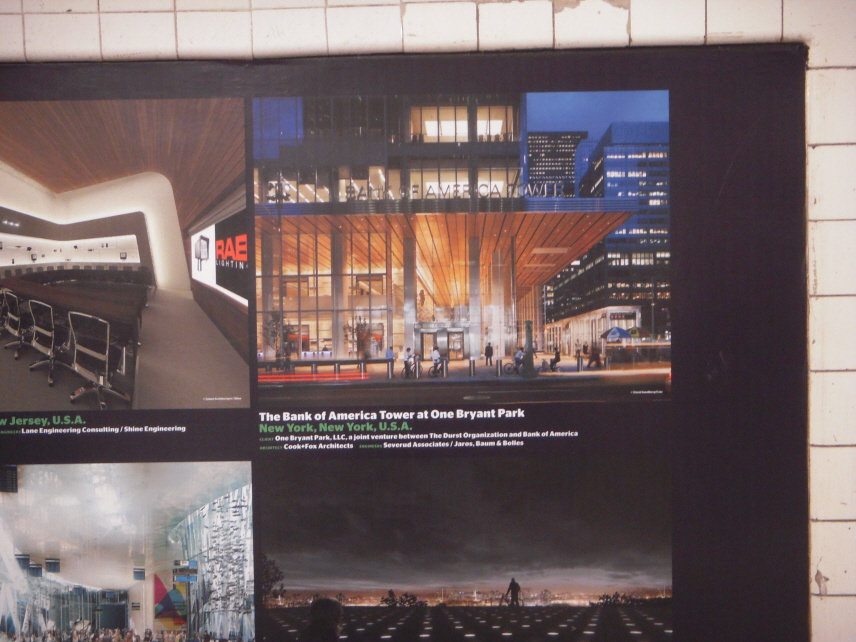
On our way to catch and write about “Urbanized,” the new Gary Hustwit documentary about urban design* we discovered, heading up from the A Train, that the subway corridor directly under the IFC Center theater hosting the film is lined with AIANY (“American Institute of Architects New York”) posters featuring different architectural projects. Some of those images are of Hall of Shame subsidy grabbers, and for sure at least the pictures of the of the net-public-loss Atlantic Yards Prokhorov/Ratner (“Barclays”) basketball arena are destined to be disgruntling.

(* Noticing New York’s review of Urbanized” is here: Saturday, November 5, 2011, Now Appearing In Gary Hustwit’s New Documentary “Urbanized”: Amanda Burden, New York’s High Line and Community Protest)

Prokhorov/Ratner (“Barclays”) Basketball Arena

CitiField Baseball Stadium

A second heavily subsidized expensive new sports venue, the Mets new CitiField baseball stadium was also amongst the images. Now seems like a good opportunity to recall something Noticing New York paid attention to in the summer of 2009: Prompted by the federal bailout (with Citibank among those getting substantial rescue funds) and the public’s hostility to the way that stadium had been financed with excessive public subsidies, suggestions were being made all over the place that CitiField should be renamed. (See: December 4, 2008, Citi Field by Any Other Name, by George Vecsey, December 5, 2008, Citi Field by Any Other Name, Part II, by Andrew Das, December 5, 2008, Answers From Brian Lehrer of WNYC, Part 3, by The New York Times, The Brian Lehrer Show, December 05, 2008, Bailout Stadium, Friday, December 05, 2008, and Mon Nov 24, 2008, So what should we, the American taxpayers, rename Citi Field? By 'Duk.)

The huge preponderance of suggestions (138 from Brian Lehrer listeners alone) for the renaming of the stadium reflect the public’s anger: “Debits Field,” “Field of Nightmares,” “Field of Schemes,” “Bailout Ballpark.” “The Field That Ruthless Built (reserved for the Yankees new stadium)” “Shea-m (Shame) Stadium,” our own “Shady Stadium” suggestion, or taking a cue from Bill Maher “SITTY Field with the H.”

Bank of America Tower

Also present amongst the images was the Bank of America Tower at One Bryant Park. Though that building, currently the second tallest in New York City, may have things to recommend it, Bank of America is in the headlines right now due to consumer outrage over its decision (now retracted) to charge its customers ludicrous fees to use their debit cards, and the size of the tower bearing the bank’s name (bringing increasing density to Bryant Park) was facilitated by assistance the government gave the developer in wielding the threat of abusive eminent domain.

Positioned Pitches

(Above, from the promotional site for "Urbanized")

How did the AIANY gallery wind up being displayed in that underground Greenwich Village subway corridor? Does AIANY regularly display such posters at that location? Did AIANY envision that “Urbanized” would be showing above in the IFC Center and that they could catch the exact audience they’d like to reach? That seems a bit far fetched (even if we can find Hustwit on AIANY's calendar and actually, in NYC, October is “Archtober” in which AIANY has an annual New Work exhibition). More likely, the posters were there at the same location for the same reason that the film was. Greenwich Village is a place where you can find people interested in the arts, including architecture; maybe not business or corporate types but individuals susceptible to the seduction of well-crafted images. Maybe people you want to reach because they are an on-the-edge demographic you don't think you already have assuredly on board with your message. And if you want to reach out effectively to those people it's good to offer your wares around hub subway stations where flows of such people converge.

The subway images promoting the Prokhorov/Ratner arena and these other government assisted, government subsidized projects is also part of something else that has been a Noticing New York preoccupation recently: The pummeling we are getting everywhere we go reflecting a severe imbalance in the public dialogue delivered via paid speech. Big picture, the skewing of wealth in this country is working in conjunction with the increasing privatization of the traditional avenues and elements of public speech (including but not limited to public spaces and streets in which to speak). That means that we are forever being subjected to ubiquitous, insistent cues and reinforcements of (for example) the way Forest City Ratner wants things perceived. (See: Saturday, October 22, 2011, Occupy Wall Street and the Banks- Messages From Bonnie & Clyde, “They’ve Got Too Much Money”: Ownership of the Public Forum by the Wealthy?)

Corrections Please

(More on the calculations with respect to the above is available here.)

And because the images on these subway corridor walls are of government-assisted, publicly- subsidized projects this is essentially a self-pummeling since the images are ultimately paid for by the public itself (and those who have been the victims of eminent domain), notwithstanding that it was skewed wealth that initially tilted those subsidies into the developers' pockets. Cyclically, if the message does get through, then no one amongst us is supposed to object the next time one of these developers persuades politicians to tilt more subsidies into their pockets.

Given that correction is desperately needed to the not-so-subliminal subterranean subjugation I thought I would do in this article what have been doing in others, provide examples of the images we should instead be seen on subway posters and on billboards blasting their message to the public around the city.


To see more in this vein go to:
• Monday, May 2, 2011, “Welcome To Brooklyn” Where the Game Is Frivolous Spending On Boondoggle Basketball Arenas- Getting the Image Right

• Wednesday, October 26, 2011, Longing For Correcting Images to Jay-Z’s Hip-Hop Hype and Ratner’s Atlantic Yards “Strategy of Distraction”

• Sunday, October 30, 2011, Unhappy Halloween: Recalling Last Year’s Tricky “Treats”: The Ghastly Ghosts Lurking In PR Messages From Atlantic Yards To Zucotti Park