Showing posts with label Mets. Show all posts

Wednesday, August 15, 2012

With Discordant Synchronicity The “Barclays” Center Will Open At LIBOR Scandal’s Peak: What The New York Times Is And Isn’t Covering

Good news reporting needs to be integrative. You make reported news events more meaningful to your readership when you acknowledge the broader context in which those events are taking place and how they likely relate to your readership community. Compartmentalization of the news may sidestep cognitive dissonance but it is nonetheless a disservice to anyone wanting to make sense of the world.

I am thinking about this because I am thinking about how the New York Times is reporting the LIBOR interest rate-rigging scandal in connection with which the name “Barclays” has become a new shorthand synonym for how low the ethical standards of Wall Street can sink. How will the Times relate that reporting to what is relevant to residents of its home town, New York City?

A Times Search Centering on "Barclays" vs. One Centering on "Barclays Center"

If you do a search of the New York Times site for the word “Barclays” everything that comes up first is relevant to the scandal notoriously besmirching the bank’s name; see below.

Conversely, with the Barclays LIBOR scandal so prominently in news in recent weeks, if you do a 30 day search of the Times site for the term “Barclays Center,” the new Forest City Ratner/Mikhail Prokhorov-owned basketball arena scheduled to open soon, and therefore destined to open contemporaneously with criminal indictments of Barclays traders, you get a list of hype and hoopla articles about the center that make no mention of the darkening cloud of the Barclays scandal; see below.


At "Public Information Session" No Sign of Really Big Barclays Sign To Come

(Above, NY Post/Dana Sauchell photo from New York Post story about the affixing of the Barclays sign to the side of the arena on August 7, 2012.)

This omission of reference to the icky oddness of brandishing the “Barclays” name is going on even as new plans were unveiled to plaster an additional Barclays logo in super giant lettering on the top of the arena. When you look down from a helicopter at Brooklyn, the borough will be prominently branded with the scandal-associated name! (FYI: In the fall of 2009 when the arena design was released to the public and a public information session was held- the closest approximation to to a public comment hearing that took place- the renderings and models shown to the public were all presented WITHOUT this “Barclays” top-side emblazoning. Its possibility was discreetly kept under wraps.*)
(* I’ll have to go back and find the question about signage I am sure I asked at that September session. My recollection with the aid of some notes is that I asked specifically about the possibility of very large signage, possibly illuminated, possibly animated and that Forest City Ratner spokesman Joe DePlasco said that it was not part of the “current concept” for the arena design and assured everyone that anything done would be “within ESDC design guidelines.” To get a truly forthcoming answer about what was planned I should probably have crafted my question more carefully.)
(Above, rendering and model of the arena released when the public was being informed about its design. Below, renderings released long afterwards and a photo of Barclays logo lettering as, just a week ago, it it is begun to be painted on the roof.)

Fourth of July Celebration of the Name's Interdependence

The Times hasn’t failed entirely to notice the awkwardness associated with the fact that the new heavily promoted arena is prominently parading the scandal-associated name. On July 3rd and 4th (are these heavy Times readership days?) the Times ran two articles in quick succession each observing the awkwardness. The first was a business “Deal Book” article, the second was by its sports business reporter Richard Sandomir. Each referred to how naming sports stadia and arenas to promote corporate brands can run afoul of the haunt of a running “curse” or history of “ill-fated choices.” There is a long list of such stadia and sports venue names that have been embarrassingly affixed at almost exactly the wrong time: like Enron Stadium (for the Houston Astros), Adelphia Stadium (for the Titans in Nashville), Citi Field Stadium (for the NY Mets), the almost Allianze Stadium (for the NJ Jets and Giants- the problem was German concentration camp associations), Trans World Airlines Dome (for the St. Louis Rams), the almost CMGI stadium (for the New England Patriots), PSINet Stadium (for the Baltimore Ravens) and the first of the two articles also mentions the sponsorship deals of Conseco, and, American Airlines. (See: Investment Banking/| Legal/regulatory July 3, 2012, What’s in a Stadium Name? Often Trouble for a Company, by William Alden and Sports Business:arena Names Can Spell Embarrassment, by Richard Sandomir, July 4, 2012).

In an accentuation of the awkwardness, the William Alden Times Deal Book article astutely observes that in 2007 (when the Barclays scandal activities were cooking but not unveiled) the Times had quoted Mayor Michael R. Bloomberg as saying “People will be talking about the Barclays Center all the time, all year, for decades to come.”

The question for me is, having for the record reported about the extreme awkwardness in these two Fourth of July week stories, should the Times now be setting the elephant-in-the-room observation aside, maintaining radio silence on subject, as if it was never mentioned at all?

Calling For a Collocation, a Shorthand Set of Acknowledging Words

I vote for adoption of shorthand reference for all articles about the Ratner/Prokhorov “Barclays” Center going forward, the sort of collocation or pseudo-title formulation the press frequently uses as a reminder to quickly orient the reader to key, presumably understood, facts. Remember when Robert Vesco was never simply “Robert Vesco” but always “fugitive financier Robert Vesco”? Similarly, you always read about “convicted bomber Timothy McVeigh,” “disgraced reporter Judith Miller,” or “reputed New York Gambino family associate Guido Penosi.”

Rather than zeroing out future Times references to the Barclays name problem going forward (which seems to be the way things may be shaping up) I suggest adoption of a phrase that can be included in every Times article mentioning the Center like the “awkwardly-named,” “problematically-named,” or “embarrassingly-named Barclays Center.”

William Safire, the Times former language columnist, weighed in about whether journalistic pseudo-titles conform properly to appropriate Times style but he concluded that while in most cases simple descriptions work (like “an architect” after a name) this can be “a bit silly” when what is being referred to is well known:
‘Frank Gehry, an architect’ would make us seem clueless. In those cases, we often use the description before the name, with ‘the’ — ‘the architect Frank Gehry.*’
(* As in “architect Frank Gehry was jettisoned from design duties for the Atlantic Yards project by developer Forest City Ratner which has decided to save money switching to cheap modular construction instead”?)

Scandal a Free-Ranging Free-For-All, Involves Local New York Governments Subsidizing Promotion of "Barclays" Center

On the business story writing side of the equation, which the Times perhaps considers more serious, the Times is, indeed, covering the LIBOR rate manipulation scandal. It isn’t writing Barclays Bank out of the story as the lead player and central focus of attention in the rate-manipulation fraud. The most recent of the Times stories repetitively returns to references to “Barclays” to anchor the key points being made. It uses the bank's name a total of fifteen times counting the one time the bank’s name appears in one of the article’s picture captions. (See: August 5, 2012, As Libor Fault-Finding Grows, It Is Now Every Bank for Itself, by Azam Ahmed and Ben Protess.)

Notwithstanding, the Times hasn’t been covering another important part of the local story about which Noticing New York has been reporting even though it should be of special interest to New York City residents: The fact that various branches of New York state and local government may be suing Barclays Bank over its rate manipulation. This is especially interesting and relevant to the stories about the awkward naming of the arena given that there is a chance that all four local government entities providing very substantial subsidized financing to the “Barclays” Center and the Atlantic Yards mega-monopoly (at a huge net loss to the public) may be among the vast number of potential plaintiffs suing Barclays over the rate manipulation.

The Times has reported nothing about any of New York’s local governments possibly suing Barclays, but the list includes New York City itself, the MTA, the New York City Housing Development Corporation, the New York City and New York State Comptrollers, their respective pension funds and the New York State Attorney General.

Here are two recent Noticing New York articles on this subject, including links back to earlier Noticing New York Articles (going back to mid-July): Saturday, July 28, 2012, More On Why Sued-For LIBOR Losses May Be Substantial And More On Figuring Why Mayor Bloomberg Is Minimizing The Public's Loss and Thursday, July 26, 2012, “Barclays” Center Opening Pending; Fellow Government Officials Don’t Back Bloomberg Re Minimizing NY Lawsuits Against Barclays Bank.

Per its headline, the most recent Times article gives a good picture of how the LIBOR scandal is shaping up on Wall Street as a sort of every bank for itself kind of affair. Blame-spreading finger pointing is going on that is quite abnormal for Wall Street. Normally the industry works to put up a common front when dealing with regulators and investigating prosecutors. One lawyer involved in the case is quoted as saying “There is no information-sharing among banks unlike the past 15 years of federal investigations.”

The article gives some sense of the scope of the frenetic free-for-all that is shaping up. Here is another article from Bloomberg News from just a few days before that also conveys the disparate and diverging interests of the banks but also makes clear how this also means that everybody in the financial world can be expected to sue everybody else: Fidelity Joins BlackRock in Weighing Libor Action Against Banks, by Christopher Condon and Alexis Leondis - Jul 26, 2012.) (Previously, NNY noted that Bloomberg News wrote about this as a “feeding frenzy of sharks” with “everyone’s preparing for war” in the litigation area.)

The Bloomberg News article notes that Baltimore is among those suing in a case that “stems from its purchase of interest-rate swaps” to protect the city from interest rate changes after it sold variable-rate bonds and quotes Baltimore’s Mayor Stephanie Rawlings-Blake as saying, “I am going to fight for this city and do what I can to protect the city taxpayers who ultimately suffered financial damage as result of Libor manipulation.” Mayor Rawlings-Blake’s statement is the kind of statement we should be expecting from leaders in local New York government but it is not the kind of statement we have heard from Mayor Bloomberg who is downplaying the fact that he admits the city may similarly be suing Barclays.

Another article appearing in the Times in recent days doesn’t actually mention the Barclays name (referring only to “banks”) but it ought to be considered as clearly having importance with respect to the ongoing Barclays scandals: Corporate Fraud Cases Often Spare Individuals, by Michael S. Schmidt and Edward Wyatt, August 7, 2012.

Corporate Fines Paid, Corporations and Top Executives Move On, Escaping Criminal Prosecutions, To Promotionally Buff Their Image, Quite Affordably

It makes the point that the infrequency with which criminal charges are brought against corporate executives encourages executives to pursue illegal activities that defraud government:
Pharmaceutical companies, military contractors, banks and other corporations are on track to pay as much as $8 billion this year to resolve charges of defrauding the government, analysts say — a record sum and more than twice the amount assessed last year by the Justice Department.

* *

But while the collections are a boon to the government and taxpayers, they are resurrecting questions about the relative lack of charges against executives at the companies that are getting the stiffest penalties.
In writing about the ignominy of Bob Diamond’s abrupt departure as the chief executive of Barclays Bank, I provided some calculations that made pretty clear that after Barclays payment of fines both Barclays and Mr. Diamond would still have tons of netted cash left over to pay the relatively small sums that may then be required (illegal and disreputable conduct notwithstanding) to refurbish their names and reputations as the Barclays name gets promoted on the arena and New York City subway stations and Mr. Diamond’s name shines out on a building next to Colby College’s admissions center. (See, Tuesday, July 24, 2012, No Sparkle In Barclays’ Bob Diamond: Societal Mores Unmoored, What And Who We Honor Today- That Which We Used To Shun.) People should keep in mind that the fine that was paid by Barclays was paid partly to preclude criminal prosecution of the corporation. Criminal prosecution of lower level brokers is, however, predicted.

In that same article about Mr. Diamond I picked up on an applicable quote from law professor Frank Pasquale (appearing in a July 19, 2012 Boston Review essay):
Many naming-rights deals are not merely advertising. Rather, they are transparent efforts by dubious enterprises to buy goodwill by permanently associating themselves with famous landmarks.
(See: Names, Trains, and Corporate Deals: Why Public Transit Shouldn’t Sell Naming Rights. See also Atlantic Yards Report’s review of that article: Tuesday, July 24, 2012, Naming-rights deals, suggests law professor, are "transparent efforts by dubious enterprises to buy goodwill by permanently associating themselves with famous landmarks".)

The Enron Stadium Time Line: Lessons To Be Learned

Who is to say how embarrassingly the naming of the Barclays Center will be in the end? Up to this point, perhaps the most embarrassingly named stadium of all time was Houston’s Enron Stadium.

The time line on the naming of the Enron stadium runs thus.

The Enron Corporation began to engage in fraudulent accounting manipulations in the mid 1990s.

In March of 2000 the opening of the Enron Field was getting good pre-publicity from the New York Times sports page that sounds roughly like some of the publicity the Barclays Center is getting from that page currently:
What used to be an abandoned railroad yard and station and a downtown eyesore is now Enron Field, an impressive addition to the downtown skyline -- from the deep center-field fence 436 feet away to the modest distance of 326 feet down the right-field line to the tempting 315-foot clearance down the left-field line, the shortest in the major leagues.
Enron Field opened in April of 2000.

In January 2001 Enron was involved in secretly manufacturing the California power crisis. 2001 was also the year that Enron collapsed.

By January 2002 the world knew Enron was being criminally investigated.

As of February 27, 2002 agreements were negotiated in connection with Enron’s bankruptcy filing to eliminate the Enron name from the stadium whereupon the name became Astros Field instead.

Notwithstanding the rosy glow aspect of the Times sports page reporting about the stadium in 2000, by January 2002 the Times was on the spot with a “backdrop” article summarizing everything that went wrong with the company, the regulators and the supportive politicians and power players involved in the scandal like both president Bushes. It begins by describing the scene the day the stadium opened, making clear how it epitomized what was seriously out of whack:
On the day that Enron Field made its debut in April 2000, its ''Diamond Club'' was a portrait in power.

In the state-of-the-art baseball stadium's most exclusive section, behind home plate, there were the George Bushes -- a former president and a president to be -- along with the younger Mr. Bush's running mate, Dick Cheney, and his successor as governor, Rick Perry. Nearby was Senator Kay Bailey Hutchison, whose husband, Ray, is a lawyer with Enron's chief law firm, Vinson & Elkins. And then came the executives of Houston's biggest companies, who had vied to become the younger Bush's most prominent fund-raisers, just as they had jockeyed to buy the prized luxury seats.

And at the center of it all, down on the pitcher's mound, was Kenneth L. Lay, the man responsible for building Enron into an American powerhouse, throwing out the first ball.

If the cozy intertwining of business and politics at Enron Field is not unique to Houston or to Texas, it is pronounced here, and it was starkly visible that day. Now, in the company's spectacular collapse, the relationships are starkly visible once more, as Congress and the Justice Department ask whether that closeness, a part of the city's heritage, was at least partly to blame.

''It's a classic example of the circle of influence and inside connections that this entire case typifies,'' said Scott Harshbarger, president of Common Cause. ''And it's not only about these guys. It's what has been happening in Washington for so long now.''
(See: Enron's Collapse: Backdrop; In Houston, the Lines Dividing Politics, Business and Society Are Especially Blurry, This article was reported and written by Don Van Natta Jr., John Schwartz and Jim Yardley, January 20, 2002.)

If the Times were willing to look hard enough it could be reporting about how the opening of the Barclays Center, without coincidence, similarly represents and symbolizes the same sort tangle of politics, powers and interrelated crony capitalism connections that communicates how things are very wrong. Will it?

Times on the Issue of Corporate Branding of Public Assets, Generally

The Times has written about the issue of government selling out the right to corporately brand public assets. The most recent article appeared in June: Your Ad Here, on a Fire Truck? Broke Cities Sell Naming Rights, by Michael Cooper, June 24, 2012. I wrote about it here: Friday, June 29, 2012, Government Gets Branded. I hope my article added significantly to the depth of the discussion. The June Times article was mainly a catalog of examples of what is happening around the country and skirted any real discussion of the policy issues behind what was reported.

In contrast a Times article from July 2004 about an interest on the part of the MTA and Bloomberg to sell to corporations the right to name city subways systems and parks included the following observations. They sound much like some of my Noticing New York coverage:
Another challenge for governmental institutions seeking sponsorship deals is public acceptance. In Boston, Ralph Nader and an organization he helped found to fight the spread of advertising in America, Commercial Alert, lobbied vigorously against the plan to add corporate sponsors to the names of subway stations.

''This is part of the decline of American values,'' said Gary Ruskin, the group's executive director. ''We used to name things after people who were heroes, people we were proud of. Now we name things after the corporation with the deepest pockets.''

''How low will New York sink?'' he said.

Although renaming a subway station or bridge or tunnel may seem harmless, there are subtle but important effects, said Siva Vaidhyanathan, an assistant professor of culture and communication at New York University, who has written about the cultural impact of trademarks.

''The moment you slap any sort of private trademark on a public institution, you're reducing the sense of public investment,'' he said. ''I feel less invested in the quality of Verizon Grand Central Station or Eddie Bauer Central Park.''

(See: Now a Message From a Sponsor Of the Subway? By Michael Luo, July 27, 2004.)

Bloomberg And The MTA Once Said That Selling Corporate Naming Rights Was About Raising Money, . . . BUT. . .

Responding to the lead of Bloomberg and MTA spokesmen, this 2004 article analyzed the pro-side of the argument for selling corporation naming rights for city subway stations as being of financial benefit for the public, not to benefit corporations. It was to bring in money for the transit system and city. In the end, that turned out not to be the case because when in June of 2009 the MTA sold the right to name two of the systems biggest subway stations “Barclays” the MTA did so for a pittance, essentially taking nothing back for the public at all, only $200,000 per year for 20 years, far below what ought to have been paid or what those rights were worth. It would seem that if the MTA had been thinking about selling these naming rights since at least the summer of 2004, five full years, they should have been able to structure a more competent deal to benefit the public had they wanted to.

Public Disfavor For Naming Rights Sales (Scandal-Associated or Not)

The public isn’t enamored of these naming rights deals and laws have been sought to end them. When the Citibank’s name wound up going up on the new heavily-publicly subsidized Mets Citi Field stadium at the same time that Citibank was being publicly bailed out by the federal government with TARP funds Ohio Democratic Representative Dennis Kucinich and Republican Texas Representative Ted Poe sought federal changes to require Citigroup to cancel the naming arrangements and recoup the money. (See: Should We Call it Bailout Stadium? February 10, 2009 by Tom Gallagher and Citi Field or Bailout Ballpark? Two Congressmen are urging Treasury to force Citigroup to pull out of its $400 million naming rights deal for the Mets' new stadium. Here's why that's a bad idea., by Paul R. La Monica, CNNMoney.com editor at large, January 30, 2009)

In a sense, we may now have come almost full circle because one of the charges being investigated in the LIBOR rate manipulation scandal is whether, given the interest rate manipulations, the banks taking TARP loans failed to pay the federal government everything that should have been owed on those loans.

The public doesn’t necessarily need a scandal, TARP-flavored or otherwise, to think that selling corporate naming rights to public assets is a bad idea. In the Fall of 2004 San Francisco voters passed a referendum by a 55%-45% margin prohibiting sale of corporate naming rights for Candlestick Park, the home to the San Francisco ‘49ers. Candlestick Park had originally been named in a public naming contest: It doesn’t have cooperate associations.

Here from a news release reporting on the referendum:
Huge majorities of Americans want government to restrict the creep of advertising into nearly every part of our lives and culture. According to a Yankelovich Partners poll in April, 60% of Americans have amuch more negative opinion of marketing and advertising now than a few years ago, 61% of Americans feel the amount of marketing and advertising is out of control, 65% feel constantly bombarded with too much advertising and marketing, and 65% think there should be more limits and regulations on marketing and advertising.
(See:For Immediate Release: November 4th, 2004, San Francisco Approves Referendum Against Sale of Naming Rights for Candlestick Park.)

That rejection of the sale of naming rights is without a scandal as a reason the public might not want to be bombarded by the Barclays Bank name. What about with a scandal of the magnitude that continues to brew?

(Below, pictorial evidence of community resistance to the naming of its subways stations "Barclays": T Shirts available for purchase that protest the name change and some guerrilla political street art commenting on what associations the promoted "Barclays" name should evoke. Other of the modified subway signs said "Barclays always has the best fixed rates" and Barclays was totally cool with apartheid in South Africa.")

I hope future New York Times sports articles start referring regularly to the Ratner/Prokhorov arena as the “problematically-named Barclays Center” or something else of informative ilk. The last article written about the discordance of the curtain going up on the “Barclays” promotion at just this time was written by Richard Sandomir. He hasn’t written any articles about the “Barclays” Center since so it remains to be seen whether his next article will hearken back to his last in this key respect. Mr. Sandomir has written stories about naming rights before (and been taken to task about the need for careful accuracy and balance by Norman Order of Atlantic Yards Report: Wednesday, January 06, 2010, When it comes to details of the Barclays naming-rights deal, the Times plays "he said, she said," leaving Ratner with the last word.)

Will The Times Cover How The Barclays LIBOR Scandal Interrelates To The News of What's Going On Locally, Including The Local Atlantic Yards Scandals? We'll See. . .

I’ve written before that it is my opinion that the Times cannot adequately cover national stories if it compartmentalizes away the obvious links involving what needs to be reported about Atlantic Yards. I have also written about how the Times seems disinclined to write unfavorable stories about Atlantic Yards and the mega-monopoly development real estate developer, Forest City Ratner, the same developer who at a critical time as the Atlantic Yards story was unfolding entered into a business relationship with the Times to build the Times new headquarters.

We’ll see what happens but I think that the Times, in writing about the Barclays LIBOR scandal should also keep writing about the Barclays naming rights scandals and should also get around to writing about the fact that the very same government entities that plowed far too much subsidy into the “Barclays” Center and Atlantic Yards also, ironically, have cause whereby they may be suing that same Barclays Bank at the very same time that publicly paid for arena promoting that bank opens.

Friday, June 29, 2012

Government Gets Branded

(Above, a government "fireman" from "Fahrenheit 451" now branded appropriately for our modern times with KFC, Ratner/Prokhorov "Barclays" and "Nets" advertising logos. Click on image to enlarge. Nets logo from artwork by Tracy Collins.)

One of the most indelible images of cinematic science fiction, a vision of an insidious transmogrification of government, came to us via the late Ray Bradbury’s “Fahrenheit 451”: A young boy with his mother looks down from an overpass as racing fire trucks speed by, sirens sounding, an eerie blue gumball beacon flashing and says: “Oh, mummy, look! Firemen. Mummy, there's going to be a fire.” In Bradbury’s future, firemen no longer “put out fires” instead they burn books.

Well it appears that the future is arriving. It isn’t exactly the future Bradbury envisioned, though it does involve a transmogrification of government epitomized by a scene of a racing fire truck. In this future the young boy looks down from the same overpass and says: “Oh, mummy, look! Firemen. Mummy, they’re going to fry some fiery grilled ™ Kentucky Fried Chicken!”

(Above, "Fahrenheit 451"'s little boy and his mummy.)

Burning Question Respecting Hobbling Governments

The New York Times recently ran a story about how cash-strained cities are selling corporations the right to use municipal assets as billboards to advertise their products and this includes, as the article’s opening example, Baltimore’s City Council passing a resolution favoring the placement of corporate ads on city fire trucks. The article notes that KFC has been “a pioneer in this kind of unconventional ad placement” and has placed its logo on fire hydrants and manhole covers in “several cities in Indiana, Kentucky and Tennessee.” (See: Your Ad Here, on a Fire Truck? Broke Cities Sell Naming Rights, by Michael Cooper, June 24, 2012, picture on side from article.)

Bradbury’s nightmare future involved an Orwellian-style totalitarian, authoritarian government controlling and limiting its populace’s thinking by scrupulously denying them access to books. The future that is arriving is almost the reverse: Instead of a government with intrusively-great power, the reality that is arriving is governments shrunken down to dependent weakness. This is more like the nightmare dystopia envisioned in the science fiction film “Robocop,” where a shrunken, debilitated government is so small and bankrupt that it is unable to resist a privatizing sell-off of its central functions to huge unaccountable corporations; even the police department is administrated by a private corporation (paving the way- spoiler alert!- for that corporation to be the film’s villain maneuvering for a land grab).

Dumbing Down the Public

In “Fahrenheit 451” the government deprives the public of books intending that the public have an illiterate lack of perspective about what is going on in the world, the activities of the government included. In a different way, plastering fire trucks with cooperate advertisements involves a similar dumbing down of the public’s understanding of the role of government, particularly the government’s appropriate and proper interrelationship with private enterprise. It implies that government exists almost by the cooperate sector’s grace or as a sideline to it and that, as in the Robocop dystopia, it can be appropriate for government to put its core functions up for sale to the highest bidder.

A cavalier attitude about government selling out to business entails consequences. In recent Noticing New York coverage I wrote about Jane Jacobs’ warning in her “Systems of Survival: A Dialogue on the Moral Foundations of Commerce and Politics;” (1992) that the inappropriate mixing of government and business tends to result in a degradation of fundamental moral systems and principles (much as is depicted in the film Robocop). With such intermixtures, government officials reorienting themselves to serve business interests are prone to forget that they are supposed to perform an essential guardian role protecting the public interest first, foremost, and above all else.

In “Fahrenheit 451” the squelching of free speech that deadens the public’s critical thought process is heavy-handed and obvious and performed directly by the government. What’s happening in the future of today's world is that the sound of meaningful free speech in this world is being snuffed out by its inability to compete with the amplified cacophony of commercial “speech-on-steroids.” For more about this and also how speech is becoming increasingly commercially privatized through copyright, media ownership, property ownership and other laws favoring corporations see: Saturday, October 22, 2011, Occupy Wall Street and the Banks- Messages From Bonnie & Clyde, “They’ve Got Too Much Money”: Ownership of the Public Forum by the Wealthy?

Dismissing Government's Importance

When cooperate logos are slapped-on on government vehicles one might infer that what the government does is inherently less important than the private sector. Really now! . . .

. . . There is a reason that fire trucks are painted red: Not because that is the color of fire but to make an urgent, immediate claim on the public’s attention, also with sirens and flashing lights, so that the fire truck can pass through traffic, people pulling over to the side to make way for the a mission of rescue more important than everyone else's everyday commute or trip to the store. (The Times article mentions corporate logos could similarly wind up on Onondaga County Rescue helicopters.) What absurd redefined message does it send that a fire truck’s first claim on the attention of a surrounding sea of traffic will now be to urge people to eat at a particular fast food chain?

It consigns the actual purpose of the fire truck to a second class tier. Presumably, no business or enterprise would choose to advertize on fire trucks if the public perception was that the fire department was doing a poor job. But if the fire department is doing a good job why shouldn’t the information and logos appearing on the trucks be exclusively about that department as a way to advertise for the raising and allotment of tax dollars?

99 and 44/100ths of the Truth

The implication is also that crucial public services are being delivered only because the fast food chain is stepping in to finance them. That’s hardly the case. As the Times hints, what the advertising could bring in would be paltry compared to the overall cost of running a fire department. The Baltimore City Fire Department is comprised of stations that “house about 100 firefighting, emergency medical and special operations companies.” Advertising is not expected to bring in enough to keep even one company open. (Closing one fire company would save Baltimore a little over $2 million a year. - The article reports that closing three would save on the order of $6 million a year.) In other words, despite the handing out of a misleading advertising credit the taxpayers are paying for probably around 99 and 44/100ths of the cost of that municipal department, which is pretty much the whole ball of wax.

Finding Government Admirable

The public does respond to logos and insignia that give credit to public workers. After 9/11 there was a flourishing trade in caps and T-shirts and similar items sold around New York with Fire and Police Department logos even if there were not always duly licensed. (See also this.)

Government Sized Up and Down

But why should we expect scrawny, drowned-rat government to effectively negotiate deals that are fair to the public? Part of the reason governments are willing to consider such desperate plans (and able to make any sort of credible case when presenting them to public) is because they are so hard up for money and that is because, going back to the late 1970s, there has been a concerted effort by conservatives to “starve the beast” (i.e. the government, with tax cuts and the creation of government deficits), the goal being, in the words of conservative activist Grover Norquist, to get the government “down to the size where we can drown it in the bathtub.” Hence, the image of a drowned-rat government pleading for table-scrap income from fast food advertising.

For more about the intentional creation of deficits so that, “Spending cuts could then be sold as a necessity rather than a choice, the only way to eliminate an unsustainable budget deficit”, See Paul Krugman’s column: The Bankruptcy Boys, February 21, 2010.

If the starving of the beast hasn’t yet got local government down to the size where those governments can be drowned in a bath tub they are at least down to the size where they can be lassoed, roped, and branded like calves at a rodeo.

What is the proper size of government? President Theodor Roosevelt, who took on trusts, cartels, and conglomerate holding companies with his trust-busting and increased regulation of businesses, is sometimes quoted as saying that government needs to be at least big enough to take on the big corporations and monopolies. Despite the quotes I've heard I can’t find evidence that he actually said this, although I’ve researched the subject and spoken to a presidential historian expert in that period of history. If Roosevelt didn’t say it he should have: He believed in government cutting businesses down to size rather than vice versa, how else can you achieve that result? (If anyone comes across an actual Roosevelt quote to this effect let me know.)

Do Those Besieging Government Want Small Government Or Compliant Government?

Paul Krugman has pointed out that Republican apostles of small government are not necessarily sincere. New Jersey’s Governor Chris Christie and presidential candidate Mitt Romney are included in his list. He calls them “fake deficit hawks.” See: Big Fiscal Phonies, May 27, 2012.

Mr. Krugman says:
for all their alleged deep concern over budget gaps, that concern isn’t sufficient to induce them to give up anything — anything at all — that they and their financial backers want.
To establish his point on this, Mr. Krugman describes in this article the reluctance of Christie and Romney to eliminate “low taxes on profits and capital gains” and a Romney promise not to cut defense spending. But it is not just about keeping taxes low for corporations and the wealthy, or spending on the military. When Christie felt like it he decided to put the public's money into the Xanadu project, a huge, over scale, garishly designed and questionably subsidized mixed-use project critically integrated with a sports complex. (See: Friday, May 6, 2011, Xanadu- Governor Christie’s Ode-ious “Yes We Khan” Moment.)

Big Business + Big (Collusive) Big Government = Big Woes

I myself believe that government needs to be at least big enough to perform its guardianship function of taking on the big corporations and monopolies, but when government is big you can wind up getting the worst of both worlds. That happens when government neglects its guardianship function and big business and big government collude in big-time crony capitalism. That is the kind of corporatist conduct that everyone, including both the Tea Party and Occupy Wall Street ought to agree to abhor, see: Monday, October 4, 2011, On NPR, Echo of Coinciding Principles Noticed: What the Tea Party and Occupy Wall Street Ought To Agree On.

The Times On the Ratner/Prokhorov "Barclays" Arena

Mentioning that transit systems across the nation have recently been aggressive in trying to sell the naming rights of stations, the Times article covers the fact that in “Brooklyn, new signs went up last month at the Atlantic Avenue subway stop bearing a sponsored addition to its name: Barclays Center.” (See the Times provided picture on the side.) Accordingly, the Times, as it should, actually included an appropriate mention of Atlantic Yards in what it was seemingly reporting as a negative trend, something it often neglects to do. The article stated that the Metropolitan Transportation Authority is being paid for the naming of the station, but didn not point out that the payment being received is exceedingly miniscule in relation to the benefit being conferred upon Barclays. It was decided upon by the MTA with very little thought or negotiation in terms of benefitting the public. (See: Sunday, June 28, 2009, Naming a Problem: The MTA Gives Ratner the Right to Name Brooklyn Subway Stations “Barclays”).

The Times reports the amount paid as “$4 million over 20 years”: The MTA board (as described in the staff summary it got) approved “$200,000 per year”. . . Think how little that means in terms of the present value being paid!

This is not drowned-rat government lacking the skill to negotiate a credible deal– The MTA is a big, sophisticated government organization with appreciable resources– This is instead big-time crony capitalism. It is an example of what Jane Jacobs warned happens when, in pursuing “private/public partnerships,” government officials mix government functions up with the pursuit of business: The government officials stray from their guardianship responsibilities and fail to protect the public. In the case of Atlantic Yards, however, those government officials strayed from and neglected their true responsibilities far earlier; it all began with the abuse of eminent domain with the goal of benefitting a private developer at the expense of the public.

What's In An Advertised Name: By Any Other Other Name Wouldn't "Barclays" Smell. . . ?

Think about the appropriateness of naming New York City subway stops “Barclays Center” (while receiving virtually nothing of value to do so). “Barclays,” nothing but a name being advertised, is simply one more name in a sea of distracting ads. The “Barclays” bank didn’t build the arena that advertises its name; it’s being built by Bruce Ratner with the financial assistance of a Russian oligarch, Mikhail Prokhorov. The bank contributed nothing to the city or the borough of Brooklyn in order to build it. It has nothing to do with the arena. “Barclays” is not the name of the name of the basketball team planning to play there. It is not even necessarily the name of an honorable bank. Just of now the bank has been fined £290m ($450m) for manipulating LIBOR rates to benefit its traders and cook its books. Chief executive Bob Diamond is under pressure from British politicians to quit over the rate rigging scandal.

Perhaps the bank can certainly use the advertising at this time given its bad acts, but the public finds itself much in the same position as when, in the middle of the fiscal crisis, the new Mets “Shady Stadium” found itself opening with the name "Citifield," after an apparently failing bank. Barclays was also deeply involved in various scandals throughout the fiscal crisis. Citibank survived 2008 but was just downgraded by Moody’s. The message from the Moody’s downgrade of Citi and several other banks is that the banking system isn’t more sound than in 2008.

How long will any of these banks be around and by what names? Remember Chemical Bank? Manufacturers? One day it may cause substantial confusion when “Barclays” isn’t around either. Perhaps the most recent scandal will take its toll. Perhaps the Euro crisis will. Maybe, given the scandal, Barclays will have to rebrand with a new name or merge into a bank with another name. It may go bankrupt. The AOL Time Warner Center is no longer the AOL Time Warner Center, but for a building that is just a corporate headquarters, to endure a name change is of far less consequence than for the names of two subway stops to change in a subway system that is obscure and complicated enough to understand already.

When the Barclays name fades away there will be no residual sense of history associated with its passing because it was, after all, just an advertisement for something that had no association with its place or moment in time. There was no reason for government to confer upon it the very special honor of making it a place name in the city. It makes no more sense to name subway stations “Barclays” than to put KFC logos on Baltimore fire trucks.

Sunday, November 6, 2011

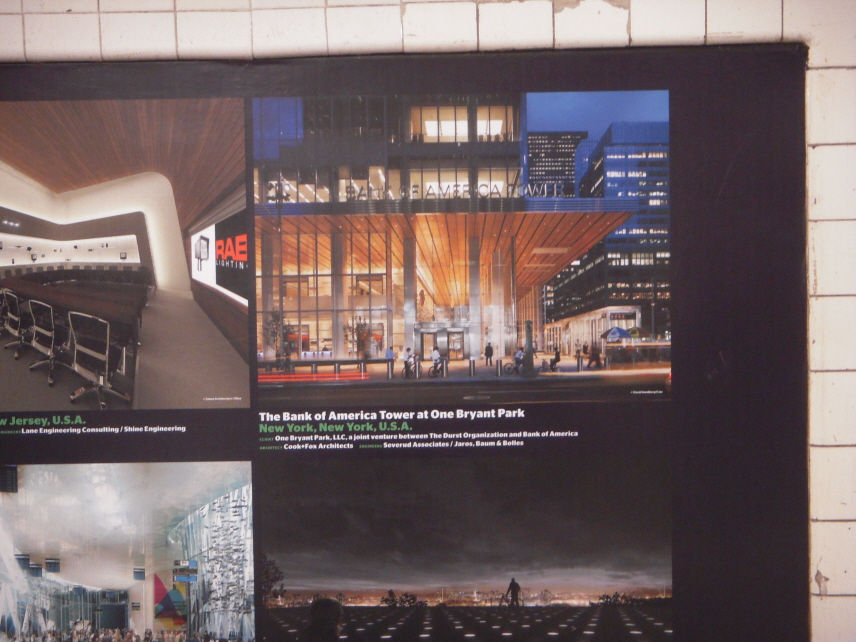
Rogues Gallery: The AIANY (“American Institute of Architects New York”) Subway Corridor Posters Under the IFC Center Showing “Urbanized”

(Above, an example of how AIANY's postered Greenwich Village subway hall promoting subsidized projects SHOULD look, not how it actually does. Click to enlarge.)

On our way to catch and write about “Urbanized,” the new Gary Hustwit documentary about urban design* we discovered, heading up from the A Train, that the subway corridor directly under the IFC Center theater hosting the film is lined with AIANY (“American Institute of Architects New York”) posters featuring different architectural projects. Some of those images are of Hall of Shame subsidy grabbers, and for sure at least the pictures of the of the net-public-loss Atlantic Yards Prokhorov/Ratner (“Barclays”) basketball arena are destined to be disgruntling.

(* Noticing New York’s review of Urbanized” is here: Saturday, November 5, 2011, Now Appearing In Gary Hustwit’s New Documentary “Urbanized”: Amanda Burden, New York’s High Line and Community Protest)

Prokhorov/Ratner (“Barclays”) Basketball Arena

CitiField Baseball Stadium

A second heavily subsidized expensive new sports venue, the Mets new CitiField baseball stadium was also amongst the images. Now seems like a good opportunity to recall something Noticing New York paid attention to in the summer of 2009: Prompted by the federal bailout (with Citibank among those getting substantial rescue funds) and the public’s hostility to the way that stadium had been financed with excessive public subsidies, suggestions were being made all over the place that CitiField should be renamed. (See: December 4, 2008, Citi Field by Any Other Name, by George Vecsey, December 5, 2008, Citi Field by Any Other Name, Part II, by Andrew Das, December 5, 2008, Answers From Brian Lehrer of WNYC, Part 3, by The New York Times, The Brian Lehrer Show, December 05, 2008, Bailout Stadium, Friday, December 05, 2008, and Mon Nov 24, 2008, So what should we, the American taxpayers, rename Citi Field? By 'Duk.)

The huge preponderance of suggestions (138 from Brian Lehrer listeners alone) for the renaming of the stadium reflect the public’s anger: “Debits Field,” “Field of Nightmares,” “Field of Schemes,” “Bailout Ballpark.” “The Field That Ruthless Built (reserved for the Yankees new stadium)” “Shea-m (Shame) Stadium,” our own “Shady Stadium” suggestion, or taking a cue from Bill Maher “SITTY Field with the H.”

Bank of America Tower

Also present amongst the images was the Bank of America Tower at One Bryant Park. Though that building, currently the second tallest in New York City, may have things to recommend it, Bank of America is in the headlines right now due to consumer outrage over its decision (now retracted) to charge its customers ludicrous fees to use their debit cards, and the size of the tower bearing the bank’s name (bringing increasing density to Bryant Park) was facilitated by assistance the government gave the developer in wielding the threat of abusive eminent domain.

Positioned Pitches

(Above, from the promotional site for "Urbanized")

How did the AIANY gallery wind up being displayed in that underground Greenwich Village subway corridor? Does AIANY regularly display such posters at that location? Did AIANY envision that “Urbanized” would be showing above in the IFC Center and that they could catch the exact audience they’d like to reach? That seems a bit far fetched (even if we can find Hustwit on AIANY's calendar and actually, in NYC, October is “Archtober” in which AIANY has an annual New Work exhibition). More likely, the posters were there at the same location for the same reason that the film was. Greenwich Village is a place where you can find people interested in the arts, including architecture; maybe not business or corporate types but individuals susceptible to the seduction of well-crafted images. Maybe people you want to reach because they are an on-the-edge demographic you don't think you already have assuredly on board with your message. And if you want to reach out effectively to those people it's good to offer your wares around hub subway stations where flows of such people converge.

The subway images promoting the Prokhorov/Ratner arena and these other government assisted, government subsidized projects is also part of something else that has been a Noticing New York preoccupation recently: The pummeling we are getting everywhere we go reflecting a severe imbalance in the public dialogue delivered via paid speech. Big picture, the skewing of wealth in this country is working in conjunction with the increasing privatization of the traditional avenues and elements of public speech (including but not limited to public spaces and streets in which to speak). That means that we are forever being subjected to ubiquitous, insistent cues and reinforcements of (for example) the way Forest City Ratner wants things perceived. (See: Saturday, October 22, 2011, Occupy Wall Street and the Banks- Messages From Bonnie & Clyde, “They’ve Got Too Much Money”: Ownership of the Public Forum by the Wealthy?)

Corrections Please

(More on the calculations with respect to the above is available here.)

And because the images on these subway corridor walls are of government-assisted, publicly- subsidized projects this is essentially a self-pummeling since the images are ultimately paid for by the public itself (and those who have been the victims of eminent domain), notwithstanding that it was skewed wealth that initially tilted those subsidies into the developers' pockets. Cyclically, if the message does get through, then no one amongst us is supposed to object the next time one of these developers persuades politicians to tilt more subsidies into their pockets.

Given that correction is desperately needed to the not-so-subliminal subterranean subjugation I thought I would do in this article what have been doing in others, provide examples of the images we should instead be seen on subway posters and on billboards blasting their message to the public around the city.


To see more in this vein go to:
• Monday, May 2, 2011, “Welcome To Brooklyn” Where the Game Is Frivolous Spending On Boondoggle Basketball Arenas- Getting the Image Right

• Wednesday, October 26, 2011, Longing For Correcting Images to Jay-Z’s Hip-Hop Hype and Ratner’s Atlantic Yards “Strategy of Distraction”

• Sunday, October 30, 2011, Unhappy Halloween: Recalling Last Year’s Tricky “Treats”: The Ghastly Ghosts Lurking In PR Messages From Atlantic Yards To Zucotti Park

Friday, May 20, 2011

The Miscalculations Encouraged By the Fuzzy Math of Subsidies: Yankee Stadium Bonds on Verge of Default- A Case Study

Noticing New York is not a fan of subsidies for sports venues like stadia and arenas. Even when the schemes behind those subsidies work out as the public officials dispensing them intended they tend to amount to crony-capitalism style transfers of more wealth to the already wealthy and connected. As in the case of the new Yankee Stadium they can replace taxpaying businesses with freeloading businesses exempt from the tax rolls. As in the case of the Atlantic Yards Prokhorov/Ratner basketball arena they wind up being significant net losses for the public. Add to all of this is the fact that these schemes may not even work out as public officials intended. They may work out a lot worse. To consider the implications of that point more thoroughly let’s direct our attention to a new Transportation Nation story about bonds issued to subsidize Yankee Stadium that are on the verge of defaulting: After Hundreds of Millions of Dollars of Public Subsidies, Barely Used Yankees Parking Garages Face Financial Collapse, May 19, 2011, by Jim O'Grady.

(The WNYC Transportation Nation story has also been substantially reprised in this WNYC story: Yankees Parking Garages Driven to Brink of Financial Collapse, Thursday, May 19, 2011, WNYC, by Jim O'Grady.)

Defaulting Bonds

The bonds issued in connection with Yankee Stadium that are in jeopardy of possible default are $237 million in tax-exempt bonds that were issued to finance a 21-acre parking garage complex for the new stadium. The stadium was subsidized by the public in multiple ways, not just by these parking garage bonds; other subsidized bonds were issued for the stadium itself. At the moment it's just these parking garage bonds that are in danger of default and not the other bonds financing the stadium directly. Those stadium bonds are presumably OK for now (unlike the bonds issued around the same time to finance the stadium for the financially flailing Mets) but the financial difficulties associated with the garage bonds highlight how the city’s public officials made a number of fundamental miscalculations when handing out these subsidies.

No Problem, Says Bloomberg

The Transportation Nation story includes information about Mayor Bloomberg cavalierly dismissing the screw-up:
Mayor Bloomberg says private bondholders, not taxpayers, will be on the hook if the Bronx Parking Development Company defaults on the bonds. On his weekly radio show, he shrugged off the Bronx Parking Development Company’s possible collapse.

“The city has no downside,” he said. “If they were to go bankrupt, it doesn’t hurt us. It wouldn’t be good for the project.”
Notwithstanding Bloomberg’s blithe dismissal, defaults on municipal bonds that are issued and promoted by the city administration are bad. Bad for the city, not just for the bond holders who also get shafted when things go wrong after the city convinces them to buy their product. When bond holders get shafted by a New York issuance, how do you think they will feel about buying bonds the next time a New York issuance comes out? Especially when you have a top city official like the mayor dismissing their interests, sounding like the mistake was all on the part of the investors who bought what the city was selling.

And, by the way, as we will be discussing, there is a long list of additional downsides for the city.

Who’s Watching?

This default was on the Forbes radar screen as of last fall: Yankee Stadium Parking Garage Bonds Are Among Shaky Muni Bonds, Sep. 21 2010 as well as that of the Bond Buyer, Yankee Stadium Parking Garages on Track for Default on $238M of Debt, Tuesday, September 14, 2010, By Ted Phillips and Crain’s, Yankee Stadium parking strikes out: Bronx outfit faces default on bonds as fans park elsewhere and residents fume, by Hilary Potkewitz, March 13, 2011.

The WNYC public radio stories note that the garages were also defended in 2006 by City Council Speaker Christine Quinn, Bloomberg’s regular comrade in crime when it comes to promoting developer-promoted over-development.

Underwriting Immediately Proved Wrong

The bonds were issued by the city’s Industrial Development Agency in 2007. That means that there was hardly the blink of an eye between the underwriting of the bonds and the proof, through failure, that the underwriting was terrifically wrong. The New Yankee Stadium opened in April of 2009, so the bonds took only the first two seasons to go bust, given that before that, during construction, interest on the bonds would have been paid out of capitalized interest (i.e. funds borrowed from the bond holders up front.) WNYC reports that the garage facility is $17 million behind in back rent and other payments owed to the city.

When the Fuzzy Wuzzies Come to Bear

The default is illustrative of a danger everyone should be on guard against when it comes to development through subsidies: Beware of miscalculation because those involved in development are likely to have put away their sharp pencils. Subsidies, generate fuzzy math, fuzzy thinking and they take peoples' eyes off reality and real costs. Those who are expert at working City Hall to finagle subsidies do not necessarily have the same skill sets as those who know how to shave a profit out of the real world, and frequently there is also the danger that their thinking is that if and when they are off on their numbers they will be patching things together at the back end with additional subsidy flows, perhaps with a “too big to fail” argument. That seems to be the case with Atlantic Yards. (The latest about Atlantic Yards fuzzy math was reported upon by Atlantic Yards Report yesterday.)

In the case of Atlantic Yards, say for example with the mega-project’s implausible initial job-projection numbers, fuzzy math is cultivated as a habit to get a foot in the door for what would otherwise have been an unacceptable project. Atlantic Yards' false projection of a ten-year build-out rather than a multi-decade build-out is another example.

Listing, We Sink With Miscalculations

So what were some of the miscalculations made with respect to the issuance of these now defaulting bonds for the new Yankee Stadium complex? Here is a list:
1. That there was no need for 9,000 parking spaces* in the eleven garages in the onsite complex directly serving the stadium. (With the stadium’s reduced 50,287 seat capacity- the reduction was between 4,561 and 7,459 seats while 2,000 parking spaces were simultaneously added- that’s one parking space with the new configuration for every 5.587 seats for a baseball game. And games are not selling out.) WNYC reports that on game days the garages are two-thirds empty and Crains reports they have never been more than 60% full. This is an odd miscalculation for officials serving the public to make in a city where the policy should be to encourage mass transit and discourage the onslaught of vehicular surges through stadium neighborhoods. (Atlantic Yards planning is similarly biased toward providing parking spaces.)

(* It should be noted that of the 9,000 parking spaces there were 250 additional parking spaces, previously intended for “public use” that were given to the Yankees “for the private use of Yankees officials, players and others” so that the Bloomberg administration “intent on obtaining a free luxury suite for its own use” could get a suite with twelve seats. Because the city and state codes governing public official ethics are different, this was not technically an ethics code violation although Governor Paterson’s obtaining a set of free tickets to a Yankee game was and consequently earned him a $62,125 fine. The overriding caveat, however, is to beware of public officials obsessed with using the office they hold to attend sports games for free.)

2. That the new, more expensive stadium parking would be attractive enough at the new, more expensive prices to attract sufficient utilization to support the bonds. Was that a good bet when they underwrote the bonds in 2007? In spring of 2009, concurrent with the first season’s opening, Noticing New York reported on the skepticism of two old-timers, both baseball scouts. They thought $29 was too much to charge for parking (Sunday, March 15, 2009, Inside Baseball.) The price of parking has recently been hiked to $35, probably worsening the situation. Will we now see a vicious cycle of price hikes intended to compensate for low utilization?

3. That other existing cheaper local private sector garage and parking facilities wouldn’t out-compete the subsidized Yankee garage facilities. (WNYC reports competitors are charging as little as $15.)

4. That high prices wouldn’t cause those who do drive to the stadium to roam the streets looking to usurp the street parking that was previously available to those who live in the neighborhood. This part of the miscalculation nullifies some of the environmental assessments made when the new stadium was first considered and winds up being contrary to assurances that Yankees president Randy Levine offered the City Council during at least one public hearing.

5. That the alternative transportation options provided by the new Metro-North stop added next to the stadium as part of the reconfiguration wasn’t essentially a duplicative and conflicting public investment.

6. That having all of this unutilized new parking infrastructure was more desirable as a public investment than the alternatives that were available. Some of the alternatives:
a. New York State didn’t need to spend $70 million in taxpayer dollars to build Parking Garage B, the private VIP garage with direct access into the stadium. Using the way-back (time machine) capabilities of the Internet (and their inventory of previous posts) to hold everyone accountable to the facts and a consistent story, No Land Grab pointed out that in 2006 “discredited” “sports economist” Andrew Zimbalist Jr., wrote in a New York Times Op-Ed that “all parking revenue would go back to the state and more than pay off the investment.” - One more fuzzy math miscalculation.
b. The neighborhood public parks and trees sacrificed to create the parking could have been kept instead. 377 mature oak trees might have been kept or at least some of them. 25.3 acres was taken. The "replacement" parkland for the community includes space on top of one of the stadium's parking garages, some already mapped parkland, and a patchwork of other plots ranging up from less than a half acre in size.
c. The city wouldn’t then have to be paying all of the $195 million it is supposed to be paying to replace parkland it gave to the Yankees.
d. The local community needn’t now be dealing with the fact that the “replacement” parkland has been slow to materialize and inferior.
A Jane Jacobs Digression

In her The Economy of Cities, urbanologist Jane Jacobs at one point digresses as she is discussing how new kinds of work evolve out of previously existing tasks and occupations. One of Jacobs' themes in this book is her endorsement of cities for their ability to foster these new, generally productive, ingenuities but she cautions that while it is ordinarily a good thing that new trades can evolve from old ones, the particular evolutions that result are not always to be desired. As she declares (page 54) not all the results are necessarily “useful, legal or innocuous.” In a long list she catalogs examples of things that are not “useful, legal or innocuous” and includes police that take bribes (or burglarize) and government officials who stuff ballot boxes and to this list she adds:
some city-planning departments take to scouting out and processing profitable deals for favored real-estate operators and also to organizing and running fraudulent “citizens’ organizations” to help overcome public opposition.
This observation can be readily adapted to say that while the work of government officials administering subsides may, when they start out, be doing the job of serving the public (a useful and desirable vocation), when they become captives of the development industry they have embarked upon a qualitatively different kind of pursuit (one that isn’t useful or innocuous and may not even be legal). When the miscalculations associated with administering subsidies become profuse as with the list above perhaps it is time to believe that the administering public officials have transitioned into the captive class. (Consider the concept of “Agency Capture.”)

In the End the Community Pays the Price

The WNYC Transportation Nation story begins and ends with an anecdote about a local community high school varsity baseball team that can no longer play its games in the community because the Yankees built one of their parking lots on the field where the varsity team used to practice and the team is still waiting for promised replacement fields. Jim Dwyer of the Times also wrote about how the varsity team now buses out of the community to its games. (About New York, Yankees Claimed a Park; Children Got Bus Rides, October 23, 2009. Putting the miscalculations in terms of the losses to the community and public is really the only way to put appreciate what the miscalculations actually mean.

Here is a cruel irony about how badly the local community has been shortchanged that may be added to the list of miscalculations- - it doesn’t seem to have been noted in any of the coverage to date: Since some of the “replacement” parkland for the community includes space on top of one of the stadium's parking garages, the community might now stand to lose that parkland (as inferior to the original replaced park as it might be). As Crain’s notes, “A default could set up a seizure by bondholders and would leave the garages' future in question.” Presumably the future of that parkland as well.

Saturday, November 14, 2009

The Yankee’s Hoggish New Stadium Monopoly Taxes The Rest of Us


If you haven’t yet heard WNYC’s October 28, 2009 Ailsa Chang story about how the new Yankee Stadium is sucking up inside the cloister of its privately-owned walls the economic activity that once upon a time existed in the surrounding Bronx community, take seven minutes to listen to it now, without further delay. WNYC also provides a text transcription of the story at its site. (See: News: Main Street NYC Returns to 161st Street in The Bronx, by Ailsa Chang.)

Waking Up to Some Singular Facts

Develop Don’t Destroy Brooklyn dubbs this arresting story (broadcast on the evening of the World Series kick-off): “A Cautionary Tale for Local Businesses Around the Proposed Atlantic Yards Arena Site” (10.28.09). Irrespective of whether Yankee Stadium is in all ways precisely analogous to the proposed Atlantic Yards Nets arena (Atlantic Yards Report analyzes that it isn’t, see: Saturday, October 31, 2009, Would the AY arena, like the new Yankee Stadium, suck retail inside?), the situation at Yankee Stadium should wake up virtually anyone to the fact that projects sold to the public as providing “economic development” may deliver just the opposite. Why is that? In order to consider Yankee Stadium in terms of what it does and why it is important to consider it first for what it is: a monopoly.

Larger “Sports” Complexes Fewer Sports Seats

Listening to the WNYC story made us think about the stadium’s monopolistic characteristics when we described how sports arenas and stadiums in this country are becoming much bigger (three or four times the park sizes of 40 to 50 years ago) even when the number of seats in them is, if anything smaller, and that is because these sports parks are trying to capture inside their walls all the shopping and eating drinking that their patrons might be doing when they visit. Yankee Stadium is just one example. The WNYC story points out that while the new ball park has “4000 fewer seats” it has become a “mega-mall” that is in decimating competition with local merchants taking away the business that used to be theirs.

We are not sure about the above reported figure of “4000" fewer seats: The reduction seams to be even greater. The Yankees’ own site says the reduction was 4,561, from 56,886 to 52,325, but the latter of those two figures (52,325) is only good if you oxymoronically include 1,886 standing room “seats.” Going by the figures in Wikipedia the reduction was 7,459, a reduction from 57,545 to 50,086 and Field of Schemes estimated that the it was about a 14% reduction in real seat terms. (See: February 26, 2009, Yanks exec: Yes, we have no seats.)

Cartel Behavior

No matter. A reduction of supply to boost prices is a characteristic of cartels. The Times reported that the Mets cut back the number of seats in their ballpark by 25% in order to stoke demand (See: Fewer Seats and More Sellouts Were Mets’ Priorities, by Richard Sandomir, March 27, 2009.) The new Mets Citifield stadium has 42,000 seats, far fewer than their average fan attendance in recent years (51,165, in 2008). That same article reports the seats in the new Yankee Stadium are below the “team’s 2008 attendance average of 53,069.”

Learning Not To Share

The more important point, however, is how the new Yankee Stadium contains a much bigger mall full of national chain stores, and that it doesn’t share its patrons with the surrounding neighborhood. In fact, transit facilities in the area have been redesigned to facilitate this lack of sharing. The WNYC story includes an interview quote from Stanford University economist Roger Noll who it says “has looked at every stadium built in the last 20 years” to conclude they don’t give “a real, substantive boost to neighborhood businesses” which often actually end up “doing a lot worse.” Says Noll: “The whole point of a modern athletic facility – whether it’s an arena for hockey and basketball or a stadium for football or baseball – is to get all of the money to be spent inside the stadium.” There is juicy stuff here, so listen to the WNYC story about how the stadium has vacuumed up much of what was the community’s economic activity into their private walls where they will be paying rent to the new stadium’s owner.

Grabbing Some Commodified Culture

The beginning of this October we attended an afternoon session at a Kingsbourough College conference on Brooklyn development that focused on Atlantic Yards. One of the presentations was by Stuart Schrader of the CUNY Graduate Center. It dealt, in big picture terms, with Atlantic Yards as an effort to seize and monopolize the culture of what is Brooklyn. Mr. Schrader’s paper is not yet available but he directed us to another paper that he said had influenced him, The Art of Rent: Globalization, Monopoly and the Commodification of Culture,
by David Harvey (08.27.06). The overall point of all this is that although we tend to think in terms of monopolies as being with respect to certain industries and commodities, the interest in capturing a monopoly can extend to being an exclusive conduit for virtually anything, even culture.

One can probably detect from the term “monopoly rent” and thinking about the concept of “surplus rent” and the modern day use of the more recently-coined term “rent-seeking” that there is a bit of classical dialectic underlying these concerns that hearkens all the way back to Marx, but it is hard not to be conscious of the urge that Forest City Ratner and others have to appropriate native culture such as Brooklyn’s unto themselves. As we once previously quoted Norman Oder of Atlantic Yards Report writing about the Ratner organization’s use of the image of the Brooklyn Bridge “which happens to be closer to the Brooklyn Paper's longtime DUMBO offices, rather than the generic MetroTech office park” . . . “Forest City Ratner has not been shy about appropriating Brooklyn Bridge iconography in advertising.”

The tragedy is that, to the extent that monopolistic takeovers of culture succeed, what almost invariably ensues is its replacement with something less authentic and more generic and cookie-cutter like the aforementioned MetroTech.

Putting the “Mega” with the “Monopoly”

We wanted to mention Mr. Schrader ‘s presentation but we have probably gone too far afield in doing so because it is unnecessary to get into esoteric concepts about the monopolization of culture in order discuss the many monopolistic characteristics in which Atlantic Yards is throughly steeped. So much so that these days we find that we are nearly as apt to routinely refer to the Atlantic Yards project simply as a `mega-monopoly’ as we are to refer to it as a `megadevelopment.’

Layers Upon Layers of Monopoly

Mega-monopoly probably describes Atlantic Yards better than any other single word given that:
• The gestating seed of Atlantic Yards was a big league sports franchise. These franchises are exempt from antitrust rules and if you search the Atlantic Yards Report site you will find a lot of discussion of their monopolistic nature by economists and other experts. (You will also find a lot of our own comments about Atlantic Yards as a monopoly.)

• Atlantic Yards’ birth was midwifed by another monopolistic expedient, the award of the project to Forest City Ratner on a no-bid basis, which was essential to preclude any possible competition.

• Its succor and the basic sinew of its composition is the eminent domain abuse that chases away all other competitors and transforms what was the competitors’ into Forest City Ratner’s.

• Atlantic Yards has been further coddled by government agencies that have lavished on it additional hundreds of millions of dollars from the taxpayers on a no-bid basis, given its extraordinarily valuable naming rights and exempted it (and these many gifts) from the requirements of appraisal and bids under the Public Authorities Accountability Act.
Maturing Into a Tax Base Problem

Take away any one of the above special monopolistic favors, for instance by subjecting Atlantic Yards to the requirement of a fair bid, or by take away its privilege to abuse eminent domain, and the project fails, it withers unwholesomely on the vine quite as it deserves.

On the other hand, allowed to mature, the mega-monopoly becomes something rather monstrous that drains the resources of the community at large. Here is something important that the WNYC report on Yankee Stadium neglected to mention. The community economic activity in the Bronx that existed before the new Yankee Stadium was built was all increasing the value of local property paying property taxes. It was all contributing to the city’s tax base. But Yankee Stadium is tax-exempt (courtesy of political deals present and past). It doesn’t pay property taxes. That means that when all that local economic activity was sucked up within the sealed walls of the stadium the activity that was on the tax rolls helping everyone in the city, metamorphosed into payments that now only line the pockets of the private owners of Yankee Stadium.

No Taxes? Another Special Benefit Among Too Many to Mention

The privilege not to pay taxes! That’s one more of those special benefit that keeps projects like Yankee Stadium and Atlantic Yards alive. When it comes to Atlantic Yards the list is so long, it is hard to remember all the special benefits. For instance, shouldn’t we mention the zoning override that will selectively apportion an extraordinary amount of extra density on the Ratner property as opposed to other property tax-paying owners in the borough?

Are Taxes Intercepted and Redirected Back for the Private Benefit of Those “Tendering” Them Truly Taxes?

Now it’s time to get a little bit technical because Yankee Stadium’s monopolistic removal of pre-existing economic activity from the tax rolls provides a marvelous opportunity for us to elucidate upon an important, sometimes debated point. Sometimes people say that Yankee Stadium is not off the tax rolls. And sometimes the same people say that Yankee Stadium is not financed with the city taxpayer’s money. (The same applies to the proposed Atlantic Yards Nets arena because the same R-TIFC-PILOT" agreement scheme- pronounced "Artifice-PILOT"– or "Return Total Intercepted For Costs-Payment In Lieu Of Taxes"-- that was used to finance Yankee Stadium is proposed to be used for the arena.) We think that these people are wrong and are trying to promote ideas that are mutually self contradictory. We admit that there are areas with certain shades of grey which we will get to in a moment, but in the end they are not so important.

Basics Before Nuances

Before we get into the nuances, let us review the basics. The owners of Yankee Stadium pay “theoretical” real property taxes (sometimes called “synthetic” property taxes in the community of lawyers financing these deals just so that nobody confuses them with the real thing). The reason the taxes are only theoretical is because the government never gets them; they never go into the public coffers. Instead they are intercepted and used to pay the personal obligations of the Yankee Stadium owners, most importantly the bonds that were issued to finance the Stadium.

We have been quoted as explaining it this way:
The setup is basically like paying taxes on your home and then having the government use that money to help you pay off your mortgage," said Michael D. D. White, a former vice president and top lawyer for the state finance authorities.
(See: Your 'Net' Loss, $2b in Taxes to Ratner, By Rich Calder, April 14, 2008.)

So basically, if you want to think of the Yankee Stadium as being on the tax rolls you have to think of it as being publicly financed with taxpayers’ money because all the taxpayers’ intercepted money goes to the privately owned sports team. Conversely, if you want to think of the stadium as being privately financed then don’t think of it as being on the tax rolls. You can’t have it both ways- - Something we’ll come back to in a moment. One more thing: This neat little bit of legerdemain is the basis upon which the interest on Yankee Stadium bonds was theoretically made tax-exempt which constitutes a whole other raid on the city, state and federal taxpayers. (We’ll get back to that too.)

We described this in more detail with respect to Atlantic Yards (shortly before the official numbers increased a lot) in this Huffington Post article we authored: More Money for the Very Rich: An Unsporting Pursuit? March 17, 2008. Just recently the same subject was visited with a similar explanation by Daniel Goldstein in this Huffington Post article: Wrong Way PILOTs Would Crash into Atlantic Yards, November 3, 2009.

Bloomberg Leads the Stadium Bond Duplicity

Who are those who would try to have it both ways? Mayor Michael Bloomberg for one, someone who was no doubt just trying to confuse the voters since he surely ought to know better. We took Mr. Bloomberg to task on this in: Stadium Finance: Mayor, Professing to Know Numbers, Should Know He Can’t Have It Both Ways (Unless He’s Keeping Two Sets of Books) (Monday, December 15, 2008) For another article where we took the mayor further to task about Yankee Stadium bonds, getting into other objections about them, see: Another Lulu: Revisiting the Yankee and Mets Stadium Scams (Tuesday, January 13, 2009).

Acknowledging Some Difficult Nuances

Now for some nuances, and then we will get to why the way that Yankee Stadium is taking economic activity from neighboring properties off the tax rolls relates to these nuances.

We are about to set forth some distinctions that are difficult to discern and understand. We will do so for the purpose of acknowledging a different point of view even though we don’t exactly agree with it. We warn you that the level of sophistication involved in these distinctions might be a bit daunting but if you bear with us we think we will be able to describe then to you.

It might help to begin with an event that dramatizes a point.

City Parks Commissioner Benepe, Toes the Mayor’s Line on Yankees’ Bonds
(above: City Parks Commissioner Adrian Benepe at Brooklyn Bridge Park meeting.)

We had an elucidating exchange about the Yankee Stadium bonds with New York City Parks Commissioner Adrian Benepe when the subject came up at a January meeting where plans for the Brooklyn Bridge Park were being presented. Mr. Benepe was there to provide figures to put into perspective the perceived high cost of that park. During the question and answer session one member of the audience who had concerns about the luxury development planned for the park brought up Yankee Stadium (also mentioning the similar Mets stadium) as an example of Bloomberg’s propensity for giveaways to his wealthy and connected friends. Mr. Benepe responded, like a good commissioner, apparently taking a page from Bloomberg (see our above link about Bloomberg’s statements the month before). Benepe wound up saying exactly those things that we said we disagree with:
Just to correct the record. The city isn’t paying for either stadium. Both the teams are paying for the stadiums. The city is paying some related costs around the stadium. The billion dollars is being paid for by the Yankees, . . the $800 million being paid for by the Yankees . .
Someone in the audience, perhaps the original questioner, interrupted to say the “The bonds, the bonds.” Mr. Benepe continued:
Yeah and they’re paying back the bonds. They have to pay them all back.
At this point it was our turn to interrupt to correct Mr. Benepe and we called out that the bonds were being paid with city real estate taxes and that he was wrong. Mr. Benepe, before he decided that silence was the better part of valor, said:
They don’t pay property taxes, haven’t paid them before.
The Yankees Don’t Pay Real Property Taxes and Weren’t Paying Them Before

After the question and answer session concluded we spoke with Mr. Benepe, telling him that while we disagreed with him and consider that the Yankee Stadium bonds are being paid with intercepted taxpayer money (just as the city has certified to the IRS), we understood his point about the Yankees just not paying taxes at all. There is an argument that people like Mr. Benepe apparently subscribe to that it should be accepted as a forgone conclusion that the Yankees just don’t pay taxes, or at least that there will be a lot of taxes from which we can expect that society will automatically excuse them. We don’t agree in such a forgone conclusion and that conclusion is somewhat at odds with the theory that entitles Yankee Stadium bonds to any possible tax exemption. But, if one makes it a forgone conclusion that the Yankees are entitled not to pay taxes then the “taxes” that they don’t pay and use instead to pay off their own private bonds can be viewed by people like Mr. Benepe and Mayor Bloomberg as a kind of magic found money that wouldn’t otherwise exist.

Not That Simple: Some Complications

Additional Real Taxes At Least Someone Else Might Have Paid

Stop! It’s not that simple. Complication number one: It may be easy to conceptualize that since the Yankees were not paying taxes on their old stadium that maybe at least that same amount, the amount they were already not paying, should be regarded as an amount it would be impertinent for timid public officials to request them to pay later on. But what about any taxes beyond that? Say for instance, when that tax exemption is expiring or when a new stadium on new land increases the value of what the Yankees own and should be taxed? (We are coming back to this in a minute.)

And what if such a change in status is displacing another possible thing of taxpaying value? In the case of the proposed Atlantic Yards Nets arena, the arena which won’t pay taxes is to be built on a central Brooklyn site above subway stations, a site that would certainly otherwise be occupied by a taxpaying commercial property such as an office building or housing. Yankee Stadium arguably didn’t replace another possible taxpaying commercial property: What it did replace, rather sadly, was the community’s parks. (The city has so far been slow to construct even the inadequate replacement amenities that are supposed to compensate the public.- A responsibility that is partly Mr. Benepe’s.)

Additional Really Truly Completely Fake “Synthetic” Taxes

Finally, one more complication: Beyond the taxes that the Yankees wouldn’t pay because they `traditionally’ don’t, and beyond the taxes that the Yankees perhaps should pay and don’t as a result of the convoluted R-TIFC PILOT financing scheme, there are some additional theoretical “synthetic” taxes that would never ever be paid by the Yankees or anyone else under any circumstances because the taxes are entirely a fiction meant to sucker the IRS into considering the Yankee’s bonds tax-exempt. These additional theoretical “synthetic” taxes were created by the New York City Finance Department by artificially inflating the assessed value of the stadium to an absolutely unrealistic figure. (See: Sunday, April 12, 2009, Bloomberg Update: Fire and Ice (Part II) and also Sunday, April 19, 2009, Keeping up with Bloomberg and Friends: Stark New Scandals and Is it True WSJ Readers Don’t Commit Murder?) (We told you this was complicated.) So to the extent that these “taxes” never in fact existed or could even possibly have existed and were just created as a fiction to swindle the IRS they, are indeed, more magic found money. Though these fake taxes don’t actually divert real property taxes even though they do cost city, state and federal taxpayers money in the end.*

(* How intercepted real estate taxes should be categorized, affects a precise calculation of subsidy that big projects like these are receiving, for instance the $2-3 billion in subsidy that we calculated is going to Atlantic Yards. To the extent that one admits that a portion of the tax payments theoretically intercepted are simply fictional shams meant to fleece the IRS, then it is appropriate to somewhat reduce the total subsidy figure. Similarly, the Benepe argument with which we disagree would be that the total subsidy figure should be further reduced by disregarding the amount of subsidies the Yankees have already been routinely pocketing.)

Declaring the Yankee Stadium Bonds Taxable

What about the fact that the Yankee Stadium bonds are not actually entitled to be tax-exempt because of this last illegal ruse? (See: Saturday, November 8, 2008, Does Questionable Assertion of Attorney-client Privilege Point to Yankee Stadium Bond Taxability?) We still think that irrespective of whatever activity there has been by bond lawyers skulking about in Washington, D.C. in their efforts to persuade the IRS not to declare the Yankee Stadium bonds taxable as a result of this abuse, the IRS should finally get around to lowering the boom and declaring the Yankee Stadium bonds taxable. New York City officials went too far: The IRS should let them know that. The IRS needs to send a message and dismiss the lobbying.

In Chart Form

The forgoing seemed complicated enough so we thought it might be worthwhile to put it in chart form. So here it is (click to enlarge):

But, With WNYC’s Insight, Let’s Add One Important Thing to the Chart

We thought we had all the bases covered with above chart. That was until we heard the WNYC story and we realized that we had never thought about the way that the new Yankee Stadium/Mall would absorb the local taxpaying economic activity into the shelter of its tax exempt walls. It occurred to us that this needed to be added to our chart of the taxes not being paid. Below then is the revised chart of the taxes the Yankees are not paying (click to enlarge).

As the addition to the above chart observes, the mall-ifcation of the new stadium has created new off-the-tax-rolls shopping mall property. It means that taxpaying economic activity that once involved many local merchants outside the stadium has been simultaneously monopolized and converted into property that is off the tax rolls. Further, because the in-stadium shops are off the tax rolls they are more likely to out-compete the taxpaying mom and pop enterprises that will still try to exist in the community. Commissioner Benepe may have been correct in pointing out that the Yankees had a tradition of not paying taxes on their old stadium but now with the regime going into effect at their new stadium the Yankees are starting a new tradition of not paying taxes on a whole lot more than what they never paid taxes on before. In other words, this is an example of how Bloomberg’s “economic development” projects are anything but.

As we said at the beginning of this article, if you haven’t yet heard WNYC’s October 28, 2009 Ailsa Chang story about how the new Yankee Stadium is sucking up the economic activity that once upon a time existed in the surrounding Bronx community take seven minutes to listen to it now, without further delay. We hope these additional insights about the monopolistic characteristics of the development government officials are fostering helps to further inform your listening.