Wednesday, April 20, 2011

Fighting His Third Term Curse Bloomberg Now Uses His Own Money To Promote Mega-Projects That Aren’t Happening

Noticing New York already has already once covered the growing public perception that Mayor Michael Bloomberg is having problem-cursed third term with mounting public awareness of his accumulating mistakes. (See: Saturday, April 9, 2011, Add To Bloomberg’s Other Mistakes: Mistakes In NOT Acknowledging Mistakes, Including A Certain Ratner Mega-Monopoly.) In doing so, consideration was given to a New York Time’s article on the subject: News Analysis, Ever-Growing Image of a Stumbling Third Term for Bloomberg, by David M. Halbfinger, April 7, 2011.

Not mentioned in the previous Noticing New York post is that the Times article had this very interesting tidbit:
For his part, Mr. Bloomberg seems aware that symptoms of “third-term-itis” have manifested themselves. For weeks now, he has been using his own money to pay for campaign-style advertisements, nominally to bolster his battle with the teachers’ union, but widely taken as an effort to lift his sagging approval ratings.
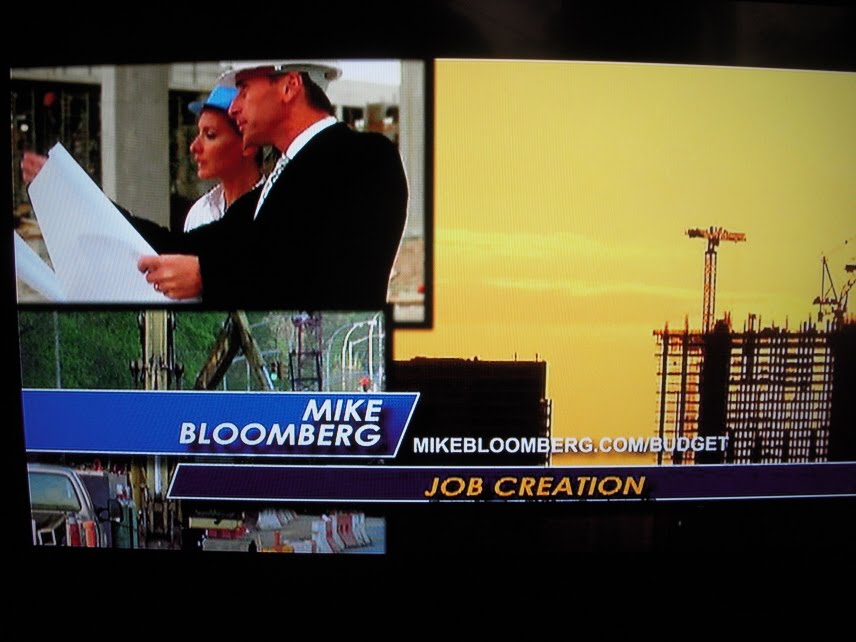
I caught one of these personally financed Bloomberg “campaign-style advertisements” the other day (it ended with the legend: “Paid for by Michael R. Bloomberg”). Whether it was nominally or otherwise intended “to bolster his battle with the teachers’ union” or “an effort to lift his sagging approval ratings” it, surprisingly, prominently devoted precious moments of its 30 seconds to promoting Bloomberg’s big, city-assisted real estate developments. We are able to discern that the ad is talking about such real estate developments from the assisting visuals (see above/below) even though the projects are euphemistically referred to obliquely only as “critical job creation projects.”

Bloomberg announced just today that he is forming a "campaign committee" to oversee his spending to promote his positions and that his spending, to date, is in the "upper six figures." Does that sound like it's about to hit one million dollars? Mailers have also been landing in peoples mail boxes but, so far, not ours.

Surprise: The Best Defense for lack Of Project Headway?


It is a surprise that Bloomberg should be promoting his city-assisted real estate developments given that Bloomberg, now into his third four-year term, has made so little headway with any of his mega-development dreams. Truth to tell, most of the `jobs’ they have so far created have been only for those in the demolition trades. With all the demolition it is perhaps not so surprising that New York is not growing anywhere near as fast as Bloomberg expected. After all, the necessary corollary to “if you build it they will come” must certainly be, “if you tear it down they will leave,” certainly if you don't replace what you tear down.

During the era of Robert Moses, another famous tear-down artist (or should we say tear-down “mad scientist” rather than “artist”) the population of the city shrank dramatically. To be completely fair, Moses was also building a lot during this era, though much of it for cars that helped accelerate the departure from the city Moses' other policies were helping to foster.
The projects initiated under Bloomberg have all so far involved mostly just destruction: Atlantic Yards, Willets Point, the Columbia University’s takeover of West Harlem, Coney Island. Hudson Yards on the West side of Manhattan does not involve destruction except to the extent that its oppressive scale will likely detract from the benefit it will provide long term. But even though that particular mega-project did not require any Bloombergian-brand destruction to proceed, it has not preceded.

Even the most necessary projects that Bloomberg was handed as relatively ready to go when he took office have languished, Moynihan Station (which could be helping to jump-start the languishing Hudson Yards) is one key example. The very slow-proceeding replacement of buildings at the World Trade Center site should also be mentioned as one of the most unfortunate examples of a blank slate. We are now approaching the tenth anniversary of that site’s demolition and Bloomberg, who took office only months after 9/11 has been in office almost that entire time. Bloomberg’s focus in that neighborhood was: i.) sending federal Ground Zero funds to his pet Waterfalls project, and ii.) the special benefits and variances his administration gave allowing an extra large Goldman Sachs building to go forward across the street from the Ground Zero site where it would override and diminish the quality of the carefully thought-out Battery Park City plan while competing with the Silverstein Ground Zero buildings.

Similarly, Brooklyn Bridge Park was ready to proceed when Bloomberg took office but Bloomberg only got started with it when he was electioneering for his third term. See: Monday, May 24, 2010, Looking a Gift Horse in the Mouth? An Examination of Brooklyn Bridge Park in Terms of the Politics of Development, Part I. And attention to proceeding with building upon the vacant riverside expanse at Queens West was neglected while the Bloomberg administration preoccupied itself with the Olympics bid and what it might tear down elsewhere.

Surprise: The Best Defense for lack Of Jobs?

It is also surprising that Bloomberg is advertising his languishing city real estate projects as “job creation projects” given that, for instance the Atlantic Yards arena is now mainly famous for the jobs it isn’t creating while the housing to be constructed is now conspicuously in the news for the cutback in jobs associated with the developer’s announced intention to shift to modular construction, building the tallest modular building in the world (if this pushing-the-limits of technology is permitted), and perhaps making the densest area of North America a forest of such units.

Even if one focuses on the construction industry jobs stimulated by the Bloomberg administration’s massive up-zonings of certain areas around the city, those temporary construction jobs must, in areas like Williamsburg, be weighed against the many blue collar jobs were simultaneously lost with the abrupt and total zoning changes that were passed. Now in Williamsburg there is an oversupply of new luxury units along the water while just a little further inland we witnessed a wholesale abandonment of new residential construction projects (caused by the financial crisis) lying fallow on formerly occupied industrial sites that provided the kind of jobs and economic activity that would likely have survived that downturn.

How NOT to Produce an Affordable City

It is true that economic growth fosters population growth, but perhaps more important, population growth (and sometimes economic growth) is spurred by affordability. There are only so many wealthy people in the world. The parts of the country growing the fastest are generally where new residential units can be produced quickly and cheaply. In theory, the Bloomberg administration is interested in generating many new units in order to foster growth. But Bloomberg’s destructions do not necessarily result in an increase of affordable units. They are more of a churn, or something worse. Atlantic Yards provides a sorry example.

Atlantic Yards involves tearing down existing housing units, many of them exceedingly affordable, and replacing them, in time, with a greater number of less affordable units. While those units will be replaced in time, in the interim they are being replaced with nothing at all. (The interim will involve several decades during which we can measure an associated population drop.) Even if the units are eventually replaced as planned they will be replaced by diverting and misallocating housing subsidies from other projects where those subsidies could be more effectively used to provide more affordable housing (more of it and at lower cost) without the destruction of existing units involved at Atlantic Yards.

The Percolated Popping of the the Population Projection

Bloomberg’s preoccupation with a predicted growth of the city’s population began at the very beginning of his second term. At his second inauguration on January 1, 2006 (lack of progress building at Ground Zero was already an issue) Bloomberg made the point then that, “our population is at an all-time high.” That same month Bloomberg disclosed that city planners were drafting a strategy to deal with this expected growth and then in mid-February the administration officially announced that the population was expected to go from what the administration then estimated was a record 8.2 million at that time to nearly 9.4 million in 2025. (See: By 2025, Planners See a Million New Stories in the Crowded City, by Sam Roberts,
February 19, 2006.)

Was the city’s population then really the 8.2 million the administration says it was in January of 2006? The brand new census figures state that the city’s population grew only 2.1% in the last decade and is currently 8.175 million, lower even than what the administration estimated in 2006. The Bloomberg administration is disputing the new census figures, in part because the lower than predicted numbers found by the census may cause the city to lose aid, but there is thinking that these numbers may be right. Back around the time the city promoted its 8.2 million estimate it had also been disputing lower numbers found by the census and lobbying the Census Bureau for revisions to adjust the numbers upward, with success. According to the Times, writing in early 2006:
The latest official census figures actually showed a slight decline in New York State's population. But, on the basis of housing construction, the city has successfully challenged recent city estimates, and the Census Bureau has accepted the city's figure of 8,168,338 as of 2004.
No matter whose figures you take that would mean that the city population has been hovering at a nearly unchanging level since 2004.

The census had accepted the boost to that 8,168,338 in the fall of 2005 based on statistical work done by the director of the population division of the Department of City Planning, and his colleagues in other branches of city government, Joseph J. Salvo, and according to the Times, “his colleagues in other branches of city government.” (See: With New York Help, Census Finds 64,000 New Yorkers, by Sam Roberts, October 4, 2005.) These administration officials found another 64,259 New Yorkers (“as many people as live in all of Santa Fe, N.M.,” points out the Times) not by use of statistical sampling, but instead uncovering “housing units and people that the census had missed.”

The Times article quipped:
The revisions have also propelled Dr. Salvo's name into the lexicon of American demography. John H. Mollenkopf, director of the Center for Urban Research at the City University of New York Graduate Center, called it "the Salvo effect."
The problem, in retrospect is that the census is unlikely to have missed the same units all over again when doing the new census just out. Also, back then the figures were interpreted to mean that as contemporaneously reported by the Times, “between April 2000 and July 2004, the number of New Yorkers grew by a total of 160,060, or 2 percent.” In other words, in four years the city was supposed to have grown the same 2 percent it is now suspected the city actually grew in the entire last decade.

The census now estimates that the city grew only 2.1% in the last decade. At that rate, it will take the 8.175 million population the census now estimates to be the city’s population until the 2080 decennial census to reach the 9.4 million figure the Bloomberg administration, in 2006, estimated the city would reach in 2025.

When in February 2006 the Bloomberg administration released its prediction that in the next 19 years the city would grow by another 1.2 million those projections were closely linked with Bloombergian rhetoric calling for major development throughout the city. In April of 2007 the Bloomberg-projected growth was included in the unveiling of the what is referred to as Bloomberg’s 2030 Plan or PlaNYC Although the Estimate of Growth Was Ever So Slightly Moderated. (See: Mayor to Unveil 25-year Outline for Greener City, by Diane Cardwell and Charles V. Bagli; William Neuman contributed reporting, April 20, 2007.) The Cardwell/Bagli times article about the mayor’s Earth Day hyped new plan opened with the population projection:
With New York's population expected to grow by one million in two decades, Mayor Michael R. Bloomberg will call on Sunday for a raft of ambitious and sometimes contentious proposals that are intended to ease traffic congestion, reduce air pollution, build housing, improve mass transit and develop abandoned industrial land.
Let’s see: 2007 plus two decades would be a population of about 9.4 million by 2027. The Mayor’s actual website for the plan is only a tad more circumspect in its estimates:
Our spectacular recovery has catapulted population to a record high - 8.2 million. By 2030 more than nine million people will live in New York.
Interestingly, since the new contradictory numbers were released by the Census Bureau the city has changed neither this text nor the accompanying chart showing the city reaching about 9.12 million in 2030. (See image below.- If corrected the second green triangle approximately over 2010 should be down more or less level with the blue square over the year 2000.)
(Chart from PlanNYC website.)

Bloomberg's Record on Statistics

Inaccurate representation population statistics should be added to a growing list: While the Bloomberg administration proudly revels in its image of having a hard-nosed statistics orientation, in October of 2009 the Times ran three separate stories about different areas where figures being provided by the administration diverged from reality. Its numbers were reportedly off in the areas of: School test score improvements, addition of affordable housing units (as many were being lost as created), and the lack of job creation and quality job creation.

Bloomberg’s police statistics are also in question.

Arguments For Growing the City Are Good

It is not that development and growth in New York City isn’t a good thing. It is. Among other things, more people living more densely in cities is good for the environment. Also, as Jane Jacobs pointed out in her Economies of Cities, city dwellers are also more economically productive and creative of new technologies. Much of the entire world economy takes place in very short list of the world’s largest cities. The world’s largest 150 cities account for only 12 percent of the global population right now, but they account for 50% of global GDP (“Gross domestic product”) or economic activity and that percentage is headed even higher. (See: How much global GDP do the world's 150 largest cities account for?, Marketplace Morning Report, Wednesday, April 13, 2011.) GDP isn't a perfect measure of value but that figure does communicate the gist of the idea that cities are productive places.

So there are reasons to strive to allow New York City to grow. But there are plenty of opportunities for the city to grow without the accompanying Bloomberg-style destructions.

The Absence of Population Growth Under Bloomberg

Why hasn’t the city grown significantly under Bloomberg even as he announced that this is what he has been directing his efforts towards? The February 2006 Times story initially announcing Bloomberg’s grand projections contain a clue, a quote from Robert D. Yaro, president of the Regional Plan Association:
“One way to keep these forecasts from happening is to make it prohibitively expensive to live and work here.”
This is essentially a pithy recap of what we reviewed earlier in this post with the precept that population growth (and sometimes economic growth) is spurred by affordability.

Is New York getting to be a more expensive city? Here is another window into the economy from September of 2007 to help answer that question:
Since Mr. Bloomberg took office in 2002, the city budget, adjusted for inflation, has swelled faster than it has under any other mayor during the last 27 years, increasing by 23 percent, to $60 billion.

By contrast, spending rose 8 percent during Mayor Rudolph W. Giuliani’s eight years, and 4 percent under Mayor David N. Dinkins, who served one four-year term. Mr. Bloomberg’s spending also outpaced that of Mayor Edward I. Koch, who increased the budget by 19 percent over his last two terms.
(See: Under Bloomberg, Budget and Revenues Swell, by Diane Cardwell, September 17, 2007.)

The point is not that Bloomberg increased spending 23 percent when the population was increasing less than 2 percent. The point is that he was able to do it and how he did it. He increased borrowing (which was appropriate after 9/11) and eventually raised taxes, fines and fees. The thrust of the above Times article is that Bloomberg’s salvation for all the extra spending was on the revenue side:
“He does look to the revenue side to meet needs,” said Charles Brecher, research director at the Citizens Budget Commission, a business-backed research group and a co-author of “Power Failure,” which studied New York politics and policy from 1960 to the early 1990s.
The revenue came mainly from the economy which is to say that it came from the concurrent Wall Street and real estate booms. Much less came from new fees and taxes:
Although the rise in revenues is overwhelmingly due to growth in the economy, roughly 15 percent of the increase resulted from Mr. Bloomberg’s imposition of new taxes* and fees, primarily the property tax increase, according to an analysis by the Independent Budget Office, a publicly financed research and policy agency that does not report directly to the mayor.

(* On of the subheads that appeared on the screen during Bloomberg-financed commercial was “No New Taxes”.)
Ironically, at the time Mark Page, then the city’s budget director, posited that there was “a major increase in revenue that has enabled us to cut taxes and spend more” resulting from a growth in the economy and the population. There have been a few things Mark Page wasn’t right about but given that it now looks like the population apparently wasn’t growing significantly, for Mr. Page to be at least partly right about this assessment of the city’s budget dynamics which he was in charge of understanding, revenues must have grown without the population growing.

There are two not so comforting answers to how this could be so. One is that, as Noticing New York assessed before, much of the revenues were short-term, up-front revenues derived from the real estate building boom. That is a problem because this short-term revenue is taken in all up front and as it is fluctuating or volatile it can at any time cease for long periods. It is also a problem to the extent that the revenues are derived from (and place a premium on continuing) a churn where existing city assets that are torn down are not necessarily replaced with assets that are equal to or better than those being lost. (Remember that with Atlantic Yards and the Columbia takeover of West Harlem there will be long intervening periods when we will get nothing.)

The other discomforting answer is that the revenues have been coming from the super-hyped up Wall Street economy. That economy, which faltered briefly during the financial crisis before it was saved by a rescue package targeted to its preservation, may one day suffer more permanent setbacks. Some of the ubiquitous new hedge funds may be creating and exporting world-wide value depending upon their particular operations. But surely others may be better compares with high-stakes gambling operations that reshuffled wealth to those spinning the wheel. How long are we to rest assured that these routines will be permitted to continue?

Surely push-back against the industry is a possibility when the operations of our urban financial centers are viewed as exporting to the rest of the country, and other nations like Iceland and Ireland, the impoverishment of crashing bubbles.

More Rich New Yorkers, A Group Apart

In the meantime those hedge funds pay taxes and generate some very rich New Yorkers. That does not necessarily mean that the city is more affordably attractive for the rest of us. Though the Wall Street incomes are going up, New York Area Median Income (the mid-line income level that 50% of us are above and 50% below) has been relatively stable. The annual median income figures that HUD uses to determine housing program eligibility have the New York area’s median income going up 10.85% (before adjustment for inflation) from year 2000 to year 2010, from $56,200 to $62,300. (The HUD figures involve occasional anomalies too complicated o explain here but these figures are fair and representative for the discussion here.) Meanwhile, according to figures from Edward L. Glaeser, whom we will say more about in a minute, average per worker income in Manhattan (total salaries divided by population) has been going up at a far faster rate than nationally and far faster than the area median income figures just recited:
Between 2000 and 2008 (the latest year available from County Business Patterns) payroll per worker in Manhattan increased by 35 percent (7.8 percent in real terms — that is, after adjusting for inflation) to $102,000. Over the same period, national payroll per worker increased by 25 percent (for no real gain) to $42,000.
Glaeser’s figures are only the 2000 to 2008 years available to him. The HUD New York area median income figures for those same years went up from $56,200 to $59,700, or 6.22% compared to the 35% average income figure increase presented by Glaeser. Glaeser points out that in real terms, after adjusting for inflation his figures represent a 7.8% increase. After adjusting for inflation the HUD figures represent a 14.2% decrease in buying power. While these figures may be challenged as less than perfect for exact comparisons they clearly do well enough make a point that people probably generally sense anyway, that measurable incomes are going up at the upper end of the New York income spectrum with the average salary being dragged up by Wall Street’s salaries but declining for the typical Joe.

Edward Glaeser, an economics professor at Harvard, blogging in the Times notes three things about the residential unit count in New York City that explain the population’s rise by a mere 167,000 individuals in the last decade:
1. “the city ended up adding only 170,000 units over the decade, a 5.3 percent increase”

2. “Typically, population increases by a few percentage points less than the housing stock increases because of shrinking household size”

3. “the city’s measured vacancy rate increased to 7.8 percent in 2010 from 5.6 percent in 2000, which means 80,000 fewer units being occupied” (In other words of the only 170,000 units added over the decade there was a net addition of only 90,000 occupied units.
(See: March 29, 2011, The Census Surprise in New York, by Edward L. Glaeser.)

One thing to note about the 7.8 percent vacancy rate Glaeser cites is that it is an average vacancy rate and that, because of rent regulation, vacancy rates tend to be higher at the upper end of the market where market prices prevail more often rather than being held artificially low in the case of many regulated units. That means that an even greater proportion of the vacant units are likely to be amongst the new supply of luxury units added by the Bloomberg administration policies.

Luxury living also suppresses population in relation to the housing supply in another way: Disproportionate increases in wealth can also effectively empty space (akin to what you get with shrinking family size) when, for example, the wealthy hedge fund manager decides to empty a Brooklyn Heights building that was previously occupied by ten families in order to reoccupy it with his or her family as a private townhouse, or similarly when a wealthier family buys and intends to occupy three apartments in a cooperative rather than one. If the market isn’t building additional units for the people getting pushed out the result will be higher housing prices and/or people leaving the city.

There is a theory about adding to the housing supply known as “filtration.*” It is a rough cousin to the theory of “trickle-down economics.” The idea is that the superior purchasing power of those in the upper end of the market can be harnessed to generate the construction of additional new housing units (much like construction the Bloomberg administration considers it is fostering) and the rest of society can benefit as older units are cast off by the upper classes. But this theory isn’t going to work the way it is supposed to if disproportionate increases in income at the upper end of the spectrum result in proportionately greater consumption of housing by the wealthy, say for example by buying infrequently occupied pied-à-terres.

(* “A survey that he conducted when he was a city housing official, Dr. [Frank S.] Kristoff [formerly chief housing economist in the Wagner and Lindsay administrations] said, showed that there were 2.4 moves within the city for each unit constructed. `If you build for the market, very effective filtration takes place,’ he said.” - See: Private Sector Is Paralyzed In Housing Slump Here; Nonsubsidised Housing Still In Slump,
by Alan S. Oser, February 15, 1970.)

Show Me the (Lack of) Money!

(Note: The Albany Times Union story selected for its headline about state fiscal woes appeared just days after this Atlantic Yards Report story about how Bloomberg appointees had neglected their fiduciary duties as board members in raiding funds from the MTA for the developer of Atlantic Yards.)

Bloomberg’s self-financed commercial (that we originally started talking about) begins with a whiny complaint focusing on how New York City has run out of money and positing that it's not Bloomberg’s fault:
New York City: For decades we’ve sent billions more of our tax money to Albany than we got back. Now a state budget crisis is leading to hundreds of millions in budget cuts, cuts that threaten New York City teacher layoffs.
“Billions” . . “hundreds of millions”: It would be good to put such figures in perspective.

Bloomberg called the state budget an “outrage” when upon its announcement the city estimated that it got only about $200 million in benefits from the state budget of the $600 million the city requested. And, as highlighted in an ensuing City Hall press release, Bloomberg focused in on $300 million in revenue-sharing funds directed to the city that the new state budget was cut out.

The federal budget cutbacks in progress will also affect the city but, unlike the state budget cuts, the Bloomberg administration has gone low profile about criticizing them. Prior the April 8, 2011 compromise that averted the threatened shutdown of the federal government there were estimations that the city would be sorely affected by the federal cutbacks. (See: Republican Federal Budget Would Force Huge Spending Cuts On New York City, Gus Lubin, Jan. 25, 2011.) After the compromise there were brief announcements passed on via local radio that Bloomberg officials were studying the effect of the cuts on the city but subsequently there has been no New York City follow-up (although the projected negative effect on New Jersey cities across the river has been covered). Is Bloomberg’s low profile on this related to presidential ambitions?

Pending what more we might hear about this from the Bloomberg administration, here are the kinds of figures from proposed federal cutbacks that were of concern prior to the compromise: $150 million more cuts for the MTA, a $5 million cut for law enforcement, and a $9 million loss in pre-K Head Start funding.

All of these figures, the $300 million loss in state aid, the proposed $150 million + $5 million + $9 million cuts in federal aid are offered to put in perspective the $2-$3 billion being spent on a mega-monopoly like Atlantic Yards. Atlantic Yards is all being handed to one developer without bid. (See all the piles of cash in the Bloomberg commercial image above?)

It is true, the exact figures of what Atlantic Yards will cost haven’t been recently re-calculated (with shifting facts they ought to be) but the casualness with which the duty to calculate such figures has been ignored by the Bloomberg administration is part of the problem, together with the fact that the administration has never forthrightly and honestly presented these costs to the public. $2-$3 billion, my own calculation (that allows substantial room for error within the $1 billion range stated) is still accurate.

Not all of that $2-$3 billion will be spent in one year, as with other figures cited earlier which are annual budgetary amounts. It is also true that not all of the $2-$3 billion is city money (it is a co-funding mixture of city, state and federal money) or that it will all be spent during the three terms of the Bloomberg administration, but it is true that through his actions as mayor Bloomberg is seeking to commit the public to a totality of expenditures in that amount while he is in office.

The Core of the Problem With Bloomberg's Mega-Projects

These expenditures are a red flag advertisement to state and federal officials that the city doesn’t seriously need money, that when we have it we can afford to spend it frivolously even when we are advancing the most substantial portion of that for a basketball arena (the Ratner/Mikhail Prokhorov arena) which it has been calculated will result in a net loss to the public. That net-deficit-to-the-public arena was recently declared the “core of the project” in the state senate hearing testimony of Kenneth Adams, the man nominated to run ESDC, the state agency theoretically overseeing the project, thereby with Bloomberg’s aid, getting around the city reviews of and public participation that would otherwise have been required.

Merriam Webster provides these definitions for what Mr. Adams likely meant when he referred to the arena as the “core of the project” (I don’t think he was analogizing to the stripped-away inedible remainder of piece of fruit somebody might hand you):
• a central and often foundational part usually distinct from the enveloping part by a difference in nature
• b : the essential meaning : gist
• c : the inmost or most intimate part
The "most intimate part" sometimes means or implies the most `honest' or part or part most honestly representational of the whole.

Or similarly from Dictionary.com:
• the central, innermost, or most essential part of anything.
If such a money-losing frivolity as the arena is “the core” of the significant large-scale expenditures Bloomberg is mobilizing, why then should the state and federal government send more money our way? And with money being spent so frivolously by Bloomberg, is it any wonder that the city, pursuing policies with the rhetoric of intending growth, has become too expensive for a growing population to reside here?

Bloomberg self-financed a 30 second advertisement to laud his accomplishments. Imagine what we might have had to talk about in this post if the ad we were considering had run a full minute.

Friday, April 15, 2011

Snow Job? Is Bloomberg, Under Oath, Actually Criticizing His Own Work Ethic?

It is almost as if the rules for New York Times reporters writing about Mayor Michael R. Bloomberg are specially laid out in a secret style manual- - The paper has gotten into an infuriating habit: It strolls to the very brink of making a connection that, if overtly expressed, would be an obvious insult to the Mayor. Then, instead of making that connection, as if out of polite deference, it stops just short but furnishes enough of a hint or innuendo such that those who read political news carefully and consistently and with a certain amount of recollection can make the connection themselves. Others will find things sailing over their heads.

An example is in today’s paper in the Times story about Bloomberg’s grouchily sarcastic demeanor when being deposed in the federal discrimination lawsuit brought by the Equal Employment Opportunity Commission against his Bloomberg L.P. media conglomerate. (See: Mayor Shows His Testy Side in Deposition for a Lawsuit, by David W. Chen, April 14, 2011.) The story was on the verge of a spectacular closer after covering Bloomberg’s testimony about his conglomerate’s hostility towards their female employees who take maternity leave or are interested in working from home. (Alternately, Bloomberg thinks that if women instead go to work for a more understanding competitor they are traitors.) The Times got so close and then shied away from concluding with the really stinging observation that could have had everyone talking.

Here is the button the Times opted for instead:
Still, one line in Mr. Bloomberg’s testimony sounds prescient, given the mayor’s recent experiences with winter weather.

When asked about whether he felt that working from home made “good business sense,” Mr. Bloomberg said no, then added, “I’m sure we made exceptions if somebody had a physical problem or there was a snowstorm and they couldn’t get to work or something like that.”
That reference to Bloomberg’s mismanaged snowstorm handling may sound unflattering enough in itself. However, who but the most astute cognoscenti amongst the Times readers are going to remember that part of the issue riling the public during the snowstorm was that Bloomberg himself was `phoning it in,’ working not so much “from home” but from his vacation-spot, extra home in Bermuda (or the private plane he uses for his regular Friday commutes to the island).

Bloomberg defended his phoning it in this way back in January:
"The important thing is you are in communication. I not only have my cell phone, you have a police detail with you with all sorts of communications all the time. And to the best of my recollection in nine years there has never been a time when you couldn't communicate"
(See: As Storm Approaches, Bloomberg Says He is in Charge of City, Wherever He is, by David Freedlander, January 11, 2011.)

For more about Bloomberg phoning it in during the snowstorm see: Mayoral Sign-Out Sheet? Secretive Jaunts Spur a Thought, by Michael Barbaro, February 6, 2011. That earlier Times article tells you everything necessary to piece together the fact that Public Advocate Bill de Blasio almost certainly became, as a formal legal matter, the acting mayor while Bloomberg and his deputy mayors were away during the storm but that nobody ever informed de Blasio or anyone else of that fact. Once again, it’s all there in the Times write up, but again, only a careful and knowledgeable Times reader is going to pick up this astonishing tidbit given the polite deference with which the information is presented.

Wednesday, April 13, 2011

New Bike Map Is Out: In Microcosm the Conflict of City Planning Policy Re Car-Oriented Atlantic Yards

The new 2011 bike map is out. As our constantly changing city shape-shifts into new incarnations, the map presents in microcosm public policy conflicts respecting the transportational characteristics planners want the city to assume in the future.

The annually revised bike map (also available in a web version) is distributed “FREE” by the city’s Department of Transportation. (Authorship credit is also given on its cover to Jenette Sadik-Kahn as DOT Commissionner, The City of New York- Michael R. Bloomberg, the Department of City Planing- Amanda M. Burden, FAICP*, Director, and Department of Parks and Recreation- Adrian Benepe, Commssioner.)

(* Fellow of the American Institute of Certified Planners)

Its free distribution represents an aspirational endorsement by city planning officials of this form of alternative transportation. In support of this goal the city has also been designating and creating more bike lanes around the city than ever before.

The interesting thing about this year’s map is its cover, celebrating brownstone Brooklyn with a picture of the Hoyt Street bike lane going through Cobble Hill. The intersection shown is Hoyt Street and Dean. Dean Street is another street providing bikers with a bike lane route through what is currently brownstone Brooklyn.

Ironically, the Hoyt and Dean intersection is just .6 miles or 3 minutes away from the car-centric (and parking lot-centric) Atlantic Yards megadevelopment proposed by developer (and heavy subsidy collector) Bruce Ratner of Forest City Ratner (now working in conjunction with Russian Oligarch Mikhail Prokhorov). The negligible distance can also be measured as the distance of four long blocks and one very short one.

If this distance doesn’t strike you as short, if it seems enough to put Ratner’s mega-monopoly at a safe and sufficient remove, we can also put things into perspective this way: It is actually less than the .7 mile distance one will need to travel to get from one corner of Ratner’s vast mega-monopoly to the other. Remember also that bikers using the Dean Street bike lane will have their brownstone reveries interrupted for a couple of blocks when they have to travel alongside the intimidating and unprecedentedly dense Ratner/Prokhorov car-oriented Atlantic Yards design (and planning) fiasco. That is, of course, if New York politicians continue to let Ratner/Prokhorov continue building it for the next several decades, piling on a rich slather of disproportionately favorable subsidies.

(Above, the same two areas shown together on the new bike map. Below, the Dean Street bike lane approaching the Atlantic Yards site.)

Even if the building stops (or however slowly it goes) the result will be car-oriented since the much unnecessary destruction that has been Ratner's plotted prelude to everything (like demolishing Ward Bakery building) will present the public with acres of traffic-generating parking lots in the interim.

(Picture: Rendering by the Municipal Art Society- for its Atlantic Lots- showing the teardown of the neighborhood the project plan involves -Original Aerial Photograph by Jonathan Barkey.)

This very expensive planning boondoggle didn’t have to be car-oriented. It makes no sense for it to be so. The proposed Ratner project sits atop a confluence of subway lines. One way we know that is that, among the freebies Mayor Bloomberg (via his representation on the MTA) gave to Ratner to subsidize his 30-acre mega-project is the naming of not one, but two very sizable subway stations.

Saturday, April 9, 2011

Add To Bloomberg’s Other Mistakes: Mistakes In NOT Acknowledging Mistakes, Including A Certain Ratner Mega-Monopoly

The blood is in the water. Right now Michael Bloomberg’s poll numbers are way down in the dumps and the press is finally picking away at the tatters of the myth of his infallibility. The New York Times says that Cathie Black’s forced resignation on the 95th day of her ever so brief (but hard fought) tenure is Bloomberg’s “most embarrassing reversal yet.” It then adds to the list of his recent reputational woes “botched snow removal” (not mentioning the exacerbation of Bloomberg insistence on keeping secret* all information about his plane’s concurrent trip to sunny Bermuda) and the “CityTime automated-payroll scandal, with its hundreds of millions of dollars wasted and tens of millions allegedly stolen by contractors.” (See: News Analysis, Ever-Growing Image of a Stumbling Third Term for Bloomberg, by David M. Halbfinger, April 7, 2011.)

(* Public Advocate Bill de Blasio may even have officially been acting mayor for a while without ever having been informed about it!)

Atlantic Yards on the Parade of Hits

The list of Bloomberg’s errors in the Times analysis continues together with additional toothsome details about why those various failures should especially rankle and irk the public. The top-listed complaints in the Times article coincide with those cited by City Council Member Tish James, who adds as an additional headliner (in a website statement) the ever more ill-fated Atlantic Yards Ratner/Prokhorov mega-monopoly, describing how “many would consider this the third term curse.” (Friday, April 08, 2011, Council Member James: departure of Cathie Black, along with Atlantic Yards, a sign of Bloomberg's "third-term curse")

A Curse Paid For Upfront

The third term suffering this curse is, of course, the one Bloomberg earned so disreputably first by overturning the City Charter provisions prohibiting it and then by spending over a hundred million dollars of his own money to campaign, more than ten-fold what his opponent, William C. Thompson, was able to spend. In fact, depending upon what spending you included in Bloomberg’s expenditure to assume office (including charities and targeted contributions to various other politicians, political parties and potential endorsers) the ultimate tally is potentially far higher, verging on the order of a billion. Bloomberg even gave between$43 million and $51 million in public and personal subsidies into a museum project led by the wife of his opponent worked (some of it very late in the campaign).

All of this money needed to be spent by Bloomberg to promote the ostensible rationale by which, with a City Charter change, Bloomberg needed to elected to his accursed third term: That no one else had the management expertise to guide the city at that time.

Previous Myth Debunking

Noticing New York has often tackled the task of debunking Bloomberg’s myth of managerial magnificence. The most recent reviews of the subject (linking back to prior NNY posts similarly analyzing the myth) were occasioned by recent CityTime mismanagement schedule which hits very close to the core area of Bloomberg’s (formerly) vaunted private sector expertise: the development of computer management and information systems. (See: Saturday, March 26, 2011, The Myth Of Bloomberg’s Management Expertise Reexamined: What Happens When Government Doesn’t Manage Its Programs and Monday, March 28, 2011, Take TWO (AYR’s) On Times Coverage- Revisiting Light Shed by CityTime Outsourcing Scandal When Reexamining Bloomberg Management Myth.) The second of those two recent articles compares the strongest attributes for which publishing executive Cathie Black might have been picked with publishing executive Michael Bloomberg’s: A facility with sales and promotion, in both Ms. Black’s and Mr. Bloomberg’s case, particularly an unabashed willingness to self-promote. (Check out Bloomberg's "Mike.gov," "Mike.org," and "Mike.com.")

Atlantic Yards Mixed Deep Into the Stew of Mistakes

The first of those Noticing New York two stories focuses on Bloomberg’s willingness to delegate to the private sector tasks that inherently need to be done by government and thus makes a link to Bloomberg’s misguided practice of delegating, with virtually no oversight, the development of large swaths of the city to private developers. The prime example is the city’s grant of a 30-acre monopoly over prime Brooklyn real estate to Forest City Ratner, when it gave the Atlantic Yards mega-project to Ratner without bid. The second story cemented the Atlantic Yards connection, picking up on Atlantic Yards Report’s observation that Bloomberg's budget director, Mark Page, was responsible for pushing through both: i.) the scandal-ridden CityTime contracts, and ii.) the continued uncontrolled outsourcing of the Atlantic Yards megadevelopment (again as a monopoly and again without bid) to Forest City Ratner in June 2009, in a very substantial revamping of the project, a revamping entirely for the developer's benefit.

That brings us to Bloomberg’s mistakes overlaying all his others, the failure to acknowledge mistakes.

Bloomberg's Admission of a Mistake Billed as Something New

The recent Times article about Bloomberg’s mounting third term stumbles contains the following about Bloomberg’s acknowledgment of mistakes:
William C. Thompson Jr., the former comptroller who lost the mayor’s race to Mr. Bloomberg in 2009, said he also noted a change in the mayor’s tone on Thursday as he announced Ms. Black’s departure.

“It is a different Mike Bloomberg who finally admits to failure, and failure on this public a position,” Mr. Thompson said. “This is him saying he was wrong about Cathie Black, and that everyone else was right.”
Do we now have a different Bloomberg who is finally acknowledging mistakes? Then what about Atlantic Yards?

Bloomberg's Opportunities to Come to Terms With Mistakes Go Back At Least to 2008

This brings us back to Noticing New York coverage on the subject of Bloomberg’s acknowledging his Atlantic Yards mistakes, circa October of 2008. The article was critical of Bloomberg’s then-recent announcement that he was seeking a third term. (See: Wednesday, October 1, 2008, Coming to Terms With Mistakes.)

Here are some quotes:
Coming to Terms with Mistakes

The most pronounced downside of a Bloomberg third term involves a need to acknowledge and correct mistakes. . . .

* * *

Here is a press conference question for Mayor Bloomberg: Does he acknowledge any mistakes and, if so, is he willing to correct them?

* * *

There is another philosophy of decision-making to which I suspect Bloomberg subscribes. It is more prevalent in the less bureaucratic business world: “Better a bad decision than no decision at all.”

The question is, when you have made a bad decision, what do you do about it?

Should we have to live with the mistakes produced by badly made decisions? No matter what?

* * *

The Uncorrected Mistake of Atlantic Yards

Atlantic Yards is probably Bloomberg’s supreme mistake. . . . Atlantic Yards is a spectacular example of a decision that was rushed through with improperly forced haste and it is a spectacular example of just how bad the consequences of such thoughtless haste can be.

The Bloomberg administration has implicitly acknowledged the ignominy of its failure with respect to Atlantic Yards. It did so in the way it handled the departure of Deputy Mayor for Development Daniel Doctoroff (see: Atlantic Yards As Political Hot Potato.)

However disgraceful all its lapses, the Bloomberg administration has done nothing to correct the misreckoned Atlantic Yards course it is on. Correction could be made with less difficulty than continuing through the bog in which the city is now steeped. It would be relatively easy to do what is needed which is to take the project back to the drawing board and bid it out to multiple developers. (Yes, this time the megaproject, currently 17 separate building sites, should actually be bid out.) The project is adrift, amorphously ill-defined and the developer repeatedly transgresses with unacceptable behavior that should long ago have disqualified the developer from Bloomberg’s ongoing accommodation and indulgence.
Bloomberg Mistakes Then and Now

That was then. This is now. Since that time Atlantic Yards has progressively deteriorated, each incremental degradation giving Bloomberg the opportunity to walk away from it. But that is precisely the opportunity that Bloomberg missed when, through his CityTime scandal-tarred budget director, Mark Page, Bloomberg piled additional subsidized on Ratner in June of 2009 for an even less publicly desirable version of Atlantic Yards. Those additional subsidies were piled on just weeks after Bloomberg told the press it was time to turn off the spigot and that no additional public funds should be poured into Forest City Ratner’s Atlantic Yards. He said: “We’re not putting money in. We’re going to invest our money in better schools and in safer streets and in better parks and everything else.” (See: Friday, June 26, 2009, Deciphering Words of a (Campaigning) Bloomberg on Atlantic Yards: “Enough Already” Means, “Bruce, We Have Another $180 Million Plus To Give You!)

Bloomberg still has the opportunity to walk away from the Atlantic Yards mega-project and declare it a recognized mistake. Bloomberg’s recently departed housing commissioner Rafael Cestero said that Atlantic Yards is not deserving of additional housing subsidies (it, "was not a good public investment"). Such subsidies would be disproportionate and greater than the subsidies that other more deserving projects would be eligible for elsewhere in the city. Nevertheless, given Bloomberg's very recent defense of the megadevelopment (immediately after talking with Bruce Ratner), Atlantic Yards Report is predicting that we should all gird for the awfulness of yet more subsidies for Atlantic Yards courtesy of Mr. Bloomberg. Atlantic Yards Report has an excellent record in making such calls.

Do we have a new, different Mike Bloomberg who finally acknowledges mistakes? Is Mr. Thompson correct when he says that Bloomberg is now a man finally willing to admit to failure on a public position. . and acknowledge, as Mr. Thompson puts it about Cathie Black, “that everyone else was right”?

It would be nice if we had a new Bloomberg who admits and corrects mistakes. But don’t hold your breath.

Friday, April 8, 2011

“Reverse Morality” Clauses for Celebrity Endorsers: What Are They? Something Celebrities, Including Jay-Z, Should Try Enforcing

I just listened to a CLE (Continuing Legal Education) course on the subject of morals clauses in celebrity endorsement contracts. What attracted me to learn more about that topic?

I am interested in the way that Jay-Z (in tandem with his wife, Beyoncé), financially enlisted by Forest City Ratner, have gotten themselves involved in: Promoting Bruce Ratner’s (and Mikhail Prokhorov’s) disreputable Atlantic Yards mega-monopoly. I’ve already provided Noticing New York ruminations on the subject, see: An Insert Preview - Music Superstar Ethics: How Completely You Can Sell “You can say what you say, but you are what you are.” Jay-Zzzzus! (Wednesday, March 9, 2011). A short preview of that longer article is available here.

Representing Celebrity: “Must Watch” Legal Education

The CLE course provided more food for thought on the subject. The course, “A Detailed Look at Morals Clauses in Celebrity Endorsement Deals,” available through Lawline.com, was put together and presented by Rutgers-educated Andrew Bondarowicz, Esq. “the Founder and President of Aregatta Group, a management consulting firm providing strategic planning and management services for clients in the fields of sports and entertainment, finance, and the non-profit sector.” Mr. Bondarowicz’s Lawline-provided bio goes on to tell us that: “In the past, Mr. Bondarowicz has served as Chair of the Entertainment, Arts and Sports Law Section of the New Jersey State Bar Association and as a panelist at the Seton Hall Sports & Entertainment Law Symposium.”

Lawline’s promo for the course bills it as:
a must-watch course for both attorneys representing celebrities as well as those seeking guidance on how to guard their clients from the risks involved in associating themselves with celebrity endorsers.
Scandalously Fun

The course was definitely worth the time I spent with it. And spending some time reviewing celebrity scandals can be fun. In Bondarowicz’s list: Kobe Bryant, (basketball player for the NBA’s Los Angeles Lakers team- accused of sexual assault), Kate Moss (high-profile English model photographed when it looked like she was snorting cocaine), Michael Phelps (Olympic swimmer holding the records for the most golds medals won in a single Olympics- eight in 2008- surpassing Mark Spitz’s seven in 1972, caught smoking what appeared to be marijuana from a glass bong) Ben Roethlisberger (football quarterback for the NFL’s Pittsburgh Steelers twice accused of sexual assault- in July of 2009 and March of 2010- without charges being brought), Michael Vick (football quarterback for the NFL’s Atlanta Falcons who served time for being involved in an illegal dog fighting ring.) and Tiger Woods (master golf player who got involved in multiple extramarital affairs).

Impetus to Stay 99 and 44/100% Pure

Impetus for morals clauses also came from Marilyn (Briggs) Chambers, the 1970s porn star actress who appeared tenderly holding a baby on the cover of the Ivory Snow box under the Proctor and Gamble "99 and 44/100% Pure" product slogan. If it is true that Proctor and Gamble had acquired an old stock photo of Chambers for the box, a morals clause wouldn’t have helped in that situation.

Tiger’s Out of the Woods

According to Bondarowicz, the scandal listed with the biggest financial fallout was the Tiger Woods marital infidelity scandal, “estimated to be somewhere between 5 and 12 billion dollars.” That this is the biggest amount reflects the fact that Woods, who after his scandal-related hiatus has resumed playing again, is (still) the most highly paid professional athlete in the world.

Bondarowicz says that the use of morals clauses has been growing substantially, initially having been used to deal with the risky living of Hollywood stars and then as a way to establish distance from and disapproval of “Communism.” According to Bondarowicz morals clauses are standard today in all endorsement contracts, whereas the likelihood of encountering them in 1997 was only 50%.

A Set of Concerns From Those That Are "Hard" to “Softer Categories”

Bondarowicz gives a list of proscribed behaviors, transitioning into “softer categories” that can be included as the trigger points for taking action under morals clauses that attorneys draft:
• Conviction for felony or misdemeanor

• Criminal indictment

• Moral turpitude violations

• Offensive or objectionable behavior

• Violations of public decency

• Actions that can bring public disrepute, contempt, scandal or ridicule
Do Unto Others

If you are imagining that the endorsing celebrity is the one that winds up proscribed from all of the above then you have not jumped ahead to what was of particular interest to me when I was considering Mr. Bondarowicz’s presentation: The extent to which the expectation of moral behavior should be a two-way street and that these standards might be reciprocally applied to the corporations dolling out the money for the endorsements.

I was, for instance, thinking about the possible contractual rights of Natalie Portman the Oscar-winning actress and celebrity figurehead for the House of Dior, who announced her decision to refuse to be associated with Dior designer John Galliano after his anti-Semitic rant in Paris. Galliano was promptly fired afterward, but where would Ms. Portman have stood if he hadn’t been?

Imagine the possibilities if celebrities, like Ms. Portman, by demanding principled action from corporations, could shift the standard of conduct on the part of those corporations.

Buying a Moral Image (and What Else?)

Right now things pretty much only work in reverse. Corporations don’t worry about their own behavior. (Bear in mind the earlier mention of Bruce Ratner/Forest City Ratner as an illustrative example.) They just worry about the behavior of their endorsers and thereby hope to acquire through purchase an image that they themselves may not necessarily deserve.

According to Mr. Bondarowicz (the quoted material below is from the written materials for his course):
* Most companies are trying to achieve a similar set of goals
and objectives through endorsement deals:
* Increase brand awareness or visibility;
* Appeal to a particular demographic;
* Implement certain public relations opportunities; and
* Increase product sales.
By applying these insights you can test to see what you think Bruce Ratner was thinking when he brought Jay-Z (with wife Beyoncé tucked into the bargain) into the his Atlantic Yards promotions. Likely much of the same was intended or hoped for with the invitation that got Jay-Z similarly involved in the Aqueduct Raceway scandal.

And if the star-endorser doesn’t deliver the goods? With the right morals clause the corporation gets to just dump the endorser and hire a new one who will.

Sauce for the Gander?

95% of Mr. Bondarowicz’s all-too-brief course deals with things from the perspective of corporations hiring endorsers (or at least the same thing from the perspective of celebrities who don’t want to get too badly screwed by their endorsement contracts if they are the ones to step out of line- like having to write big checks back to return their money), but there is something that Bondarowicz finally deals with at the end of his presentation that cuts the other way. It is called a “reverse morality” clause. That, counter-intuitively, while having the ring of a bad thing, but it is potentially a good one.

A “reverse morality” clause is where the celebrity, like the example given of Ms. Portman, gets to tell the corporation to shape up. What a phenomenally better world we might live in if there were people who could regularly dictate such corporate rectitude!

Growing Prevalence Escapes Enforcement

Unfortunately, while reverse morality clauses are actually becoming more prevalent (Mr. Bondarowicz’s says they were almost unheard of 20-30 years ago but are becoming popular in the post-ENRON environment) they are rarely enforced. Why not?

Mr. Bondarowicz puts it this way:
While the considerations may be very similar, it is very unlikely that morals clauses will be enforced in reverse situations mainly because the brand is the one typically that’s paying the endorser and unless you’re willing to forgo the financial implications of that deal you tend to find a way to work within the relationship. Secondly, the brand sought out the endorser to serve as spokesman for the company and in times of crisis it becomes even more advantageous to utilize the services of that endorsement to regain credibility and trust with the public.
That rather delicado lawyer-speak can be translated thus: If the endorser enforces the reverse morals clause they will lose a paycheck, but if they work something out with "the brand" to avoid the clause being triggered they just might get paid even more as they bail the corporation out in its days of crisis.

Selling Out At An Even Higher Price

This brings to mind the lyrics of Tom Lehrer’s “Selling Out” in which he sings about, what else (“Selling Out is easy to do/It's not so hard to find a buyer for you . . . sometimes you have to close your eyes”):
I've always found ideals, don't take the place of meals,
That's how it is and how it will always be!

It's so nice to have integrity, I'll tell you why,
If you really have integrity, it means your price is very high.
The Arrival of Crisis Tests and the Integrity of a Moral Philosopher

These lyrics, together with Bondarowicz’s admonitions about times of corporate crisis creating an opportunity for the endorser to earn much more, lead to some speculation about Jay-Z (and Beyoncé). Forest City Ratner is now in a time of crisis. In fact, if you apply the triggers above in the list of standards that usually apply to paid endorsers, Forest City Ratner has by the judgment of many of us crossed quite a few of those lines, at least in the “softer categories.” As for the “harder” categories, there hasn’t yet been a conviction for felony or misdemeanor or a criminal indictment, but many would convincingly argue that Forest City Ratner is dancing uncomfortably close to those triggers as well. - - Does all this mean that Jay-Z’s paycheck is going up?

And here is another thought: It has been Noticing New York's previous observation that with his “You can say what you say, but you are what you are,” aphorism Jay-Z has apparently held himself up to the rest of us as a moral philosopher. Does that, in Tom Lehrer vernacular, mean Jay-Z achieved the “integrity” of having a very high price to begin with? Might Jay-Z even have been lucky enough to have included a reverse morals clause in contracts with Ratner whereby he is now upping his ante?

Janis Ian and Natalia Zukerman This Saturday Night at First Acoustics at Brooklyn Heights First Unitarian Church

Would you like a night out to hear some great music in the neighborhood this weekend? Saturday evening at 8:00 PM you can catch Janis Ian in a return engagement in the First Acoustics series at the Unitarian Church in Brooklyn Heights. Natalia Zukerman will be her opening act.

What does notice of a local music event have to do with Noticing New York’s more typical focus on development in New York City and associated politics? - - It’s a long story (some of which is still being written). Some of it can be found via the segments linked to below:
Wednesday, March 16, 2011
Another Insert into the Music- Hands Joining Across Eras: Brooklyn Heights Unitarians and How a Historical Landmark Saved the Past For the Future

Wednesday, March 9, 2011
An Insert Preview - Music Superstar Ethics: How Completely You Can Sell “You can say what you say, but you are what you are.” Jay-Zzzzus!

Tuesday, October 19, 2010
Adding A few More Off Topic Notes (Or Are They Really?)
Here again is the information about Saturday night’s performances. Tickets are available on line. Enjoy.
Saturday evening at 8:00 PM
Janis Ian
with special guest
Natalia Zukerman
First Acoustics
April 9, 2011
All seats $30.00
For More Info

Friday, April 1, 2011

Highway Removery: Bloomberg Says “My Way Is the Highway,”- Private-Public Partnership Finally Bridging a Gulf

(The open scar of the BQE Bloomberg announced he will soon cover over via a newly announced private-public partnership.)

The Bloomberg administration just announced intentions to accelerate materialization of an intriguing part of Mayor Michael Bloomberg’s PlaNYC 2030, (which plan was announced during his second term) in order to bring about, before the completion of Bloomberg’s third term, the platforming and building over the Brooklyn Queens Expressway that separates Brooklyn’s Red Hook and Carroll Gardens. Nine new blocks of residential housing will be created. Perhaps even bigger news is that the Bloomberg administration has, with some hoopla, unveiled its intentions to implement the construction via an ambitious new form of private-public partnership, supported by charitable dollars, that it says will create a windfall for the public.

Return of the Prodigally Lost Value

Carroll Gardens and Red Hook were once just one neighborhood, formerly both together being considered the neighborhood of "Red Hook." It was only years after they were separated by Robert Moses' building of the deep, gashing trench of the BQE that now separates them that a new distinct name, Carroll Gardens, was found for what then felt like a separate neighborhood.

When the highway sliced through, property values on each side of it plummeted. The windfall of public benefit the Bloomberg administration says it is about to bring about is to reverse that precipitous decline that occurred in 1945. It is expected that by virtue of covering over the highway the value of properties on both sides of the highway will rise astronomically.

It has been noted that the Alfred Tredway White buildings alongside the BQE, built for a lower-income population (before the building of the BQE), were already being sold off as up-scale condominiums even before this announcement. Those buildings were busy going up in value before the BQE was built and went way down again in value for an extended period after Moses put through the road. As the Alfred Tredway White structures were already back to selling for nearly top dollar, local real estate brokers are projecting that these and other properties have nowhere to go but to skyrocket up stratospherically.

(Below: Alfred Tredway White buildings as they currently stand beside the trench and drawn as originally conceived before the trench sliced through.)


Value that Might Be Parked

Jumping with sharp-eyed alacrity into the unfolding events, State Senator Daniel Squadron has co-authored a proposal with Assemblywoman Joan Millman: They are urging that the envisioned windfall increase in values be captured with tax increment-financing to divert the resulting increased property taxes to pay expenses for the Brooklyn Bridge Park. Noting that the building over the BQE will be taking place just blocks away from the park, Squadron observed that the new structures being erected will greatly expand the population accessing and benefitting from the park every day. Squadron pointed out that, in all probability, the reason the Bloomberg administration now found it attractive to accelerate this proposed development was because of the world-class contributions the park would be making to neighborhood aesthetics and amenities.

Bloomberg immediately took issue with the Squadron/Millman proposal. Caught off guard when he was at a City Hall Press conference he was holding about raising money with Beyoncé for Haitian earthquake relief, Bloomberg said that people should be reminded that he gained exclusive control over the park as a result the recent deal he made with Governor David Paterson when Paterson was a beleaguered lame duck (albeit Bloomberg’s control is through an obfuscating tangle of authorities created by the state’s Empire State Development Corporation). Bloomberg said he didn’t want anything interfering with his plans to have development in the park pay for the park and criticized Squadron and Millman, saying that it should be inconceivable that property taxes from any valuable properties within city border should be diverted from the city’s general fund where they can be used to pay for police, fire and public (and privatized) charter schools. Contacted afterward for comment Squadron retorted with a combative query: “Isn’t that exactly what Bloomberg is doing with development in the park; creating lots of residential towers that will be off the official tax rolls and diverting monies from the city’s general fund?”

For many, the platforming over the BQE is considered long overdue. Although it was included as an element of the mayor’s 2030 plan, the idea had been urged long before that, including some serious discussion in 1980. Above is an image from architect Susannah Drake from her DLANDSTUDIO, whose proposals preceded the mayor’s adoption of them into his plan (the above envisioning is only a park- no buildings). Ms. Drake is also proposing that the BQE trench be covered in South Williamsburg. Ms. Drake, President of the New York Chapter of the American Society of Landscape Architects, is also responsible for spearheading the creation of sponge parks along the Gowanus Canal, that would clean up that waterway with the construction of planters and remediation basins alongside the canal — underneath pedestrian esplanades . (Video here.)

Density Needed

Not everyone in the community is in favor of the new housing the mayor just announced: Some only favor platforms without housing to connect the neighborhoods (perhaps interspersed with substantial open gaps to vent car exhaust- see image below). While it is agreed that either plan would create the envisioned substantial benefits of rising property values in the adjacent neighborhoods being reconnected, Robert K. Steel, the mayor’s Deputy Mayor For Economic Development, said that only the housing plan would pay for the platforming over the ditch and that would be only if the housing is built at a super high density. “Ideally,” said Mr. Steel, “we’d like to be building at a density that pays for about 297% of the platform's cost.” Mr. Steel emphasized that in determining the appropriate density at which to build over the ditch, external benefits (or detriment) to the surrounding neighborhood would have to remain out of consideration as part of the equation to justify whether to proceed. Mr. Steel said that, failing to proceed with the increased density housing proposal, the city would be back to its recently “retrenched” proposal (pun intended) where the city would just plant more nearby tress and perhaps hang a few planters along the infamous urban auto gorge.

(Architect Susannah Drake's image of an only partially covered highway.)

Mayor Bloomberg Leads Private-Public Partnership to Effect the New Development

In order for the public to get the proclaimed windfall without delay the Bloomberg administration has announced that Mayor Bloomberg will himself undertake to be in charge of the new development. Bloomberg made emphatically clear that this does not mean that he no longer believes in development of the city via the award of control over major swaths of the city to private developers in private-public partnerships. Quite the contrary, according to Bloomberg, who noted “this will be an outstanding example of exactly the kind of private-public partnership I believe in. You will see this because I will be leading by example.” Bloomberg explained that he will not be taking responsibility for the new development via the mayor’s office, which according to Bloomberg, “would involve working with a lot of civil servants.” Instead, he will be taking charge through Bloomberg, L.P. as Bloomberg, L.P. will be the private developer part of the private-public partnership.

Bloomberg noted that, among other things, this approach will take advantage of the efficiencies of organizational structures already in place. He noted that the mega-project would be headed up for Bloomberg L.P. by Daniel Doctoroff, Bloomberg’s former Deputy Director for Development who, after moving to Bloomberg L.P., has continued to work on other key city projects such as Moynihan Station and the Hudson Yards. Bloomberg and Doctoroff informed reporters that the waiver Doctoroff got from the city’s conflict of interest board would also apply to these activities so there was no need to check.

A Duck Tape Substitution

Bloomberg L.P. was not always the first choice to be the private developer side of the private-public partnership. The city originally leaned toward selection of Forest City Ratner. Seth Pinsky, President of the mayor’s New York City Economic Development Corporation said that a lot of people viewed the Ratner organization merely as a professional subsidy collection organization. “That underestimates Ratner,” said Mr. Pinsky, “by the time Ratner has completed the Atlantic Yards project it will have learned a lot about platform construction. The superior expertise garnered at taxpayer expense should not be discounted or wasted.” Nevertheless, Mr. Pinsky said the city had problems with the Ratner organization leading to the decision to switch to the expertise available if things are managed under Doctoroff and his people.

“First,” said Pinsky, “there are the Ridge Hill and Kruger indictment tapes concerning Forest City Ratner’s participation in bribing government officials. We are not sure all the tapes made have surfaced yet.” Secondly, said Pinsky, there is a question of good government: “When you are NOT taking bids it looks bad to keep handing out swaths of the city to the same real estate development firms. It looks like the mayor is playing favorites. It is better to take turns and hand out deals on a rotating basis.”

Pinsky said this would also provide better options in the future: “When the time comes to platform over and build upon 192 acres acres of Sunnyside Yards, with 18,000 and 35,000 (maybe even 75,000!) housing units on the site, it won’t be just the Ratner organization that has acquired this expertise on the taxpayer’s dime: We’‘ll be able to give the work to Bloomberg, L.P.!”

Notwithstanding the switch from Forest City Ratner, Daniel Doctoroff, the man now in charge of this development, says he is prepared to learn a few tricks from the Ratner organization, “in the best sense of that term,” said Doctoroff. “Ratner has figured out how to reduce the cost of high density housing by using modular construction. We will be doing the same thing. And there will be less criticism since we will then BOTH be doing it.”

What Will It Look Like?

Nevertheless, Doctoroff assured the press that this housing will be "beautiful." He said he had a surprise in store for everyone in terms of what it will look like. “The neighborhood is historic and low-rise townhouse and brownstone. Therefore we are planning to do something very retro that fits right in.” A great fan of Robert Moses, Doctoroff plans to resurrect a Moses design that was intended to fit in and replace a major segment of Brooklyn Heights (see below), “except that it will have to be a lot taller.” He says the building will have to be more than twice as tall to pay for the platforming plus desired profit. Though the building will run the entire nine blocks its design will still connect the neighborhood with street-level portholes through which people of average height will be able to pass.
(Above, of the left, the building with which Robert Moses planned to replace a significant portion of Brooklyn Heights. On the right, a scaled up version of that building Doctoroff hopes to emulate with modular construction. The new building would also be nine blocks long.)

In a concession to pleasing everyone, Doctoroff said that the design would not just be a “retro-simplicity” arrangement of the modular units. He also plans to spice things up with some ultra-modern flourishes. To this end, architectural artist Richard Serra, famous for his large-scale assemblies of sheet metal and particularly “Tilted Arc” (removed from the front of the Jacob Javits Federal Building), has agreed to contribute his minimalist talents.

In a recycling coup that Doctoroff says will help this building qualify as one the greenest Doctoroff will every construct, Serra will be recycling the steel from Tilted Arc in adornments to the building he plans to make. He says he also hopes by the shape and arrangement of those adornments to preserve some of the original sculpture’s essence: A metaphor for unfeeling, insensitive, bureaucratic government. And Serra says he hopes the adornments, by tilting up in an arc shape, will remind people of the sculpture’s original shape.

(Above, the structure before the Serra gew gaws. Below, the structure after the Serra gew gaws are added. Community groups are complaining that the rendering below deceptively uses tricks of perception and inaccurate photo-shopping to show the Serra additions minimizing- click to enlarge- the apparent scale of the project. Bloomberg said he will hold a Charrette for the community to get used to the scale of the new "Arc" building being billed as the "Char-Arc.")

Reduced Cost Through Charity

Bloomberg expects to reduce the overall cost of the project (and boost returns to investors on the equity side of the transaction) by directing into it charity funds that are under his control. To that end, funds Bloomberg collected through the Mayor's Fund to Advance the City for the victims of the recent Japanese disasters may be temporarily rerouted or “reutilized.” “In the end the Japanese will get these monies with interest,” said Bloomberg, “we will be setting the whole thing up with long-term zero-coupon capital appreciation bonds. Right now I consider it best to hold these monies in trust so that they can later be reserved to restore economic activity in the hardest hit areas needing assistance after radiation dies down. The half-lives of cesium and strontium mean that could be as much as 300 years and the bonds will need to long-term enough to cover that but, boy, will this capital be appreciated.”

Bloomberg became almost contemplative for a minute and then sighed, “you know, Ratner pulled a pretty mean one getting the Chinese to invest in his project interest free with that EB5 thing. At least, whatever we do, we’re paying an internal rate o finterest at a LIBOR rate set by Barclays.”

Bloomberg’s Equity Partner Easy to Find

As for investment on the equity side, Bloomberg had to look no further than Vornado, landlord for Bloomberg L.P.’s Bloomberg Tower, which among other things, houses the Charlie Rose show. Referring to the way that he was able to get approval for Vornado's 15 Penn Plaza, the proposed very fat skyscraper near Penn Station that will, because of its extra bulk, blot out view of the Empire State Building from New Jersey, Bloomberg said: “We’ve proved that we can work well together.” That much at least was confirmed by commentators such as former Parks Commissioner Henry Stern, who said of the set of variances obtained to build that Vornado building 56% bigger than permitted for any other building around the heavily congested Penn Station: “It is a top-down decision, clearly made at City Hall and not by the Planning Commission,” made possible by the tricks the Planning Commission then had to turn for the mayor.

Low- And Moderate-Income Tenants With Equal Access to Quality Amenities

In order to get tax exempt financing and other grants from the City’s Housing Development Corporation (and possibly the state agencies as well) the new residential housing will be 20% low-income for at least a while. Conscious of the conspicuously high level of amenities he intends to provide, Bloomberg is adamant that all the low- and moderate-income tenants will share in comparable amenities. Included in these amenities all tenants in the complex with cable TV will get “Bloomberg Business Television” for free (conveniently located on Channel 30), and each apartment will also come with a reduced-cost Bloomberg terminal (paid for by a bump in rent).

Noting that the low- and moderate-income units would be occupied by unfortunate pre-big job Wall Street interns, Bloomberg said, “these guys have just as much need for our business services as those who are going to be in the luxury units so they better start getting used to it.”

Endorsement From ACORN

Citing Bloomberg’s commitment to provide these low- and moderate-income units, ACORN’s Bertha Lewis enthusiastically endorsed the unveiled project and said she also felt vindicated by the plan to exclude from occupancy families whose income is in the 51% to 59% of Area Median Income band, noting that this was precisely what she had negotiated for the 22-acre Ratner mega-monopoly.

Inking Later This Week

Bloomberg’s deal is being inked later this week with Environmental Impact statements to follow “someday, eventually,” said Bloomberg. Bloomberg promised to use two sets of different colored "Mike.com" and "Mike.gov" pens when signing in order to keep track of his two different roles in the transaction, both as mayor and head of Bloomberg, L.P. (and to avoid issuing any invalid pen “certificates” for the unprecedented transaction). He will likely even use a third colored "Mike.org" pen set at the closing for supply of the charity funds.

Completion Date Specified

The contractual completion date for the project is July 04, 2013, so as to be (with a reasonable buffer) a date falling prior to the last day of Bloomberg’s third term, December 31, 2013. The contract, however, includes extensions exercisable at the developer’s option that could allow construction to be completed perhaps as late as April 1, 2073. AKRF, which is preparing the environmental impact statement, said that if the option to extend to this date were exercised it should be especially easy to deal with via a minor correction to the EIS since it would only involve an anagrammatic shuffling around of a few relatively meaningless digits (07/04/2013 to 04/01/2073). Lee Gold Standardstein, a spokesman for AKRF, quoted ESDC’s attorney Philip Karmel on this: “Construction is construction” adding “what does it matter if something is finished in 2013 or on April 1st WHATEVER? There will be parking available to those waiting.”

Bloomberg-Enhanced Accountability

Bloomberg said, unlike other private-public transactions, this one will provide citizens of New York with extra protection since he will be accountable on both sides of the transaction. Among other things Bloomberg said it gives the public the extra control in that if they are unhappy with what he is doing they will be able to “express their displeasure” by not voting for him for his fourth term or for president (against Obama), whichever he next decides to run for. “You can’t do that with a Forest City Ratner!” said Bloomberg.

(For historically related coverage see: Wednesday, April 1, 2009, City Hall’s Call: Why Forest City Ratner’s Gehry Beekman Tower Will Only Be 50% of Originally Planned Height- It’s Structural.)