(Above, Today's New York Times front page devotes two-thirds of its above the fold space with yellow highlighting to emphasize how many potential whistleblowers at Penn State DIDN'T come forward to report the football program's child abuse scandal.)
The Penn State Scandal As a Fable About Whistleblowing
I’ve written about the subject of the Penn State College Football sexual abuse of children scandal before. When I did it was on the subject of the public damnation directed at the potential Penn State whistleblowers who didn’t blow the whistle versus the damnation awaiting whistleblowers who do blow the whistle against the powers-that-be, very noticeably, and especially for those who blow the whistle against government malfeasance. As a close-to-home, dear-to-Noticing New York’s-heart example of government's antagonism toward whistleblowing I cited the abysmal designed-to-fail whistleblowing policies and practices of the State’s “Empire State Development” agency ("ESD," formerly the Empire State Development Corporation- its name keeps changing to protect the. . .? ). (See: Wednesday, November 16, 2011, Whistleblowing and ESD: Culture and the Questionable Spirit In Which the State Agency Most Responsible For Atlantic Yards Wields Omnipotent Powers.)
No Whistleblowing At ESD: An Arena Arrives Courtesy of Fantasy Facts
ESD is the state agency that was co-opted by developer Forest City Ratner to sponsor its mega-monopoly-enhancing Atlantic Yards megadevelopment. ESD’s designed-to-fail whistleblowing policies and practices did fail. ESD was the state agency that participated in scamming Justice Marcy Friedman’s state Supreme Court with false representations that the agency had a legitimate expectation that the Atlantic Yards megadevelopment would be completed within ten years (instead of twenty-five, very possibly forty+) which was the basis for the environmental review done for it. No whistleblowing state employee came forward from ESDC to inform Justice Friedman of the scam. (See: Wednesday, July 13, 2011, Breaking: Judge rules for community groups, says state failed to study impact of 25-year buildout, requires ESDC to prepare a Supplemental EIS, but refuses to stay current construction, Thursday, April 12, 2012, Appellate Court smacks down ESD, upholds decision ordering new study of long-term Atlantic Yards impact, requires new approval of Phase II; Forest City reminds us: it doesn't affect arena and Tuesday, June 26, 2012, Court of Appeals denies effort by ESDC, Forest City to appeal timetable case; state must analyze impact of 25-year buildout; will leave cloud over project as arena opening approaches; provokes new call for oversight.)
With no state employee coming forward to reveal the state’s misrepresentations, those misrepresentations were temporarily accepted by Justice Friedman as veracious. Had that not been the case it would have been incumbent upon Justice Friedman to rule, as she eventually did, based on the actual facts, that the mega-project had never been the subject of a proper environmental review. Had she made such a timely ruling the issuance of ESD bonds for the Ratner/Prokhorov (“Barclays”) sports arena oughtn’t to have proceeded. Since the issuance of those bonds were subject to an IRS deadline (the ending of a special exemption from the law against tax-exempt financing of private arenas and stadia) the developer’s private arena would never have been built and the entire megadevelopment would have fallen apart, probably being taken away from Ratner and distributed amongst multiple developers in the process.
The Penn State Scandal As a Fable About Outsized College Football Programs
The new news that’s out with respect to the Penn State Scandal is that, according to a just issued report by former FBI director Louis Freeh, (267 pages including appendices) is that there were not just a few potential whistleblowers that did not come forward to report the ongoing abuse of children but a whole panoply of potential whistleblowers that failed to. That’s basically the point of the New York Time’s from page today where the Penn State scandal takes up two-thirds of the above-the-fold space (with the yellow highlighting emphasizing which of a list of prominent individuals knew and didn’t report what when). (See: Abuse Scandal Inquiry Damns Paterno and Penn State, By Ken Belson, July 12, 2012.)
The Brian Lehrer show today did a better job than the Times of zeroing in on what is the crux of this story, the reason that so many potential whistleblowers did not come forward: The Penn State football program had grown so powerful and unaccountable that no one dared report abuse. There is an accompanying loss of perspective such that, in the words of the Freeh report, the “most senior leaders at Penn State” had a “total and consistent disregard . . . for the safety and welfare of Sandusky’s child victims.” (The Brian Lehrer Show: Lessons from Penn State, Friday, July 13, 2012- click below to listen.)
 In other words, at Penn State, the college’s football program has essentially become the unchecked “powers-that-be” at the university, calling all the shots, making the football program that much more analogous to the government entities I discussed that find whistleblowers anathema and choose to stymie them. Everyone from janitors up to people in the highest positions of authority were afraid to hold the program accountable. In the Brian Lehrer discussion, Jonathan Mahler, a contributing writer at The New York Times Magazine and author of the Kindle Single "Death Comes to Happy Valley," describes how in early 2000 a new dean tried to take on Coach Paterno and was thwarted when Paterno threatened to stop fund raising.
Mahler speaks about how the football programs of all the big Division One schools, including Penn State’s, have become independent entities standing apart from the academic side of the universities, even undermining their mission and culture, with huge stadia and special buildings and complexes that can dwarf a university or small town in which it resides. (The Penn State stadium seats over 100,000 which, Brian Lehrer points out, makes it more than twice the size of Yankee Stadium.) Then there are disciplinary problems with players, some of them with criminal records, upon whom have been bestowed a special impunity respecting bad behavior. All of this unfolds in the context of, and is driven by, an uncritical fandom.
A Moral About The Sport of Child Abuse
When I wrote about the Penn State scandal before I didn’t write about the outsized, unchecked power of the football program as part of the problem, but I have been writing some other articles, let’s call it a series, about the many features of commercialized sports that are dismaying. In that regard I have given a fair amount of focus to the infusion of money into the nominally amateur sports played in college, high school and now even down to middle school level. The commercializing pressures from those vast infusions corrupt the standards according to which we treat our youth.
In his Brian Lehrer appearance Jonathan Mahler briefly mentioned the problem of the exploitation of student athletes and its pervasiveness. Yes, we are not treating our children well. From top to bottom at Penn State, from university president down to janitor, no one could see the priority of preventing the abuse of children? In fact, the Freeh report’s headline-grabbing finding that all this lack of perspective and accountability, resulting from putting commercialization and uncritical fandom first, has resulted in a “total and consistent disregard . . . for the safety and welfare of” children, could also serve as a thumbnail description for the last Noticing New York `sports glummery’ article in which I suggested that the way we now readily exploit and sacrifice children for sport makes our current reality rather like the dystopia envisioned in “The Hunger Games.” (See: Monday, July 9, 2012, More Sports Glummery.)
 (Above, included in that earlier 'sports glummery' article, Katniss Everdeen from the "The Hunger Games" outfitted with a promotional Brooklyn Nets Basketball jersey and Adidas sneakers pressed upon her by corporate sponsors. Read about the subject of corporate branding of GOVERNMENT here.)
Earlier Noticing New York articles in this ‘sports glummery’ series are:
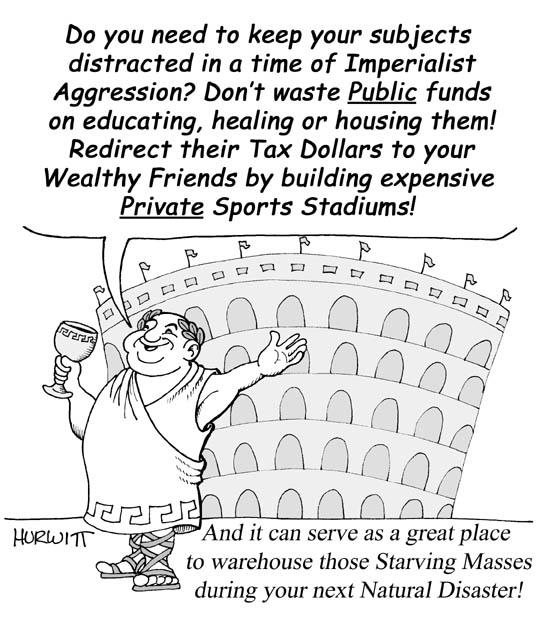
• Friday, September 24, 2010, Sports Culture Capper: Yankees, Professional Sports and Criminals Wearing Yankee Hats.And by the way, it probably shouldn't escape notice that this same dystopic sports world is what helped to bring us the previously mentioned eminent domain-abusing Ratner/Prokhorov (“Barclays”) arena arriving on our doorstep when the potential ESD whistleblowers sat idly by.
• Sunday, June 24, 2012, Sports Glummery