Showing posts with label Sports fandom. Show all posts

Saturday, January 26, 2013

Sports Glummery: Goodbye To Professional Sports Teams Like Dem Dodgers Bums Doesn’t Mean Riddance To Paying For Them, Now Says The Times

It’s front page news today. . .

Many bemoan the Dodgers unceremoniously departure from Brooklyn, New York back in 1957, but the New York Times tells us that due to an impending deal with Time Warner Cable the company's subscribers in Southern California are going to be paying “between $4 and $5 a month” more even if they don’t watch the Dodgers.  And because Time Warner Cable won’t be able to charge enough to cover the entire cost of the Dodgers deal it is very possible non-sports watchers may see a degradation of the quality of the rest of their cable service as Time Warner figures out how to absorb the shortfall it will be swallowing.

The Times didn’t say that New Yorkers will themselves see a rise in cable prices due to the Dodgers deal, only that New Yorkers (along with Los Angeleans) are already in some cases paying a “$2 to $3 monthly surcharge” to pay for “regional sports networks.”  Since I expect Dodgers games will sometimes be played on New York channels I bet the cost somehow factors in to what is paid although I couldn’t discern from the Times article for certain that either the existing arrangement or the impending deal means that New Yorkers pay much for Dodgers team games they don’t watch, only that they pay a lot, in general, for professional sports games even when they are not watching them.

One piece of good news reported in the article is that, “Verizon FiOS, perhaps testing the waters, announced a sports-free package of channels this week that is $15 cheaper than a similar package with sports.”

The New York Times has now caught up with and put on its front page something Noticing New York was writing about last July: how those of us who don’t watch and otherwise shun having anything to do with professional sports are paying a lot for them anyway in our cable TV subscription packages.  The Times article is here: Rising TV Fees Mean All Viewers Pay to Keep Sports Fans Happy, by Brian Stelter, January 25, 2013.

Noticing New York’s article in July, which went into more detail about what options (or the lack thereof) New York City residents have to try to avoid the extra amounts they are having to pay for sports they don’t watch (and may actually consider not all that great to have around in other ways), is here: Monday, July 9, 2012, More Sports Glummery.

The topic of the Times article and my earlier Noticing New York article is variation on a theme that I made the subject of independent research I did with my professor (Charlotte Price) when I was studying economics at Sarah Lawrence: how and when it can become possible for people to wind up paying for and buying things they don’t want.  It’s sort of a challenging set of propositions that run counter to the standard expectations and intuitions that generally ensue from and accompany normal economic theorems.

This is what the Times said in its article today sounding like the subject that drew me to research it back then:
For the most part, all of these networks are requirements, not options for cable customers. (Some distributors charge extra for packages of sports channels for die-hard fans, but the big networks remain in the packages that most customers get.) [Even though the Times says Dodgers games ] . . . were lucky to garner 100,000 viewers on any given day.

    * * * *

“The cable industry has done everything it can to bundle programming and force consumers to buy things they don’t want,” said Gene Kimmelman, a former Justice Department antitrust lawyer.
When I was trying to figure out these paradoxes of people paying for what they did not want back at Sarah Lawrence I kept coming back to models that involved collective decision-making and found myself often getting into the realm of political decision-making.   This was when my professor assisted me by introducing me to the work of Kenneth Arrow.

As for non-sports fans being forced to pay for that which they are not fans of, when politics and their manipulation come into play in decision-making, the examples of what results are probably all the more extreme.  That’s when you get the example of the so-called “Barclays” arena where every non-sports loving New Yorker is being forced to pick up the costs of subsidizing tickets for every game to the tune of perhaps $20.00 a seat every game.  A couple of games can easily come to $700,000.00 and there are many more games than that.  And then we have the hoggish Yankee Stadium to pay for too.  The list, of course, goes on.

Still the Times has been cheering the arrival of the “Barclays” arena without pointing out that many, many New Yorkers don't want to pay those extra taxes they are being forced to pay to heftily subsidize it.

Monday, November 5, 2012

Criticized For Prioritizing Now-Cancelled Marathon Sports Event Bloomberg (Still Looking Forward To Barclays) Side-Steps Informational Hurricane Updates

Bloomberg at virtually secret Saturday evening press conference where a question about his bad judgement about prioritizing sports events over hurricane recovery inevitably came up 
When you are mayor of New York bad news can make for a good personal news cycles, except when you blow it.  Mayor Michael Bloomberg was getting a straight set of predictable kudos for his theoretically no-nonsense handling of the superstorm Sandy disaster.  That was until the conversation started shifting to the fact that, despite the advice of all his top aides, Bloomberg was indulging himself in some nonsense: Bullheadedly deciding he would proceed with the city’s annual marathon despite the schizophrenic drain on city resources and commitments it would entail.  Bowing to the weight of public opinion the marathon was eventually cancelled Friday evening, hours after the mayor had again staunchly supported proceeding with it.

Upon examination, it looks like that when the news turned bad for Bloomberg, Bloomberg decided that he would hide out, manipulating the news cycle by deep-sixing the very same regular set of hurricane aftermath update press conferences through which he had been garnering his kudos during the long week of disaster news.

And there is more that could have motivated Bloomberg to play with the news cycle: Despite the week’s challenging hurricane disaster and recovery events, Bloomberg was looking forward to the inaugural basketball game of the Nets at the “Barclays” Center. When the marathon was cancelled, the “Barclays” game was scheduled for Saturday night, just twelve hours before the morning of the marathon.  Because of hurricane relief efforts and mass transit disruptions the previously scheduled Wednesday and Thursday night Nets games at the “Barclays” arena were cancelled, but before they were cancelled Bloomberg  embarrassed himself by saying, in the thick of early hurricane recovery efforts on Tuesday, that he not only hoped the Wednesday Nets game would proceed but that he would take a personal break from hurricane recovery to attend it.

Given the equivalencies that were in play, any traction the marathon cancellation story got was likely to lead to questions about, and pressure on the administration to postpone or cancel, this third Saturday night basketball game as well.  The mantra explaining cancellation of the marathon being repeated on all the networks was that at this juncture a sports event could not take precedence over the recovery efforts.  The basketball game at the 18,000-seat “Barclays” arena, though a smaller event than the marathon, was, because of recovery challenges in the storm’s aftermath, going to require a specially superintended support effort by Bloomberg administration.

Because of Bloomberg’s commitment, the marathon was on all week until the sudden, about-face cancellation on Friday at about 5:30 PM.  The Bloomberg administration was holding regular updating midday press conferences about hurricane recovery measures and the last mention of the plans to proceed with the marathon was when Bloomberg was questioned about it at the press conference on Friday afternoon at about 1:33 PM.  The exchange went like this:
Female reporter: Surely you've heard and read some of the comments from people on Staten Island who feel that it's insensitive to hold the marathon and wonder how it can be said that no resources are being diverted it to it. How many city employees are working to support the marathon?
   
Bloomberg: Well, for example the police department right now has to be at most of the intersections where there is no lights. Lights are gonna be back on tonight.  Mass transit solves a lot of other problems where the police provide those traffic control resources.  It does use some resources, but it doesn't use resources that can really make a difference in recovery and that sort of thing. It's a different group of people.  It's a relatively small amount of the sanitation department's resources.  And we have to have a city going forward.

I don't think there's any question but we have. . . There are New Yorkers who have lost loved ones and nothing's gonna ever replace that.  People who have lost their homes: we have to make sure that we do everything we can to help them recover.  We have to work around the clock for people to get through this thing and I assure you we' re doing that.  And, if I thought it took any resources away from that, we would not do this.  But we have plenty of police officers that work in areas that aren't affected. We don't take all of them and move them into areas that are affected. There will be no diversion of resources. There will be no redistribution of our efforts, no diminution of our efforts.

We have a 24/7 operation going which I am confident we're going to do.  We have to do everything we can to help people and when power returns over the next day and then, mass transit, more people are able to go to homes, that's going to make a big difference.

But as Rudy Giuliani said to me this morning, he said,`You know right after 9/11 people said exactly the same thing: New York has to show that we are here and that we are going to recover and that we can,’ while we help people, still help companies that need the business,  still generate a tax base so that we have the resources to help people and give people something to cheer about and what's been a very dismal week for a lot of people . . . And he reminded me also there was a demand from people that we close. . . Cancel the New Year's Eve celebration because of a snowstorm.  Uhm, I think Rudy had it right: you have to keep going and doing things and you can grieve, you can cry and you can laugh all at the same time.  That's what human beings are good at.            
When news came at 5:30 PM that the marathon was being cancelled nonetheless, the news networks were saying to expect a press conference about it at City Hall shortly afterwards.  Those led to believe that this meant that Bloomberg would shortly be appearing to address the cancellation were wrong: In lieu of a personal appearance to address the issue his office simply issued a short statement of the mayor (and the New York Road Runners) in the form of a press release (November 2, 2012- according to the Times it was released at 5:21 p.m. EST):
The Marathon has been an integral part of New York City's life for 40 years and is an event tens of thousands of New Yorkers participate in and millions more watch. While holding the race would not require diverting resources from the recovery effort, it is clear that it has become the source of controversy and division. The marathon has always brought our city together and inspired us with stories of courage and determination. We would not want a cloud to hang over the race or its participants, and so we have decided to cancel it. We cannot allow a controversy over an athletic event –– even one as meaningful as this –– to distract attention away from all the critically important work that is being done to recover from the storm and get our city back on track. The New York Road Runners will have additional information in the days ahead for participants.
Almost immediately the Times was reporting the story as being about Bloomberg’s poor judgment and stubborn pigheadness: 
Mayor Michael R. Bloomberg, facing criticism that he was favoring marathon runners arriving from around the world over people in devastated neighborhoods, reversed himself and canceled the New York City Marathon.

    * * * *

For days, the mayor, who is often reluctant to abandon a position of his, insisted on going ahead with the race, saying it would signal that the city was back to normal.

He changed his mind as opposition became nearly unanimous.

    * * * *

Within the mayor’s inner circle, though, there were concerns. Some advisers worried that the criticism could steal the focus from Mr. Bloomberg’s well-received performance during and after the storm, and could damage his legacy in the way that the city’s botched response to a blizzard had done in 2010.

Behind the scenes, there were also concerns about what the world would see: images of runners so close to neighborhoods that had been battered by the storm, at a time when gasoline remained in short supply and mass transit was still not fully functioning.

Police Commissioner Raymond W. Kelly and Deputy Mayors Howard Wolfson and Patricia E. Harris all argued for calling off the event.
(See: Hardship Strains Emotions in New York, by James Barron and Ken Belson, November 2, 2012.)

If this was the story that was going to get traction, wasn’t it inevitable that the press was going to ask about the special support the city was mustering for proceeding with that other highly-hyped sports event, the Nets “Barclays” basketball game?  Especially, since Bloomberg has already laid the overly-enthusiastic bad-judgment connection by saying, the day after the hurricane, that he wanted the Wednesday basketball game to proceed and that he personally planned to attend it?  And if the press has asked about still-pending Saturday basketball game there would have been pressure to also cancel it, together with the special support the city was mustering to make it happen.

By lying low and not allowing the marathon story to get attention and traction Bloomberg therefore also forestalled having to address controversy over the specially assisted Bruce Ratner/Mikhail Prokhorov “Barclay” arena sports event.  But to do so Bloomberg’s strategy had to, at the same time, sacrifice the regular press conferences Bloomberg had been holding to keep New Yorkers up-to-date about the disaster recovery events.

As noted, Bloomberg did not come out on Friday evening to personally update the public when he cancelled the marathon.

Some might think, like I originally thought,  that Bloomberg did not hold a press conference about hurricane recovery on Saturday.  The expected press conference did seem to vanish from the news cycle but he actually did hold one.  What assured that this press conference was not covered in the news cycle was that it wasn’t held in the morning or midday like others; he delayed holding it until late Saturday afternoon.  Ironically, what then worked synergistically to assure that it would get no coverage is that he held it at a time when all of the local stations had cancelled their evening news for football events.  (Was taking advantage of this conscious on Bloomberg's part?)  Up until this preemption by the sport of football the networks had been obsessing about the hurricane’s aftermath with a lot of special coverage.

Do you wonder whether the cancellation of the marathon came up at this very next below-the-radar and under-reported press conference?  You bet it did, but being held in the evening there would have been no time to discuss any cancellation of the “Barclays” Nets game and Bloomberg cleverly controlled the question and answers to dissuade and prevent any possible follow-up questions about that “Barclays” event.  Here is the question and answer at that press conference with respect to the marathon:
Reporter: Can you just explain what happened between early Friday when the marathon was on, and later Friday when it was canceled.  And what would you say to some of the runners saying they wish it was canceled earlier so they didn't have to come.

Bloomberg: Well I wish we didn't have a hurricane and that we could have had a great event.  So, you know. . . could have, would have, and should have isn't something that I deal with. What simply happened was it became a source of dissension and we don't need that right now and hopefully next year we'll have a great event where people can come to the city and enjoy what the city has to offer and compete and participate and the spirit of the race is to bring people together.  When that became a divisive issue I just made the decision that it should not go on. the good news is that the supplies for the marathon have been donated to communities that need them, something like 600 medical blankets delivered directly to residents of Midland Beach by volunteers who went door to door with them and some 10,000 cases of water were sent to a central distribution center in Floyd Bennett Field.  Other supplies are being sent out now so you know the situation changes shame that it had to happen but we've got to do the right thing at each time and I am looking forward to I'm sure all about those runners too, to coming back next year. 
How did Bloomberg assure that there were no follow-up questions about this or the “Barclays” event?   When he first called on the reporter asking about the marathon he told the reporter that, because he was prioritizing hurricane recovery events over other matters (like sports), he would only take such a question at the end.  It was clever: because he was prioritizing hurricane recovery efforts he would not take a question about his misplaced priorities relating to sports events.  The exchange whereby Bloomberg deferred the marathon question went like this:
Reporter: On the marathon, can you explain…

Bloomberg: Let's just stick to this for the time being then we'll come back. I'll be happy to take a question.  This is a little bit more important: We're trying to talk about people getting their lives together.
Bloomberg next deferred as being similarly off-topic a question about preparedness of the Board of Elections for the Tuesday presidential election.  When in short order there were no more questions about anything else, Bloomberg took the Board of Elections question saving the marathon question for the very last. Then, upon providing his answer to marathon question, Bloomberg quickly segued to end the press conference with a reminder about how important it was for the stricken population in the city to take appropriate measure to shelter from the cold.

I still don’t know whether Bloomberg went to the Nets game that night where the Nets introduced their new mascot, BrooklynKnight (BrooklynKnight is a Brooklynite- get it?) being promoted as a mythical defender of Brooklyn.  As late as the Saturday evening press conference was there would have been just enough time for the mayor to get to “Barclays” arena before the game started.

Do I really think that Bloomberg manipulated this news cycle? 

Normally, the mayor’s press office puts up video of the mayor’s press conferences on its web page.  One indication that Saturday’s press was intended to be low profile is that no video of it was posted.  Instead, there was only a press release transcription of the mayor’s prepared remarks (Mayor Bloomberg Updates New Yorkers on City Response to Hurricane Sandy).  The transcription was minus the question and answer exchange with the press.  As you might infer from this Noticing New York article that the question and answer period of any mayoral press conference is often the most important part of any such event, zeroing in on issues of controversy rather than the official story packaged for distribution. Video of the next mayor’s next press conference updating New Yorkers on Sunday went up without Saturday’s ever being put up. 

Another way that helped ensure that Bloomberg’s Saturday press conference was as safe and friendly as it could be was to include Secretary of Housing and Urban Development Shaun Donovan who came out of the Bloomberg administration and who gets favorable press. (The city is estimating that it is going to have to find housing for 30,000 to 40,000 families dispossessed by the storm.)  Secretary for Health and Human Services Kathleen Sebelius and Congresswoman Carolyn Maloney were also at this little-reported press event.

The way I was able to find video of the event (embedded below) and verify that it had actually occurred was by going to the New York Times hurricane update blog and scrolling backward to 5:07 PM Saturday.


Yes, it is to be expected that a mayor will try to control the news messages out there about him.  Here is something scary to think about: In the course of researching Bloomberg’s storm-related press conferences one of the top hits I got in a Google search was video of his November 2, 2012 press conference on his private self-promoting MikeBlooberg.com site.  This site acts in 1984 style as a faux news press release site to promote the news about himself that Bloomberg likes.  That day there was a transcription of the Friday, November 2, 2012 press conference.  Since it didn’t include the questions and answers that followed, it had nothing about the marathon or Bloomberg saying then that it should not be cancelled.  In any event it is all gone now, replaced by the favorable news that Bloomberg’s site administrators are choosing to feature on that site now.

Is there a more innocent explanation for why Bloomberg personally absented himself from the news cycle from midday Friday until Saturday evening?  Did he zip off to Bermuda in that space of time for a shorter version of his regular weekend trip?  There would have been enough time for him to do so.  Maybe he did, but I suspect that bottom line is he simply didn’t want stories about his bad judgment with respect to sporting events getting traction.

Friday, July 13, 2012

An Additional Heaping Helping of Sports Glummery: Penn State Scandal Investigative Report- Power of College Football Out Of Control

(Above, Today's New York Times front page devotes two-thirds of its above the fold space with yellow highlighting to emphasize how many potential whistleblowers at Penn State DIDN'T come forward to report the football program's child abuse scandal.)

The Penn State Scandal As a Fable About Whistleblowing

I’ve written about the subject of the Penn State College Football sexual abuse of children scandal before. When I did it was on the subject of the public damnation directed at the potential Penn State whistleblowers who didn’t blow the whistle versus the damnation awaiting whistleblowers who do blow the whistle against the powers-that-be, very noticeably, and especially for those who blow the whistle against government malfeasance. As a close-to-home, dear-to-Noticing New York’s-heart example of government's antagonism toward whistleblowing I cited the abysmal designed-to-fail whistleblowing policies and practices of the State’s “Empire State Development” agency ("ESD," formerly the Empire State Development Corporation- its name keeps changing to protect the. . .? ). (See: Wednesday, November 16, 2011, Whistleblowing and ESD: Culture and the Questionable Spirit In Which the State Agency Most Responsible For Atlantic Yards Wields Omnipotent Powers.)

No Whistleblowing At ESD: An Arena Arrives Courtesy of Fantasy Facts

ESD is the state agency that was co-opted by developer Forest City Ratner to sponsor its mega-monopoly-enhancing Atlantic Yards megadevelopment. ESD’s designed-to-fail whistleblowing policies and practices did fail. ESD was the state agency that participated in scamming Justice Marcy Friedman’s state Supreme Court with false representations that the agency had a legitimate expectation that the Atlantic Yards megadevelopment would be completed within ten years (instead of twenty-five, very possibly forty+) which was the basis for the environmental review done for it. No whistleblowing state employee came forward from ESDC to inform Justice Friedman of the scam. (See: Wednesday, July 13, 2011, Breaking: Judge rules for community groups, says state failed to study impact of 25-year buildout, requires ESDC to prepare a Supplemental EIS, but refuses to stay current construction, Thursday, April 12, 2012, Appellate Court smacks down ESD, upholds decision ordering new study of long-term Atlantic Yards impact, requires new approval of Phase II; Forest City reminds us: it doesn't affect arena and Tuesday, June 26, 2012, Court of Appeals denies effort by ESDC, Forest City to appeal timetable case; state must analyze impact of 25-year buildout; will leave cloud over project as arena opening approaches; provokes new call for oversight.)

With no state employee coming forward to reveal the state’s misrepresentations, those misrepresentations were temporarily accepted by Justice Friedman as veracious. Had that not been the case it would have been incumbent upon Justice Friedman to rule, as she eventually did, based on the actual facts, that the mega-project had never been the subject of a proper environmental review. Had she made such a timely ruling the issuance of ESD bonds for the Ratner/Prokhorov (“Barclays”) sports arena oughtn’t to have proceeded. Since the issuance of those bonds were subject to an IRS deadline (the ending of a special exemption from the law against tax-exempt financing of private arenas and stadia) the developer’s private arena would never have been built and the entire megadevelopment would have fallen apart, probably being taken away from Ratner and distributed amongst multiple developers in the process.

The Penn State Scandal As a Fable About Outsized College Football Programs

The new news that’s out with respect to the Penn State Scandal is that, according to a just issued report by former FBI director Louis Freeh, (267 pages including appendices) is that there were not just a few potential whistleblowers that did not come forward to report the ongoing abuse of children but a whole panoply of potential whistleblowers that failed to. That’s basically the point of the New York Time’s from page today where the Penn State scandal takes up two-thirds of the above-the-fold space (with the yellow highlighting emphasizing which of a list of prominent individuals knew and didn’t report what when). (See: Abuse Scandal Inquiry Damns Paterno and Penn State, By Ken Belson, July 12, 2012.)

The Brian Lehrer show today did a better job than the Times of zeroing in on what is the crux of this story, the reason that so many potential whistleblowers did not come forward: The Penn State football program had grown so powerful and unaccountable that no one dared report abuse. There is an accompanying loss of perspective such that, in the words of the Freeh report, the “most senior leaders at Penn State” had a “total and consistent disregard . . . for the safety and welfare of Sandusky’s child victims.” (The Brian Lehrer Show: Lessons from Penn State, Friday, July 13, 2012- click below to listen.)


In other words, at Penn State, the college’s football program has essentially become the unchecked “powers-that-be” at the university, calling all the shots, making the football program that much more analogous to the government entities I discussed that find whistleblowers anathema and choose to stymie them. Everyone from janitors up to people in the highest positions of authority were afraid to hold the program accountable. In the Brian Lehrer discussion, Jonathan Mahler, a contributing writer at The New York Times Magazine and author of the Kindle Single "Death Comes to Happy Valley," describes how in early 2000 a new dean tried to take on Coach Paterno and was thwarted when Paterno threatened to stop fund raising.

Mahler speaks about how the football programs of all the big Division One schools, including Penn State’s, have become independent entities standing apart from the academic side of the universities, even undermining their mission and culture, with huge stadia and special buildings and complexes that can dwarf a university or small town in which it resides. (The Penn State stadium seats over 100,000 which, Brian Lehrer points out, makes it more than twice the size of Yankee Stadium.) Then there are disciplinary problems with players, some of them with criminal records, upon whom have been bestowed a special impunity respecting bad behavior. All of this unfolds in the context of, and is driven by, an uncritical fandom.

A Moral About The Sport of Child Abuse

When I wrote about the Penn State scandal before I didn’t write about the outsized, unchecked power of the football program as part of the problem, but I have been writing some other articles, let’s call it a series, about the many features of commercialized sports that are dismaying. In that regard I have given a fair amount of focus to the infusion of money into the nominally amateur sports played in college, high school and now even down to middle school level. The commercializing pressures from those vast infusions corrupt the standards according to which we treat our youth.

In his Brian Lehrer appearance Jonathan Mahler briefly mentioned the problem of the exploitation of student athletes and its pervasiveness. Yes, we are not treating our children well. From top to bottom at Penn State, from university president down to janitor, no one could see the priority of preventing the abuse of children? In fact, the Freeh report’s headline-grabbing finding that all this lack of perspective and accountability, resulting from putting commercialization and uncritical fandom first, has resulted in a “total and consistent disregard . . . for the safety and welfare of” children, could also serve as a thumbnail description for the last Noticing New York `sports glummery’ article in which I suggested that the way we now readily exploit and sacrifice children for sport makes our current reality rather like the dystopia envisioned in The Hunger Games.” (See: Monday, July 9, 2012, More Sports Glummery.)
(Above, included in that earlier 'sports glummery' article, Katniss Everdeen from the "The Hunger Games" outfitted with a promotional Brooklyn Nets Basketball jersey and Adidas sneakers pressed upon her by corporate sponsors. Read about the subject of corporate branding of GOVERNMENT here.)

Earlier Noticing New York articles in this ‘sports glummery’ series are:
• Friday, September 24, 2010, Sports Culture Capper: Yankees, Professional Sports and Criminals Wearing Yankee Hats.

• Sunday, June 24, 2012, Sports Glummery
And by the way, it probably shouldn't escape notice that this same dystopic sports world is what helped to bring us the previously mentioned eminent domain-abusing Ratner/Prokhorov (“Barclays”) arena arriving on our doorstep when the potential ESD whistleblowers sat idly by.

Monday, July 9, 2012

More Sports Glummery

(Above, Katniss Everdeen from the "The Hunger Games" outfitted with a promotional Brooklyn Nets Basketball jersey and Adidas sneakers pressed upon her by corporate sponsors.)

For those of you who enjoyed and felt they didn’t get enough of Noticing New York’s recent Sports Glummery article (Sunday, June 24, 2012) there’s more this past weekend delivered courtesy of Atlantic Yards Report reporting on a recent book by Sports Illustrated writer George Dohrmann: Saturday, July 07, 2012, Play Their Hearts Out: youth basketball and the shoe purveyors (like Adidas, coming to Barclays Center) that are "going to do what's good for their companies" (plus: the Dwight Howard angle).

Sports Glummery was in essence a sequel to, and expansion upon an earlier Noticing New York article expressing disgruntlement with commercialized sports: Friday, September 24, 2010, Sports Culture Capper: Yankees, Professional Sports and Criminals Wearing Yankee Hats.

Sports Glummery presented observations about how the love of sport for the sake of genuine sport and the business of sports are “immiscible,” which is to say that like oil and water they really can't mix, and the article suggested, citing thinking offered by Jane Jacobs in her “Systems of Survival: A Dialogue on the Moral Foundations of Commerce and Politics,” (1992) that when they do get mixed something goes wrong so that ethical boundaries wind up being crossed, reflected by atrocious conduct that results when the unbridled exuberance of fandom uncritically embraces the relentless exploitations of know-no-limits commercialization.

Sports Glummery told of how “college basketball” has been commercialized to such an extent that college students are abused, forced to work for free and deprived of an education and an educational environment. It also examined how the pressure of sports commercialism results in senseless risk and serious physical injuries for football players, including those who are only at the high school level.

Blaming Adidas: Pushing Commercialization of Sports Down From the College Basketball Level To Middle School

The recent 2010 book by George Dohrmann, "Play Their Hearts Out: A Coach, His Star Recruit, and the Youth Basketball Machine," tells of how the commercialization of student basketball is now being pushed down the food chain down even as low as the seventh and eighth grades in middle school, where “boys as young as eight and nine are subjected to a dizzying torrent of scrutiny and exploitation” with nobody “going to much trouble to see to it the athletes get an education, a decent childhood, good parenting or meaningful relationships.”

He blames the shoe companies, according to Atlantic Yards Report, “especially Adidas. In its competition with Nike and Reebok, Adidas pushes harder than ever.”

George Dohrmann says the “sneaker companies infused the game with money” (together with company influence). Adidas wants the kids wearing their shoes and out there promoting their brand.

Adidas brand promotion deserves some extra special focus. Atlantic Yards Report notes that:
Adidas, of course, is opening its first store in Brooklyn at the Barclays Center*, as announced 3/2/0/12. And Adidas, some suggest, is pushing Orlando superstar Dwight Howard to come to Brooklyn and the major media market.
(* That's the name for the moment of the Bruce Ratner/Mikhail Prokhorov basketball arena spearheading an eminent domain abuse land grab to expand the real estate developer's government-assisted mega-monopoly.)

The Atlantic Yards Report article should be read in full for a full appreciation of its unpleasant implications respecting the inexcusable corporate abuse of children.)

Games Strictly From Hunger

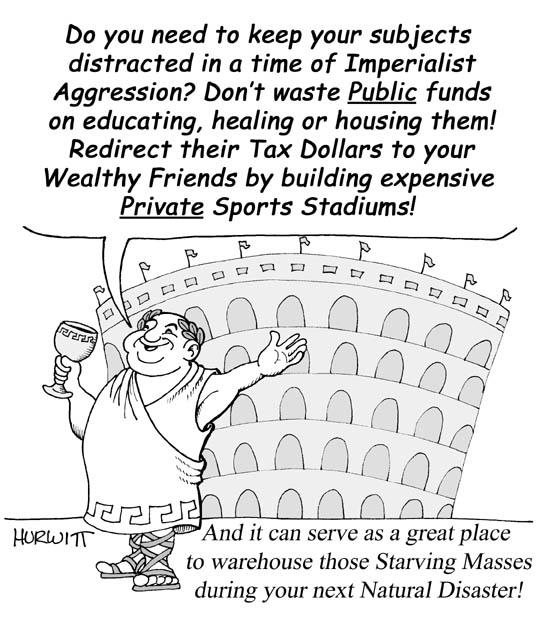
(Above, a "bread and circuses"-themed cartoon by Mark Hurwitt, used in Sports Glummery. More about Mr. Hurwitt here. More about "bread and circuses" themes below.)

In the first article I wrote enumerating my personal dissatisfactions with the professional sports business I mentioned the 1975 dystopic science fiction film “Rollerball” for its apt fitness in describing the cynical “bread and circuses” use of professional sports to distract and manipulate the populace. I’ll stand by that, but if we as a society have now begun eating our young, destroying them for our amusement physically, mentally, and spiritually with the commercialization of the sports marketplace perhaps we should retire “Rollerball” as the film that best metaphorically warns of what degradations we face replace it with the newer, grimmer, recently released “The Hunger Games” film, another science fiction film about a unpalatable future where a ruling elite annually selects children from twelve districts, two children from each, to participate in an extended gladiatorial fight to the death that is watched on national television by the entire nation after its gleefully shameless PR hype by the government. (Hence the visual at this article's outset of the "The Hunger Games'" Katniss Everdeen in Adidas sneakers and a Nets basketball team jersey.)

Bad News For Those Who Would Escape: A Cable Bind

As discussed in my previous Sports Glummery article there are those who dream of inaugurating a moderated form of fandom whereby individuals of conscience can with proper restraint avoid complicity with the dastardly deeds done in the pursuit of profit by the highly commercialized sports industry. Others, like myself, would prefer to keep life simple: We would shun the industry to effect a clear-cut divorce and separation. Whatever one may wish for, escaping complicity may not be so easy.

It turns out, according to recent analysis that even those of us who never watch professional sports can blame the franchises running that industry for significantly driving up the cost of our cable television bills: 90 percent of Americans pay for cable, satellite or fiber optic television, and according to the Wall Street Journal in 2010, about 40 percent of consumers' basic cable bills probably went towards sports programming. (See: The Incredible Value of Live Sports: Transcript, Friday, May 25, 2012.*)


(* See also: Cable TV angry about NFL broadcast deals, by Jeff Tyler, Marketplace for Tuesday, December 6, 2011; Cable Television Bills Have Nearly Tripled In The Past 10 Years, The Huffington Post, Jillian Berman, 12/30/11; MEDIA & MARKETING, December 6, 2011, Cable-TV Honchos Cry Foul Over Soaring Cost of ESPN, By Sam Schechner and Martin Peers- "You're in a position where many people may not care about sports content, and their bill goes up anyway," said Derek Chang, who oversees all programming acquisition at DirecTV, DTV in an interview Monday. "They start to get to levels where customers say they just can't afford it."- Smart Spending: Is Pay Per Channel Cable TV Inevitable? by Brad Tuttle, August 26, 2011; How Much Do You Pay for Each of Those Cable Channels You Don’t Watch?, 03.20.12 Written by Dustin Rowles; Peter Kafka, Hate Paying for Cable? Here’s Why, March 8, 2010 at 5:00 am PT.)
That means that until those in charge unbundle premium sports broadcasting so that it is no longer a required part of basic cable packages (Capitol Hill has considered mandating such an a la carte option ) there is a huge subsidy being sent to the commercial sports industry. In Brooklyn, Time Warner Cable customers pay $70.95 a month for a Digital Starter Pak (130 channels, technically a combination of “Basic Service” + “Standard Service”) or $85.45 for DTV value (more than 350 channels) and both of these packages include all the expensive sports channels driving up basic cable bills. The only way to eliminate the expensive sports channels is to drop down the number of channels you are subscribing to by about 60% (from that "value" package) to pay $49.99 for a TV Essentials package which will still include delivery of the ESPN sports news channel!

As Time Warner may appreciate, dropping down to the TV Essentials package is likely an undesirable option because if you do select it you will lose a multitude of other stations in which the non-sports enthusiast would probably be interested and which individually or collectively ought to cost very little to subscribe to: Comedy Central bringing you the Jon Stewart and Stephen Colbert shows (costing the cable company only about 3% of what ESPN HD does) or the only slightly more expensive Turner Classic Movies (which costs the cable company only about 5% of what ESPN does, an amount only just above the industry average cost for a channel). Some of these channels you to which you would thus be denied access cost the cable company so very little that the broadcasters are almost paying the cable company instead of vice versa (and there is even a valid argument this should be the case when these channels carry advertising): BBC World News costs the cable company a mere fractional pittance of about .75%, less than even 1%, of what ESPN does, putting it in the same price league as the Hallmark channels (Movies and a general programming channel), Lifetime Movie Network, Bloomberg TV, The Science Channel of the Discovery Kids Channel.

The main programming plans of Verizon’s FIOS network, running $64.99 to $89.99 a month for the standard promoted packages, include ESPN and the sports channels although also available from Verizon with significantly less promotion is a very pared down Local Digital option ($12.99 per month) . . . Or you can eliminate ESPN (and Turner Classic Movies as well) but still get other sports channels by going with the not-so-attractive La Conexion ($54.99 per month). Similarly, Direct TV with its packages (running $29.99 to $44.99) affords no option without ESPN. Direct TV actually owns some sports networks.

One reason the cable networks are unlikely to cease promoting the sports channels anytime soon is that, according to On The Media’s analysis, the continuing entanglement works well for the cable companies: The cable audience is less likely to cut the cable cord (and go with the proliferating alternate internet delivery options) because the sports audience, much more so than others, demands to watch content live and the cable companies still have a monopoly on the delivery of this particular form of live content.

So the next time you go into a Time Warner Cable TV office to pick up a new cable box and you see the cable representatives all dressed in professional basketball team jerseys (see the photographs of the Time Warner Cable representative in the Nets team jersey below) you might want to think about how, perhaps exactly contrary to your wishes, you are being made a party to this enforced subsidy of sports teams that is driving up your cable bill and making you complicit in the exploitation of children.

Sunday, June 24, 2012

Sports Glummery


(Above, a cartoon by Mark Hurwitt, that perhaps doesn’t precisely coincide with what I am saying in this article, except at the very end. More about Mr. Hurwitt here. Judy Gorman, Mr. Hurwitt’s wife, a singer musician whose repertoire includes a number of activist protest songs- including Leonard Cohen’s “Everybody Knows”- is performing at the Brooklyn Heights Cinema on Wednesday night, June 27, 1912, at 9:00 PM. I am expecting that one of her songs will be “Everybody Knows” – See DDDB’s open letter to Mr. Cohen mentioning this song.)

Back at the start of the new year, as part of its ongoing coverage of the Atlantic Yards boondoggle of which the Ratner/Prokhorov (“Barclays”) basketball arena is an important constituent part, Atlantic Yards Report ran a pair of articles which conjoined to bleaken the rah-rahing regularly rallied up for the monied world of big-time organized sports.

The Prokhorov Ratner Arena: Second Thoughts Regarding College Basketball

One of those articles offered “some second thoughts” on the big-time sport of college basketball “that feeds the NBA and the soon-to-be Brooklyn Nets,” reporting on two writers’ criticism about how college sports are no longer about what some once remembered loving about them (“fun, fellowship and artistry”), but are instead about a permeating hypocrisy of these big-money college sports whereby all sorts of people and corporations are making an unbelievable amount of money, partly because they do so with an unacknowledged commercialization on the backs of young “student” athletes who are not compensated for their participation in these enterprises. (See: Monday, January 02, 2012, Time for some second thoughts on college sports: giving up on college football and paying (football and basketball) athletes.)

Mr. Oder, who writes Atlantic Yards Report, concludes that article with the observation: “But the system would not be successful, as these writers make clear, without widespread fan complicity.”

Turning on Sports?

The other Atlantic Yards Report article reviewed a tirade written by a sports fan, musician/designer/activist Scott M.X. Turner, anguished about such complicity and the corrosive effect of big money on sports:
“I like sports and deplore sports”

“for a guy [himself] who hates sports this much, how come you still watch?”

“End of the day, sports fans are infused with self-hate. . . We shell out ridiculous amounts of cash to owners who steal candy from babies and then roll the pram in front of a bus to eliminate the witness.”
(See: Monday, January 02, 2012, RebelMart's Mimeograph Machine, on sports: "we sit in silence when owners and leagues rip us off")

Scott Turner’s scunner for these negative aspects of sports had much in common with what I laid out as my own feelings about organized sports (Friday, September 24, 2010, Sports Culture Capper: Yankees, Professional Sports and Criminals Wearing Yankee Hats), the preeminent distinction being that Mr. Turner struggles with being a self-acknowledged fan of big-time sports and I am a self-acknowledged sports grump. Sure I went to Dodgers games with my father, but I got over that. As I wrote before, rather than being a sports voyeur, I'd rather go out and just get some exercise biking, swimming, or skiing (whether or not I go for a slightly-aging person’s personal best), and rather than paying attention to the teams, strategies and statistic-collecting of sports I’d rather invest similar energies to navigate the nefarious politics involved when, as Mr. Turner suggests, sports fandom is manipulated “to justify all the wasteful projects” (like Atlantic Yards, the Mets and Yankee stadiums) we “spend taxpayer dollars on.”

Yes, I’m a sports grump, and there is a lot to be grumpy about.

Methodical Madness, Behind The March Haircuts

When Mr. Oder reported about the critiques respecting how unfair it is not to compensate the young athletes who participate in big-money college sports, he missed reporting on a half-hour PBS Frontline segment “Money & March Madness” (video here and transcript here) that made even more scathingly clear the hypocrisy whereby the fairness of paying compensation to the athletes is being avoided. The theory for not paying the “student” basketball players is that because it is “college basketball” it constitutes “amateur” sports, and refusing to compensate the athletes keeps it that way. Everyone is catching onto the fact that big-money college basketball is hardly amateur or nonprofessional and the Frontline report adds to this the fact that very little of what goes on has to do with getting a college education, the ostensible rationale for declaring that the sport is amateur.

According to the Frontline report:
• The “student” players are given scholarships to play [they may not cover all their costs- “on average $3,000 short” of essential expenses] but the rule (in effect since 1973) is that the scholarships cannot be multi-year, only one year at a time. If the player’s playing is unsatisfactory (or if the player is unable to play because of injury) the scholarship can be taken away so a player should not expect that the scholarships will be in place except to cover their successful playing, i.e. that the scholarships are not in place to provide for an education. If a player isn’t playing well it is likely the scholarship will be taken away, to be offered to a replacement player. I don’t know under what pretense the 1973 rule against multi-year scholarships was put into effect but it seems clear it works against the players’ interests.

• Actual graduation rates can be startlingly low for those playing football and basketball. For instance, the documentary focuses on Baylor College: “According to the NCAA [the “National Collegiate Athletic Association” the organization that runs the industry] Baylor's basketball team graduates less than half of its players. And last year, the graduation rate for Baylor's African-American players was 29 percent.”

• Playing basketball leaves little or no time to study: “Getting educated is hard to do when you're spending 50 hours a week playing football or basketball.” (Michel Lewis, Author, “The Blind Side”.) Lewis describes the players as “essentially indentured servants.”

• If, alternatively, it were to be supposed that the purpose of being a student athlete was not to get a general education, but to get educated in the game of basketball so as to start a career in that limited field the news is not good in that regard either: “1 percent of college players. . . make it to the NBA.”

• Frontline provides an estimate that in college football a star quarterback’s value, what they are not getting paid, is $5 million. With the players not getting paid there is plenty to divide up. The current 14 year March Madness contract with CBS and Turner Broadcasting is for $10.8 billion. With advertising licenses and video games, that’s just one income stream. And everyone else gets to dip in deeply: Coaches are paid “$2 million, $3 million, $4 million, $5 million.”
This is college? This is amateur? Isn’t this just a big-business rip-off run amok?

Immiscible (definition to follow)

Among other things, this sports/business mix, this not-for-profit/business mix doesn’t sound like a moral environment. Jane Jacobs, who wrote a series of books that seized the public’s attention and steered the public dialogue starting with "The Death and Life of Great American Cities" (1961), much later wrote another book that, as yet, has escaped the attention it probably deserves, “Systems of Survival: A Dialogue on the Moral Foundations of Commerce and Politics,” (1992). The book, which as its title indicates is about the morality of systems, convincingly argues the flaws of trying to mix things that should not be mixed, particularly mixing business enterprises with government and politics, because the moral systems that apply to each must necessarily remain different and incompatible (so much for the current fashionability of today’s “private-public partnerships” like Atlantic Yards).

Perhaps inevitably, near the end of the book (p. 190) the dialogue gets around to the problem professional sports as a mix of business and something else (Jacobs’ book is structured like a Plato dialogue with competing ideas and questions expressed by multiple characters, fittingly so because by the end she ascribes much of the derivation of the book’s ideas to Plato himself).

Using the word “immiscible,” which for many of us requires a definition (“incapable of mixing or attaining homogeneity—used especially of liquids” i.e. like oil and water), one of the book’s characters quotes evolutionary biologist Stephen Jay Gould:
“Gould was writing about professional baseball. On the one hand, it's a business. On the other hand, it's a game of heroes and epic achievements and mythic failures. Each mode, as he calls it, is true of the game. The two are immiscible, and all lovers of the game must recognize the distinction. Then he goes on to draw an analogy to science and religion. I’ll quote him. This is a supposed conflict, more accurately a pseudo-conflict that shouldn't exist at all but flares up only when one side invades the domain of the other… These subjects form necessary components of a complete life but they integrate no better than… oil and water. We each need to carry a jar with two layers.”
There is much in this ignored book by Jacobs to argue over (perhaps not successfully against) and to think about. It is hard to do her subtle thinking justice without going into much more detail. Jacobs would probably suggest that injustice is being produced when the mixing sports game with business allows a big-money college sports business decision to be made not to compensate the indentured servant athletes premised on a mythic sports game notion that these are amateur heroes who are truly college students.

Jacobs’ book is full of other examples of what happens when realms that should remain distinct (together with their associated moralities) improperly intermix, so that one gets what she calls “monstrous hybrids.” Most typically the examples she gives involve an improper mixing of business and government (but there are also examples of improperly mixing charity and business). These include: Corrupt police forces where you pay for justice, similarly judges and judicial systems that sell out to commercial interests, Mafia integration into business, Marxist government intrusions into business, government “economic development projects” that quickly convert to “Pork-barrel projects for political purposes, the world over,” state creation of monopolies, when investment bankers resort to cunning cooperate raider-style warfare, accountants and lawyers who participate in the perpetration of fictions. Jacobs' point is not that either business or government is bad: She's sees both are good but only when in their separate places although one of the proper roles of government is to police the commercial sector.

Suited For Leisure Play

In “Systems of Survival,” Jacobs advances some intriguing anthropological notions about how sports began (like games, dance, music and art) as frolicking leisure play, in what was a purer sort of sport-for-the-sake-of-sport noncommercial context, like tournaments held among knights, and that such sports traditions (as in the case of the Olympics) were inherently linked to a tradition of amateurism (“Think about the long aristocratic tradition of the amateur with time on his hands exerting himself strenuously for sheer love of a sport, an art, or a field of learning– not for economic gain.”- p.79) But it would probably be too much to go into this at greater length in this article so as to chart all the implications it might have for the nuances of this discussion.

Bush Wacked

When commercialism gets hold of sports all sorts of things can go awry, and sometimes when commercialism gets hold of sports it forays as well into the realm of politics and then things can get a whole lot worse.

Were it not for sports we might never have had George W. Bush as president. The same PBS Frontline series that presented the “March Madness” program every four years presents a delving special, (always titled “The Choice”) about the respective presidential candidates (there should be one coming up soon enough about Romey and Obama). In 2004 when Bush was running against Kerry it presented interlaced biographies of those two men. One thing that was clear was that it was Bush’s involvement in the twisted use of sports, his lending of his face and personality for the promotion of the public funding of Texas Rangers stadium and the associated eminent domain land grab of land for the stadium and land around it (for real estate speculation purposes), that was a turning point for Bush and transformed him into a potential candidate for governor and ultimately for president. He proved his ability to sell what probably ought to have been considered odious: Look where it got him!

Before his involvement with the Rangers stadium Bush was largely a failure, a draft avoider who went AWOL from the National Guard (where he had been politically ensconced to be safely away from Vietnam), a failed oil businessman, a heavy drinker, a poor student.

Interviewed in the Frontline documentary, Bush’s Texas Rangers partner Roland Betts* says (redacting out Bett’s hype and personal plug for the stadium):
“My counsel to him was, "You are only known as the son of the president of the United States. . . You can do something that attracts attention. . . and you're going to be in a much better position four or five years from now to then run.”
(* Known to New Yorkers as the developer of Chelsea Piers and a member of many preeminent boards in the city including that of the Lower Manhattan Development Corporation involved in rebuilding the World Trade Center site.)
The Frontline Narrator picks up: The plan was to build a new ballpark on seized land and then raise local sales taxes to pay for its construction. It generated some controversy. But Bush, good with people, came in and helped sell the deal. He became a partner and the club's most visible face.

Followed by Frontline’s reporter: By far, his most successful experience as a businessman was with the Texas Rangers. He was businessman as politician, in effect. He was the public face and, in a way, front man for the Rangers franchise. He sat in a box at the Rangers games and shook hands. There was a big political component to that because they had to get the stadium built with public money.

It didn't escape notice that he was the son of the president. And then he was surrounded with people like Roland Betts, who were very seasoned and experienced businessmen and who invested and piloted the project. And that was the one deal in his business career that he really did well on.

Segueing back to the narrator: In just a few years, Bush reaped a personal profit of over $10 million,* while building his own big-league reputation.
(* Other reporting, like Davis Cay Johnston’s calculate that the city’s public taxes transformed George W. Bush's 2% $600,000 sporting investment into a $17 million capital gain. Others calculated his gain at $14 million.)

Happy Face Manipulations

To reiterate: It was Bush’s ability to put a smiley face on this enormous transfer of wealth from the general tax populace to a wealthy elite that proved his qualifications for further ascendency. Nicholas Kristoff suggests that part of Bush’s job, along with conspiring “with city officials to seize private property that would be handed over to the Bush group” for real estate speculation purposes was to mislead “the city into raising taxes to build a $200 million stadium” being handed over to the Rangers.

Sports fandom can be used to manipulate, sometimes for arguable good as the point was made in the film Invictus about Nelson Mandela’s use of the 1995 Rugby World Cup in dismantling the after-effects of apartheid, and sometimes as in the case of Bush and the Rangers stadium or Ratner’s arena, to gloss over real estate land grabs and major raids on the public treasury.

Price Tags

Manipulated by their fandom the public often fails to appreciate the significant costs into which they have been suckered. It definitely wasn’t the entire story or the only cause, but the $11 billion* 2004 Olympics in Athens definitely helped lead into the current Greek fiscal crisis. Many of the Greek facilities built for that Olympics are now mothballed and becoming modern ruins. Did the feeling that all possible and affordable, in retrospect not so realistic, contribute to the other famously fuzzy accounting that accompanied Greece’s addition to the eurozone in January 1, 2001? And many believe that the Greek fiscal crisis could precipitate the dissolution of the eurozone itself as a run on Greece’s banks turns into a run on Spain’s and ultimately those of Italy, one of the larger economies in the zone.

(*12.2 billion including security.)

Cities that host the Olympics don’t come ahead financially although there are inevitably those that will take both sides arguing whether there is sometimes benefit. But the costs frequently fall unevenly on the less advantaged.

Displacements

China was accused of displacing more than 2 million people from their homes in preparation for the Olympics held there with inadequate compensation or due process.

Brasil, preparing for the 2016 Olympic games, is looking to evict the poor from the decades-old settlement in which they live. (See the New York Times Story: Slum Dwellers Are Defying Brazil’s Grand Design for Olympics, By Simon Romero, March 4, 2012.) In theory the planned Olympic Village in Rio De Janeiro will be “a new piece of the city,” it’s just that this promotional description disregards that this redevelopment jettisons an old already existing piece of the city, and as pointed out, the hosting of the Olympics will only last “a few weeks.” The poor who are being displaced from the neighborhood are in very technical terms “squatters,” but given that property laws are enforced in Brasil (like in some other parts of South and Central America) with the kind of clarity and feverish vigilance with which we in the United States enforce our immigration laws (i.e. practically none), that doesn’t mean that these lower income folk should be thought of as undeserving of protections and rights; being a squatter in Brasil is not like being a squatter in the United States. The residents of the settlement are resisting their pending eviction and the Times story describes a Brazilian press sympathetic to their plight.

The Times story points that the resistance of those being evicted coupled with efforts from local construction unions to benefit more substantially from the building of the facilities means that the construction is behind schedule and facing nightmarish overruns. At the same time the Brazilian press is pursuing corruption allegations about Olympic and World Cup plans and “scandals involving high-ranking sports officials.” Further perspective on the eviction of the lower class residents from their “favela” neighborhood is available in this opinion piece in the Times by Theresa Williamson, a city planner, who heads Catalytic Communities, a Rio de Janeiro-based organization assisting the favela communities: A Missed Opportunity in Rio, April 3, 2012.

Spectating Nonetheless

Having proclaimed that I am not a sports spectator I must admit that I have been known to occasionally sit for a prolonged spell watching the Olympics (and it is a way to spend time with my wife who will inevitably watch some of the Olympics). Things like synchronized swimming, ice skating and gymnastics can be beautiful and some things like ski jumping and snow boarding in a half-pipe demonstrate human abilities that, like magic tricks are fascinating to watch* . . But how much would I call upon others, especially the already disadvantaged, to sacrifice for their glorification?

(* Sometimes I wonder about the freakish extremes to which these accomplishments can go: Swimmer Michael Phelps won a record eight gold medal at the 2008 Beijing Olympics in part because his unusual body proportions– Huge wingspan, slightly webbed fingers, unusually long torso, very short legs, size 14 feet– give him a shape a lot more in common with a whale than other human beings?- Whales are the evolutionary result of land mammals that returned to the water. Although humans in general have slightly webbed fingers, rumors that Phelps are more so are said to be untrue.)

Romney In the Footsteps of Bush?

While promotion of public financing of the Texas Rangers stadium together with its associated land grab may have been what put George W. Bush on a new trajectory toward the White House, promotion of the Olympics is similarly featured as a “Turnaround” and key prominence-raising event on the resume of Mitt Romney, another son of a prominent Washington politician who is now eager to be the next Republican in the White House. Writing for the Daily Beast, investigative reporter Wayne Barrett took a lacerating look at whether Romney’s real achievements with respect to the 2002 Utah Winter Olympics were the touted managerial successes and successes in cleaning up the Olympics or, quite the contrary, becoming enmeshed “the ethical swamp” surrounding the running of the Olympics and thereby making alliances “with some of the key figures of the Salt Lake scandal--alliances that have been paying dividends ever since, and helping to finance his presidential ambitions.” (See: Romney Saved Salt Lake Olympics From Scandal, But at What Price? Apr 12, 2012.)

On the subject of whether Romney “overstated his contributions” to the Utah Olympics and was motivated by his political ambitions to take the position to “give him a platform from which to jump,” see this Washington Post story which seems to pull some of its punches with its he-said/she-said style: 10 years after Salt Lake City Olympics, questions about Romney’s contributions, By Amy Shipley, February 12.

Bloomberg and Olympics

Many New Yorkers are happy that Mayor Michael Bloomberg did not succeed in luring the 2012 summer Olympics to New York City (even reportedly a historically revisionist Mayor Michael Bloomberg himself!). That is certainly the Noticing New York point of view. In the “what ifs, and might-have-been department,” it is interesting to wonder though: Would the “ethical swamp” of the Olympics have found itself outmatched and unable to navigate the daunting morals of New York State mega-project real estate, or would it have been vice versa?

Unhealthy Sports Participation

Although I profess that for reasons of health I prefer participation in physical sports-type activity over spectation (I don’t want to sit around with potato chips and dip hitting the remote’s replay button while drinking beer and watching the Super Bowl), there are those sports that I have witnessed that for reasons of health I absolutely don’t want to participate in. Sports may have evolved from contests of valor like jousting but I have never had a desire to joust or fling a mace or have one flung at me. Similarly, boxing seems absurd to me. My high school briefly introduced boxing (and it was a Quaker school!) and I was assigned to box my classmate Barry Korey because we matched out at a similar big size. I found no pleasure in taking or delivering blows to the head, having my ears ring or feeling disorientated after a hit. (You may wonder if the ruminating way ideas are explored and connected in Noticing New York may have benefitted or not by this rattling of my brain in adolescence.)

You don’t have to like the sport of boxing to have a pronounced appreciation for Mohamed Ali as a human being. It is so sad to see that articulate beautiful man reduced by Parkinson’s disease, ultimately unable to speak in public, likely caused by the pugilistic trauma of repeated blows to the head, a condition that affects a high percentage of boxers.

For the same reason, I wouldn’t play serious tackle football. Brain trauma suffered regularly and with a predictability is a feature of the way football is now played in the United States. Former professional football players are being driven to suicide rather than continue to suffer the long term effects of such injuries and now, when they do so, follow a practice of shooting themselves in the chest so that their damaged brains can be scientifically studied when they are dead. (See: A Suicide, a Last Request, a Family’s Questions, By Alan Schwarz, February 22, 2011.)

British football also involves the prospect of similar head injury.

It isn’t just professional football where brain injuries are being suffered. PBS’s Frontline series, mentioned at the beginning of this article for its coverage of the abusive treatment of college basketball players in connection with “March Madness” and big business college sports, has also covered how High School and College Football players are suffering similar CTE (Chronic traumatic encephalopathy) damage, visible under the microscope when the brains of very young athletes are autopsied. (See: Football High, April 12, 2011) This Frontline documentary is not exclusively about the young players suffering progressive CTE, it is about how adults are pressuring young High School athletes to take all sorts of risks also, for instance, resulting in unnecessary heat stroke deaths and hospitalizations for coma, renal failure and potential permanent organ failure or less severe injuries that may debilitate and cause those athletes life-long pain.

The Frontline program examines the high-stakes influence of money on the High School sports activities and the way that these feed into the big-money college system with the High School players under scrutiny by “an army of college scouts and national media.” The immiscible line having been crossed, these kids no longer seem to be playing for their own fun and fellowship; there no longer seems to be sporting balance to it all.

OK, virtually all sports have some risk: You can be hit by a car biking through the streets of New York, horseback riding involves riding a several thousand pound animals that are unpredictable, you can drown swimming, you can wear out your knees running, but the risks seem qualitatively different when injury becomes almost more likely than not.

Fandom vs. Critical Thinking and Judgment

In considering these Frontline stories about the way that adults are treating and influencing students, I think we tend to recoil in light of the “consensus among neuroscientists, for example, that brain regions and systems responsible for foresight, self-regulation, risk assessment and responsiveness to social influences continue to mature into young adulthood.” (See: The Young and the Reckless, by Elisabeth S. Scott and Laurence Steinberg, November 13, 2009.) Even without putting adolescence into the mix, sports fandom seems to be frequently accompanied by a lack of critical thinking, an abandonment of judgement. That doesn’t mean that sports fans should be denied their own choices, but when such a lack of critical thinking and judgment is abused as an opportunity to hurt others who are not in a position to look out for themselves it becomes highly objectionable. Children and student athletes shouldn’t be taken advantage of, just the same way as I object, when the lack of critical thinking associated with sports fandom is abused to divert my taxes into the pockets of the wealthiest or to spearhead their unfair land grabs at the expense of the poor and others through eminent domain abuse.

When sports fandom collides with critical thinking about abuses it would seem that it ought to be a teachable moment where we as adults can educate the younger generation that there are limits that should not be surpassed in the name of uncritical fandom: Why then is it that we so often feel that it must instead be the reverse and that adult judgment, knowledge and experience must succumb to the childish urge to cater to fandom at all costs?

I went to the recent June 10, 2012 clergy-led rally protesting the opening of the Prokhorov/Ratner (Barclays) basketball arena much of which involved pointing out that the arena was arriving on the scene with broken promises* about virtually everything else that was supposed to accompany it; jobs, housing, respect for the community. Many speakers made the point that public funds could have been spent on things of more value to the community than an arena. With all this, it was interesting how often the ministers and other speakers felt they had to craft into their expressions of ire hurled at the developer, admonitions to the younger generation of the community not to be distracted by the hype about the arrival of the Nets basketball team or the associated Jay-Z hoopla. It was further suggested that aware young people from the neighborhood should circumspectly avoid (boycott) the arena, although it was also pointed out that many young people in the neighborhood (for whom so many promises had been broken) might find it difficult to afford the high cost of a ticket to the arena, that the tickets were priced with a very different audience strata in mind.

(* There is more to be said about the rhetoric at this meeting, about how if the church leaders want to negotiate effectively to see promises kept and subsidy used effectively they are going to have to call for the “Atlantic Yards” site to be taken away from Ratner so that, for instance, the UNITY Plan could be implemented.)

Staying Conscious While Visiting Yankee Stadium

The fact that I am a sports grump is not going to change the fact that sports fans abound. At least one of my daughters has expressed doubt that she is likely to discover a boyfriend who is not a sports fan. That’s not what I ask for; fans can be fans, but I would ask for a responsible consciousness to accompany that fandom.

I’d ask, for instance, that a fan going up to the Bronx to view a Yankee game might visit not only the inside of that team’s new publicly paid for ballpark but would also tour the surrounding neighborhood to consider the well-documented evaluation by activists representing the community that the smaller and more fragmented parks the Yankees belatedly delivered to the community in exchange for the community park land they took to build the new stadium and parking lots are inferior. Not only that: The treeless park the Yankees have given the community that includes the actual playing field that was a a part of the old Yankee stadium is designed, with it many baseball oriented engraved-plaques and engraved benches, to be an ancillary advertisement for the Yankees. (The community report says that hundreds of trees, 70% of the community's mature trees, some over forty feet, and at least 400 trees in all were destroys for the Yankee’s project.)

I would also ask the visitor to take note that the new Yankee Stadium, although it has fewer seats, takes up a larger footprint than the old so that it can incorporate inside the stadium non-taxpaying replacements (owned by the Yankee team owners) for the formerly tax-paying independent sports businesses that surrounded Yankee stadium and are now (the stadium moved a distance away from them) consequently struggling.

If fans in their fandom can manage to stay conscious of prices paid such as this then perhaps sports fandom won’t continue to be the subject of abuse that makes the world a lot worse and leaves me grumpy.