Showing posts with label City Planning. Show all posts

Thursday, June 6, 2019

The Commissioners of The New York City Planning Commission: From The Human-scale NYC Viewpoint of Lynn Ellsworth, They Are The Foxes Guarding City Planning Henhouse

 Top row left to right: Mariso Lago, Kenneth Knuckles, Joseph Douek, Alfred Cerullo, Richard Eaddy,
Middle row left to right: Allen Cappelli, Hope Knight, Anna Hayes Levin, Orlando Marín, Larisa Ortiz
Bottom row left to right: Michelle de la Uz, Rad Rampershad, David Burney, Carl Weisbrod

We've grown bleary eyed seeing it on the federal level since Donald Trump took his trip from NYC's real estate world and started appointing his cabinet and top government policy officials: It seems like there isn't a single such appointment made where the inherent conflicts-of-interest and the effective capture by private interests of federal public agencies doesn't seem the carefully crafted intention of the appointment, rather than a gawd-awful mistake, incompetence or general obtuseness about what is in the public interest.  (It was right from the beginning.)

Where might Mr. Trump have learned that such a cookie-jar approach to populating government could be accepted as routine and par for the course?  Maybe from the way that New York City "government" puts the real estate industry in charge of "governing" all things real estate.  probably the most egregious example is New York City's City Planning Commission Commissioners.  There are tons of other examples in this city (like the revolving door at the Landmarks Preservation Commission for those who then lobby).

Villager op-ed
Lynn Ellsworth of Human-scale NYC recently addressed the question just how totally the City Planning Commission is captured by industry interests with an op-ed in The Villager, back up with her research that provides  gallery portraits of the Commissioners and the allegiances to the real estate industry that laden them.  See: OPINION: Foxes guard City Planning henhouse, by Lynn Ellsworth, May 22, 2019.

Her opinion piece represents points Ms. Ellsworth made at a May 15, 2019 press conference recently on the steps of City Hall speaking about the current developer practice of grabbing the sky for luxury condo units by building "void" buildings launched upwards to new heights on stilts to be taller than the rest of the city. 

May 15, 2019 press conference
Ms. Ellsworth's gallery is also reminiscent of a similar round-up of suspect commissioners that Citizens Defending Libraries put together in 2015 when the Planning Commission was hellbent to approve the shrink-and-sink deal that would sell Brooklyn's second largest library in order to turn the site over to the developer of a luxury tower.  Full disclosure: As a co-founder of Citizens Defending Libraries, I was involving in putting that round up together as well as requests that various commissioners recuse themselves, only a few of which did (there was an opinion of no conflict of interest).  See:  Report on Tuesday, September 22nd City Planning Commission Hearing On Proposed Sale and Shrinkage of Plus Testimony of Citizens Defending Libraries, and Open Letter To NYC Planning Commissioner Cheryl Cohen Effron Respecting Her Vote About Selling & Shrinking the Brooklyn Heights Library, Other Libraries The Revson Foundation, Center for an Urban Future, And More.

Alicia Boyd of MTOP (Movement to Protect the People) is another activist who, in concert with a coalition of others, has sought to ventilate these conflicts of interest that usually go unremarked upon.  That has included demonstrations and press conference outside of the Planning Commission.

Lynn Ellsworth with Citizens Defending Libraries outside City Hall, December 2015 protesting library sale.
Ms. Ellsworth's gallery and the research it represents is a beautiful piece of work and valuable to have at hand.  She indicates that it may be subject to some refinement with some future revisions, but it is too extraordinary a resource not to be look at now.

Does Noticing New York publish the work of others?: Seldom, but sometimes.  In this case, veteran Noticing New York readers will find themselves in very familiar territory.   Enjoy, and file away for future reference.  Oh, and as you read, you will see references to NYC library sales.

* * *    
The Fox Guards the Henhouse at the Department of City Planning
Part 1: Profiles in Complicity

Communities Cannot Get A Fair Hearing when the Regulatory Agency is Captured by the Industry it is Supposed to Regulate.

By Lynn Ellsworth, of Human-scale NYC, May 16, 2019
(Contact: lynnellsworth [at] outlook.com)
In 1976, sociologist Harvey Molotch wrote a famous essay describing an "Urban Growth Machine" consisting of a coalition of large property owners, developers, realtors, industry-dependent elites and politicians whose economic interests aligned to push for insatiable real estate development they dubbed "growth".  Many years later, Rutgers economist Jason Barr studied high-rise development in Manhattan and described a "Skyscraper Industrial Complex" of real estate developers, real estate advisors and financiers, construction unions, architects, construction and engineering firms whose economic self-interests aligned to demand never-ending and unregulated high-rise construction.  

These forces have crystalized in New York City in the most powerful special interest lobby New York has ever known, the Real Estate Board of New York (REBNY) whose Board of Governors is dominated by an elite group of spectacularly wealthy oligarchic families, some of which have become feudal dynasties with thousands of tenants paying rent to them. It is a situation not seen since the medieval period. REBNY's financial and lobbying power is a matter of common knowledge.

This power is only a problem and a matter of public interest when the real estate industry comes to control the institutions that are supposed do the regulating for the public good. The Department of City Planning is a case in point. There, the Fox has come to guard the henhouse and communities can no longer get a fair hearing.*  The Commissions hearings have become a kind of Kangaroo Court for communities, for even the Commissioners at City Planning who aren't directly involved in real estate development are all clearly members of the "Skyscraper Industrial Complex".
(* Part 2 will discuss how to repair the situation in the City Charter.  This article will be subject to possible revisions- Please send typo alerts or any new facts to the attention of the author.)
To be specific, of the 13 members of the Commission who control the Department of City Planning:
-    One is a real estate investor, a donor to the Mayor and runs a $75 million "opportunity fund" for Brooklyn (Douek)
-    One is a former lobbyist for the real estate industry (Cappelli)
-    Five are real estate developers of various types, ranging from an employee of Bluestone to CEOs of Development Corporations to the head of the Fifth Avenue Committee (de la Uz, Knuckles, Eaddy, Knight, and Marín)
-    The current Chair's professional history is that of running the notorious corporate subsidy-granting Empire State Development Corporation, a real estate development entity for the state.  It has seriously abused eminent domain to the detriment of black and low-income communities. One academic notes that the Corporation acts as "Robin Hood in reverse, taking from the poor to give to the rich" (Lago)
-    Only one has a degree in urban planning, but alas, runs a consulting firm advising city agencies and developers how to "optimize" their retail tenant mix so that it fits the owner's "goals" (Ortiz).
-    At least two have serious conflicts of interest with the current rezoning project on the table at Gowanus (Bluestone and Fifth Avenue Committee).  At least one had a clear conflict of interest with the East Harlem rezoning (Knuckles).
-    Two are architects with high-rise projects under their belts (Burney and Rampershad).
-    One has long been a cheerleader for the Hudson Yards project and whose spouse is a partner at the  ‘Big Law' firm of David and Polk that advises the developers such as Extell who are involved in the Hudson Yards project as well as many other major real estate players in NY (Levin).
-    One is CEO of the real estate controlled BID, the Grand Central Partnership, whose board of directors reads like the Who's Who of the Board of Governors of the Real Estate Board of New York and who has pushed for multiple upzonings in Midtown(Cerullo)
Is it any wonder these Commissioners, the majority of which represent the real estate development community, mistake upzoning, real estate profit-making and high-rise projects for actual urban planning?  We call on the City Charter Commission to repair the situation (see Part 2 for details).

Profiles of the Real Estate Industrial Complex at DCP:  with citations.

Mariso Lago, Chair of the DCP.  One of her claims to competence for serving as Chair is her experience as CEO of the Empire State Development Corporation. Part of the stated mission of the Empire State Development Corporation (ESDC) is to support economies though "real estate development" across New York State.  The current Chair is Howard Zemsky, a real estate developer who owns the Larkin Development Group. ESDC mostly organizes public subsidies for big developer-run projects (such as the Amazon project.  It also issues public bonds to pay for them and awards contracts to developers.  Current NYC "signature" and "large-scale" projects include the redevelopment of Penn Station and of the Javits Convention Center.  ESDC specializes in creating interlocking boards of subsidiaries to carry out its work. It is famous for the abuse of eminent domain to impose its vision.  It used those powers for the disastrous Atlantic Yards Project that demolished a swathe of Brooklyn as well as the Columbia Manhattanville Project that destroyed an immense stretch of West Harlem for Columbia University's new glass-filled campus. One of ESDC's subsidiaries was also responsible for building luxury housing in Brooklyn Bridge Park - even when it become clear that housing was not needed to subsidize the park. One of the ESDC's subsidiaries still manages a portfolio of 20,200 housing units in New York City. ESDC bonds were used to build a network of 32 adult prisons to accommodate people arrested under the Rockefeller drug laws.*  "Good Jobs First" a national good government group, accuses the ESDC of "awarding lavish subsidies with little accountability."  An Institute for Justice report by Dr. Dick Carpenter found that ESDC's "eminent domain abuse disproportionately targets those who are less well off and less educated" and acts as "Robin Hood in reverse, taking from the poor to give to the rich."  The Brooklyn Bridge Park redevelopment was particularly ridden with conflicts of interests and scandal during Ms. Lago's tenure at the Empire State Development Corporation. The architect of one of the governor's biggest deals at the ESDC was found guilty of bid rigging. E.J. McMahon, Director of the watchdog group ‘Empire Center' has fretted over misplaced priorities at the ESDC with the comment: "What roads could you build, what bridges could you build with the money you are spending on factories [then handed over] for private corporations?" Gotham Gazette describes ECDC-supported entities as "scandal-plagued."  Ms. Lago has publicly supported a high-rise, glassy, Dubai-on-the-Hudson vision for New York City in a video interview with the real estate press , calling it a ‘win-win-win'.  She mentions that the only real strategy DCP has it to define areas to "take more density" and in the same interview she expresses to be one with REBNY's desire to do away with the State FAR cap on height and bulk.  She has no training in urban planning.
(*King, Ryan S.; Mauer, Marc; Huling, Tracy (February 2003). "Big Prisons, Small Towns: Prison Economics in Rural America" (PDF). The Sentencing Project. Archived from the original (pdf) on 2010-07-10.)
Kenneth Knuckles, Vice Chair of the Commission.  He has been on the Commission since 2002 and has no training in urban planning.  He was the longtime CEO of the Upper Manhattan Empowerment Zone Development Corporation (known as UMEZ) and only retired from there at the age of 70 in April of 2018.  UMEX is a real estate development organization that does a few other small business support activities under the heading of "economic development."  Substantial funding for UMEZ comes from New York City, meaning UMEZ has an internal incentive not to bite the City hand that feeds it.  Under Mr. Knuckles, UMEZ provided $87 million in loans to real estate development projects and was the key player setting up the controversial East River Plaza that benefited big developers (specifically, Ratner, Blumenfeld, and Canyon Capital Advisors).  That plaza is a vertical mall for big box stores and features a bizarre $64 million parking lot that as of 2012 was nearly empty, with less than 5% used of the spaces actually in use.  A senior accountant who worked at UMEZ wrote about his experience there on Glassdoor, saying "the only successes I saw while I was there were in funding large corporations to develop areas in Harlem." Mr. Knuckles is quoted in Crain's thus: "I would like to say we created the environment that was conducive to stores like Whole Foods [now owned by Amazon] coming to Harlem."  The role of Whole Foods in the "whitification" of Harlem was called out in 2016 in Michael Henry Adam's moving opinion column in the Times, "The End of Black Harlem" in which Adams wrote: "Whole Foods might as well be Fortnum and Mason…To us our Harlem is being remade, upgraded, and transformed, just for them, for wealthier white people."

Joseph Douek, Commissioner.  He is Chair and CEO of an investment and hedge fund called Viceroy Equities which is "betting big on Brooklyn with a $75 million Opportunity Zone fund".  Recall that opportunity zone investors will pay zero capital gains taxes if their real estate investments are held for ten years.  Opportunity zones are pure subsidies to real estate investors.   He has no training in urban planning.  Opportunity zones in Brooklyn overlap with proposed upzonings.

Alfred Cerullo, Commissioner is the President and CEO of the Grand Central Partnership, a big real estate Business Improvement District (BID). That BID drove the recent upzoning for the Vanderbilt Corridor and Midtown East, as both upzonings directly benefited members of the Partership. Of course, the Board of Directors of the Grand Central Partnership also reads like a who's who of the Real Estate Board of New York, with REBNY's CEO John Banks literally serving as the official secretary of the BID.  Cerullo is a Republican and former actor with a law degree, but no training in urban planning.  SL Green, a big real estate firm, owned 1 Vanderbilt and spearheaded the shocking upzoning for that area.

Richard Eaddy, Commissioner.  Mr. Eaddy's work prior to government service was with ET Partners, a real estate development and consulting firm.  He had previously been Chief Financial Officer of the real estate company "L & M Equity Participants" the precursor of L& M Development partners, a firm which brags on its website that it has "over $7 billion in development, construction, and investment".  He was also development manager at the real estate company Olympia and York.  His master's degree is in real estate development.  He has no training in urban planning.  It is safe to consider Mr. Eaddy to be a member of the real estate development community.

Allen Cappelli, Commissioner  A lawyer without training in urban planning who appears to be a professional board member, although according to the New York Times he was once a lobbyist for the real estate industry.  He is a former member of the board of the MTA where he served for 8 years overlapping with John Banks, current president of the Real Estate Board of New York (Cappelli was appointed to the MTA in 2008, while Banks was already on it while Banks continued to be on the MTA with Cappelli until 2015).  As a resident of Staten Island, Cappelli "was the only [MTA] member of the board to vote against increasing tolls and fares."  Note that the New York Times has called the MTA "one of the most unwieldy bureaucracies in the state" with an infamous amount of "bloat."  After leaving the MTA, De Blasio put him on the Civil Service Commission for three days a week of work at $412 a day.

Hope Knight, Commissioner is President and CEO of a private entity known as the "Greater Jamaica Development Corporation" whose mission is to "plan, promote, coordinate and advance responsible development" and is specifically responsible for glassy towers in the Jamaica neighborhood known as "The Crossing" and the "Hilton Garden Inn" and is now actively promoting to builders property lots containing 99,000 and 84,000 square feet respectively.  The Chair of the Board of the corporation is Peter Kulka, CEO of KJL Management Corporation, a real estate property management company in Queens." The Corporation's job of cheerleading new development includes the breathless phrase on their website "Jamaica makes new development happen!  $3.7 billion worth!" Ms. Knight's prior work had been on the Upper Manhattan Empowerment Zones" from 2003-2015, (an entity described under the paragraph for Commissioner Knuckles.)  Ms. Knight does not have a degree in urban planning but instead an MBA from University of Chicago and considerable prior experience in banking with Morgan Stanley.

Anna Hayes Levin, Commissioner.  Her degree is in law, not urban planning. She served for many of the Empire State Development Corporations subsidiaries  such as those for the redevelopment of Hudson Yards and the Javits Center.  For example, she was  "alternative director" of the Hudson Yards Development Corporation. She had been chair of the Land Use Committee of CB4 during the tumultuous and controversial approvals for the Hudson Yards project between 2001 and 2009. At the time, she was also on the Javits Community Advisory Committee and on the Penn Station Community Advisory Committee, all ESDC projects.  Ms. Levin is married to a senior counsel and long-time partner at the law firm of Davis Polk, a firm which claims (in their words) to be ‘'at the center of the real estate marketplace." Their clients include major real estate players in NYC including SL Green, Slate, Naftali, Related, RXR, and Extell.  Their website specifically states that the firm advised Related on the Hudson Yards deal.

Orlando Marín, Commissioner.  He is currently employed by the Bluestone Organization, which is "a private developer" and which describes itself on its website as "a real estate development company."  Bluestone's website says it is developing projects with the ‘Fifth Avenue Committee" (a real estate development corporation whose Chair is also on the Commission).  Mr. Marin also once worked at the Empire State Development Corporation. He has a BA in architecture and a diploma in ‘Real Estate' as well as a Master's in public administration.  He lives in the Longwood area of the Bronx, an area that Crain's describes as a place where investors "clamor to rezone."  Bluestone's website describes its investments in areas where upzonings have been or are now on the agenda, including Bushwick, Jamaica, Gowanus, Crown Heights and Rockaway.  Some of these are in partnership with developers such as the Fifth Avenue Committee, Hudson Properties, and Jonathan Rose.

Larisa Ortiz, Commissioner.  Ms. Ortiz does have a degree in urban planning, but her principal job is working as a consultant (Larisa Ortiz Associates) to real estate developers and government agencies. She specializes in how to optimize their retail rents. Many of her clients are either large shopping center developers and New York City agencies and BIDs.  She markets herself as (from her website) a "commercial district advisor."  Her firm's mission includes to "develop market-based strategies for the redevelopment of urban places."  One of her clients is the New York City Economic Development Corporation where she advised them on the miserable "Fulton-Nassau Crossroads" program for retail in Lower Manhattan and the similarly controversial retail destruction of the Essex Street Market.

Michelle de la Uz is a Commissioner and Executive Director of the "Fifth Avenue Committee" which is unequivocally a real estate development firm, notwithstanding its status as a "community development corporation."  It's website claims real estate assets of over $100 million and has buildings in the works that will cost more than $400 million.  The committee does specialize in "affordable" housing, a term whose definition is obviously contested throughout the city and Uz does have a record of voting against rezonings that she thinks do not have deep enough levels of affordability, but she does not question the high rise or skyscraper character of De Blasio's policies. She does not have a degree in urban planning.  The Fifth Avenue Committee was instrumental in the demolition of the Brooklyn Public Library in Sunset Park. They received a no-bid contract to take on that particular development project.  The village of Sunset Park hotly contested the arrangement, pointing out that the Fifth Avenue Committee had given heavily to De Blasio's non-profit "Campaign For One New York."  Her organization in 2017 got $2.945 million in revenue from "government grants" and spends over $5 million for salaries, nearly all of its total revenue. Part of its revenue comes from $385,000 in rents from the buildings it owns. The Fifth Avenue Committee founded the "Gowanus Neighborhood Coalition for Justice" to advocate for certain groups during the planning for the Gowanus upzoning, a group that has pushed in favor of the rezoning.*  De la Uz wrote an op-ed in the Daily News in 2018 advocating for a spot rezoning for the community-contested project at 80 Flatbush Street in Brooklyn that favored a single developer, saying ‘we need to build bigger' and says resistance to developers is just "a regressive reality that must change" echoing the unproven fantasy REBNY p.r. line that not building skyscrapers might "impact job growth." She then fantasizes in the op-ed that the 80 Flatbush project was going to happen "without public subsidies" which indicates a weak grasp of reality.  Last, her organization partnered with another developer, Hudson Properties, to advocate for building a child care center next to the spot on the Gowanus canal that emits coal tar fumes that are so toxic that even the Environmental Protection Agency is concerned.
(* See the audit and 990 forms for Fifth Avenue Committee that Propublica has kindly made available.)
Rad Rampershad, Commissioner.  Mr. Rampershad is an architect, not an urban planner. He is resident of the low-rise, heavily down-zoned neighborhood of Richmond Hill, Queens, where Gary Barnett the CEO of Extell also lives.  He is a Senior Project Manager at the Gerald Caliendo architecture firm in Briarwood, Queens. His firm designed the glassy high rise "Four Points by Sheraton" in Long Island City and the similarly massive glass tower known as the "Z Hotel" in Hunters Point north of Long Island City. Architects like this are courtiers and dependents to the real estate industry.

David Burney, Commissioner.  Mr. Burney does have a degree in urban planning and is director of the Urban Placemaking and Management program at Pratt Institute School of Architecture, all of which definitely makes him not a real estate developer and not a deep part part of the "Growth Machine."  He was Director of Design and Capital Improvement for NYCHA for 13 years under Bloomberg, a worrisome aspect of his professional life:  as we all know there has not been adequate capital improvement in NYCHA for many, many years during the Bloomberg era. Mr. Burney was also one of the architects who did the massively over-scaled 29-storied Zeckendorf Towers in the Grammercy neighborhood while he was at the firm of Davis, Brody, & Associates.

Carl Weisbrod, former Chair of the Commission.  He is a senior advisor at HRA, a consulting firm that advises real estate developers and government agencies on big redevelopment schemes. The Real Deal credits Weisbrod for turning Times Square into the tourist zoo that it has become while he was in a "series of government positions."   He was for example president of the Economic Development Corporation for some of that period during which time he used "eminent domain aggressively to help the city take-over much of the land in the 42nd Street area."  While at HRA he led the rezoning of Hudson Square on behalf of his client the real estate division of Trinity Church.  That rezoning is resulting in the subsequent demolition of many a historic property in that area. He is a lawyer, but has no degree in urban planning.  He was for many years head of the Alliance for Downtown, a big real estate BID (developer Bill Rudin was one of the founders) that dominates much of the politics of Lower Manhattan.  As head of City Planning, he pushed through De Blasio's upzonings, over the opposition of  90% of the community boards in the city.  In that position, he also green-lighted the massive Extell tower in the Two Bridges area of Manhattan, claiming that the developer's requests amounted to a "minor modification" of the permit he granted, thus Carl Weisbrod, former Chair of the Commission.  He is a senior advisor at HRA, a consulting firm that advises real estate developers and government agencies on big redevelopment schemes. The Real Deal credits Weisbrod for turning Times Square into the tourist zoo that it has become while he was in a "series of government positions."  He was for example president of the Economic Development Corporation for some of that period during which time he used "eminent domain aggressively to help the city take-over much of the land in the 42nd Street area."  While at HRA he led the rezoning of Hudson Square on behalf of his client the real estate division of Trinity Church.  That rezoning is resulting in the subsequent demolition of many a historic property in that area. He is a lawyer, but has no degree in urban planning.  He was for many years head of the Alliance for Downtown, a big real estate BID (developer Bill Rudin was one of the founders) that dominates much of the politics of Lower Manhattan.  As head of City Planning, he pushed through De Blasio's upzonings, over the opposition of  90% of the community boards in the city.  In that position, he also green-lighted the massive Extell tower in the Two Bridges area of Manhattan, claiming that the developer's requests amounted to a "minor modification" of the permit he granted, thus allowing the developer to avoid going through ULURP. The Manhattan Borough President has sued the city over Weisbrod's decision.  Weisbrod has since become Chair of the Trust for Governor's Island which is overseeing a major plan to allow developers to have their way with the island. Cityland describes Weisbrod at the time of his appointment as having a "continuity of a pro-growth outlook" (with "growth" referring to real estate development.)  When he was appointed to City Planning, Cityland also noted that "his commitments to curtail the limbo of the pre-certification process, loosen the shrink-wrapping nature of some building envelope controls….. will be welcome news for developers."  Cityland concluded with obvious satisfaction that he would get those things done for the developer community.

Part 2:  What is to Be Done?

The Fox Guarding the Henhouse situation can be fixed with tighter conflict of interest rules in the City Charter. 

To be continued…

Saturday, November 3, 2018

How To Vote On The Three City Charter Reform (Reform?- Really?) Proposals on The November 6, 2018 Ballot! (NO, NO. . . & MAYBE. .?)

The adviceon how to vote on three proposal to change the NYC Charter sent out by two activist coalitions (above) is pretty similar and largely negative about the proposals.
The short answer is—

Vote NO on #1
Vote NO on #2
On #3?: Think about it, only MAYBE? YES.

In other words on the three proposals to change the New York Cit Charter that are on Tuesday’s ballot (all that “flip the ballot” stuff you have been hearing about that sounds oddly, perhaps intentionally, reminiscent of “Flip the Congress”) here is how it is recommended that informed, community activist-minded voters vote:
1.    On “Campaign Finance Reform- Reducing the amount of contributions to politician’s campaigns and increasing the amount of matching funds.”  VOTE NO.

2.    On “Creation of New Community Engagement Agency.”   VOTE NO.

3.    On “Term Limits on Community Boards.”  MAYBE VOTE YES (but THINK ABOUT IT!!- see below)
We are shortcutting this process and not doing all our own thinking on it.  Instead, having reviewed them, we present here the consonant recommendations, with some very validly expressed reasoning of both MTOPP (The Movement To Protect The People) and The New Yorkers For A Human-Scale City Alliance, two activist group coalitions vigorously fighting for more responsible, less destructive development (with less displacement) that will better reflect the wishes of New Yorkers.
 
First off, as you can glean from the title of this post, to call something a “reform” doesn’t mean that it actually is validly and unquestionably a “reform”; some changes labeled “reforms” actually make things worse for most of use while shifting more power, benefit and control to the powerful (think Trump’s “Tax Code Reform”).  Next, the way that revisions to the City Charter get proposed and put before the voters makes it likely that proposed changes will benefit those already powerful and controlling the process and not those wanting to challenge power.  This will likely hold as the general reality of things unless and until strong, broad based populist efforts seize the initiative and coordinate for proposals that effect true reform.  That is not exactly true of the mostly below-the-radar way that the current proposals were cooked and served up.

Here is some background on what happened as described by The New Yorkers For A Human-Scale City Alliance.
The Mayor created a Charter Review Commission last spring, shoved it through with little advertising or public debate, and that Commission came up with three ballot proposals that you will encounter when you go to vote next week.  Most voters had no idea it was happening.  We testified at one of their hearings about campaign finance and community board reform.

The City Council, not to be outdone, created its own Charter Review Commission, which, I am told, is preparing another round of hearings this winter. We testified at the first round of their hearings and will be testifying again this winter and spring.

The composition of both Commissions is not encouraging (too many people who reflect the views of Big Real Estate and the Mayor), but the presence of campaign finance reform advocate Sal Albanese on the Council's commission is a hopeful sign that the Council's Commission will continue to address that particular issue this winter and we could get better reform ideas out of them that with the bad ideas the Mayor's team has come up with.  Here is what is on the ballot (to see more detail, go to Ballotopedia here.)
Remember that every ballot proposal is worded by the people who want to see it enacted and is thus worded with the hope of enticing people to vote for it.

One thing that is highly discouraging is that, as City and State observes in its reporting: “The measures from de Blasio’s commission . . have drawn overwhelming approval from the city’s Democratic lawmakers.”  Proposals that please "Big Real Estate and the Mayor"?  This is another example of how the Democratic machine in New York City continues to work against the most fundamental interests of the public while nominally working for the public dressing up, without significant challenge from the press, in fauxmanteau progressivism.  That’s why, to get some genuine reforms, this city needs to institute instant run-off voting and start growing third party generated alternatives for the voters to vote for.

Below are the proposals worded as you will see them on Tuesday’s ballot followed, in each case respectively by the analysis and recommendations of MTOPP and The New Yorkers For A Human-Scale City Alliance.  Interjected in brackets is some of my own Noticing New York thinking about the composition of community boards.
  
Question #1: Campaign Finance
This proposal would amend the City Charter to lower the amount a candidate for City elected office may accept from a contributor. It would also increase the public funding used to match a portion of the contributions received by a candidate who participates in the City’s public financing program.

In addition, the proposal would make public matching funds available earlier in the election year to participating candidates who can demonstrate need for the funds. It would also ease a requirement that candidates for Mayor, Comptroller, or Public Advocate must meet to qualify for matching funds.

The amendments would apply to participating candidates who choose to have the amendments apply to their campaigns beginning with the 2021 primary election, and would then apply to all candidates beginning in 2022.
Shall this proposal be adopted?
MTOP’s Recommendation to vote NO:
Campaign Finance Reform- Reducing the amount of contributions to politician’s campaigns and increasing the amount of matching funds.
First you have to keep in mind that there are a lot of laws on the books that allow Politicians to get large sums of money from various sources.  For example, campaigning and collecting funds when you are not facing an opponent!  This allows existing elected officials to create large war chests that they can use later, if a challenger does come a few years down the line.

Thus the reducing of the contributions will only benefit the large, well machined candidates who have the real estate industry working behind them exercising all of those other loopholes.  Whereas the small candidates who truly must rely upon small contributions will be further hurt. 

For example, in the election campaign against Councilwoman Laurie Cumbo, she had three campaigns working for her. Her own, the Mayor’s and the Hotel Industry!!!  So a reduction in contributions to her campaign would not have made much of a difference, but with Ede, who was running against her, it would have been large since she had only one campaign!

MTOPP's  Position:
MTOPP says no.  If real voting reform is wanted (and it is not) then all of these loopholes need to be eliminated not just campaign contributions.
The New Yorkers For A Human-Scale City Alliance’s Recommendation to vote NO:
Proposal 1:  Vote No.  Lowers the maximum campaign contribution in the City's Campaign Finance Law (not the state law) from $5,000 to $2,000.
Vote NO.

Why vote no?  Think about it. Can you afford to give $2,000 to a politician?  This is a fake fix to the campaign finance system and all the politicians know it.  It won't stop the dependence of politicians on the wealthy or on big real estate, nor does it even address the issue we have been raising for a year about loopholes big as trucks that allow big real estate to get around the rules that are part of this law. This isn't a even an improvement - it's a pretend fix, an actual insult to good government groups and to the public. Don't let any politician get away with the claim that they "improved" the system with this one. It would be a shameful lie on their part.  Vote NO.
* * * *
Question #2: Civic Engagement Commission
This proposal would amend the City Charter to:

Create a Civic Engagement Commission that would implement, no later than the City Fiscal Year beginning July 1, 2020, a Citywide participatory budgeting program established by the Mayor to promote participation by City residents in making recommendations for projects in their communities;

Require the Commission to partner with community based organizations and civic leaders, as well as other City agencies, to support and encourage civic engagement efforts;

Require the Commission to establish a program to provide language interpreters at City poll sites, to be implemented for the general election in 2020;

Permit the Mayor to assign relevant powers and duties of certain other City agencies to the Commission;

Provide that the Civic Engagement Commission would have 15 members, with 8 members appointed by the Mayor, 2 members by the City Council Speaker and 1 member by each Borough President; and

Provide for one of the Mayor’s appointees to be Commission Chair and for the Chair to employ and direct Commission staff.

Shall this proposal be adopted?
MTOP’s Recommendation to vote NO:
Creation of New Community Engagement Agency.
This is suppose to be a government agency that will encourage more community engagement, foster more participation in elections and provide Community Boards with City Planners, (professionals who are suppose to know all about the rezoning laws etc..)

Now isn’t the community board suppose to be the place for community engagement? And why would you need a completely new government agency just to provide the community boards with planners?

The answer is simple.  If you empowered community boards to hire their own planners, then the planners would be beholden to the community board and have their best interest at heart.

However, if you allow another agency to do the hiring then those being hired would be beholden to that agency’s directives.  The Department of City Planning has such a bad reputation in communities all over the city that they are no longer trusted and in some community boards are told to get the hell out!   Now this new agency who’s leaders will be hired by the Mayor, will hire and then lend City Planners to community boards.

The rational is that the only reason community boards are saying no to all of these rezonings is because of ignorance. If they just understood all the benefits that would be gained from all the developments being proposed Community Boards would be more willing to agree to them.

For example, when the City Planning Commission was reviewing the Brooklyn Botanic Garden rezoning to increase the heights on land that was downzone to protect the garden, the Department of City Planning blamed the no vote that  Community Board 9 gave because CB9 didn’t have a planner! 

But we we did.  We had Richard Birack, Borough President Eric Adams's planner, at every meeting, “giving” his expert opinion, that sometimes amounted to pure lies and half truths. But the proof is in the pudding, it doesn’t take a rocket scientist to understand the devastating effects of rezoning, not when there are so many examples out in the world, including how the Department of City Planning will simply ignore all suggestions from the community despite all of those so called “community engagement” sessions!!!
The New Yorkers For A Human-Scale City Alliance’s Recommendation to vote NO:
Proposal 2:  Vote No. Creates a Civic Engagement Commission dominated by Mayoral Appointees who then get to mess around with so-called participatory budgeting and community boards land-use work. 
Vote NO.

Why vote no?  This is a blatant attempt to create even more power for a despotic Mayor who already has way too much power in our Charter. It also makes some of us laugh.  Our Mayor won't even take petitions or respond to petitions that neighborhood groups send him, and he wants a Civic Engagement Commission? Worse, those who came up with this idea seem to think civic engagement just means controlling community boards on land use and pretending to give us a say in budgeting. Ugh. This is an Orwellian proposal.  Vote no.
 * * * *

Question #3: Community Boards
This proposal would amend the City Charter to:

Impose term limits of a maximum of four consecutive full two-year terms for community board members with certain exceptions for the initial transition to the new term limits system;

Require Borough Presidents to seek out persons of diverse backgrounds in making appointments to community boards. The proposal would also add new application and reporting requirements related to these appointments; and

If Question 2, “Civic Engagement Commission,” is approved, require the proposed Civic Engagement Commission to provide resources, assistance, and training related to land use and other matters to community boards.

Shall this proposal be adopted?
[Noticing New York Thinking:

As can be seen from the analysis of MTOPP and The Human Scale New York coalition below, there are huge problems with the current composition of the city's local community boards, including that they are often rife with conflicts of interest and accountable on very short leashes to the Borough Presidents.  We have seen the composition of such boards punishingly changed by Borough Presidents when they represented the community in their votes.  We have also seen the calculated re-composition of the boards and their committees in advance to prepare for and ensure the vote results the real estate industry wants in instances such as the proposed sale of public libraries for real estate deals.  But does the institution of term limits ensure any improvement with respect to what needs to be fixed?: Only sometimes in some particular instances, and other times it can have the opposite result.

In general, the Noticing New York thinking is to favor term limits for powerful executive positions like the President of the United States or the Mayor of the City of New York because they wield such power of office that, together with the bully pulpit keeping them in the spotlight, the power of their incumbency undermines accountability.  In the case of others operating as part of communal bodies that need to be strengthened in standing up to those powerful executives, it is likely a different story.  Term limits mean that those who have increased their power and influence by becoming knowledgeable (and appropriately skeptical?) learning how to represent the public are turned out of office, their resources lost even when the public needs and wants them.  Term limits can make office holders think short term and in terms of their next office, not their current one, which may not mean representing their current constituents' priorities.   Term limits were introduced to New York City by big money interests and when offices change hands big money has an extra out-sized influence when voters need to familiarize themselves with entirely new faces and dig down below a public relations blitz veneer (case in point- Councilmember Laurie Cumbo who obtained office by virtue of REBNY money and proved to be outrageously opposite to her the promises of her innocuous, reassuring campaign platitudes.)

The question is how to make community boards more accountable to and representative of the community.  More transparency with stricter conflict of interest controls would help a lot.  Should community board members be elected directly by the public?:  The problems with that, as with electing school board members and judges, is that it is too much for the average voter to catch up with by the time they get into the voting booth.  That opens the door for other inside powers to have too much influence.

What community boards and other New York City boards of influence (the Landmarks Commission, City Planning Commission, boards of the three city public library systems) might benefit from is diffusing the appointments to those boards among more elected officials who the public is likely to be able to identify and hold accountable when their interests don't get represented.  One of the benefits of all the myriad appointments to boards and commissions now made by the New York City mayor is that the public knows who the mayor is and, as such, can more easily hold him or her accountable.  What the mayor does is more likely to be written about and covered by the press.  But one individual having all the power involves no checks and balances and sets up just one easy target for the powerful influencers like the real estate industry.  Others who could be making appointments include, as the case may be: The New York Public Advocate (giving that office more of the power it should have), The City (and perhaps sometimes State) Comptroller, local City Councilmen, perhaps in some cases the City Council as a body, Borough Presidents (offices that also currently have scant power).

If nothing else, more diffused power means that when moneyed interests want to put the fix in they have more elected officials to corral and buy off and it is harder for them to operate for long stretches in secret.  It is also likely to provoke a few more real open debates on a few more things before votes rather than discussions before votes being as scripted as they almost always are now.

Maybe, rather than succumbing to the eyewash and pretending that there is any worthwhile  "reform" here, all of three of these proposals should just be short down together.]      

MTOP’s Recommendation to vote (a “hard one”- That is not very clear) YES:
Term Limits on Community Boards
There are two points of view: The Upper White Middle Class Community Boards and the Community of Color Community Boards.

As has been the case since the inception of Community Boards and their empowerment in 1974, community boards have fared a lot better in white upper middle class neighborhoods than in communities of color.

White Upper Middle Class Community Boards

Community Board members in white upper class community boards are knowledgeable, know their stuff, have been around the block and have been a thorn in the real estate industry side, because of their unwillingness to let anything slide by them.

These board members are very strong and Borough Presidents have been unwilling to let them go because of the political consequences.  However, if term limits are introduced, then the Borough Presidents can not be blamed and then they will get to put who they want in, who will be beholden to their goals and not necessarily the goals of the community.

Thus term limits in White middle class communities may weaken these boards!

Communities of Color
What about communities of color, who’s boards are already weakened?  There have been countless complaints against these community boards and their members.  Serious violations of the law are done openly and no one does anything about it.  For the most part the board behaves like a private club with a few people running the whole thing for years, at the expense of the rest of the community.

These open violations are tolerated by the City and Borough Presidents, to enable the political structure to get what they want from the board when they need it, i.e. rezoning requests.

In these communities people see term limits as a great opportunity to get rid of these long standing board members and to attempt to integrate and to diversify.  However based upon the experience of a Community Board (CB9) who had a major change in their members over the past four years ago, this may not be the answer, especially if the Borough President has his eyes on that community for rezonings.

An Example of Changing the Guard at a Community Board

In Community Board 9, (CB9)  Borough President Eric Adams, in 2014,  removed the long standing (30 years or more) board members (Jewish and White men),  and replaced them with Black folks who had the same agenda and motive - to rezone the community. However, not all of the new board members were apart of that intention and thus we have been successful at least of not having another rezoning request materialize at CB9, despite certain members of CB9 working all kinds of tricks to do so.

But our struggle hasn’t been easy, we have had to file at least seven lawsuits, we have demonstrated, we have filed complaints, we have been arrested and have decided to dedicate our entire lives to protecting this community against certain Community Board members who’s intention it is to fulfill Borough Hall’s mandate of rezoning for the real estate industry.

In fact, we lost one of our strongest allies, who was the first vice-chair of CB9 because she was a strong opponent against a massive rezoning.  She was removed off the board despite being an officer of the board, after only two years of service, whereas there were other board members who had been on the board for over 30 years, still there.

That means that even if community boards members are replaced, a lot of how that board will function will be determined by the Borough President and his/her agenda,

MTOPP Position

MTOPP Says Yes. This was a hard one, because we don't want to see community boards weaken, but  if this city wanted true diversity then they would diversify who can place members on the Board. Right now all of the board members are placed there by the Borough President with only the City Council members making recommendations. Having City Council people make those appointments as well as the Borough President could go a long way to diversifying and ensuring that it is not just the Borough President’s agenda that will be followed.

What we know however is that true diversity can not happen when only one person is allowed to appoint and remove board members off of community boards and this is not going to change unless people really fight and demand it.

In the case of CB9 we do believe that having representatives that are on the board who reflect the majority of the residents in the community has empowered us to at least prevent a massive rezoning, where as if the board was still in the hands of those few we might be writing a different story.
The New Yorkers For A Human-Scale City Alliance’s Recommendation to vote YES:
Proposal 3:  Vote Yes. Term Limits for Community Boards
Vote YES!

Why vote this way?  Well, to start with, Community Boards are, in the words of Councilmember Reynoso, "political cesspools", meaning that since they are unelected, they get filled with an even worse stew of unregulated conflicts of interest, lobbyists, political sycophancy, and executive teams of Democratic Party Political Clubs. They are the fiefdoms of Borough Presidents who appoint them and who control them tightly (ex: warning people who speak in ways they don't like to be quiet or get lost or just mass firing them as has happened in the Bronx).  The Community Board system desperately needs four reforms:

1.    term limits (and hey, if we need the institutional memory of the old-timers, they can always serve as non-voting public members);
2.    to be elected by neighborhood voters, we don't need a Borough President choosing who represents us, like a one-person Electoral College - we know how not to vote for lobbyists or real estate developers.
3.    much stricter conflict-of-interest rules to rid the boards of lobbyists;
4.    and a new mission and mandate to actually do something relevant to neighborhoods.

We see term limits as a good start and we can have them without the creepy civic engagement commission the Mayor wants.  We need more reforms as well, but this is one of them. We demand term limits from our elected politicians, why not term limits for our unelected neighbors who pretend to be looking after our interests? Vote YES!

Saturday, April 1, 2017

A Giant Leap Forward Into Tiny Benefits: Bloomberg Micro-Apartment Initiative Shrinkage Grows Under de Blasio

The architectural question in a nutshell: With good design, how much space do people really need to live well?
It’s big news about the value that can be crammed into the what’s small.  Saying that good things can come in small packages is a teeny-weeny, really shrunken-down understatement when good creative design is unleashed to run rampant in terms of what it can accomplish.
Coverage of shrinking Micro-Units and their future from Curbed
Bold new design concepts the de Blasio administration is endorsing for adoption via new NYC Department of City Planning regulatory changes will, as a furthering step, grow the micro-apartment initiative launched by the Bloomberg administration that started back in 2013.  Many will remember how good tiny (“squeezy living”) apartment design was being studied by the Bloomberg administration when Mayor Bloomberg, vying with global warming champion David Koch for the title of wealthiest New Yorker, paced off, with uber-wealthy city planning commissioner Amanda Burden, the smallest space that economically challenged New Yorkers looking to be thrifty could live in.

Why wealthy City Planning Commissioner Amanda Burden and mega-billionaire Mayor Michal Bloomberg even have room for company as they searchingly examine to consider the tiniest apartment size fellow New Yorkers might live in.
A design competition held by Bloomberg’s administration led to micro-apartments that have already been built (Monadnock Development’s “Carmel Place”) to receive rave reviews by real estate industry press.   Special permission was given to have apartments of just 275 to 300 square feet ignore what were obviously outmoded tenement-banishing city rules that previously required new apartments built to exceed 400 square feet.  While that was first a trial exception its has been formalized as a new standard.
But shrinking apartments down to 275 or 300 square feet was obviously wasting space when good design can make apartments that are far smaller great fun to occupy while showing off one’s inventiveness.  Having started by thinking of small apartments that were 275 or 300 square feet as the new frontier, officials in the de Blasio administration were profoundly embarrassed to be confronted by the startling elegance of a Paris apartment that was garnering social media attention. That apartment was 8 square meters. . . or, converting from the metric system, it was, in square foot terms, an 86 square foot apartment, not even a third the size of what the Bloomberg set as its goal for what would be a supposedly “micro-apartment.” 
From the viral video of the Paris apartment.  Click if you want to try to enlarge.  It has captions- "Several ways to use the space are possible depending on different needs." "Easy to access"  for the bed in the top cupboard. "Proof that a small space doesn't have to necessarily mean a poor space."
That Paris apartment showed how versatility and good organization can ensure that space that could seem cramped seems humongous instead.  Another advantage: New Yorkers living modern lives and looking to frugally save their money have found that a smart crafty move in many respects is to own less "stuff."

When good design gets unleashed everything with respect to size is relative.  As Shakespear’s Hamlet once told companions Rosencrantz and Guildenstern: “I could be bounded in a nutshell and count myself a king of infinite space.”  Just as the superb ingenuity of the Paris apartment enlarged and made the Paris apartment hugely magnified and spacious, distilled inventiveness the de Blasio administration is fostering is making it possible to make even less space than that seem and and actually be utilized as if it as bigger.

The de Blasio administration decided to advance the achievements of the micro-unit program after the warm reception and good press coverage it got for its continuation of Bloomberg’s shrink-and-sink program for reducing the size of New York City libraries.  That program lets real estate developers willing to work with the de Blasio administration get the benefits of owning most of the real estate previously entrusted to the city for public library use.

Once upon a time, candidate de Blasio running for the office of mayor decried these Bloomberg administration sell offs saying: “once again we see, lurking right behind the curtain, real estate developers who are very anxious to get their hands on these valuable properties.”  More recently, de Blasio has been amplifying his thoughts expressed then saying: “When you think `curtains,' you think theater.  The city is an expectant audience.  What we are doing is raising the curtain dramatically so that the real estate industry can take center stage for us and deliver benefits the way that only the real estate industry can!” 

While these new "minimus-micro-units" will be slightly less expensive than larger apartments, they will, on a square foot basis, charge much higher rents than the higher rents per square foot rents that are being charged for the first micro-units constructed in the city, just as those pioneering small units, charged far higher rents, on a per square foot basis, than for typical larger apartments.  That's partly because the units are, on a square foot basis, more expensive to construct since the reduced general living space, means there is a proportionately higher amount of expensive building infrastructure; HVAC, piping, heating, etc.  However, on the flip side, there will be additional simultaneously costs-saving amenities: Tenants will all have easy access to sumptuous and exquisitely furnished common areas including bathrooms and kitchens with multiple hotplates and microwave ovens.
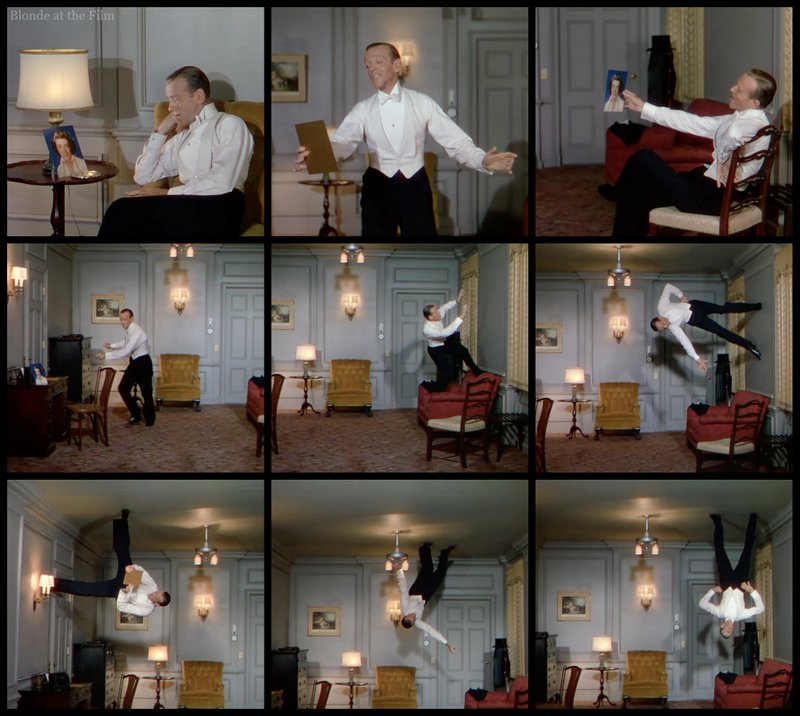
Fred Astaire in "Royal Wedding"- You get the idea: The trick was that the room rotated, which meant that the cealing and walls became more dance floor space for him for his talented footsteps to multiple over.
There is every reason for renters of the new minimus-micro-units to feel “royal” as they occupy them.  The break through enabling their leap forward in fitting people into space came from an architect working at the Marvel Architects firm, Isadore Doonaut Squrlay.  Until recently, working at SHoP Architects, another firm getting a lot of city project related business, Mr. Squrlay signs his correspondence and memos “Izzy,” but is generally referred to around the office as “I.D.”  “I call it my `Royal” idea” said Mr. Squrlay, “because I got my idea from Fred Astaire, more specifically Fred Astaire in `Royal Wedding.’  Probably everybody remembers the famous scene where Fred Astaire dances around a room, first up the walls and then on the ceiling.  Well I was watching that scene and I realized how every which way it flipped the rooms seemed like a different rooms with a whole lot more space we usually don’t think of using.  And I thought: `Why not do this for real? People could be climbing the walls for real!’”
Either Rosencrantz or Guildenstern could come visit Hamlet.
The round rooms unlock and rotate as desired, shifting based on a person’s weight, rolling on ball bearings, “brass balls,” says Mr. Squrlay, “you really have to have brass balls to do something like this.”

Allowing the units this 360 degree flexibility allows for a incredible versatility.  A ceiling becomes a bed, a few angles over it it's a recliner or props you up to read in bed.  If the rotation is left unlocked occupants can get far more (maximus, maximus) exercise walking miles and miles without stopping, never even needing to change the direction of their tread, although that's possible too; you can tread these miles in either direction.  When walking these miles the storage seats become steps like in a step class making the walk a little like the step classes normally available in ritzy gyms.

With the two storage units that also serve as chairs, the denizens of these units can also have visitors although if Hamlet wanted his school chums Rosencrantz and Guildenstern to visit it would probably be best if they came one at a time.  
 
The units will be prefab and easy to produce.  Like the units in the first micro-apartment building launched under Bloomberg those prefab units will be built in the Brooklyn Navy Yard and then stacked by crane at the site.   The round design of the units makes this exceptionally easy, the exact opposite of the problems encountered by Forest City Ratner stacking prefab units to build what was to be its first building at Atlantic Yards (now going by its new alias of “Pacific Park”) where alignment difficulties caused huge problems, interminable construction delays and huge cost overruns.

Because the units are round they can just be dropped into place and then they naturally align taking on a natural hexagonal formation much like a beehive.  “Humans have a lot to learn from nature and the way the insects like bees have organized their living arrangements,” said Mayor Bill de Blasio adding, “It’s no accident that we admiringly refer these as `social insects’.”
Natural hexagonal pattern- Seen in beehive at the right
The units are all required to be precision crafted to uniform size to achieve this perfect hexagonal alignment intended by nature.  That means that different units won't be different sizes for different people, something that has been under discussion as an additional space saver.  In the future different size units could used on an building by building basis, with buildings customized to house differing populations sorted based on the differing stature of individuals in the population.
Units configure an align themselves in a natural pattern
Purnima Kapur, Executive Director of the Department of City Planning, said that the new design presented an intriguing question about calculating the FAR (Floor To Area Ratio) that ordinarily limits building in New York City.  Because the circularity of the units mean that the units technically have no true floor (everything that might be considered floor is also wall and ceiling too) her City Planning department will be able to interpret the regulations that none of these new units need to be counted as using up any of the permitted FAR that normally puts a maximum cap on development although Ms. Kapur did avow that after a period of experiment the department will come up with some restrictions on the maximum size of buildings than can be built containing these units.  Ms. Kapur said that the department’s regulation that the units don’t count against permitted FAR will be a “circular reasoning” regulation.  By the same reasoning, no new laws will be required to launch the program because any laws subjecting units to measurement restrictions don't apply to units that can't be measured (except perhaps by reference to pi- A sort of "pi in the sky program"?).

The city is launching the program with the building of the units in a long list of buildings destined to replace the city’s libraries in all five boroughs. The city’s issuance of Request For Proposals from developers, with specs all detailed by I.D. Squrlay, was issued today, April 1, 2017.

Sunday, November 15, 2015

Do Conflicts of Interest Steer the New York City Planning Commission? The Answer Is “Yes” When It Comes To Selling/Shrinking Public libraries (Unless You Don’t Want to Call Them “Conflicts of Interest”)- Implication For Protecting The Public

Over 2,000 completed testimony forms opposing sale and shrinkage of the library and collected in just over two weeks
On September 22, 2015 the City Planning Commission was taking oral testimony about whether to approve a proposal to sell very cheaply Brooklyn’s second largest central destination library, located in Downtown Brooklyn, the recently expanded and fully upgraded Brooklyn Heights Library.  Citizens Defending Libraries (of which I am a co-founder) delivered over 2,000 completed testimony forms collected in just over two weeks at the end of the summer opposing the sale and drastic shrinkage of the library. Confronted with twenty-two reasons not to sell the library, most members of the public submitting the testimony cited the more than half of those reasons not to sell the library, the majority citing all of them. . . . . .   

Notwithstanding, on November 2, 2015, ten City Planning Commissioners voted unanimously to sell and drastically shrink the library, pulling in very little money for the city in return for that sale.
Click to enlarge: Twenty-two reasons that most of the more than 2,000 people delivering testimony against the library sale thought were good reasond NOT to sell the library
What explains why not one of these commissioners sided with the express, nearly universal sentiment on the part of the public?
The New York City Planning Commission at the September 22, 2015 hearing
The lock-step lineup of commissioners also voted 180 degrees contrary to the recommendation Brooklyn Borough President Eric Adams made against selling and shrinking the library.  Moreover, the commissioners knew that Citizens Defending Libraries also has, with its two petitions, well over 25,000 signature opposing such sale, shrinkage and underfunding of libraries.  The commissioners rejected and failed to take to heart the common sense, some would say conservatively-based advice of Nicole Gelinas of the Manhattan Institute, who directed an appeal to them in her New York Post column before their decision about how we are depriving “future generations” : NY libraries shouldn't be selling land - especially to build `affordable housing', By Nicole Gelinas, October 18, 2015.- See also her radio segment on the subject.

About the only conceivable explanation for the commissioners being so out-of-sync is that, pretty much across the board, the City Planning Commissioners have interests very different from the rest of the public’s. . .

. . . Two commissioners currently in office actually didn’t vote (there are twelve commissioners now holding office): The two were recused from the vote because they were acknowledged to be directly involved in the proposed library sale and shrinkage under consideration.

One commissioner recused was, Joseph Douek.  He is one of the trustees of the Brooklyn Public Library, one of the co-applicants proposing to convert the library into a real estate deal and also was on the board of another co-applicant, the NYC Economic Development Corporation (EDC), while the proposed sell-off was formulated.

The other commissioner recused was Michelle de la Uz.  Her position on the commission is as an appointee of the Public Advocate (appointed by de Blasio when he held the position). The Public Advocate's job is to be an elected watchdog for the public interest.  In another capacity Ms. de la Uz heads the Fifth Avenue Committee in which role Ms. de la Uz has already been advocating for the sale and shrinkage of this library and also pursuing a number of other Brooklyn Public Library real estate deals like Sunset Park, Clinton Hill (requires accompanying upzoning), Red Hook and finally turning the Sunset Park Library into a multi-use development.  Supposedly Commissioner de la Uz’s Sunset Park Library   redevelopment will be moved to the head of the list for city funding if the Brooklyn Heights Library is sold.

But what of the other ten commissioners who did vote?  Whatever causes their point of view to diverge so significantly from what the public wants, they say it is not a conflict of interest and they say there was no similar need for any other of them to to similarly recuse themselves.  We know this because Citizens Defending Libraries raised the issue of the likely need of seven more commissioners to recuse themselves, noting how those seven commissioners were respectively, in various ways, involved professionally with businesses, entities, and individuals in selling off the libraries.
CPC Chair Carl Weisbrod
Firmly rejecting the notion that any other commissioner might have to recuse themselves by reason of a conflict of interest the commission’s Chair Carl Weisbrod observed of the various professional entanglements (refereed to by him as their “essential . . . broad exposure to the business realms and civic realms of city life”) we “clearly would not want a commission of cloistered monks.”

Whether the commissioners have been living like “cloistered monks” or not, the question is whether the vote of all ten of the commissioners, each and every one of them under the circumstances and taking their associations into account, could be interpreted as independently exercised votes of conscience rather than reflecting a desire to please those in the real estate industry.

Having conflicts of interest is inherently awkward, but having a conflict of interest doesn’t make you a bad person.  What makes someone a bad person is having a conflict of interest and letting that conflict of interest determine an outcome.  A shade of nuance over from this is having a conflict of interest and, because you believe that you can still exercise your best judgement, voting or exercising discretion in a position of trust despite that conflict.  If you then vote in accordance with how that conflict might sway you (rather than the reverse) even if you think you are exercising your best judgment, you then have an appearance of impropriety, difficult to explain away.

If your standard is that you should avoid the appearance of improprieties (and that’s the standard most would advise) and you have many conflicts that can create such appearances then you may not be a bad person, but the question is whether you are holding a position it is not good for you to hold, whether it would be better for another, less conflicted person, to hold that position instead. . .

. . . With the world of New York real estate (especially the huge projects and major decisions regularly coming before City Planning) being such a small world of big monopolies, mostly a few, often family-based organizations, it is not surprising that commissioners who are `broadly’ involved in that world and not living like “cloistered monks” would face overlaps of involvement worth looking at.

Along these lines, the Citizens Defending Libraries press release announcing that it was raising the conflicts of interest issue noted:
The perhaps startling number of commissioners asked to recuse themselves can be accounted for by a number of things deserving public attention: Because so many of the New York City Planning Commission commissioners are deeply enmeshed in their own private real estate careers, the ubiquity of Forest City Ratner as a developer, and lastly because all of New York City's many libraries have now become an attractive target for transformation into real estate deals.
The reference to Forest City Ratner is because four of the commissioners had identifiable business interactions with Forest City Ratner and the commissioners were voting to approve the amendment of an agreement with Forest City Ratner (incidentally allowing for the wiping out of a public park and open space with many trees) whereby the transfer development rights could transferred through Forest City Ratner’s property.

Aside from the recused commissioners de la Uz and Douek, three other of the commissioners had connections to library sale transactions, one of them being Chair Weisbrod because of the involvement of the Episcopal Diocese of New York in real estate matters relating to the sale of New York City Libraries.
Commissioner Cheryl Cohen Effron, a particularly interesting case when it comes to conflicts of interest and selling off libraries
When it come to selling libraries Commissioner Cheryl Cohen Effron was a particularly interesting case because she (and I am stealing language liberally from the press release) has multiple relationships with many of the people involved in promoting the sale of New York City libraries.  That includes working directly with Linda Johnson, president of the BPL, one of the co-applicants to sell and shrink the library.  It also includes being on the board of the Revson Foundation formulating policy with Sharon Greenberger, the former Chief of Staff to Daniel Doctoroff, Deputy Mayor for Development for the Bloomberg administration who as a BPL trustee worked with Janet Offensend to structure this and other library sale transactions.  Her involvement with promoting the sale and shrinkage of libraries in a surprising variety and number of ways is extensively set forth in this open letter to her from Citizens Defending Libraries before the commission's vote: Friday, October 30, 2015, Open Letter To NYC Planning Commissioner Cheryl Cohen Effron Respecting Her Vote About Selling & Shrinking the Brooklyn Heights Library, Other Libraries The Revson Foundation, Center for an Urban Future, And More 

Among other things, the Revson Foundation granted money to the Sunset Park Library real estate transaction tied in with this one, a reason Commissioner de la Uz has already recused.  The Revson Foundation has also given money to a number of other organizations promoting NYC library sales, including the Center for an Urban Future whose representatives testified more than once during these proceedings that the Brooklyn Heights Library (and others) should be sold based on reports the center did funded by the Revson Foundation.  Effron has been simultaneously involved on the "Benefit Committees" for Center for an Urban Future galas (for at least two years) working with David Offensend who, as COO of the NYPL sold the Donnell Library while his wife Janet was involved as BPL trustee structuring the nearly identical proposed Brooklyn Heights Library sale.
On left the David Offensend deal, the luxury tower replacing the  Donnell library. On right, the Janet Offensend deal, a luxury tower to replace the Brooklyn Heights Library replicating the Donnell deal.
The debacle of selling the Donnell Library, still infamous, was alluded to several times by the commissioners during the hearing as a generally acknowledged mistake (although the Revson funded Center For An Urban Future endorses it as model).  We have now passed the 8th anniversary of its sudden, secretive sale: The luxury hotel, condominium tower and restaurants the lucky developers to whom the property was handed got to build were up and running last March, but the tiny, underground, shrunken mostly bookless library to `replace’ the once grand Donnell is still nowhere in sight.

David Offensend was also working to sell the Mid-Manhattan Library and Science, Industry and Business Library as part of the Central Library Plan.  That’s the same plan predicated on removing 3 million books from the research stacks of the 42nd Street Central Reference Library and sending them to New Jersey, something hurriedly done before Bloomberg left office so that we are still trying get them brought back.

Commissioner Effron was not recused from the vote and voted just the way one would expect her to given all these previous efforts   Explanations for why none of the commissioners, including Commissioner Effron, recused themselves were offered in general terms so pinpointing what exact reasoning applied to each respective commissioner is difficult.  From what was offered it seems that, in the case the of Ms. Effron, the idea seemed to be that she didn’t have a conflict of interest because Sharon Greenberger, working with her the board of the Revson Foundation to set policy and provide funds to organizations promoting library sales, including the Center For an Urban Future, and former hedge funder David Offensend, working with her on the fund-raising galas for the Center For an Urban Future, were considered just “acquaintances.”  Chair Weisbrod suggested that to “just know” someone or have inconsequential dealings with them was not a concern. The Commission Counsel, Anita Laremont, opined for the board that “incidental business relationships” don’t create conflicts while Weisbrod similarly said that just to have “dealings with” someone doesn’t create a conflict.

What was perhaps intended by Chair Weisbrod to be the coup-de-grace in dismissing any idea that Ms. Effron could have a conflict of interest was that her long record of involvement with those pushing for these library transactions together with any of Commissioner Effron’s own committed involvements in promoting such library sales and shrinkage as Donnell, the Brooklyn Heights Library and the NYPL Central Library Plan, were “charitable.”  Mr. Weisbrod, reading from his prepared statement, referred to board member involvement in “charitable efforts to assist libraries.”

The Revson Foundation is a charity.  The Center for Urban Future is non-profit.  Spaceworks, receiving funding from Revson with a principle purpose (albeit with a real estate oriented bent) of shrinking and privatizing NYC public library space as “underutilized” is technically non-profit, Urban Librarians Unite, advocating for library sales is a non-profit and receiving funds from Revson is a non-profit.

Ms. Effron “has served on more than twenty boards”- That’s from Ms. Effron’s bio on the website of the Municipal Art Society introducing her as “as a New York-based real estate developer specializing in the revitalization of warehouses into multi-tenant manufacturing centers” from when she was a speaker at a “summit” in 2011.

Although BPL president Linda Johnson, who when she arrived at the BPL in 2010, the year before, told her board that the real estate plans were her priority, was also a speaker at the summit that should not be held against Ms. Effron because the speakers in 2011 were many and far ranging. Nonetheless, the Municipal Art Society has also been devoting it resources to the promotion of this and other library sales.  Worse, it stands as a prime example of how a charitable organization’s charted course can be commandeered and reversed.  As Noticing New York has covered before, the Municipal Art Society, once a bulwark for the public interest has started backing developments it once helped direct excoriating criticism at, handing out two awards for Ratner’s Atlantic Yards (once the “poster child” for bad development) and an award to the man who was viewed as having bollixed it up, Sharon Greenberger’s former boss and Bloomberg Deputy Mayor for Development, Daniel Doctoroff.

That a once powerful organization that could be depended upon to critique the excesses of the real estate industry has now, instead, been moved into the category of cheerleader (only occasional deference to its ostensible purposes still paid) must be extremely valuable to the real estate industry, “Better than money in the bank” to use an expression.

Sounds like a joke, but true story-  Two hedgefunders sit in a Mid-town Manhattan Starbucks.  “So what’s up?” says the first.  “I don’t know,” says the second sounding somewhat put upon, “They’re wanting us now all to get on the boards of 501(c)(3)s.”  

Why when you look at the LinkedIn profile for a young ambitions professional, a salesman/consultant/PR type always playing the angles, do you see the vaguely expressed objective of “getting on the board of a charity”?  Just any kind of “charity”?

With the percentage of nonprofit board members coming from the finance industry reportedly doubling since 1989, the increasing dominance of Wall Street financiers on charitable boards is raising concerns about how those institutions set their goals.

Charities should not always be presumed to be doing good in this world.  Forest City Ratner created “charities,” non-profits to promote Forest City Ratner's very much for-profit Atlantic Yards project.  With financial assists Ratner also induced existing charities to veer into the course of supporting his project, putting them at odds with the broader community opposition that soon arose.  Then Ratner essentially used one of the non-profits he created to run a candidate (Delia Hunley-Adossa) for City Council against Tish James, the City Council Member who was leading strong opposition to his mega-monopoly project.

Charities should not always be presumed to be doing good in this world, but the presumption that they are doing good can be like putting on a suit of armor for those from the business world who have other motivations.

In a May 30, 2015 New York Times Sunday Review Op-Ed, "Who Will Watch the Charities?," by David Callahan, founder and editor of Inside Philanthropy, says "(W)e should end the charade that all philanthropy is somehow charitable," and gives multiple examples of why.

There are, of course, requirements under state law that the purposes of charities be truly charitable.  There are levels of regulation under the federal tax code intended to enforce concepts along those lines which the IRS is supposed to enforce.  State law is most often supposed to be enforced by the State Attorney General, (currently in New York State: Eric Schneiderman) but that is a political position, subject to the same sway of big money as may subvert the purposes of charities.  In all, there is much deference paid to the judgement of the supposedly charitable boards even when the decisions they make are suspect or bad.

Whether conclusive or not, that activities are denoted as “charitable” goes a long way to negate an inference of “financial gain” being sought.  The City Planning Commission concluded that, apparently largely because they were describing them under the rubric of  “charitable,” Commissioner Effron’s deep and repeated involvements with those shrinking libraries were not conflicts because, as such, she would not be considered to be using “her position to obtain a financial gain, contract, privilege or other private or personal advantage, direct or indirect for . .  herself or for any person or firm with whom he or her is associated.”

In fact, in presenting how involved Commission Effron has been with promotion of library real estate deals Citizens Defending Libraries did not trace through any of her involvements to “financial gain” or attempt to say specifically whether she was receiving other “private or personal advantage, direct or indirect for . .  herself or for any person or firm with whom he or her is associated.”
The Effrons described by Muckety as a “power couple,”
Commissioner Effron is described by Muckety as one half of a “power couple,” her husband being Blair W. Effron, co-founder of New York based Centerview Partners, an investment banking firm based in New York City with offices in London, Los Angeles and San Francisco.

According to its website since its 2006 founding Centerview has:
advised on over $1 trillion of transactions. Our clients include over 20% of the 50 largest companies in the world by market capitalization, and we have been involved in many of the largest and most complex corporate situations and transactions.
The subject of conflicts of interest can be confusing and baffling in the challenge of its analysis, especially when one realizes that conflicts don’t necessarily have to manifest themselves in bilateral quid pro quos.

For instance, conflict can involve three-way exchanges.  When former Connecticut Governor John G. Rowland resigned in scandal one of the things that brought him down was the purchase from the governor of a “pied-à-terre” condominium unit at an apparently inflated price by an antiques dealer.  The antiques dealer, a Mr. Pratt, didn’t have any business dealings with Governor Roland and wasn’t trying to get any benefits for himself, but “Mr. Pratt's frequent business partner and closest friend” was Robert V. Matthews, whose companies “received $8.7 million in rent and $4.8 million in loans and loan guarantees during Mr. Rowland's tenure.”

Another example of how confusing things can be: Harvard Law School professor Lawrence Lessig, who (together with others such as Zephyr Teachout) writes about the problem of what money in politics buys at the expense of public good, has been making it clear that the corruption of money in politics should not be considered just the kind of particularized quid pro quos that the Roberts Supreme Court is trying to narrow things down to “a contribution” to a government official or candidate “in exchange for his agreeing to do a particular act within his official duties.”  It is instead a more systemic problem involving generalized understandings about how the interests of wealthy players will be served ahead of those of the general public.

This gets into questions of what the law is, or may be interpreted to be, versus what it should.be. . . .  Or as the refrain goes: “The crime is what’s actually legal!”  (At least when certain people are writing the rules.)

Thus part of the defense being mounted for former NYS Assembly Speaker Sheldon Silver against his criminal prosecution for corruption is that while there may be more or less broad belief on the part of the public that Albany is corrupt, and while what goes on there, even exactly what Silver was doing may make people “uncomfortable” it is not against the law because Silver successfully side-stepped leaving evidence of a technical ”quid pro quo.”

In his opening statements in Silver's criminal trial Silver’s defense attorney Steven Molo said of Silver and his the huge payments he was taking as alleged kickbacks (per the Observer):
. .  the government simply disapproved of the entirely legal fact that Mr. Silver and other state lawmakers can hold outside employment and, instead of trying to change such laws—which he said will present “inherent conflicts of interest”—the government was “leveling false criminal charges against one of the senior legislative officers, senior government officials in this state.”

 “It makes some people uncomfortable, but that is the system New York State has chosen, and it is not a crime,” Mr. Molo said. “The prosecutors are trying to make it a crime, but it’s not.”
A New York Post editorial chose to quote Mr. Molo on another aspect of the defense, everybody does it:
"It's impossible, absolutely impossible," argued defense lawyer Steven Molo, "for a member of the Assembly to .?.?. do the job that a person in the Assembly does and not have some sort of conflict of interest.
   
"That may make you uncomfortable," he added, "but that is the system New York has chosen, and it is not a crime."
That’s not exactly a you can’t be a “cloistered monk” defense, but it has an echo of it.

It’s worth remembering that Sheldon Silver, and similarly charged Republican Senate leader Dean Skelos also, may not be convicted.

The key to what’s actually kosher, or what ought to be, is what Sheldon Silver sought to conceal.  So, last Monday, testimony was taken from a staff member on the Assembly Ways and Means Committee about how budget reports were adjusted to conceal Speaker Silver’s involvement with “discretionary funding that Sheldon Silver had allocated to items of his own choosing.” 

It is worth noting that during the oral testimony hearing about the library sale, Commissioner Effron was conspicuous in her non-disclosure of her relationship with the Center for an Urban Future when eliciting testimony from its representative.

The possibility of conflicts on the part of the other City Planning Directors don’t involve charities.  Dismissing the possibility of their importance, Chairman Weisbrod said that they in some cases involved  “really ancient dealings.”  CPC Council Anita Laremont stated “Past business relationship is irrelevant. . . . Acquaintances, past business dealing, or incidental business relationships do not meet [the definition of conflict of interest].”

Not much of what was raised for the commission to consider about conflict of interest was all that “ancient,” except for one past involvement of Chair Weisbrod himself: Chair Weisbrod was the former head of the NYC Economic Development Corporation when the Ratner agreement about development of the property, then sought to be amended, was put in place for the adjacent Ratner building completed in 1986.  As for the real estate deals involving the Episcopal Diocese of New York and its pension funds purchase of a portion of the NYPL’s SIBL at 34th Street, the deal's inception looks like it goes back to 2007, but in 2012 there was a significant transfer of real estate, followed with a number of other transactions, some quite recent, and it looks quite likely that negotiations still continue respecting future possibilities.

While certain dealings could maybe be characterized as "ancient" the conflicts of interest law sometimes has a long memory with a “lifetime bar” (albeit narrowly construed) applying to city officials and employees ever working on the “same transaction” for someone else in the future.  While this “revolving door” prohibition invokes an elephant's memory standard, there isn’t a reverse counterpart that prohibits someone implementing a transaction for a private party then going into government and continuing to implement it further or consummate it there.

As for Chair Weisbrod’s previous involvement with the Ratner deal at EDC: Although not cited, he might have been able to excuse himself from a “lifetime” bar with respect to it by arguing that he was, at the CPC, once again working for government, not the private sector, so the bar should not apply.

A review of most of the other overlapping professional relationships of the commissioners show they involve more contemporaneous and/or possibly recurring situations.

For instance, Commissioner Orlando Marín has a professional association with the Bluestone Organization.  The Hudson Companies is the developer applicant wanting to buy and shrink the library.  Bluestone is a partner with the The Hudson Companies in another Brooklyn project, Gowanus Green.

Orlando Marín
Mr. Marín did not recuse himself, reportedly because he is not now with the Bluestone organization.  But when Bluestone was called up by someone seeking to check this information about when Marin left Bluestone, it was Commissioner Marin who answered the phone.  The explanation is, reportedly, that he operates as a sub-contractor.  We understand that answering the phone at Bluestone Mr. Marin was not happy and somewhat defensive, complaining about being “stalked.”  But, remember, there is nothing wrong about having a conflict of interest, the question is whether someone lets that conflict determine outcomes.  Conflicts should also not be concealed.

On September 22nd, after the commission hearing where oral testimony was taken, several of us there to defend the library had to wait patiently to talk to Commissioner Marin because David Kramer, whose Hudson Companies was a co-applicant asking for the library sale, was ahead of us conversing with  Commissioner Marin about business opportunities and who they mutually knew and who was doing what.  While it cannot be said exactly that Kramer was offering Marin business we as listeners agreed that it was very easy to interpret it as having that flavor, and the conversation was certainly reminder to Marin that they were in the same club with shared interests and point of view.

Later, after one of the commissioners’ meetings (Monday, October 5, 2015) where there was a follow-up discussion about the library before the commissioners voted, CPC staff shooed me away from talking to Commissioner Cantor (whose question indicated he was uninformed about the relationship between the Donnell and Brooklyn Heights libraries, including the Offensends).  I was told it was improper for the public to be talking to the commissioners while a matter was pending.

There is a back hallway at the City Planning Commission that leads to where the commissioners can be found before and after their meetings.  It is blocked by a sign that reads “Staff Only Beyond This Point.”  After the commission’s November 2nd voted to approve sale of the library to Hudson Companies, a witness excitedly reported seeing David Kramer pass beyond that sign, disappearing down the hallway.  Sounds like he knew his way.

Should Citizens Defending Libraries have raised these questions about conflicts of interest before a vote?  With any group, and this must be supposed about the commissioners too, there is a strong psychological impulse to “circle the wagons” and band together when any of its members are in any way questioned.  And while not all the commissioners were exposed to questions about the possibility of conflicts in this instance, the possibility of other other conflict being raised in the future is huge.  A little research in connection with other matters might expose nearly all of the commissioners to many such challenges going forward.  You might say that, thinking ahead to the future, they needed to defend how principled or not they have a right to be as a matter of principle.

Citizens Defending Libraries could have waited and raised these issues after the vote, but raising them after the vote seems lame, sour-grapes, and last ditch, less like you were honestly concerned about the issue from the get-go.  The actual fact of the matter is that, given the composition of the board and its history, the board could have been expected to vote the interests of the real estate industry club to which they belong no matter what.  Raising these issues explicitly as we did in advance in a context where the public interest was so clearly contrary to what the board decided at least helps light the way for those who will be dealing with the City Planning Commission in the future.

Chair Weisbrod dismissed the need for any other commissioners to recuse themselves somewhat disdainfully, sounding admonishing as he asserted that by raising these issues Citizens Defending Libraries “demonstrate a lack of understanding as to what constitutes a conflict of interest.”  To add authority to this assertion Weisbrod said that the CPC’s Counsel, Anita Laremont had discussed the issue with the city's Conflict of Interests Board.

Is the Conflicts of Interest Board exacting and tough enough to protect the public?  Some things it does will throw a convincing scare into people.  For example: As previously written about in Noticing New York, in 2009 the Conflict of Interest Board sought to fine a librarian $1,000 because, as a proud father, he promoted and gave away free copies of his daughter's new graphic novel version of  of "Macbeth." 

At almost exactly same time, the Conflicts of Interest Board was exempting the members of charitable boards, including those on the library boards, from newly enacted disclosure rules, doing so very much against the expectations of legislators who had passed the law.  It may be said that the tough rules are for small fry, not the big fish.

In 2009, the New York Times wrote about how the Conflicts of Interest Board was likely not so reliable for discerning conflicts pertaining to Mayor Bloomberg:  City Board Set Up to Monitor Ethics May Have Conflicts of Its Own, by David W. Chen, September 6, 2009:
But even as they scrutinize the ethics of others, several board members, all five of whom were appointed by Mayor Michael R. Bloomberg, have ties to city funding and the mayor's fortune that raise questions about their own potential conflicts.

        * * * *
 
Dick Dadey, executive director of Citizens Union, a nonprofit government watchdog, said, "There may be reason to question how strongly they are monitoring the activities of senior administration officials, given that they have ruled against a number of lower-level city employees for rather minor mistakes or judgments and then appear not to be as equally fair-minded in their review of higher-level folks."
Conflicts of Interest Board bias is likely to flow from who appointed them.  The five members of the Conflicts of Interest Board are appointed by the Mayor (with the advice and consent of the City Council).  When Mayor Bloomberg first took office, the COIB, its then members appointed by his predecessor, issued restrictions to prevent Bloomberg’s continued interactions with his Bloomberg LLP. terminal sales business.  Ultimately, those restrictions were not enforced when Bloomberg ignored them and kept calling up his business to check on terminal sales (mostly with companies doing business with the city).  The board that was not enforcing the restrictions transitioned to one Bloomberg appointed himself.
Anthony Crowell, on the Conflicts of Ethics Board and the Brooklyn Public Library Board, appointed to both by Bloomberg.  He was Bloomberg's special counsel.
Currently, three of the five sitting COIB members were appointed by Bloomberg.  One of those three is Anthony Crowell, a trustee of the Brooklyn Public Library, and former chair of the BPL's borad of trustees as the library sales were first pursued hot and heavy.  He was appointed by Bloomberg when he was Bloomberg’s special counsel.

Does this make it sound like the club that gets to decide who can do what is altogether too small?  In 2006 the Conflicts of Interest Board was asked whether Anthony Crowell being on the (charitable) BPL board (ultimately pushing for libraries sales) at the same time he was part of the Bloomberg administration constituted a conflict of interest.  He’s still on the BPL board so you can guess what Conflicts of Interest Board decided.

No matter, it is not really clear at this point what was communicated to the Conflicts of Interest Board in the recent discussions the City Planning Commission reportedly had with them nor which of them did what in reaching the conclusions that there were no other conflicts of interest that needed to be dealt with.

Here is what the CPC’s Counsel Anita Laremont stated for the record during the meeting:
in order for there to be a conflict requiring recusal . .  there would need to be a determination that a commissioner was attempting to use his or her position to obtain a financial gain, contract, privilege or other private or personal advantage, direct or indirect for him or herself or for any person or firm with whom he or her is associated. . .  Past business relationship is irrelevant. Nothing in the various alleged relationships evidences an association of the type that would constitute a conflict or allow the conclusion that any commissioner was attempting to use his or her position for personal or financial gain or other advantage for themselves or others.  We remain unaware of any such relationship, beyond those of Commissioner de la Uz and Commissioner Douek who are both recused .
The relevant provision of the City Charter on this is Charter Section 2604 subsection 3, which prohibits public servants from using or attempting to use their city position to obtain any financial gain, contract, license, privilege or other private or personal advantage, direct or indirect for themselves or for any person or firm with whom or with which they are associated. . . Acquaintances, past business dealing, or incidental business relationships do not meet this definition.  In short, none of the claimed relationships here would require recusal for any of the named commissioners.
To be absolutely fair, although the overwhelming divergence of the commissioners' votes from what would obviously appear to be public interest cannot be readily explained without resorting to an examination of problematic ties to the real estate industry, not every one of the ten votes can necessarily be ascribed to possible conflicts of interest.
Commissioner Anna Hayes Levin, a particularly depressing vot because of Manhattan Borough President Gale Brewer.
The vote that was most depressingly troubling and not explicable in this way was that of Commissioner Anna Hayes Levin, the appointee of Manhattan Borough President Gale Brewer.

Commissioner Anna Hayes Levin has no apparent conflicts or ties to the real estate industry. Appointed by Borough President Gale Brewer, she should have been expected to vote exactly as Gale Brewer wanted so long as it was the right thing, and Commissioner Levin comes across as very smart and informed so she must have known that voting for the sale and shrinkage of the library was not the right thing to do.  During the hearing she properly raised valid, on-target concerns about what was proposed: That this was a “one-shot deal,” a lack of a proper appraisal showed that the city was not even getting the “tear-down” value of an extremely valuable asset, how there was absolutely no guarantee that any of proceeds going to the city would ultimately be spent on libraries (the “main argument” for the proposed sale), that the BPL was selling the library without even bothering to design the “replacement” shrunken library first, she expressed concern about the imbalance and burdens between development and supporting public infrastructure when our educational infrastructure, schools and libraries get such short shrift.

She firmly expressed all these appropriate concerns during the early days of the proceedings and then she did that classic government maneuver that’s always startling whenever it is pulled in these situations: The day of the vote she obliquely announced that all her “concerns had been met” leaving it a mystery how that could possibly be.

Needless to say there is probably reason to be enormously disappointed in Gale Brewer as the probable influencer of this outcome.  It does not bode well with respect to the planned sale of SIBL being talked about that results in the shrinkage of the Mid-Manhattan library when “renovated.”  Further, it is already time to acknowledge that Brewer has not been the friend to SIBL one would hope and expect.

As Brewer’s appointee Commissioner Levin should also have voted against the sale based on Commission Chair Weisbrod’s indication that the sale of this public asset could be viewed (dangerously) as setting an interchangeable precedent for something Gale Brewer recently fought while still a City Council member: Selling public schools for redevelopment, putting them in the base of towers.  Indeed, although Citizens Defending Libraries offered caution about this and all its associated problems in its testimony, less than two weeks after the commission’s vote a report ran on WNYC, sounding like it had been placed by the de Blasio administration, a trial balloon for future PF.  It told us “Mayor de Blasio says” that the public should “allow developers to build taller and, in return, get things like new schools and libraries” in the buildings.  See: Dumbo Developer Proposes Schools in New Apartment Buildings, Friday November 13, 2015.
WNYC's report: Dumbo Developer Proposes Schools in New Apartment Buildings
Ironically, reporter Janet Babin’s WYNYC report is structured around “one real estate mogul” Jed Walentas of Two Trees Management in Dumbo who is “on board” making the proposal to do this “wherever there are new apartments coming on line” and uses the example of school space being put into Walentas’ Dock Street, Walentas proclaiming it “a model of how schools should get built.”   The report makes no mention of the sordid details of how the withholding of a more appropriate school was used to blackmail the community into approving a bigger Dock Street project for Walentas that the report holds up as a desirable example.

The report, biased in terms of time allocated and otherwise, lets Walentas make a sort of too-good-to-be-true-free-lunch pitch that by allowing a “bending the zoning code” by Mayor de Blasio we’d be creating “land for free” (Really?), and that “private developers can build schools cheaper than the city” and that the city spends “way too much money” building schools.  In asserting that there will soon be a “shiny new school” in the Walentas building the report skips mention of the controversial bait and switch the community is now dealing with in that respect.

The entire WNYC report offers just one sentence that offers a different point of view to counter what it hypes, but it’s a good one.  Maggie Spillane, a member of the community education council for Brooklyn Heights says: “I think for children, where they learn matters, and I don’t know that developers whose main interest is in selling apartments, really have the interest of the school children, sort of at the forefront.”  Her on-target observation, however, is undercut by the quickly following suggestion that a developer may want a good school to help sell apartments.

Think for a moment: Isn't the reason that we need our libraries and new schools because developers have gone crazy-wild building taller all over the place already?

How can the answer is to that problem then be to build even more and even taller?  (it's like those who say the answer to guns in schools is even more guns in schools.)  What happened to providing schools and libraries the old-fashioned way keeping pace with development, no hostage taking allowed?

Besides, why are we noticing that the result of letting the private developer Hudson Companies build super-tall (400 feet) on the site of the Brooklyn Heights Library is that the `rebuilt' shrunken library the public is getting in exchange, hardly a free lunch, is actually a significant loss, just one-third the size of the library the public, no private developer in sight, recently enlarged and fully upgraded in 1993.

Why is it that Gale Brewer apparently wanted her appointee to the City Planning Commission to set a precedent to approve the sale and shrinkage of NYC city libraries, likely followed by New York City schools in deals that drastically shortchange the public?  Why would she want to be seen as retroactively blessing the inexcusable sale and shrinkage of the Donnell Library?  An answer is that she may have had a deal with de Blasio.  In the larger scheme of things, that's OK, not a conflict of interest, if Borough President Brewer made a good trade, one that actually benefitted the public.  Horse trading and deal making is the basis for much of the way that government and politics operate.

But why would de Blasio want to be selling off and shrinking libraries, something he decried as he ran for mayor saying: 
It's public land and public facilities and public value under threat. . . and once again we see, lurking right behind the curtain, real estate developers who are very anxious to get their hands on these valuable properties
The answer is that, shortly after saying this, de Blasio was taking money from the real estate development team looking to acquire the Brooklyn Heights Library while their application was spending.  Money in politics is not the kind of possibly prohibited conflict of interest we have mostly been talking about here, but in the big picture, money in politics represents interests that conflict with those of the public.

Reade Street, above the door when you enter City Planning Commission premises
The vote of the city Planing commissioners occurred at 22 Reade Street.  That’s sadly ironic because the commissioners voted to greatly curtail and take away space for New Yorkers to read. . .

. . .  Another irony: The Monday the commissioners voted to shrink library space the New York Times ran a front page story about how the troubling shortage of New York City library space often means that needs are not being fulfilled.  The article said that surging “demand for story time  . .   has posed logistical challenges” for NYC libraries “particularly those in small or cramped buildings.”  See: New York Times:  Long Line at the Library? It's Story Time Again, by Winnie Hu, November 1, 2015.
Citizens Defending Libraries tweet of New York Times story about inadequate library space.
You can't make this stuff up!

The City Planning Commission would have you believe that there were no conflicts that should have required any of the other commissioners to recuse themselves, a sort of `Move along folks, nothing to see here' kind of thing.  It's flabbergasting that, even by the very narrow constraints according to which the CPC would like to define and admit to conflicts that their answer is that there absolutely weren't any more conflicts at all to be recognized (or even asked about).  Beyond this, there is the bigger picture question of what is allowed to drive the planning commission and what the public would likely sense ought to be considered a conflict with an appropriate writing and interpretation of law.  That kind of analysis would likely call for more recusals in this instance and probably for a different, stricter approach to selecting who should serve on the commission in the first place.

Thankfully the City Planning Commission speaking for the real estate industry doesn't have the last say.  Whether the Brooklyn Heights Library should be sold and shrunk will now proceed to the New York City Council will confront the issue of setting this formidable precedent. Its first hearing will be 1:00 PM this Wednesday, November 18th in the Council Chambers at City Hall. The City Council is a body of elected officials.  There Stephen Levin, the elected City Councilman in whose district the City Council is in, will have a substantial say about the outcome.  At a previous hearing Mr. Levin said that "95%" of his constituents are opposed to this sale, that he wasn't able to walk "ten feet in district" without hearing about this issue and that it was the "#1 issue" when he was re-elected. . .

. . .  We'll see how this plays out.