Showing posts with label Saint Ann's School. Show all posts

Thursday, August 13, 2015

Open Letter To New York Times Public Editor Margaret Sullivan Regarding Non-disclosures By Ginia Bellafante and the New York Times In Connection With Article About Proposed Sale And Shrinkage of Brooklyn Heights Library

The following is an open letter I wrote to the New York Times Public Editor Margaret Sullivan concerning an article for which I was interviewed as co-founder of Citizens Defending Libraries by that article's author Ginia Bellafante.

* * * *
To: Margaret Sullivan, Public Editor, New York Times
Public@nytimes.com

Dear Ms. Sullivan,
Subject: Non-disclosure of reporter's connection to significant aspect relevant to article about proposed sale and shrinkage of major Brooklyn Library, that private school will benefit very substantially behind the scenes.
I am writing to call to your attention to and ask for your evaluation as New York Times Public Editor of an article written by a New York Times reporter, Ginia Bellafante, with a slant that may not have been discernable to many New York Times readers, but should be very discernible to those who know the facts concerning the subject as well as I believe Ms. Bellafante did.  Ms. Bellafante's editor observes that the article reflects an "opinion" Ms. Bellafante's formed about a very important public issue, whether a major public asset should be sold for redevelopment, the Brooklyn Heights Library, the central destination library in downtown Brooklyn, proposed to be replaced by a luxury tower with a drastically shrunken library at its base.

The article is: Brooklyn Libraries, Development and Misdirected Fear, July 10, 2015

Ms. Bellafante left out of her article many facts, some might think oddly or preferentially, that would very likely have caused her readers to form an opinion, contrary to her own, and conclude that the proposed library sale and shrinkage is unwise.  Her omissions included leaving out the fact that, quite shocking to many, a private school, Saint Ann's, is benefitting to the tune of what is likely to be tens of millions of dollars if the library is sold and shrunk.  Behind the scenes the possibility of materializing this private benefit for the private school seems to be a significant factor in driving forward this public transaction with its attendant public losses.

More important, in terms of letting readers evaluate the objectivity with which Ms. Bellafante was presenting what she wrote, Ms. Bellafante neglected to disclose to them, something unknown to me when she was interviewing me for the article: that she is a parent with a child in that Saint Ann's school that stands to benefit from the transaction she was writing about.

In addition to Ms. Bellafante not disclosing this herself when she wrote the article, the New York Times thereafter chose not to publish a comment on her article (the article was one that was open for comment) that I wrote that would have filled in this omission.  My comment on the article, provided below, noted that Ms. Bellafante disclosed to me, as she was writing the article, that she already knew about how Saint Ann's, a private school, is getting a significant payday (in a currently undisclosed amount) if the proposed sale and shrinkage of the public's library proceeds. Plus my comment noted that Ms. Bellafante and I had discussed the issue of Saint Ann's lobbying for the sale and shrinkage of the library in the background.  I also noted that  Ms. Bellafante did NOT tell me during those discussions that she is a Saint Ann's parent.

The Times decision not to publish my comment was apparently made after my ultimately-not-to-be-published comment was forwarded to Ms. Bellafante's editor who, apparently after consultation with Ms Bellafante, contacted me to say that it was not being published and to explain her view as editor that these things were not of concern.  I do not concur with Ms Bellafante’s editor in this assessment and I am providing our email exchange about this below.

Unfortunately, the publishing of Ms. Bellafante’s article was very well timed to influence an important political vote by Brooklyn Community Board 2 about whether the transaction should proceed and was used as propaganda by those attempting to push the transaction forward.

It would probably be worthwhile to consider chronologically the following concerning Ms. Bellafante’s writing of the article.

On July 6, 2015, the Monday after the 4th of July weekend Ms. Bellafante showed up at a hastily scheduled meeting of the Brooklyn Community Board 2 Land Use Committee.   Because the meeting was atypically being set up ad hoc at the very last minute with notice not going out to the public until 8:55 PM, Thursday, June 30th (essentially for all practical purposes Friday morning of the 4th of July weekend) Citizens Defending Libraries of which I am a part and co-founder of, had a tough time notifying as many people as we could to get the word out that this meeting was to occur.

According to what Robert Perris, the District Manager for CB2 told CB2 members later (July 11, 2015) when distributing and touting Ms. Bellafante’s “observations,” Ms. Bellafante “apparently walked over from her Brooklyn Heights home to attend the community board's public hearing on the ULURP applications associated with the Brooklyn Public Library's plans for its Brooklyn Heights and Business and Career branches” to attend the meeting.

Attending the meeting Ms. Bellafante heard discussion by a CB2 Land use committee that was obviously flailing about helplessly with, for instance, a total lack of knowledge about how much they were actually shrinking the library.  The public was not allowed to speak before the Land Use Committee voted, but it would be hard to think that anyone attending would not have been greatly affected, taking expressed sentiments to heart, when, at the end of the meeting, a long line of community members got up and spoke absolutely unanimously and very eloquently (we should get all our video posted on this) inveighing against sale and shrinkage of the library. No member of the public attending the meeting spoke any words of approval for the scheme.

In news coverage of that night summarizing many of the comments I am quoted as follows:
"This is a very sad vote," said Michael D. D. White, co-founder of Citizens Defending Libraries, which has been fighting the sale. "You've declared open season on selling off of libraries, you've declared open season on the selling off of public assets in general. And you've set the precedent for selling them off at an extraordinarily low price."
See:  the Brooklyn Eagle:  CB2 committee approves sale of Brooklyn Heights Library, with caveats, By Mary Frost, July 7, 2015.  I said much the same thing on News 12 coverage which, with a few short minutes and few words managed to cover other essential points Ms. Bellafante neglected in her article.

Apparently, however, Ms. Bellafante's point of view was not, and perhaps could not be, swayed by the public sentiments expressed that night.  Ms. Bellafante’s editor email to me stated that Ms. Bellfante’s “opinion” that “the redevelopment of the Brooklyn Heights branch should go forward had already been formed” and, in fact, was formed before she learned that the Saint Ann’s school her child attends was benefitting.  We don’t know when Ms. Bellafante decided she would write her article, but it has come to our attention that Ms. Bellafante was informed that Saint Ann’s was benefitting at least by the evening of Monday, June 29, 2015. . .  which means that her “opinion” was already formed by that Monday.

Tuesday, July 7th, the day after the Land Use Committee meeting Ms. Bellafante attended, Ms Bellafante reached out to me leaving a message on Facebook at 3:42 PM.  See below:
Michael: I am a Brooklyn Heights resident and columnist at the NYT and I'm writing this week about some of the changes facing Brooklyn libraries (both at Cadman and Sunset Plaza).

I was at the Community Board meeting last night and noticed some folks holding up signs and assumed they were affiliated with Citizens Defending Libraries. I'd love to talk to you (and/or you and your wife, who I understand is also very involved in this issue) about some of your concerns. I live right on Willow so could meet for coffee in the AM if you have time or we could talk on the phone if that's easier.

Let me know. My email is  giniab[at]nytimes.com

Many thanks,
Ginia
Ms Bellafante finally reached me the following afternoon (Wednesday July 8th) when she called my cell phone wanting a call back “before 6:30 PM” because she was “on a deadline.”

I called her back and we talked extensively starting about 4:30 PM.  In multiple respects I was surprised by how much she told me she already knew about the library sales.  Although she was contacting me with a stated deadline that was imminent, Ms. Bellafnate’s preparation for her article with its pro-development message the article did not appear to have been be rushed into production. 

Her article, published in the Metropolitan Section, was posted on line Friday afternoon.

In collecting more information from me, Ms. Bellafante let me know that she was already very familiar with many facts she later left out of the article, including how Saint Ann's private school is benefitting behind the scenes if the public's library is sold and shrunk.  She was also aware of the linkage between the sale of the Donnell Library for an inexcusably low price and the virtual carbon-copy replication of that model with the proposed sale of the Brooklyn Heights Library: She said she knew that when David Offensend was at the NYPL overseeing the much criticized Donnell sale, his wife, Janet Offensend, went to the BPL where she was key in evolving the "real estate strategy" and concurrent decision to sell and shrink the Heights Library.

Nevertheless, there were a fair number of things I told her that she didn't know that I noted didn't show up in her article even when I think they were of significance.  For instance, that Bill de Blasio had stood on the steps of the 42nd Street Central Reference Library in July of 2013 calling for a halt to the sale and shrinkage of libraries, including this particular Brooklyn Heights Library,* but then not long after, while developer applications were pending was taking money from the development team his administration ultimately selected as he let the sale proceed through to the next steps preceding the public approval process that Ms. Bellafante was writing about.  At Ms. Bellfante's request I directed her to a video available on the Citizens Defending Libraries YouTube channel of de Blasio's July 2013 statements appearing beside us to opposing the library sales.
(* Mr. de Blasio (7/12/2013): "It's public land and public facilities and public value under threat. . . and once again we see, lurking right behind the curtain, real estate developers who are very anxious to get their hands on these valuable properties")
Instead of mentioning anything about de Blasio in connection with the above, Ms. Bellafante downplayed the likely legitimacy of suspicions about our top elected officials and the sacrifice public assets for real estate development by suggesting to her readers that such suspicions were a sort of reflexive hangover, an "aftermath of the Bloomberg era" (therefore safely past tense and dissociated from the de Blasio era?).

I was also able to inform Ms. Bellafante, because she did not know, that Scott Sherman, who had written a series of articles about proposed NYC library sales and shrinkages for The Nation, had a new book book just out, "Patience and Fortitude- Power, Real Estate, and the Fight to Save a Public Library," that included in it new revelations about just how extremely little the NYPL netted from the sale and shrinkage of the Donnell Library: Less than $33 million.  From that amount must still be subtracted annual rent for a temporary replacement Donnell that started at $850,000 after Donnell, still not reopened in any form, closed in spring of 2008 and also must be subtracted millions of dollars paid to high-priced professionals associated with making that transaction materialize.  That very low net price was for a 97,000 square foot library shrunk down to a largely underground and largely bookless library of just just 28,000 square feet, while the penthouse apartment in the 50-story luxury tower replacing this public building is on the market for $60 million and other apartments in the building are selling for prices in the neighborhood of what the NYPL netted.

Ms. Bellafante did not tell me that she had already formulated an opinion that the Heights Library should similarly be sold and shrunk, but a few odd things indicated she might already have some leanings about certain things . . .  

Ms. Bellafante dismissed with disinterest the inconsistencies of the Brooklyn Heights Association respecting its position on selling and shrinking the library because of the gap in time between when it advocated the library be enlarged and its switch to now advocate that it be shrunk.

The fact that the library was significantly enlarged and completely upgraded with appreciable public expense in 1993, making the building essentially 5 years newer than the adjacent Forest City Ratner One Pierrepont Plaza, Morgan Stanley building, was irrelevant to her.  That Morgan Stanley building is where Hillary Clinton has chosen to locate her National Campaign Headquarters.  “After all,” that (1993) was “twenty years” back at the time the BPL announced it wanted to sell the library Ms. Bellafante reasoned aloud sharing her thoughts.

The Friday afternoon Ms. Bellafante's article went up, I immediately started posting comments to the article to add to it facts and perspective that I felt the article lacked.  Processing of comments was slow with some taking five hours to appear.

Publication of Ms. Bellafante’s article this particular weekend was very well-timed to have an influence on a CB2 vote scheduled for the following Wednesday, July 15, 2015, as to whether the library should be sold and shrunk and Saturday, the afternoon following the article’s publication it was sent around to all the CB2 members as propaganda by the CB2 District Manager suggesting the relevance of Ms. Bellfante’s “observations” to the upcoming vote.  See below:
July 11, 2015 at 3:20:21 PM EDT.

"Ginia Bellafante, who writes the "Big City" column in the Metropolitan section of the New York Times, apparently walked over from her Brooklyn Heights home to attend the community board's public hearing on the ULURP applications associated with the Brooklyn Public Library's plans for its Brooklyn Heights and Business and Career branches.  The applications are on the agenda for this Wednesday's general meeting, to be held at 6:00 pm at St. Francis College.  I thought the members of Community Board 2 and its Land Use Committee might be interested in Ms. Bellafante's observations."- District Manager Robert Perris.
(For what it’s worth, almost as soon as Ms. Bellfante’s article was posted on Friday, 3:04 PM, Ashley Cotton, Senior Vice President and Chief of Staff of Forest City Ratner, another of the real estate parities involved in the proposed library sale and shrinkage tweeted Ms. Bellafante’s article embedding a “thank you.”)

On Sunday, July 12th when I learned in the afternoon that Ms. Bellafante was a Saint Ann’s parent I submitted the following comment to the Times article (I was still awaiting publication of a previous comment about digital books).  This is the comment the Times would not publish:
When I spoke with Ms. Bellafante there was a great deal of information she impressed me by telling me that she already knew,, most of which doesn't appear here.  For instance, the background connections explaining how this proposed sale is modeled on the Donnell sale debacle, conceived at the same time.

Ms. Bellafante also explained that she knew all about how Saint Ann's, a private school, is getting a significant payday from the sale and shrinkage of the public's library in a currently undisclosed amount.  We discussed the issue of Saint Ann's lobbying for the sale in the background.

What Ms. Bellafante did NOT tell me and I now understand to be true is that Ms. Bellafante is a Saint Ann's parent, something not disclosed in this article.
Here is what Ms. Bellafante's editor wrote back to me at the end of the next day confirming that Ms. Bellfante was a Saint Ann's parent together with reasoning about my comment that was not being published:
From: Virshup, Amy  
To: mddwhite  
Sent: Mon, Jul 13, 2015 4:39 pm
Subject: Your comment on Ginia Bellafante's column

Dear Mr. White,

I am Ginia Bellafante's editor at the Sunday Metropolitan section of the Times and your comment about Ms. Bellafante's recent column on proposed library redevelopments in Brooklyn was forwarded along to me. The comment was not posted on the site, as I'm sure you know.  But I didn't want to let the moment pass without getting back to you.

I spoke to Ms. Bellafante about any possible conflict of interest. She began following the library issue before she knew that any possible sale of air rights by St. Ann's could be part of the project. She had not heard that anyone in the school was lobbying for the redevelopment to go forward, until you and other opponents claimed to her this was the case. Her opinion of whether the redevelopment of the Brooklyn Heights branch should go forward had already been formed and was not influenced by this news, or by the fact that she has a child at St. Ann's.

As citizens of New York, we here at the Times often end up writing and editing about things that intersect with our own lives. There are cases in which we feel that a reporter or columnist is simply too close to an issue to write fairly about it. We don't think this is one of those cases.

Sincerely,
Amy Virshup
Here is what I wrote back:
Monday, July 20, 2015 9:21 pm

Dear Ms. Virshup,

Yes, thank you, I am aware that the Times did not publish my comment.

When I talked with Ginia she told me that she knew all about the Saint Ann's payday.  I was surprised by how much she knew about this and other things like the linkage between Donnnell and other library sales with the Offensends (from our shared Brooklyn Heights neighborhood*) in the background and somewhat surprised by how much she chose to leave out as too unimportant to specifically mention, and too unimportant apparently to weigh in the balance of her conclusions.

        * We also similarly talked about Mr. Gutman.

Talking about Saint Ann's, we talked about the PowerPoint presentation that Saint Ann's did for its faculty about the library sale.  We also discussed at length the issue of Saint Ann's lobbying for its private benefit behind the scenes to drive forward this transaction where the public incurs significant loss.  I don't know when Ms. Bellafante first became well informed about the Saint Ann's payday before talking to me, nor do I know when she formulated her opinions, but I firmly feel it was, as a matter of good journalistic practice, a matter for her to disclose to her readers.  Ostensibly, at least she was formulating her thoughts when seeking information from me, and perhaps she should still have been.  On the other hand you are suggesting she already had a fixed idea of the conclusions she intended to promulgate before contacting me.

Failing disclosure in her article, I think it would have been fairest to the public and Ms. Bellafante's readers to at least learn that Ms. Bellafante was a Saint Ann's parent via my comment when I offered it rather than blocking it. This would have been especially valuable to have done on a timely basis, because Ms. Bellafante's article was used as a propaganda piece sent out officially by the CB2 office for CB2 board member consideration in connection with their vote before the CB2 members voted.  It was very well timed and well written for that purpose.

I could quibble about other matters in the article that look like they reflected an agenda on Ms. Bellafante's part, but I suppose I will only add that Ms. Bellafante did not mention to me that she was was going to depict Citizens Defending Libraries as having a sort of a feud with Urban Librarians Unite.  I don't believe she mentioned Urban Librarians Unite at all, and she certainly didn't mention her intent to have them comment on Citizens Defending Libraries or offer any opportunities of balance in that regard.

As for the question of when a columnist is too close to an issue to write fairly about it there will be different opinions. I, myself, personally, believe it is often necessary to write about things intersecting closely with our own lives. .  although maybe this is less often the case at the Times where the staff is large.  The lack of disclosure is what is troubling.

As to whether these or other relationships affected Ms. Bellafante's judgement in these matters, some of her logic troubled me like quickly dismissing the oddness of so drastically shrinking a library we so recently expanded (effectively the library is five years newer than the adjacent Ratner building, One Pierrepont Plaza, where Hillary Clinton has located her national headquarters).  Right now I'll leave the question of whether Ms. Bellafante's judgement was affected to others to consider without stating my own conclusion.  It's something I believe you and the Times should still be thinking about.   As for the public, it  won't be able to evaluate the question for itself without disclosure.

MICHAEL D. D. WHITE
Citizens Defending Libraries 
Noticing New York
http://noticingnewyork.blogspot.com/
National Notice
http://nationalnotice.blogspot.com/
W: (718) 834-6184
C: (917) 885-1478
mddwhite [at]aol.com
I did not get a response back.

One additional afterthought I’ve had is that, even if Ms. Bellafante formulated her apparently irrevocable opinion that the library should she sold before she formally knew that Saint Ann’s was getting a great deal of financial benefit in the background, she still formulated her opinion with that Saint Ann's sale being part of the milieu, the background and social environment of people around her, against which she formulated her thoughts.  Without being very careful it is not so easy to say that there was no consequent influence.

The purpose of this letter is not to point out where Ms. Bellafante and I may disagree in about conclusions that could be subjective, but pointing out some of these differences will help indicate instances where more wary and alerted readers might conclude that Ms. Bellafante's judgment was off.

Ms. Bellafante is entitled to a personal observation upon which she describes the library as "dilapidated," especially since she told me that she has visited the library with her son, but it is an assessment we don't share and I directed her to an extensively complete set of photographs including all the space not normally viewable by the public that I believe supports a different conclusion.  While it must be treated as Bellafante's own assessment it seems less accurate than an indication that she was looking to pass along promulgated talking points of the BPL.  Using sarcasm to belittle the idea that there is need for scrutiny because the BPL estimated costs of $9 million in necessary repairs for the library, $3.5 million for a partially out of commission air conditioning system (actually estimated by the BPL as higher than that) are likely inflated, Ms. Bellafante tossed off to her readers a disbelief that library administrators are interested in doing real estate deals, but the BPL's minutes show that when Linda Johnson arrived as BPL president she told her board that real estate deals were her top priority.

While Ms. Bellafante's quoting me about digital books is an accurate portion of our conversation about digital vs. phyical books it is a highly truncated one.  Yes, as recently covered by a WNYC "On The Media" segment and National Notice article, digital books and keeping physical books off site does mean libraries cease to have zones of privacy, but in saying that we are not against digital books I cited librarian John Palfrey's new "BiblioTech" book as calling for digital plus physical books (requiring more, not less, room), and I noted that people tend to prefer physical books (probably in part because they learn better with them- as covered in the Times) so that, despite the push of the BPL and NYPL toward digital books, circulation is way up with almost all of that circulation being physical books.  I also cited the just-out Washington Post article about how much more expensive digital books are and how with a push to digital rental models and increasingly consolidated content control digital books may mean that content winds up just vanishing from the libraries. . . .

. . . Instead, Ms. Bellefante's article uses was written to imply that the Brooklyn Heights Library is being shrunk based on "library science."

In conclusion, I believe that that there is substantial evidence that Ms. Bellafante approached her subject with bias and a fixed predetermination about what she would write that improperly fore-ran her collection and analysis of relevant facts and that, partly because that fixed predetermination persisted the way it did that Ms. Bellafante being a Saint Ann's parent, a school benefitting very significantly from this transaction, should have been disclosed in her article.  Similarly, I think the Times should have published rather than blocked my comment that would have provided an alternative, though less effective, disclosure of that relevant fact.  In fact, I see no reason why the Times did not publish my comment other than the original lack of disclosure might have been viewed as potentially embarrassing.

Had readers been informed by such disclosure there would have been cause to be more alert for the balance that I believe was missing from Ms.Bellafante's article.

Here, albeit with a few overlaps from what is cited above, are things Ms. Bellafante left out of her article:
    1.    The mistake of shrinking this library ( last enlarged with public expense and sacrifice Oct.1993) down to just  one-third size* can  never be corrected, nor can the “replacement” library, stuck in the bottom of a luxury residential tower, ever grow with the neighborhood, CBD, borough or city.  Though this shrinkage is to a preordained size, no replacement library has been designed and  no estimation at all has been done of how many books it should hold.

            (*  63,000 square feet to just 21,000 square feet.)

    2.    The BPL is selling a  sturdy,  readily adaptable library in good shape, together with its land and development rights worth over $100 million (probably $120 million or more) to the public in order to net next to nothing in a transaction that may even incur a  net cash loss.  Further, there is no assurance that the paltry sums, if any, gleaned from the sale,  all going to the city, would ever subsequently go to libraries.  Libraries, highly valued by the public, cost relatively little to fund, but this sale is apt to encourage further underfunding like this.

    3.    This sale would sacrifice one more public asset (an education-supporting one at that) to build yet another new, huge residential tower that would further burden the public infrastructure such as PS8, already at  140% capacity.

    4.    The gentrifying aspects of this project are unmistakable with a public asset democratically serving everyone equally being shut down, lower income patrons coming to the neighborhood  kicked out, and so-called “affordable” housing units built  “poor door” style at a far remove from Brooklyn’s burgeoning downtown and upper crust Brooklyn Heights.

    5.    The developer has  refused to say how much of a payday the private Saint Ann’s School is getting from the public’s sale and shrinkage of the library, because that’s a “ private” transaction, even though  it’s driving this  public one.  Shouldn’t Saint Ann’s be paying the BPL?  (It may likely get more from this sale than the BPL is getting.)

    6.    This sale sets the unfortunate precedent for serially underfunding and selling off other libraries (per the BPL strategic real estate plan) and other public assets (like  public housing) setting a template for how public assets can be picked off one by one.  This developer is making hundreds of millions of dollars: The incentives for other such deals will always be there.   If we can’t stop them at libraries . . .where can we stop them?

    7.    It’s improper that while the developer’s application for this project was pending Bill de Blasio was taking money sent to him by its development team,  in his words:  “lurking right behind the curtain . .  very anxious to get their hands on these valuable properties.”

Here are links I supplied Ms. Bellafante as research resources to supplement what I understood she had found:
    •    This Citizens Defending Libraries page with a handout we gave the CB2 Land Use Committee members (linking to other handouts including the memo about environmental issues).  It links backward to other valuable sources.  Monday, July 6, 2015,  Handout Number 1 For July 6, 2014 Brooklyn Community Board 2 Land Use Committee Meeting- Let's Get the Record Straight! Concerns Re Proposed Library Sale+Shrinkage To be Voted On 
   •    This is the Citizens Defending Libraries YouTube 12-minute interview with the 2-minute de Blasio clip right after the introduction.  BK Indie Media Interviews CDL On Library Selloff Schemes
    •    This is the product of the Citizens Defending Libraries forums we've had on the subject of selling off and privatizing public assets in general.  Our Public Assets Under Attack- A Calamity of the Commons Unfolding That We Must Act Collectively Against- How best To Express It? 
   •    This presentation of the tour photos showing the library to be in very good shape with lots of readily usable space.   In A Closed Library, A Tour of Much The Public Doesn't Get To See- Don't Let Them Close This Library, The Brooklyn Heights Library On Cadman Plaza West, Corner of Tillary & Clinton

    •    This is Citizens Defending Libraries statement of principles posted in connection with the Sunset Park library proposal.  Monday, November 3, 2014,  Proposed Statement of Principles Concerning Any Possible Redevelopment of Library-- Sunset Park Branch.
    •    Reference to recent Noticing New York articles I wrote about the libraries from July and June.

Sincerely,

MICHAEL D. D. WHITE
Citizens Defending Libraries 
Noticing New York
http://noticingnewyork.blogspot.com/
National Notice
http://nationalnotice.blogspot.com/
W: (718) 834-6184
C: (917) 885-1478
mddwhite [at]aol.com

Sunday, July 5, 2015

How Self-Contradictory Can The Brooklyn Heights Association Be As It Advocates Sale And Shrinkage of The Brooklyn Heights Central Destination Downtown Library?

Three strikes and you're out?

The Brooklyn Heights Association has now taken three solidly self-contradicting positions as it digs in to argue for what's an obviously absurd stance for it to be taking in the first place: its promotion of the sale and shrinkage of the Brooklyn Heights Library, Brooklyn's central destination library in Downtown Brooklyn on Cadman Plaza West at the corner of Tillary and Clinton.

 • First, the BHA now arguing for the shrinkage of a library that it previously advocated be enlarged and which was, in fact, thereupon enlarged and considerably upgraded at appreciable public expense and inconvenience, reopening in the fall of 1993.

. .  Calling for the shrinkage of a library the BHA had previously called for the enlargement of?. .

. . . That's inconsistency Number 1.

 • Then, how is it that when Citizens Defending Libraries (of which I am a co-founder) asked the Brooklyn Heights Association to call for proper funding of New York City libraries so that the Brooklyn Heights, Mid-Manhattan, SIBL and Pacific Branch libraries would not be sold, the BHA refused to call for proper funding, saying such funding was NOT a neighborhood concern?. . . BUT NOW---  The Brooklyn Heights Association is calling for the Brooklyn Heights Library to be sold because (supposedly) the sale and shrinkage would mean that libraries in other neighborhoods would get better funding? . . . Actually, that is such a treacherously false belief about funding as to be patently silly, because there is no guarantee that money would actually go to libraries, this library is being sold off at a huge public loss in a transaction that may net less than zero cash, and selling off libraries to developers as a self-cannibalizing funding program may simply foster more underfunding.

Switching from saying that proper funding of NYC libraries is not a BHA or neighborhood concern to saying that it is an important enough BHA and neighborhood concern so that it's a reason to sell off the Brooklyn Heights Library is inconsistency Number 2.

 • Now you can read on the BHA's website that the BHA is opposing new buildings in Brooklyn Bridge Park because:
Public school overcrowding will be exacerbated by the additional development. PS 8 is already operating at more than 140% capacity and turning away local kindergarteners for this Fall.
Right!  . . . But tearing down and shrinking a library supporting educational pursuits and consequently the school system isn't a similar problem, or an even greater exacerbation of it?

That's inconsistency Number 3! . . .

. . . Three strikes and you are out?

Why then might we theorize the Brooklyn Heights Association wants to be so terrifically, consistently inconsistent when it comes to wanting to see the library sold?
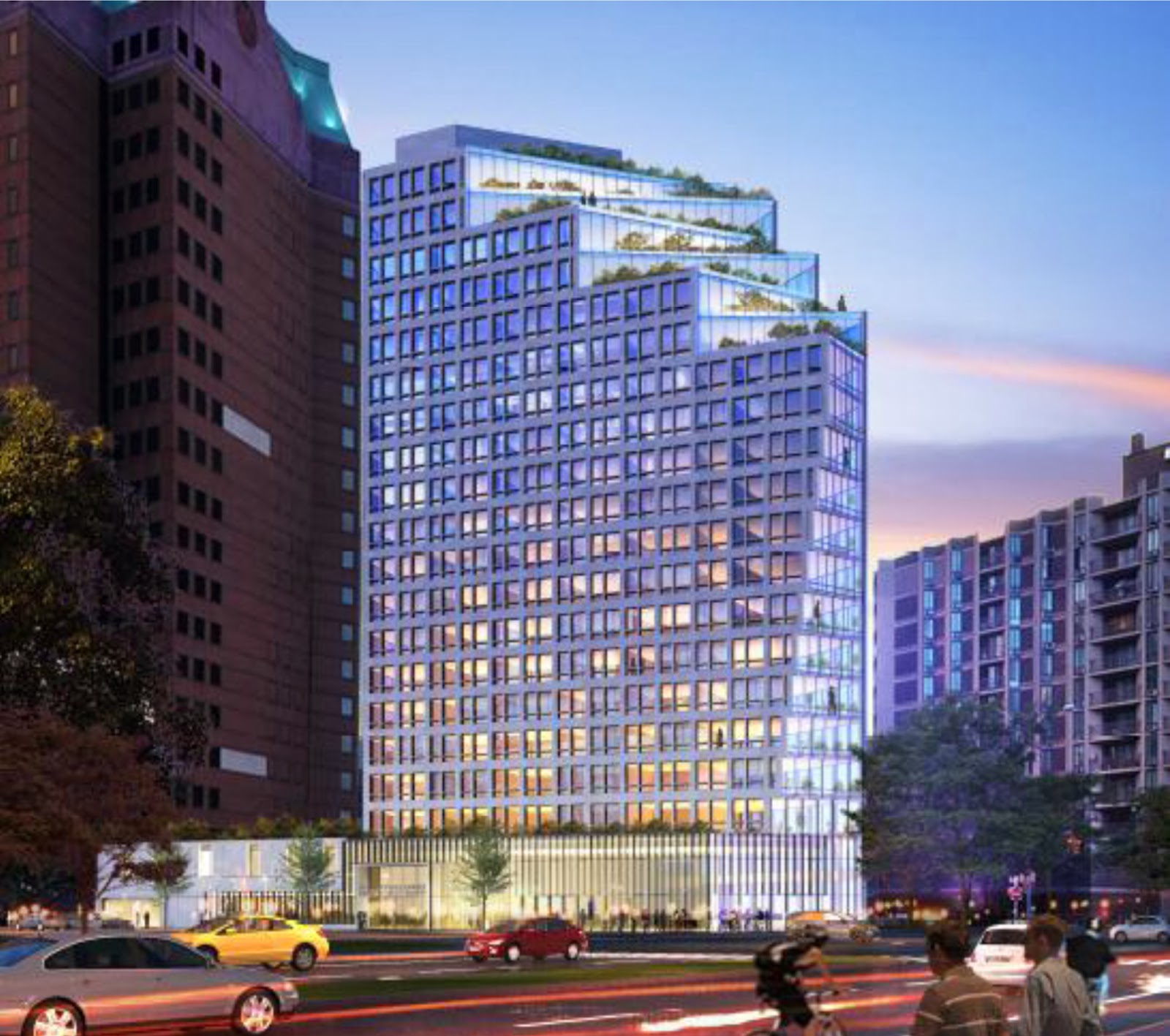
Click to enlarge if you dare- The Library-squashing tower that would benefit Saint Ann's private school and a developer if built, but not the public.
Here is Noticing New York coverage where you can read about two things to which we must unfortunately give connected consideration:
• How at the June 17th Brooklyn Community Board 2 Land Use Committee hearing about selling and shrinking the library the developer refused to say what Saint Ann's school is being paid as a result of the library's sale and shrinkage because,"it's a private transaction". . . He said that even though this private transaction is driving a public one!

• How Saint Ann's-connected people are deciding for the Brooklyn Heights Association that the BHA should promote the sale and shrinkage of the library.
Friday, June 26, 2015, Embarrassment of Past Riches!: Augmentation of NYC Book Space At Two Business Libraries Simultaneously- Only Recently The Brooklyn Heights Association Fought For Larger, Not Smaller Libraries.
Brooklyn Hts Blog: Who do you support?
Who then do we want to trust on this?  Do we want to trust the consistently inconsistent Brooklyn Heights Association?  Or as the Brooklyn Heights Blog asked after the 2014 Brooklyn Heights Association annual meeting: Who do you support, the BHA or Citizens Defending Libraries?

I think it's pretty clear: If the Brooklyn Heights Association wants to truly represent the community and the public interest, as is its responsibility to do, it's time for the Brooklyn Heights Association to contradict itself just one final time, changing its position to oppose the sale and shrinkage of the library, and the BHA should do so now while doing so can still have a beneficial effect on the process. . .

It would be the most consistent thing it could do and the thing most consistent with the public's interest.

Friday, June 26, 2015

Embarrassment of Past Riches!: Augmentation of NYC Book Space At Two Business Libraries Simultaneously- Only Recently The Brooklyn Heights Association Fought For Larger, Not Smaller Libraries

Click to enlarge if you dare- The Library-squashing tower that would benefit Saint Ann's private school and a developer if built, but not the public.
Do you know that in the 1990s, not so very long ago at all, New York City substantially augmented its library resources by spending to create more library space at two major central destination business libraries simultaneously?  And, if you rewind the clock, looking at one of those libraries, the Brooklyn Heights Association was in the thick of things fighting for more library space. . .

. .   Now, as fate (or the real estate industry) would have it, both of those central destination business libraries are besieged by those who would sell them, hand them out as juicy deals.

. .  And, for reasons that seem suspicious, the Brooklyn Heights Association now finds itself on the other side, advocating to shrink the library it once fought to enlarge.

The First Ever Hearing On Selling and Shrinking a Public Library- Running Into the BHA

Wednesday June 17, 2015 was the first ever hearing about selling and shrinking a NYC library, the Brooklyn Heights Library, Brooklyn's central destination library in Downtown Brooklyn on Cadman Plaza West at Tillary and Clinton, was held before the Land use Committee of Brooklyn’s Community Board 2.
Patrick Killackey, president of the Brooklyn Heigts Association now favoring the sale and shrinkage of Brooklyn's Brooklyn Heights Library.- From the Brooklyn Eagle
At the end of the hearing I approached Patrick Killackey, the new president of the board of the Brooklyn Heights Association, and told him the BHA was long overdue in following through to reconsider and change the position it took in favor of selling and shrinking the library, a reconsideration Killackey’s predecessor, Alexandra Bowie, said publicly the BHA might be willing to entertain when I questioned her as a co-founder of Citizens Defending Libraries at the February 24, 2015 annual Brooklyn Heights Association meeting:
"I will take that up with our library committee, which is how we operate, and if the library committee feels that it wants to revisit the question, then I will take it to the full board," Bowie said.
Bklyn Hts Blog: Who do you support?
The BHA’s original decision to support the sale and shrinkage of the library was rushed, secretive, lacking in public input and suspect in a number of ways.  We have asked the BHA to change course from the start, including at the previous, 2014 BHA annual meeting.  Back then, as well, it was very clear that public sentiment was strong on our side.

The last time I approached Mr. Killackey entreating that the BHA finally reconsider its position was at the May 9, 2015 annual Brooklyn Heights Association house tour where a majority of those on the tour wore our Citizens Defending Libraries “Don’t Sell Our Libraries” buttons.  Mr. Killackey told me then he was “off duty.”

I am sure Mr. Killackey believed I came on strong as I approached him after the hearing, and I probably did as I was very annoyed that at the hearing the BHA had just delivered inane testimony in favor of selling and shrinking the library Ms. Bowie herself standing to read it into the microphone.  Mr. Killackey may also have felt beset upon under the circumstances, because the hearing that had just concluded was packed with people.  Setting aside those people whose salaries (via the real estate industry or closely analogous situations) depended upon the testimony being in favor of a library sale and shrinkage, the hearing testimony was virtually unanimously opposed to selling and shrinking the library, leaving the Brooklyn Heights Association an odd outlier.
People told me they left the hearing more passionately opposed to the library sale and shrinkages than when they arrived.  This was after listening to Brooklyn Public Library president Linda Johnson protest to a groaning audience that “the BPL is not in the real estate business.”  And it was after hearing the developer refuse to say what Saint Ann's school is being paid as a result of the library’s sale and shrinkage because, he averred, “it's a private transaction” . . .  even though it is driving a public one!

I told Mr. Killackey that the BHA should be meeting with Citizens Defending Libraries and that we could educate the BHA about what was wrong with their position and the way that it had been reached.  Mr. Killackey seemed insulted and told me that I didn’t know anything about him or what he already knew about the library sale.

Fighting To Properly Fund Libraries

We then got into a discussion where Mr. Killackey made the point that NYC libraries have always been underfunded and have always had to fight for funds.  I have had a number of discussions with various people recently and it seems to me that this is a talking point that people arguing for the sell-off and shrinkage of libraries are now using to contradict what we have made a point of saying: NYC libraries are being underfunded at an unprecedentedly low level as an excuse to sell them off.
The explanation for library underfunding!  It's easy to see: The generation of deals like this, the 50-story building replacing the Donnell library.  And the proposal to replicate the Donnell sale swindle with a 38-story building replacing the Brooklyn Heights Library.
If you see things the way we do then what seems to be a very hard thing to explain becomes easy to explain: You ask “why should a `progressive’ mayor be engaged in an unprecedented underfunding of the libraries in a time of plenty?” - Then you look at the huge luxury condominium tower proposed to replace the Brooklyn Heights Library, shrinking it down to one-third size, and you say that’s the answer staring me starkly in the face!  And the answer is all the more obvious when you realize that the real estate development team “lurking right behind the curtain” to build it is sending money to the mayor.  See:  Saturday, June 6, 2015, WNYC Reports Mayor de Blasio's "Furiously Raising Funds"- Including From Developers "Lurking Behind The Curtain" of Library Real Estate Sales- And WNYC's Money?

We Used To Fight For Funds To Expand Libraries: Business Libraries As Case In Point

Mr. Killackey is correct that there is a history of libraries needing to fight for their funds from the city, just as every department or entity seeking city funding fights to justify its case for funds.  But the libraries never before had to fight for funds so that underfunding wouldn’t be a reason to sell and shrink libraries.  Au contraire, in the past, libraries were fighting for funds to expand.  And fighting for funds to expand vs. fighting for funds not to sell and shrink libraries is  hardly an apples to apples comparison.
Two central destination libraries (the Downtown Brooklyn heights Library and SIBL) that were both funded at the same time, both with a special focus on business.  The facilities for library patrons were thus mightily expanded, an embarrassment of rishes.  And now both may vanish at the same time? 
Example?: A really good one is this very library that Killackey’s BHA is advocating be sold and shrunk.  In June of 1992 Crain’s New York Business was reporting about the expansion going on at this library.  The point of the article was that the BPL’s fight to fund the library was going to be more uphill because of competition as the city simultaneously went forward with another expansion of library space,  plans for the NYPL’s Science, Industry and Business Library (SIBL) at 34th Street in the former B. Altman’s building:
The usually subdued leadership at the Brooklyn Public Library is peeved that Brooklyn’s pre-eminent business library is being cast aside as city and state officials build a library that may duplicate work already done by Brooklyn Public.
Not to worry: Both central destination business library expansions were fully funded and completed in the end.
The BPL spent $5 million, the equivalent of nearly $10 million in today’s dollars, on its central destination Brooklyn Library.  Opened in 1962 with 90,000 books its collection was by then up, substantially, to 130,000 volumes, plus periodicals and other resource materials.  The library reopened Tuesday, October 12, 1993 in a no-cost-overrun renovation.  The library added new second floor space over two of its wings.  It involved a substantial gutting for the installation of upgraded mechanical, wiring, air conditioning and heating (an automatic system), energy efficient lighting, while providing and adding space for on-line computer services recognizing the “technological revolution.”  It alleviated what had been “a cramped atmosphere.”  (See: Heights Press: Library Reopens Next Tuesday, by Roanan Geberer, October 7, 1993 and Library Renovation is Moving Along, by Roanan Geberer, July 23, 1992.)  The Building (now 63,000 square feet) was thereby expanded “by nearly a third.” (See: The Phoenix, Expansion Work To Close Branch For 12-16 Months, Michael Armstrong, May 2-10, 1991.)

In Manhattan, SIBL moved forward to completion, opening in the spring of 1995.  It’s 160,000 square feet of new additional library space cost $100 million (consider adjusting that for an equivalent in today’s dollars).

Reverse Course On Both Business Libraries- Simultaneously?

The Crain’s June 1992 article discussed to what extent these two libraries competed with each other, duplicating services, but what library patrons got was investment and expansion of such services at both sites simultaneously.  Now, with a proposed concurrent sale of both libraries, library patrons would lose services at both locations simultaneously. . .

. .   In fact, part of SIBL has already been sold.  In 2012 the NYPL quietly sold off 87% of SIBL’s space for just $60.8 million.  What it sold off was space where books could be stored and readily retrieved from.  With the sale books disappeared from the site, most of what in the 1992 Crain’s article NYPL president Timothy Heally described as SIBL’s “overused . .  business and science collection” of 2.5 million volumes.  Librarians tell us many of these volumes now take appreciable extra time to retrieve for patrons because they are in Chicago.  According to Crain’s, SIBL was also “a depository for patents and government documents from not only the United States, but nations of the European Community.”  Similarly, the Brooklyn library enlarged in 1993 was a designated Federal Depository (and still is).

The unsold portion of SIBL that’s threatened by the NYPL’s announced intent to sell it, constitutes, just as it is all by itself, a very valuable viable library notwithstanding that so much of its book storage space has been sold off.  That’s even though SIBL now has far fewer books than the 90,000 volumes the Brooklyn library had on premises when it opened in 1962.  By contrast, in Crain’s in 1992 the NYPL bragged that SIBL’s book count was “20 times that of Brooklyn’s” and that it had “60,000 periodical titles.”

Visit SIBL at 34th Street and Madison and see what you find there.  It continues, in beautifully designed fashion, to have every imaginable resource that a library intended to provide a platform for and to work with computer resources is supposed to provide.  Although SIBL’s book count has been devastatingly diminished, it has expanses of currently empty shelves that could be refilled, this at a time when library circulation is up about 60% with almost all of that increase being physical, not digital books.

Knowledgeable About The Turnaround?

Mr. Killackey's thus-it-has-ever-been-so assertion that libraries have always had to fight for their funding with his accompanying implication that we are not now facing a new threat as their sale is blames on that underfunding, ignores that fact that throughout the Giuliani administration we were expending public funds to expand libraries.  It was only when the Bloomberg administration came in, also looking at selling off other public assets (schools, public housing, etc), that we made a 180% turnaround.  It ignores how the BPL’s minutes document that before the BPL was planning to sell libraries there was no backlog of capital library expenditures.  It ignores how the minutes of the BPL document that when the plans to sell libraries were being launched the BPL agreed with the city to defer and build up those capital repairs rather than fund them and that this was done in tandem with an effort to “strengthen the argument for” its “strategic real estate plan” to sell and shrink libraries.  All of this had been documented in Noticing New York, but Mr. Killackey seems unaware (.Sunday, August 31, 2014, Mostly In Plain Sight (A Few Conscious Removals Notwithstanding) Minutes Of Brooklyn Public Library Tell Shocking Details Of Strategies To Sell Brooklyn's Public Libraries.)
As Mr.Killackey says, I don’t know what he knows, but what he knows seems to ignore how, at approximately the same time, just after Bloomberg got his third term, he dramatically started cutting funding to libraries even as library use was increasing greatly.  The de Blasio administration, proceeding with library sales, has not restored those cuts.

When The BHA Fought For a Bigger Library and Smaller, More Contextual Buildings

too "bulky" said BHA
The expansion of the Brooklyn Heights library with the 1991-1993 construction effected an increase to the library’s space for which the Brooklyn Heights Association had been fighting for a number of years.  In 1985 when the Brooklyn Heights Association was fighting Forest City Ratner’s huge new One Pierrepont Plaza building planned for erection next to the Brooklyn library as too “bulky,” a deal was reached allowing the Ratner building greater height in exchange for cutbacks at its top and Ratner’s promise to give 12,000 square feet in the building to the library for it to expand into.  This sweetener was intended to deal with the overcrowding at the library’s adjacent site.  (See: Pact on Brooklyn Tower Reached, By Josh Barbanel, October 25, 1985.)  Ratner’s building was completed in 1988.

Library Space Promised to Sweeten Deals For Bigger Development- Not Delivered

Ratner’s 1985 offer of library space as a sweetener to induce approval for a bigger development is reminiscent of how in discussions of transforming libraries into mixed-use redevelopments there has been crass frankness about the manipulative offer of libraries as a “placating gesture” to get the public to approve greater development.  More recently, Two Trees Development offered the public 15,000 square feet of new library space in its BAM South luxury tower as sweetener for a substantial increase in the size of the permitted building, a deal handed out to it from the city by the Bloomberg administration that, like the 1985 Ratner deal, was given away without a bid.

Interestingly, Ratner apparently was never required to make good on its 1985 pact for the libray space sweetener.  Similarly, on May 27, 2007 BPL spokesman David Woloch quietly confessed to CB2’s Youth and Education Committee that instead of providing the 15,000 square feet of library sweetener space in the BAM South project once promised, Two Trees would be giving just 2,500 square feet, one-sixth of what was originally promised.  (See: Friday, February 1, 2013, City Strategy Of Withholding Basic City Services To Blackmail Public Into Accepting Bigger Development.)

The proposed luxury condominium tower that would squash the library down to one-third size dwarfs the adjacent1988 Ratner tower and has no cutbacks.

At a June 10, 2015 BPL presentation to Brooklyn's Community Board 7, Mr. Woloch assured members of the Sunset Park Community that if its library is torn down for redevelopment into a mixed-use facility there will be no bait and switch, that what is promised will be built.  The Sunset Park plans were first disclosed here in Noticing New York with the BPL catching up to give out information afterwards.  In a sense there has been a victory in that for the first time since Citizens Defending Libraries has been on the scene a library being sold is proposed to be enlarged, in this case to 20,600 square feet, virtually the same size the central destination 63,000 square foot downtown library is proposed to be shrunk to.

Illusory Promises- One Reason the BHA is Wrong
 
Unfulfilled and unenforceable promises provide a perfect segue for talking about more of what is wrong with the Brooklyn Heights Association’s position to back the sale and shrinkage of the library.  A top reason the BHA gives for selling and shrinking the library is that, “proceeds from the sale will go to the BPL, which will use them to renovate other branch libraries.”

This is wrong on a number of counts:
    1.    As one of the CB2 Land Use Committee members noted there is no way to assure that net funds, if any, would actually go to such funding of other libraries.  There is no way to track it through or assure that New York City, to whom the money would go, would actually give more money to the libraries as a result.  The city could actually just give less overall to the libraries.  There is only the vaguest idea that morally money ought to come back to the libraries, but the libraries are already funded at an immorally low level, below what was compacted with Andrew Carnegie when he gave libraries to the city.  What's more, if low funding translates this way into hand-offs to real estate developers, we are only apt to see more of this kind of low funding in the future.

    2.    The BPL is being totally untransparent about how there will be virtually no net proceeds from the sale of the library.  It may wind up with a negative cash result.  The BPL is disguising, underestimating and refusing to acknowledge the costs that must be netted out of the transaction.

    3.    The proposed self-cannibalizing sale of this library doesn’t generate resources for the library; it involves a huge loss of library resources.  It would cost $60 million to rebuild the library building.  The building together with the land there and the rights to expand for additional public uses there mean the dollar value fo the library to the public is well over $100 million, probably around $120 million. . . and yet the BPL would net virtually nothing from a sale, perhaps less than zero.  (See: Sunday, June 14, 2015, Selling a $100 Million Plus Library For What? A Pittance! More Transparency Please.)
More On Why the BHA is Off Track, Including The Saint Ann's Problem

The BHA’s testimony also includes a reference to the private Saint Ann's School in weirdly suggesting with rather out-of-the-blue belatedness that perhaps there should be some negotiation for a larger library:
Given the recent announcement that Saint Ann's School will not purchase the space originally assigned to them, we urge the Brooklyn Public Library to consider negotiating with Hudson for additional space in the building. In the event that the underground space is unsold, we welcome Hudson's plan to excavate less of the site.
If the reverse-course shrinkage of this library is truly the colossal mistake most people think it is and the library should therefore be larger, or if in the future it's determined the library should be larger because the city, borough, central business district and surrounding residential neighborhood are all growing fast (which they all are) there is a problem: Stuck in the bottom of a residential luxury tower, the library can never be enlarged afterwards.*  Yet the BHA suggests negotiating for a larger library, but is ready to just shrug if those negotiations don’t work out?  Come now!  How contradictory can you get?
(* Sunset Park has a similar problem where a no-bid. behind-the-scenes process now puts that library on track to be put in the bottom of a residential, not a commercial, building, and also precluded the use of anther better site for the expanded library.)
Perhaps more important, the BHA’s mention of Saint Ann’s School in its testimony is deceptive.  It makes it sound like Saint Ann’s was paying for the space it was getting in the building rather, than as was the case, being paid with the transfer of that space for its development rights.  Remember the developer refusing to say how much Saint Ann’s is being paid?   The BHA’s wording also makes it sound like Saint Ann’s School was no longer going to be involved in the transaction, a misleading impression the developer and BPL apparently tried to foster right before the hearing.

If fact, it must be recognized that private Saint Ann’s School is getting a substantial pay day due to the fact that because the library, a publicly owned asset, is being sold and shrunk, Saint Ann’s can sell its development rights free-and-clear without the nuisance and cost of having to demolish and reconstruct its own building.

Who were the BHA’s library deciders, that core to the BHA committee that passed its judgment that the library should be sold and shrunk in this developer-pleasing transaction?
BHA board member library deciders conferring at the June 17th hearing- Both on the BHA's library committee- Right Alexandra Bowie who delivered testimony- Left Erica Belsey Worth high-end architect and Saint Ann's parent.
Alexandra Bowie, who operated with great secrecy at the beginning, was one of them.  Some years ago when Ms. Bowie was still President of the BHA and Mr. Killackey was still an unelevated board member, my wife and I tried to express concern about what Ms. Bowie had said to us about the users of the library that came to the library from the nearby projects.  Mr. Killackey was dismissive of our concerns.
Architect and Saint Ann's parent Inger Yancey- “The Yancey's were an early founding family of Saint Ann's School.”
Other BHA board members who are library deciders for the BHA and therefore for the entire neighborhood that the BHA is suppose to represent?:  Erika Belsey Worth and Inger Yancey.  Both are architects.  Both are Saint Ann’s parents.  Ms. Belsey Worth designs for those with a more refined taste who can afford it. As for Ms. Yancey, reading the Brooklyn Eagle it is apparently a point of pride that:  “The Yancey's were an early founding family of Saint Ann's School.”   

Frankly, this is unfair and lacks proper process.

A Dead-locked CB2 Land Use Committee and A Declared End To Public Hearing Input While The Developer Continues To Lobby

After the hearing the CB2 Land Use Committee deadlocked and did not vote to approve the library sale and shrinkage.  One reason expressed by committee members was the lack of any true assurance that any funds, net or otherwise, from the sale and shrinkage would actually go back to the libraries.  That concern took hold despite the fact that the BHA blithely ignores that problem.  Another reason expressed was that the committee had previously voted not to approve any big new developments until the infrastructure problem of local school PS8, at 140% over capacity is attended to. .  It was recognized that voting to approve the transfer of the public land to build this tower would have overridden this stance established by the committee’s previous vote. . .

. . .  What we see is a worsening imbalance as we try provide the public infrastructure necessary to keep up with development as privatization of once-public assets accelerates with transfers such of these.

The deadlock was apparently unexpected, the BPL and the developer having timed their progress in requesting a vote to their belief that with behind-the-scenes lobbying they had locked up the votes they needed.

Hopefully the committee was also influenced in its vote by: The public testimony; the BPL’s total lack of transparency with respect to this and other proposed library sales; and the value of the asset being sold versus the insanely low price for which it would be sold off.

As the CB2 Land Use Committee debated its vote there was kibitzing from the some public in attendance calling attention to the fact that two of the CB2 Land Use Committee members are salaried employees of the BHA.  It was asserted that these two members should recuse themselves and not vote.  That’s an interestingly hard call to make because at that very moment those two  members seemed to be doing the right thing and making the right points about why the proposal to sell the library was a problem.  But if the two members who are employees of the BHA were to recuse themselves it could wind up in essentially the same place because a majority of affirmation votes is required for the committee to approve the sale and shrinkage and recusals, like negative votes or abstentions would all similarly subtract from that required total.

The CB2 Land Use Committee is going to be asked to vote on the proposed library sale and shrinkage yet again. 
June 12, 2015 CB2 Executive Committee meeting
At the June 12, 2015 CB2 Executive Committee meeting, CB2 Chair Shirley McRea announced that approval of the proposed sale and shrinkage of the library was being sent back to the committee referring to “an email from the board office.”  Chair McRae said that July 6th was being looked at for the date for the new committee meeting, but that they were having difficulty setting it up. Following the committee meeting she said it was planned that the full CB2 board would take up the matter July 15th.

Ms. McRae told the room:
Now the follow-up meeting to last Wednesday’s meeting, and everyone needs to be very clear on this, the public hearings are closed, There are no more hearings on the BPL.  It’s over.  It's done with.   It was done on Wednesday.  When this committee meets next it will be to do what they were supposed to. .  What should have taken place, what should have taken place at last Wednesday’s meeting without having sat there for three, four, five hours and then trying to come to some decision.  I just want everyone to be clear on that: It is not a repeat of the public hearing.  This is for the committee now to come together and do the business of the committee.
Maybe the “hearing” is technically over, but that Wednesday the 17th, immediately the hearing, the developer was lobbying the committee members to change their votes, so it is not as if the CB2 land Use Committee isn’t still hearing things from the developer.  Hopefully, they will also still be hearing things from the public and it would be nice if one of the things they hear was the Brooklyn Heights Association admitting their decision was seriously flawed and wrong and admitting to the position that we should not be selling and shrinking a valuable library for a pittance.

The BHA we should stand up with us and the rest of the community against these deals that don’t benefit the public, but do benefit private parties with private interests antagonistic to the public’s, a developer sending campaign contributions to the mayor and a private school.
Two Tom Otterness sculptures at the 14th Street Station on the A-Train.  Which way will the library struggles turn out? With book lovers on top?  Or with all our public wealth transferred to the monied interests who will dispense a few pennies as handouts?

Tuesday, October 7, 2014

The Public Loss of Selling And Shrinking the Brooklyn Heights Library- How Great Will the Loss Be? Let's Calculate

In simple bar graph form- The BPL is proposing to drastically shrink the size of the publicly owned space in the Brooklyn Heights Library from 63,000 feet (blue) to just 21,000 square feet (on left) of which just 15,000 square feet would be above ground.  More visuals in this article look more directly at the existing building and property to explore what the public would lose at the site in terms of the benefits it is familiar with.
Of course, it was disheartening to learn that Brooklyn Public Library wanted to take another step forward with its proposed sale and shrinkage of the Brooklyn Heights Library by voting to approve and announcing the selection of a developer on Tuesday, September 16th. . . .  Actually, they did it in the reverse: First the BPL announced with a morning press release and press conference that the developer selection was in place and then the BPL board voted in the evening to bless that apparently forgone conclusion. . .   

It was disheartening, but it meant that, for the very first time, key specifics were available to the public, an actual design associated with, very importantly, an identified gross sales price figure that, once paid, would give the developer, whom we now know to be the Hudson Companies, the right to buy and shrink the library. . .  With that information we can, for the first time, calculate the extent to which the public will be losing out in the transaction.

It does appear that the public will be losing out in the transaction big time, that the transaction as this irreplaceable library is sold will almost certainly be a net loss for the public.
Base of the building visual now being abandoned
With the identification of the developer we also get to see a new proposed visual for the base of the building housing the "replacement" library apparently abandoning the visual previously supplied.
New version of the building's base (interestingly squoze down) giving a faux impression of being much like the existing library.  Think it's two above-ground floors?  Probably not.  Appears to extend all the way to Ratner's One Pierrepont building? Don't press your luck.
The new visual seems as if it was meant to suggest that the new library, although vastly shrunken, would look, reassuringly, very much like the existing two-floor library, similarly stretching most of the property line along Cadman Plaza West.  But don't be deceived: Were the above-ground space of the replacement library arranged as two stories and stretched out that length, it would be the equivalent of a thin laminate onto the base of the new luxury tower, a virtual applique for visual effect, a Hollywood set, a classic Potemkin Village maneuver.
The existing Brooklyn Heights Library (to be demolished and lost?) actually two stories tall and running about 200 feet, most of the property facing along Cadman Plaza West.
The proposed "replacement" library would have just 15,000 square feet of above-ground space, a small fraction of the Brooklyn Heights Library's current above-ground space.  It would have another 6,000 feet of space underground.  The existing Brooklyn Heights Library also has underground space, far, far more than that, that holds books and though not currently visited by the public, is otherwise available to be put to what the public decides is the best use.

Stretched out as two floors along the Cadman Plaza West side of the space the existing Library building occupies, one can see what a small fraction of the existing building's current above-ground space that amounts to, significantly less than half.  The library is giving up most of its above-ground space before even considering the great deal of underground space we tend to discount.
Above- The existing two-story Brooklyn Heights Library overlaid on the real estate parcel (with boundaries indicated) on which it sits.  That portion highlighted in brighter orange would be the amount of similar above-ground space the proposed "replacement" library would take up.  Hardly enough to be functional, certainly not functional as the central, destination library it has been since it was built. 
Same as above with a ruler for reference.
The existing Brooklyn Heights Library is essentially a two-story building with substantial underground space.  The is a small amount of square footage on the first floor that has no space over it on the second.  There is also some cantilevered space on the second floor with no corresponding ground floor space under it.  There is also some third floor mechanical space and stairs that leads up to it.

The visuals above show nothing for the underground space just as you can't see the underground space (quite voluminous) of the existing building. 
Aerial view of existing library from Bing maps used in the composite image above.
Boundaries of the city-owned library property that would be handed off to the developer (Hudson) for the luxury tower with the shrunken library tucked in its base.
There is another way of looking at the space, rather than consider what a thin laminate it would make along the length of Cadman Plaza West How much space would be retained measuring from the south where the adult reading room and Business and Career section of the library currently are.  Doing so (see below) allows for an easy way to describe (see below) space being lost.
If you know the library, you can now see it like the equivalent of giving up:
    •    The auditorium
    •    The Computer Center
    •    The Children's library
    •    The second floor conference room
    •    Office areas
    •    The entrance area
    •    The main administration desk
    •    The bathrooms
    •    The elevators
    •    The stair areas
OR, if you were looking at it the previous version with the library space arranged as a "laminate," what was being given up was:
    •    Parts of all the above
    •    Plus substantial portions of:
    •    - The public part of the Business and Career Library, and
    •    - The main public reading room for adults upstairs
The images also make clear how we are giving up the park space sitting area and the landscaped open areas around the library.
Above you see how much of the area alongside the library on Clinton Street and to the immediate north is publicly owned open landscape that, sold, would disappear along with the library.
The same space would disappear, replaced by the base of the luxury tower when the library is shrunk.  See below.
319 feet tall
Although the intended sale of the Brooklyn Heights Library was not publicly announced until 2013, those making decisions at the Brooklyn Public Library have known for years, since 2007 and perhaps as far back as 2005, that it wanted to effectuate such a sale.  For some seemingly inexplicable reason, the charming sitting area and park at north end of the library has been locked and made off-limits to the public for some time.  One possible explanation?: The first thing one wants to do when selling off a public asset is to run that asset into the ground and otherwise alienate it from the public's affection.  Locking up the park helps to do that.
Is this park and sitting area kept locked to ensure that the public won't use it, be attached to it and fight for it when the BPL sells it to a developer that will build on top of it?
Similarly, are there green space areas outside the library that might have been maintained and landscaped with significantly less zeal in recent years (see below) precisely because they want to sell the library off?  This is very typical behavior when institutions plan development they hope the public won't oppose.  NYU has done it and St. Vincent's was doing it before it went bankrupt in the middle of pursuing its contorted real estate machinations.
Maintained with less than appropriate zeal?  What about those visiting the library to check out books on botany?
The BPL recently paid a consultant to tell it that "economic development" should become part of its mission.  If it wants to go into sidelines, why not let those who come to the library wanting to check out books on botany further their interest and learn more by doing some community gardening on the premises.

Would the public be compensated, and adequately so, for the loss of all the library space and the surrounding property?. . .

. . . It is obvious that the BPL knows it has a problem on this score in making representations on two fronts:
    •    It wants to under-represent what is being sold, and
    •    It wants to over-represent what it is getting back in return.

Under-representation of what is being sold

In terms of under-representing what is being sold, the BPL attempted an obvious ploy in its press release announcing the sale.  It pretended to be selling less of the library than it actually is by comparing the total square foot size of the proposed replacement library to the  "square feet in the current branch that are accesible (sic) to the public."  That's hardly an apple-to-apples comparison unless the 100% of the replacement library will be "square feet" that, unlike the locked park area, are "accesible" or "accessible"  to "the public."  Heaven knows how the BPL calculated what it didn't consider "accesible/accessible" to the public.  They obviously cut a lot of space out of their consideration as being accessible to the public.  Did they exclude auditoriums?  Conference rooms where public meetings have been held?  Bathrooms?  Service desk areas?  Stairways?  Elevators?  Staff offices?  Mechanical support areas?  Bookshelf space?  Any area where books or any other library necessaries are stored?  How about entryways, hallways and stairways?

Somehow the library managed to calculate that there are only 28,000 square feet "accessible to the public."  Then the BPL wanted to disregard nearly half of this space because it is space of the Business and Career portion of the library that it "will move to the Central Library, a more central location"  where they are not adding or building any new space to house it.  A "more central location "?:  There are 11 colleges in the central business district of Downtown Brooklyn which by virtue of the central mass transit hub upon which it sits is central not only to all of Brooklyn, but residents of Manhattan as well.  What's more, because there is no new space being created for it at the Grand Army Plaza Library we may more properly think of the Grand Army Plaza Library as being the place where that Business and Career portion of the existing library goes to disappear.


We now know that the gross price the Brooklyn Public Library will receive from the developer for selling and shrinking the library is $52 million.  It is not surprising that this gross price is small given that most of the development rights for the site were transferred out to Forest City Ratner in 1986: Friday, September 20, 2013, Forest City Ratner As The Development Gatekeeper (And Profit taker) Getting The Benefit As Brooklyn Heights Public Library Is Sold.  Ratner still holds some of those development rights unused.

The next problem is that the public doesn't net the already very small gross sales price.  The BPL seems quite aware of how very little is being netted because it is estimating that the new much smaller library will cost $10 million to build, an obviously low-balled figure.  The sale and shrinkage of the Brooklyn Heights Library is closely modeled on the sale of the Donnell Library, a five-story central destination library in Manhattan sold for a pittance, netting the NYPL far less than its value to the public and less than it would have cost to replace it.  It was sold to net the NYPL less than $39 million while the far smaller penthouse apartment in the 50-story building going up on its former site is on the market for $60 million.

Based on the $20 million cost of building the shrunken 28,000 square foot "replacement" Donnell library (still under construction) the price of building the shrunken 21,000 square foot "replacement" Brooklyn Heights Library would come to $15 million.  The developer's proposal for the library even mimics closely the design for the Donnell Library, that in turn mimics a bookless Japanese library and a Prada store in SoHo.  See below: 
Proposal C's Donnell mimicking descending stair-step "flexible" space
Library?- The stair-step "flexible" space design to 'replace' Donnell
Bookless Japanese library as inspiration for Donnell? From A AS Architecture
The developer's proposal- A library?
That $15 million replacement estimate 's is conservative if you believe the cover of the issue of the Real Deal, stacks of which were available for free at Brooklyn Heights Library this week (see below):  "Rising construction prices hit developers."

The Real Deal: "Rising construction prices hit developers." Really?
Netting $15 million out of a $52 million gross purchase price already leaves only $37 million, but to ascertain whether the public is is coming out ahead or behind on this deal one has to tally up all its costs and everything the public is giving up.  So one should actually subtract out the cost of replacing the entire assets being sacrificed to the deal, the cost of replacing the entire Brooklyn Heights Library.  Certainly the costs of replacing just the rest of the above-ground portion of the library would be at least another $20 million.  That would leave just $17 million before netting out any other additional costs.  . . . It also doesn't consider the loss of the rest of the space that is currently underground.


But what must additionally be netted includes:
    •    The value of the library that the public will miss from the time the existing library is shuttered until the time it is replaced by the new one.  The current plan is to have a very small, 8,000 square foot, temporary library for this interim that will be paid for by the developer (essentially as a self-cancelling increment to the purchase price), but, even by the BPL’s own stingy assessment that the “replacement” library should be 21,000 square feet, that leaves the community 13,000 feet shy of having a library even the size of that shrunken library for the entire construction period.  The BPL is assuring that the “replacement” library will be supplied in no more than 3 ½ years.  In the case of Donnell the “replacement” library was also supposed to be in place in place in no more than 3 ½ years.  Donnell closed in spring of 2008, six months sooner than it was supposed to, and its “replacement” will currently not be in place until at least the end of 2015, 7 ½ years later.  Construction of the replacement has been repeatedly pushed back without consequence to the developer or recompense to the public although the NYPL had the power to insist on the same.  Similarly, government officials have gone out of their way to enforce publicly promulgated and promised time frames for the Atlantic Yards project, something that is virtually impossible to expect when developers have the political upper hand.

    •    All of the transaction costs associated with selling off the library, including all of the professionals, lawyers, real estate experts, etc., associated with the transaction.  This naturally includes the allocable amounts paid to the former Forest City Ratner Vice president who came up with the strategic real estate advice and analysis that the first two libraries the BPL should sell should be this one and another, the Pacific Branch, right next to Forest City Ratner property.  The initial payment authorized to be paid to that professional real estate consultant was just a little under $1 million.  Amounts paid to consultants should also include amounts paid to consultants and lawyers to deal with community opposition to the sale even if no lawsuit si brought by the community and all such expenditures are prophylactic.

    •    The cost, including all allocable staff time, of moving the library twice, first into the very small temporary library (and storage for what won’t fit), and then into the new shrunken library.

    •    The value of the space surrounding the library.

    •    The value of the light and air the library supplies to the neighborhood.  While some may argue for the desirability of the new density to create the luxury condominiums that will tower sufficiently over the surrounding neighborhood to gain a view of the harbor from the upper floors, it should be remembered that the library was built with urban renewal, and that many affordable housing units and commercial properties were demolished with eminent domain on the theory that creation of less density and more light and air was the most desirable thing.

    •    The historic and landmark value of the library.
What might some of these additional losses to the public amount to?

The 13,000 square feet of library missing during construction.   Sephora's is reportedly paying $140 per square foot for its commercial lease down the street, in the Municipal Building, where is is occupying space where the library should likely have been moved (without any ensuing interruption in service) if, with better planning, the library was, indeed to be sold for redevelopment.  As a comparable that might seem high, but a real estate comrade I was talking with pointed out that assembling large amounts of space on the edge of Brooklyn Heights and Downtown Brooklyn is difficult, so it is arguable that a premium price might be in order.   The 13,000 square feet at $140 would come to $6.37 million for a 3 1/3 year lease.  Arguably, the construction might be completed in less than 3 1/2 years so, with luck, some amount of this could be recouped upon surrendering the lease back to the landlord or some sort of very short sublease, but, because it could not be assured that construction would be completed sooner, it would be necessary to lease the space for the entire 3 1/3 years.  There is also another countervailing risk: That rather than the promised 3 1/3 years the actual expense might involve something more like the 7 ½ years it's, so far, taking to replace Donnell.

Total transaction costs.   We know that the initial payment to the Forest City Ratner Vice President was close to $1 million.  We know that there are many very highly-priced consultants already engaged by the BPL in connection with the library sales, including Booz and Co.  We know that high-priced legal talent is expensive.  We know that the transaction here is not just a sale, it is also negotiation for new space with plans to build.  Would we be conservatively underestimating to expect that all transaction costs would come to at least 10%, or another $5.2 million?

The cost of two moves.  Have you ever moved a business?  Experienced the distractions and time it took for staff to plan and figure out where everything is going to go and how it is going to go and be kept track of? The costs are not to be discounted and there are more outside professionals to pay.

The value of the space surrounding the library.  There are surely those who don't value green spaces around a dense and growing neighborhood. 

Without arguing that point we will simply note how the lyrics of Joni Mitchell’s “Big Yellow Taxi” acknowledge a world where some people not appreciating the trees and trees and green that they've got act accordingly to replace them with what Ms. Mitchell’s song makes clear that, she at least, values less, paved parking spaces:
They took all the trees
Put 'em in a tree museum *
And they charged the people
A dollar and a half just to see 'em

Don't it always seem to go
That you don't know what you've got
Till it's gone
They paved paradise
And put up a parking lot
Rather than argue the point of how valuable the green may or may not be to the public we'll use Ms. Mitchell’s song as a basis to simplify things by valuing the space around the library at what Ms. Mitchell values less: parking spaces.  In fact, some of the space around the library is now currently used for parking.
Sunday, the library sadly closed, a lone care pulls in to take advantage of the space
The space around the library might, if used entirely for parking, provide maybe about nineteen parking spaces.  See below:
What are parking spaces worth in New York City?  There are actual market figures on this.

In the summer of 2007 parking spaces were reported to be worth almost a quarter of a million dollars, $225,000.  Prices may have gone up with the New York Times reporting a parking space purchase of "$250,000 a tire" or $1 million.  See: Buy Condo, Then Add Parking Spot for $1 Million, by Michelle Higgins September 9, 2014. 

To be fair, this was one transaction "at Broome and Crosby Streets, itself the former site of a parking lot" and the Times supplied other figures, another Manhattan transaction where spaces were listed for a half million and a Boston space for $560,000 and a London space for $565,859.  It reports that the past year the average price throughout Manhattan has been $136,052.

Nineteen parking spaces at that average Manhattan price would come to about $2.6 million, but if it is assumed that the border of Brooklyn Heights and Downtown Brooklyn is a relatively premium neighborhood and that the value of a parking space, albeit outdoors, ought to be around $260,000, then the value of nineteen spaces ought to come to around $4.94 million.  Of course we don't know if this would make Joni Mitchell happy.

319 feet tall- But how much taller?
The value of the light and air the library supplies to the neighborhood.   We probably have already arrived at an appreciable net negative, the public suffering a loss if this proposed transaction is implemented, without attributing any further additional loss to the light and air that will be sacrificed if a luxury tower is built, but it is difficult to calculate the value of lost light and air because no version of any of the possible proposed developments showed a project with all the development rights that are available being used.  See: Monday, December 16, 2013, Tall Stories- Buildings Proposed To Shrink The Brooklyn Heights Library: Brooklyn Public Library Publishes Seven Luxury Building Proposals To Shrink Away Brooklyn Heights Library.
The value of light and air?
The historic and landmark value of the library.  The current library is at least the second most important library in the BPL system, one that everybody in the borough knows, and the building was designed by by Francis Keally, the same man who designed the Grand Army Plaza Library, the other Brooklyn library that almost everybody knows.  Keally was a former president of the once-venerable Municipal Arts Society and a head of the New York chapter of the AIA.  One might consider how nice it is that these two well-designed buildings go together providing stature and thematic linkage.
Francis Keally's Brooklyn Heights design

Francis Keally's Grand Army Plaza design
Repairs?  Are we forgetting something?  Aren't there calculations that say that the current library needs repair, perhaps $9 million?  Should these amounts be treated be weighed in favor of  shrinking the library since the replacement library would theoretically not need repair when built?  The BPL would argue this to be the case, but it should only be done if you believe the BPL's inflated estimates and to do so you would have to disregard that the BPL's own board meeting minutes indicate that the estimates were worked on by a former Forest City Ratner Vice President specifically with the goal that they become a convincing argument to sell the library.  The BPL's calculations for the Brooklyn Heights library are clearly intentionally inflated.

The BPL has been playing with its figures respecting the capital repairs it says it needs in its system's and which it argues are a reason for selling and shrinking libraries.  Often it rounds up the figure stated for the public to $300 million in what it will say are "necessary repairs."  Other times, pinned down to be more specific, they BPL gives a lower figure, $280 million and uses the weasel words "unmet repairs" allowing for more exaggeration.  In any event, these figures didn't exist at all until the BPL launched its plans for real estate deals and started building them up with deferrals while scouting for additional expenses to add into the its pretextual mix.
The developer's proposal as summarized in the materials previously furnished by the BPL about the proposals it received

114 "Affordable Housing" Units?  What about the announcement that the developer will also build "114 off-site affordable housing units" somewhere else within the boundaries of Brooklyn Community Board 2, perhaps by the Brooklyn Navy Yard.   That involves a whole other set of calculations.  Those units will be subsidized with government funds that could be used for other "affordable housing" and purposes other than dismantling a library that all Brooklynites need and evicting them from an increasingly wealthy and exclusive Downtown.

"Reaction" of Brooklyn Heights Association

The Brooklyn Heights Association's behavior respecting the issue of the library has been very unbecoming.  Theoretically the protector of the neighborhood it has, instead, explicitly condoned the sale and shrinkage of the library, giving the BPL cover to sell it off.  The BHA has now “reacted” specifically to this proposal that has been before it since the beginning of last December.  Its reaction at this late date bespeaks a certain amount of play-acting as they express “concern and cautious optimism.”  The expression of “concern” is offered seemingly to certify that they are looking out for the community (which few at this point believe) and the “cautious optimism” comes as their first step toward further promotion of the sale.   See: BHA Speaks Out on Brooklyn Heights Library with "Concern and Cautious Optimism", By Homer Fink on October 4, 2014 and OPINION: BHA responds to Heights Library redevelopment plan, From the Brooklyn Heights Association's website

The BHA’s “reaction” is mostly a very mild stab at an aesthetic critique with a pretext that there is an open process going on about issues (i.e. they hoped “the developers and BPL trustees will take the time to re-evaluate their design, and engage in an open process with the broader library”):
. . . what we are seeing is a clunky condominium sitting atop generic retail space. We want to see a distinctive and welcoming public building that provides a graceful transition from the civic buildings on Cadman Plaza to the residences of Brooklyn Heights — a library that is a visual gateway to the neighborhood.
The two most substantive aspects of the BHA’s reaction are both dangerously clumsy on their part.
How far away from Brooklyn Heights and the downtown area might the "affordable" units be built?  The boundaries of Brooklyn's Community Board 2 range far.
They unfortunately seem a little too pleased that the affordable units for lower income tenants will not be in the building and thus likely outside of the neighborhood as well:
The off-site affordable housing, which must be within Community District 2 boundaries, will allow for a less bulky building on this constricted site.
The second clumsily taken substantive position?: Like the proverbial broken clock that manages occasionally to be right the BHA observes:
The decision to assign considerable square footage to an exclusive private school gymnasium does not reflect the inclusive mission of our public library system.
The BHA is right that it should not be within the mission of the library to benefit a private school by selling and shrinking libraries just as it should not be within the mission of the library system to do so to benefit a private developer, both of which are happening here.  More simply, it should not be the mission of the library to be engaged in “economic development” notwithstanding the fact that the library hired a consultant from Philadelphia to tell it that its mission should be expanded to include “economic development” in which case there could be odd arguments made for a library system to sell and shrink libraries and eliminate books and librarians.

The BHA is wrong, however, in its apparent background supposition that the gymnasium for the Saint Ann’s School was a benefit that the city or the BPL negotiated to exchange the library for, with the thought that it might now be possible to figuratively come back with receipt in hand to exchange the gymnasium for something else:
Moreover, the project can and should address broader community priorities. . . . Community or public school space is called for in lieu of a private school gym.
It might be pure doltishness on the BHA’s part to think the library was traded for a gymnasium, or perhaps this is a cynical ploy to make it look like the BHA is negotiating for something it knows it won’t obtain.  The fact is that Saint Ann’s is getting a gymnasium isn't because the city or the BPL negotiated for that. Saint Ann’s is getting a gymnasium because it is selling its development rights by joining in the same zoning lot with Forest City Ratner and library property.  By selling and shrinking the library the city makes it possible for Saint Ann’s to negotiate that benefit for itself, but Saint Ann’s is not going to sell its privately owned development rights for “community or public school space.”   Does the BHA really understand so little about this transaction that is affecting the Brooklyn Heights neighborhood so significantly?

More About Private School Saint Ann’s Interest in the Transaction
 
What is true is that private benefit that Saint Ann’s is getting by virtue of this transaction means that the private school is likely to push for the public library to be sold and shrunk just as the private condominium developer undoubtedly wants the same thing to happen.  The question is whether they will have the upper hand when dealing with our public officials, because this transaction can only happen if those public officials, including our City Council and Mayor de Blasio, allow it to proceed. 
Monday afternoon at 4:30 the Saint Ann’s faculty was treated to an hour-long PowerPoint presentation explaining how the library sale would benefit Saint Ann’s.
At the top right of the PowerPoint, the library property labeled as the BPL's, with arrows indicating what is going to be switched around where.
Getting involved in these real estate transactions apparently has Saint Ann's thinking in bigger and broader terms with other interrelated real estate projects and renovations planned as funds flow in.  During the PowerPoint presentation a pie chart was shown of some of the funds involved (below).  What exactly is Saint Ann’s thinking?  Maybe they'll say if asked.
   

The entire block, Ratner Property highlighted, showing what, with Ratner cooperation, could be treated as a single merged zoning lot to transfer development rights from Saint Ann's School to the library site
Above, Saint Ann School building with development rights that are not yet utilized.  Ratner property is in the background, literally (and metaphorically?)
Perhaps the best way to end this article is with a gallery of more pictures so that people will better understand (see below) what stands to be lost if the Brooklyn Heights library is sold and shrunk.  Or maybe it would be best to note that Citizens Defending Libraries (of which I am a co-founder) has launched a Citizens Audit and Investigation of the details concerning the Brooklyn Public Library's secretive and strange pursuit, going back to around 2005, of converting all of Brooklyn's libraries into real estate transactions that will shrink them diminishing the respect for and availability books and librarians and the core missions of a library system.  See (last accessed 10/7/2014): Press Release: Citizens Audit and Investigation of Brooklyn Public Library- FOIL Requests and PHOTO & VIDEO GALLERY: September 16, 2014 Rally Outside BPL Trustees Meeting- BPL Trustees Vote To Hand Off Brooklyn Heights Library To Hudson Co. As Developer.
In essence, the proposal is to shrink the library to the equivalent size of just two rooms like this Business and Career Library space from which would have to be subtracted all entryway, administrative, bathroom, stairway and elevator space.
 
Adult reading room on the second floor over the Business and Career section of the library.
Is the public likely to feel more privileged with second floors window to look out as it has now rather than any additional space being stuck in the basement?
Computer room- Excess space?

The normally full children's room, right before closing, on a day just after the Library has again changed its hours ensuring confusion about when it's open and what routines will work when you plan your visits

Useless hallway space?  Where you can wait for an elevator or congregate waiting for friends, take in an exhibit in this space that graciously transitions from one room to another, buffering sound . . .
I am presently missing pictures that show the frequently used auditorium in its full glory, but this picture from the Brooklyn Eagle is from the night that the auditorium was used to announce this as the first public disclosure of plans to sell and shrink a Brooklyn public library.  The community was not happy.  (The auditorium was used for primary voting this last election.)
Here, also from the Brooklyn Eagle, a photograph of Deborah Hallen using the auditorium to ceremonially display for the record a proclamation by Borough President Marty Markowitz honoring the work of the “Friends of Brooklyn Heights Branch Library" which was then , and now, a lead collaborator in pushing forward the proposed sale and shrinkage of the library.