Thursday, January 10, 2013

Another “Times Effect”: The Times As Gatekeeper Of Populace’s Populous Debate. . Unpublished Noticing New York Comment On Beyonce’s Moral Choices

What’s most important in this world?  What the New York Times pays attention to or what our multitudinous citizenry invests its time and energy in scrutinizing?  Sometimes a Venn diagram would show those two things as substantially overlapping with the New York Times exercising a gatekeeper role to ensure it remains so as much as possible.

In a New York Times Sunday Review article last weekend Mark Bittman, food journalist and author and columnist for the Times, picked up reminiscently on what has been a repeated theme in past Noticing New York articles: Whether Beyoncé Knowles is behaving morally when she questionably associates with and puts her image and influence behind questionable things.  In this case Mr. Bittman's focus was $50 million that went into a Beyoncé Super Bowl Pepsi promotion, half of which was going directly to Beyoncé and her “creative projects.” Mr. Bittman's concern is that the consumption of sugary soda is a significant public health problem.  See: Why Do Stars Think It’s O.K. To Sell Soda?, January 5, 2013.

On Tuesday I covered and commented on Mr. Bittman’s Beyoncé article here in Noticing New York: January 8, 2013, Tsk, Tsk: More Criticism of Beyoncé’s Moral Choices In a New York Times Op-Ed Piece.

However newsworthy Beyoncé’s connection to sugary soda really is, the public who have participated in making Jay-Z and Beyoncé the world's richest celebrity couple definitely seem to care.  In my Noticing New York article I noted that Mr. Brittman’s column had generated voluminous reader comments (410 reader comments with still another hundred comments awaiting moderation before they show up) and wondered if the comment I submitted to his article would show up.  At the time of this writing, the comments to the Bittman article published by the Times site moderators are up to 425 with comments having now been published.  In answer to my wondering: My comment has not been published.

Although in one case it is close, to date, the number of published comments on the Bittman Beyoncé column exceed, in some cases substantially, the number of comments on any of the other articles in the Sunday Review set up to take comments.  Here are the number of comments published on other pieces appearing in the January 5th Sunday Review (commenting for most of them are now closed).  Collectively, they do evidence that the Times comment sections provide an active and important forum for public comment.
    •    Can Social Media Sell Soap?, (appearing on the front page of the Sunday Review) by Stephen Baker: . . . 90 Comments

    •    The Surreal World: Capitol Hill (appearing on the front page of the Sunday Review) by Maureen Dowd:. . . . 287 Comments

    •    The Myth of Universal Love, by Stephen T. Asthma. . . . 325 Comments

    •    How to Choose a College, by Frank Bruni. . .183 Comments

    •    The Blessings of Atheism, by Susan Jacoby. . . 297 Comments

    •    Diary of a Creep, by Rend Smith. . . 423 Comments

    •    Dying for Freedom (about Lincoln and the Emancipation Proclamation), by Jim Downs. . . 323 comments

    •    Rapturous Research (about the exhilaration of authors when exhaustively researching an historical topic), by Sean Pidgeon . . . 153 Comments

    •    More Risk-Taking, Less Poll-Taking, by Thomas L. Friedman. .   264 comments

    •    Boehner, American Hero, by Ross Douthat. . .315 Comments

    •    The Public Editor: When Reporters Get Personal, by Margaret Sullivan. . .47 Comments
The New York Times published comments to Mr. Brittman’s Beyoncé morality story in three categories: “All,” “Reader Picks” and “NYT Picks.”  The additional fifteen comments published by the Times since I wrote on Tuesday appear as “Reader Picks” or “NYT Picks.”

For an idea of the additional comments the Times published while not publishing my comment here are the lead-in sentences of the last fifteen comments (they are largely reiterative of the 410 comments that went before):
    1.    Soda and diet soda are great items for celebrities to endorse, especially at the superbowl, where many ads (and parties) are focused on alcohol.. . .

    2.    Yes, if you isolate seeds from 200 apples and crush them (not swallow them) and eat them you will die of cyanide poisoning. But a few seeds will do nothing, . . .

    3.    Well Soda is American; an American thing to do: drink soda. . .

    4.    Once again Mark Bittman found food Jesus and now like a true fanatic he thinks we all have to convert.. .

    5.    Why don't they advertise the sugar free diet versions of these drinks? . .

    6.    How much money does Beyonce need? Seems like she and other celebrities take anything that comes their way without any thought to. . .

    7.    Doesn't anyone have any responsibility for their own actions anymore? One soda is fine. . .

    8.    Great article. Fit Fathers has been saying the same thing. Stars are hypocritical by. .

    9.    Get real. Soda, bacon, candy, beef, etc has been with us long before obesity. . .

    10.    Thanks Mr. Bittman for being willing to ask why popular entertainment figures are willing to endorse this particular seemingly innocuous product that actually causes . . .

    11.    In light of last week's CDC report on the lack of correlation between longevity and body mass (at least for "moderate obesity,") . . .

    12.    Give me a break. Comparing soda to cigarettes is a stretch, the vast majority of consumers consume soda with no ill effects . . .

    13.    It is a little laughable to think that Beyonce could be ashamed to endorse junk food. Almost everyone eats a little junk food now and then . . .

    14.    Can't wait until these celebs start endorsing 5 Hour Energy and Red Bull.. . .

    15.    Somehow it's fitting that Beyonce works to fill bodies with empty soda calories...after all she fills . .
Here is my comment that the New York Times editors moderating comments declined to publish:
Am I going to be the first reader to mention in my comment black actor and activist Harry Belafonte’s observation that Jay-Z and Beyoncé, now privileged with wealth and influence, have “turned their back on social responsibility”?  Mr. Belafonte wasn’t talking about the scourge of sugary soda, albeit a legitimate health problem, he was talking about broader societal issues.

Also, will my comment be published here and will it be selected as a New York Times “pick” if I mention that Jay-Z and Beyoncé have also both shilled for the so-called “Barclays” arena (part of the eminent domain and subsidy abusing Atlantic Yards project) which: 1.) The Times itself, with a conflict of interest, has shilled for even in its news pages, and 2.) partners to promote Coca-Cola, Pepsi’s almost equally sugary rival?

See the following Noticing New York article: [I then included the link to Tuesday's Noticing New York: Tsk, Tsk: More Criticism of Beyoncé’s Moral Choices In a New York Times Op-Ed Piece]
My inclusion of a link in my comment was not the reason for its exclusion.  Other comments published include links.

As I have pointed out before, the documentary “Page One: Inside The New York Times” described what it identified as the “New York Times Effect,” mostly using the Times’ own staffers to describe it, which refers to the way the Times leads the way in establishing what is, or is not, news.  It may be that the Times not only has an effect in leading the way to establish what is on the agenda for consideration as news but also has an effect on after-flow of the ensuing public discussion of those issues.

The morality of promoting sugary soda will be discussed; it happens to be a concern that New York Mayor Bloomberg has personally championed.  The morality of bringing the Atlantic Yards mega-monopoly into existence, including the so-called “Barclays” arena, will not be part of the public discussion.  As it so happens the same mayor has indicated that he wants the issues surrounding Atlantic Yards and the arena forgotten: “No one will remember how long it took.” (And by implication the associated issues and problems with the mega-project), says the mayor.  Says his mega-project-supporting ally, the Brooklyn borough president: “no one will ever remember what the fight was about.”

Not by happenstance, the top ranks of the city’s power elite are thoroughly permeated by individuals quite happy to see the mega-project issues similarly vanish from the public consciousness.  And the Times, which has relationships with all of these individuals, including the subsidy collector/developer Forest City Ratner itself, accommodates, scrubbing its news stories, even retroactively, of any mention of the issues, see: Saturday, September 29, 2012, Report: How The Times Expunged Its Own First Draft Of History On “Barclays” Center Opening To Replace It With The Pro-Ratner Narrative It Favors and Monday, October 1, 2012, New York Times Ghost Article: The Searchable Remnants On The Web Of Banished (Anti-Ratner/Anti-Jay-Z?) “Barclays” Center Opening Article.

Before I started writing Noticing New York I submitted prospective pieces to the Times that were not published.  If I ever were published in the Times I am sure that what appeared there would receive a greater readership than what I publish in Noticing New York.  That would have its advantages, but the advantage of a blog like Noticing New York is that when the Times does not publish what I write it can readily be published here instead, hopefully providing some balance.

If you have a reasonable comment on the Times Beyoncé article that the Times moderators won’t publish, I am happy to publish it here in Noticing New York.

Meanwhile, I have tried submitting the following new comment on the Bittman column to the Times:
I previously submitted a comment on this article that did not survive moderation to get published here.  It related Mr. Bittman's observations to the similar way that Jay-Z and Beyoncé have promoted the “Barclays” arena and the Atlantic Yards mega-project of which the arena is a part.  I notice that there is no mention in any of the comments published here to Beyoncé’s association with Atlantic Yards.  I am wondering whether any other of the comments that did not survive moderation to get published referred to Beyoncé’s and/or Jay-Z’s Atlantic Yards or “Barclays” activities.

Wednesday, January 9, 2013

National Notice Article About Bloomberg Equating New York Teachers Union With NRA

From the New York section of Monday's New York Times
Readers of Noticing New York will know that in the context of covering real estate and development policy in the city I often provide contextual background stories debunking the myths of beneficence and competence cultivated by Mayor Michael Bloomberg.  I’ve written another such article (Wednesday, January 9, 2013, A Teachable Moment: Bloomberg Veers Off Course In Gun Violence Prevention Debate) but I published it under the National Notice banner because it was, in part, a follow-up to an earlier National Notice article I wrote about gun violence prevention policy (Monday, December 31, 2012, Guns As The Solution To Guns? A Meditation on Corporate Solutions In General).

Noticing New York readers might be interested in the new article that also concerns Bloomberg’s relationship with the New York City teachers union (he commented that the union is like the NRA) and city education policy in general.  Gun violence prevention is also something that is going to get even more attention in New York in the coming days as Governor Cuomo made it one focal point of his State of the State address today.

For those readers who may not have caught up, in addition to writing Noticing New York I write National Notice when I am addressing subjects that principally involve national matters and policy, but I have always found that as the aforementioned articles may illustrate the themes of articles appearing under each of the two banners tend to be remarkably consonant, overlapping and integrated.  So Noticing New York readers may have an interest in popping over to read National Notice from time to time.   Noticing New York and National Notice also both have their own Facebook pages which can be "liked" to get notice of new articles.

Tuesday, January 8, 2013

Tsk, Tsk: More Criticism of Beyoncé’s Moral Choices In a New York Times Op-Ed Piece

Oh, my!  In an Op-Ed piece appearing in the last New York Times Sunday review Mark Bittman, food journalist and author and columnist for the Times has taken issue with Beyoncé Knowles’ morality for hawking sugary soda to her audience.  Mr. Bittman notes that Pepsi is putting $50 million into a Beyoncé Super Bowl promotion, part of which money will go to support Beyoncé’s “creative projects.” A correction to the article makes clear that about half of the $50 million that will be spent will go directly to Beyoncé and her “creative projects.” See: Why Do Stars Think It’s O.K. To Sell Soda? January 5, 2013.

Mr. Brittman’s leveling of this criticism at Beyoncé is reminiscent of the criticism I have leveled in Noticing New York articles at Beyoncé and her husband, Jay-Z, for shilling for the highly subsidized, eminent domain-abusing so-called "Barclays" arena and thereby being partly responsible for bringing it into existence at the expense of Brooklynites, the local community and the citizen taxpayers of New York.  See: Friday, April 8, 2011, “Reverse Morality” Clauses for Celebrity Endorsers: What Are They? Something Celebrities, Including Jay-Z, Should Try Enforcing.  Maybe it should be noted that the “Barclays” arena also partners to conspicuously sponsor the promotion of sugary soda: It sponsors Coke, the main competitor of Pepsi.

Beyoncé’s morality has also been previously called into question for her 2009 New Year’s Eve special performance for the Gaddafi clan (Gaddafi as in Lybia) in St. Barts in the Caribbean.  (See: Wednesday, March 9, 2011, An Insert Preview - Music Superstar Ethics: How Completely You Can Sell “You can say what you say, but you are what you are.” Jay-Zzzzus!)

Her husband, Jay-Z, also seems to have repetitive problems in terms of his choice of associates: Friday, March 11, 2011, Lightning Keeps Striking: It Couldn’t Happen To Some More Deserving People . . Over and Over, Again- Ratner, Illegal Bribes and Jay-Z and Beyoncé.

From Beyoncé’s looks and superbly healthy-sounding voice one might intuit (without it’s being guaranteed) that the 31-year-old Ms. Knowles is not a big consumer of sugary beverages herself;  She is merely selling a brand.

But is it fair for Mr. Bittman to be picking on poor Beyoncé?  After all Charlie Rose, who is such an unimpeachable PBS paragon of legitimatizing influence that New York’s Channel Thirteen itself uses him to sell trust in the station, also shills for sugary soda (once again Coca-Cola, Pepsi’s rival) and Rose has similarly shilled repeatedly for the “Barclays” Center arena and its subsidy collector/developer Bruce Ratner.   . .

. .  But wait: Are there no parallels to Beyoncé performing specially for the Gaddafi clan New Year’s Eve in St. Barts?  Maybe there are: On the second occasion when Rose had Bruce Ratner on his program to promote the “Barclays” arena he also hosted at the same time the arena’s co-owner, Mikhail Prokhorov, a Russian oligarch who, as is almost necessarily the case in Russia, is embroiled with his wealth and its procurement in Russian politics.  This entailed some very uncomfortable groveling by Rose as he joked with Prokhorov about Russian politics as he worked to keep the tone of that program light in keeping with the show's overall happy sales pitch theme.

Isn’t Beyoncé just doing what so many of us decide to do?: Taking a job, making a living where one can be found in a world where options for an honest living are fast being gobbled up by our own homegrown oligarchs and our often less than suitably reputable corporations?  But Mr. Bittman argues that Beyoncé and her husband ought now to be past the point of desperation for money and to the point of making moral decisions:
I suppose it would be one thing if she needed the money or the exposure but she and Jay-Z are worth around $775 million.
Mr. Bittman’s hyperlink takes the reader to the information that Beyoncé and Jay-Z are the richest celebrity couple in the world.  But they weren’t always.  Perhaps one can theorize that the original moral compromises were made somewhere along the way to this status . . . so why then should anyone begin to make fine moral distinctions at this point?

Why would we expect Beyoncé and Jay-Z to make finer moral distinctions than Charlie Rose?  Because they have more money?

There is perhaps a more valid moral criticism of Beyoncé and Jay-Z that has been made.  Mr. Bittman characterizes Beyoncé as “a politically aware woman” because:
she with her husband, Jay-Z, raised money for President Obama and supported Michelle Obama’s “Let’s Move” campaign, meant to encourage children to exercise.
There is, however, disagreement about the political awareness and/or sincerity of the couple.    A reader comment selected by Times editors as amongst the best asks why Beyoncé  merits the label “politically aware” (several reader comments question this assessment) saying that she seems instead “much more ‘profitably aware’”.  Jay-Z himself says he doesn’t understand Occupy Wall Street’s concerns about the one percent and the ninety-nine percent (“what are you fighting for?. . . I don’t know what the fight is about. What do we want, do you know?. . . This is free enterprise. This is what America is built on.”)

The criticism of Beyoncé and Jay-Z that may be the most astute comes from black actor and activist Harry Belafonte when he concludes that the now-privileged couple have simply “turned their back on social responsibility”:
“I think one of the great abuses of this modern time is that we should have had such high-profile artists, powerful celebrities. But they have turned their back on social responsibility. . . . That goes for Jay-Z and Beyoncé, for example.”
See: Harry Belafonte: Jay-Z, Beyoncé ‘have turned their back on social responsibility’, by Alexis Garrett Stodghill, August 8, 2012.

There is no question though that Beyoncé has an influence on the culture.  Mr. Brittman’s column has so far generated 410 reader comments (with still another hundred comments awaiting moderation before they show up- We'll see if my comment shows up).  That’s a lot!  Most are primarily a defense of sugary soda as being something that’s not all that bad, not so much a defense of Beyoncé herself, but the top comment amongst the readers’ pick of the collection (which proceeds on to some other pithy observations) begins:
Did you imagine that celebrities are not just like ordinary people whose judgment can be distorted by the lure of money?

Friday, January 4, 2013

Escalation Of A Problem: Does Last Minute Architectural Fix Of “Barclays” Arena Put Ratner In A Familiar Fix?

Top figure: My brother Stephen.  Below him, George Willig
This post about the architecture of the so-called “Barclays” arena will mention my brother Stephen (seen in the picture above, the relevance of which will be shortly be explained) and George Willig (also in the picture) whose name should excite some neurons in the brains of trivia experts knowledgeable about the 1970s.

I wrote about my brother and George Willig and Philippe Petit in an earlier Noticing New York article.  I was also writing then about another Ratner-constructed building and was writing about the same thing I am going to write about here.

Background On Arena Architecture: The Steel Lattice Grid Added When Finalizing A Design

First, some background about the architecture of the Ratner/Prokhorov owned arena to which the name of the Barclays Bank has been affixed with that name of ill repute being affixed in turn to New York subway stations so as to amplify the advertising that is intended to improve the public’s associations with the “Barclays” name.

Without commenting upon the aesthetic value of what was actually achieved, it should be noted that the aesthetics of the arena are all achieved by something that was never meant to be in the first place, something that was added in and resorted to at the last minute, a latticework wreath of weathering steel panels, including a projecting “oculus,”to disguise the basic and standard design beneath.  See the following Atlantic Yards Report's article from which the indented quotes below are extracted: Friday, December 28, 2012, In the WSJ: "Barclays Center is winning over Brooklyn" (but does it "work for the people closest to it"?).

From the Wall Street Journal’s annual architectural roundup written by Julia Lovine:
The 675,000-square-foot sports arena sits at the edge of a residential neighborhood. And it is as hulking and out of scale as feared, but locals have found it interesting enough architecturally to reconsider its potential. The architects animated a very basic arena form, covering it with rusted steel panels—thousands of them, each one slightly different in size—turning something ponderous, dynamic.  In a bold gesture at street level, a swooping oculus projects out over the subway and commuter train stairs.
From the comment of Atlantic Yard Report’s Norman Oder on the above Wal Street Journal article:   
. .  that "bold gesture at street level" was never meant to be. The arena plaza, and oculus, are the product of failing to build the massive office tower designed for that space. The arena surely looks less imposing, and more neighborhood- friendly, that way. But the office tower was key to the financial projections that made Atlantic Yards plausible.

For the record, the oculus does not really lead to "commuter train stairs." Arena visitors are instructed to walk down Atlantic Avenue to get to the Long Island Rail Road--otherwise, they must pay a subway fare to walk underground.
Noticing New York has not yet commented upon the success of the arena’s aesthetics (and may never do so) except that Noticing New York has observed how the arena and its oculus (often now described by others as “muscular”) expresses a corporatizing dominance over the space that's been taken over.  But this isn’t criticism of a design failure as it likely constitutes a success in terms of what was actually intended:
 . . . the huge dark cooperately logoed “Barclays” Center and its “oculus” loom over you.  Like an oversized flat screen in a sports bar, the “oculus” perpetually reformulates moving images that show hypnotically distracting advertisements from all the corporations who have deemed it beneficial to associate themselves with Ratner’s scandalous doin’s in his ruin of Brooklyn.

The insistent flashing ads in the oculus, together with the arena’s general overbearingness in the space are, it’s worth remembering, financially juiced by the arena’s nonpayment of taxes.  We, the public, pay the expenses the arena doesn't.
(See: Sunday, October 7, 2012, Will The “Daily News” Plaza at the “Barclays” (LIBOR) Center Be A Public Space For Free Speech?: Police Issue A Directive To The Contrary.)

As Mr. Oder notes, whatever aesthetic success has been achieved with the oculus and the lattice steel wreath encompassing the oculus was all a hastily-added afterthought that was inconsistent with the original design and plan.  The oculus is where, in the still-not-officially-disavowed original site plan design, an office building is supposed to stand.  In fact, the original site plan design calling for a total of four buildings to surround the arena would leave very little of the lattice visible.  (See image below from: Monday, September 21, 2009, A Stitch in Time: Post ESDC Meeting Ratner Releases Another (FIFTH!) New Set of Arena Plans.)

Above, original site plan showing the two apertures where fragments of lattice could theoretically remain.
Models of the original Frank Gehry design show those four buildings actually abutting the arena, with the arena (acknowledged to be large itself) so nestled in to the surrounding larger shapes that it virtually disappears.  As currently planned, will such surrounding buildings, however many of them are ever built, be similarly so close and abutting the arena?  When SHoP architects (Gregg Pasquarelli and Chris Sharples) were on Brian Lehrer the beginning of October they answered my phoned-in query in this regard as it pertained to the first of these buildings now expected to be built experimenting with new modular technology.

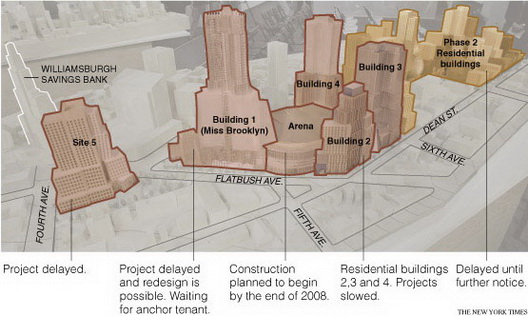
From 2008 Gowanus Lounge coverage of project slow down and delay
From Atlantic Yards Report coverage in turn covering the Times
Their answer, perhaps fudged, was that none of the wreath would wind up being dismantled because the new buildings would wind up being just a “backdrop” to a changing composition, since, unlike the original Gehry design, the buildings won’t be part of an integrated single design.  I posted a follow-up comment on the show page saying that I believe that if the other buildings are ever built on the block they will abut and that means that you won’t see as much of the weathering steel wreath that was added to the original design and that much of the wreath may have to be taken down.  If the buildings don’t actually abut they are likely to wind up being so very close that it will amount to nearly the same thing.
 
Other things have similarly made it seem as if the arena lattice was hastily conceived, irrespective of whether it has been rightfully or wrongly praised by a fawning press that is rarely critical of Ratner.

It may have come as a surprise to many that the “12,000 panels of a material called weathering steel” . .  “bleeds bits of fiery color onto the surrounding area, especially in its early life.”  (For more, including photos of the “rusty dripping” see: Friday, November 30, 2012, After pre-rusting the Barclays Center facade, the metal drips, after all.)  In any event, the new sidewalks being stained, already full of unpromised cracks, are hardly pristine.

Posterior protuberance the weekend of Jay-Z's opening concert
Another surprise, when constructed, we discovered that a posterior protuberance emerged from the lattice’s streamlined form that was never shown to be intended when the reformulating plans associated with the addition of the lattice were put on display for public reaction.  (See: Sunday, October 7, 2012, The Posterior Protuberance Of the Ratner/Prokhorov Barclays (LIBOR) Center Not Indicated On Model Submitted To Sell Arena To Public.)

Most recently, we have been greeted with the New Year's fresh news of a New York Times scoop: Back in August it was discovered that there was a problem with the 23,351 bolts fastening the steel plates to the arena structure. The fabricator had sent bolts that were half as strong as those that had been ordered.  As a five-month replacement regimen was undertaken and ongoing, the news was apparently handled by Ratner and the professional firms working for his Forest City Ratner firm so that the information didn’t get around, not to the New York City Building Department nor passed along by the construction monitor reporting to arena’s bond holders about the status of their investment’s construction.
Image,  Chang W. Lee Photo, showing bolts from Times January 1 scoop article: Problem With Weak Bolts Has Complicated the Barclays Center’s Early Days
Problems may have stemmed from the fact that, as the Times article notes: “The fabricator for the 12,000 steel panels — no two alike — abruptly shut down midway through the job.”   Somehow, although the bolts are only half the strength that were ordered, it has been determined that only about 8% of them (1,768) are actually going to get replaced.  (See, particularly respecting the possibility of intentional obfuscation: Wednesday, January 02, 2013, Barclays Center opened with defective bolts, not disclosed fully to Department of Buildings; problem hints at why ESD, construction monitor have obscured the issue.)

As the Times defective-bolt-scoop article author Charles Bagli writes: “with innovation has also come headaches.”  Bagli ends his Times article sounding a note of perhaps intentionally ironic hope:
As for the blossoms of metal staining the sidewalks surrounding the arena? Eventually the panels will stop rusting and workers will use power washers to remove all traces of metal from the sidewalks.
I am not so certain this is true.  Although Bagli in his article at one point describes the material of which the 12,000 panels are made as “pre-weathered steel” and although the Merritt & Harris construction monitoring reports that didn’t mention the defective bolts documents refer to “weathered panels” I believe the exact term for the material used is “weathering steel” which is to say that there is no past tense involved; while the weathering process may slow as it progresses it will never be finished.  The Times reported in late August that to prevent the rusting from being worse upon initial installation the steel, before it arrived on site “spent about four months at an Indianapolis plant where they were put through more than a dozen wet-and-dry cycles a day” effectively amounting to about “six years of weathering”.

Other things that this Times article noted about the weathering steel: If water is allowed to pool anywhere holes can rust through the material like an old auto body and if mischievous passers-by throw magnets up onto the steel they stick (perhaps affecting the weathering patterns?)

Past As Prologue: Possible Ascension Of Another Problem With The Lattice Wreath

That being background (and mischief perhaps a good segue), we now get to the part of this post wherein I will talk about my brother Stephen, George Willig, Philippe Petit and connect them with another building built by Foerst City Ratner.  It involves another problem with the lattice work facade that may not have been considered when its design solution was hastily resorted to.

I have been thinking about writing this article since the summer, long before the arena was completed or brought online.  I held back because I didn’t want to get ahead of the story.  Also there are times when, in writing about a story, you can unintentionally become part of it.  You can provoke it into existence.  For some months now it seemed to me that what was obvious to me must be obvious to everyone else and that if I just waited I would be writing about the story after it fully unfolded. I would have avoided provoking it to happen or, alternatively, provoking an inscrutable preemptive response on Ratner's part.

A number of years ago, in August of 2008 I wrote about redevelopment at Ground Zero, the former site of the World Trade Center.  As part of that article I wrote about the relationship of human beings to buildings that dominate the environment, how the dominance of a building can create a corresponding human urge to conquer that dominating object, a sort of because-it’s-there exercise at attempting to cut a too big building back down to human size, restoring the balance of human relationship.  (See: Tuesday, August 5, 2008, TWO, AND FRO?)
   
Philippe Petit tight-rope walking between Trade Center Towers in video preview for "Man on Wire" documentary.
So it was with the World Trade Center towers which my article pointed out were not particularly beloved or good design but inevitably evoked response from day one. So we got the French aerialist Philippe Petit, who with meticulous clandestine preparation, tight-rope walked between the Twin Towers in 1974.  (In my article I recommended the 2008 documentary about his feat “Man on Wire.”) The towers also attracted George Willig, the Queens mountain climber and toy maker who climbed the South Tower in May of 1977.
George Willig climbing World Trade Center Tower
Postcard from 1964 Worlds Fair showing Unisphere
How does my brother Stephen, a cameraman, fit into this tradition of scaling large scale structures?  My brother, who has done some risky things as a cameraman (bracing himself on the rigs affixed to speeding cars to film car commercials, etc.) is also a climber.  Before George Willig ascended the World Trade Center building Willig scaled the Unisphere in Flushing Meadow Park, the symbol of the 1964 World’s Fair left in place afterwards by Robert Moses and cohorts.  Willig participated in a film documenting this exploit, so before Willig scaled the Unisphere my brother had to do some of his own climbing so as to be up above, looking down on an ascending Willig for suitably impressive shots.  Ergo, the image at the top of this article that shows my brother Stephen in climbing harness ascending the Unisphere ahead of Willig.

French "Spiderman" Alain Robert climbing Times/Ratner building June 5, 2008 to call attention to global warming from YouTube Video of climb
The point is that there is a tradition of climbing buildings and it is in this respect that we can concern ourselves with another building that Forest City Ratner built in relatively recent memory: The Renzo Piano-designed New York Times Building built employing eminent domain to vanquish those owners and occupants who had previously utilized its 41st Street and 8th Avenue location.  On July 9, 2008 the Municipal Art Society, at an annual meeting held in the New York Times building, presented that building with a “MASterwork” award for its design.  It was by weird coincidence the very same day that the third climber in five weeks had attempted to scale the Times Building.  Even as the award was being presented at the meeting within the building construction workers were busy working outside removing the ceramic rods and boxing up other features of the building’s distinctive architecture that provided such an open invitation to climbers.  Those open invitation features are no longer there.

We often observe about warfare how humans preoccupy themselves with "fighting the last war."  If there is architectural equivalent to this bromide it must not pertain to the Forest City Ratner firm because even if elements of Ratner’s Renzo Piano New York Times Building built in 2007 had to be dismantled because they were such an open invitation to urban climbers seeking to scale urban Everests and make statements, the “Barclays’ arena presents a conspicuous rerun of this problem.

It’s a veritable stairway to the stars, or at least the twinkling LED diodes of the oculus!

If the arrival of climbers is a testament to the public’s recognition of a building’s significant dominance in an environment perhaps the arena hasn’t succeeded in it goals because months have now gone by and climbers haven't shown up.  It leaves me a little surprised.  And now the time has come: Rather than wait any longer I thought I’d finally write this article now.

The same view when arena was under construction, June 1st
Maybe it's a stroke of good luck that nobody has yet tried to climb the arena: If the bolts holding the panel stairway are only half as strong as specified there could perhaps be a problem with holding human weight.  I’m sure the specifications must have been such that the panels were supposed to stand up to a storm like Sandy (whose winds weren’t nearly as bad as they could have been). . . They probably ought also to have been specified to be sufficient to hold human weight.  But if only 8% of the bolts are being replaced to cure a 50% strength insufficiency?

Another easy climbing access pointOn the day this photo was taken the Ratner organization was busy delivering press to the spot
And what about the lattice as a planned near-by “backdrop” to the new residential building now being undertaken?  The architects say it won't abut , still will a climber hanging from the lattice be able to reach out and touch the new building?  Who knows?  Quite possibly we will never find out: Despite all the interest the press has shown in the arena's exercise in muscular frou-frou, the urban climbers out there haven't been similarly intrigued.

Seriously though: After Ratner's high-profile experience with the three urban climbers who were drawn to the Renzo Piano New York Times Building, wasn't this on the Ratner firm's checklist of stupid learn-from-experience mistakes to avoid?  Or was Mr. Ratner in just that much of a desperate hurry to get his approvals and get started?

Monday, December 24, 2012

While I Tell of Yuletide Treasure

This time of year is filled with seasonal traditions involving studies in contrasts by which we better know and appreciate the opposites that otherwise might not claim our attention.  The time of the winter solstice, the darkest time of the year in the Northern Hemisphere is when many of us practice lighting lights to sparkle in the deeper dark of the early evenings and extra-long nights to cheer ourselves with a celebration of human closeness just when the gloom and drear is most profound.  And the coming of the shortest day of the year is when we rejoice that from here on the days will be lengthening.*
(* The solstice this winter is extra special in that when it arrived at 6:12 A.M.on December 21st it was the earliest arrival of the winter solstice since 1896, 116 years earlier and just beyond the fringe of when almost any living human now alive was first  alive.  The solstice arrived on the portentous and numerically odd date of12/21/12, which was also the date that the Mayans ended their 5,125-year long-count calendar, causing some to predict it would be a day of world-ending apocalypse.)
This time of year is also a time when we fixate on the bunching up of wealth and treasure, combining it with a concentrated reverence for the importance of giving.  We save up all our shopping, to run out on or after “Black Friday” to make this time we give while giving less the rest of the year.  Our holiday stories are also about studies in contrast having to do with the bunching up of the “Yuletide Treasure” that we sing about in in “Deck The Halls”: Dickens’ Scrooge is a miser who for years collects wealth by the sharp moves he makes at the expense of others (later with a change of heart he is able to be freely generous with that same accumulated wealth), Theodore Geisel (Dr. Suess) envisioned the mean-spirited Grinch, a reverse-Santa Claus, who, intending to steal them, collected up in the sack on his back all the presents the entire community had intended for each other (later with a change of heart he is almost like a real Santa Clause by simply being able to return to the community what was theirs to begin with), and then there is the magical fable of “It’s a Wonderful Life” where the villain (who never has a change of heart in the story) is the mean Mr. Potter whose goal (realized in one of the film’s two competing alternate realities) is to own everything in the community so that if anyone wants a job or the comfort of an inviting home they have to come “crawling” to beg from him.

Noticing New York’s seasonal tradition has been to run annual reminders of how closely the “It’s a Wonderful Life” fable parallels the very real facts about the way that Bruce Ratner and his Forest City Ratner company have been assisted by government with atrociously deep subsidies and abuse of eminent domain to acquire a mega-monopoly in Brooklyn at everyone else’s expense. It is exactly the kind of study in contrasts on which we fixate at this time of year.

Much has been made of, and the media has been preoccupied since this Fall with, the brunched-up wealth and glitter of the Ratner/Prokhorov “Barclays” arena.  I wrote about this way: 
There are certainly those who look upon the “Barclays” Center and see impressive value there;  They crow about the spectacle of its glitter. A frequently used metaphor for a glittering and startling concentration of wealth piled up in one place is that of the treasure chest.  Some people who make proclamations about  what Brooklyn has gained with the “Barclays” Center, people like Ratner, Prokhorov, Bloomberg, Markowitz, and Charlie Rose gloat over the arena's glitter.  I see what they are gloating over as representing much the same thing as a treasure chest.  Like a treasure chest, the “Barclays” Center undeniably gleams with heaps of accumulated value.  But the “Barclays” Center, like those fictional fairytale treasure chests, comes by its impressive heaped up gleam because it is an accumulation of pirate booty, illegally seized and hoarded.

 All that piled-up wealth represents the brooches and necklaces that are not out in the community being worn as adorning ornament by the ladies, it’s the candlesticks and silver that are not festooning local dinner tables, it represents the gold that is not circulating through and enriching the general commerce of the community.  It also represents the cost of the fear, violence and suffering when that wealth was wrested from its original owners at sword point or with the discharge of blunderbusses.

    * * * *
The thing to remember is that the revelry around the glint and gleam of the “Barclays” Center is, at its core, a celebration of an immense and unforgivable transfer of wealth from the local community to a force of marauders.
(See: Wednesday, October 10, 2012, Weighing The Change In Brooklyn: The True Cost Of “Barclays” Center Glitter, The Cost Of “Barclays” Center Tickets.)

And, in contrast to all that bunched-up wealth there are the vast seized acres, there are the empty and underutilized parking lots that lie at the back of the arena, there are the nearby homes where the sound of the arena's bass penetrates in.  In “It’s a Wonderful Life” Mr. Potter always had a glamorous mansion, perhaps even more so, after seizing the bulk of the town: The question was whether it was worth having to crawl to him and beg for a job from him when he was the only game in town.
More fence going up around Ratner's superblock
Partial view of the very long fence around Ratner superblock now mostly used for parking
What is the glamorous glitter worth when Barbra Streisand plays Ratner’s arena but the public is highly subsidizing her performances to the turn of perhaps $700,000?  That is just the Grinch giving back what was the community’s in the first place.  It is actually worse because when the Grinch gave back the stolen presents he gave back everything totally and freely, relinquishing all claim.  When Ratner invites people into the “Barclays” Center he is like Mr. Potter, charging $4.50 for water that would have been free with the music at Freddy’s Bar, just one of the parts of the neighborhood removed as part of Ratner’s taking spree.  In the end the glitter of how much richer Ratner has become is, like in all the other traditional tales of the season, just a measure and metaphor for the off-screen impoverishment of the community.

The "Barclays" Center advertising oculus showing Barbra Streisand, one of the singers who has not answered an open letter from the community questioning why she was performing at the Ratner/Prokhorov arena 
Here are past Noticing New York stories that probe the “It’s a Wonderful Life” parallels in greater depth.  Just one last thought. . .In the end all these tales have the same moral: It isn’t about bunched-up wealth.  That isn’t what has value.  The value of life is all about sharing and people in the community mutually supporting each other with real giving.

Happy holidays to all.
 •    Saturday, December 24, 2011, Traditional Christmas Eve Revisit of a Classic Seasonal Tale: Ratnerville, the Real Life Incarnation of the Abhorred Pottersville
•    Friday, December 24, 2010, Revisiting a Classic Seasonal Tale: Ratnerville

•    Thursday, December 24, 2009, A Christmas Eve Story of Alternative Realities: The Fight Not To Go To Pottersville (Or Ratnerville)

Thursday, December 6, 2012

Why Atlantic Yards Outrage And Examination Is Important- A Reminder Presents Itself By Taking A Look At The City And State Power Structure

Bruce Ratner, from City & State's list of the 100 most powerful people in New York City- Where on the list does he belong?  Read on.
Readers might sometimes ask, as I often ask myself, why do I write so much about Atlantic Yards? Noticing New York was not created like Atlantic Yards Report for the exclusive purpose of covering the Atlantic Yards story. It was created to write about development in New York City and associated politics, the ways in which the city is shaping itself as a place to live.

Nor was Noticing New York created with a conscious intent to just carp about what I am critical of.  I’d be writing more often (as was my original intention) about those things that can be praised if I saw them as comparatively more important.   (Often I do praise forms of development unfolding naturally in the city but do so in the context of pointing out what the real estate industry is doing to thwart or undermine such progress.)  My goal has been to prioritize, to write first about those things that most glaringly need to be pointed out and emphasized in the public dialogue.

I could be writing more often about some of the other things that I’ve written about, like the dismantling of Coney Island, Hudson Yards, the Columbia University takeover of West Harlem, how a hospital, St. Vincent’s, was transformed into a real estate project which was all that was left when the hospital then went bankrupt, or how the city is handling growing density. I could also write about things that I have not yet gotten around to writing about but ought to, such as the NYU expansion.

Some of these things like the shrinking of Coney Island and the NYU expansion, involve much more complicated narratives that therefore need to be written about; They also take much more work to do so.  (Those wanting to catch up a bit on the Coney Island story should try to see the documentary “Zipper: Coney Island's Last Wild Ride” by Amy Nicholson, about which I will have to get around to writing my own review.)

By contrast, the Atlantic Yards narrative is a stark one involving far fewer shades of gray with its developer-driven purpose of transferring more wealth and power to those in whom wealth and power is already concentrated, the cheating and dishonesty, poor urban design and the persistent perversions of process.  It embodies in stark relief virtually every highly objectionable form of conduct in which local public officials and the real estate industry engage that sap the quality of life in this city.

If people can’t understand the Atlantic Yards narrative there is little hope that the populace will understand what is needed in order for this city to be properly governed and to avoid an impoverishment of the city . . . but if they do understand Atlantic Yards, it becomes a prism through which to understand so much else  happening in this city that similarly needs to be addressed. But you have to start with the worst: If you can’t stop the worst excesses then everything else is up for grabs.

I offer all of the above as prologue to calling your attention to Norman Oder's Atlantic Yards Report story on City & State's publication of its list of  "the 100 most powerful people in New York City politics."
Mr. Oder points out, with itemizing information and analysis about 33 of those named, that fully one-third of the 100 individuals are critically intersected with the Atlantic Yards mega-project in one way or another. Mostly they intersect as supporters of the mega-monopoly.  Only a few intersect as possible opponents who have been neutralized (the latter group including State Attorney General Eric Schneiderman who, having accepted money from Bruce Ratner, hasn't investigated Atlantic Yards despite the hopes he offered in that regard when running for his office).  See: Wednesday, December 05, 2012, The NYC Power 100 and Atlantic Yards: many intersections (and Ratner behind Markowitz?).

The remarkable thing is that Bruce Ratner, the developer/subsidy collector behind Atlantic Yards, is ranked as only the 59th most powerful individual on the list given all the ways Atlantic Yards is insidiously integrated into the New York power structure and is subserviently being supported by so many theoretically powerful individuals   Mr. Oder notes the anomaly that Bruce Ratner is ranked as less powerful than Brooklyn Borough President Marty Markowitz (who is at #40), “AY's biggest cheerleader”, now a lame duck.  Whose payroll will Markowitz wind up on when he leaves office at the end of his expiring term?  Up till now he has been getting money from Ratner for his long-term favorite activity, concerts put on with a “not-for-profit” structure.

Putting aside any rationalizations that people might use to dress up their positions, Atlantic Yards, when honestly assessed, can only be evaluated as a boondoggle that's deeply destructive to the fabric of the city.  It is therefore frightening to think that so many of the city's power elite are aligned behind making it happen.  It can only be explained in one of two ways: Either Ratner is himself so powerful that those theoretically in power dare not oppose his mega-monopoly, or they will tolerate his personal mega-boondoggle because in a quid pro quo way they expect that their turn will come to similarly feed at the trough.  Which is it?  Neither would be good news.  I think that the extent to which one or other is true depends on the individuals at whom we are looking.

Mr. Oder identified Atlantic Yards interconnections for only 33 of the individuals on the list, including the obvious ones like Mayor Michael Bloomberg.  I think it is possible to add to those 33; in some cases that may involve stretching a bit further to identify the Atlantic Yards connections; in other cases it involves stretching not so very far at all.  I come up with a list that, with Mr. Oder's 33, tallies to 47, or nearly 50% of the entire list.  Further research could perhaps lengthen the list still more.

Here, in reverse order, working up from the bottom of City and State's list, are the additional names with my own observed connections in italics.  The unitalicized text is from City & State. (The first numbers appearing below are my rising tally toward 47):
34.    93. Diana Taylor- Girlfriend of Mayor Bloomberg and Managing Director, Wolfensohn & Co.  (Ms. Taylor, is not only Bloomberg's girlfriend, on the board of Brookfield Properties and on the board of Hudson River Park was connected with the removal of Occupy Wall Street from Zucotti Park, a milestone event when it comes to the privatizing of public space, which in turn makes the similar privatizing of public space that is part of Atlantic Yards comparatively acceptable.)
35.    92. Martin Golden- State Senator Golden is one of very few Republican state senators in the city and a close ally of Bloomberg and unions.  (And he conspicuously testified in support of Atlantic Yards at hearings.)
36.    67. Charles Meara- Chief of Staff to Council Speaker Quinn- The speaker’s longtime top aide was also chief of staff to Quinn’s predecessor.  (If Quinn is on Mr. Oder's list of intersections shouldn't her Cheif of Staff be on that list for the same reason?)
37.    44. Edward Koch- Former New York City Mayor and Partner, Bryan Cave LLC  (Koch was a mentor to First Deputy Mayor Patricia Harris- see below- before she left to work for Bloomberg in the private sector about the time that Bloomberg began to show his interest in politics, with a corresponding shooting up of his wealth.  Harris, first in the private sector and then working in Bloomberg's mayoral administration, oversees the handing out of charitable donations which are used to keep the recipients politically in line and behind Bloomberg.  Among other things this was used to procure Bloomberg a previously prohibited third term.  Thus Atlantic Yards continued.  For a more specific Atlantic Yards connection see the notes on Ms. Harris below.  Koch, supportive of Harris, has never publicly criticized her.)
  38.    36. Charles Rangel- U.S. Representative- Rangel’s power has been diminished in recent years in the wake of scandals, which lost him the chairmanship of the powerful Ways and Means Committee, but he remains a leader in Harlem and the black community and demonstrated his continuing might by fending off a strong challenge this year. (Rangel lobbied for a special tax break for Yankee Stadium, was expected to lobby for housing bonds for Atlantic Yards and lobbied for the special federal tax loophole extension obtained for issuance of bonds for the Ratner/Prokhorov "Barclays" arena.
39.    34. Thomas DiNapoli, State Comptroller.  (DiNapoli has the power and obligation to investigate misconduct at state public authorities and has not exercised it with respect to the excess and improprieties respecting Atlantic Yards.  DiNapoli also do not insist, as he could have, that Atlantic Yards receive no state financing without a new approval of the altered mega-project by the Public Authorities Control Board, which approval his office must bless.)
40.    33. Cyrus Vance Jr.- Manhattan District Attorney  (While New York State Attorney General Eric Schneiderman would be the most appropriate to investigate Atlantic Yards this could also be done by Vance, although the fact that his jurisdiction is Manhattan means the required nexus for investigation is much reduced.)
41.    31. Patrick Foye- Executive Director, Port Authority of New York and New Jersey  (Foye was previously in charge of the Empire State Development Corporation, the state agency agency theoretically in charge of Atlantic Yards during an important period when it continued to advance.)
42.    26. Joseph Lhota- Chairman and CEO, Metropolitan Transportation Authority (Lhota was recently interviewed and featured in a Daily News article about the opening of the so-called Barclays Center, supplying quotes that helped create the misimpression that Forest City Ratner was supplying the public with free subway station improvements.  As noted by Mr. Oder the Daily News is partnering with Ratner and Prokhorov in the arena.)
43.    25. William Rudin- Vice Chairman and CEO, Rudin Management Company  (Since Rudin- involved with the St. Vincent's debacle- is Vice Chair of the Real Estate Board of New York it must be noted that Atlantic Yards would not be proceeding without REBNY's support.  Mr. Oder notes, for instance, that Real Estate Board of NY President Steven Spinola, also on this list, is an AY supporter.  REBNY supported the specially preferential tax abatement legislation for the mega-project which Mr. Oder mentions when talking about Assemblyman and former Brooklyn Democratic Chair Vito Lopez, who is also on the list.)
44.    24. Bradley Tusk- Founder, Tusk Strategies- Tusk orchestrated Mayor Bloomberg’s path to a third term, and continues to serve as a key political adviser to the mayor, not to mention a host of top corporate clients like Walmart.  (Tusk, who Bloomberg hired away from disgraced Illinois Governor Ron Blagojevich, apparently never had good judgment when it came to advising his principals to stay away from special deals for insiders.  Is it a stretch to suspect that Mr. Tusk assists Atlantic Yards by allowing Bloomberg to feel comfortable occupying a world where benefits are handed out to big corporations o the basis of relationships?)
45.    21. Merryl Tisch- Chancellor, New York State Board of Regents- One of the state’s top education policymakers, Tisch has established herself as an independent, forceful voice on New York City’s schools. Tisch, who married into one of the city’s wealthiest families, has also flirted with a run for mayor.  (The Tisch family Ms. Tisch married into is the construction and real estate family.  She is married to James S. Tisch, President and Chief Executive Officer of Loews Corporation, who is involved in construction through the hotel chain. James Tisch is also on the board of the New York Federal Reserve with Kathy Wylde- also on the power list as an AY supporter- and Lee Bolinger, both of whom advocate abuse of eminent domain.  And Tisch, with his name on some Channel 13 PBS station buildings, is on the board of New York's Channel 13 that with Charlie Rose programs has propagandized for Atlantic Yards while refusing to broadcast critical documentaries about the megadevelopment like "Brooklyn Matters" or "Battle For Brooklyn."
46.    11. Rupert Murdoch- Chairman and Chief Executive Officer, News Corporation  (Murdoch not only owns the New York Post, which has followed in the footsteps of the New York Times in giving Atlantic Yards a largely free pass from public scrutiny.  More important, at a key time he curtailed valuable coverage of Atlantic Yards at the local level by buying up the local papers, including the Brooklyn Paper which, when acquired by him, ceased the critical and insightful coverage of Atlantic Yards it had been providing.)    
47.    6. Patricia Harris- First Deputy Mayor  (Not only does Ms. Harris, as noted above, oversee the handing out of Bloomberg charity with political strings attached; she also oversees the city Landmarks Commission. All indications are that Ms. Harris had a hand in signing the death sentence for Ward Bakery- to clear the site for Ratner and improve the odds of approvals he needed- when she and Mayor Bloomberg met with Bruce Ratner in a meeting that bore evidence of a quid pro quo arrangement of contributions to Bloomberg charities in exchange for project approvals.)
If you haven't yet read Mr. Oder's Atlantic Yards Report article about the the intersections of the other 33 individuals on the list with Atlantic Yards I suggest you proceed to read it now so you will have the whole picture.

Wednesday, December 5, 2012

A New York Magazine “Best Bet”: The Brooklyn Museum Offers Its Love Of Brownstone Neighborhoods, The Savaging Of Which It Lauded

Left, Claudia Pearson illustrations featured in Brooklyn Museum gift shop.  Right, townhouses and Freddy's Bar torn down for Atlantic Yards- Click on any image to enlarge
During a ten-year stretch roughly coinciding with the Great Depression, Universal Studios gave us a golden era of monsters: Dracula (1931), Frankenstein (1931), The Mummy (1932), The Invisible Man (1933) and werewolves as in the Werewolf of London (1935) and The Wolf Man (1941).  You might also consider including The Phantom of the Opera with two principal release dates framing that decade (1925 for the original and a remake in 1943).  The Dr. Jekyll and Mr. Hyde films, with versions made in 1931 and 1941, although in a similar vein, was not from Universal, produced by two other studios, Paramount and MGM, respectively.

The fun thing about the monsters was that each came packaged with some hokum mythology not necessarily genuinely derived from classic source material.  It was useful if the framework of the mythology was also serviceable for setting up damsel-in-distress scenarios.  One such myth that served very well in this regard was the curse afflicting the cinema werewolves: That when they transformed they were compelled to try to kill the things they loved most.

Why was I thinking about this old horror film trope about werewolves?  Because, reading New York Magazine’s “Best Bets” column I discovered that the Brooklyn Museum is selling in its gift shop tea towels celebrating the charm of brownstone Brooklyn designed by illustrator Claudia Pearson.  According to New York Magazine, Ms. Pearson is “Clinton Hill–based” and “drew inspiration from her surroundings” when she designed these towels.  Presumably they are sold in the Brooklyn Museum in partial acknowledgment of the museum’s own  “Prospect Heights” address and by way of making a statement of its oneness with a community comprised of and valuing what is being depicted.
New York Magazine's "Best Bets" feature

Claudia Pearson tea towels from New York Magazine website
Rummaging around the internet I discovered that the Brooklyn Museum shop also sells a “Brooklyn Brownstone Mug” similarly designed by Ms. Pearson.
Claudia Pearson's Brooklyn Brownstone Mug
The not so humorous irony in all of this is that these same Brooklyn brownstone neighborhoods the museum is celebrating in its gift shop are beset by the prospect of some significant destruction and dismantling, with portions even being removed from the Brooklyn map altogether.  The vortex around which this destruction swirls is Atlantic Yards, the heavily subsidized corporatizing eminent domain takeover a significant swath of Brooklyn by which Forest City Ratner is increasing its mega-monpoly stranglehold on the borough’s assets.  Ms. Pearson’s Clinton Hill brownstone neighborhood, together with the Brooklyn Museum’s Prospect Heights brownstone neighborhood, both border the Atlantic Yards site footprint along with the other significant brownstone neighborhoods of Park Slope, Fort Greene and Boerum Hill.

Going to the Brooklyn Museum's gift shop online we see how prominently Ms. Pearson's brownstone Brooklyn work is being featured
For all its negative implications for these neighborhoods and for the rest of the city’s population, Atlantic Yards was something the Brooklyn Museum, itself, helped to promote and bring about when, with key approvals hanging in the balance without which the mega-project could not have proceeded, the Brooklyn Museum decided to give a special award honoring Bruce Ratner, the head of the Forest City Ratner, the developer/subsidy collection firm responsible for it.  In theory, the giving of the museum’s Augustus Graham award to Ratner was to signify that Ratner embodied, as a man, the praiseworthy attributes of community service and selflessness, something quite the opposite of what the Atlantic Yards project has truly been all about.

If the museum’s award honoring Ratner didn’t itself tip the balance toward Ratner’s obtaining the approvals needed, it certainly combined to exert influence with the things that did.   The museum’s award to Ratner was publicly protested (with Ratner being characterized as a “vampire” among other things) but the museum has never apologized to the communities of Brooklyn for what it did.  While the error of making the award should have been obvious at the time, that was before the mega-project significantly degenerated, and more and more underlying negative facts about it got publicly disclosed.  (Abbreviating the list: The mega-project is now receiving much more subsidy than before, its design has been cheapened, unions have been double-crossed, the passage of time steadily exposes the sham and folly of the community benefit agreement signing and endorsements, the time frame for its build-out will be decades- perhaps forty years- not the ten years first advertised.  And then there was the way that rightfully or wrongly Ratner skirted indictments when implicated in investigations.) . . .

. . . Notwithstanding that the negatives of the situation have become much more conspicuously abject, the Brooklyn Museum still has not issued an apology to the community or sought to reverse the travesty of its award to Ratner by reclaiming or renouncing it.

Is there a way that the effect of the museum now honoring brownstone Brooklyn could be more starkly startling?. . . . Ms. Pearson could design and the museum could sell in its gift shop, products (see below), tea towels and coffee mugs that depict Freddy’s Bar and Grill and the little nearby townhouses torn down to create the so-called “Barclays” arena and the now empty acres and parking lots Ratner owns around it.  Maybe that would also be more appropriate in that the museum, as with its dusty old linen-wrapped mummies, often focuses on educating the public about what was and is now no more.

Should the Brooklyn Brownstone mugs in the museum shop show townhouses in the process of demolition like the ones below?
The Tracy Collins photos above that appeared in Atlantic Yards Report show the demolition of Dean Street townhouses before it was clear the land would ever be used for the Ratner project.  Land on which they were sited is still vacant.
With an image of the now demolished 489 Dean Street derived from a Tracy Collins photograph, the kind of "Brownstone Brooklyn" coffee mugs the Brooklyn Museum could be selling
A Freddy's Bar Mug?
Tea towels that feature the buildings next to Freddy's that were torn down (from a Tracy Collins photograph)
If the Brooklyn Museum, set up as a charitable organization to serve the public, actually values Brooklyn and its brownstone neighborhoods, what was it that caused the lycanthropic transmogrification whereby it howled harmonizing tones of praise and support for Ratner as he wolfishly prepared to devour more of Brooklyn and its brownstone acres into his increasingly gargantuan government-supported mega-monopoly?  The elixir that brought about that transformation was money.  Despite what the museum’s Augustus Graham award is supposed to honor, Ratner was not honored for what he had done for the community: He was honored for the money he had given to the museum that had gotten his people placed on the museum’s board of trustees.

Sometimes the idea that one kills the thing one loves is explored as a concept with serious real ramifications that are to be studied.  Jane Jacobs, the great urbanist observer and thinker who wrote “The Death and Life of Great American Cities,” explored in that book a sort of `killing the goose that laid the golden egg’ concern in an urban planning context: She wrote (p. 246*) that the benefits of a diverse economy can be killed off by a rush of businesses coming in to take advantage of an “enviable location” so that the “enviable location” thereby ceases to exist.  Or, alternatively, in another context, you can find theories that “killing the thing you love” is a beastly symptom of the alpha male urge to dominate at all costs.
(* “. . . .making the same mistakes as a family I know who bought an acre in the country on which to build a house. For many years, while they lacked the money to build, they visited the site regularly and picnicked on a knoll, the site’s most attractive feature. They liked so much to visualize themselves as always there, that when they finally built they put the house on the knoll. But then the knoll was gone. Somehow they had not realized they would destroy it and lose it by supplanting it with themselves.”)
The situation with the still unapologetic Brooklyn Museum is neither of these.  Although it’s a damsel-in-distress scenario with the public and Brooklyn’s brownstone neighborhoods in jeopardy and although the treacherous peril of this world becomes all the more frighteningly dangerous when that damsel’s self-proclaimed lover suddenly reveals a sinister face that is opposite to that mild and friendly one that has been shown before, the elixir that provokes that Jekyll and Hyde transformation here is simply money and there is no real magic or mystery to the transformation. It is simply the hypocrisy that money can so readily buy.