Showing posts with label Weather Weirding. Show all posts

Monday, November 5, 2012

Criticized For Prioritizing Now-Cancelled Marathon Sports Event Bloomberg (Still Looking Forward To Barclays) Side-Steps Informational Hurricane Updates

Bloomberg at virtually secret Saturday evening press conference where a question about his bad judgement about prioritizing sports events over hurricane recovery inevitably came up 
When you are mayor of New York bad news can make for a good personal news cycles, except when you blow it.  Mayor Michael Bloomberg was getting a straight set of predictable kudos for his theoretically no-nonsense handling of the superstorm Sandy disaster.  That was until the conversation started shifting to the fact that, despite the advice of all his top aides, Bloomberg was indulging himself in some nonsense: Bullheadedly deciding he would proceed with the city’s annual marathon despite the schizophrenic drain on city resources and commitments it would entail.  Bowing to the weight of public opinion the marathon was eventually cancelled Friday evening, hours after the mayor had again staunchly supported proceeding with it.

Upon examination, it looks like that when the news turned bad for Bloomberg, Bloomberg decided that he would hide out, manipulating the news cycle by deep-sixing the very same regular set of hurricane aftermath update press conferences through which he had been garnering his kudos during the long week of disaster news.

And there is more that could have motivated Bloomberg to play with the news cycle: Despite the week’s challenging hurricane disaster and recovery events, Bloomberg was looking forward to the inaugural basketball game of the Nets at the “Barclays” Center. When the marathon was cancelled, the “Barclays” game was scheduled for Saturday night, just twelve hours before the morning of the marathon.  Because of hurricane relief efforts and mass transit disruptions the previously scheduled Wednesday and Thursday night Nets games at the “Barclays” arena were cancelled, but before they were cancelled Bloomberg  embarrassed himself by saying, in the thick of early hurricane recovery efforts on Tuesday, that he not only hoped the Wednesday Nets game would proceed but that he would take a personal break from hurricane recovery to attend it.

Given the equivalencies that were in play, any traction the marathon cancellation story got was likely to lead to questions about, and pressure on the administration to postpone or cancel, this third Saturday night basketball game as well.  The mantra explaining cancellation of the marathon being repeated on all the networks was that at this juncture a sports event could not take precedence over the recovery efforts.  The basketball game at the 18,000-seat “Barclays” arena, though a smaller event than the marathon, was, because of recovery challenges in the storm’s aftermath, going to require a specially superintended support effort by Bloomberg administration.

Because of Bloomberg’s commitment, the marathon was on all week until the sudden, about-face cancellation on Friday at about 5:30 PM.  The Bloomberg administration was holding regular updating midday press conferences about hurricane recovery measures and the last mention of the plans to proceed with the marathon was when Bloomberg was questioned about it at the press conference on Friday afternoon at about 1:33 PM.  The exchange went like this:
Female reporter: Surely you've heard and read some of the comments from people on Staten Island who feel that it's insensitive to hold the marathon and wonder how it can be said that no resources are being diverted it to it. How many city employees are working to support the marathon?
   
Bloomberg: Well, for example the police department right now has to be at most of the intersections where there is no lights. Lights are gonna be back on tonight.  Mass transit solves a lot of other problems where the police provide those traffic control resources.  It does use some resources, but it doesn't use resources that can really make a difference in recovery and that sort of thing. It's a different group of people.  It's a relatively small amount of the sanitation department's resources.  And we have to have a city going forward.

I don't think there's any question but we have. . . There are New Yorkers who have lost loved ones and nothing's gonna ever replace that.  People who have lost their homes: we have to make sure that we do everything we can to help them recover.  We have to work around the clock for people to get through this thing and I assure you we' re doing that.  And, if I thought it took any resources away from that, we would not do this.  But we have plenty of police officers that work in areas that aren't affected. We don't take all of them and move them into areas that are affected. There will be no diversion of resources. There will be no redistribution of our efforts, no diminution of our efforts.

We have a 24/7 operation going which I am confident we're going to do.  We have to do everything we can to help people and when power returns over the next day and then, mass transit, more people are able to go to homes, that's going to make a big difference.

But as Rudy Giuliani said to me this morning, he said,`You know right after 9/11 people said exactly the same thing: New York has to show that we are here and that we are going to recover and that we can,’ while we help people, still help companies that need the business,  still generate a tax base so that we have the resources to help people and give people something to cheer about and what's been a very dismal week for a lot of people . . . And he reminded me also there was a demand from people that we close. . . Cancel the New Year's Eve celebration because of a snowstorm.  Uhm, I think Rudy had it right: you have to keep going and doing things and you can grieve, you can cry and you can laugh all at the same time.  That's what human beings are good at.            
When news came at 5:30 PM that the marathon was being cancelled nonetheless, the news networks were saying to expect a press conference about it at City Hall shortly afterwards.  Those led to believe that this meant that Bloomberg would shortly be appearing to address the cancellation were wrong: In lieu of a personal appearance to address the issue his office simply issued a short statement of the mayor (and the New York Road Runners) in the form of a press release (November 2, 2012- according to the Times it was released at 5:21 p.m. EST):
The Marathon has been an integral part of New York City's life for 40 years and is an event tens of thousands of New Yorkers participate in and millions more watch. While holding the race would not require diverting resources from the recovery effort, it is clear that it has become the source of controversy and division. The marathon has always brought our city together and inspired us with stories of courage and determination. We would not want a cloud to hang over the race or its participants, and so we have decided to cancel it. We cannot allow a controversy over an athletic event –– even one as meaningful as this –– to distract attention away from all the critically important work that is being done to recover from the storm and get our city back on track. The New York Road Runners will have additional information in the days ahead for participants.
Almost immediately the Times was reporting the story as being about Bloomberg’s poor judgment and stubborn pigheadness: 
Mayor Michael R. Bloomberg, facing criticism that he was favoring marathon runners arriving from around the world over people in devastated neighborhoods, reversed himself and canceled the New York City Marathon.

    * * * *

For days, the mayor, who is often reluctant to abandon a position of his, insisted on going ahead with the race, saying it would signal that the city was back to normal.

He changed his mind as opposition became nearly unanimous.

    * * * *

Within the mayor’s inner circle, though, there were concerns. Some advisers worried that the criticism could steal the focus from Mr. Bloomberg’s well-received performance during and after the storm, and could damage his legacy in the way that the city’s botched response to a blizzard had done in 2010.

Behind the scenes, there were also concerns about what the world would see: images of runners so close to neighborhoods that had been battered by the storm, at a time when gasoline remained in short supply and mass transit was still not fully functioning.

Police Commissioner Raymond W. Kelly and Deputy Mayors Howard Wolfson and Patricia E. Harris all argued for calling off the event.
(See: Hardship Strains Emotions in New York, by James Barron and Ken Belson, November 2, 2012.)

If this was the story that was going to get traction, wasn’t it inevitable that the press was going to ask about the special support the city was mustering for proceeding with that other highly-hyped sports event, the Nets “Barclays” basketball game?  Especially, since Bloomberg has already laid the overly-enthusiastic bad-judgment connection by saying, the day after the hurricane, that he wanted the Wednesday basketball game to proceed and that he personally planned to attend it?  And if the press has asked about still-pending Saturday basketball game there would have been pressure to also cancel it, together with the special support the city was mustering to make it happen.

By lying low and not allowing the marathon story to get attention and traction Bloomberg therefore also forestalled having to address controversy over the specially assisted Bruce Ratner/Mikhail Prokhorov “Barclay” arena sports event.  But to do so Bloomberg’s strategy had to, at the same time, sacrifice the regular press conferences Bloomberg had been holding to keep New Yorkers up-to-date about the disaster recovery events.

As noted, Bloomberg did not come out on Friday evening to personally update the public when he cancelled the marathon.

Some might think, like I originally thought,  that Bloomberg did not hold a press conference about hurricane recovery on Saturday.  The expected press conference did seem to vanish from the news cycle but he actually did hold one.  What assured that this press conference was not covered in the news cycle was that it wasn’t held in the morning or midday like others; he delayed holding it until late Saturday afternoon.  Ironically, what then worked synergistically to assure that it would get no coverage is that he held it at a time when all of the local stations had cancelled their evening news for football events.  (Was taking advantage of this conscious on Bloomberg's part?)  Up until this preemption by the sport of football the networks had been obsessing about the hurricane’s aftermath with a lot of special coverage.

Do you wonder whether the cancellation of the marathon came up at this very next below-the-radar and under-reported press conference?  You bet it did, but being held in the evening there would have been no time to discuss any cancellation of the “Barclays” Nets game and Bloomberg cleverly controlled the question and answers to dissuade and prevent any possible follow-up questions about that “Barclays” event.  Here is the question and answer at that press conference with respect to the marathon:
Reporter: Can you just explain what happened between early Friday when the marathon was on, and later Friday when it was canceled.  And what would you say to some of the runners saying they wish it was canceled earlier so they didn't have to come.

Bloomberg: Well I wish we didn't have a hurricane and that we could have had a great event.  So, you know. . . could have, would have, and should have isn't something that I deal with. What simply happened was it became a source of dissension and we don't need that right now and hopefully next year we'll have a great event where people can come to the city and enjoy what the city has to offer and compete and participate and the spirit of the race is to bring people together.  When that became a divisive issue I just made the decision that it should not go on. the good news is that the supplies for the marathon have been donated to communities that need them, something like 600 medical blankets delivered directly to residents of Midland Beach by volunteers who went door to door with them and some 10,000 cases of water were sent to a central distribution center in Floyd Bennett Field.  Other supplies are being sent out now so you know the situation changes shame that it had to happen but we've got to do the right thing at each time and I am looking forward to I'm sure all about those runners too, to coming back next year. 
How did Bloomberg assure that there were no follow-up questions about this or the “Barclays” event?   When he first called on the reporter asking about the marathon he told the reporter that, because he was prioritizing hurricane recovery events over other matters (like sports), he would only take such a question at the end.  It was clever: because he was prioritizing hurricane recovery efforts he would not take a question about his misplaced priorities relating to sports events.  The exchange whereby Bloomberg deferred the marathon question went like this:
Reporter: On the marathon, can you explain…

Bloomberg: Let's just stick to this for the time being then we'll come back. I'll be happy to take a question.  This is a little bit more important: We're trying to talk about people getting their lives together.
Bloomberg next deferred as being similarly off-topic a question about preparedness of the Board of Elections for the Tuesday presidential election.  When in short order there were no more questions about anything else, Bloomberg took the Board of Elections question saving the marathon question for the very last. Then, upon providing his answer to marathon question, Bloomberg quickly segued to end the press conference with a reminder about how important it was for the stricken population in the city to take appropriate measure to shelter from the cold.

I still don’t know whether Bloomberg went to the Nets game that night where the Nets introduced their new mascot, BrooklynKnight (BrooklynKnight is a Brooklynite- get it?) being promoted as a mythical defender of Brooklyn.  As late as the Saturday evening press conference was there would have been just enough time for the mayor to get to “Barclays” arena before the game started.

Do I really think that Bloomberg manipulated this news cycle? 

Normally, the mayor’s press office puts up video of the mayor’s press conferences on its web page.  One indication that Saturday’s press was intended to be low profile is that no video of it was posted.  Instead, there was only a press release transcription of the mayor’s prepared remarks (Mayor Bloomberg Updates New Yorkers on City Response to Hurricane Sandy).  The transcription was minus the question and answer exchange with the press.  As you might infer from this Noticing New York article that the question and answer period of any mayoral press conference is often the most important part of any such event, zeroing in on issues of controversy rather than the official story packaged for distribution. Video of the next mayor’s next press conference updating New Yorkers on Sunday went up without Saturday’s ever being put up. 

Another way that helped ensure that Bloomberg’s Saturday press conference was as safe and friendly as it could be was to include Secretary of Housing and Urban Development Shaun Donovan who came out of the Bloomberg administration and who gets favorable press. (The city is estimating that it is going to have to find housing for 30,000 to 40,000 families dispossessed by the storm.)  Secretary for Health and Human Services Kathleen Sebelius and Congresswoman Carolyn Maloney were also at this little-reported press event.

The way I was able to find video of the event (embedded below) and verify that it had actually occurred was by going to the New York Times hurricane update blog and scrolling backward to 5:07 PM Saturday.


Yes, it is to be expected that a mayor will try to control the news messages out there about him.  Here is something scary to think about: In the course of researching Bloomberg’s storm-related press conferences one of the top hits I got in a Google search was video of his November 2, 2012 press conference on his private self-promoting MikeBlooberg.com site.  This site acts in 1984 style as a faux news press release site to promote the news about himself that Bloomberg likes.  That day there was a transcription of the Friday, November 2, 2012 press conference.  Since it didn’t include the questions and answers that followed, it had nothing about the marathon or Bloomberg saying then that it should not be cancelled.  In any event it is all gone now, replaced by the favorable news that Bloomberg’s site administrators are choosing to feature on that site now.

Is there a more innocent explanation for why Bloomberg personally absented himself from the news cycle from midday Friday until Saturday evening?  Did he zip off to Bermuda in that space of time for a shorter version of his regular weekend trip?  There would have been enough time for him to do so.  Maybe he did, but I suspect that bottom line is he simply didn’t want stories about his bad judgment with respect to sporting events getting traction.

Friday, November 2, 2012

BREAKING NEWS: Bloomberg Administration Cancels Hurricane-Controversial Marathon- Creates Extra Pressure For Similar Nets Opener Postponement

As of about 5:30 this afternoon the Bloomberg administration succumbed and cancelled the New York City Marathon in order to end the controversy about holding the marathon while the city is still straining to devote the resources it needs to recover from superstorm Hurricane Sandy.  Given the equivalencies in play that now puts a lot of extra pressure on the administration to postpone or cancel the Saturday night basketball game as well for which appreciable public resources are also being specially devoted at this time.

Moments before the announcement of the cancellation I had put up an article raising the question of whether because of comparability between the events the Nets and Barclays owners would be asked to contribute to hurricane relief as the marathon runners had been requested to:  Friday, November 2, 2012, Bloomberg Asks Runners In Now Controversial Marathon to Donate To Hurricane Relief: Will Similar Request Be Made Concerning Nets Game?

Right now in connection with the cancellation of the marathon people are saying that a sports event cannot take precedence over the recovery efforts.

Bloomberg Asks Runners In Now Controversial Marathon To Donate To Hurricane Relief: Will Similar Request Be Made Concerning Nets Game?

Mayor at this afternoon's press conference where he said marathon runners should donate to hurricane relief efforts
(Added 5:34 PM: Note Breaking news addendum about marathon cancellation at the bottom of this post.)

At his mayoral press conference this afternoon on the measures being taken to put New York City back on its feet after superstorm Hurricane Sandy Mayor Bloomberg addressed the controversial decision to go ahead with the city’s annual marathon, as scheduled, starting Sunday morning.

At his mayoral press conference yesterday Bloomberg linked discussion of proceeding with the marathon with plans for the scheduling of the Nets inaugural basketball game at the so-called “Barclays” Center.  That opening game, which was postponed, is now being held the Saturday night before the marathon.  Bloomberg had originally wanted the opening Knicks vs. Nets game to be held Wednesday night, even without working mass transit and even though it was hard on the heals of Monday’s storm.

At this afternoon’s conference Bloomberg told everyone that the marathoners participating on Sunday morning were being asked to contribute $26.20 each toward hurricane relief, apparently as a measure to make proceeding with the marathon more acceptable despite the fact that, inevitably, some public resources will have to be diverted into the marathon while the city, particularly Staten Island where the marathon starts, is still dealing with significant storm recovery efforts on multiple fronts.  (The amount of $26.20 was chosen to represent the 26.2 mile length of the Marathon.  The mayor says he hopes some marathoners will contribute more.)

The city will also be diverting appreciable resources in support of Saturday night’s basketball game.  Will the Nets and "Barclays" arena owners (Bruce Ratner and Mikhail Prokhorov) similarly be asked to make special donations toward hurricane relief to offset likely public irritation about public resources being diverted to their enterprise while hurricane relief is still so importantly underway?  Maybe.  The thing is that the diversion of public resources into the Nets and the “Barclays” Center is already way beyond outrageous and that is why Noticing New York publicly urged that Barbra Streisand write a check for $700,000.00 to the public (or whatever part of that amount her conscience dictated) as reparation for the vast amount of public subsidy that can be attributed as the public cost of her two concerts performed at the “Barclays” arena.  See: Friday, October 19, 2012, Political Thoughts In Her Email Aside, Streisand Owes Response To Community Letter Asking “Why Play Barclays?” Plus Maybe A $700,000 Check!

The "Barclays" Center advertising oculus showing Barbra Streisand, one of the singers who has not answered an open letter from the community questioning why she was performing at the Ratner/Prokhorov arena 
If the Nets and “Barclays” owners write a check will the amount begin to cover the subsidy poured into the arena?

Also at this afternoon’s press conference the mayor itemized a credited list of contributions toward hurricane relief from firms like Goldman Sachs and real estate firms upon whom Bloomberg has gone out of his way to confer benefit.  The list was like a commercial for those firms.  Will the donations be in any way equal to the public cost of benefits Bloomberg has conferred on such firms during his tenure as mayor?

I doubt it.

Addendum, at 5:34 PM:  Note the following breaking news: The marathon has just been cancelled (shortly after this post went up) by the Bloomberg administration.  In terms of the equivalencies in play that puts a lot of extra pressure on the administration to postpone or cancel the Saturday night basketball game as well.  Right now people are saying about the marathon that a sports event cannot take precedence over the recovery efforts. 

Despite Expected Kudos, Bloomberg Tires of Hurricane Relief Administration Role: That, Or He Tremendously Disrespects Homeland Secretary Janet Napolitano

Nice day for helicopters?
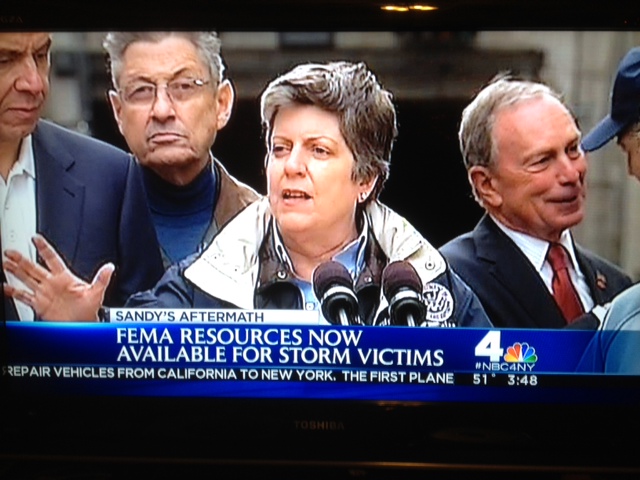
Despite receiving the predictable kudos for his high-profile mayoral role in the storm relief administration efforts following Hurricane Sandy, Michael Bloomberg seems to be getting rather bored with it all . . . Either that, or he has a terrific disrespect for Homeland Secretary Janet Napolitano, who was here in New York on behalf of the federal government to assist with the delivery of FEMA aide.

Yesterday Bloomberg and other local New York politicians, Governor Andrew Cuomo and New York Assembly Leader Shelly Silver included, stood with Janet Napolitano as she described the measures being taken the by federal government to aid New York City and the rest of the afflicted region.  The other elected officials were stoicly attentive to her words in the typical fashion to which we have all become inured.  Bloomberg, standing only two feet behind Secretary Janet Napolitano, could not have been more conspicuously disengaged.

This is my best profile, Mr. DeMille
Bloomberg bounced up and down on his feet.  He looked at the sky, this way and that.  He looked at his shoes.  He stared off sideways into the far distance, presenting his visage in complete profile.  With a big grin he made conversation with what appeared to be another more junior federal official standing with him behind  Napolitano.  He made strange faces, squinting and rolling up his eyes.
Grin, trading a few jokes
Maybe Bloomberg didn’t think that the federal government’s delivery of FEMA aid to the stricken city and region was a big deal.  Maybe Bloomberg didn’t think that the local NBC station was going to feature coverage of the delivery of that aid, running this video clip during their extended special coverage of recovery related events.

A "did-you-really-say-that?" startle
Maybe Bloomberg was noticing and was judgmental that when Secretary Napolitano delivers information that has been prepared for the public’s consumption she doesn’t race through a reading of her words at a fast rate similar to the mayor’s own that helps communicate the fabled businesslike efficiency he promotes as his métier.  Maybe Bloomberg is just impatient when he has to stand by and listen, surrendering the stage to someone not officially on his payroll.  Certainly it couldn’t have been that Napolitano is a woman: Bloomberg has hired many women and even promotes them to high positions.

Squint
Was it that on Saturday, the day before the storm, Bloomberg had told FEMA the city would not need FEMA help?: The mayor grew testy during the question and answer segment of at his afternoon press conference today when asked about that, saying that the city could rely on its own NYPD police and NYFD firemen, notwithstanding that several times during the press conference Bloomberg did refer to FEMA help that had been necessary in a number of other respects.

As Bloomberg repeatedly swiveled his attention heavenward I couldn’t help wonder what he might be looking for or thinking about.  His helicopter?  Was he thinking that this was one exceptional week he wouldn’t be able to scoot out to the airport and fly his private plane for one of his regular extended weekends at his Bermuda home?  But if he went to Bermuda this weekend he’d miss the Nets basketball game opening the "Barclays" Center he promoted at three successive hurricane relief press conferences.  That opening game was postponed until this Saturday night although Bloomberg had originally wanted the opening Knicks vs. Nets game to be held Wednesday night, even without working mass transit, hard on the heals of Monday’s storm.

As can be seen, Bloomberg has been very good at racing through the statistics concerning the services the city officials under his command are admirably providing.  It remains, though, that sometimes Bloomberg is not busy reading from these prepared scripts for which he is getting accolades.  Then his actions disclose that maybe his mind is often somewhere else.  Maybe part of all that racing through things, together with Bloomberg’s infamous impatience, is about something other than just business efficiency. . . his personal concern with wanting to get on with other very different things.
Tilting my head far enough this way who can I see over Janet's shoulder?
I can just picture it. . .
Furrowed

Wednesday, October 31, 2012

Bloomberg Masterful In Superstorm Sandy Disaster, Except When He’s NOT: “Barclays” Center Promos and Global Warming

Mayor Michael Bloomberg has joined the list of New York politicians who will be remembered for their masterful no-nonsense handling of overwhelming disasters: Giuliani and Pataki preceded him with their handling of 9/11 and now Bloomberg and Governor Andrew Cuomo faced by the unprecedented inundation of New York City by superstorm Hurricane Sandy will follow. . . .

. . . Bloomberg confronted the public, reading out status reports with cool, just-the-facts-you-need in-a-disaster efficiency that will earn him positive recognition, except when he just couldn’t help himself, and strayed off course.  In the course of two back-to-back news conferences on the extraordinary disaster accompanying hurricane he twice embarrassed himself, each time taking time out from the business of the hurricane relief efforts and reports on deaths to swing into promotion for the so-called “Barclays” basketball arena (which he has started calling a “stadium”- does he think a full scale stadium could have been squeezed into the neighborhood?).

The first time, Tuesday evening, Bloomberg told the public he was looking forward to attending a Nets game at the arena the very next night (taking an early break from overseeing response to the disaster).   The second time, a scant few hours later on Wednesday afternoon, Bloomberg reversed himself, saying that the basketball game he hoped would be held Wednesday night would be postponed at his recommendation.
Bloomberg recounting that a certain news service (his own) says the the Nets game he plans to attend will be held as scheduled despite the hurricane disaster.
Here is the exchange from Tuesday evening.  It begins with a question from a female reporter amongst the press corp sent to cover the human and mega-financial disaster the city faces that was symptomatic of where the New York press’s head is at in terms of escalating the show business promotion of “Barclays” as a story that consistently trumps real news (like the political corruption that built the arena):
Female Reporter: Here in Brooklyn, [obviously- or inaudible?] there’s a big event, the Knicks vs. the Nets opening game.  I know that transportation is limited. Is that game going to be rescheduled or . . .  (inaudible as she is cut off)

Bloomberg:  I don't know.  I did see the story on a well-known news service that said (giggle*) that the NBA was going ahead with the three games, I guess tomorrow night, and they had not decided yet about Thursday night's game.  Uhm, I hope they do it. I plan to go.  It's going to be tough to get there because, remember, one of the great things about the Barclay's Center is the great mass transit that runs under it; unfortunately for the moment, not a lot is running under it.  What they are going to do, I don't know, but if it's scheduled I will go.  I think it's going to be a great arena and it's a great thing for Brooklyn, and so. . . [moves on to the next and last question]
(* What the giggle was about was Bloomberg’s amusement that the “well-known news service” to which he referred was his own company Bloomberg, L.P. and I guess he reads what his own service reports about Nets sports events even during city disasters.  Watching the video- the exchange is at 20:45 you can decide whether the sound of amusement Bloomberg makes when he obliquely refers to his conflict of interest is best described as a giggle, a small guffaw or just something of a “tssk.”)

Notably, Bloomberg’s tongue doesn’t trip at all over the “Barclays” name for the arena despite the scandal associated with the bank after which we have now named portions of the city.
Bloomberg announcing Nets game is being cancelled on his recommendation
Today at 3:14 P.M. Bloomberg completely reversed himself.  (That is, if saying you hope a game won’t be cancelled and that you will take time off from dealing with the disaster to go to it and then recommending that the game instead be cancelled amounts to a complete reversal?)  Here is what Bloomberg said after speaking about how this Halloween parents should be careful to ensure responsible trick or treating and reminding everyone that the Halloween parade had been postponed (because police officers have to do other more important things right now).  Bloomberg had already announced on Tuesday evening that the Halloween parade would be postponed.
At my recommendation the NBA has canceled tomorrow night's game between the Knicks and the Nets.  It was going to be the first Nets game in the new stadium.  Now the first Nets game will be Saturday at 7:30 at the Barclays Center.  The Nets play the Toronto Raptors and this game will be rescheduled. The NBA will be working with the city to provide extra bus services for Saturday night because the subways may not be back after that.  There is plenty of mass transit that's one of the beauties of the Barclays Center.  Unfortunately, it just . . we didn't count on Sandy.  Hopefully, Sandy doesn't come along very often.  I am sorry about the game.  I was personally going to take my daughters and Diana.  We were looking forward to it. It's a great stadium.  It would've been a great game, but the bottom line is there is not a lot of mass transit. Our police have plenty of other things to do.  I know lots of fans are going to be disappointed.  And the players are disappointed.  You should know the players wanted to play this, but . . ah. .   I did talk to the NBA and recommended that . . ah . . . Asked them to . .  uh . .  cancel the game.  It's all up to me.
Bloomberg then went on to say that the city's annual marathon being held on Sunday (when most of the power will would be back on) was not being canceled.

Atlantic Yards Report has covered this already and also created an edited videos mashup of Bloomberg’s two mid-hurricane disaster press promotional statements about the Nets games below:  Wednesday, October 31, 2012, Bloomberg, with no chagrin about reconfirmation yesterday of Brooklyn Nets debut, announces inaugural game against Knicks postponed "at my recommendation"; NBA expresses sympathy with "all those affected"; CEO Yormark does a 180-degree turn.


How could Bloomberg embarrass himself more?  By acknowledging that the hurricane superstorm reflects a changing climate (it almost certainly does) but hedging about whether climate change is caused by human beings (something that's absolutely certain).  At the same press conference Tuesday, Bloomberg said:
Is a storm like this that’s so strong and so unusual a “global warning” incident?  I think what is clear is that the climate’s changing.  Nobody knows whether it is a cicular or a secular thing.  (Sic.)
When Bloomberg said “cicular” he probably meant “cyclical.”   When he said “secular” I thought he probably meant having do to do with day-to-day human activity rather than the divine (not what it actually means- sort of like “secular humanism”) instead of its more obscure meaning of  “occurring or persisting over an indefinitely long period.”  Now, I’m not so sure but in any case it seems clear he meant to say that while he believes climate change is clearly upon us he was irresponsibly dodging endorsement of the scientific consensus that the change in climate is caused by humans.

Tuesday, October 30, 2012

On New York’s Being Prepared (Really Prepared) In Advance (Really In Advance) For Storm Surges. . . And Wondering About NYC Tunnels. .

Above, a photo of the East Village, Avenue C and 8th Street, that's all over the internet.  The closest I can figure its provenance is here.  You don't need to imagine the condition of the subways beneath the streets because there are plenty of photos showing up.
(The following post is one I was about to put up during the storm last night when my internet went down.- Obviously I now have my internet back.)

Given the onslaught from Hurricane Sandy it seemed appropriate to remind readers of a prior Noticing New York article that was partly about the need for New York City to be prepared (really prepared) with better infrastructure for storm surges: Wednesday, September 29, 2010, Brooklyn Tornadoes and a Cool-Headed Appraisal of Weather Weirding in New York.

As I listened to talk of the storm’s approaching surge I started thinking about something I really don’t know much about, which is the buoyancy of New York City’s subway and other metropolitan region tunnels and their general vulnerability when waters surge over them and the sediment burying them.  Buoyancy can be a concern when constructing tunnels.  Sometimes they are weighted down with gravel so they sink.  Making tunnels deep enough is a concern when the harbor are dredged.  The harbor and the tunnels are just deep enough for some big ships to pass.  Sometimes there is concern about the effect of tides on the surfaces of underground tunnels.

So I know there is a concern about what will happen if the subways get swamped with saltwater as a result of this or any future storm surge.  What I don’t really know, and will for the time being just wonder about, is whether the tunnels under the waters of the harbor are vulnerable to any kind of damage from storm surges when vast rushing quantities of water pass over at accelerated and exceptional speeds, disturbing the sediment that covers them.  (As for buoyancy, a flooded tunnel isn't buoyant.)

Locked inside during a long storm, one’s mind is inclined to wonder.  Perhaps a reader who knows more about the vulnerability of  buried tunnels than I do will venture some information.  Troubling the MTA with my curiosity is the last thing I want to do as they have been preoccupied with plenty of other things since I began my wondering in this regard.

Notwithstanding what I don't know about the tunnels' vulnerability to surge, my earlier post set forth at the beginning of this post links to some authoritative reports with advice about how New York should be preparing for a future that experts believe will involve more storm surges than before and surges that are more severe.

PS:  I did not hit the `publish' button to have the above go up on the internet last night before my internet went down.  Signing on the internet today I see that people are passing around a prescient 2005 article by Aaron Naparstek about how New York should foresee a big storm:  "The Big One," July 27, 2005.  The other thing I am hearing now that the storm surge has receded is that last night the waters of the Hudson and New York Harbor reached their highest recorded levels in 200 years.  Were harbor waters ever higher than that?  Maybe and maybe not: We don't know because no records were kept before that.

Only a year ago, with Irene, we had a large storm that was in many respects substantially similar to this one.  Though its damage wound up being delivered differently, with some minor alterations the Irene damage delivered could have been very much the same . . . .

. . . Could this become the pattern of a new normal?

Wednesday, September 29, 2010

Brooklyn Tornadoes and a Cool-Headed Appraisal of Weather Weirding in New York

(Above, the September 16, 2010 storm passing over Manhattan.)

Get ready: This is going to be about New York and the environment in some very, very big-picture terms.

A Brooklyn Tornado, A First!
“Jeffrey M. Warner, a meteorologist at Penn State University, said that the tornado was the first one to hit Brooklyn since at least 1950, when modern record-keeping began.”
Was Mr. Warner talking about the September 16, 2010 tornado that tore through Park Slope with its sister storm taking a slice out of Flushing, Bayside and Forest Hills, Queens? Perhaps 1000 trees were uprooted around the city in a few swift minutes, cars were crushed and a woman in one of those cars was killed. (An initial report by the Times cited an estimate by Adrian Benepe, the city’s parks commissioner “that as many as 2,000 of the 650,000 street trees had been killed or else so crippled that they would have to be cut down.”)

(Above, one of the exceedingly large trees that went down in Prospect Park during the storm. In Prospect Park alone, according to the Times: “40 trees went down, and almost 130 others were badly damaged.” Prospect Park was constructed 1866-1873. Might this old tree have gone back that far?)

Seeking Historical Context on the Weather

No, Mr. Warner, the Penn State University meteorologist, wasn’t talking about this month’s storm when he was identifying the first tornado “to hit Brooklyn since at least 1950, when modern record-keeping began.” The purpose of this article talking about the weather is to put things in a bigger historical (and possible future) context and we are quoting Mr. Warner for the purpose of doing that. Mr. Warner was talking about the August 8, 2007 tornado and storm that “raged through Sunset Park and Bay Ridge, ripping the roofs off five brick rowhouses, yanking thick trees out by their roots, turning cars sideways and shattering countless windows.” That means that in the last three years, on separate late-summer occasions, we have actually had the first TWO Brooklyn tornadoes since “modern record-keeping began."

In 2007, the Times reported how that first Brooklyn tornado “forced the evacuation of 20 buildings,” damaged another 50 buildings, killed one woman, involved 100 to 200 cars being smashed or hit by trees and was “the third time in seven months that a sudden downpour had brought the transit system to its knees.” Mr. Warner had more historical context about the unusualness of the weather:
It was the first tornado to hit New York City since 2003, when a weak tornado touched down in Staten Island, and only the sixth tornado recorded in the city since 1950, Mr. Warner said.
(See: Tornado Hits Brooklyn; Subway Back in Service, by Anahad O’connor and Graham Bowley, August 8, 2007.)

Global Weather Warming and “Weirding” of Weather

Welcome to the effects of global warming? There’s a good likelihood that’s what’s going on. While the United States has more tornadoes than any other part of the world, the conditions that make the Midwest ideal for their formation do not exist in Brooklyn, but August 17, 2007, not many days after the first Brooklyn tornado, NASA published a report based a climate model they had developed predicting that violent severe storms and tornadoes may become more common as earth's climate warms. (See: Global Warming Will Bring Violent Storms And Tornadoes, NASA Predicts, ScienceDaily, Aug. 31, 2007). We endorse the suggestion of replacing the term “global warming” with the term “global weirding” because it is more descriptive of what happens as global temperatures rise and the climate changes: There are all sorts of weather extremes, including violent weather events.

More on New York’s Historical, Once Cooler, Climate

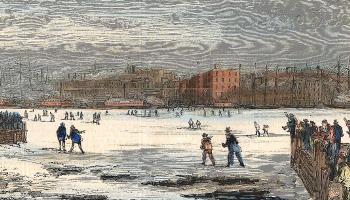
New York’s climate isn’t what it used to be. You don’t have to consider the advent of tornadoes to know that. Ric Burns’ 16-hour documentary film on the history of New York recounts how an impetus for the building of the Brooklyn Bridge (begun in 1870 and opened in 1883*) was the freezing over of the East River in January of 1867. The freeze locked up barges and ships and prevented ferry service for commuters between New York and Brooklyn, two separate cities at the time. Intrepid commuters could, however, walk across the ice if they dared. (Here is PBS video. Below is picture from The Brooklyn Bridge: a wonders of the world book By Elizabeth Mann, Alan Witschonke.)

(* It can be regarded, in part, as a great public work constructed mostly during the extended great depression of 1873)

In the 1800s the East River froze over often enough, regularly providing in ice bridge between Manhattan and Brooklyn, so that even the New York Times as paper of record seemingly couldn’t keep straight how often it happened. (The Times does make mistakes.) We found this March 14, 1888 article in the Times written at the time of the Great Blizzard of 1888. It tells us that in the 1800s the river had frozen over on “six other instances recorded during the present century”; solidly in early February 1813, for a few hours in February 1817, for two days in the last week of January 1821, solidly in January 20, 1851, from noon to 4:00 PM January 17, 1857, February 1875 between the 9th and the 13th and finally on March 13, 1888, the day of the Great Blizzard. Including the Great Blizzard that would make for seven instances in all except that the Times list leaves out the January 1867 freezing that was impetus for the building of the Brooklyn Bridge, which included would make eight such freezes.

We also found the print below on the Brooklyn Library’s site which it says was published Harper's Weekly in March of 1871. The library's post writes about the accompanying story as if it were contemporaneous coverage* but, unless it depicts a prior year's event, 1871 would bring the total for freezes to at least nine.

(* “According to the accompanying article, the changing tides forced the ice to break apart after only a few hours, leaving groups of people scrambling for safety. Those not quick enough to reach land in time were stranded on ice floats in the frigid water--a frightening end to a playful excursion.”)

Colorfully Cool

The 1888 Times article provides an account of that freeze that is quite something to visualize. The entrances to the Brooklyn Bridge were jammed with hundreds of people. “The ice was fully six inches thick and covered with two more inches hard pack snow.” On the Brooklyn side one enterprising young lad set up a ladder down to the ice and charged dedicated Brooklyn commuters two cents apiece to use it. On the other side between Fulton and Beekman another fellow assisted people back up off the ice for five cents apiece. Several hundred people reportedly crossed the ice before “Brooklyn Police authorities, fearful of catastrophe and loss of life” put an end to it. Then with some stragglers still crossing steel prowed tugboats came up from the Battery to ram the ice and “the startled pedestrians,” observing their approach and “comprehending aright their intention” “scattered and ran for the nearest shore.” Not everyone made it. The ice was broken apart with a “report like that of a small canon” and a dozen men remained on the ice floes in “despair” until thrown a rope and rescued by one of the tug “little the worse for their temporary peril and fright.”

The Times article also colorfully reports that during the 1857 freeze the Rev. Henry Ward Beecher made his way across the ice bridge with a young lady companion “asserting that it was not the wicked alone who could stand in slippery places.” I know what you are thinking: Didn’t the safe crossing of a river on an ice floe by Eliza escaping from the evil Simon Legree factor as a key element of the plot of Uncle Tom’s Cabin, the anti-slavery novel written by Beecher’s sister Harriet Beecher Stowe? The answer is yes but if you are thinking that this inspired Ms. Stowe that would not be the case since her book was published in 1852. Reputedly, the Ohio crossing was inspired by another true incident concerning the escape of a young slave woman in1838. Unless the Times got the date of Beecher’s crossing wrong it was more likely Beecher who was inspired by his sister Stowe’s book than vice versa. (I will resist at this time recounting how Beecher officiated in Brooklyn Heights over the marriage of my great-grandmother’s sister to the son of one of the nation’s most famous eccentrics.)

And the 1700s?

Clearly we have not been experiencing this kind of cold weather in New York since I was born in the middle of the 20th century nor the years of that century which preceded me. We have also not seen such cold in first ten years of the 21st century. What about the 1700s? On page 213 of Mike Wallace’s Gotham: A History of New York City to 1898 we see that the river froze over allowing people to walk to Brooklyn in the winter of 1772-73. Then during the Revolutionary War in 1780, the “coldest winter ever known on the North American Continent” the Hudson River froze over for five weeks (likewise a large part of Long Island Sound) with the ice being able to bear a man on horseback until March 17th. The British were able to move troops, two 2-ton cannons and eighty sleighs of provisions from Manhattan to Staten Island over the frozen river ice. (See: The New York Chronology: The Ultimate Compendium of Events, People, and Anecdotes from the Dutch to the Present, By James Trager.) (The British wanted to defend themselves against George Washington's troops who were in Morristown, N.J.)

Can anyone remember Staten Island ferry service ever being suspended for five weeks because the harbor was solid with ice eight or more inches thick? Yes, this weather in 1780 was not only very cold but also exceptionally cold even for those times. Unfortunately, it is time to move on from this subject rather than delve more deeply.

Weather We Were Inspired

(Above, from Wikipedia Park Place in Prospect Heights Brooklyn during the Blizzard of 1888.)

We shouldn’t, however, depart from the subject of the Great Blizzard of 1888 without mentioning that this severe weather event is also credited with inspiring a great public work. Just as the freezing of the East River in1867 is credited with spurring construction of the Brooklyn Bridge, so too is the Great Blizzard of 1888 credited with spurring the construction of the city’s underground subways, speedily constructed and opened in 1904.

One More Way to Destroy the City?

Most of the time we would like to avoid bothering our Noticing New York mind with the problems of global warming or weather weirding. Generally, we are content to preoccupy ourselves with the more traditional ways our local politicians vex us with much more mundane plans to destroy the city, such as the notion that we should be tearing down all the historic buildings in Coney Island while reducing its amusement area down to a minimal fraction.

We confess we found ourselves initially irritated by the “apocalyptic thinking” of the “Rising Currents: Projects for New York’s Waterfront,” show at the Museum of Modern Art (image above). (See Architecture Review: 'Rising Currents: Projects for New York’s Waterfront' Imagining a More Watery New York, by Nicolai Ouroussoff, March 25, 2010.) Its grand scale thinking made us uncomfortably ill at ease, reminding us of the kind of from-on-high it-is-easy-to-replace-everything planning arrogance* that is, for example, associated with Coney Island’s destruction.

(* Sure, its easy enough to tear down a portion of Prospect Heights, including newly renovated buildings, to construct the murkily unparticularized “Atlantic Yards” but the ability to actually fill in this hole developer Bruce Ratner created in the neighborhood becomes a theoretical maybe-someday exercise when the developer says of replacement construction: “it's really market-dependent as to when it will really be completed.”)

Then there is the question what can you do about global warming- what’s the old complaint?: Everyone talks about the weather but nobody does anything about it? That was funny in Mark Twain’s time when the weather wasn’t man-made. Now that our weather is essentially a product of mankind the perplexity of our responsibility tends to deflate the jest.

Bloomberg to the Rescue?

What if our most superpowerful local politician, Mayor Michael Bloomberg, were put on the case? Indeed, in what we would deem to be a product of Bloomberg’s wealth, corporate influence and ambitions for presidential office it was announced on September 21st that Bloomberg has been elected to “serve as chair of the C40 Climate Leadership Group, an association of major cities around the world committed to reducing carbon emissions and slowing climate change.” See the press release on the City’s web page. Is this good? Well, we did our own Noticing New York assessment of Michael Bloomberg’s environmental qualifications. See: Monday, November 2, 2009, On Your Way Vote, We Quizzically Ask: How “Green” Is Our Bloomberg? Our analysis? At best Mr. Bloomberg is a Johnny-come-lately and his heart isn’t really in it.

Burning Fossil Fuels

Mankind is continuing to blithely burn the fossil fuels that contribute to global warming. Basically, this involves removing from the earth and injecting into the atmosphere vast quantities of carbon that were sequestered underground for hundreds of millions or billions of years,* going back eons before mankind was a glimmer in the eye of the universe, (and even before the first trees). (Modernish mankind only goes back about 1.2 million years, divergence from the ape lineage is estimated to begin about 5 million years ago, most of the modern art and culture instincts that make us recognizable to ourselves didn’t begin to emerge until only about 70 thousand years ago.) The early earth’s atmosphere went through some gyrations but, simply put, before those vast quantities of carbons were mostly sequestered the world was an unrecognizably warm place that human beings would have found stifling.

(* Most coal was sequestered starting about 400 million years ago. Coals have been discovered in rocks as old as the Precambrian, but it was not until the Devonian Period (some 400 million years ago) that woody plants became abundant on land and peat deposits were able to accumulate enough to make a minable coal. The deposit of significant quantities of oil underground goes back even further, 2.5–2 billion years to the Archean-Paleoproterozoic transition. Then a radical modification in recycling of organic matter, and the Shunga Event—the accumulation and abundant deposition of unprecedented anomalously organic-carbon- rich-matter sediments forming petroleum source rocks and the inferred generation and migration of the oldest known significant volumes of oil/petroleum.)

Free Ride For the Fossil Fuels Industry

Continued burning of fossil fuels persists because it is attractive to the petroleum, gas and coal industry. It is attractive to them because these industries are highly subsidized. They are subsidized overtly with such things as steep tax breaks and, more important, they are subsidized by not having to pay for what they take from the public. The fossil fuel industry doesn’t have to pay for polluting the atmosphere with injected carbon, they don’t have to pay for the cost of higher sea levels, acidification of the oceans, or extreme weather events. They are also insulated, as in the case of the BP oil spill, from full legal liability for the damage done to the environment from spewing oil directly into the ocean.

Close to Home in New York, the Hydrofracking Example

In essence, the profit of the fossil fuels industry is predicated on what they are able to extract from the public and the public realm without paying for it. If anyone doubts the extent to which this can be the case we suggest a viewing of the documentary Gasland, about the bourgeoning hydrofracturing (hydraulic fracturing) industry. Gasland* has been aired on PBS and HBO, and has been in theaters. It is also viewable on DVD. This is the film where homeowners demonstrate how after nearby drilling water from their house faucets has suddenly become flammable. New Yorkers need to be conscious of hydrofracturing because it stands to put New York City’s watershed at risk together with risking most of the state’s above- and below-ground clean water resources. Accordingly, Gasland has scenes that take place in the City Council Chamber and on the steps of City Hall, including a press conference unattended by the City Hall reporters inside the building. If you don’t immediately go see the film we suggest that you at least listen the Terry Gross Fresh Air interview with filmmaker Josh Fox.

(* We went looking for the industry’s side of the story with respect to the Gasland film. You can judge for yourself but we found its quibbles troublingly hypertechnical and misleading in their arguments about what laws the industry is, or is not, partly subject to and whether drinking water is protected from industry practices. Is the film perhaps more Michael Mooreishly shrill than would be ideal to make its case? Given the fracking industry’s use of nondisclosure agreements we are unlikely ever to know.)

Beyond the fact that hydrofracturing as a fossil fuel extraction process represents the desequestration of ancient carbon material (in New York and other nearby states, Pennsylvania, Ohio, Maryland, West Virginia, New Jersey, even a small portions of Kentucky and Tennessee, it involves removal of gas from the Marcellus Shale Formation deposited almost 400 million years ago) the process entails multiple antisocial problems. Millions of gallons of water, chemicals and sand are trucked into a region and injected underground under high pressure to liberate, mix with, and force natural gas to flow up to the surface.

About half of what is pumped underground is removed afterward. The rest remains as underground contamination. The toxic mix that is removed goes into “flowback,” “frack water,” or “produced water” evaporation pits. It can seep back down into the earth and it is sometimes sprayed into the air to speed evaporation. Because of industry-sponsored legislation for which Dick Cheny and Halliburton are partly responsible there is secrecy about the chemicals used in hydraulic fracturing operations (which may vary from site to site) but the chemicals include toxins, known carcinogens and heavy metals.

The health effects of being around all this, including the effect on animals, are gruesome. Human beings (who are not drinking the contaminated ground water; nobody will, not even people form the industry or regulators) suffer neuropathies, deadened senses of smell and taste and brain damage. In other words the industry extracts health from the public without paying for it.

Fossil Fuels Industry: Bloomberg and the City’s Real Estate Industry

Noticing New York has written a lot about how under Bloomberg the public realm in New York City is habitually sold off to politically connected developers who do not pay value for it. (See: Monday, February 23, 2009, Un-funny Valentines Arriving Late: Your Community Interests at Heart.) The way in which the politically-wired fossil fuels industry treats the public commons is essentially another version of the same thing. We can and will at another time extend the analogy by explaining why practices in the hydrofacking industry known as “compulsory integration,” or “forced pooling,” where the government forces owners to give up rights to their land, are closely akin to eminent domain abuse but for the moment we hope the analogies are clear enough.

Let’s ask again: Is Bloomberg the man to take on the problems of Global Warming?

Global Warming and New York City

The problems global warming poses for the city are real and need to be thought through. Global sea levels are rising. Sea level is about a foot higher than it was a hundred years ago. The planners of Brooklyn Bridge Park say they have planned for a sea level rise of an additional three feet. That’s only what’s planned for and perhaps relatively near term. Sea levels could rise more than that. Even if sea level rises only another foot or so the intrusion of water into our underground subways will put a lot more stress on the pumping system that day-to-day keeps the subways dry.

The city is also exposed and vulnerable to more catastrophic events when sea level rises. New York is lucky in that the configuration of our coastline somewhat diminishes the overall odds of hurricanes hitting the city (less so Long Island) but there is still a significant chance a hurricane will hit. With weather weirding that storm could be extra strong. And with a sea level rise added into the bargain New York City faces a very significant increased risk from hurricane storm surge. The population is large, prime real estate assets on low-lying land prevalent and the logistics of evacuation are difficult. Damage to the city could be in the hundreds of billions.

Here from a March 23, 2006 report the State Assembly Committee on Corporations, Authorities, and Commissions under Assemblyman Richard Brodsky:
New York City and the Long Island region have been directly hit by 11 hurricanes over the last 120 years, for an approximate frequency of one hurricane every 10 years. The most severe hurricane to hit the New York coastal region has been a Category 3 hurricane. According to historical records, since 1815 there have been four Category 3 hurricanes that have hit the New York City region: 1815, 1821, 1893, and 1938.
Among other things, the storm of 1938, which mostly missed the city, hitting Long Island and more severely elsewhere, flooded Providence, Rhode Island.

On the prospect of vulnerability to storm surge damage the report said:
The City is especially vulnerable to storm-surge flooding because of the New York bight: the right angle formed by Long Island and New Jersey. The New York bight makes storm surge values in New York City higher than anywhere else along the eastern seaboard. New York Harbor and the surrounding rivers essentially act as a funnel, and the water will have nowhere to go but on land. While a Category 3 storm will cause a 12-13 foot storm surge in Florida, the same hurricane will cause a storm surge above 20 feet for most of New York City’s coast.
The first part of the above quote come from state and federal government agencies, the New York State Emergency Management Office, Federal Emergency Management Agency, U.S. Army Corps of Engineers. The second part estimating the storm surge height and what follows below is from a New York Press article by Aaron Naparstek, the founder of Streetsblog, for which Naparstek got information from Mike Lee at OEM.
Everything below Broome Street will be inundated, some parts under as much as 20 and 30 feet of water. Chelsea and Greenwich Village are completely flooded, with the Hudson spilling over all the way to 7th Avenue. Likewise, the East River and East Village become one, with ocean water surging all the way to 1st Avenue…A major hurricane will push ocean water down from the Long Island Sound into the Upper East Side, South Bronx and northern Queens, flooding those areas severely. Vast stretches of southern Brooklyn, Queens and Staten Island will be devastated.
Could a storm surge and damage really be as bad as described above? Maybe and perhaps not but how wrong can we afford to be?

Storm Surge Barriers?

I was at the New York City Council during little reported hearings where the possibility and expense of buildings storm surge barriers was discussed. It’s done in the Netherlands. The cost was estimated at $5 billion and possible because there are only a few choke points in the harbor that would need to be addressed. Naturally, any public work estimated to cost $5 billion will probably cost more: The Brooklyn Bridge (built during the reign of Boss Tweed) cost more than twice its original estimate. But $5 billion is not much more than all the public subsidies we are putting into the Atlantic Yards project; money spent on such barriers would be for infrastructure of benefit to all rather than subsidizing one development firm’s private profit at the expense of others and wouldn’t even $10 billion likely be a small cost compared to the cost of a catastrophic storm surge?

Here is another thing we wonder: Couldn’t the barriers be built with a second function in mind; the use of tidal energy to generate electricity? If that were so, wouldn’t their effective cost be greatly reduced? Or perhaps the barriers/generators would even pay for themselves? That would even more likely be the way the math works out if you consider the cost to society of using fossil fuels. Isn’t this a more reasonable expense to ask the public to bear than that of hyrofracking or off shore drilling and oil spills? As we noted before in this post, severe weather has in the past provided the impetus for great New York public works. This wouldn’t be the first.

A Personalized Noticing New York Experience of the Brooklyn Storm

My own personal experience of the September 16, 2010 Brooklyn tornado was not as dramatic as that of some others but I will tell it to you. I was not where the worst of storm was. (One friend of ours was biking through Park Slope and was admitted to very much needed shelter by someone she didn’t know when she climbed a stranger’s brownstone stoop as the worst of the storm hit dead on)

I was busy writing Noticing New York when I heard rolling thunder. I noticed that the roll of the thunder didn’t stop: There were no intermittent breaks as the lightening flashed. It was odd enough so that shortly thereafter I began to record the thunder (the recording is not that interesting as the sound of wind and thunder compete). I decided the sound of the thunder bore investigation and proceeded to the Promenade from where I was able to see that a storm covered the entire horizon over Manhattan and that the wort of it seemed to be a wall of water cascading down in the vicinity of Red Hook. It was later reported Red Hook was one area the storm hit forcefully. Raindrops were beginning to fall and I could tell that a sweep of more drenching rain was about to come. Waiting until almost the last minute I largely escaped it by sprinting ahead. It took just a few bounds before I was back inside my building’s small portico but by that time my back was completely soaked while the front of me was completely dry. Looking out from the vestibule above the stoop I saw torrents.

Below are videos of the arriving storm and then the torrents that followed. As I said, Brooklyn Heights was not subject to the worst of it.

Upstairs, I knew I recognized the pattern of the weather I’d seen. Suspecting that they would be talking about tornadoes I turned on NY1 and, indeed, they were announcing that there was at that moment a tornado in Brooklyn. Showing it on the map it was not immediately clear to me that I was out of range, which I was, but in a very few minutes it was over. My instincts were right; it was tornado weather over Brooklyn. If my instincts are right in some other respects discussed here, let’s hope we will be able to do something about the global weather weirding that has brought tornadoes to visit in Brooklyn for the first time ever.