Friday, October 12, 2012

Justin Davidson’s New York Magazine Review Of Hudson Yards Echos Concerns Raised By NNY, But Does So Without Mentioning Obvious Atlantic Yards Parallels

This week’s New York Magazine presents us with Justin Davidson’s “exclusive preview” of Hudson Yards:  From 0 to 12 Million Square Feet, published Oct 7, 2012.

That well worth reading article manages to raise a number of points that echo issues Noticing New York has been writing about, including a concern Noticing New York revisited and featured in an article posted here the day before Davidson review.  This concern was highlighted in the teaser caption leading into the Davidson review (“In a few weeks, construction begins on New York’s largest development ever. Hudson Yards is handsome, ambitious, and potentially full of life. Should we care that it’s also a giant slab of private property?”) and Davidson further zeroed in on it with the two concluding paragraphs with which he buttoned up his four page review of the coming project: Should we worry that  this “Mega-metropolis” is private property of a single owner?:
The plaza is the node where the site’s conflicting forces reveal themselves: the tension between public and private, between city and campus, between democratic space and commercial real estate. Occupy Wall Street’s takeover of Zuccotti Park last year pointed up the oxymoron inherent in the concept of privately owned public space: You can do anything you like there, as long as the owners deem it okay. Childs hopes that his client’s insistence on premium-brand design won’t make Hudson Yards just the province of privilege. “We want this project to be laced through with public streets, so that everyone has ownership of it, whether you’re arriving in your $100,000 limo or pushing a shopping cart full of your belongings.”

The plans include drop-off lanes, so the limos are taken care of. But if the shopping-cart pushers, buskers, protesters, skateboarders, and bongo players start feeling too welcome at Hudson Yards, Related’s security guards will have a ready-made argument to get them to disperse: This is private property.
Here is Noticing New York’s last meditation on precisely that subject: Sunday, October 7, 2012, Will The “Daily News” Plaza at the “Barclays” (LIBOR) Center Be A Public Space For Free Speech?: Police Issue A Directive To The Contrary.)

The thing to note is that all the valid concerns in the Davidson review, including this one, respecting the 26-acre Hudson Yards project also apply (and get focus on from Noticing New York) in terms of Forest City Ratner’s Atlantic Yards mega-monopoly but there is no mention of this by Davidson.  In fact, the language of the Davidson article is frequently written in a way that seem to imply that the sister mega-project Atlantic Yards must not even exist, this right at the same time as all the current hoopla accompanying the opening of the first Atlantic Yards building, the so-called “Barclays” Center, and just weeks after Davidson’s own New York Magazine review of that “Barclays” Center in an issue if the magazine featuring a cover story about the arena’s debut.

The New York Magazine description of Hudson Yards as a “Mega-metropolis” is reminiscent of Noticing New York’s regular description of Atlantic Yards as a mega-monopoly.”   Compared to the 26-acre Hudson Yards, the Ratner mega-monopoly, placed atop the converging ganglia of Brooklyn’s most important subway lines, consists of 50+ acres.  Most of those Ratner acres are contiguous, a contiguity achieved through government assistance; eminent domain abuse for their acquisition by Ratner and subsidy for his continued ownership.  At the Atlantic Yards site itself there are more than 30 contiguous Ratner-owned acres.  The Atlantic Yards site itself is nominally just 22 acres, but that doesn’t change the fact that with the adjacent property already owned by Ratner when he decided to wipe out competition in the neighborhood (via eminent domain), it’s 30+ contiguous acres all together.  And the Forest City Ratner overall plan concerns the entire 30+ acres.

The other thing that makes the Ratner mega-monopoly comparatively more extreme is the immense jump in density preferentially assigned to the Ratner-owned property over that of his neighbors.  Not so with Hudson Yards: Hudson Yards is only slightly more dense than its surrounding neighborhood.*  The Hudson Yards density is odd because the greater density the neighborhood ought to be the property closest to the subway lines, but the oddnesses are not so nearly as odd as the extremely preferential density being granted Ratner with an override of city zoning that was not subject to traditional public review.

(* What is considered dense in midtown areas relative to other midtown areas may start changing:   The Bloomberg administration recently unveiled plans to almost double-- starting in 2017-- the density of Manhattan’s already very dense Midtown business district surrounding Grand Central, from 39th Street to 57th Street on the East Side.) 

I have presented Noticing New York criticisms of Hudson Yards but in many ways the government handling of Hudson Yards is significantly superior to Atlantic Yards.  Hudson Yards was subject to a fairly careful competitive bid: Atlantic Yards was not.  The MTA got what was probably the best price that could be gotten for Hudson Yards, given the way the request for bids issued was structured: Not so Atlantic Yards where there was what was essentially an escalating giveaway by the MTA to the developer on multiple fronts.

In terms of design caliber I also thought that the Related Companies proposed design for the Hudson Yards site was one of the better designs. . .  Not the best— I thought that the design presented by Brookfield Properties* was the best— but better than the poor design of Tishman Speyer, the company that first won the right to Hudson Yards acres and then defaulted on fulfilling the terms of their bid.

(* Ironically, since we are speaking in key respects about free speech in essentially public space that winds up subjected to privatization, it is impossible not to note that in a universe that is growing absurdly small in terms of the identifiable 1%, Brookfield is the nominally “private” owner of Zuccotti Park without whose participation there couldn’t have been an eviction of Occupy Wall Street’s 99% from that park.)

The better attributes of Hudson Yards notwithstanding, I have been critical of the Hudson Yards plan in several respects, going back a number of years.  For one thing it's too dense.  My major criticism is that rather than bidding out the site as a whole to one developer years ago (and have it lie fallow for so long), government should have prepared the site itself, then bid out subdivided parcels to multiple developers:
If the government (as opposed to a private developer) was preparing the site it would not be necessary to postpone the site’s preparation at this time. Site preparation during the current economic downturn might even be cheaper. As it would be a public work, it would arguably be in the running for funding through federal stimulus, an important part of that being that the prepared parcels would later be bid out. But stimulus money cannot be given to a private developer already signed onto the deal because it would totally change the equation based upon which the developer bid to pay the public a low amount for the site. Used that way, the money would eliminate the risk developer assumed and constitute an award of enormous private benefit to the developer without bid.
Just the way that real estate developers create value by subdividing property, had the government subdivided Hudson Yards (and Atlantic Yards) like what was done with the Battery Park City site, the cumulative amount government would get for the acreage it sold would be far greater.

Speaking in larger terms that applied to this and multiple other projects being championed by the Bloomberg administration at the time I said:
Strip things down to their core and you find that something is being sold. What is being sold is what belongs to public. Sometimes it is referred to as the “public realm.” That means such things as the right not to have our streets and avenues closed and sold off, the right to our historic neighborhoods, the right to good urban design, livable density and the right not to have our parks or amusement areas like Coney Island given away for development or speculative purchase.
Davidson, in his Hudson Yards review, presents his misgiving about the single developer approach in design terms: The potential for the possible “thrilling coherence” of “auteur” style development versus the risks of  “a place of oppressive uniformity, where each aesthetic miscalculation is multiplied many times over.”   Or, as Noticing New York has written, from a Jane Jacobs perspective, will we, with the single ownership of mega-projects, experience the banes of regimentation and monotony?  Davidson notes that the Related Companies were responsible for the Columbus Circle Time Warner project (rather mall-ish in Noticing New York’s estimation) and offer the none-too-encouraging observation that Hudson Yards could be that Columbus Circle project writ large:
 . .if you imagine the complex blown out to five times its size, you begin to get a sense of what’s coming at Hudson Yards. . .   But massive as it is, the Time Warner Center is dainty by comparison.”
Net Net: By subdividing properties like Hudson Yards and Atlantic Yards to be bid out and developed by multiple developers the public gets: 1.) Faster development, 2.) more money for the land it is selling, and 3.) better design.

In addition to what's said about free speech in public areas that have been "privatized," Davidson’s article is filled with other statements that cry out for a refrain of “What about Atlantic Yards?” in response:
    •    New York has no precedent for such a dense and complex neighborhood, covering such a vast range of uses, built in one go.           
            What about the bigger and more intrusive Atlantic Yards?

    •    $3 billion in taxpayer-funded improvements encircle the Related fiefdom—not including city tax abatements. “Where else have you ever seen this kind of public money for infrastructure to service a whole new development, in the heart of the city, with that much land and no obstacles?”           
            What about the huge amount of subsidy going to Atlantic Yards?  It’s hard to do apples to apples comparisons but $2-$3 billion in subsidies are going to Atlantic Yards.

    •    [On squeezing suitable public open space in amongst oversized skyscrapers] That’s a spectacular challenge; there are few great models for a European-style piazza within a ring of skyscrapers.
            What about Atlantic Yards?  Its towers too will be inordinately belittling to their interspersed public spaces.  Davidson quotes Thomas Woltz, the landscape architect charged with the challenge:  “In an open space next to 1,000-foot towers, our tallest tree is going to be like an ant next to a tall man’s shoe”

    •    Bloomberg hoped to draw the 2012 Olympics to New York with promises of a West Side stadium. The fact that London won the games was a disappointment to him but a stroke of luck for the West Side, scuttling what would have been a disastrous stadium plan, while at the same time calling attention to the value of the real estate above the tracks.
            What about Atlantic Yards that jammed a sports arena into the middle of conjoining brownstone neighborhoods and overriding city ordinances that should have required at least 200 feet of distance between such an arena and residences.  The West Side stadium wouldn’t have done that.

    •    The site as a whole is a yawning pit, not so much a blank slate as an empty socket, surrounded by amenities and infrastructure just waiting to be plugged in.
             What about Atlantic Yards?  Don’t people need to be reminded that the Atlantic Yards footprint, by comparison, wasn’t “an empty socket,” that 60% of it was a neighborhood that was a mixture of valuable historic buildings, busy business, and a lot of recent new development, all of which was scooped out and thrown away to make way for Ratner?
The Davidson article is full of good points and presents much to mull over, but as with so much in life what isn’t said may be more important than what is said . . .  Interesting in an article that buttons up its ending with concluding statements about the value of free speech when its exercised!

What If The Media Is Caught Flatfooted About The “Barclays” Center? (The Ratner/Prokhorov Arena Named For That LIBOR Scandal Bank)

I am not saying it will happen. . . I am not saying how long we will have to wait to know if it will. . . . But it could happen. . .   And what would happen if it does?

What will happen if, after all the dutifully stenographic PR hype and hoopla promulgated by the media about how great the “Barclays” Center is, the “Barclays” Center fails?  What if, for all that media hoopla instructing the public to have positive emotions and adoring respect for the “Barclays” arena, the public actually rejects the arena and the arena goes under?

What will the press say then?  Will they say: “We saw it coming!”?

That seems almost impossible to conceive given the present hyperbolic celebrations of the arena, but given the media’s bottomless ability to rewrite history, paying attention only to whatever is the temporal fashion of the moment in reporting reality, they might very well do that.

The so-called “Barclays” Center has fans.  And it will no doubt have fans into the future, whatever that future holds.  But it's easy for the “Barclays” Center to have fans, even some local fans, and still be vastly unpopular in the neighborhood and borough it has decimated in spearheading the takeover of so much neighborhood for Forest City Ratner’s mega-monpoly.  Similarly it can have fans and still fail financially.

In the end, it is a question of how many people go to the arena, paying its high prices, ignoring its symbolism, and, similarly, how many performers consent to perform there.

Failure could look like this: Attendance is lower than what is needed to support the arena financially.  Ratner and Prokhorov, the owners, raise prices (on tickets together with all the extra hidden incidentals) to cover costs, driving attendance down further.  It becomes a vicious cycle.  Meanwhile, many performers decide not to perform at the not-so-adored arena, limiting the number of quality shows, curtailing ticket sales still more.  An increasing negative perception of the arena (and those willing to perform there) grows, resulting in more performers shunning the arena that unspeakably promotes the “Barclays” bank.

That’s why there is such a concentration on advertising now, as the arena promoters try to make a first and lasting impression that convinces potential ticket buyers and performers alike the arena is something special and good for the community that people should want to go to.  But if, and especially as, the arena fails, all of that far too desperately ubiquitous advertising we have been subjected to will also have to be cut back, subsiding and falling by the historical wayside in another cycle of decline.

What happens if the arena goes under financially?  Ratner and Prokhorov might lose ownership of the arena, which would teach them a well-deserved lesson.  It could also forestall the rest of the Ratner Atlantic Yards mega-monopoly and lead to better development practices around the city.

And, by the way, I’m staying away from the arena for a good long while.

Oh, and another by the way, you have heard that government tax-exempt bonds recently issued in New York City to support a large new sports venue are failing?:  Those were the municipal bonds ($237+ Million) issued for Yankee Stadium's vast new parking garages despite warnings from, and over the objection of, the community.

Thursday, October 11, 2012

Silly Little Post About Barbra Streisand And Freddy's Bar. . And Money That's In The Wrong Place

Back on July 25th I published a sort of silly little post that I suggested might give readers a small peek into the inside world of blogging. . .(See: Silly Little Blog Post About Dumb Little Blog Ad: My Excoriation of Barclays Paid-For Name Building Earns More Barclays Spending To Get Its Name Out.)

I recounted how an ad popped up on my Google Blogger screen (as they do) right after I hit the button to publish a Noticing New York article that extensively castigated Barclays Bank (and its resigned-in-disgrace, chief executive Robert E. “Bob” Diamond) for not being inclined to do the right thing by community standards but nevertheless paying to have the `honor' of having their names prominently appear on things like the “Barclays” Ratner/Prokhorov basketball arena opening in Brooklyn and the (Bob) “Diamond Building” on Colby College’s campus (See: No Sparkle In Barclays’ Bob Diamond: Societal Mores Unmoored, What And Who We Honor Today- That Which We Used To Shun) . . .

. . . .  The Google Blogger ad that popped up was, if you can believe, for Barclays BankTelling me I should “open an account today” with Barclays!

As I explained, the ad probably popped up because (scary to think) Google Blogger knew what I was writing about!

As I explained (in more detail) when I wrote that earlier silly little post, I'd previously had a similar experience:  It was when I was writing about how Bloomberg was spending too much money to get re-elected  (Sunday, November 1, 2009, Bloomberg vs. Thomson (54% to 29%?): It’s Not What You Think. (For Instance the “P” is Missing and What Might “P” Stand For?).)  The ensuing advertisement Google Blogger generated  told me I should  "vote for Bloomberg! "

Now, while writing another article I have had another similar internet experience.  Yet again, I was writing about how people are spending too much money promoting the wrong things and I was writing once again about the Ratner/Prokhorov arena that has promtionally been named "Barclays."   (See: Wednesday, October 10, 2012, Weighing The Change In Brooklyn: The True Cost Of “Barclays” Center Glitter, The Cost Of “Barclays” Center Tickets.)  In the article I zeroed in on concerts Barbra Streisand is scheduled to be performing in the Ratnner/Prokhorov "Barclays" arena.  Ms. Streisand, a self-described activist, is one of the singers who has not answered an open letter from the community questioning why she is performing at the scandalously spawned and scandalously named arena.  (The other, incongruously, is singer/song-writer Leonard Cohen.)

I was asking whether it made sense that government should be subsidizing tickets to the Barbra Streisand concerts to the tune of $20 a ticket when that same $20 would have paid for an entire night out at Freddy's, the local bar and music venue that was evicted from the neighborhood through eminent domain abuse to clear the way (together with much of the rest of the neighborhood) for the "Barclays" Center.  Freddy's, or a versin of what it had been, had to move to another neighborhood in Brooklyn where it now pays higher taxes (like the rest of us) to subsidize the Streisand concerts and the other activities at the "Barclays" Center.  I asked readers to consider: What would happen if, instead of subsidizing "Barclays" Center's corporatizing takeover of Brooklyn, the same amount of money was spent on subsidizing 3.6 million trips (with $20.00 each) to local tax-paying cabarets and restaurants?

In composing the article I did research for it by watching a video about Freddy's Bar and Grill that I found on Norman Oder's Atlantic Yards Report site.  Many videos you can play on the internet automatically include advertising snippets.  What do you think happened when I clicked and started to watch the video about Freddy's?  You can probably guess by now: Two eyes appeared floating on top of the video about what a wonderful neighborhood bar Freddy's was.  It was an ad for Barbra Streisand and the eyes were hers. ----  That is the image you see at the beginning of this post.

It wasn't an ad for her performances at the "Barclays" Center and I don't know exactly why it appeared.  Was the explanation, as before, that Google again knew what I had been writing about?  Or was it because I was clicking on the web from Brooklyn and all of Brooklyn is being targeted with Barbra advertising because of the upcoming concert?  Or did the ad appear because the internet knew I was interested in that spot where Freddy's once stood, perhaps even in the music once offered there, and calculatingly pulled up the new substitution?

I don't know exactly but I get the overall point:

Write about how an obscene amount of money is being spent promoting Bloomberg: You'll get an advertisement promoting Bloomberg in response.

Write about how absurd it is to be spending public resources promoting the name of a nefarious bank like Barclays:  You'll get an advertisement telling you Barclays is so great you ought to bank with them.

Write about how unfair it is that local music is being put out of business by having to subsidize Barbra Streisand at the "Barclays" Center: You'll get an advertisement telling you to go out and buy Barbra's music.

Suffice it to say too much money being spent on advertising is on the wrong side of things.  I won't go into the question here about whether the funds spent on all this lavish Bloomberg and Barclays advertising or the subsidies for Barbra Streisand's concerts were come by fairly.  You probably know that it is my Noticing New York viewpoint that just wasn't the case.

I'll leave you with this. . .   Maybe you’d like to click on this video by Peg Byron about the old Freddy’s and see what advertisement comes up for you.  Whatever ad comes up the Freddy's video itself is a good one I suspect you will enjoy watching.

Wednesday, October 10, 2012

Weighing The Change In Brooklyn: The True Cost Of “Barclays” Center Glitter, The Cost Of “Barclays” Center Tickets

The "Barclays" Center advertising oculus showing Barbra Streisand, one of the singers who has not answered an open letter from the community questioning why she is performing at the Ratner/Prokhorov arena 
With the opening of the Ratner/Prokhorov “Barclays” Center in Brooklyn last week much is being written about what has been lost and what we might think we have gained.

I believe it was Brian Lehrer who summed up for his listeners the October 2nd New York Magazine cover story— Brooklyn Is Finished.”  (followed by a small subtitle) “Or has it only just begun.” — as being sort of about how Brooklyn may have become a victim of its own success.

Brian Lehrer or one of his staff may have speed-read the Mark Jacobson New York Magazine story referred to (its relative incoherence challenges a careful read), but I don’t think it can be cited for the proposition that Brooklyn is a victim of its own success.  Nevertheless, the article certainly mulls over, without providing much explanation, the issues of what has been gained and lost with the arrival of the “Barclays” Center.

The arrival of the “Barclays” Center in Brooklyn hardly represents Brooklyn being a victim of its own success: What it represents is the borough’s failure to fend off a corporatizing grab of its burgeoning local culture.

Elegy For Loss In A Corporatizing Grab

Jay Michaelson writing in the Huffington Post (An Elegy for Brooklyn, in the Shadow of Barclays, 10/02/2012) did a far better and much more succinct job than the New York Magazine article in weighing the losses that come with the arrival of Barclays.  Michaelson, like  Jacobson in New York Magazine, tends to see the losses through his own set of personal filters, but he gets it mostly right, particularly with respect to the principles involved.  What is being lost is the wealth of a diverse, locally-generated ecosystem, “an experiment in a different kind of urban renewal.”  (You may hear echos of Jane Jacobs and NNY’s testimony about HDC’s proposed issuance of more bonds for Ratner.)  What is being plunked down by Ratner in exchange is just more of the ubiquity of “the same chain-restaurants and sports bars, the same monotonous culture” that you witness in other corporately fostered environments.

Says Michaelson: “Once again, something unique is being displaced by something ordinary and crass.”

“Manhattanization”?

Michaelson gets perhaps only one thing wrong.  He says: “Today, the Slug is the tip of a pincer of Manhattanization.”   (He refers to the “Barclays” Center as “the slug” and to living near it as living in “shadows of the Slug.”) I think “Manhattanization” isn’t the operative concept because I have always doubted that the more politically powerful Manhattanites would have allowed anything like Ratner’s governmentally assisted acquisition of a 50+ acre monopoly or Ratner’s other various oppressions of the surrounding neighborhood.  Manhattanites defeated Bloomberg’s wishes to place the Jets Stadium on Manhattan’s West Side.  I have also always doubted that Manhattanites would have tolerated the extreme and sudden jump proposed to take the Ratner-controlled property to unprecedented density.  I may need to reassess that last doubt now given the Bloomberg administration recently unveiled plans to almost double (starting in 2017) the density of Manhattan’s already very dense Midtown business district surrounding Grand Central, from 39th Street to 57th Street on the East Side.

Corporatizing Takeover Comes Subsidized

On another key point Michaelson is absolutely right: That the corporatizing takover of Brooklyn is not the result of natural economic forces.  It is the result of subsidies snuffing out those forces.  “Real capitalism was already here, in the form of bodegas and boutiques,” he tells us while reminding us that the “slug” is “the bastard child” of government subsidies, and:
Real capitalism is about small businesses creating a diverse market ecosystem. Mega-capitalism is about big money squashing all of it like a bug.
Indeed, what we see when looking the “Barclays” Center is the big box store version of entertainment.  Similar to the way that big box stores are so often able to strike special deals with government for tax exemption, giving them extra edge over mom-and-pop stores, the “Barclays” Center doesn’t pay taxes.  It is also additionally supported by other subsidies as well.

If you go to see Babs Streisand* playing the “Barclays” Center, Bruce Ratner and Mikhail Prokhorov as its owners need not set aside even one penny of your ticket price to pay for taxes.  But if you want to open an intimate music venue across the street that hosts local musicians, including possibly young next-generation Streisands, you are going to be at a competitive disadvantage: You’ll have to pay taxes and you won’t have the rest of the “Barclays” package of subsidies helping you.  In fact, you will have to pay extra taxes to pick up the tab for the those subsidies and the taxes the “Barclays” Center isn’t paying.
(*Note: The community has sent an open letter Barbra Streisand and Leonard Cohen respecting their scheduled performances at the arena, holding open the possibility that “as artists with a history of philanthropy, social justice and civil liberty advocacy, and protest lyrics” Streisand’s and Cohen’s acceptance of performance dates at the arena might mean that they had yet “to learn about the history behind the venue” with which they were associating themselves.” The artists have yet to respond to the community’s letter.)
The kind of corporatizing agglomeration of wealth into a privileged tax-exempt fortress you see at the “Barclays” Center is similar to what was done with the building of the new Yankee Stadium: The new Yankee Stadium has fewer seats than the old (so the ticket prices could be raised), but its overall footprint is actually bigger than the previous stadium so that, for the benefit of a corporatizing few, it could include within its tax-exempt privileged walls the business activities once plied by others outside those walls who paid taxes.

Could the boundaries between whom government is choosing to benefit and whom government works against be any clearer?

Cost Of The Corporatizing Subsidy: Is That The Ticket?

It’s worth doing some quick, back-of-envelope calculations to understand exactly what the “Barclays” Center subsidies mean.

Let’s assume that there will be about 225 events a year at the “Barclays” Center (at least that’s a number its prospective bondholders relied on), and then let’s assume that typical events might be filled with about 16,000 (that's just a tad below the attendance figures for the opening Jay-Z concerts.)  That would give us 3.6 million ticket sales a year.  The actual number of performances might be more or might be fewer and overall attendance could be different but this is a good ballpark figure for our purposes.

Now let's think what that translates into in terms of per ticket subsidy.  Let's start with the real estate taxes that are not being paid.  The way the deal works is that that real estate taxes being side-stepped are equal to the debt service on the tax-exempt bonds issued for the arena (essentially mortgage debt financing a large portion of the building).   $511 million of tax-exempt bonds were issued by the state for Ratner and Prokhorov at an overall interest rate of 6.48%.

The Official Statement describes multiple, for the layman complicated kinds of bonds.  The cash flow going to debt service (available here) jumps around (starting out low just after the construction period, ratcheting up and then back down again) but, leaving out the construction period, a simple debt calculation for thirty-five years over which the bonds amortize translates to an annual figure for unpaid taxes of $36,962,520.00, or $10.27 per ticket.

But that's just the start because there are other subsidy costs that have to be added in as part of the additional cost of each ticket.  There is: 1.) the annual city, state and federal subsidy to lower the interest rate on the bonds, 2.) the allocable portion of the MTA write-down on the land, 3.) the city’s donation of the closed down part of Fifth Avenue and the allocable portion of the closed section of Pacific Street, 4.) the allocable portion of the $279 million in cash from the city and state, 5.) the abuse of eminent domain to obtain land at lower cost, 6.) the entire package of preferential density for other buildings on the block and exemptions from rules that normally apply, like not building arenas within 200 feet of residential buildings.

Probably, because only the arena and not much more is opening for a period of time, allocable portions assigned to the arena should be boosted.

That’s not to mention extra police, subway trains, and other city services needed to support the arena.

The city, state and federal subsidy to lower the interest rate on the bonds comes to about $95 million in subsidy.  But over the 38 year term of the bonds that only about $2.5 million a year.  Sales tax is also being avoided.  It could all be allocated to the construction years but maybe it is better to allocate to the first ten years at about $1.75 million a year.

The MTA write-down on the land value and the city gift of street streets probably ought to be valued at about $72.61 million all together.  (More should probably be added onto this because the developer is also getting a free option on more land with it but we'll ignore that.) If that total is taken over the next ten years that's $7.261 million a year.

If, given the arena's immediate delivery with most else about the mega-project in abeyance we might allocate 40% of the city and state cash to the arena and decide that it should be allocated to the next ten years?  That would be another $11.6 million a year.

At this point all these additional amounts come to another $22.671 million in subsidy a year.  So at this point the per ticket subsidy is running at about $16.56.  The value of the rest of the subsidies like eminent domain acquisition of land, density and all sorts of exemptions is harder to calculate.  I suggest that for conceptual purposes which just round it out to about $20.00 a ticket, which is probably low.

$20.00?  That could have covered an entire night out at Freddy's the neighborhood bar with music performances that was evicted by eminent domain's threat and left money over to spend elsewhere in the community.  (Apparently once referred to as the “borough of Brooklyn’s most vital cultural hub”- It's in the video in the link.)

Think what would happen if, instead of subsidizing 3.6 million "Barclays" tickets the same amount of money were spent to subsidize 3.6 million trips to local tax-paying cabarets and restaurants?   

A ticket to see Barbra Streisand isn’t, by everyone’s standards, cheap: $104 to $716.65.  And that’s the nominal cost of the tickets not yet including the addition of these subsidies.  It also doesn’t include added fees charged beyond the face amount of the ticket.

But if the tickets aren’t cheap that’s, in part because, Ratner and Prokhorov didn’t have to agree to lower what they charge for tickets in exchange for subsides.  They can charge what the market will bear.  They are not a nonprofit and since they aren't they are allowed to make as much profit as they can and all that money can go back to Ratner's Cleveland or Prokhorov's Russia, or wherever.  There is no no one, and no practical expedience that requires them to recycle those monies through the community.

Their ability to charge the going rate also explains why the cost of a bottle of water in the arena can be $4.50.  You may especially want that bottle of water before you leave if you show up for a Jay-Z concert at its scheduled starting time 8:00 PM not knowing you should really expect him to start an hour and a half after that.  (At Freddy's you could get a glass of water for free.)

Tickets for Jay-Z concerts were in two categories.  Tickets that were supposed to be market rate tickets were reportedly running between a low average price of $452 to a high average price of $530.  Floor seats for the much-hyped show were over $2,000.  Then there were 7000 tickets nominally being offered at the crowd-friendly price of $29.50 ($37.20 with fees) that were actually reaching the secondary market at $195.23.

Whatever the nominal ticket prices you just have to remember that, with the subsidies, the amounts that Ratner and Prokhorov get to pocket and take back with them to Cleveland, Russia, or wherever, are going to be greater by that amount.  If you go with the cheap $104 Barbra Streisand ticket its real price (before fees) is $124.  The $29.50 Jay-Z concert ticket is $49.50 or $57.50 with fees.  But if you are spending the better part of a grand for a ticket maybe you consider these amounts other citizen taxpayers are shouldering for your ticket trifling.

But now here is something else to consider: If the number of performances go down or if attendance figures wind up being lower than the per subsidy amount allocable to each seat-filling ticket goes up.  Something else happens too: Ratner and Prokhorov may find themselves wanting to raise ticket prices.  If they do, it could turn into a vicious cycle: higher prices reducing attendance.

Glittering Treasure Chest Of Value

There are certainly those who look upon the “Barclays” Center and see impressive value there;  They crow about the spectacle of its glitter. A frequently used metaphor for a glittering and startling concentration of wealth piled up in one place is that of the treasure chest.  Some people who make proclamations about  what Brooklyn has gained with the “Barclays” Center, people like Ratner, Prokhorov, Bloomberg, Markowitz, and Charlie Rose gloat over the arena's glitter.  I see what they are gloating over as representing much the same thing as a treasure chest.  Like a treasure chest, the “Barclays” Center undeniably gleams with heaps of accumulated value.  But the “Barclays” Center, like those fictional fairytale treasure chests, comes by its impressive heaped up gleam because it is an accumulation of pirate booty, illegally seized and hoarded.

All that piled-up wealth represents the brooches and necklaces that are not out in the community being worn as adorning ornament by the ladies, it’s the candlesticks and silver that are not festooning local dinner tables, it represents the gold that is not circulating through and enriching the general commerce of the community.  It also represents the cost of the fear, violence and suffering when that wealth was wrested from its original owners at sword point or with the discharge of blunderbusses.

Piratical Plunder Attracts

The 1991 movie “Hook,” a Spielberg revisitation of the “Peter Pan” story, is flawed in many ways but it tries so hard in an overblown way to cram so much in that it inevitably succeeds in various interesting incidentals (like Glenn Close in an incognito cameo as a male pirate, long before her gender-switching role as Albert Nobbs).  The conceit is that Peter Pan has grown up and that now, as Peter Banning, he has forgotten who he was.  There is a metaphor that I thought ill-handled and clumsily maudlin but that stuck with me nevertheless:  The adult Banning (Robin Williams) is now in the real estate and financial industry with a investment banking private equity firm, something like Bain Capital, that specializes in taking over vulnerable firms.  As Banning’s son relates, Banning “blows them out of the water” upon encountering “any resistance.”  The fairytale’s Wendy, now aged into a grandmother (Maggie Smith), quiets upon hearing this. Fixing Banning in her gaze says, “So, Peter, you’ve become a pirate!”

The metaphor is not seriously developed or capitalized upon in the film, but it gets emphasized in a brief ensuing moment as Banning shivers when he looks at pirate imagery embedded in the nursery’s wallpaper.  The point is that boys who once gloried in championing justice, can easily forget their origins, growing up into men seduced by the attractions of piratical plunder.  We may see Ratner’s professionals as being so enticed to the other side of justice  . . . and perhaps even Ratner himself.

The thing to remember is that the revelry around the glint and gleam of the “Barclays” Center is, at its core, a celebration of an immense and unforgivable transfer of wealth from the local community to a force of marauders.

Glitter of Golden Eggs?

Jane Jacobs, the great urbanist observer and thinker who wrote “The Death and Life of Great American Cities,” writes in that book (p. 246) about a sort of `killing the goose that laid the golden egg’ concern, that the benefits of a diverse economy can be killed off by a rush of businesses coming in to take advantage of an “enviable location” so that the “enviable location” thereby ceases to exist.

Days ago Charlie Rose did what amounts to his second infomercial for Bruce Ratner to promote the “Barclays” Center.  (In it, he jokes with Ratner about `manipulating politicians’ and also jokes with Russian Oligarch Mikhail Prokhorov about free speech in Russia.)  Characterizing Ratner to his (trusting?) PBS audience as a “worrier--a soft-spoken worrier,” Rose served up to Ratner a succession of perfect Tee-ups for all sorts of Ratner self-promotion: “What's the biggest misconception about you, that you would like people to know is simply not true?” 

Rose, keying off the sort of Jane Jacobs `killing the golden goose’ concern I just mentioned told Ratner that he assumed that Ratner, in building the “Barclays” Center, wanted “to make sure that none of this causes Brooklyn to lose Brooklyn, to be what it is. . .  I mean, if you have the definition of something that has soul, you want to make sure that nothing gets in the way of that soul.”

Ratner (who later flatters Rose in the interview by telling him he asks “very good questions”) naturally affirms the point.

Ratner also affirms moments later when Rose suggests that Ratner wants to honor, or as Ratner says, “continue the soul of Brooklyn” so that, in Rose’s words “it doesn't look like Brooklyn has been bought.”  (“Stolen” is actually the image that comes to mind.)

During the interview, Rose flourished and had the Mark Jacobson New York Magazine cover story displayed on the screen.  Rose’s questions” played off the aforementioned motif, interpreting this as a moment when no one wants Brooklyn to be “victim of its own success.”  

But none of this is true.  Ratner’s putting up the “Barclays” Center is not an example of Ratner being attracted to the golden goose of Brooklyn’s soul.  More likely he viewed the sports arena as an extension of his pennant-decorated shopping malls across the street and as a way of wiping out the competing development springing up just streets away (streets that he know owns thanks to the government and eminent domain abuse).  Most of Brooklyn’s recognized success has happened since Ratner announced his plans in 2003; this success happened in spite of Ratner's plans, and it thrives better when at a safe remove from Ratner.  But now that the Ratner arena unveiling comes in the middle of the ongoing Brooklyn success story with which everyone is so familiar he can hardly afford to be seen as being at odds with it.  But he is at odds with it!

Subsidies Falsify Cost Equations And Warp And Extinguish Development

Though things absolutely stand to be lost, this time it isn’t exactly about the care and preservation of golden geese.  It is't about Ratner valuing the golden eggs that are being laid.  The antagonism between Brooklyn and what Ratner is creating is more direct.  The Jane Jacobs caution that more aptly applies to the “Barclays” arena is expressed in her 2000 book, “The Nature of Economies,” in which she warns that:
. . . subsidies falsify both costs and prices. . ..  lies of that sort warp development.
Immediately after, as further explanation of the pitfalls of falsified costs, Jacobs cites the post-Soviet Russia in which Rartner’s partner Mikhail Prokhorov made his fortune:
Monopolies, established by cronyism and strong-arm methods, along with pervasive extortion and corruption, falsify actual cost anyhow; racketeering enterprises prefer eliminating competitors to competing with them on prices, quality and services.
Let us then, before ever entering the “Barclays” Center, keep our wits about us.  Let us remind ourselves that the true cost of a ticket to enter is much greater than the dollar amount that appears on one’s ticket.  Part of that cost is what Michaelson in his Huffington Post column reminds us is what may vanish, unable to withstand Ratner’s “onslaught”:
 . . . Within a mile of Barclays Center, there are over 100 restaurants, mostly local and independent, many of them serving local and organic food in literally every cuisine of the world (there's a fantastic French Caribbean place right in the shadow of the Slug). There are co-ops and quirky thrift shops, Pentecostal churches, brownstones and city housing; there are lots of bicycles on the street.

Sunday, October 7, 2012

The Posterior Protuberance Of the Ratner/Prokhorov Barclays (LIBOR) Center Not Indicated On Model Submitted To Sell Arena To Public

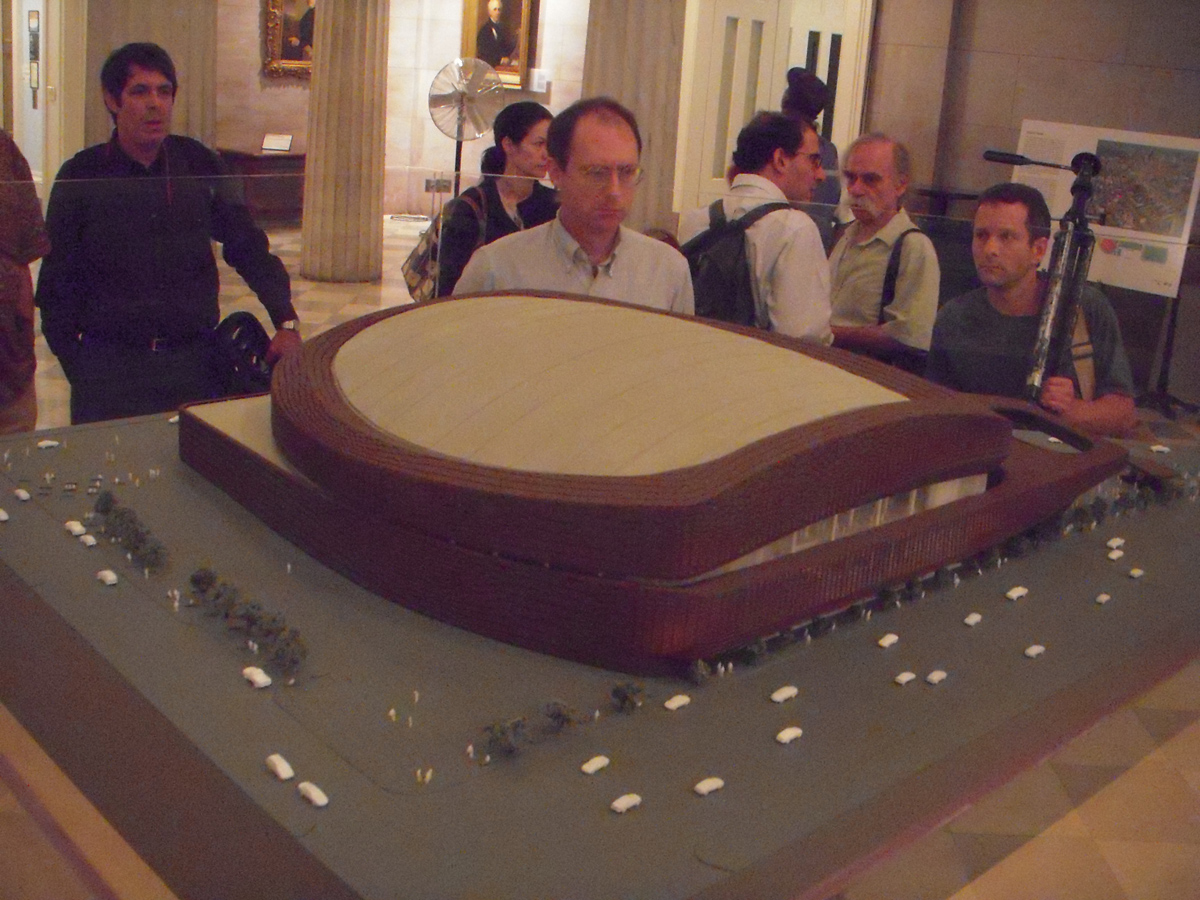
Noticing New York earlier covered how, when a model of the forthcoming Ratner/Prokhorov Barclays (LIBOR) Center was on display at Brooklyn’s Borough Hall and being presented by its architects in September of 2009, the model and information being given out did not disclose that the now infamous name and logo of Barclays Bank would be placed on the roof, advertising the bank’s brand (and supposed respectability) to all those citizens in helicopters, airplanes and nearby tall buildings (or taking pictures from them).  Also not unveiled, despite public inquiry, were the animated lighting schemes: the advertising “oculus,” the rooftop laser lights, and the flashing colored lights of the weathering steel grid.  (See: Wednesday, August 15, 2012, With Discordant Synchronicity The “Barclays” Center Will Open At LIBOR Scandal’s Peak: What The New York Times Is And Isn’t Covering.)

Here is one other thing the model publicly on display and presented by architects to sell the building to the public depicted as not being part of what would ultimately be built (and which now has been built): A posterior protuberance.  It’s square and blandly uninspired, perfunctory in the extreme, nothing in the least worth praising architecturally.

You can well imagine why it wasn’t included as part of the sleek design and image the architects wanted to sell to the public at the time. . .

. . .  But, since it is at the back of the building (where, at the moment, you only see what’s left of the forgotten community of original residents the developer is turning his back on) we might now presume it to be believed that what’s actually built doesn’t actually matter.

Pictures below:
Posterior protuberance the weekend of Jay-Z's opening concert
Posterior protuberance with "art wall" leading up to it in the forground
Here is what the public was shown that the building’s posterior was supposed to look like:
Model on display in Borough Hall, September 2009
September 2009- Sleek, no posterior protrusion
It may be that the protuberance at the back of the building matters less for another reason: Maybe someday the residential buildings that Forest City Ratner says will someday be built around the arena, actually will be, in which case, much of what is around the building now may disappear, in some way subsumed into that eventual reconfiguration.   The protuberance may disappear and I have pointed out (first in September of 2009) that I expect that much of the weathering steel wreath that decorates the original, underlying airplane hanger design of the arena will also disappear.

I got a chance to ask about how much of the wreath’s decoration might succumb to future reconfigurations when the SHoP architects (Gregg Pasquarelli and Chris Sharples) were on Brian Lehrer Tuesday.

Their answer, perhaps fudged, to my phoned-in query was that none of the wreath would wind up being dismantled because the new buildings would wind up being just a “backdrop” to a changing composition, since, unlike the original Gehry design, the buildings won’t be part of an integrated single design.  I posted a follow up comment on the show page saying that I believe that if the other buildings are ever built on the block they will abut and that means that you won’t see as much of the weathering steel wreath that was added to the original design and that much of the wreath may have to be taken down.  If the buildings don’t actually abut they are likely to wind up being so very close that it will amount to nearly the same thing.

While we are on the subject of whether renderings give a clue: Was the dominance of the advertising oculus fairly foreshadowed by what the architects presented?  See below. 
September 2009 model
Original rendering
Day-to-day reality of the advertising oculus
Other Noticing New York articles have previously covered the deceptiveness of architectural renderings and models.  See: Friday, September 26, 2008, Weighing Scale and Thursday, September 10, 2009, The Surrounding Light Smears Ratner’s Atlantic Yards Arena.

Atlantic Yards Report recently addressed the subject of how the SHoP Architects renderings made the arena appear smaller in comparison to neighboring buildings than an actual attempted panoramic recreation of their pictures show it in fact to be.  See: Wednesday, September 05, 2012, Unbuilt towers and a hovercraft perspective: what's wrong with common Barclays Center rendering (plus an accurate panorama from Tracy Collins).

Does anyone know where architects rank in terms of trusted professions amongst, politicians, newsmen and real estate brokers?  Where would you rank them?

Will The “Daily News” Plaza at the “Barclays” (LIBOR) Center Be A Public Space For Free Speech?: Police Issue A Directive To The Contrary

Demonstrators in "Daily News" Plaza at end of Saturday FUREE March 
A lot of the interaction between the protesters protesting the opening of the Ratner/Prokhorov Barclays (LIBOR) Center Arena, the media and those showing up for Jay-Z’s first night concert there almost didn’t happen.  That interaction almost didn’t happen because the city police didn’t want it to happen.  More specifics on this shortly.  It was important that what did happen happened in the large triangular space in front of the arena now named the “Daily News” Plaza.  It’s named that as the result of a sponsoring partnership the Daily News (owned by a fellow real estate developer) has entered into with the arena owners.

Privatization of Public Space and Forest City Ratner’s Mega-Monopoly

Given Bruce Ratner’s corporate takeover of huge swaths of Brooklyn’s most central and important areas, there is a crucial concern as to whether the spaces that his Forest City Ratner organization owns and controls will be treated as public spaces.  With government assistance, including deep preferential subsidies and the abuse of eminent domain, the Ratner organization now exercises dominion over more than 50 acres of Brooklyn that sit astride the convergences of the borough’s key subway lines.  Because Ratner is being preferentially granted the right to build at unprecedented density the effect of that mega-monopoly is multiplied several fold.

(Above a map on the governmentally-assisted Ratner mega-monopoly.  Below depiction of how that mega-monpoly overlays with the subway lines) 

Three things are important with respect to the potential for free speech in this regard: 1.) The privatization of previously public space, 2.) Monopolization of a huge amount of space in Brooklyn by Ratner (precluding pluralism), and 3.) The interconnections between Ratner and government in terms of bringing this about and then perpetuating the privatized Ratner mega-monopoly.

What kind of public space will there be for the vast number of citizens living under the Ratner sway in terms of forums for public discussion and debate?  Will the historical expectation of such forums, such public commons, be eliminated with the privatization of public space that the government assisted?   The government turned over to Ratner streets and sidewalks that were previously public, together with property that had been owned by other property owners in the neighborhood.

The issues of free speech in a world of privatized public space present fundamental questions that Noticing New York explored in an article prompted by the Bloomberg administration’s pending eviction of Occupy Wall Street protestors from Zucotti Park, once known as Liberty Plaza.  (See: Saturday, October 22, 2011, Occupy Wall Street and the Banks- Messages From Bonnie & Clyde, “They’ve Got Too Much Money”: Ownership of the Public Forum by the Wealthy?)  The John Zucotti after whom that park is now named was once a government official but at the time Liberty Plaza was renamed after him he was a powerful zoning lawyer prominent in the real estate industry.
Future of the Ratner/Prokhorov “Daily News” Plaza As A Place For Free Speech

Is it possible that the large triangular “Daily News” plaza outside the arena could be used as a central commons for public discourse?  It's well suited in several ways: It’s centrally located and, especially with the new subway station entrance, very easy to get to.   It’s broad, flat and, for much of any given day, substantially devoid of other uses.  A tradition could easily spring up for it to be used much as it was used during the four days of community protests against the arena’s opening and Atlantic Yards, as a place for groups to convene, express and call attention to their opinions.

A downside is that the plaza is very noisy.  This might be readily guessed simply by witnessing all the traffic on the multi-lane avenues that flank it, but the plaza is made even more noisy by the roar of subway trains that pass periodically underneath it.

Admittedly, it isn’t the plaza outside of City Hall; You don’t, as you do there, have the feeling that you may be addressing nearby government officials housed within the formal dignity of a building built to honor the relation of the elected and the electorate.  Instead, the huge dark cooperately logoed “Barclays” Center and its “oculus” loom over you.  Like an oversized flat screen in a sports bar, the “oculus” perpetually reformulates moving images that show hypnotically distracting advertisements from all the corporations who have deemed it beneficial to associate themselves with Ratner’s scandalous doin’s in his ruin of Brooklyn.
The insistent flashing ads in the oculus, together with the arena’s general overbearingness in the space are, it’s worth remembering, financially juiced by the arena’s nonpayment of taxes.  We, the public, pay the expenses the arena doesn't.

The plaza between Flatbush and Atlantic Avenue is not City Hall Plaza but in an era where the “Barclays” Center aptly represents a corporatizing takeover of the borough and where real estate developers like Ratner now own the politicians you can find in City Hall and Brooklyn’s Borough Hall, perhaps it represents an even more fitting space for delivering messages to the people who are now really in power.

Who Actually “Owns” This Space?

Will those in power let it the plaza space be used as public space?  That partly depends on a technical question as to who is deemed to have technical legal ownership of the plaza.  At one point a contingent of Occupy people, experienced in such newly pertinent “free speech” distinctions, arrived and asked where the property line was.  I must confess that even as a real estate property lawyer I had not thought about this in advance.  I wasn’t even sure there was a line traversing the plaza although, obviously, the public had to have some sort of rights if they were going to be able to enter and exit the new subway station entrance which the Daily News absurdly claimed that Ratner altruistically gave to New Yorkers as a “free” present.

Apparently there is some sort of formal property-dividing line somewhere between the subway entrance and the arena, probably about where the Ratner/Prokhorov owners of the arena typically set up their sign (see below) about how they want the plaza to be used.  Even with that subtraction of "Ratner/Prokhorov" space there is still ample space for public forums remaining.  But should Ratner and Prokhorov technically be thought of as having the right to control the plaza as private space?  There are all sorts of leases going back and forth so that the space could be deemed “public” to qualify for the public’s payment of its costs.  In theory the plaza space is a public benefit furnished to the public so as to help justify the Ratner takeover of everyone else’s property.
Photo above from Atlantic Yards Report post about fortification of Ratner/Prokhorov perimeters
And then there is the concept that the Ratner people have themselves promotionally advanced: That the “30,000 square foot open space plaza” should be a public meeting place comparable in ways to the very public “Grand Central clock,” a location where you can pass the time, watch the passing public pageant, and wait for your friends to join you.

As it was, the protestors congregated only on “their”, the “public” side of the line.

Police Direction That The Plaza Not Be Used For Protest

Not long before 5:00 PM police, crossed over the “line” to come over from the “Ratner/Prokhorov” area to tell all of the protesters, myself included, that they didn’t want us there.  I was there with some of the “Billionaires for Barclays” group, some of the Occupy’s Guitarmy and some other protestors.   

A white shirted officer, accompanied by surrounding group of several other officers, came over and asked who was “in charge.”  Nobody was.  We were all there for similar reasons but nobody was “in charge.”  This earned a sigh from the officer.

“You have to go have to go over to the other side of the street,” he said, pointing across Flatbush at the sidewalk beside the Bears Community Garden.

“Why?”  I am not sure who asked, or even if I did myself.

“Because I’m telling you to,” he said.

“Why?”   I think we all knew the real answer: It was because, with 5:00 PM approaching they expected press and ticket holders to be arriving soon and they wanted to accommodate Ratner and company by removing demonstrators from the picture.

“Because you are obstructing the sidewalk and blocking traffic.”

“No we aren’t,” came the response and with the not huge number of demonstrators present we certainly weren’t.

“I’m directing you to move across the street and if I direct you, you have to go where I tell you,” said the officer.

“Wait a minute,” I said, “We have to do whatever you tell us?  If you tell us to go into that building there,” I said pointing to Ratner’s Atlantic Center across the street, “then we have to go there?  And if you tell us to go into that building there,” I said pointing to Ratner’s Atlantic Mall, also across the street, “then we have to go there?”
(Above, seen in the form of a panaramic collage, a partial view of Ratner's mall properties in back of the "Daily News" Plaza.)

I must admit I was surprised to find myself talking to a police officer this way.  It’s fairly ingrained in me to defer to authority.  Still I was annoyed with what they were trying to pull and if they succeeded it would make the demonstrations less visible and less meaningful, much the way that the Bloomberg administration has previously chosen to structure the handling of protests: segregated “free speech zones”  where people can be ignored and segregated “free press zones” placed at a very safe remove from those “free speech zones.”

“I see no difference,”
I said, waving my arms to indicate the other areas of the plaza around the subway entrance “between these people here, and those people there, and those people there.”

Actually, I did see a difference: The people the officer was asking to leave were expressing an opinion that was opposed to the arena.  But in all other respects, it's true, there was no difference.  All day the newly opened plaza had attracted a fair number of the curious, some fans as well.  To the extent that the people I gestured at included some fans wearing fan-ware then they too could have been considered to have been expressing an opinion about the arena, just an opinion that Ratner was happy to have expressed on the opening night of the arena.

Of course, as could readily be expected, not very long after the officer’s direction to move, the plaza would soon be tread by Borough President Marty Markowitz, interested in drawing as large a crowd of press and fans around him as possible so that he could express his opinion that the opening of the arena was a glorious thing.

At this point something happened that I didn’t expect: The officer backed off.  “Well, just keep moving,” he said.  “Don’t block anything.”

He and his surrounding flank of officers moved off but he left me feeling nervous, like my rights to the space were diminished.

Maybe that’s why when a man in a suit stepped out of a car onto the plaza and I asked him, “do you see any difference between the people standing here and the people standing over there, or there?”   His brown suit was conservatively tailored and carefully pressed so I thought for a moment he might have been one of the black ministers who had led the Candlelight Vigil of a hundred and fifty people protesting the opening of the arena near that spot the night before.  He wasn’t: He was from the media and there was a cameraman with him.  He didn’t answer me.  He only stared off to the horizon, a faraway look in his eye.

Occupy Style Mic Check In Plaza: Oculus Sound System Revs Up

This press fellow didn’t return to our vicinity when a few minutes after the police moved off the group of protesters circled up for a “mic check,” the Occupy style of communication, amplified by crowd repetition, typically used to address a group.

As soon as we started the mic check, the “Barclays” Center oculus sound system revved up.  It’s something I have never heard before and haven’t heard since.  “Oh, no,” I thought, because Norman Oder had already speculated in Atlantic Yards Report that the potentially very loud sound system might have been intended as a crowd dispersal feature: Wednesday, September 26, 2012, Ads at the oculus and arena entrance: lots of sound (and maybe crowd dispersal capacity). . . .
  
. . . If that was the reason the system was being turned on, someone controlling the volume knob must have thought better of it pretty fast: Almost as fast as the volume started to come up it was turned back down again to zero.

The mic check, which I participated in, addressed such things as crony capitalism and the LIBOR scandal that the Barclays Bank has been thoroughly implicated in.  Never mind that scandal: Barclays is still getting its name implicitly celebrated back to “respectability” by having the arena and subway hubs bear its name and its former president, Bob Diamond, who had to resign in disgrace is similarly having his name implicitly celebrated back to respectability by having a building beside the admissions office at Colby College bear his name.

Caskets Arrive In Plaza Reanimating Free Speech

If the police had planned to move in again to move us out later they probably lost their chance when a short time thereafter a crowd of anti-gun violence activists showed up with two caskets to call attention to their message.  They were weren’t protesting the arena, Jay-Z or the developer’s tactics although maybe they should have, but they saw the space as public forum and opportunity.  (See: Saturday, September 29, 2012, Activists bring anti-gun violence message to sidewalk outside Barclays Center.)

Controlling Public Space For Free Speech vs. Things Under Control Of The Press

The police may have wanted to play along with Ratner’s game plan and help set the scene for the press where for the day of the opening everybody would appear to be saying that the opening of the arena was just great, as though no one is appalled.  They achieved that but it also mattered less given that the media, including the New York Times, engaged in compliant, self-censoring viewing and reporting on the opening events hoopla with blinders on.  (See: Saturday, September 29, 2012, Report: How The Times Expunged Its Own First Draft Of History On “Barclays” Center Opening To Replace It With The Pro-Ratner Narrative It Favors and Wednesday, October 3, 2012, Media and Activists: Putting The News Of The Jay-Z Concert Opening Of The “Barclays” Center In Context.)

Free Speech, Freedom of Assembly: The Intimidation And Comfort Factors

Does the “Barclays” Daily News Plaza work as place for public free speech?  That will depend partly on how it is managed.  Late that night of Jay-Z’s concert, after the Jay-Z crowd had moved inside the arena, another protestor, a less experienced one, confided in me that she felt very uncomfortable being in the plaza.  She described it as “creepy” and was eager to get away.
Lynda Robb Johnson who sees that protesting might be fun with President Ford’s daughter, Susan Ford Bales, on the Jim Roselli radio show in Chautauqua NY.
A number of weeks ago I heard Lyndon Johnson’s daughter, Lynda Johnson Robb, say that say that she thought that many of the protestors that came out to protest against her father’s perpetuation of the Vietnam War came out to have a good time.  I appreciate that the harsh criticism her father was subjected to was no doubt painful for her but I think more often the opposite is true in two respects: Being part of the group in power has its enjoyable aspects and it’s uncomfortable to protest. The times I got out to protest the Vietnam War were uncomfortable for me and I find protesting, in general, can be very uncomfortable.  I put the discomfort aside, because I believe it’s something important to do, like voting.  And I am very thankful to the people who have more stamina than I do in pursuing it.

What happens when that level of discomfort is cranked up?  I certainly felt uncomfortable when the officer directed us to remove ourselves away from the arena.  And my fellow protester the night of the Jay-Z opening concert is right: There is a lot going on around the arena that does make one feel creepy and uncomfortable.

The night of the Jay-Z concert uniformed anti-terrorist personnel guarded the arena Starbucks franchise.
The day after when the FUREE (Families United for Racial and Economic Equality) march ended at the arena a phalanx of red-jacketed arena ushers deployed to define a “do-not-cross” line that fended protestors out of the plaza’s center.
Even Monday evening, three days after Jay-Z’s opening concert and two days after the community’s four days of formal protest had concluded you could still see the police manifesting a significant presence as they planned their strategy for the day.
The overall manpower deployed is stunning.  See these yellow-jacketed pedestrian safety fellows going into action for the day.
Some, not all, of this would hardly be necessary except that the arena with its takings and with its celebration of the privileges of an elite over the rights of the common citizen has created the kind of tensions and divisions in the community that kind of abuse certainly ought to create.

Will the deployment of all this manpower stifle free speech in the plaza?  Newspapers used to represent a celebration of free speech.  Will the plaza, named “Daily News” after a newspaper provide a place for free speech?  Or will it in the end only celebrate the dominance of commercial speech?

The answer is important because, until the day comes when it is taken back, Ratner has been given an unspeakable mega-monopoly in Brooklyn.  You can no longer walk formerly public streets and sidewalks either to get to a protest or to protest on them without Ratner’s permission because those streets and sidewalks were given away to Ratner by the city.  With mega-monopolies like this being handed out in the city where will the public find places to speak?
(Above, police barricades on both sides of the Sixth Avenue behind the Ratner/Prokhorov "Barclays" arena.  Below, gates closing off Pacific Street, now owned and controld by Ratner.)

More fence going up around Ratner's superblock
Partial view of the very long fence around Ratner superblock now mostly used for parking
The Times On The Subject Of Brookfield Properties As Purveyors Of Public Space And The Eviction Of Occupy Wall Street

In the end we may lose our interconnected freedoms of free speech and public assembly, or at least the meaningfulness of those rights, not with a bang but with a simper. . . The simper of media praise for how we should be forgetfully contented with whatever mix of entertainment salves corporations chose to serve up in exchange for those displaced freedoms.

This week the Times, which in many way provided egregiously bad reporting on the free speech issues underlying Occupy Wall Street’s eviction from Zucotti Park, ran a story praising Brookfield (insert “Office”) Properties “a high-end commercial real estate operation” for its art presentations in what it refers to as “the public spaces” of the “office buildings it operates.”  Brookfield is the nominally “private” owner of Zuccotti Park without whose participation there couldn’t have an eviction.  (Purveyors of Office Space and Lively Arts, by Allan Kozinn, September 30, 2012.)

The article on Brookfield’s hosting of the art presentations broached the free speech issue in Brookfield’s control of its space.  It did so in delicate, mild, lauding terms: A composer is quoted as saying “They have been really open-minded and flexible” . . . “You can talk to them about the power of an idea, and that’s really liberating.”  But the article also communicates that because Brookfield views the space as “public space” (not despite it’s being public space), it exercises control: “they don’t want anything that’s too far away from family fare in terms of language or imagery.”   The quote, coming from John Schaefer, WNYC’s radio host of avant-garde music programs, sounds almost like an endorsement.

The article speaks in terms of all of Brookfield’s public space generally but pays a fair amount of attention to its Battery Park City Winter Garden space which in many ways is functionally very critical as public space, integrating with and connecting other carefully designed Battery Park City space.  Immediately outside it on the other side of the expanse of windows there is more public plaza along the water.  I haven’t researched to determine whether or not Brookfield is contractually obligated to publicly use the Winter Garden space.  It’s not mentioned by the Times.

Why, of all times would this be the moment that the Times runs such an article?  It hints that maybe it's because the 25th anniversary of the arts program is approaching (but not really here).  Or, is it because with the weather changing that people will remember that we are coming up on the anniversary of Brookfield’s decision (the first half of last October) to evict Occupy Wall Street?  Because the Brookfield PR department, mobilizing prophylactically, contacted the Times to work something out?  The Times article makes absolutely no reference to Brookfield’s role in the eviction of Occupy Wall Street from Zucotti Park.   

The Privatized Barclays Space And The Forceful Commercialism There

In the end the “free” public entertainments provided by Brookfield sound rather pleasant as written about by the Times.  At the “Barclays” Center, with its unremitting, illuminated ads, promotion of the commercial messages we are supposed to consume is much more in-your-face as is also the New York Times writing about it.

I’ve noted before that the New York Times has been using Jay-Z for its own promotion and, conversely has been in reciprocal fashion promoting Jay-Z.  It continues.

Friday morning, my listening to public radio station WNYC was interrupted when I thought I heard announced that the New York Times would be running a week-long lifestyle series about Jay-Z concerning his likes and tastes.  I now think that I misheard and that the New York Times isn't running a week-long lifestyle series about Jay-Z concerning his likes and tastes and that the story instead was that Jay-Z would be live-streaming his last “Barclays” concert to launch a YouTube channel and that, as part of this launch, JAY Z's new YouTube channel, “Life+Times,” (not the New York Times) will be running that week-long lifestyle series.  Per its promotion “Life+Times” is a content-rich hub that seamlessly blends the interests  of JAY Z” with practically everything else under the sun, “editorially” providing an “insider’s perspective.”

So it won't be the New York Times running such a series, but communicating with other people while still under my misapprehension that the Times would, I didn’t encounter any real surprise or an awakening of new outrage, only a dismayed resignation that this is what things have come to, that with all the other hype the Times has already run, it is absolutely to be expected that the Times would run such silly and fawning promotion of Jay-Z.  What are things coming to when our reality is that you can no longer tell the difference?  When the meaningful apsects of free speech dwindle and necessary public conversations get replaced with  . . .   You tell me!