Showing posts with label Hudson Yards. Show all posts

Friday, October 12, 2012

Justin Davidson’s New York Magazine Review Of Hudson Yards Echos Concerns Raised By NNY, But Does So Without Mentioning Obvious Atlantic Yards Parallels

This week’s New York Magazine presents us with Justin Davidson’s “exclusive preview” of Hudson Yards:  From 0 to 12 Million Square Feet, published Oct 7, 2012.

That well worth reading article manages to raise a number of points that echo issues Noticing New York has been writing about, including a concern Noticing New York revisited and featured in an article posted here the day before Davidson review.  This concern was highlighted in the teaser caption leading into the Davidson review (“In a few weeks, construction begins on New York’s largest development ever. Hudson Yards is handsome, ambitious, and potentially full of life. Should we care that it’s also a giant slab of private property?”) and Davidson further zeroed in on it with the two concluding paragraphs with which he buttoned up his four page review of the coming project: Should we worry that  this “Mega-metropolis” is private property of a single owner?:
The plaza is the node where the site’s conflicting forces reveal themselves: the tension between public and private, between city and campus, between democratic space and commercial real estate. Occupy Wall Street’s takeover of Zuccotti Park last year pointed up the oxymoron inherent in the concept of privately owned public space: You can do anything you like there, as long as the owners deem it okay. Childs hopes that his client’s insistence on premium-brand design won’t make Hudson Yards just the province of privilege. “We want this project to be laced through with public streets, so that everyone has ownership of it, whether you’re arriving in your $100,000 limo or pushing a shopping cart full of your belongings.”

The plans include drop-off lanes, so the limos are taken care of. But if the shopping-cart pushers, buskers, protesters, skateboarders, and bongo players start feeling too welcome at Hudson Yards, Related’s security guards will have a ready-made argument to get them to disperse: This is private property.
Here is Noticing New York’s last meditation on precisely that subject: Sunday, October 7, 2012, Will The “Daily News” Plaza at the “Barclays” (LIBOR) Center Be A Public Space For Free Speech?: Police Issue A Directive To The Contrary.)

The thing to note is that all the valid concerns in the Davidson review, including this one, respecting the 26-acre Hudson Yards project also apply (and get focus on from Noticing New York) in terms of Forest City Ratner’s Atlantic Yards mega-monopoly but there is no mention of this by Davidson.  In fact, the language of the Davidson article is frequently written in a way that seem to imply that the sister mega-project Atlantic Yards must not even exist, this right at the same time as all the current hoopla accompanying the opening of the first Atlantic Yards building, the so-called “Barclays” Center, and just weeks after Davidson’s own New York Magazine review of that “Barclays” Center in an issue if the magazine featuring a cover story about the arena’s debut.

The New York Magazine description of Hudson Yards as a “Mega-metropolis” is reminiscent of Noticing New York’s regular description of Atlantic Yards as a mega-monopoly.”   Compared to the 26-acre Hudson Yards, the Ratner mega-monopoly, placed atop the converging ganglia of Brooklyn’s most important subway lines, consists of 50+ acres.  Most of those Ratner acres are contiguous, a contiguity achieved through government assistance; eminent domain abuse for their acquisition by Ratner and subsidy for his continued ownership.  At the Atlantic Yards site itself there are more than 30 contiguous Ratner-owned acres.  The Atlantic Yards site itself is nominally just 22 acres, but that doesn’t change the fact that with the adjacent property already owned by Ratner when he decided to wipe out competition in the neighborhood (via eminent domain), it’s 30+ contiguous acres all together.  And the Forest City Ratner overall plan concerns the entire 30+ acres.

The other thing that makes the Ratner mega-monopoly comparatively more extreme is the immense jump in density preferentially assigned to the Ratner-owned property over that of his neighbors.  Not so with Hudson Yards: Hudson Yards is only slightly more dense than its surrounding neighborhood.*  The Hudson Yards density is odd because the greater density the neighborhood ought to be the property closest to the subway lines, but the oddnesses are not so nearly as odd as the extremely preferential density being granted Ratner with an override of city zoning that was not subject to traditional public review.

(* What is considered dense in midtown areas relative to other midtown areas may start changing:   The Bloomberg administration recently unveiled plans to almost double-- starting in 2017-- the density of Manhattan’s already very dense Midtown business district surrounding Grand Central, from 39th Street to 57th Street on the East Side.) 

I have presented Noticing New York criticisms of Hudson Yards but in many ways the government handling of Hudson Yards is significantly superior to Atlantic Yards.  Hudson Yards was subject to a fairly careful competitive bid: Atlantic Yards was not.  The MTA got what was probably the best price that could be gotten for Hudson Yards, given the way the request for bids issued was structured: Not so Atlantic Yards where there was what was essentially an escalating giveaway by the MTA to the developer on multiple fronts.

In terms of design caliber I also thought that the Related Companies proposed design for the Hudson Yards site was one of the better designs. . .  Not the best— I thought that the design presented by Brookfield Properties* was the best— but better than the poor design of Tishman Speyer, the company that first won the right to Hudson Yards acres and then defaulted on fulfilling the terms of their bid.

(* Ironically, since we are speaking in key respects about free speech in essentially public space that winds up subjected to privatization, it is impossible not to note that in a universe that is growing absurdly small in terms of the identifiable 1%, Brookfield is the nominally “private” owner of Zuccotti Park without whose participation there couldn’t have been an eviction of Occupy Wall Street’s 99% from that park.)

The better attributes of Hudson Yards notwithstanding, I have been critical of the Hudson Yards plan in several respects, going back a number of years.  For one thing it's too dense.  My major criticism is that rather than bidding out the site as a whole to one developer years ago (and have it lie fallow for so long), government should have prepared the site itself, then bid out subdivided parcels to multiple developers:
If the government (as opposed to a private developer) was preparing the site it would not be necessary to postpone the site’s preparation at this time. Site preparation during the current economic downturn might even be cheaper. As it would be a public work, it would arguably be in the running for funding through federal stimulus, an important part of that being that the prepared parcels would later be bid out. But stimulus money cannot be given to a private developer already signed onto the deal because it would totally change the equation based upon which the developer bid to pay the public a low amount for the site. Used that way, the money would eliminate the risk developer assumed and constitute an award of enormous private benefit to the developer without bid.
Just the way that real estate developers create value by subdividing property, had the government subdivided Hudson Yards (and Atlantic Yards) like what was done with the Battery Park City site, the cumulative amount government would get for the acreage it sold would be far greater.

Speaking in larger terms that applied to this and multiple other projects being championed by the Bloomberg administration at the time I said:
Strip things down to their core and you find that something is being sold. What is being sold is what belongs to public. Sometimes it is referred to as the “public realm.” That means such things as the right not to have our streets and avenues closed and sold off, the right to our historic neighborhoods, the right to good urban design, livable density and the right not to have our parks or amusement areas like Coney Island given away for development or speculative purchase.
Davidson, in his Hudson Yards review, presents his misgiving about the single developer approach in design terms: The potential for the possible “thrilling coherence” of “auteur” style development versus the risks of  “a place of oppressive uniformity, where each aesthetic miscalculation is multiplied many times over.”   Or, as Noticing New York has written, from a Jane Jacobs perspective, will we, with the single ownership of mega-projects, experience the banes of regimentation and monotony?  Davidson notes that the Related Companies were responsible for the Columbus Circle Time Warner project (rather mall-ish in Noticing New York’s estimation) and offer the none-too-encouraging observation that Hudson Yards could be that Columbus Circle project writ large:
 . .if you imagine the complex blown out to five times its size, you begin to get a sense of what’s coming at Hudson Yards. . .   But massive as it is, the Time Warner Center is dainty by comparison.”
Net Net: By subdividing properties like Hudson Yards and Atlantic Yards to be bid out and developed by multiple developers the public gets: 1.) Faster development, 2.) more money for the land it is selling, and 3.) better design.

In addition to what's said about free speech in public areas that have been "privatized," Davidson’s article is filled with other statements that cry out for a refrain of “What about Atlantic Yards?” in response:
    •    New York has no precedent for such a dense and complex neighborhood, covering such a vast range of uses, built in one go.           
            What about the bigger and more intrusive Atlantic Yards?

    •    $3 billion in taxpayer-funded improvements encircle the Related fiefdom—not including city tax abatements. “Where else have you ever seen this kind of public money for infrastructure to service a whole new development, in the heart of the city, with that much land and no obstacles?”           
            What about the huge amount of subsidy going to Atlantic Yards?  It’s hard to do apples to apples comparisons but $2-$3 billion in subsidies are going to Atlantic Yards.

    •    [On squeezing suitable public open space in amongst oversized skyscrapers] That’s a spectacular challenge; there are few great models for a European-style piazza within a ring of skyscrapers.
            What about Atlantic Yards?  Its towers too will be inordinately belittling to their interspersed public spaces.  Davidson quotes Thomas Woltz, the landscape architect charged with the challenge:  “In an open space next to 1,000-foot towers, our tallest tree is going to be like an ant next to a tall man’s shoe”

    •    Bloomberg hoped to draw the 2012 Olympics to New York with promises of a West Side stadium. The fact that London won the games was a disappointment to him but a stroke of luck for the West Side, scuttling what would have been a disastrous stadium plan, while at the same time calling attention to the value of the real estate above the tracks.
            What about Atlantic Yards that jammed a sports arena into the middle of conjoining brownstone neighborhoods and overriding city ordinances that should have required at least 200 feet of distance between such an arena and residences.  The West Side stadium wouldn’t have done that.

    •    The site as a whole is a yawning pit, not so much a blank slate as an empty socket, surrounded by amenities and infrastructure just waiting to be plugged in.
             What about Atlantic Yards?  Don’t people need to be reminded that the Atlantic Yards footprint, by comparison, wasn’t “an empty socket,” that 60% of it was a neighborhood that was a mixture of valuable historic buildings, busy business, and a lot of recent new development, all of which was scooped out and thrown away to make way for Ratner?
The Davidson article is full of good points and presents much to mull over, but as with so much in life what isn’t said may be more important than what is said . . .  Interesting in an article that buttons up its ending with concluding statements about the value of free speech when its exercised!

Wednesday, April 20, 2011

Fighting His Third Term Curse Bloomberg Now Uses His Own Money To Promote Mega-Projects That Aren’t Happening

Noticing New York already has already once covered the growing public perception that Mayor Michael Bloomberg is having problem-cursed third term with mounting public awareness of his accumulating mistakes. (See: Saturday, April 9, 2011, Add To Bloomberg’s Other Mistakes: Mistakes In NOT Acknowledging Mistakes, Including A Certain Ratner Mega-Monopoly.) In doing so, consideration was given to a New York Time’s article on the subject: News Analysis, Ever-Growing Image of a Stumbling Third Term for Bloomberg, by David M. Halbfinger, April 7, 2011.

Not mentioned in the previous Noticing New York post is that the Times article had this very interesting tidbit:
For his part, Mr. Bloomberg seems aware that symptoms of “third-term-itis” have manifested themselves. For weeks now, he has been using his own money to pay for campaign-style advertisements, nominally to bolster his battle with the teachers’ union, but widely taken as an effort to lift his sagging approval ratings.
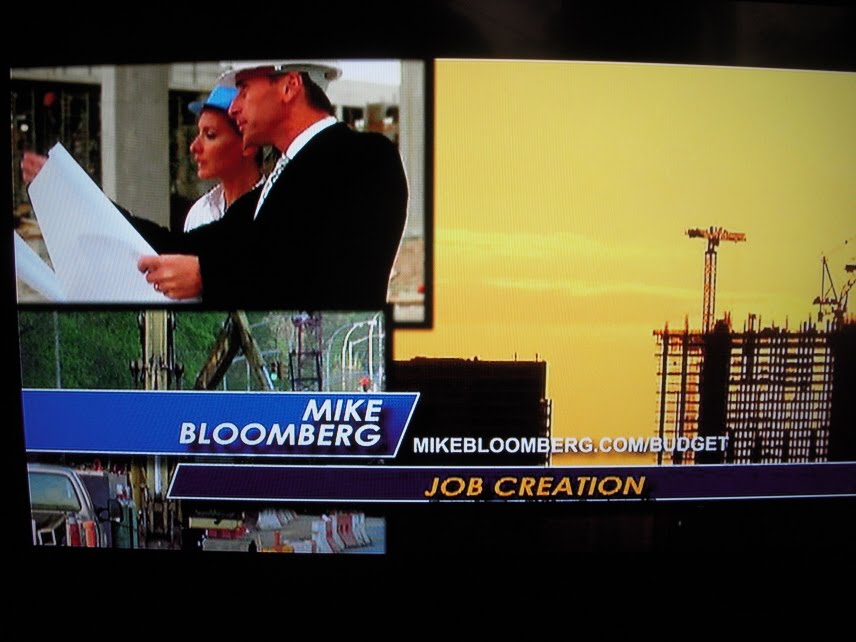
I caught one of these personally financed Bloomberg “campaign-style advertisements” the other day (it ended with the legend: “Paid for by Michael R. Bloomberg”). Whether it was nominally or otherwise intended “to bolster his battle with the teachers’ union” or “an effort to lift his sagging approval ratings” it, surprisingly, prominently devoted precious moments of its 30 seconds to promoting Bloomberg’s big, city-assisted real estate developments. We are able to discern that the ad is talking about such real estate developments from the assisting visuals (see above/below) even though the projects are euphemistically referred to obliquely only as “critical job creation projects.”

Bloomberg announced just today that he is forming a "campaign committee" to oversee his spending to promote his positions and that his spending, to date, is in the "upper six figures." Does that sound like it's about to hit one million dollars? Mailers have also been landing in peoples mail boxes but, so far, not ours.

Surprise: The Best Defense for lack Of Project Headway?


It is a surprise that Bloomberg should be promoting his city-assisted real estate developments given that Bloomberg, now into his third four-year term, has made so little headway with any of his mega-development dreams. Truth to tell, most of the `jobs’ they have so far created have been only for those in the demolition trades. With all the demolition it is perhaps not so surprising that New York is not growing anywhere near as fast as Bloomberg expected. After all, the necessary corollary to “if you build it they will come” must certainly be, “if you tear it down they will leave,” certainly if you don't replace what you tear down.

During the era of Robert Moses, another famous tear-down artist (or should we say tear-down “mad scientist” rather than “artist”) the population of the city shrank dramatically. To be completely fair, Moses was also building a lot during this era, though much of it for cars that helped accelerate the departure from the city Moses' other policies were helping to foster.
The projects initiated under Bloomberg have all so far involved mostly just destruction: Atlantic Yards, Willets Point, the Columbia University’s takeover of West Harlem, Coney Island. Hudson Yards on the West side of Manhattan does not involve destruction except to the extent that its oppressive scale will likely detract from the benefit it will provide long term. But even though that particular mega-project did not require any Bloombergian-brand destruction to proceed, it has not preceded.

Even the most necessary projects that Bloomberg was handed as relatively ready to go when he took office have languished, Moynihan Station (which could be helping to jump-start the languishing Hudson Yards) is one key example. The very slow-proceeding replacement of buildings at the World Trade Center site should also be mentioned as one of the most unfortunate examples of a blank slate. We are now approaching the tenth anniversary of that site’s demolition and Bloomberg, who took office only months after 9/11 has been in office almost that entire time. Bloomberg’s focus in that neighborhood was: i.) sending federal Ground Zero funds to his pet Waterfalls project, and ii.) the special benefits and variances his administration gave allowing an extra large Goldman Sachs building to go forward across the street from the Ground Zero site where it would override and diminish the quality of the carefully thought-out Battery Park City plan while competing with the Silverstein Ground Zero buildings.

Similarly, Brooklyn Bridge Park was ready to proceed when Bloomberg took office but Bloomberg only got started with it when he was electioneering for his third term. See: Monday, May 24, 2010, Looking a Gift Horse in the Mouth? An Examination of Brooklyn Bridge Park in Terms of the Politics of Development, Part I. And attention to proceeding with building upon the vacant riverside expanse at Queens West was neglected while the Bloomberg administration preoccupied itself with the Olympics bid and what it might tear down elsewhere.

Surprise: The Best Defense for lack Of Jobs?

It is also surprising that Bloomberg is advertising his languishing city real estate projects as “job creation projects” given that, for instance the Atlantic Yards arena is now mainly famous for the jobs it isn’t creating while the housing to be constructed is now conspicuously in the news for the cutback in jobs associated with the developer’s announced intention to shift to modular construction, building the tallest modular building in the world (if this pushing-the-limits of technology is permitted), and perhaps making the densest area of North America a forest of such units.

Even if one focuses on the construction industry jobs stimulated by the Bloomberg administration’s massive up-zonings of certain areas around the city, those temporary construction jobs must, in areas like Williamsburg, be weighed against the many blue collar jobs were simultaneously lost with the abrupt and total zoning changes that were passed. Now in Williamsburg there is an oversupply of new luxury units along the water while just a little further inland we witnessed a wholesale abandonment of new residential construction projects (caused by the financial crisis) lying fallow on formerly occupied industrial sites that provided the kind of jobs and economic activity that would likely have survived that downturn.

How NOT to Produce an Affordable City

It is true that economic growth fosters population growth, but perhaps more important, population growth (and sometimes economic growth) is spurred by affordability. There are only so many wealthy people in the world. The parts of the country growing the fastest are generally where new residential units can be produced quickly and cheaply. In theory, the Bloomberg administration is interested in generating many new units in order to foster growth. But Bloomberg’s destructions do not necessarily result in an increase of affordable units. They are more of a churn, or something worse. Atlantic Yards provides a sorry example.

Atlantic Yards involves tearing down existing housing units, many of them exceedingly affordable, and replacing them, in time, with a greater number of less affordable units. While those units will be replaced in time, in the interim they are being replaced with nothing at all. (The interim will involve several decades during which we can measure an associated population drop.) Even if the units are eventually replaced as planned they will be replaced by diverting and misallocating housing subsidies from other projects where those subsidies could be more effectively used to provide more affordable housing (more of it and at lower cost) without the destruction of existing units involved at Atlantic Yards.

The Percolated Popping of the the Population Projection

Bloomberg’s preoccupation with a predicted growth of the city’s population began at the very beginning of his second term. At his second inauguration on January 1, 2006 (lack of progress building at Ground Zero was already an issue) Bloomberg made the point then that, “our population is at an all-time high.” That same month Bloomberg disclosed that city planners were drafting a strategy to deal with this expected growth and then in mid-February the administration officially announced that the population was expected to go from what the administration then estimated was a record 8.2 million at that time to nearly 9.4 million in 2025. (See: By 2025, Planners See a Million New Stories in the Crowded City, by Sam Roberts,
February 19, 2006.)

Was the city’s population then really the 8.2 million the administration says it was in January of 2006? The brand new census figures state that the city’s population grew only 2.1% in the last decade and is currently 8.175 million, lower even than what the administration estimated in 2006. The Bloomberg administration is disputing the new census figures, in part because the lower than predicted numbers found by the census may cause the city to lose aid, but there is thinking that these numbers may be right. Back around the time the city promoted its 8.2 million estimate it had also been disputing lower numbers found by the census and lobbying the Census Bureau for revisions to adjust the numbers upward, with success. According to the Times, writing in early 2006:
The latest official census figures actually showed a slight decline in New York State's population. But, on the basis of housing construction, the city has successfully challenged recent city estimates, and the Census Bureau has accepted the city's figure of 8,168,338 as of 2004.
No matter whose figures you take that would mean that the city population has been hovering at a nearly unchanging level since 2004.

The census had accepted the boost to that 8,168,338 in the fall of 2005 based on statistical work done by the director of the population division of the Department of City Planning, and his colleagues in other branches of city government, Joseph J. Salvo, and according to the Times, “his colleagues in other branches of city government.” (See: With New York Help, Census Finds 64,000 New Yorkers, by Sam Roberts, October 4, 2005.) These administration officials found another 64,259 New Yorkers (“as many people as live in all of Santa Fe, N.M.,” points out the Times) not by use of statistical sampling, but instead uncovering “housing units and people that the census had missed.”

The Times article quipped:
The revisions have also propelled Dr. Salvo's name into the lexicon of American demography. John H. Mollenkopf, director of the Center for Urban Research at the City University of New York Graduate Center, called it "the Salvo effect."
The problem, in retrospect is that the census is unlikely to have missed the same units all over again when doing the new census just out. Also, back then the figures were interpreted to mean that as contemporaneously reported by the Times, “between April 2000 and July 2004, the number of New Yorkers grew by a total of 160,060, or 2 percent.” In other words, in four years the city was supposed to have grown the same 2 percent it is now suspected the city actually grew in the entire last decade.

The census now estimates that the city grew only 2.1% in the last decade. At that rate, it will take the 8.175 million population the census now estimates to be the city’s population until the 2080 decennial census to reach the 9.4 million figure the Bloomberg administration, in 2006, estimated the city would reach in 2025.

When in February 2006 the Bloomberg administration released its prediction that in the next 19 years the city would grow by another 1.2 million those projections were closely linked with Bloombergian rhetoric calling for major development throughout the city. In April of 2007 the Bloomberg-projected growth was included in the unveiling of the what is referred to as Bloomberg’s 2030 Plan or PlaNYC Although the Estimate of Growth Was Ever So Slightly Moderated. (See: Mayor to Unveil 25-year Outline for Greener City, by Diane Cardwell and Charles V. Bagli; William Neuman contributed reporting, April 20, 2007.) The Cardwell/Bagli times article about the mayor’s Earth Day hyped new plan opened with the population projection:
With New York's population expected to grow by one million in two decades, Mayor Michael R. Bloomberg will call on Sunday for a raft of ambitious and sometimes contentious proposals that are intended to ease traffic congestion, reduce air pollution, build housing, improve mass transit and develop abandoned industrial land.
Let’s see: 2007 plus two decades would be a population of about 9.4 million by 2027. The Mayor’s actual website for the plan is only a tad more circumspect in its estimates:
Our spectacular recovery has catapulted population to a record high - 8.2 million. By 2030 more than nine million people will live in New York.
Interestingly, since the new contradictory numbers were released by the Census Bureau the city has changed neither this text nor the accompanying chart showing the city reaching about 9.12 million in 2030. (See image below.- If corrected the second green triangle approximately over 2010 should be down more or less level with the blue square over the year 2000.)
(Chart from PlanNYC website.)

Bloomberg's Record on Statistics

Inaccurate representation population statistics should be added to a growing list: While the Bloomberg administration proudly revels in its image of having a hard-nosed statistics orientation, in October of 2009 the Times ran three separate stories about different areas where figures being provided by the administration diverged from reality. Its numbers were reportedly off in the areas of: School test score improvements, addition of affordable housing units (as many were being lost as created), and the lack of job creation and quality job creation.

Bloomberg’s police statistics are also in question.

Arguments For Growing the City Are Good

It is not that development and growth in New York City isn’t a good thing. It is. Among other things, more people living more densely in cities is good for the environment. Also, as Jane Jacobs pointed out in her Economies of Cities, city dwellers are also more economically productive and creative of new technologies. Much of the entire world economy takes place in very short list of the world’s largest cities. The world’s largest 150 cities account for only 12 percent of the global population right now, but they account for 50% of global GDP (“Gross domestic product”) or economic activity and that percentage is headed even higher. (See: How much global GDP do the world's 150 largest cities account for?, Marketplace Morning Report, Wednesday, April 13, 2011.) GDP isn't a perfect measure of value but that figure does communicate the gist of the idea that cities are productive places.

So there are reasons to strive to allow New York City to grow. But there are plenty of opportunities for the city to grow without the accompanying Bloomberg-style destructions.

The Absence of Population Growth Under Bloomberg

Why hasn’t the city grown significantly under Bloomberg even as he announced that this is what he has been directing his efforts towards? The February 2006 Times story initially announcing Bloomberg’s grand projections contain a clue, a quote from Robert D. Yaro, president of the Regional Plan Association:
“One way to keep these forecasts from happening is to make it prohibitively expensive to live and work here.”
This is essentially a pithy recap of what we reviewed earlier in this post with the precept that population growth (and sometimes economic growth) is spurred by affordability.

Is New York getting to be a more expensive city? Here is another window into the economy from September of 2007 to help answer that question:
Since Mr. Bloomberg took office in 2002, the city budget, adjusted for inflation, has swelled faster than it has under any other mayor during the last 27 years, increasing by 23 percent, to $60 billion.

By contrast, spending rose 8 percent during Mayor Rudolph W. Giuliani’s eight years, and 4 percent under Mayor David N. Dinkins, who served one four-year term. Mr. Bloomberg’s spending also outpaced that of Mayor Edward I. Koch, who increased the budget by 19 percent over his last two terms.
(See: Under Bloomberg, Budget and Revenues Swell, by Diane Cardwell, September 17, 2007.)

The point is not that Bloomberg increased spending 23 percent when the population was increasing less than 2 percent. The point is that he was able to do it and how he did it. He increased borrowing (which was appropriate after 9/11) and eventually raised taxes, fines and fees. The thrust of the above Times article is that Bloomberg’s salvation for all the extra spending was on the revenue side:
“He does look to the revenue side to meet needs,” said Charles Brecher, research director at the Citizens Budget Commission, a business-backed research group and a co-author of “Power Failure,” which studied New York politics and policy from 1960 to the early 1990s.
The revenue came mainly from the economy which is to say that it came from the concurrent Wall Street and real estate booms. Much less came from new fees and taxes:
Although the rise in revenues is overwhelmingly due to growth in the economy, roughly 15 percent of the increase resulted from Mr. Bloomberg’s imposition of new taxes* and fees, primarily the property tax increase, according to an analysis by the Independent Budget Office, a publicly financed research and policy agency that does not report directly to the mayor.

(* On of the subheads that appeared on the screen during Bloomberg-financed commercial was “No New Taxes”.)
Ironically, at the time Mark Page, then the city’s budget director, posited that there was “a major increase in revenue that has enabled us to cut taxes and spend more” resulting from a growth in the economy and the population. There have been a few things Mark Page wasn’t right about but given that it now looks like the population apparently wasn’t growing significantly, for Mr. Page to be at least partly right about this assessment of the city’s budget dynamics which he was in charge of understanding, revenues must have grown without the population growing.

There are two not so comforting answers to how this could be so. One is that, as Noticing New York assessed before, much of the revenues were short-term, up-front revenues derived from the real estate building boom. That is a problem because this short-term revenue is taken in all up front and as it is fluctuating or volatile it can at any time cease for long periods. It is also a problem to the extent that the revenues are derived from (and place a premium on continuing) a churn where existing city assets that are torn down are not necessarily replaced with assets that are equal to or better than those being lost. (Remember that with Atlantic Yards and the Columbia takeover of West Harlem there will be long intervening periods when we will get nothing.)

The other discomforting answer is that the revenues have been coming from the super-hyped up Wall Street economy. That economy, which faltered briefly during the financial crisis before it was saved by a rescue package targeted to its preservation, may one day suffer more permanent setbacks. Some of the ubiquitous new hedge funds may be creating and exporting world-wide value depending upon their particular operations. But surely others may be better compares with high-stakes gambling operations that reshuffled wealth to those spinning the wheel. How long are we to rest assured that these routines will be permitted to continue?

Surely push-back against the industry is a possibility when the operations of our urban financial centers are viewed as exporting to the rest of the country, and other nations like Iceland and Ireland, the impoverishment of crashing bubbles.

More Rich New Yorkers, A Group Apart

In the meantime those hedge funds pay taxes and generate some very rich New Yorkers. That does not necessarily mean that the city is more affordably attractive for the rest of us. Though the Wall Street incomes are going up, New York Area Median Income (the mid-line income level that 50% of us are above and 50% below) has been relatively stable. The annual median income figures that HUD uses to determine housing program eligibility have the New York area’s median income going up 10.85% (before adjustment for inflation) from year 2000 to year 2010, from $56,200 to $62,300. (The HUD figures involve occasional anomalies too complicated o explain here but these figures are fair and representative for the discussion here.) Meanwhile, according to figures from Edward L. Glaeser, whom we will say more about in a minute, average per worker income in Manhattan (total salaries divided by population) has been going up at a far faster rate than nationally and far faster than the area median income figures just recited:
Between 2000 and 2008 (the latest year available from County Business Patterns) payroll per worker in Manhattan increased by 35 percent (7.8 percent in real terms — that is, after adjusting for inflation) to $102,000. Over the same period, national payroll per worker increased by 25 percent (for no real gain) to $42,000.
Glaeser’s figures are only the 2000 to 2008 years available to him. The HUD New York area median income figures for those same years went up from $56,200 to $59,700, or 6.22% compared to the 35% average income figure increase presented by Glaeser. Glaeser points out that in real terms, after adjusting for inflation his figures represent a 7.8% increase. After adjusting for inflation the HUD figures represent a 14.2% decrease in buying power. While these figures may be challenged as less than perfect for exact comparisons they clearly do well enough make a point that people probably generally sense anyway, that measurable incomes are going up at the upper end of the New York income spectrum with the average salary being dragged up by Wall Street’s salaries but declining for the typical Joe.

Edward Glaeser, an economics professor at Harvard, blogging in the Times notes three things about the residential unit count in New York City that explain the population’s rise by a mere 167,000 individuals in the last decade:
1. “the city ended up adding only 170,000 units over the decade, a 5.3 percent increase”

2. “Typically, population increases by a few percentage points less than the housing stock increases because of shrinking household size”

3. “the city’s measured vacancy rate increased to 7.8 percent in 2010 from 5.6 percent in 2000, which means 80,000 fewer units being occupied” (In other words of the only 170,000 units added over the decade there was a net addition of only 90,000 occupied units.
(See: March 29, 2011, The Census Surprise in New York, by Edward L. Glaeser.)

One thing to note about the 7.8 percent vacancy rate Glaeser cites is that it is an average vacancy rate and that, because of rent regulation, vacancy rates tend to be higher at the upper end of the market where market prices prevail more often rather than being held artificially low in the case of many regulated units. That means that an even greater proportion of the vacant units are likely to be amongst the new supply of luxury units added by the Bloomberg administration policies.

Luxury living also suppresses population in relation to the housing supply in another way: Disproportionate increases in wealth can also effectively empty space (akin to what you get with shrinking family size) when, for example, the wealthy hedge fund manager decides to empty a Brooklyn Heights building that was previously occupied by ten families in order to reoccupy it with his or her family as a private townhouse, or similarly when a wealthier family buys and intends to occupy three apartments in a cooperative rather than one. If the market isn’t building additional units for the people getting pushed out the result will be higher housing prices and/or people leaving the city.

There is a theory about adding to the housing supply known as “filtration.*” It is a rough cousin to the theory of “trickle-down economics.” The idea is that the superior purchasing power of those in the upper end of the market can be harnessed to generate the construction of additional new housing units (much like construction the Bloomberg administration considers it is fostering) and the rest of society can benefit as older units are cast off by the upper classes. But this theory isn’t going to work the way it is supposed to if disproportionate increases in income at the upper end of the spectrum result in proportionately greater consumption of housing by the wealthy, say for example by buying infrequently occupied pied-à-terres.

(* “A survey that he conducted when he was a city housing official, Dr. [Frank S.] Kristoff [formerly chief housing economist in the Wagner and Lindsay administrations] said, showed that there were 2.4 moves within the city for each unit constructed. `If you build for the market, very effective filtration takes place,’ he said.” - See: Private Sector Is Paralyzed In Housing Slump Here; Nonsubsidised Housing Still In Slump,
by Alan S. Oser, February 15, 1970.)

Show Me the (Lack of) Money!

(Note: The Albany Times Union story selected for its headline about state fiscal woes appeared just days after this Atlantic Yards Report story about how Bloomberg appointees had neglected their fiduciary duties as board members in raiding funds from the MTA for the developer of Atlantic Yards.)

Bloomberg’s self-financed commercial (that we originally started talking about) begins with a whiny complaint focusing on how New York City has run out of money and positing that it's not Bloomberg’s fault:
New York City: For decades we’ve sent billions more of our tax money to Albany than we got back. Now a state budget crisis is leading to hundreds of millions in budget cuts, cuts that threaten New York City teacher layoffs.
“Billions” . . “hundreds of millions”: It would be good to put such figures in perspective.

Bloomberg called the state budget an “outrage” when upon its announcement the city estimated that it got only about $200 million in benefits from the state budget of the $600 million the city requested. And, as highlighted in an ensuing City Hall press release, Bloomberg focused in on $300 million in revenue-sharing funds directed to the city that the new state budget was cut out.

The federal budget cutbacks in progress will also affect the city but, unlike the state budget cuts, the Bloomberg administration has gone low profile about criticizing them. Prior the April 8, 2011 compromise that averted the threatened shutdown of the federal government there were estimations that the city would be sorely affected by the federal cutbacks. (See: Republican Federal Budget Would Force Huge Spending Cuts On New York City, Gus Lubin, Jan. 25, 2011.) After the compromise there were brief announcements passed on via local radio that Bloomberg officials were studying the effect of the cuts on the city but subsequently there has been no New York City follow-up (although the projected negative effect on New Jersey cities across the river has been covered). Is Bloomberg’s low profile on this related to presidential ambitions?

Pending what more we might hear about this from the Bloomberg administration, here are the kinds of figures from proposed federal cutbacks that were of concern prior to the compromise: $150 million more cuts for the MTA, a $5 million cut for law enforcement, and a $9 million loss in pre-K Head Start funding.

All of these figures, the $300 million loss in state aid, the proposed $150 million + $5 million + $9 million cuts in federal aid are offered to put in perspective the $2-$3 billion being spent on a mega-monopoly like Atlantic Yards. Atlantic Yards is all being handed to one developer without bid. (See all the piles of cash in the Bloomberg commercial image above?)

It is true, the exact figures of what Atlantic Yards will cost haven’t been recently re-calculated (with shifting facts they ought to be) but the casualness with which the duty to calculate such figures has been ignored by the Bloomberg administration is part of the problem, together with the fact that the administration has never forthrightly and honestly presented these costs to the public. $2-$3 billion, my own calculation (that allows substantial room for error within the $1 billion range stated) is still accurate.

Not all of that $2-$3 billion will be spent in one year, as with other figures cited earlier which are annual budgetary amounts. It is also true that not all of the $2-$3 billion is city money (it is a co-funding mixture of city, state and federal money) or that it will all be spent during the three terms of the Bloomberg administration, but it is true that through his actions as mayor Bloomberg is seeking to commit the public to a totality of expenditures in that amount while he is in office.

The Core of the Problem With Bloomberg's Mega-Projects

These expenditures are a red flag advertisement to state and federal officials that the city doesn’t seriously need money, that when we have it we can afford to spend it frivolously even when we are advancing the most substantial portion of that for a basketball arena (the Ratner/Mikhail Prokhorov arena) which it has been calculated will result in a net loss to the public. That net-deficit-to-the-public arena was recently declared the “core of the project” in the state senate hearing testimony of Kenneth Adams, the man nominated to run ESDC, the state agency theoretically overseeing the project, thereby with Bloomberg’s aid, getting around the city reviews of and public participation that would otherwise have been required.

Merriam Webster provides these definitions for what Mr. Adams likely meant when he referred to the arena as the “core of the project” (I don’t think he was analogizing to the stripped-away inedible remainder of piece of fruit somebody might hand you):
• a central and often foundational part usually distinct from the enveloping part by a difference in nature
• b : the essential meaning : gist
• c : the inmost or most intimate part
The "most intimate part" sometimes means or implies the most `honest' or part or part most honestly representational of the whole.

Or similarly from Dictionary.com:
• the central, innermost, or most essential part of anything.
If such a money-losing frivolity as the arena is “the core” of the significant large-scale expenditures Bloomberg is mobilizing, why then should the state and federal government send more money our way? And with money being spent so frivolously by Bloomberg, is it any wonder that the city, pursuing policies with the rhetoric of intending growth, has become too expensive for a growing population to reside here?

Bloomberg self-financed a 30 second advertisement to laud his accomplishments. Imagine what we might have had to talk about in this post if the ad we were considering had run a full minute.

Thursday, November 18, 2010

Extension of the Number 7 Subway Line to New Jersey: An Exciting Infrastructure Idea (With Only One Hidden Big Oops)

(Above, form the New York Times: A map drawn by Steve Lanset and Ralph Braskett showing their plan for an extension of the No. 7 subway line to Secaucus, also available on their website.)

Just out is the news that the Bloomberg administration is considering a further extension of the Number 7 subway sine all the way to New Jersey as a replacement for the proposed trans-Hudson ARC railway tunnel that New Jersey Governor Chris Christie just killed. Christie killed the ARC tunnel theoretically to save money even though:
. . . the ARC tunnel is a mass transit project that represents the creation of the kind of critical big-scale regional connections (like the Erie Canal) that have been an essential factor in the growth of our metropolis. The Times also writes about how the project was supposed to “provide jobs for 6,000 construction workers” and “raise property values for suburban homeowners.” In other words the ARC tunnel is the kind of mass transit infrastructure project that equitably confers benefit widely and stimulates development throughout the territory.
(See: Friday, October 8, 2010, Putting It Together: Who Should Be Selling Green Cards?)

Secaucus 7?

Extension of the Number 7 subway line to New Jersey is an exciting idea to think about although its serious contemplation is so new that it has not yet received the vetting of valuable, nay essential, public debate. The key to making it attractive is that it would be cheaper (it’s hoped) than the ARC tunnel. That’s because starting at 11th Avenue and going west from there, (rather than the Penn Station/Macy’s location between 7th and 8th Avenues) it would avoid “the costly proposition of boring a tunnel under Manhattan to Herald Square.” * (See: Mayor Bloomberg Explores Extending Subway to New Jersey, November 16, 2010, by Andrea Bernstein.) Further: “The line would also instantly take riders to Grand Central station, a holy grail of the ARC project” though commuters would have to switch trains in Secausus. The switch means there will be time lost in what will not be a “one-seat ride.”

(* At about “half the cost,” $5.3 billion, according to a supposedly “closely guarded,” (?)- now widely quoted- four-page Hudson Yards Development Corporation memorandum to which New York Times reporters got access.)

Extension of An Extension

For those who are not following closely, service on the Number 7 line currently goes as far west as Broadway and 7th Avenue at Times Square but, partly in preparation for the development of the far West Side and Hudson Yards, new tunnels extending it are in place all the way to 11th Avenue and considerably south from there. Those tunnels are expected to be put into service fairly soon in infrastructure-time terms. (See image from the New York Times on side: Click to enlarge.)

Official Acceptance of an Idea Taken Out of The Gift-Wrapped Box Community Activists Presented It In

It would be particularly thrilling to see the idea implemented because, according to a story in today’s New York Times, this idea, like the creation of the High Line, was one that officialdom first rejected and ignored when it was identified and promoted by grassroots members of the community. (See: Extend a Subway Line Under the Hudson? For Two Men, It’s Hardly a New Idea, by Patrick Mcgeehan, November 17, 2010.)

The Times reports about how two collaborators, Steve Lanset and Ralph Braskett, had set up a website (Subway to Secaucus) to promote the idea of such a subway line extension for which they received a lot of “abuse” and “very little praise.” Now, according to the Times:
On Wednesday, Mayor Michael R. Bloomberg attributed the idea to recent “thinking totally out of the box” by Robert Steel, his new deputy mayor for economic development.
We gather from this that in the Bloomberg administration “thinking totally out of the box” constitutes listening to community suggestions. Paging Jane Jacobs: She would have gotten such a good guffaw over this one. What is it about the far West Side? Where does it get its mojo that initially rejected suggestions by community activists would finally have been listened to twice in such quick succession: First the suggestion to create the High Line, and now this extension?

They Could Do It Again

If the Bloomberg administration wants to listen there are plenty more community activists willing to offer “thinking” that is “totally out” of the Bloomberg administration’s “box.” The Coney Island community is suggesting that many more amusement area acres be preserved at Coney Island* along with historic buildings that define the area’s heritage. And wouldn’t it be nice, as activists suggest, to see the sun and feel the sea breeze when arriving at the Coney subway station? Then there is the community’s UNITY plan for development of Vanderbilt Yards where, instead, the Bloomberg administration is allowing free rein (free reign?) to the developer-centric notions of Atlantic Yards developer Bruce Ratner that he should have a 30-acre, 40-year mega-monopoly. Among other things the UNITY plan calls for the development of this area to be split up and properly bid out to multiple developers. Back to this thought momentarily.

(* If more acres were preserved maybe historic boardwalk businesses would not now be getting evicted. In our eyes, recent Coney evictions proclaim that the amusement district was made too small, given that there is no space to share with authentic Coney Island history. And what sense does it make in terms of “economic development” to throw out time-tested and resilient businesses in the middle of an economic recession? A petition on the subject available here.)

Secaucus 7 or The Big Chill?

Some cold water is being thrown on the idea of the extension. It is put forth mainly in terms of whether the kind of federal funds mustered for the ARC tunnel could be redirected to such an extension. (See: Experts say plans to extend 7 line subway to New Jersey are a dead end, feds won't fund it, by Adam Lisberg and Pete Donohue, Daily News Staff Writers, November 18th 2010.) That criticism seems potentially surmountable while not addressing either the basic practicality of the suggestion or the essence of its merit. It might also be wondered whether the highway lobby would like people to believe that these funds can’t be redirected this way because they would prefer that funds be rerouted into automobile-related subsidies.

If, ultimately, upon debate and reflection the idea remains a good one and can be effected, it appeals to us on principle. Noticing New York favors an “infrastructure first” investment in mass transit. In particular, because of the broad benefit it affords and development it encourages, investment in infrastructure is to be favored as an approach to stimulating development that is superior to direct subsidies to private developers for projects they will privately own . . .

. . . There is just one big Oops associated with the proposed new plan for this subway extension and that is not with respect to what the city envisions doing going forward: It is with respect to what the city has already done. It has to do with the inadvisability of mega-developments.

The Inadvisability of Hudson Yards (and Other Development) as Mega-development

We have written before about reasons it was ill-advised to develop Hudson Yards as a one-developer mega-development. The principles also apply to other proposed mega-developments such as the 30-acre, 40-year Atlantic Yards mega-monopoly and the approximately 75-acre Willets Point single developer concept.

For more on this refer to what we wrote about Hudson Yards in this post (Monday, February 23, 2009, Un-funny Valentines Arriving Late: Your Community Interests at Heart) which points were extracted by Atlantic Yards Report in (Wednesday, February 25, 2009, Noticing New York's critique of major projects, and the path not taken of site preparation (at Hudson Yards and AY)). See also what wrote about the benefit of multiple developers versus mega-monoply development here: Monday, October 19, 2009, Thompson’s Advocated Multiple Parcels (a la Battery Park City) vs. Single-Developer Mega-monopolies Should Boost Developers’ Bids.

In summary form the points we raised were:
• Multiple parcels enable and speed development

• “Retailing” parcels increases developer bids, increasing funds the public will collect

• The absence of economies of scale for megadevelopment

• Avoidance of the four “M”s: Megadevelopment, (Mega-) Monopoly, Monoculture and Monotony

• The benefits of keeping the role of government and developers distinct when it comes to the provision of infrastructure (it should be the government’s job), particularly as it relates to working within economic cycles and the investment of stimulus to spur the economy in bad times.
Taking the last point first, it was easy to point out with respect to Hudson Yards:
If the government (as opposed to a private developer) was preparing the site it would not be necessary to postpone the site’s preparation at this time. Site preparation during the current economic downturn might even be cheaper. As it would be a public work, it would arguably be in the running for funding through federal stimulus, an important part of that being that the prepared parcels would later be bid out. But stimulus money cannot be given to a private developer already signed onto the deal because it would totally change the equation based upon which the developer bid to pay the public a low amount for the site. Used that way, the money would eliminate the risk developer assumed and constitute an award of enormous private benefit to the developer without bid.
In other words, if the city hadn’t farmed out all of Hudson Yards as a 26-acre mega-deal (which the city had to restructure for the developer’s benefit, see: Tuesday, April 27, 2010, Surprised? MTA Restructures the Hudson Yards Deal; Developer Cherry Picks More Benefit While Public Keeps the Risk) the city would have maintained substantially more latitude to deal fluidly with the economic crisis. Further, if the city had then stepped in to invest in the infrastructure associated with developing Hudson Yards, then New York citizens would have recouped a much greater amount upon a retail selling off individual parcels to multiple developers. Conversely, doing what it did- giving up its rights to the acreage first-, the city set itself up for a problem: If the city invested in infrastructure after already having sold these 26 acres to a single developer it would, as we wrote, “constitute an award of enormous private benefit to the developer without bid.”

Adding An "Extension" to the Concept Just Expressed

What we didn’t foresee when we wrote about there being an “enormous private benefit to the developer without bid” if the city invested in infrastructure after having already sold these 26 acres to a single developer was this new proposal to extend the Number 7 line.

This proposed extension is just such an investment in infrastructure, and guess what?: The developers love it.

How joyously are developers about embracing the concept of this new infrastructure? The rather developer-oriented Crains had a whole story devoted to it. We provide quotes below, beginning with its first paragraph:
A proposed expansion of the No. 7 subway line into New Jersey would be a boon for New York City real estate developers.

* * * *

“Every developer I've spoken to thinks it's a terrific, simple idea,” said Steven Spinola, president of the Real Estate Board of New York. “They all think it will be wonderful.”
(See: November 17, 2010, NY landlords embrace 7-line extension to NJ: Proposed project's lower cost and fewer disruptions seen as big plusses; gives fresh hope for West 41st Street subway stop—and area property owners, By Marine Cole.)

This was part of the Times article announcing the idea (emphasis added):
And the project would almost certainly serve as a boon for the planned $15 billion Hudson Yards residential and office development, to be built on platforms over the West Side railyards. That project has been stymied by the recession and an absence of demand for new residential and commercial space.
(Take the No. 7 to Secaucus? That’s a Plan, by Charles V. Bagli and Nicholas Confessore, November 16, 2010.)

The embrace by developers of the idea’s obvious benefit to them was also being discussed by
WNYC reporter Andrea Bernstein (and director of the Transportation Nation blog) on Brian Lehrer yesterday. Available at: The Brian Lehrer Show, Subway to Secaucus, Wednesday, November 17, 2010.)


The Big Oops on the Extension

What does all this developer enthusiasm about the extension of the Number 7 line mean? It means that in a world where this potentially ingenious plan goes forward there would be one more very significant reason why the city and the MTA could have gotten a lot more money and a lot better deal had the 26-acre Hudson Yards property been retained and sold to multiple developers as individual development parcels after the area’s infrastructure improvements were made. That option is now precluded because the Bloomberg administration, as is its bias, elected instead for a mega-development, mega-monopoly transfer of the property.

Tuesday, April 27, 2010

Surprised? MTA Restructures the Hudson Yards Deal; Developer Cherry Picks More Benefit While Public Keeps the Risk

In light of the New York Times report today about delays and proposed developer-favorable modifications with respect to the West Side’s 26-acre Hudson Yards Project we would like to note how it confirms and hearkens back to concerns we raised a long time ago. (Railyards Deal May Still Be Weeks Away, by Michael M. Grynbaum, April 26, 2010.) Are we really that much smarter than the MTA’s board? Or are we just more attentive to protecting the public interest?

In an extended overview piece in early 2009, we wrote about Hudson Yards (and a number of other projects) while reflecting how Bloomberg’s attraction to privatizing public development with his accompanying propensity for huge mono-developer projects doesn’t serve the public. (See: Monday, February 23, 2009, Un-funny Valentines Arriving Late: Your Community Interests at Heart.)

The Benefit of Hudson Yards That Could Be Accruing Now

The pith of our concerns with respect to the Hudson Yards project as they are now very much materializing in the most recently reported events was republished by Norman Oder in an Atlantic Yards Report story. (See: Wednesday, February 25, 2009, Noticing New York's critique of major projects, and the path not taken of site preparation (at Hudson Yards and AY).)

We said then that delay at Hudson Yards was being occasioned precisely because the project was proceeding as one massive project with a single developer and that if instead the MTA site was prepared by the “government (as opposed to a private developer) . . . it would not be necessary to postpone the site’s preparation at this time. Site preparation during the current economic downturn might even be cheaper.” If MTA development of the site were proceeding immediately it could be a be providing a counter-cyclical benefit to fight the economic downturn and we noted that:
As it would be a public work, it would arguably be in the running for funding through federal stimulus, an important part of that being that the prepared parcels would later be bid out. But stimulus money cannot be given to a private developer already signed onto the deal because it would totally change the equation based upon which the developer bid to pay the public a low amount for the site. Used that way, the money would eliminate the risk developer assumed and constitute an award of enormous private benefit to the developer without bid.
Atlantic Yards Report reiterated the obvious parallels to the Atlantic Yards megadevelopement.

A Golden Sacking?

Instead of the above envisioned benefits being available for the public, the Times is reporting how (much the same way that happened with Atlantic Yards) the MTA is being asked to forgo these benefits and reformulate the mega-deal so as to make it more beneficial to the developer, Related, whose financial partner is Goldman Sachs.

Per the Times:
Under a deal unveiled Monday, Related would commit to the project with a $21.7 million down payment.
Later on it explains:
After signing the contract, Related will still have to post another $21.7 million in the following 12 months. But the new plan allows the developer to post a promissory note in lieu of cash.
Putting this in context (which the Times doesn’t): In the original deal with Tishman Speyer that was abandoned with substitution of second-choice Related as the developer, a total of $43.5 million was supposed to have been paid in two installments with the second being paid “in 2009 or 2010.” In May of 2008 Related agreed “to the same tentative $1.054 billion deal that Tishman had signed in March” with the payments aggregating to the same $43.5 million on essentially the same schedule. In other words the amount the developer must now pay is lower, delayed and reduced to being only 50% of what previously had to be paid entirely in cash.

The Times goes on today saying:
But the company would not have to close on the project — and therefore start paying the 99-year lease — until after the city’s real estate market improves.

The arrangement addresses a sticking point in a negotiation that began in 2008, when the economy was still going strong. The deal had been delayed by protracted negotiations and the strains of the economic downturn, as financing for major real estate endeavors has dried up.
Remembering When the Economy Collapsed

The truth is, 2008 is not when the economy was "strong" but when it was collapsing. When the deal with Related was struck in May of 2008 the economy was already in a dramatic collapse. Here is what the Times said back then in an article about why the Tishman Speyer deal for Hudson Yards didn’t consummate:
Developers who a year ago would have gleefully bid any price for a building or a project are now delaying or abandoning projects in New York and elsewhere as the economy has slowed and many lenders have balked at financing real estate projects in the wake of the credit crisis.
(See: Deal to Build at Railyards on West Side Collapses, by Charles V. Bagli, May 9, 2008.)

So the MTA is structuring a new plan. As is typical with so-called public-private partnerships where what is public and what is private is confused and up for grabs, the public is taking all the risk and the private developer (now getting a lower price and having less obligation) is cherry-picking to get all the benefit. (Remember, as we pointed out back in 2009 and at at the outset of this piece: If there were not a privatized development scheme for the 26-acres as a mega-deal, the public would, in fact, be getting a lot of benefit now without waiting. It would be get the boost it needs in a bad economy.)

Here is the description of the new plan that appears in the Times today:
Under the plan, Related would commit to a 99-year lease on the 26-acre railyards for $1 billion, the original price. But three specific measures of the real estate market, including average prices for Manhattan co-op and condo sales, must be met before the company would be forced to close on its contract; in the earlier plan, Related would have had to close within 150 days of signing.
Presumably, if the original bid had made it clear that the buyer had the option of proceeding only when the market was good, the competing bidders would have been willing to bid far higher amounts at the outset.

The Benefit of Forethought vs. A Rush Without Review and Reasoned Consideration

Just like the recasting of the Atlantic Yards deal with the MTA (which was also phenomenally bad for the public and also no doubt a long time in the making) the Hudson Yards deal was rushed to the MTA board with no time for reasoned consideration. (Regarding the Atlantic Yards rejiggering see: Wednesday, June 24, 2009, Noticing New York Discloses What MTA Chairman H. Dale Hemmerdinger Has in His Closet, Tuesday, June 23, 2009, Thoughts on the MTA’s Finance Committee Meeting Wherein Atlantic Yards Was Considered as an “Information Item” and Friday, December 18, 2009, Big Picture Questions: Does MTA Chairman Jay Walder Comprehend Atlantic Yards Link to MTA Cutbacks?)

Here again is the Times. The Times points out that the MTA’s Finance Committee was bypassed (again similar to what happened with Atlantic Yards):
Members of the authority’s board, who received details of the deal on Sunday, expressed frustration that they had no time to review the plan before being asked to approve it. “I really feel that in these big developer deals we get the bum’s rush,” said Doreen Frasca, a board member. The finance committee issued no recommendation on the plan.
Here is some advice for "frustrated" MTA board members: You wouldn’t be getting in these kinds of binds if they abandoned the ill-advised practice of doing these single developer mega-deals and you wouldn’t be surprised with so little time to think about things if you were reading some of the Noticing New York articles where we consider these critical issue ahead of time.

Monday, February 23, 2009

UN-FUNNY VALENTINES ARRIVING LATE: YOUR COMMUNITY INTERESTS AT HEART


Remember grade school when you sent multiple valentines around the class? Well this month was Valentine’s Day and we were imagining, if we could peek into other people’s mail, what kind of valentines we might discover that various of our New York City communities might be sending to other of our various New York City communities in recognition of the affinity they have that comes from having certain things in common.

With whom do we envision communities might share their hearts? We envision that they might share them with other communities that have the same interests at heart.

Here are our thoughts, with respect to the communities in the different boroughs of our city.

1. South Bronx and Yankee Stadium. Up in the South Bronx the community is sitting with unreplaced parkland. Their parkland was taken to build, at substantial taxpayer expense, Yankee Stadium. Mayor Bloomberg focused on a not-so-sweet suite deal that would not benefit the public. It seems to us that the community might want to send out empathic valentines to other communities whose community board members where replaced by borough president action because community board members trying to protect their community voted against a destructive project. They might want to send out valentines to other communities beleaguered by stadium and arena finance scams that disregard the interests of the community.


* * *


2. Willets Point & the New Mets Stadium. The Willets Point community might find itself sending a valentine back to the South Bronx community. The Willets Point community, next to the new nontaxpaying Citi Stadium which just replaced Shea Stadium, is now under threat of having eminent domain used to eliminate is bustling taxpaying businesses in a questionable move to give a huge 75 acre development monopoly to a single developer. The community might want to send valentines to other communities faced with the abuse of eminent domain as swaths of acreage are turned over to single developers with whom government is collaborating to give special benefits. Valentines might go to communities such as Prospect Heights and Fort Greene where Atlantic Yards is proposed, and to West Harlem (Manhattanville) which Columbia wants to own all of for an expansion. Those communities are likely to have holes in their hearts for 20 or 30 years as a result.


* * *


3. Destruction of Historic Coney Island. Coney Island is where the community is experiencing the systematic dismantling of its famed amusement area by a developer. Is the developer acting in collaboration with the city government to create this hole in the community that will likely persist for decades? The city is doing nothing to stop it and is pursuing a zoning change that will reward the developer with higher land prices for having removed the amusement park uses and not complied with the city zoning that requires them. Whether working in conscious coordination with the developer or not, the city probably catalyzed the developer’s destruction when it advertised its receptively to destruction of the Coney Island amusement area. The Coney community might want to send a valentine to other communities with developer-created holes-in-their-hearts induced by developer-sympathetic mismanagement by the city. The holes-in-the-heart of Coney will, of course, be a loss for that community and its unique heritage, but Coney is an area of recreation that should belong to all the city. Its draw should be wide.


* * *


4. Development in Brooklyn Bridge Park. Perhaps the Coney community would like to send a valentine to Brooklyn Heights, DUMBO, Cobble Hill and Red Hook communities where a predilection for prioritizing commercial development is being given odd weight as Brooklyn Bridge Park, which should be one of the city’s most important new waterfront parks, is planned and designed. Some strange and fretful politics have been created by the illogical precept that a park of citywide importance should “pay for itself.” Even if one can question what the city can currently afford and whether all of the waterfront area now available for new use should become park, the precept that a city park should “pay for itself” has created confusion and uncertainly about design and management that compound exponentially with the vagaries of an erratic real estate market now on a downward trajectory. As a consequence, there are valid concerns about the unpredictable answers as to just what development may happen. There are equally valid accompanying concerns that the mystery development that finally materializes will be driven by factors other than what normally makes for good urban design and zoning. Then there is a danger that density, driven by the goal of hitting a high profit target, will become too dense. The situation also presents the significant concern that the “park” will be designed and operated as a “backyard” to the residental and hotel development. It needn’t be that way, but the false equation of the precept that “parks must pay for themselves” drives the tension in exactly that direction.

* * *


5. Pier 40 on Manhattan’s West Side. Maybe those Brooklyn neighborhoods we just described should be sending some of their valentines to the Manhattan riverside community at West Houston Street. They are struggling with the idea that Pier 40 needs to be self-supporting. More than six years have gone by trying to find proposals that work in this respect. The community board recommended that the Hudson River Park Trust board vote down the proposals that were presented to deal with the deteriorating pier. Instead of wanting something developmentally very elaborate (such as Related Development’s proposal which included putting Cirque du Soleil on the pier) the community wanted something simple and more in line with what it currently has, including soccer fields and other recreational uses. Economic viability being a problem, the trust is now reviewing its plans and suggesting changes to state legislation to make it easier to build something at Pier 40.

* * *


6. DUMBO and the Proposed Dock Street Project. Concerned as they are about how the decisions they have been presented with have been bundled together, Manhattan’s West Side Pier 40 community will probably want to send one of their valentines to the DUMBO neighborhood in Brooklyn. Unable for years to get the School Construction Authority to consider building the school they wanted, the community was suddenly presented with a bundled decision opportunity to approve, at greater height, a building it already rejected as too tall in order be granted a school within the building. It must now be skeptically asked what good is a residential building that can only be “sold” by tacking on a school and whether a school shoe-horned into a project is likely to be the equal of a school designed with the community’s needs foremost in mind rather than to coerce it to approve an extra large project it previously rejected.

* * *


7. Gehry/Ratner Beekman Tower Blackmail. These kinds of Faustian bargain bundles can also lead to awkward after-the-fact choices. Right across the river on the other side fo the Brooklyn Bridge from the Dock Street project is the Beekman project, another towering project into which a school was inserted as a sales gimmick. The project is designed by Frank Gehry and looks like what you would get if you sculpted a gothic tower out of wax and then made a quick pass with blowtorch. With this project we saw how the tactic of bundling backfired and how the public was hurt when, with construction underway, the developer, Forest City Ratner, blackmailed the public and the community board, telling them they were holding construction of the school hostage for the demanded receipt of extra subsidy.

* * *


8. In Red Hook Brooklyn, IKEA, a Park and a Dry Dock. Having a bad development deal forced down its throat might cause the DUMBO community to send a valentine to the Red Hook Community. Lest anyone think that the “bundling” of development decisions is about good economics, keeping the city solvent or making sure that tax revenues flow, one can consider the situation in Red Hook. Red Hook got a new IKEA store and an expensive new Michael Van Valkenburgh park. But in order to get these things the community and the city lost a graving dock (dry dock), which the city and its economy sorely need, to create an outdoor parking lot for the IKEA. This resulted in the elimination of high-paying jobs while replacing them with a similar number of much lower-paying jobs. The real tragedy is that, if the IKEA (with its parking lot) was wanted, it was not necessary to sacrifice the graving dock in order to have it. We could have had both IKEA and the graving dock. The city is now looking at spending a billion dollars to replace the sacrificed dry dock. Why was an existing, necessary and productive billion dollar asset sacrificed? We attribute it the city’s reflexive accommodation of big real estate projects and the administration’s failure to value what we have. This was also a failure to value what the community values.

* * *


9. The Proposed Atlantic Yards Megadevelopment in Brooklyn: Poster Child For Everything Developmentally Bad. Speaking of destroying what the community values and what is economically of superior value, the Fort Greene and Prospect Heights communities, near the proposed Atlantic Yards, should get a valentine from Red Hook. The developer-driven Atlantic Yards involves tearing down worthwhile existing buildings. Some of those buildings, like the Ward Bakery are historic and surpassingly valuable as candidates for adaptive reuse. Others were very recently produced within the last few years by a vigorous and governmentally unaided development economy that the project seeks to quash and replace. The communities near Atlantic Yards will be getting empathy valentines from, and sending them to, almost all the other communities in New York beset by bad development. Atlantic Yards is the one project that is so supremely bad that it is the poster child for virtually every kind of city and state development incompetence and collusive oversubsidization of big developers. Atlantic Yards is an example of what you get when you turn over to a developer all the “public” decision-making functions, telling them they can write themselves a sky-is-the limit blank check. Every decision box with respect to this megadevelopment has been checked in the developer’s favor and none in the public’s. Designed as a maximum subsidy-sponge with a maximum churn, the project is mainly a redistribution of assets in the developer’s favor rather that the creation of wealth or value. The overscale project involves eminent domain abuse in the extreme. The megaproject is bad design, overly dense and seizes streets and avenues to augment an already indefensible 30+ acre governmentally assisted developer monopoly. Though the developer had a free hand filling in his blank check, ESDC, the lead New York government agency effecting this project, admitted aloud in court Monday that they approved this megaproject without ever weighing the extraordinary magnitude of benefit the developer was bestowing upon himself against the definite harm and, at best, only incidental benefit befalling the public.


* * *


10. Eminent Domain Squeezing in Previously Unimagined Density into Central Business Neighborhoods. The Bryant Park neighborhood in Manhattan likely would get a valentine from the proposed Atlantic Yards neighbors. The neighborhood will be experiencing more density than once imagined for it, courtesy of the use of eminent domain to unexpectedly squeeze that density in. Will this previously dense area become more so to an uncomfortable degree? Similarly, more density is coming to Downtown Brooklyn where eminent domain is also planned so that developers who want to build big buildings with bulky floorplates will be able to do so. Like the plan for Atlantic Yards, the density is planned to come with a loss of some of the streets that would help make the extra density more bearable. The streets would not be kept as valuable or reminders of the past the way the streets in the Wall Street area were landmarked and preserved. We could go on. Little of Harlem’s 125th Street might remain after the use of eminent domain in conjunction with zoning that will substantially increase density.


* * *


11. On Manhattan’s East Side, A Dense New Solow Project. Valentines concerning oppressive density will be going back and forth between many neighborhoods. One of the senders and recipients will be Manhattan’s East Side. Seven generic-looking straight-up glass towers are proposed to be built along the waterfront south of the United Nations. The density the City Planning Commission allowed with an approved rezoning is probably greater because, even though streets will be reinserted into the grid, those streets were once demapped when a Con Edison generating plant was on the site. That streets once happened to be privately owned is not a legitimate reason to have approved greater than normal density. The 9.8 acres of land is the largest privately purchased and owned tract being developed in Manhattan (compare that to the 30+ acre government-sponsored no-bid monopoly being awarded Ratner in Brooklyn). In theory, the immense size of the Solow development was negotiated down from a possibly more immense size by public officials, but the tallest proposed tower at 595 feet, is about 60 stories and 90 feet taller than the United Nations building. The unexcitingly designed neighborhood of new towers is supposed to house about 3,000 apartments and 1.06 million square feet of commercial space, as well as 69,000 square feet of retail. There is good news in that the Municipal Art Society led negotiations to obtain developer cooperation that will continue East Side waterfront access by building a waterfront park and promenade. As the park is such an obvious benefit (almost a “need”) for the neighborhood and its creation will involve public expenditures, why was it so hard to negotiate this? Didn’t the developer understand it was to his own benefit? . . . And this is a Manhattan community that should have more political power and say than most! Still, this grand scheme project may be a hole in the ground for years to come. The developer is now involved in several lawsuits relating to financing and the residents of Tudor City sued to prevent the project from happening. In particular, the community in this area ought to be upset that, in order to approve the unusually immense density for the project, the City Planning Commission adjusted its review timetable to favor review of the developer-driven rezoning proposal rather than the community-sponsored 197-Community Board 6 proposal for rezoning of the area that antedated it. Since the community plan should have receive, but didn’t, preference over the developer-driven plan, Community Board 6 can compare notes and commiserate with Community Board 9 which submitted a community-based 197-a plan to accommodate Columbia’s expansion into West Harlem. . . .

* * *


12. Columbia’s Expansion into West Harlem. In the case of Columbia’s proposed expansion into West Harlem, the City Planning Commission also followed a review timetable that sped up and slowed down as necessary to favor the Columbia-as-developer-driven plan over an earlier prepared community board-sponsored 197-a plan. Columbia’s own plan involves some highly intricate and odd-explanation reasoning about why there has to be a neighborhood-wide, seven-story-deep basement under the project such that, according to Columbia, Columbia must be granted each and every fraction of real estate it wants to develop in the vicinity over the next 25 or more years, no ifs, ands or buts and with not the slightest little corner clipped off. Columbia probably benefits a lot in its quest in that the other residents and landowners in the neighborhood it is figuratively knocking off the economic up-escalator are not high income. It probably benefits even more in its quest in that people recognize Columbia is a revered nonprofit institution chartered for the high-minded purposes of education and, as they have emphasized recently, health care research. Therefore people have been eager to accommodate and subsidize the “venerable” institution by bestowing upon it the right to eminent domain windfall. Columbia is being subsidized by allowing it to acquire real estate at extra-low prices by this exceptional special means of acquisition. The West Harlem community at whose expense Columbia is being subsidized should be sending a valentine to the community of Greenwich Village where, similarly, a revered nonprofit chartered for high-minded purposes, St. Vincent’s Hospital, has persuaded people that it should be subsidized by being allowed to acquire real estate at extra-low prices in other than the standard way.

* * *


13. The Rudin/St. Vincent’s Real Estate Deal. St. Vincents and its real estate partner, the Rudin Organization, are being allowed to sell off a portion of the Greenwich Village Historic District in order to replace landmark buildings with buildings of substantially greater density than could otherwise be built within the historic district. Just like Columbia, the nonprofit St. Vincent’s (and its for-profit real estate developer partner Rudin) argues that it must be allowed to develop precisely the real estate it says it needs and no other real estate, no ifs, ands or buts about it. And of course, just like Columbia, doing so will result in the greatest real estate subsidy for the “venerable” institution. The Rudin/St. Vincents’ proposal is quite a shell game. It involves swapping around different uses at different properties at several sites to play its magic tricks of garnering more density while putting asunder a portion of the historic district. The hospital claimed that due to hard times it had fallen upon and poor original planning, buildings built only 24 and 21 years before (with special planning accommodations) need to be torn down on an accelerated basis. Don’t, however, take your eye off the resulting increase in density. Like so many other proposals, the Rudin/St. Vincent’s proposal feinted by starting out with a proposal of something far worse than what they intended. This way politicians could say that they had negotiated “improvement” over what might have come to pass. The historic Greenwich Village neighborhood that is having these tricks played upon it should send one of their valentines to the downtown South Street Seaport Historic District.

* * *


14. South Street Seaport Shenanigans. There is a plan afoot to tear down buildings in the South Street Seaport complex. The buildings proposed to be torn down are not old. They were heralded as masterpieces of special government-assisted planning in Time magazine when they were built only 25 years ago in the summer of 1983. The proposal involves a lot of swapping properties around (just like the Rudin/St. Vincent’s real estate deal) but the net effect would be to allow a developer to build something new very densely (just like the Rudin/St. Vincent’s real estate deal) out over the water. A drumbeat was started about how the South Street Seaport’s time had come, how it was old and passe. Listening to the real estate community come alive with buzz, you could tell long beforehand a plan was in the works. South Street Seaport mall tenants are collectively litigating, charging that the mall is being intentionally mismanaged to run it into the ground. If the developers succeed in what they want to do, much of the historic character of the Seaport will be sacrificed. Do we need to give special permission to a developer to replace a project the city helped build only 25 years ago? Do we need to give special permission to a developer to build, with massive density, over our river when only a few blocks away from the Seaport sits a huge parcel of undeveloped land that has been vacant for decades? Where is the spirit of good planning? Where is the spirit of saying good planning takes precedence over simply accommodating every developer’s rigamarole-plan and desire to build at extraordinary density? The Landmarks Preservation Commission turned down the recent initial South Street Seaport proposal. Expect that, like the Rudin/St. Vincent’s real estate deal, the developer will return with something that is “not as bad.”

* * *


15. The Pre-eminent Master Plan Abandoned: New Goldman Sachs Tower at Battery Park City. For those concerned about design being forced to take a back seat (or just throwing design away) when the goal is to accommodate a special freebie deal to squeeze in extra density where it was never previously supposed to go, send a valentine to the community of Battery Park City. No community or neighborhood built in NYC within the last half century has been as renowned as Battery Park City for the exquisite perfection of its master planning. That is why when you visit Battery Park City it is immediately apparent that there is a one giant new overbearing building that doesn’t fit in with the orchestrated family of buildings that constitute the rest of the community: the new Goldman Sachs tower. The marvelous balance and beautiful interplay apparent everywhere else in the community is immediately and obviously missing when it comes to the jarring building that was specially subsidized for Goldman. You know instinctively that the renowned Battery Park City master plan was abandoned in order to dump the building’s density into the community. Could the extra new density of the building have been accommodated if properly designed to fit in? The answer goes unaddressed because it looks like no one even tried. It is not clear that anyone tried to exact much of anything from Goldman when Goldman and our public officials were sneaking this one in.


* * *


16. Rebuilding at Ground Zero. Before the Goldman building was built, Battery Park City was always considered to be a job exceptionally well done, from which others could learn. Here is something that should engender an exchange of valentines: When it comes to sadness that these immediately present and obvious neighboring Battery Park City design exemplars were ignored, we have pointed out that the rebuilding at Ground Zero also falls short of learning any of the lessons evident from the quality of design at Battery Park City. Ground Zero serves as an example of how, when actually given the often coveted opportunity to replace an only recently designed section of the city (South Street Seaport opened in 1983, the ribbon cutting for the Twin Towers was only ten years earlier, April 4, 1973), our current city officials are not inclined to take advantage of the opportunity to learn from past mistakes so as to produce significant improvement even when there is enormous impetus to do so. The redevelopment of Ground Zero is not one of the worst things happening in New York City. It is probably one of the best, but one would expect that with such a high profile do-over we would get the very highest possible urban design quality. You would expect that the design would learn from, reflect, match or exceed and integrate with the best design in the adjacent Battery Park City. Instead, we are getting something where the design is not of the highest quality or as exceptional as it should be. The new Ground Zero design is too much a bunch of conventional straight-up towers, some with unfortunately intimidating fortress-like bases, zooming skyward for maximum density. Qulaity of the design aside, the filling of this hole in financial downtown is proceeding with aching slowness. Why so slow? Partly because of efforts to accommodate real estate owners by struggling to squeeze in maximum density, notwithstanding the creation of new public space, an improved transit hub and the restoration of desirable previously removed streets.


* * *


17. Moynihan Station (The New Penn Station). If your heart aches with sadness for how slowly desirable public development proceeds when bollixed up when the extraneous sidetracking concerns of developers replace concerns that should be in the forefront, consider Moynihan Station, the proposed replacement for Penn Station. This is to say that our downtown lower Manhattan Ground Zero neighbor communities ought to be sending a valentine up to the Penn Station neighborhood. Government officials have been saying that the new station project, conceived decades ago, was ready and supposed to start in earnest as far back as 1997. As of the spring of 2003, with things sufficiently settled after 9/11, the project was supposed to have been completed by 2008. It hasn’t even been begun. Why? Our public officials put the public project in the hands of private developers to diddle with. Why? Because, in theory, that way they could get something for nothing. The developers stepping in were to take care of things that would normally be public responsibilities. But there is no free lunch. Something for nothing is too good to be true and when somebody offers you a deal that is too good to be true, the advice is to reject it because someone is probably scamming you. In other words, the party that offers you a something-for-nothing deal is going to be interested in what’s-in-it-for-them. So what happened when the public train station was turned over for developers to take the lead? For the developers it became all about making profit on adjacent properties. Things went so far afield as for the developers to focus on whether they could acquire and tear down Macy’s, “the world’s biggest store” in order to build huger and huger buildings in the vicinity! No wonder the possibility of proceeding in 2003 with any ghost of the 2008 “completion date” came and went. If you are not building a new train station but negotiating to buy and redesign a whole neighborhood with the goal of putting private developer profit in your pocket, you are talking a whole different time frame and the lead winds up being taken by entities whose eye is on a different ball. Developers were focusing on building towers where Madison Square Garden is and enacting laws to transfer development rights to adjacent properties they owned or were trying to buy. (Image above from Muncipal Art Society 2007-2008 Annual Report: Voice for the Future of Our City.)

* * *

18. Christine Quinn’s West Side of Manhattan: Hudson Yards and a Lot Else. Want to send a valentine to a community that might appreciate that you get less when you send in (or allow) a developer to do the job or jobs that government should do? The Penn Station neighborhood can send a valentine to the part of western Chelsea where the Hudson Yards project is planned to go, . . . someday. The developer has just been given an extension on making payments and, accordingly, it needn’t proceed with the project now. The extension is because the economic times are tough. If that is the reason for an extension it could be quite some time before anything starts there. A lot of economists are saying they expect things to be economically tough for at least five years. Things have come to an unfortunate standstill now, but this standstill didn’t need to have occured. It is directly due to a fateful decision public officials made to relinquish public development responsibilities for the 26 acres in order to put them in the now inert developer’s hands. Government had two options for developing the 26 acres and many argued the wrong choice was made. Government could have prepared the 26 acre site for development itself at it own expense. It could then have offered individuals sectioned-off development lots to the various highest bidders ready, willing and able to proceed with development immediately. Those in favor of proceeding this way argued, correctly, that this is the way that government would have received the greatest recompense for the publicly owned railyards that are to be developed. That greatest recompense would be calculated after netting out the government’s expenditures to prepare the site. Furthermore, the value of the site is currently escalating terrifically because the government is busy constructing an extension of the #7 subway line to the site. Instead, our local officials decided to have one developer take and prepare the entire site. For a variety of reasons this lowers the amount the public will receive for the 26 acres. Among other things it forces the developer to bear risk associated with when the new subway extension might actually be in place to benefit the site, a risk which could be more appropriately borne by the government. It also means that it is more difficult for the developer to undertake the financial carriage of the substantial cost of site preparation when the developer can’t reliably factor the timing and amounts of their recoupment when they actually complete commercial development. All of this uncertainty must be reflected in a lower price. And now, in addition to that lower price, it is also reflected in the developer’s delay in proceeding and in making payments for the site. Ironically, one reason the unprepared site was sold at a lower purchase price was so as NOT to have to postpone receiving these payments.

If the government (as opposed to a private developer) was preparing the site it would not be necessary to postpone the site’s preparation at this time. Site preparation during the current economic downturn might even be cheaper. As it would be a public work, it would arguably be in the running for funding through federal stimulus, an important part of that being that the prepared parcels would later be bid out. But stimulus money cannot be given to a private developer already signed onto the deal because it would totally change the equation based upon which the developer bid to pay the public a low amount for the site. Used that way, the money would eliminate the risk developer assumed and constitute an award of enormous private benefit to the developer without bid.

Would the current change in the economy resulting in the developer's default have made it possible at this point to switch over and have the government prepare the site, especially as time now seems to have borne out that this would have been the better way to proceed in the first place? Yes, the developer missing its payments presented precisely this valuable opportunity. BUT that is exactly what the administration elected NOT to do when, instead, it extended the developer’s rights to the 26 acres.

Extending the developer’s rights seems consistent with a city administration bias, as exprssed by the adminstration itself, to bequeath extended monopoly rights to individual large developers for large swaths of acreage that they will have on an “unfolding” basis “across many years” and “economic cycles” no matter the “various economic conditions” encountered along the way. Why does the Bloomberg administration do this? Is there benefit to this particular administration’s making single large, unstructured and inchoate bequests that apply for decades going out, thus sidestepping multiple opportunities for bids and checkpoints on accountability going forward into the future? By their very nature these arrangements limit participation in ownership of the city only to the very largest developers, and the arrangement works out only if the very large developers happen to remain solvent for longer than many people’s careers.

If Hudson Yards ever gets in gear and starts moving again it will be good because, like the redevelopment at Ground Zero, Hudson Yards (and the preservation fo the High Line which wraps into it) is one of the better things happening in New York right now. That’s a nice reversal because not long ago the Bloomberg administration wanted instead to bring to this same site one of the worst things that could have happened to Manhattan, the west side Jets Stadium. Adding to the unfairness of putting a stadium in a central city neighborhood, the area nearby already suffers from arena blight in the vicinity of Madison Square Garden. Even if the community dodged the Jets Stadium bullet, perhaps the neighborhood, represented by City Council Speaker Christine Quinn, would like to send some valentines to other city communities faring less well in avoiding inappropriate stadium and arena development. On behalf of her constituents, Quinn complained that the stadium was not properly planned or thought out, noting the order in which things had happened: “I just don’t think there’s been the kind of process where anyone’s tried to determine what the city really needs. The planning was done after the goal had already been decided.”

Yes, the Jets Stadium, was defeated and in its place will probably be something much better, but how effective is Christine Quinn in opposing the mayor on behalf of her community, notwithstanding the fact that she is the speaker of the City Council? Quinn is the perpetual ally of Bloomberg such that, in the case of everything we have talked about in this article, she has sided with Bloomberg against the interests of local communities. (In most recent news that means the Dock Street project.) Does that mean that when it comes time to consider the particular interests of her own community’s constituents she is effective at providing anything more than lip service in opposing the mayor? Quinn had little to do with defeating the Jets Stadium proposal which was defeated in Albany. Even though we can say that the new plans for commercial and residential Hudson Yards development represent one of the best things that could be going on in the city, the plans could certainly be improved. In this regard Speaker Quinn has participated in ineffectually raising community concerns that are being ignored by the Bloomberg administration. A January 8, 2008 open letter to the MTA from the Hudson Yards Community Advisory Committee signed by Quinn and other politicians, including Senator Duane, Borough President Stringer and others, expressed concerns about government’s efforts to cram “unprecedented density” onto the Hudson Yards site: “There is too much density for a successful environment.”

The density planned for Hudson Yards is only slightly more than the overall significant increase in density planned for a wide surrounding area. The amount of density in the works may not yet have caught the attention of all of Quinn’s constituents. Overall, there will be a continuous swath of density right across Manhattan over to and including the Solow project. (Send another valentine?) Extra increased density right over Hudson Yards is being pursued as a way of generating more proceeds from the sale of the site. The MTA is technically the seller of this public land and would receive those proceeds. Since the MTA is striving to put as much density on the site as possible, the proposed density mounds up and is greater directly over the Hudson Yards property being sold by the MTA than the property that surrounds it. (The picture inserted here shows proposed density, not the density which now exists.) That doesn’t make optimal long-term urban planning sense since the density around the property closest to the extension of the #7 subway line winds up being less, although it is there that it should be relatively greater.


The Chelsea Hudson Yards community should be sending a valentine to the Brooklyn neighborhoods that are having to contend with the shove-it-to-the-public efforts of the Atlantic Yards developer. We have commented before that the Hudson Yards Community Advisory Committee letter on Hudson Yards reveals where Speaker Quinn and the others should stand on Atlantic Yards. We’ve noted the many parallels between the proposed Hudson Yards and Atlantic Yards projects so that criticisms of Hudson Yards, which is a relatively good project (a high density project in a high density neighborhood), also apply to Atlantic Yards. At the same time, all the ways in which Atlantic Yards is different from Hudson Yards make Atlantic Yards probably the Bloomberg administration’s worst “city-planning” escapade. Interestingly, one of the things that makes Atlantic Yards so much worse is that the MTA is NOT maximizing the sales price of the land it is selling. Rather than raise more money for capital or operating expenses, the MTA is selling its property to the Atlantic Yards developer at a substantial write-down and collecting far less (hundred’s of millions less) than it could.


We could go on to talk about other things various of our city communities have in common. We could talk about communities that have to deal with misnomered “community benefit agreements” that are really rigged non-negotiations disguised as excuses not to provide benefit to the community. Communities such as Williamsburg and maybe even Union Square might want to submit arguments about where they fit in on this list and what their to-and-fro should be exchanging valentines with other communities. (We have a comments section.) There are other questionable rezonings to talk about, buildings and industries that are being carelessly lost. .


. . . We could go on and perhaps we should, but we think we have made our point. The individual communities across the city have their particular profound concerns about the way that development is done by the administration in this city. Those communities deal with and fight their fights individually and often don’t win fights they should win, but in a larger sense, the community concerns are concerns in common. The city is cutting deals, some of them intricate and clever, putting the interests of real estate developers first. Not all real estate developers, only the very big ones large enough to hobnob with the mayor.

Strip things down to their core and you find that something is being sold. What is being sold is what belongs to public. Sometimes it is referred to as the “public realm.” That means such things as the right not to have our streets and avenues closed and sold off, the right to our historic neighborhoods, the right to good urban design, livable density and the right not to have our parks or amusement areas like Coney Island given away for development or speculative purchase. Real estate taxes should be paid by everyone, without special friends of the mayor being excused or allowed to intercept those moneys for their own private use and benefit. Subsidies which come out of the public’s general funds (once those taxes have been collected) should not be made special and piled on the mayor’s favorites.

Government’s function should be to protect the public interest, not to sell off the public’s assets. Government functions should not be privatized and handed out to developers whose interest is adverse to the public. Eminent domain should be the public’s special and rarely used tool for those special public improvement the public itself creates and owns. It shouldn’t be handed out for private use by developers to enrich themselves however they chose by accumulating and owning more of the city. The city should stop creating artificial fiefdoms in neighborhood after neighborhood of the city where, through government intervention, the richest large and lumbering developers will hold an exclusive monopoly sway over vast acres and where, by consequence, we may have blight for decades as development languishes. The hole-in-the-neighborhood-heart that warrants so many understanding valentines.

All of this provokes the thought: If all our communities have similar interests in common then, collectively, these communities are in the majority. As a potentially powerful majority with common concerns at heart, there is no reason for our communities to be losing the fights to the mayor that they are. Or does the reasoning run that we must put up with this perpetual selling off of the public realm because Bloomberg is, in other respects, such a good mayor? Would one argue, as some do, that Bloomberg is needed as a mayor because his financial acumen is critical to the city? But the answer to that is the reverse. Just as the mayor has been squandering public realm assets by selling them off to the big real estate developers throughout the city, Bloomberg has also conducted the city’s finances in a squandering city-fiscal-health-debilitating way. For more on that see: More Discredit of Bloomberg as Qualified Financial Crisis Leader (Saturday, October 25, 2008.)

In conclusion, we suggest that mailboxes be watched for valentines that might be coming late. There is nothing wrong with that. We like the rule: “Better late than never.” We suggest that there may be a few neglected messages your community might want to be sending off even now. One way to start: Send a link to this article to someone in another community with a note explaining why you wanted to share it with them.