 |
| In simple bar graph form- The BPL is proposing to drastically shrink the size of the publicly owned space in the Brooklyn Heights Library from 63,000 feet (blue) to just 21,000 square feet (on left) of which just 15,000 square feet would be above ground. More visuals in this article look more directly at the existing building and property to explore what the public would lose at the site in terms of the benefits it is familiar with. |
Of course, it was disheartening to learn that Brooklyn Public Library wanted to take another step forward with its proposed sale and shrinkage of the Brooklyn Heights Library by voting to approve and announcing the selection of a developer on Tuesday, September 16th. . . . Actually, they did it in the reverse: First the BPL announced with a morning press release and press conference that the developer selection was in place and then the BPL board voted in the evening to bless that apparently forgone conclusion. . .
It was disheartening, but it meant that, for the very first time, key specifics were available to the public, an actual design associated with, very importantly, an identified gross sales price figure that, once paid, would give the developer, whom we now know to be the Hudson Companies, the right to buy and shrink the library. . . With that information we can, for the first time, calculate the extent to which the public will be losing out in the transaction.
It does appear that the public will be losing out in the transaction big time, that the transaction as this irreplaceable library is sold will almost certainly be a net loss for the public.
 |
| Base of the building visual now being abandoned |
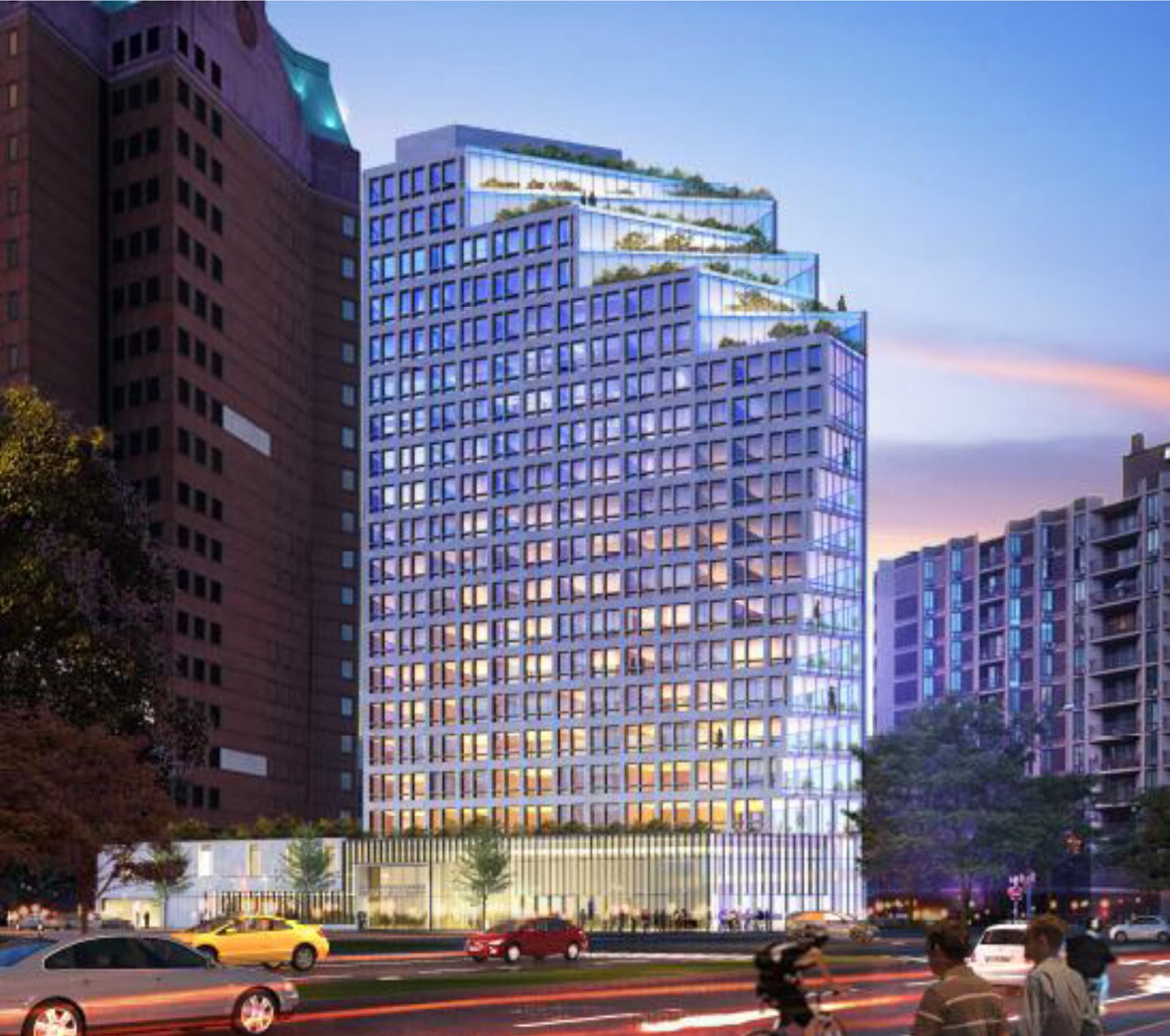
With the identification of the developer we also get to see a new proposed visual for the base of the building housing the
"replacement" library apparently abandoning the visual previously supplied.
 |
| New
version of the building's base (interestingly squoze down) giving a faux impression of being much
like the existing library. Think it's two above-ground floors?
Probably not. Appears to extend all the way to Ratner's One Pierrepont building? Don't press your luck. |
The new visual seems as if it was meant to suggest that the new library, although vastly shrunken, would look, reassuringly, very much like the existing two-floor library, similarly stretching most of the property line along Cadman Plaza West. But don't be deceived: Were the above-ground space of the replacement library arranged as two stories and stretched out that length, it would be the equivalent of a thin laminate onto the base of the new luxury tower, a virtual applique for visual effect, a Hollywood set, a classic Potemkin Village maneuver.
 |
| The existing Brooklyn Heights Library (to be demolished and lost?) actually two stories tall and running about 200 feet, most of the property facing along Cadman Plaza West. |
The proposed
"replacement" library would have just 15,000 square feet of above-ground space, a small fraction of the Brooklyn Heights Library's current above-ground space. It would have another 6,000 feet of space underground. The existing Brooklyn Heights Library also has underground space, far, far more than that, that holds books and though not currently visited by the public, is otherwise available to be put to what the public decides is the best use.
Stretched out as two floors along the Cadman Plaza West side of the space the existing Library building occupies, one can see what a small fraction of the existing building's current above-ground space that amounts to, significantly less than half. The library is giving up most of its above-ground space
before even considering the great deal of underground space we tend to
discount.
 |
| Above- The existing two-story Brooklyn Heights Library overlaid on the real estate parcel (with boundaries indicated) on which it sits. That portion highlighted in brighter orange would be the amount of similar above-ground space the proposed "replacement" library would take up. Hardly enough to be functional, certainly not functional as the central, destination library it has been since it was built. |
 |
| Same as above with a ruler for reference. |
The existing Brooklyn Heights Library is essentially a two-story building with substantial underground space. The is a small amount of square footage on the first floor that has no space over it on the second. There is also some cantilevered space on the second floor with no corresponding ground floor space under it. There is also some third floor mechanical space and stairs that leads up to it.
The visuals above show nothing for the underground space just as you can't see the
underground space (quite voluminous) of the existing building.
 |
| Aerial view of existing library from Bing maps used in the composite image above. |
 |
| Boundaries of the city-owned library property that would be handed off to the developer (Hudson) for the luxury tower with the shrunken library tucked in its base. |
There is another way of looking at the space, rather than consider what a thin laminate it would make along the length of Cadman Plaza West How much space would be retained measuring from the south where the adult reading room and Business and Career section of the library currently are. Doing so (see below) allows for an easy way to describe (see below) space being lost.
If you know the library, you can now see it like the equivalent of giving up:
• The auditorium
• The Computer Center
• The Children's library
• The second floor conference room
• Office areas
• The entrance area
• The main administration desk
• The bathrooms
• The elevators
• The stair areas
OR, if you were looking at it the previous version with the library space arranged as a "laminate," what was being given up was:
• Parts of all the above
• Plus substantial portions of:
• - The public part of the Business and Career Library, and
• - The main public reading room for adults upstairs
The images also make clear how we are giving up the park space sitting area and the landscaped open areas around the library.
%2Bof%2BGreen%2BSpace.jpg) |
| Above you see how much of the area alongside the library on Clinton Street and to the immediate north is publicly owned open landscape that, sold, would disappear along with the library. |
The same space would disappear, replaced by the base of the luxury tower when the library is shrunk. See below.
 |
| 319 feet tall |
Although the intended sale of the Brooklyn Heights Library was not publicly announced until 2013, those making decisions at the Brooklyn Public Library have known for years, since 2007 and perhaps as far back as 2005, that it wanted to effectuate such a sale. For some seemingly inexplicable reason, the charming sitting area and park at north end of the library has been locked and made off-limits to the public for some time. One possible explanation?: The first thing one wants to do when selling off a public asset is to run that asset into the ground and otherwise alienate it from the public's affection. Locking up the park helps to do that.
 |
| Is this park and sitting area kept locked to ensure that the public won't use it, be attached to it and fight for it when the BPL sells it to a developer that will build on top of it? |
Similarly, are there green space areas outside the library that might have been maintained and landscaped with significantly less zeal in recent years (see below) precisely because they want to sell the library off? This is very typical behavior when institutions plan development they hope the public won't oppose. NYU has done it and St. Vincent's was doing it before it went bankrupt in the middle of pursuing its contorted real estate machinations.
.JPG) |
| Maintained with less than appropriate zeal? What about those visiting the library to check out books on botany? |
The BPL recently paid a consultant to tell it that
"economic development" should become part of its mission. If it wants to go into sidelines, why not let those who come to the library wanting to check out books on botany further their interest and learn more by doing some community gardening on the premises.
Would the public be compensated, and adequately so, for the loss of all the library space and the surrounding property?. . .
. . . It is obvious that the BPL knows it has a problem on this score in making representations on two fronts:
• It wants to under-represent what is being sold, and
• It wants to over-represent what it is getting back in return.
Under-representation of what is being sold
In terms of under-representing what is being sold, the BPL attempted an obvious ploy in its press release announcing the sale. It pretended to be selling
less of the library than it actually is by comparing the
total square foot size of the proposed replacement library to the "
square feet in the current branch that are accesible (sic)
to the public." That's hardly an apple-to-apples comparison unless the 100% of the replacement library will be
"square feet" that, unlike the locked park area, are
"accesible" or
"accessible" to "
the public." Heaven knows how the BPL calculated what it didn't consider
"accesible/accessible" to the public. They obviously cut a lot of space out of their consideration as being accessible to the public. Did they exclude auditoriums? Conference rooms where public meetings have been held? Bathrooms? Service desk areas? Stairways? Elevators? Staff offices? Mechanical support areas? Bookshelf space? Any area where books or any other library necessaries are stored? How about entryways, hallways and stairways?
Somehow the library managed to calculate that there are only 28,000 square feet
"accessible to the public." Then the BPL wanted to disregard nearly half of this space because it is space of the Business and Career portion of the library that it
"will move to the Central Library, a more central location" where they are not adding or building any new space to house it. A
"more central location "?: There are 11 colleges in the central business district of Downtown Brooklyn which by virtue of the central mass transit hub upon which it sits is central not only to all of Brooklyn, but residents of Manhattan as well. What's more, because there is no new space being created for it at the Grand Army Plaza Library we may more properly think of the Grand Army Plaza Library as being the place where that Business and Career portion of the existing library goes to disappear.
We now know that the gross price the Brooklyn Public Library will receive from the developer for selling and shrinking the library is $52 million. It is not surprising that this gross price is small given that most of the development rights for the site were transferred out to Forest City Ratner in 1986: Friday, September 20, 2013,
Forest City Ratner As The Development Gatekeeper (And Profit taker) Getting The Benefit As Brooklyn Heights Public Library Is Sold. Ratner still holds some of those development rights unused.
The next problem is that the public doesn't net the already very small gross sales price. The BPL seems quite aware of how very little is being netted because it is estimating that the new much smaller library will cost $10 million to build, an obviously low-balled figure. The sale and shrinkage of the Brooklyn Heights Library is closely modeled on the sale of the Donnell Library, a five-story central destination library in Manhattan sold for a pittance, netting the NYPL far less than its value to the public and less than it would have cost to replace it. It was sold to net the NYPL less than $39 million while the far smaller penthouse apartment in the 50-story building going up on its former site is on the market for $60 million.
Based on the $20 million cost of building the shrunken 28,000 square foot
"replacement" Donnell library (still under construction) the price of building the shrunken 21,000 square foot
"replacement" Brooklyn Heights Library would come to $15 million. The developer's proposal for the library even mimics closely the design for the Donnell Library, that in turn mimics a bookless Japanese library and a Prada store in SoHo. See below:
 |
| Proposal C's Donnell mimicking descending stair-step "flexible" space |
 |
| Library?- The stair-step "flexible" space design to 'replace' Donnell |
 |
| The developer's proposal- A library? |
That $15 million replacement estimate 's is conservative if you believe the cover of the issue of the Real Deal, stacks of which were available for free at Brooklyn Heights Library this week (see below):
"Rising construction prices hit developers."
 |
The Real Deal: "Rising construction prices hit developers." Really?
|
Netting
$15 million out of a
$52 million gross purchase price already leaves only $37 million, but to ascertain whether the public is is coming out ahead or behind on this deal one has to tally up all its costs and everything the public is giving up. So one should actually subtract out the cost of replacing the entire assets being sacrificed to the deal, the cost of replacing the entire Brooklyn Heights Library. Certainly the costs of replacing just the rest of the above-ground portion of the library would be at least another
$20 million. That would leave just
$17 million before netting out any other additional costs
. . . . It also doesn't consider the loss of the rest of the space that is currently underground.
But what must additionally be netted includes:
• The value of the library that the public will miss from the time the existing library is shuttered until the time it is replaced by the new one. The current plan is to have a very small, 8,000 square foot, temporary library for this interim that will be paid for by the developer (essentially as a self-cancelling increment to the purchase price), but, even by the BPL’s own stingy assessment that the “replacement” library should be 21,000 square feet, that leaves the community 13,000 feet shy of having a library even the size of that shrunken library for the entire construction period. The BPL is assuring that the “replacement” library will be supplied in no more than 3 ½ years. In the case of Donnell the “replacement” library was also supposed to be in place in place in no more than 3 ½ years. Donnell closed in spring of 2008, six months sooner than it was supposed to, and its “replacement” will currently not be in place until at least the end of 2015, 7 ½ years later. Construction of the replacement has been repeatedly pushed back without consequence to the developer or recompense to the public although the NYPL had the power to insist on the same. Similarly, government officials have gone out of their way to enforce publicly promulgated and promised time frames for the Atlantic Yards project, something that is virtually impossible to expect when developers have the political upper hand.
• All of the transaction costs associated with selling off the library, including all of the professionals, lawyers, real estate experts, etc., associated with the transaction. This naturally includes the allocable amounts paid to the former Forest City Ratner Vice president who came up with the strategic real estate advice and analysis that the first two libraries the BPL should sell should be this one and another, the Pacific Branch, right next to Forest City Ratner property. The initial payment authorized to be paid to that professional real estate consultant was just a little under $1 million. Amounts paid to consultants should also include amounts paid to consultants and lawyers to deal with community opposition to the sale even if no lawsuit si brought by the community and all such expenditures are prophylactic.
• The cost, including all allocable staff time, of moving the library twice, first into the very small temporary library (and storage for what won’t fit), and then into the new shrunken library.
• The value of the space surrounding the library.
• The value of the light and air the library supplies to the neighborhood. While some may argue for the desirability of the new density to create the luxury condominiums that will tower sufficiently over the surrounding neighborhood to gain a view of the harbor from the upper floors, it should be remembered that the library was built with urban renewal, and that many affordable housing units and commercial properties were demolished with eminent domain on the theory that creation of less density and more light and air was the most desirable thing.
• The historic and landmark value of the library.
What might some of these additional losses to the public amount to?
The 13,000 square feet of library missing during construction. Sephora's is reportedly paying $140 per square foot for its commercial lease down the street, in the Municipal Building, where is is occupying space where the library should likely have been moved (without any ensuing interruption in service) if, with better planning, the library was, indeed to be sold for redevelopment. As a comparable that might seem high, but a real estate comrade I was talking with pointed out that assembling large amounts of space on the edge of Brooklyn Heights and Downtown Brooklyn is difficult, so it is arguable that a premium price might be in order. The 13,000 square feet at $140 would come to
$6.37 million for a 3 1/3 year lease. Arguably, the construction might be completed in less than 3 1/2 years so, with luck, some amount of this could be recouped upon surrendering the lease back to the landlord or some sort of very short sublease, but, because it could not be assured that construction would be completed sooner, it would be necessary to lease the space for the entire 3 1/3 years. There is also another countervailing risk: That rather than the promised 3 1/3 years the actual expense might involve something more like the 7 ½ years it's, so far, taking to replace Donnell.
Total transaction costs. We know that the initial payment to the Forest City Ratner Vice President was close to $1 million. We know that there are many very highly-priced consultants already engaged by the BPL in connection with the library sales, including Booz and Co. We know that high-priced legal talent is expensive. We know that the transaction here is not just a sale, it is also negotiation for new space with plans to build. Would we be conservatively underestimating to expect that all transaction costs would come to at least 10%, or another
$5.2 million?
The cost of two moves. Have you ever moved a business? Experienced the distractions and time it took for staff to plan and figure out where everything is going to go and how it is going to go and be kept track of? The costs are not to be discounted and there are more outside professionals to pay.
The value of the space surrounding the library. There are surely those who don't value green spaces around a dense and growing neighborhood.
Without arguing that point we will simply note how the lyrics of Joni Mitchell’s “
Big Yellow Taxi” acknowledge a world where some people not appreciating the trees and trees and green that they've got act accordingly to replace them with what Ms. Mitchell’s song makes clear that, she at least, values less, paved parking spaces:
They took all the trees
Put 'em in a tree museum *
And they charged the people
A dollar and a half just to see 'em
Don't it always seem to go
That you don't know what you've got
Till it's gone
They paved paradise
And put up a parking lot
Rather than argue the point of how valuable the green may or may not be to the public we'll use Ms. Mitchell’s song as a basis to simplify things by valuing the space around the library at what Ms. Mitchell values less:
parking spaces. In fact, some of the space around the library is now currently used for parking.
.JPG) |
| Sunday, the library sadly closed, a lone care pulls in to take advantage of the space |
The space around the library might, if used entirely for parking, provide maybe about nineteen parking spaces. See below:
What are parking spaces worth in New York City? There are actual market figures on this.
In the summer of 2007 parking spaces were reported to
be worth almost a quarter of a million dollars,
$225,000. Prices may have gone up with the New York Times reporting a parking space purchase of
"$250,000 a tire" or
$1 million. See:
Buy Condo, Then Add Parking Spot for $1 Million, by Michelle Higgins September 9, 2014.
To be fair, this was one transaction
"at Broome and Crosby Streets, itself the former site of a parking lot" and the Times supplied other figures, another Manhattan transaction where spaces were listed for a half million and a Boston space for $560,000 and a London space for $565,859. It reports that the past year the average price throughout Manhattan has been $136,052.
Nineteen parking spaces at that average Manhattan price would come to about $2.6 million, but if it is assumed that the border of Brooklyn Heights and Downtown Brooklyn is a relatively premium neighborhood and that the value of a parking space, albeit outdoors, ought to be around $260,000, then the value of nineteen spaces ought to come to around
$4.94 million. Of course we don't know if this would make Joni Mitchell happy.
 |
| 319 feet tall- But how much taller? |
The value of the light and air the library supplies to the neighborhood. We probably have already arrived at an appreciable net negative, the public suffering a loss if this proposed transaction is implemented, without attributing any further additional loss to the light and air that will be sacrificed if a luxury tower is built, but it is difficult to calculate the value of lost light and air because no version of any of the possible proposed developments showed a project with
all the development rights that are available being used. See: Monday, December 16, 2013,
Tall Stories- Buildings Proposed To Shrink The Brooklyn Heights Library: Brooklyn Public Library Publishes Seven Luxury Building Proposals To Shrink Away Brooklyn Heights Library.
 |
| The value of light and air? |
The historic and landmark value of the library. The current library is at least the second most important library in the BPL system, one that everybody in the borough knows, and the building was designed by by
Francis Keally,
the same man who designed the Grand Army Plaza Library, the other Brooklyn library that almost everybody knows. Keally was a
former president of the once-venerable Municipal Arts Society and a head
of the New York chapter of the AIA. One might consider how nice it is that these two well-designed buildings go together providing stature and thematic linkage.
Repairs? Are we forgetting something? Aren't there calculations that say that the current library needs repair, perhaps $9 million? Should these amounts be treated be weighed in favor of shrinking the library since the replacement library would theoretically not need repair when built? The BPL would argue this to be the case, but it should only be done if you believe the BPL's inflated estimates and to do so you would have to disregard that the BPL's own board meeting minutes indicate that the estimates were worked on by a former Forest City Ratner Vice President specifically with the goal that they become a convincing argument to sell the library. The BPL's calculations for the Brooklyn Heights library are clearly intentionally inflated.
The BPL has been playing with its figures respecting the capital repairs it says it needs in its system's and which it argues are a reason for selling and shrinking libraries. Often it rounds up the figure stated for the public to $300 million in what it will say are "necessary repairs." Other times, pinned down to be more specific, they BPL gives a lower figure,
$280 million and uses the weasel words "unmet repairs" allowing for more exaggeration. In any event, these figures didn't exist at all until the BPL launched its plans for real estate deals and started building them up with deferrals while scouting for additional expenses to add into the its pretextual mix.
 |
| The developer's proposal as summarized in the materials previously furnished by the BPL about the proposals it received |
114 "Affordable Housing" Units? What about the announcement that the developer will also build
"114 off-site affordable housing units" somewhere else within the boundaries of Brooklyn Community Board 2, perhaps by the Brooklyn Navy Yard.
That involves a whole other set of calculations. Those units will be subsidized with government funds that could be used for other "affordable housing" and purposes other than dismantling a library that all Brooklynites need and
evicting them from an increasingly wealthy and exclusive Downtown.
"Reaction" of Brooklyn Heights Association
The Brooklyn Heights Association's behavior respecting the issue of the library has been very unbecoming. Theoretically the protector of the neighborhood it has, instead,
explicitly condoned the sale and shrinkage of the library, giving the BPL cover to sell it off. The BHA has now
“reacted” specifically to this proposal that has been before it since the beginning of last December. Its reaction at this late date bespeaks a certain amount of play-acting as they express
“concern and cautious optimism.” The expression of
“concern” is offered seemingly to certify that they are looking out for the community (which few at this point believe) and the
“cautious optimism” comes as their first step toward further promotion of the sale. See:
BHA Speaks Out on Brooklyn Heights Library with "Concern and Cautious Optimism", By Homer Fink on October 4, 2014 and
OPINION: BHA responds to Heights Library redevelopment plan, From the Brooklyn Heights Association's website
The BHA’s
“reaction” is mostly a very mild stab at an aesthetic critique with a pretext that there is an open process going on about issues (i.e. they hoped “
the developers and BPL trustees will take the time to re-evaluate their design, and engage in an open process with the broader library”):
. . . what we are seeing is a clunky condominium sitting atop generic retail space. We want to see a distinctive and welcoming public building that provides a graceful transition from the civic buildings on Cadman Plaza to the residences of Brooklyn Heights — a library that is a visual gateway to the neighborhood.
The two most substantive aspects of the BHA’s reaction are both dangerously clumsy on their part.
 |
| How far away from Brooklyn Heights and the downtown area might the "affordable" units be built? The boundaries of Brooklyn's Community Board 2 range far. |
They unfortunately seem a little too pleased that the affordable units for lower income tenants will not be in the building and thus likely outside of the neighborhood as well:
The off-site affordable housing, which must be within Community District 2 boundaries, will allow for a less bulky building on this constricted site.
The second clumsily taken substantive position?: Like the proverbial broken clock that manages occasionally to be right the BHA observes:
The decision to assign considerable square footage to an exclusive private school gymnasium does not reflect the inclusive mission of our public library system.
The BHA is
right that it should
not be within the mission of the library to benefit a private school by selling and shrinking libraries just as it should
not be within the mission of the library system to do so to benefit a private developer, both of which are happening here. More simply, it should
not be the mission of the library to be engaged in
“economic development” notwithstanding the fact that the library hired a consultant from Philadelphia to tell it that its mission should be expanded to include
“economic development” in which case there could be odd arguments made for a library system to sell and shrink libraries and eliminate books and librarians.
The BHA is
wrong, however, in its apparent background supposition that the gymnasium for the Saint Ann’s School was a benefit that the city or the BPL negotiated to exchange the library for, with the thought that it might now be possible to figuratively come back with receipt in hand to exchange the gymnasium for something else:
Moreover, the project can and should address broader community priorities. . . . Community or public school space is called for in lieu of a private school gym.
It might be pure doltishness on the BHA’s part to think the library was traded for a gymnasium, or perhaps this is a cynical ploy to make it look like the BHA is negotiating for something it knows it won’t obtain. The fact is that Saint Ann’s is getting a gymnasium isn't because the city or the BPL negotiated for that. Saint Ann’s is getting a gymnasium because it is selling its development rights by joining in the same zoning lot with Forest City Ratner and library property. By selling and shrinking the library the city makes it possible for Saint Ann’s to negotiate that benefit for itself, but Saint Ann’s is not going to sell its privately owned development rights for
“community or public school space.” Does the BHA really understand so little about this transaction that is affecting the Brooklyn Heights neighborhood so significantly?
More About Private School Saint Ann’s Interest in the Transaction
What is true is that
private benefit that Saint Ann’s is getting by virtue of this transaction means that the
private school is likely to push for the
public library to be sold and shrunk just as the
private condominium developer undoubtedly wants the same thing to happen. The question is whether they will have the upper hand when dealing with our
public officials, because this transaction can only happen if those public officials, including our City Council and Mayor de Blasio, allow it to proceed.
Monday afternoon at 4:30 the Saint Ann’s faculty was treated to an hour-long PowerPoint presentation explaining how the library sale would benefit Saint Ann’s.
 |
| At the top right of the PowerPoint, the library property labeled as the BPL's, with arrows indicating what is going to be switched around where. |
Getting involved in these real estate transactions apparently has Saint Ann's thinking in bigger and broader terms with other interrelated real estate projects and renovations planned as funds flow in. During the PowerPoint presentation a pie chart was shown of some of the funds involved (below). What exactly is Saint Ann’s thinking? Maybe they'll say if asked.
 |
| The entire
block, Ratner Property highlighted, showing what, with Ratner
cooperation, could be treated as a single merged zoning lot to transfer
development rights from Saint Ann's School to the library site |
 |
| Above, Saint
Ann School building with development rights that are not yet utilized.
Ratner property is in the background, literally (and metaphorically?) |
Perhaps the best way to end this article is with a gallery of more pictures so that people will better understand (
see below) what stands to be lost if the Brooklyn Heights library is sold and shrunk. Or maybe it would be best to note that
Citizens Defending Libraries (of which I am a co-founder) has launched a Citizens Audit and Investigation of the details concerning the Brooklyn Public Library's secretive and strange pursuit, going back to around 2005, of converting all of Brooklyn's libraries into real estate transactions that will shrink them diminishing the respect for and availability books and librarians and the core missions of a library system. See (last accessed 10/7/2014): Press Release:
Citizens Audit and Investigation of Brooklyn Public Library- FOIL Requests and
PHOTO & VIDEO GALLERY: September 16, 2014 Rally Outside BPL Trustees Meeting- BPL Trustees Vote To Hand Off Brooklyn Heights Library To Hudson Co. As Developer.
 |
| In essence, the proposal is to shrink the library to the equivalent size of just two rooms like this Business and Career Library space from which would have to be subtracted all entryway, administrative, bathroom, stairway and elevator space. |
 |
| Adult reading room on the second floor over the Business and Career section of the library. |
.JPG) |
| Is the public likely to feel more privileged with second floors window to look out as it has now rather than any additional space being stuck in the basement? |
 |
| Computer room- Excess space? |
 |
| The normally full children's room, right before closing, on a day just after the Library has again changed its hours ensuring confusion about when it's open and what routines will work when you plan your visits |
 |
| Useless hallway space? Where you can wait for an elevator or congregate waiting for friends, take in an exhibit in this space that graciously transitions from one room to another, buffering sound . . . |
 |
| I am presently missing pictures that show the frequently used auditorium in its full glory, but this picture from the Brooklyn Eagle is from the night that the auditorium was used to announce this as the first public disclosure of plans to sell and shrink a Brooklyn public library. The community was not happy. (The auditorium was used for primary voting this last election.) |
 |
| Here, also from the Brooklyn Eagle, a photograph of Deborah Hallen using the auditorium to ceremonially display for the record a proclamation by Borough President Marty Markowitz honoring the work of the “Friends of Brooklyn Heights Branch Library" which was then , and now, a lead collaborator in pushing forward the proposed sale and shrinkage of the library. |



%2Bof%2Bphoto(669).JPG)

%2Bof%2BSaint%2BAnn%2BPresnetation.jpg)


