Thursday, July 19, 2012

“Barclays” Center Opening Pending, Will Empire State Development Sue Barclays Bank?: ESD Says The Question Is Being Reviewed By ESD Counsel’s Office

As previously covered here, Baltimore and a number of other municipal governments are suing Barclays Bank in connection with its LIBOR benchmark interest manipulations. (See: Saturday, July 14, 2012, Will The Empire State Development Corporation (ESD), The MTA, NYC And New York State Sue Barclays Bank?) It therefore seemed logical for me to wonder whether the state’s Empire State Development agency and other state and local governments in New York would also similarly be suing Barclays. Contacting the MTA I found the agency already had on hand a prepared statement to the effect that its legal counsel was reviewing and would vigorously pursue its legal options in this regard:
“The MTA has asked its legal counsel to review its options in relation to the LIBOR scandal, and will vigorously pursue all available legal actions. We are outraged about the apparent market manipulation, and will always do everything possible to protect the MTA.”
(See: Tuesday, July 17, 2012, Will The MTA Sue Barclays Bank Over LIBOR Rate Manipulation Scandal? MTA Says It Will “Vigorously Pursue All Available Legal Actions”.)

In addition, the New York State Attorney General's office is conducting an investigation into the manipulations’ financial harm to New York. That investigation is currently being conducted jointly with Connecticut’s attorney general with the AG’s office confirming that the “joint investigation could soon spread to other states.” (See: New York AG probing LIBOR scandal: Eric Schneiderman's investigation could reveal whether banks violated state anti-trust and fraud laws by manipulating the London Interbank Offered Rate, by Shane Dixon Kavanaugh, July 16, 2012.)

New York Attorney General Schneiderman’s office has released a statement that says:
“Working together, the New York and Connecticut attorneys general have been looking into these issues for over six months and will continue to follow the facts wherever they may lead.”
The above quoted Crain’s article echos my previous columns about Barclays' potential liability, saying the implicated financial institutions could be “on the hook for hundreds of billions of dollars.”

(* Matt Taibbi says that the “scale is just mind-boggling. Every town and municipality in America probably has investment holdings that are pegged to LIBOR. I think The Wall Street Journal calculated $800 trillion of financial products.” $800 trillion of loans and derivatives worldwide was the figure being used in NPR coverage yesterday.)

The Attorney General’s investigation and assessment of “whether New York suffered losses from the alleged rate-rigging scheme by banks” must mean that it is talking with all affected city and state financial agencies. They would have to be in such communication in order to be effective in answering the questions that need to be asked. I’ve contacted the Attorney General’s office with a media inquiry to confirm this but they have so far avoided getting back to me. I won’t take it personally as the Crains’ article indicates that the office also avoided getting back to Crains.

This gets me back to the original question: Is ESD, the state agency that financed the “Barclays” Center (the Ratner/Prokhorov basketball arena), going to be among the growing list of government entities that sue Barclays?

ESD’s press office confirmed to me that the question is in fact “being reviewed by our counsel’s office.” In other words, in that respect they are like the MTA.

I also asked whether ESD would, alongside the MTA, confirm:
• That ESD is similarly outraged about the apparent market manipulation.

and

• That ESD is similarly committed to do everything possible to protect ESD.
The press office’s response was that ESD “cannot comment further at this time.”

Given the pending opening of the Ratner/Prokhorov “Barclays Center” which will involve a lot of hoopla and PR playing up the Barclays name it is clear why ESD is naturally loath to excoriate the Barclay Bank at this time. ESD probably also has plenty of reason to hope that the “Barclays” is somehow is exonerated or that the bank gets off lightly in terms of the PR price it pays. Is it unfair to think that such hopes would have any possible effect on the vigor with which ESD might pursue this matter or affect the timing of its actions so that any actions ESD takes against Barclays does not coincide with the grand opening of the arena with that name that ESD itself financed?

It must certainly come up in the conversations about the implications of ESD’s actions, as I pointed out in a fly-on-the-wall (wouldn’t you love to be?) comment in my first post on this subject, speculating about the meetings that senior management and counsel at the affected government agencies must be having as they consider their obligations to recover losses for New York taxpayers.

A reader suggested to me that for clarity’s sake I reiterate from my first column the many ways that Barclays may be legally liable to the government financing agencies for the bank's rate manipulations. I am repeating from that column the bullets below. As you review them you see the importance of affirmative good faith assistance from an agency like ESD in order for investigations like the Attorney General’s to be fully effective. (This list is only a starter list):
• The financing agencies may have invested in bank instruments that paid them a lower rate of interest.

• The rate that the agencies received from developers paying loans may have been dragged artificially low.

• The agencies themselves may have paid lower interest rates on their own municipal bond obligations, but even if this was superficially to their benefit it may now make them liable to their bondholders and when sued by those bondholders they may have to legally implead (i.e. sue, or cross sue) Barclays as a result.

• Financial transactions are sufficiently complex these days so that it takes a fair amount of unraveling before all the implications of a manipulation like this can be fully assessed in terms of Barclays likely liability to the government agencies. For instance, even if the rate an agency itself was obligated to pay on its own bonds might have been lowered by Barclays shenanigans the agency (or maybe developers the agencies were assisting) might have ventured into the questionable risk of rate-swapping agreements whereby the net result was a more significant injury.
I have been in touch with other New York government agencies about whether they will be suing Barclays. I will report on my communications with the State Comptrollers Office and the City Comptrollers Office in a follow-up article: I still have some outstanding questions for which I am seeking answers.

One other agency from which I did receive a response of sorts is the New York City Housing Development Corporation. HDC is planning to issue more bonds to finance Forest City Ratner’s proposed Atlantic Yards mega-monopoly (approximately $92 million additional bonds plus providing significant additional subsidy in an unspecified amount) for a building that will structurally and reputationally be a part of the “Barclays” arena. Yesterday, at HDC’s hearing about whether to issue those bonds I testified that before making its decision about issuing such bonds the HDC board should be thoroughly informed about “all the possible lawsuits against Barclays that may or will be brought by HDC and other agencies.” The HDC board includes* the city’s Director of the Budget and Commissioner of Finance. These city officials, though appointed by Mayor Bloomberg, a friend of the banking community, should care about these things.

(* The City Comptroller, John C. Liu, is not on the board but should have jurisdictional review powers he may want to exercise in this regard.)

Will HDC's legal counsel review and vigorously pursue its legal options in relation to the LIBOR scandal like the MTA ‘s? Will it be reviewing the question like ESD’s counsel? The response from HDC Press Secretary Eric Bederman when I made inquiry specifically in reference to the hearing, prior thereto:
“HDC declines to comment on these issues at this time.”
One would certainly hope that HDC would not shirk its responsibilities to protect the taxpayers merely because it would generate bad PR in connection with a Bloomberg-supported building it is financing.

This next building for which tax-empt bonds are proposed to be issued together with the adjoining “Barclays” arena itself and all of the proposed Atlantic Yards are being financed by the coordinated efforts of the ESD, the MTA, and HDC (plus a lot of money from the city itself). I suppose that to be assured that two out of three of these financing agencies are looking at the question of suing Barclays Bank to recover losses from the LIBOR rate manipulation is pretty good. Let’s see how things stand the day of opening ceremonies for the Ratner/Prokhorov “Barclays” arena.

Wednesday, July 18, 2012

Noticing New York's Hearing Testimony Re New York City Housing Development Corporation's Subsidization of Ratner's Atlantic Yards Mega-Monopoly

(Above, a collection of government officials, present to listen to testimony, just before the HDC hearing.)

The New York City Housing Development Corporation held an important hearing today on its proposed very substantial subsidization of Forest City Ratner's Atlantic Yards mega-monopoly. Here is Noticing New York's testimony.

* * * *

July 18, 2012

New York City Housing Development Corporation
110 William Street
New York, NY 10038

Re: HDC’s proposed issuance of up to $91.96 Million in tax-exempt bonds to (plus award of accompanying additional subsidy) to fund Building 2 (461 Dean Street in Brooklyn) of Forest City Ratner’s proposed no-bid, eminent domain-abusing Atlantic Yards mega-monopoly


Dear New York City Housing Development Corporation,

The following is Noticing New York’s testimony respecting the proposed issuance of tax-exempt bonds for the above mega-monopoly.

Here are changes that should be made to the federal law under which tax-exempt bonds are permitted to be issued:
No issuance of tax-empt bonds should be permitted for a project that has been brought about by the abuse of eminent domain. The U.S. Supreme Court’s Kelo decision is one of the most unpopular of all its recent decisions (perhaps even ranking above the Citizens United decision). A huge preponderance of the American public strong disagree with it. States around the nation have passed enactments to circumscribe its implications. Even so, there are agencies like this one who would consider using federal taxpayer subsidies to finance such abuse. And the developer-driven abuse that occurred with respect to Atlantic Yards exceeds and was not even likely to have been permitted under Kelo. Unfortunately, the court did not take up the case to rule directly on this. Even as a local matter New Yorkers do not favor such abuse. In 1967 there was an attempt to amend the New York State Constitution to permit eminent domain-abusing projects like Atlantic Yards. The voters rejected it and the New York’s Constitution was never altered to make such a change.

No bond proceeds should be permitted to fund projects that were not subject to competitive bid. Projects which are not the subject of competitive bid waste public funds and subsidy, breed crony capitalism and destroy democracy.

Tax-exempt bonds should not be permitted to fund government creation or building up of private monopolies. Monopolies stultify development. They are antithetical to it because true development must partake of a diverse, richly dynamic environment of interacting elements and competitive testing of the best adaptations. Monopolies suppress development opportunities. Furthermore, in the words of Jane Jacobs: “Monopolies established by cronyism and strong-arm methods, along with pervasive extortion and corruption, falsify actual costs” [shall we note they falsify benefits as well?] Enterprises “prefer eliminating competition to competing with . . prices, quality and service.” Tax-exempt bonds are supposed to be issued by “development” agencies to foster development, not suppress it. Government officials shouldn’t replace economic ecosystems with a single privileged crony.
Why should all this be law? Because if these were provisions of federal law tax-empt bonds could not be issued for this project.

These provisions are not yet specifically part of the federal law. What is part of the federal law is that before this agency issues any tax-empt bonds it has to have this hearing so that politicians and legislators, being informed, will be forced to take accountability for doing anything as ill-advised as I have just suggested should be prohibited. If stupid things are then done despite cautions received at a hearing the laws governing the issuance of tax-exempt bonds may then be changed.

I request that HDC inform all legislators and politicians receiving a record of this hearing or inquiring about it that these recommendations were made at this hearing and that HDC further inform them that it is my recommendation any changes to the federal law enacting such restrictions should include provisions making them retroactive, by which I mean that any bonds issued ignoring the principles of these recommendations will retroactively reduce the amount of available tax-empt bond cap available to New York City and New York State. If HDC is going to use its tax-empt bond cap frivolously for a bad project the just and proper result is to take that bond cap away.

Public Agencies and Government Suing Barclays. The building for which HDC is considering issuing tax-exempt bonds will share walls and infrastructure with the Ratner/Prokhorov arena now promoting the name “Barclays.” HDC likely has cause to sue Barclays Bank over its LIBOR rate manipulation scandal. Baltimore and other municipalities in the nation are already suing Barclays. The MTA, another agency involved in the financing of this same Atlantic Yards project coordinating with HDC, has publicly stated that its legal counsel is looking at the Barclays scandal and that it will vigorously pursue “all available legal actions” to protect the MTA. HDC has been unresponsive to my inquiries about whether HDC is similarly looking at suing Barclays. My understanding is that the Barclays matter is under investigation by the State Attorney General. I presume that any presentation to the HDC board about financing this project will include in-depth information about all the possible lawsuits against Barclays that may or will be brought by HDC and other agencies. I believe that the public is also entitled to an outline of what gets described to the HDC board in this regard.

Lack of a Valid Environmental Impact Statement. The Atlantic Yards project is a project for which there is no valid Environmental Impact Statement. That has been judicially determined. This is bad not just because a proper environmental review has never been done: It is bad because the reason it hasn’t been done is that a proper review was sidestepped by fraudulent subterfuge by the developer in connection with which now-chastised government officials colluded. Whether or not there is a legal nicety by which HDC may reason this building can be financed without a proper environmental review it would not be appropriate to do so.

Character of the Developer and Prospective Project Owners. HDC needs to do its “bad apples” review of whether this developer (and prospective property owner) is suitable for the special privilege of receiving HDC financing and subsidy. Forest City Ratner is at the hub of many spokes in a wheel of indictments and various forms of bad conduct. There was the Forest City Ratner Ridge Hill prosecution, Senator Kruger’s prosecution, the recent State Attorney General Investigation resulting in a settlement concerning illegal New York City lobbying activity in connection with development that should have also have included the substantially similar activities in this vein respecting Atlantic Yards. It is not necessary for there to be an indictment or conviction of a developer for an agency to conclude that a developer is an unworthy and untrustworthy recipient of agency subsidy. A pattern of bad conduct and bad behavior and unsavory colleagues is entirely sufficient. And, Forest City Ratner’s pattern of broken promises and subterfuges is also enough.

Mikhail Prokhorov and Chinese Millionaire Investors, Prospective Owners. When HDC does its “bad apple” character reviews it will also have to look at the other prospective owners under the documents. That includes looking at the activities and conduct of Russian oligarch Mikhail Prokhorov and there are also nearly 500 Chinese millionaires expecting to get green cards by virtue of Ratner’s laughable manipulation of the federal EB-5 immigration program. This project has been put up as security for those Chinese millionaires. Thus they can become owners of the project without further HDC approval, or if HDC thinks it has a right to approve them first then those millionaires don’t have the security interest they believe Ratner promised them. The likelihood of such a foreclosure of the Chinese security interest is all the more likely given what may flow from Ratner’s recent loss of the environmental lawsuit: a required consideration of taking the Atlantic Yards mega-monopoly away from Ratner to break it up amongst multiple developers.

HDC Discretion To Reject This Project. The reason this hearing is being held is because the HDC board has discretion which it is supposed to exercise. That discretion should be exercised to reject this project. Approval of this project should not be treated as a forgone conclusion. If the board has any fears that it lacks discretion to turn down this project that feeling that its options have been constrained would highlight significantly the very reasons the cord with this developer should be cut.

HDC Has Already Financed a Forest City Ratner Project. Some HDC board members may reason that they cannot now turn down this project because HDC financed a Ratner project once in the past. Not so. In fact, the bad behavior developer engaged in respecting the HDC-financed building, now known as 8 Spruce Street, should be grounds for HDC to turn down this project. In two blackmailing episodes the developer engaged in behavior that should have chagrined HDC. It blackmailed the local community board for additional subsidy and it also stopped construction on the building, blackmailing the construction unions. Both of these incidents, particularly the latter, should have been considered threats to HDC as well. For HDC to proceed with an approval of this financing after that behavior would constitute HDC’s endorsement of such blackmailing techniques, techniques which are actually typical of the developer and facilitated by its continuing monopoly on development which government, including HDC, should now act to end.

Modular Construction As Broken Jobs Promise To The Unions. There is a possibility of this building’s modular construction, pushing the technological envelope. If not risky, the broken promises to the construction unions this represents are emblematic of how the Forest City Ratner dishonestly ignores commitments respecting its mega-project. Ratner was planning its double-cross of the unions even as he was sharing the stage at the arena opening with union representatives he was praising for their support. I am not arguing that the Ratner promise to the unions is one that needs to be honored. The unions when they supported this project did not look out for the interests of the community and consequently supported an out-of-scale project of very poor design that was detrimental to the community in many ways. Still this promise-breaking should be noted as part of an overall pattern of promises never intended to be kept even as they are made.

This Project Is Immoral. Financing this project is immoral. This project is immoral because tax-exempt bonds and subsidies should not be used to reward, buttress and facilitate eminent domain abuse, crony capitalism, government-sponsored monopoly building and grossly out-of-scale development. But that is not the whole of it.

HDC is comprised of government officials who are supposed to be acting as guardians of the public trust. This hearing is required with that notion in mind. Government officials cannot act to protect the public, they actually lose the ability to do so, if they don’t have bargaining power. Government officials won’t have any bargaining power unless the Ratner monopoly is broken up. The design of this project as a monopoly (and we will remember all the project design came entirely from Ratner) is intended to thwart public agency bargaining power. HDC’s approval of this project would buy into that construct of an intentionally emasculated government by furthering Ratner’s monopoly when HDC has discretion to reject it instead.

HDC should reject this project and allow it to fail. The Atlantic Yards development can and should be taken away from the developer and broken up and distributed among multiple developers. That way the public and agencies like HDC acting as guardians can have some bargaining power and influence over the project as it is developed. That way the community's better UNITY plan (which calls for multiple developers) can be implement and respected.

Assemblyman Hakeem Jeffries has described Atlantic Yards as being presented to the community as a “field of dreams” with the reality delivered being a “graveyard of broken promises.” It isn’t really important which local politician we ascribe such an insight to because they all see it. What is important is to realize that the entire mega-project is fabricated on a foundation of false promises from which Ratner blithely and routinely expects to escape accountability and there can be no reasonable expectation of enforcing delivery of any true benefits from Ratner while Ratner still has the upper hand in a monopoly situation. HDC should have learned a microcosmic version of this lesson in connection with the Spruce Street project.

Scarce Subsidy Delivered to Ratner Is Misdirected. Delivery of scarce-resource subsidy to Forest City Ratner for out-of-scale development hogs and misdirects subsidy that could and should be better used elsewhere, including smaller developers and not-for-profits with a better chance of it benefitting minority developers.

HDC needs to pay attention to the unhappy saga of abuse. None of us has amnesia about Ratner’s misdeeds and we are not about to get it.

They say that Atlantic Yards meant development?

Well, it’s just not so. . .

And it’s so NOT just.
It meant: Tearing down new construction and valuable historic buildings the community planned to preserve, leaving vacant lots for decades, halting the economic activity construction because it was competing with Ratner in his own backyard.

They say that Atlantic Yards meant good government? Good procedures, protections for the community, considered carefully weighed decisions. Good government?

Well, it’s just not so. . .

And it’s so NOT just.
It meant falsifying findings to declare this area was blighted. (Even Senator Schumer, a supporter of this project, said that this area, close to his home, where he bicycled, was not blighted,) This project was about illegally giving a mega-development monopoly to Bruce Ratner, over 50 acres of Brooklyn, 30 of them contiguous acres around Atlantic Yards. This was about corrupt courts and agencies rigging the delivery of a wish list of special benefits to a politically-connected developer.

They say that Atlantic Yards meant creating an affordable housing environment?


Well, it’s just not so. . .


And it’s so NOT just.
It meant tearing down housing that was truly affordable to the neediest, luxury condos, and housing the market was providing for anyway, setting up a Ratner sink-hole to beg for housing subsidies- preventing those subsidies from being used elsewhere and where most needed, Ratner only giving back the minimum that those federal (and local) subsidies always require, not a jot or a tittle more, and it means vacant lots.

They say that Atlantic Yards meant jobs and employment?

Well, it’s just not so. . .

And it’s so NOT just.
It meant evicting businesses that were providing jobs, fake Ratner “jobs” programs- Deceptions where people even worked for free, strung along by false hope, sidestepping the creation of jobs with cheap, possibly dangerous modular construction, fluffed-up incredibly inaccurate jobs figures, minority and community job promises not meant to be monitored.

They say that Atlantic Yards meant public investment.

Well, it’s just not so. . .


And it’s so NOT just.
It meant a net negative loss to the public of hundreds of millions of dollars, public subsidies of $2 to $3 billion dollars, including diverted taxes that won’t be paid and will go instead to pay for things like the Ratner/Prokhorov private arena. It means property given to Ratner lying fallow and vacant and off the tax rolls.

They say that Atlantic Yards meant providing what the community wanted and community empowerment.

Well, it’s just not so. . .

And it’s so NOT just.
It meant fake community organizations, secretly paid for by Ratner, fake community benefit agreements intended as eye-wash and diversions designed to be unenforceable. It meant a developer’s efforts to divide and bamboozle the community, to incapacitate its leadership and strip its people of their power.
I could go on. Ratner was going to create good design and green space? No, it meant super density spot-zoned for Ratner’s special benefit, an arena tightly crammed in amongst brownstones, the seizing and privatizing of public streets, sidewalks and avenues, project-design bait-and switches with (largely theoretical) “green spaces” being ditched in the process.

I could go on, and on, etc. The question is whether HDC will go on with a inexcusable endorsement of this destruction and betrayal?

Sincerely,


Michael D. D. White

PS: Video of a portion of this testimony (below) is available here on YouTube.


Note: This post was updated as of 7/19/2010 to include additional supporting hyperlinks.

Tuesday, July 17, 2012

Will The MTA Sue Barclays Bank Over LIBOR Rate Manipulation Scandal? MTA Says It Will “Vigorously Pursue All Available Legal Actions”

In follow-up to my story* about which state and city agencies and governments will possibly be suing Barclays Bank in connection with the LIBOR interest rate manipulation scandal and mentioning a long list that are possibilities it is interesting to note that, when contacted, the MTA being on the ball had already given some thought to this subject, enough to have a statement prepared and ready in advance.

(* See: Saturday, July 14, 2012, Will The Empire State Development Corporation (ESD), The MTA, NYC And New York State Sue Barclays Bank?)

Here is the MTA’s comment from MTA Media Liaison Aaron Donovan:
“The MTA has asked its legal counsel to review its options in relation to the LIBOR scandal, and will vigorously pursue all available legal actions. We are outraged about the apparent market manipulation, and will always do everything possible to protect the MTA.”
I have asked the MTA a series of follow-up questions, mostly susceptible to simple YES/NO responses. I will supply readers with the MTA’s response as soon as appropriate. If you want more information about why the MTA and other New York governments might be suing Barclays(like Baltimore and other municipalities around the nation are) for its fraudulent rate manipulation it is spelled out in bullet points in my prior article on this subject.

But there is irony here: As I noted in my original article:
If the MTA sues Barclays it will be suing the bank for which it decided it should name two major New York City subway system stations in Brooklyn (virtually for free, agreeing to take back on the public’s behalf a paltry below-market “$200,000 per year,” a shameful deal locked in for twenty years).
I have also made similar inquiries to other government agencies which probably have reason to sue Barclays (there are quite a few) and am in the process of putting these inquiries to still more. One agency that has yet to provide any response is the New York City Housing Development Corporation (HDC) which, tomorrow, Wednesday at 1:00 PM, is holding a hearing on the first issuance of bonds for the Atlantic Yards mega-monopoly since the issuance of bonds for the Ratner/Prokhorov (“Barclays”) basketball arena. A prompt response from HDC would surely be relevant to that hearing. The Hearing is at 110 William Street. For more information click on the link.

Is HDC, like the MTA, looking at vigorously pursuing “all available legal actions” against Barclays to protect HDC and New York taxpayers? As noted in my prior article, HDC is looking at issuing tax exempt bonds for a building that will, after all, share walls and infrastructure with the Ratner/Prokhorov “Barclays” arena. Should we also say that it will share reputation or disrepute with the arena?

The HDC hearing tomorrow is a key event for one of the few discretionary governmental approvals being exercised for the Atlantic Yards megadevelopment and an important precedent-setting moment. The Barclays arena bonds were relatively unique but this will be the first set of bonds (with a sizable accompanying amount of new subsidy for Ratner) for the entire rest of the mega-project, going a long way to set the precedent for any and all remaining discretionary approvals yet to come.

Saturday, July 14, 2012

Will The Empire State Development Corporation (ESD), The MTA, NYC And New York State Sue Barclays Bank?

Baltimore is suing Barclays Bank!* The Barclays LIBOR lying scandal is big stuff. The LIBOR rate that Barclays was manipulating (LIBOR stands for”London interbank offered rate”) is such a critically important universally resorted to benchmark rate that there is scarcely a man, woman or entity in the world that was unaffected by the rates that Barclays manipulated. For some people it might be good when interest rates go down (or are manipulated in that direction) but there is always someone on the other side of any such equation (pensioners for example) for whom it is correspondingly bad. And if rates get manipulated up instead the same thing is true vice versa.

(* See also: Baltimore city is among many suing big banks over allegations of rate-rigging For small investors, this could be the scandal that finally breaks their trust, July 09, 2012, By Eileen Ambrose, The Baltimore Sun.)

So here is a tantalizing irony to mull over: Will New York’s Empire State Development agency ("ESD," formerly the Empire State Development Corporation- its name keeps changing to protect the. . .? ) choose to get in line behind the city of Baltimore to sue Barclays? ESD should have a legal cause of action against Barclays given that the ESD is a state finance agency involved in a great volume of complicated financial transactions in which the LIBOR rates must have been key. If ESDC sues Barclays it will be suing the bank whose name has been plastered on the ESD-sponsored Ratner/Prokhorov Nets basketball arena effected by ESD through eminent domain abuse and false-fact environmental reviews. “EMPIRE STATE DEVELOPMENT AGENCY SUES BARCLAYS!”: What a headline!

In fact ESD is not the only municipal government entity that needs to give serious thought to suing Barclays: The Metropolitan Transportation Agency, the City of New York, the State of New York, the New City Housing Development Corporation (about to consider issuing tax exempt bond for a building that will share party walls and infrastructure with the Ratner/Prokhorov “Barclays” arena- HDC public hearing to take public comment at 1:00 PM on the July 18th), the city’s Department of Housing Development and many other state and city agencies including both the city and state pension systems are all financing and investment agencies that probably have more than adequate, various and multiple reasons to sue Barclays over the manipulated rates.

If the MTA sues Barclays it will be suing the bank for which it decided it should name two major New York City subway system stations in Brooklyn (virtually for free, agreeing to take back on the public’s behalf a paltry below-market “$200,000 per year,” a shameful deal locked in for twenty years).

If the City of New York sues it will be suing the bank the has put its name on a project to which the city has given hundreds of millions of dollars plus a multitude of freebies and free passes despite the fact that the arena will constitute a huge net loss for the public.

If New York State sues Barclays it would be pretty much the same as ESD suing Barclays since everything that ESD has done to sponsor the Ratner/Prokhorov nominally “Barclays” arena has theoretically been on behalf of the state.

There are all sorts of ways that Barclays may be legally liable to the government financing agencies for the rate manipulations.
• The financing agencies may have invested in bank instruments that paid them a lower rate of interest.

• The rate that the agencies received from developers paying loans may have been dragged artificially low.

• The agencies themselves may have paid lower interest rates on their own municipal bond obligations, but even if this was superficially to their benefit it may now make them liable to their bondholders and when sued by those bondholders they may have to legally implead (i.e. sue, or cross sue) Barclays as a result.

• Financial transactions are sufficiently complex these days so that it takes a fair amount of unraveling before all the implications of a manipulation like this can be fully assessed in terms of Barclays likely liability to the government agencies. For instance, even if the rate an agency itself was obligated to pay on its own bonds might have been lowered by Barclays shenanigans the agency (or maybe developers the agencies were assisting) might have ventured into the questionable risk of rate-swapping agreements whereby the net result was a more significant injury.
Wouldn’t you love to be a fly on the wall in the meetings that senior management and their counsel at these government agencies are now having about their obligations to the taxpayers to sue Barclays and recover losses? The logic explored must be taking some agonizing twists and turns. (Accentuating the irony, bonds issued by ESD to finance the `Barclays' arean may be among the very financial instruments generating a basis for suit!) They may be asking, “should we launch a lawsuit just in time for the grand opening of the `Barclays’ arena?”; “Is someone going to FOIL us about this?”

Can they even believe it is possible to control the timing or the spin with which this unfolds? Here is another thought: It’s not just the government agencies that have reason to sue Barclays; another possible party plaintiff to sue Barclays might be Atlantic Yards developer and mega-subsidy collector Forest City Ratner itself. That entity is involved in plenty of financial transactions, including rate swaps based on LIBOR, that were probably affected.

The crisis is just unfolding with its ultimate scope being evaluated but the many contracts across the world that come into play are worth trillions of dollars in total and the amounts to be recovered overall could ultimately be in the realm of many billions. More?* Who's to say that Barclays itself will remain solvent?

(* Matt Taibbi says that the “scale is just mind-boggling. Every town and municipality in America probably has investment holdings that are pegged to LIBOR. I think The Wall Street Journal calculated $800 trillion of financial products.”)

Here is a possibility: Say that Barclays does go bankrupt and all that is left to pay creditors is a few cents on the dollar and the distribution of some assets- Maybe Baltimore having been one of the first in line to sue will wind up having distributed to it the naming rights to the New York subway stations and to the Ratner/Prokhorov arena! Maybe then, instead of getting off at a subway stop designated Atlantic Av. - Pacific St. or “Barclays,” the stop that New Yorkers will get off at will perhaps be “Baltimore.” I already observed in an article I wrote about governments that are selling off the right to corporately “brand” public assets that the name “Barclays” on the arena is merely advertisement with no association with its place or moment in time, no sense of history, and that there was consequently no valid reason for government to confer upon it the very special honor of making “Barclays” a place name in the city. If our subway stations and the Ratner/Prokhorov arena get renamed “Baltimore” there will be an exquisite sense of history: New Yorkers and Brooklynites will look at these places and say: “These are places we call `Baltimore’ in memory of a history of pronounced and significant deceit . . . deceits for which many lawsuits were brought”- And they will be right!

Friday, July 13, 2012

An Additional Heaping Helping of Sports Glummery: Penn State Scandal Investigative Report- Power of College Football Out Of Control

(Above, Today's New York Times front page devotes two-thirds of its above the fold space with yellow highlighting to emphasize how many potential whistleblowers at Penn State DIDN'T come forward to report the football program's child abuse scandal.)

The Penn State Scandal As a Fable About Whistleblowing

I’ve written about the subject of the Penn State College Football sexual abuse of children scandal before. When I did it was on the subject of the public damnation directed at the potential Penn State whistleblowers who didn’t blow the whistle versus the damnation awaiting whistleblowers who do blow the whistle against the powers-that-be, very noticeably, and especially for those who blow the whistle against government malfeasance. As a close-to-home, dear-to-Noticing New York’s-heart example of government's antagonism toward whistleblowing I cited the abysmal designed-to-fail whistleblowing policies and practices of the State’s “Empire State Development” agency ("ESD," formerly the Empire State Development Corporation- its name keeps changing to protect the. . .? ). (See: Wednesday, November 16, 2011, Whistleblowing and ESD: Culture and the Questionable Spirit In Which the State Agency Most Responsible For Atlantic Yards Wields Omnipotent Powers.)

No Whistleblowing At ESD: An Arena Arrives Courtesy of Fantasy Facts

ESD is the state agency that was co-opted by developer Forest City Ratner to sponsor its mega-monopoly-enhancing Atlantic Yards megadevelopment. ESD’s designed-to-fail whistleblowing policies and practices did fail. ESD was the state agency that participated in scamming Justice Marcy Friedman’s state Supreme Court with false representations that the agency had a legitimate expectation that the Atlantic Yards megadevelopment would be completed within ten years (instead of twenty-five, very possibly forty+) which was the basis for the environmental review done for it. No whistleblowing state employee came forward from ESDC to inform Justice Friedman of the scam. (See: Wednesday, July 13, 2011, Breaking: Judge rules for community groups, says state failed to study impact of 25-year buildout, requires ESDC to prepare a Supplemental EIS, but refuses to stay current construction, Thursday, April 12, 2012, Appellate Court smacks down ESD, upholds decision ordering new study of long-term Atlantic Yards impact, requires new approval of Phase II; Forest City reminds us: it doesn't affect arena and Tuesday, June 26, 2012, Court of Appeals denies effort by ESDC, Forest City to appeal timetable case; state must analyze impact of 25-year buildout; will leave cloud over project as arena opening approaches; provokes new call for oversight.)

With no state employee coming forward to reveal the state’s misrepresentations, those misrepresentations were temporarily accepted by Justice Friedman as veracious. Had that not been the case it would have been incumbent upon Justice Friedman to rule, as she eventually did, based on the actual facts, that the mega-project had never been the subject of a proper environmental review. Had she made such a timely ruling the issuance of ESD bonds for the Ratner/Prokhorov (“Barclays”) sports arena oughtn’t to have proceeded. Since the issuance of those bonds were subject to an IRS deadline (the ending of a special exemption from the law against tax-exempt financing of private arenas and stadia) the developer’s private arena would never have been built and the entire megadevelopment would have fallen apart, probably being taken away from Ratner and distributed amongst multiple developers in the process.

The Penn State Scandal As a Fable About Outsized College Football Programs

The new news that’s out with respect to the Penn State Scandal is that, according to a just issued report by former FBI director Louis Freeh, (267 pages including appendices) is that there were not just a few potential whistleblowers that did not come forward to report the ongoing abuse of children but a whole panoply of potential whistleblowers that failed to. That’s basically the point of the New York Time’s from page today where the Penn State scandal takes up two-thirds of the above-the-fold space (with the yellow highlighting emphasizing which of a list of prominent individuals knew and didn’t report what when). (See: Abuse Scandal Inquiry Damns Paterno and Penn State, By Ken Belson, July 12, 2012.)

The Brian Lehrer show today did a better job than the Times of zeroing in on what is the crux of this story, the reason that so many potential whistleblowers did not come forward: The Penn State football program had grown so powerful and unaccountable that no one dared report abuse. There is an accompanying loss of perspective such that, in the words of the Freeh report, the “most senior leaders at Penn State” had a “total and consistent disregard . . . for the safety and welfare of Sandusky’s child victims.” (The Brian Lehrer Show: Lessons from Penn State, Friday, July 13, 2012- click below to listen.)


In other words, at Penn State, the college’s football program has essentially become the unchecked “powers-that-be” at the university, calling all the shots, making the football program that much more analogous to the government entities I discussed that find whistleblowers anathema and choose to stymie them. Everyone from janitors up to people in the highest positions of authority were afraid to hold the program accountable. In the Brian Lehrer discussion, Jonathan Mahler, a contributing writer at The New York Times Magazine and author of the Kindle Single "Death Comes to Happy Valley," describes how in early 2000 a new dean tried to take on Coach Paterno and was thwarted when Paterno threatened to stop fund raising.

Mahler speaks about how the football programs of all the big Division One schools, including Penn State’s, have become independent entities standing apart from the academic side of the universities, even undermining their mission and culture, with huge stadia and special buildings and complexes that can dwarf a university or small town in which it resides. (The Penn State stadium seats over 100,000 which, Brian Lehrer points out, makes it more than twice the size of Yankee Stadium.) Then there are disciplinary problems with players, some of them with criminal records, upon whom have been bestowed a special impunity respecting bad behavior. All of this unfolds in the context of, and is driven by, an uncritical fandom.

A Moral About The Sport of Child Abuse

When I wrote about the Penn State scandal before I didn’t write about the outsized, unchecked power of the football program as part of the problem, but I have been writing some other articles, let’s call it a series, about the many features of commercialized sports that are dismaying. In that regard I have given a fair amount of focus to the infusion of money into the nominally amateur sports played in college, high school and now even down to middle school level. The commercializing pressures from those vast infusions corrupt the standards according to which we treat our youth.

In his Brian Lehrer appearance Jonathan Mahler briefly mentioned the problem of the exploitation of student athletes and its pervasiveness. Yes, we are not treating our children well. From top to bottom at Penn State, from university president down to janitor, no one could see the priority of preventing the abuse of children? In fact, the Freeh report’s headline-grabbing finding that all this lack of perspective and accountability, resulting from putting commercialization and uncritical fandom first, has resulted in a “total and consistent disregard . . . for the safety and welfare of” children, could also serve as a thumbnail description for the last Noticing New York `sports glummery’ article in which I suggested that the way we now readily exploit and sacrifice children for sport makes our current reality rather like the dystopia envisioned in The Hunger Games.” (See: Monday, July 9, 2012, More Sports Glummery.)
(Above, included in that earlier 'sports glummery' article, Katniss Everdeen from the "The Hunger Games" outfitted with a promotional Brooklyn Nets Basketball jersey and Adidas sneakers pressed upon her by corporate sponsors. Read about the subject of corporate branding of GOVERNMENT here.)

Earlier Noticing New York articles in this ‘sports glummery’ series are:
• Friday, September 24, 2010, Sports Culture Capper: Yankees, Professional Sports and Criminals Wearing Yankee Hats.

• Sunday, June 24, 2012, Sports Glummery
And by the way, it probably shouldn't escape notice that this same dystopic sports world is what helped to bring us the previously mentioned eminent domain-abusing Ratner/Prokhorov (“Barclays”) arena arriving on our doorstep when the potential ESD whistleblowers sat idly by.

Monday, July 9, 2012

More Sports Glummery

(Above, Katniss Everdeen from the "The Hunger Games" outfitted with a promotional Brooklyn Nets Basketball jersey and Adidas sneakers pressed upon her by corporate sponsors.)

For those of you who enjoyed and felt they didn’t get enough of Noticing New York’s recent Sports Glummery article (Sunday, June 24, 2012) there’s more this past weekend delivered courtesy of Atlantic Yards Report reporting on a recent book by Sports Illustrated writer George Dohrmann: Saturday, July 07, 2012, Play Their Hearts Out: youth basketball and the shoe purveyors (like Adidas, coming to Barclays Center) that are "going to do what's good for their companies" (plus: the Dwight Howard angle).

Sports Glummery was in essence a sequel to, and expansion upon an earlier Noticing New York article expressing disgruntlement with commercialized sports: Friday, September 24, 2010, Sports Culture Capper: Yankees, Professional Sports and Criminals Wearing Yankee Hats.

Sports Glummery presented observations about how the love of sport for the sake of genuine sport and the business of sports are “immiscible,” which is to say that like oil and water they really can't mix, and the article suggested, citing thinking offered by Jane Jacobs in her “Systems of Survival: A Dialogue on the Moral Foundations of Commerce and Politics,” (1992) that when they do get mixed something goes wrong so that ethical boundaries wind up being crossed, reflected by atrocious conduct that results when the unbridled exuberance of fandom uncritically embraces the relentless exploitations of know-no-limits commercialization.

Sports Glummery told of how “college basketball” has been commercialized to such an extent that college students are abused, forced to work for free and deprived of an education and an educational environment. It also examined how the pressure of sports commercialism results in senseless risk and serious physical injuries for football players, including those who are only at the high school level.

Blaming Adidas: Pushing Commercialization of Sports Down From the College Basketball Level To Middle School

The recent 2010 book by George Dohrmann, "Play Their Hearts Out: A Coach, His Star Recruit, and the Youth Basketball Machine," tells of how the commercialization of student basketball is now being pushed down the food chain down even as low as the seventh and eighth grades in middle school, where “boys as young as eight and nine are subjected to a dizzying torrent of scrutiny and exploitation” with nobody “going to much trouble to see to it the athletes get an education, a decent childhood, good parenting or meaningful relationships.”

He blames the shoe companies, according to Atlantic Yards Report, “especially Adidas. In its competition with Nike and Reebok, Adidas pushes harder than ever.”

George Dohrmann says the “sneaker companies infused the game with money” (together with company influence). Adidas wants the kids wearing their shoes and out there promoting their brand.

Adidas brand promotion deserves some extra special focus. Atlantic Yards Report notes that:
Adidas, of course, is opening its first store in Brooklyn at the Barclays Center*, as announced 3/2/0/12. And Adidas, some suggest, is pushing Orlando superstar Dwight Howard to come to Brooklyn and the major media market.
(* That's the name for the moment of the Bruce Ratner/Mikhail Prokhorov basketball arena spearheading an eminent domain abuse land grab to expand the real estate developer's government-assisted mega-monopoly.)

The Atlantic Yards Report article should be read in full for a full appreciation of its unpleasant implications respecting the inexcusable corporate abuse of children.)

Games Strictly From Hunger

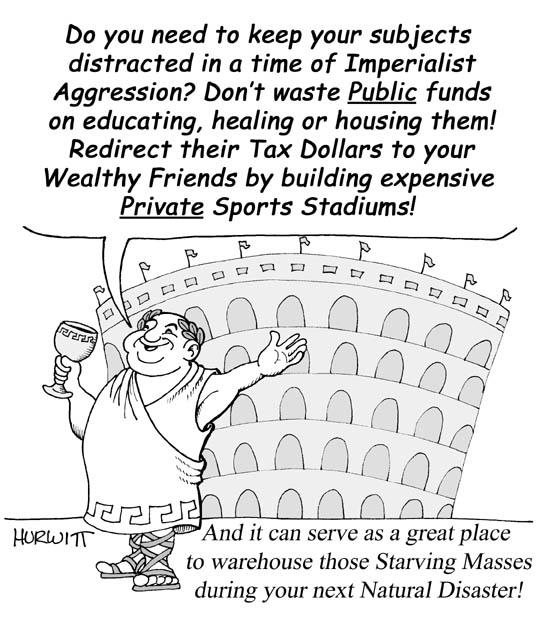
(Above, a "bread and circuses"-themed cartoon by Mark Hurwitt, used in Sports Glummery. More about Mr. Hurwitt here. More about "bread and circuses" themes below.)

In the first article I wrote enumerating my personal dissatisfactions with the professional sports business I mentioned the 1975 dystopic science fiction film “Rollerball” for its apt fitness in describing the cynical “bread and circuses” use of professional sports to distract and manipulate the populace. I’ll stand by that, but if we as a society have now begun eating our young, destroying them for our amusement physically, mentally, and spiritually with the commercialization of the sports marketplace perhaps we should retire “Rollerball” as the film that best metaphorically warns of what degradations we face replace it with the newer, grimmer, recently released “The Hunger Games” film, another science fiction film about a unpalatable future where a ruling elite annually selects children from twelve districts, two children from each, to participate in an extended gladiatorial fight to the death that is watched on national television by the entire nation after its gleefully shameless PR hype by the government. (Hence the visual at this article's outset of the "The Hunger Games'" Katniss Everdeen in Adidas sneakers and a Nets basketball team jersey.)

Bad News For Those Who Would Escape: A Cable Bind

As discussed in my previous Sports Glummery article there are those who dream of inaugurating a moderated form of fandom whereby individuals of conscience can with proper restraint avoid complicity with the dastardly deeds done in the pursuit of profit by the highly commercialized sports industry. Others, like myself, would prefer to keep life simple: We would shun the industry to effect a clear-cut divorce and separation. Whatever one may wish for, escaping complicity may not be so easy.

It turns out, according to recent analysis that even those of us who never watch professional sports can blame the franchises running that industry for significantly driving up the cost of our cable television bills: 90 percent of Americans pay for cable, satellite or fiber optic television, and according to the Wall Street Journal in 2010, about 40 percent of consumers' basic cable bills probably went towards sports programming. (See: The Incredible Value of Live Sports: Transcript, Friday, May 25, 2012.*)


(* See also: Cable TV angry about NFL broadcast deals, by Jeff Tyler, Marketplace for Tuesday, December 6, 2011; Cable Television Bills Have Nearly Tripled In The Past 10 Years, The Huffington Post, Jillian Berman, 12/30/11; MEDIA & MARKETING, December 6, 2011, Cable-TV Honchos Cry Foul Over Soaring Cost of ESPN, By Sam Schechner and Martin Peers- "You're in a position where many people may not care about sports content, and their bill goes up anyway," said Derek Chang, who oversees all programming acquisition at DirecTV, DTV in an interview Monday. "They start to get to levels where customers say they just can't afford it."- Smart Spending: Is Pay Per Channel Cable TV Inevitable? by Brad Tuttle, August 26, 2011; How Much Do You Pay for Each of Those Cable Channels You Don’t Watch?, 03.20.12 Written by Dustin Rowles; Peter Kafka, Hate Paying for Cable? Here’s Why, March 8, 2010 at 5:00 am PT.)
That means that until those in charge unbundle premium sports broadcasting so that it is no longer a required part of basic cable packages (Capitol Hill has considered mandating such an a la carte option ) there is a huge subsidy being sent to the commercial sports industry. In Brooklyn, Time Warner Cable customers pay $70.95 a month for a Digital Starter Pak (130 channels, technically a combination of “Basic Service” + “Standard Service”) or $85.45 for DTV value (more than 350 channels) and both of these packages include all the expensive sports channels driving up basic cable bills. The only way to eliminate the expensive sports channels is to drop down the number of channels you are subscribing to by about 60% (from that "value" package) to pay $49.99 for a TV Essentials package which will still include delivery of the ESPN sports news channel!

As Time Warner may appreciate, dropping down to the TV Essentials package is likely an undesirable option because if you do select it you will lose a multitude of other stations in which the non-sports enthusiast would probably be interested and which individually or collectively ought to cost very little to subscribe to: Comedy Central bringing you the Jon Stewart and Stephen Colbert shows (costing the cable company only about 3% of what ESPN HD does) or the only slightly more expensive Turner Classic Movies (which costs the cable company only about 5% of what ESPN does, an amount only just above the industry average cost for a channel). Some of these channels you to which you would thus be denied access cost the cable company so very little that the broadcasters are almost paying the cable company instead of vice versa (and there is even a valid argument this should be the case when these channels carry advertising): BBC World News costs the cable company a mere fractional pittance of about .75%, less than even 1%, of what ESPN does, putting it in the same price league as the Hallmark channels (Movies and a general programming channel), Lifetime Movie Network, Bloomberg TV, The Science Channel of the Discovery Kids Channel.

The main programming plans of Verizon’s FIOS network, running $64.99 to $89.99 a month for the standard promoted packages, include ESPN and the sports channels although also available from Verizon with significantly less promotion is a very pared down Local Digital option ($12.99 per month) . . . Or you can eliminate ESPN (and Turner Classic Movies as well) but still get other sports channels by going with the not-so-attractive La Conexion ($54.99 per month). Similarly, Direct TV with its packages (running $29.99 to $44.99) affords no option without ESPN. Direct TV actually owns some sports networks.

One reason the cable networks are unlikely to cease promoting the sports channels anytime soon is that, according to On The Media’s analysis, the continuing entanglement works well for the cable companies: The cable audience is less likely to cut the cable cord (and go with the proliferating alternate internet delivery options) because the sports audience, much more so than others, demands to watch content live and the cable companies still have a monopoly on the delivery of this particular form of live content.

So the next time you go into a Time Warner Cable TV office to pick up a new cable box and you see the cable representatives all dressed in professional basketball team jerseys (see the photographs of the Time Warner Cable representative in the Nets team jersey below) you might want to think about how, perhaps exactly contrary to your wishes, you are being made a party to this enforced subsidy of sports teams that is driving up your cable bill and making you complicit in the exploitation of children.

Friday, June 29, 2012

Government Gets Branded

(Above, a government "fireman" from "Fahrenheit 451" now branded appropriately for our modern times with KFC, Ratner/Prokhorov "Barclays" and "Nets" advertising logos. Click on image to enlarge. Nets logo from artwork by Tracy Collins.)

One of the most indelible images of cinematic science fiction, a vision of an insidious transmogrification of government, came to us via the late Ray Bradbury’s “Fahrenheit 451”: A young boy with his mother looks down from an overpass as racing fire trucks speed by, sirens sounding, an eerie blue gumball beacon flashing and says: “Oh, mummy, look! Firemen. Mummy, there's going to be a fire.” In Bradbury’s future, firemen no longer “put out fires” instead they burn books.

Well it appears that the future is arriving. It isn’t exactly the future Bradbury envisioned, though it does involve a transmogrification of government epitomized by a scene of a racing fire truck. In this future the young boy looks down from the same overpass and says: “Oh, mummy, look! Firemen. Mummy, they’re going to fry some fiery grilled ™ Kentucky Fried Chicken!”

(Above, "Fahrenheit 451"'s little boy and his mummy.)

Burning Question Respecting Hobbling Governments

The New York Times recently ran a story about how cash-strained cities are selling corporations the right to use municipal assets as billboards to advertise their products and this includes, as the article’s opening example, Baltimore’s City Council passing a resolution favoring the placement of corporate ads on city fire trucks. The article notes that KFC has been “a pioneer in this kind of unconventional ad placement” and has placed its logo on fire hydrants and manhole covers in “several cities in Indiana, Kentucky and Tennessee.” (See: Your Ad Here, on a Fire Truck? Broke Cities Sell Naming Rights, by Michael Cooper, June 24, 2012, picture on side from article.)

Bradbury’s nightmare future involved an Orwellian-style totalitarian, authoritarian government controlling and limiting its populace’s thinking by scrupulously denying them access to books. The future that is arriving is almost the reverse: Instead of a government with intrusively-great power, the reality that is arriving is governments shrunken down to dependent weakness. This is more like the nightmare dystopia envisioned in the science fiction film “Robocop,” where a shrunken, debilitated government is so small and bankrupt that it is unable to resist a privatizing sell-off of its central functions to huge unaccountable corporations; even the police department is administrated by a private corporation (paving the way- spoiler alert!- for that corporation to be the film’s villain maneuvering for a land grab).

Dumbing Down the Public

In “Fahrenheit 451” the government deprives the public of books intending that the public have an illiterate lack of perspective about what is going on in the world, the activities of the government included. In a different way, plastering fire trucks with cooperate advertisements involves a similar dumbing down of the public’s understanding of the role of government, particularly the government’s appropriate and proper interrelationship with private enterprise. It implies that government exists almost by the cooperate sector’s grace or as a sideline to it and that, as in the Robocop dystopia, it can be appropriate for government to put its core functions up for sale to the highest bidder.

A cavalier attitude about government selling out to business entails consequences. In recent Noticing New York coverage I wrote about Jane Jacobs’ warning in her “Systems of Survival: A Dialogue on the Moral Foundations of Commerce and Politics;” (1992) that the inappropriate mixing of government and business tends to result in a degradation of fundamental moral systems and principles (much as is depicted in the film Robocop). With such intermixtures, government officials reorienting themselves to serve business interests are prone to forget that they are supposed to perform an essential guardian role protecting the public interest first, foremost, and above all else.

In “Fahrenheit 451” the squelching of free speech that deadens the public’s critical thought process is heavy-handed and obvious and performed directly by the government. What’s happening in the future of today's world is that the sound of meaningful free speech in this world is being snuffed out by its inability to compete with the amplified cacophony of commercial “speech-on-steroids.” For more about this and also how speech is becoming increasingly commercially privatized through copyright, media ownership, property ownership and other laws favoring corporations see: Saturday, October 22, 2011, Occupy Wall Street and the Banks- Messages From Bonnie & Clyde, “They’ve Got Too Much Money”: Ownership of the Public Forum by the Wealthy?

Dismissing Government's Importance

When cooperate logos are slapped-on on government vehicles one might infer that what the government does is inherently less important than the private sector. Really now! . . .

. . . There is a reason that fire trucks are painted red: Not because that is the color of fire but to make an urgent, immediate claim on the public’s attention, also with sirens and flashing lights, so that the fire truck can pass through traffic, people pulling over to the side to make way for the a mission of rescue more important than everyone else's everyday commute or trip to the store. (The Times article mentions corporate logos could similarly wind up on Onondaga County Rescue helicopters.) What absurd redefined message does it send that a fire truck’s first claim on the attention of a surrounding sea of traffic will now be to urge people to eat at a particular fast food chain?

It consigns the actual purpose of the fire truck to a second class tier. Presumably, no business or enterprise would choose to advertize on fire trucks if the public perception was that the fire department was doing a poor job. But if the fire department is doing a good job why shouldn’t the information and logos appearing on the trucks be exclusively about that department as a way to advertise for the raising and allotment of tax dollars?

99 and 44/100ths of the Truth

The implication is also that crucial public services are being delivered only because the fast food chain is stepping in to finance them. That’s hardly the case. As the Times hints, what the advertising could bring in would be paltry compared to the overall cost of running a fire department. The Baltimore City Fire Department is comprised of stations that “house about 100 firefighting, emergency medical and special operations companies.” Advertising is not expected to bring in enough to keep even one company open. (Closing one fire company would save Baltimore a little over $2 million a year. - The article reports that closing three would save on the order of $6 million a year.) In other words, despite the handing out of a misleading advertising credit the taxpayers are paying for probably around 99 and 44/100ths of the cost of that municipal department, which is pretty much the whole ball of wax.

Finding Government Admirable

The public does respond to logos and insignia that give credit to public workers. After 9/11 there was a flourishing trade in caps and T-shirts and similar items sold around New York with Fire and Police Department logos even if there were not always duly licensed. (See also this.)

Government Sized Up and Down

But why should we expect scrawny, drowned-rat government to effectively negotiate deals that are fair to the public? Part of the reason governments are willing to consider such desperate plans (and able to make any sort of credible case when presenting them to public) is because they are so hard up for money and that is because, going back to the late 1970s, there has been a concerted effort by conservatives to starve the beast (i.e. the government, with tax cuts and the creation of government deficits), the goal being, in the words of conservative activist Grover Norquist, to get the government “down to the size where we can drown it in the bathtub.” Hence, the image of a drowned-rat government pleading for table-scrap income from fast food advertising.

For more about the intentional creation of deficits so that, “Spending cuts could then be sold as a necessity rather than a choice, the only way to eliminate an unsustainable budget deficit”, See Paul Krugman’s column: The Bankruptcy Boys, February 21, 2010.

If the starving of the beast hasn’t yet got local government down to the size where those governments can be drowned in a bath tub they are at least down to the size where they can be lassoed, roped, and branded like calves at a rodeo.

What is the proper size of government? President Theodor Roosevelt, who took on trusts, cartels, and conglomerate holding companies with his trust-busting and increased regulation of businesses, is sometimes quoted as saying that government needs to be at least big enough to take on the big corporations and monopolies. Despite the quotes I've heard I can’t find evidence that he actually said this, although I’ve researched the subject and spoken to a presidential historian expert in that period of history. If Roosevelt didn’t say it he should have: He believed in government cutting businesses down to size rather than vice versa, how else can you achieve that result? (If anyone comes across an actual Roosevelt quote to this effect let me know.)

Do Those Besieging Government Want Small Government Or Compliant Government?

Paul Krugman has pointed out that Republican apostles of small government are not necessarily sincere. New Jersey’s Governor Chris Christie and presidential candidate Mitt Romney are included in his list. He calls them “fake deficit hawks.” See: Big Fiscal Phonies, May 27, 2012.

Mr. Krugman says:
for all their alleged deep concern over budget gaps, that concern isn’t sufficient to induce them to give up anything — anything at all — that they and their financial backers want.
To establish his point on this, Mr. Krugman describes in this article the reluctance of Christie and Romney to eliminate “low taxes on profits and capital gains” and a Romney promise not to cut defense spending. But it is not just about keeping taxes low for corporations and the wealthy, or spending on the military. When Christie felt like it he decided to put the public's money into the Xanadu project, a huge, over scale, garishly designed and questionably subsidized mixed-use project critically integrated with a sports complex. (See: Friday, May 6, 2011, Xanadu- Governor Christie’s Ode-ious “Yes We Khan” Moment.)

Big Business + Big (Collusive) Big Government = Big Woes

I myself believe that government needs to be at least big enough to perform its guardianship function of taking on the big corporations and monopolies, but when government is big you can wind up getting the worst of both worlds. That happens when government neglects its guardianship function and big business and big government collude in big-time crony capitalism. That is the kind of corporatist conduct that everyone, including both the Tea Party and Occupy Wall Street ought to agree to abhor, see: Monday, October 4, 2011, On NPR, Echo of Coinciding Principles Noticed: What the Tea Party and Occupy Wall Street Ought To Agree On.

The Times On the Ratner/Prokhorov "Barclays" Arena

Mentioning that transit systems across the nation have recently been aggressive in trying to sell the naming rights of stations, the Times article covers the fact that in “Brooklyn, new signs went up last month at the Atlantic Avenue subway stop bearing a sponsored addition to its name: Barclays Center.” (See the Times provided picture on the side.) Accordingly, the Times, as it should, actually included an appropriate mention of Atlantic Yards in what it was seemingly reporting as a negative trend, something it often neglects to do. The article stated that the Metropolitan Transportation Authority is being paid for the naming of the station, but didn not point out that the payment being received is exceedingly miniscule in relation to the benefit being conferred upon Barclays. It was decided upon by the MTA with very little thought or negotiation in terms of benefitting the public. (See: Sunday, June 28, 2009, Naming a Problem: The MTA Gives Ratner the Right to Name Brooklyn Subway Stations “Barclays”).

The Times reports the amount paid as “$4 million over 20 years”: The MTA board (as described in the staff summary it got) approved “$200,000 per year”. . . Think how little that means in terms of the present value being paid!

This is not drowned-rat government lacking the skill to negotiate a credible deal– The MTA is a big, sophisticated government organization with appreciable resources– This is instead big-time crony capitalism. It is an example of what Jane Jacobs warned happens when, in pursuing “private/public partnerships,” government officials mix government functions up with the pursuit of business: The government officials stray from their guardianship responsibilities and fail to protect the public. In the case of Atlantic Yards, however, those government officials strayed from and neglected their true responsibilities far earlier; it all began with the abuse of eminent domain with the goal of benefitting a private developer at the expense of the public.

What's In An Advertised Name: By Any Other Other Name Wouldn't "Barclays" Smell. . . ?

Think about the appropriateness of naming New York City subway stops “Barclays Center” (while receiving virtually nothing of value to do so). “Barclays,” nothing but a name being advertised, is simply one more name in a sea of distracting ads. The “Barclays” bank didn’t build the arena that advertises its name; it’s being built by Bruce Ratner with the financial assistance of a Russian oligarch, Mikhail Prokhorov. The bank contributed nothing to the city or the borough of Brooklyn in order to build it. It has nothing to do with the arena. “Barclays” is not the name of the name of the basketball team planning to play there. It is not even necessarily the name of an honorable bank. Just of now the bank has been fined £290m ($450m) for manipulating LIBOR rates to benefit its traders and cook its books. Chief executive Bob Diamond is under pressure from British politicians to quit over the rate rigging scandal.

Perhaps the bank can certainly use the advertising at this time given its bad acts, but the public finds itself much in the same position as when, in the middle of the fiscal crisis, the new Mets “Shady Stadium” found itself opening with the name "Citifield," after an apparently failing bank. Barclays was also deeply involved in various scandals throughout the fiscal crisis. Citibank survived 2008 but was just downgraded by Moody’s. The message from the Moody’s downgrade of Citi and several other banks is that the banking system isn’t more sound than in 2008.

How long will any of these banks be around and by what names? Remember Chemical Bank? Manufacturers? One day it may cause substantial confusion when “Barclays” isn’t around either. Perhaps the most recent scandal will take its toll. Perhaps the Euro crisis will. Maybe, given the scandal, Barclays will have to rebrand with a new name or merge into a bank with another name. It may go bankrupt. The AOL Time Warner Center is no longer the AOL Time Warner Center, but for a building that is just a corporate headquarters, to endure a name change is of far less consequence than for the names of two subway stops to change in a subway system that is obscure and complicated enough to understand already.

When the Barclays name fades away there will be no residual sense of history associated with its passing because it was, after all, just an advertisement for something that had no association with its place or moment in time. There was no reason for government to confer upon it the very special honor of making it a place name in the city. It makes no more sense to name subway stations “Barclays” than to put KFC logos on Baltimore fire trucks.