Showing posts with label Ground Zero. Show all posts

Friday, January 4, 2013

Escalation Of A Problem: Does Last Minute Architectural Fix Of “Barclays” Arena Put Ratner In A Familiar Fix?

Top figure: My brother Stephen.  Below him, George Willig
This post about the architecture of the so-called “Barclays” arena will mention my brother Stephen (seen in the picture above, the relevance of which will be shortly be explained) and George Willig (also in the picture) whose name should excite some neurons in the brains of trivia experts knowledgeable about the 1970s.

I wrote about my brother and George Willig and Philippe Petit in an earlier Noticing New York article.  I was also writing then about another Ratner-constructed building and was writing about the same thing I am going to write about here.

Background On Arena Architecture: The Steel Lattice Grid Added When Finalizing A Design

First, some background about the architecture of the Ratner/Prokhorov owned arena to which the name of the Barclays Bank has been affixed with that name of ill repute being affixed in turn to New York subway stations so as to amplify the advertising that is intended to improve the public’s associations with the “Barclays” name.

Without commenting upon the aesthetic value of what was actually achieved, it should be noted that the aesthetics of the arena are all achieved by something that was never meant to be in the first place, something that was added in and resorted to at the last minute, a latticework wreath of weathering steel panels, including a projecting “oculus,”to disguise the basic and standard design beneath.  See the following Atlantic Yards Report's article from which the indented quotes below are extracted: Friday, December 28, 2012, In the WSJ: "Barclays Center is winning over Brooklyn" (but does it "work for the people closest to it"?).

From the Wall Street Journal’s annual architectural roundup written by Julia Lovine:
The 675,000-square-foot sports arena sits at the edge of a residential neighborhood. And it is as hulking and out of scale as feared, but locals have found it interesting enough architecturally to reconsider its potential. The architects animated a very basic arena form, covering it with rusted steel panels—thousands of them, each one slightly different in size—turning something ponderous, dynamic.  In a bold gesture at street level, a swooping oculus projects out over the subway and commuter train stairs.
From the comment of Atlantic Yard Report’s Norman Oder on the above Wal Street Journal article:   
. .  that "bold gesture at street level" was never meant to be. The arena plaza, and oculus, are the product of failing to build the massive office tower designed for that space. The arena surely looks less imposing, and more neighborhood- friendly, that way. But the office tower was key to the financial projections that made Atlantic Yards plausible.

For the record, the oculus does not really lead to "commuter train stairs." Arena visitors are instructed to walk down Atlantic Avenue to get to the Long Island Rail Road--otherwise, they must pay a subway fare to walk underground.
Noticing New York has not yet commented upon the success of the arena’s aesthetics (and may never do so) except that Noticing New York has observed how the arena and its oculus (often now described by others as “muscular”) expresses a corporatizing dominance over the space that's been taken over.  But this isn’t criticism of a design failure as it likely constitutes a success in terms of what was actually intended:
 . . . the huge dark cooperately logoed “Barclays” Center and its “oculus” loom over you.  Like an oversized flat screen in a sports bar, the “oculus” perpetually reformulates moving images that show hypnotically distracting advertisements from all the corporations who have deemed it beneficial to associate themselves with Ratner’s scandalous doin’s in his ruin of Brooklyn.

The insistent flashing ads in the oculus, together with the arena’s general overbearingness in the space are, it’s worth remembering, financially juiced by the arena’s nonpayment of taxes.  We, the public, pay the expenses the arena doesn't.
(See: Sunday, October 7, 2012, Will The “Daily News” Plaza at the “Barclays” (LIBOR) Center Be A Public Space For Free Speech?: Police Issue A Directive To The Contrary.)

As Mr. Oder notes, whatever aesthetic success has been achieved with the oculus and the lattice steel wreath encompassing the oculus was all a hastily-added afterthought that was inconsistent with the original design and plan.  The oculus is where, in the still-not-officially-disavowed original site plan design, an office building is supposed to stand.  In fact, the original site plan design calling for a total of four buildings to surround the arena would leave very little of the lattice visible.  (See image below from: Monday, September 21, 2009, A Stitch in Time: Post ESDC Meeting Ratner Releases Another (FIFTH!) New Set of Arena Plans.)

Above, original site plan showing the two apertures where fragments of lattice could theoretically remain.
Models of the original Frank Gehry design show those four buildings actually abutting the arena, with the arena (acknowledged to be large itself) so nestled in to the surrounding larger shapes that it virtually disappears.  As currently planned, will such surrounding buildings, however many of them are ever built, be similarly so close and abutting the arena?  When SHoP architects (Gregg Pasquarelli and Chris Sharples) were on Brian Lehrer the beginning of October they answered my phoned-in query in this regard as it pertained to the first of these buildings now expected to be built experimenting with new modular technology.

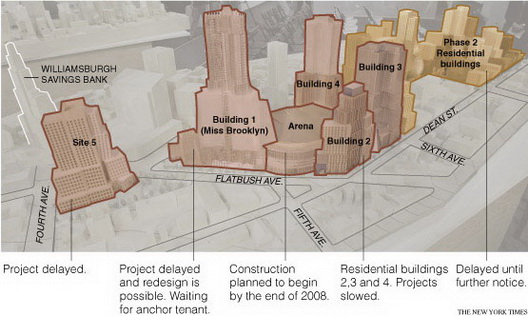
From 2008 Gowanus Lounge coverage of project slow down and delay
From Atlantic Yards Report coverage in turn covering the Times
Their answer, perhaps fudged, was that none of the wreath would wind up being dismantled because the new buildings would wind up being just a “backdrop” to a changing composition, since, unlike the original Gehry design, the buildings won’t be part of an integrated single design.  I posted a follow-up comment on the show page saying that I believe that if the other buildings are ever built on the block they will abut and that means that you won’t see as much of the weathering steel wreath that was added to the original design and that much of the wreath may have to be taken down.  If the buildings don’t actually abut they are likely to wind up being so very close that it will amount to nearly the same thing.
 
Other things have similarly made it seem as if the arena lattice was hastily conceived, irrespective of whether it has been rightfully or wrongly praised by a fawning press that is rarely critical of Ratner.

It may have come as a surprise to many that the “12,000 panels of a material called weathering steel” . .  “bleeds bits of fiery color onto the surrounding area, especially in its early life.”  (For more, including photos of the “rusty dripping” see: Friday, November 30, 2012, After pre-rusting the Barclays Center facade, the metal drips, after all.)  In any event, the new sidewalks being stained, already full of unpromised cracks, are hardly pristine.

Posterior protuberance the weekend of Jay-Z's opening concert
Another surprise, when constructed, we discovered that a posterior protuberance emerged from the lattice’s streamlined form that was never shown to be intended when the reformulating plans associated with the addition of the lattice were put on display for public reaction.  (See: Sunday, October 7, 2012, The Posterior Protuberance Of the Ratner/Prokhorov Barclays (LIBOR) Center Not Indicated On Model Submitted To Sell Arena To Public.)

Most recently, we have been greeted with the New Year's fresh news of a New York Times scoop: Back in August it was discovered that there was a problem with the 23,351 bolts fastening the steel plates to the arena structure. The fabricator had sent bolts that were half as strong as those that had been ordered.  As a five-month replacement regimen was undertaken and ongoing, the news was apparently handled by Ratner and the professional firms working for his Forest City Ratner firm so that the information didn’t get around, not to the New York City Building Department nor passed along by the construction monitor reporting to arena’s bond holders about the status of their investment’s construction.
Image,  Chang W. Lee Photo, showing bolts from Times January 1 scoop article: Problem With Weak Bolts Has Complicated the Barclays Center’s Early Days
Problems may have stemmed from the fact that, as the Times article notes: “The fabricator for the 12,000 steel panels — no two alike — abruptly shut down midway through the job.”   Somehow, although the bolts are only half the strength that were ordered, it has been determined that only about 8% of them (1,768) are actually going to get replaced.  (See, particularly respecting the possibility of intentional obfuscation: Wednesday, January 02, 2013, Barclays Center opened with defective bolts, not disclosed fully to Department of Buildings; problem hints at why ESD, construction monitor have obscured the issue.)

As the Times defective-bolt-scoop article author Charles Bagli writes: “with innovation has also come headaches.”  Bagli ends his Times article sounding a note of perhaps intentionally ironic hope:
As for the blossoms of metal staining the sidewalks surrounding the arena? Eventually the panels will stop rusting and workers will use power washers to remove all traces of metal from the sidewalks.
I am not so certain this is true.  Although Bagli in his article at one point describes the material of which the 12,000 panels are made as “pre-weathered steel” and although the Merritt & Harris construction monitoring reports that didn’t mention the defective bolts documents refer to “weathered panels” I believe the exact term for the material used is “weathering steel” which is to say that there is no past tense involved; while the weathering process may slow as it progresses it will never be finished.  The Times reported in late August that to prevent the rusting from being worse upon initial installation the steel, before it arrived on site “spent about four months at an Indianapolis plant where they were put through more than a dozen wet-and-dry cycles a day” effectively amounting to about “six years of weathering”.

Other things that this Times article noted about the weathering steel: If water is allowed to pool anywhere holes can rust through the material like an old auto body and if mischievous passers-by throw magnets up onto the steel they stick (perhaps affecting the weathering patterns?)

Past As Prologue: Possible Ascension Of Another Problem With The Lattice Wreath

That being background (and mischief perhaps a good segue), we now get to the part of this post wherein I will talk about my brother Stephen, George Willig, Philippe Petit and connect them with another building built by Foerst City Ratner.  It involves another problem with the lattice work facade that may not have been considered when its design solution was hastily resorted to.

I have been thinking about writing this article since the summer, long before the arena was completed or brought online.  I held back because I didn’t want to get ahead of the story.  Also there are times when, in writing about a story, you can unintentionally become part of it.  You can provoke it into existence.  For some months now it seemed to me that what was obvious to me must be obvious to everyone else and that if I just waited I would be writing about the story after it fully unfolded. I would have avoided provoking it to happen or, alternatively, provoking an inscrutable preemptive response on Ratner's part.

A number of years ago, in August of 2008 I wrote about redevelopment at Ground Zero, the former site of the World Trade Center.  As part of that article I wrote about the relationship of human beings to buildings that dominate the environment, how the dominance of a building can create a corresponding human urge to conquer that dominating object, a sort of because-it’s-there exercise at attempting to cut a too big building back down to human size, restoring the balance of human relationship.  (See: Tuesday, August 5, 2008, TWO, AND FRO?)
   
Philippe Petit tight-rope walking between Trade Center Towers in video preview for "Man on Wire" documentary.
So it was with the World Trade Center towers which my article pointed out were not particularly beloved or good design but inevitably evoked response from day one. So we got the French aerialist Philippe Petit, who with meticulous clandestine preparation, tight-rope walked between the Twin Towers in 1974.  (In my article I recommended the 2008 documentary about his feat “Man on Wire.”) The towers also attracted George Willig, the Queens mountain climber and toy maker who climbed the South Tower in May of 1977.
George Willig climbing World Trade Center Tower
Postcard from 1964 Worlds Fair showing Unisphere
How does my brother Stephen, a cameraman, fit into this tradition of scaling large scale structures?  My brother, who has done some risky things as a cameraman (bracing himself on the rigs affixed to speeding cars to film car commercials, etc.) is also a climber.  Before George Willig ascended the World Trade Center building Willig scaled the Unisphere in Flushing Meadow Park, the symbol of the 1964 World’s Fair left in place afterwards by Robert Moses and cohorts.  Willig participated in a film documenting this exploit, so before Willig scaled the Unisphere my brother had to do some of his own climbing so as to be up above, looking down on an ascending Willig for suitably impressive shots.  Ergo, the image at the top of this article that shows my brother Stephen in climbing harness ascending the Unisphere ahead of Willig.

French "Spiderman" Alain Robert climbing Times/Ratner building June 5, 2008 to call attention to global warming from YouTube Video of climb
The point is that there is a tradition of climbing buildings and it is in this respect that we can concern ourselves with another building that Forest City Ratner built in relatively recent memory: The Renzo Piano-designed New York Times Building built employing eminent domain to vanquish those owners and occupants who had previously utilized its 41st Street and 8th Avenue location.  On July 9, 2008 the Municipal Art Society, at an annual meeting held in the New York Times building, presented that building with a “MASterwork” award for its design.  It was by weird coincidence the very same day that the third climber in five weeks had attempted to scale the Times Building.  Even as the award was being presented at the meeting within the building construction workers were busy working outside removing the ceramic rods and boxing up other features of the building’s distinctive architecture that provided such an open invitation to climbers.  Those open invitation features are no longer there.

We often observe about warfare how humans preoccupy themselves with "fighting the last war."  If there is architectural equivalent to this bromide it must not pertain to the Forest City Ratner firm because even if elements of Ratner’s Renzo Piano New York Times Building built in 2007 had to be dismantled because they were such an open invitation to urban climbers seeking to scale urban Everests and make statements, the “Barclays’ arena presents a conspicuous rerun of this problem.

It’s a veritable stairway to the stars, or at least the twinkling LED diodes of the oculus!

If the arrival of climbers is a testament to the public’s recognition of a building’s significant dominance in an environment perhaps the arena hasn’t succeeded in it goals because months have now gone by and climbers haven't shown up.  It leaves me a little surprised.  And now the time has come: Rather than wait any longer I thought I’d finally write this article now.

The same view when arena was under construction, June 1st
Maybe it's a stroke of good luck that nobody has yet tried to climb the arena: If the bolts holding the panel stairway are only half as strong as specified there could perhaps be a problem with holding human weight.  I’m sure the specifications must have been such that the panels were supposed to stand up to a storm like Sandy (whose winds weren’t nearly as bad as they could have been). . . They probably ought also to have been specified to be sufficient to hold human weight.  But if only 8% of the bolts are being replaced to cure a 50% strength insufficiency?

Another easy climbing access pointOn the day this photo was taken the Ratner organization was busy delivering press to the spot
And what about the lattice as a planned near-by “backdrop” to the new residential building now being undertaken?  The architects say it won't abut , still will a climber hanging from the lattice be able to reach out and touch the new building?  Who knows?  Quite possibly we will never find out: Despite all the interest the press has shown in the arena's exercise in muscular frou-frou, the urban climbers out there haven't been similarly intrigued.

Seriously though: After Ratner's high-profile experience with the three urban climbers who were drawn to the Renzo Piano New York Times Building, wasn't this on the Ratner firm's checklist of stupid learn-from-experience mistakes to avoid?  Or was Mr. Ratner in just that much of a desperate hurry to get his approvals and get started?

Monday, June 1, 2009

Negotiating With Your Contractor: The Atlantic Yards As Kitchen Renovation Metaphor

At Friday’s state senate hearing on Atlantic Yards, Marisa Lago (head of the Empire State Development Corporation and responsible for Atlantic Yards on behalf of Governor Paterson) tried to make current negotiations with proposed project developer, Forest City Ratner easy to explain by likening Atlantic Yards to a kitchen renovation. That therefore allowed Ms. Lago to tell Senators Bill Perkins, Velmanette Montgomery and Assemblyman Hakeem Jeffries that Forest City Ratner is going to give the public a lot less than the public was once supposedly going to get by telling the legeslators that there isn’t going to be a garbage disposal, the level of trim and finishes won’t be the same (Formica countertops instead of granite?) and that the stove was only going to have four burners rather than six.

We’ll figure that the four burners instead of six outcome was meant to be suggestive of the fact that Forest City Ratner is now, among other things, only going to be giving the MTA a 7-train capacity train yard rather than a 9-train capacity yard. (a 22% cutback). So much for the future growth of a growing city! Along with this were the revelations that Forest City Ratner wants to pay the MTA less than previously specified for its land, wants more money from the public and is going to take a lot longer to deliver any public benefit. Some dates for delivery of public benefit may simply go unspecified. (See: Friday, May 29, 2009, Today’s State Senate Hearings on Atlantic Yards and Noticing New York Testimony.)

We rather like the kitchen renovation metaphor. Maybe it provided Ms. Lago with an out to avoid saying things in less blunt, specific or informative terms but we think that it does help make some things easier to explain. We will come back to that in a minute but first let’s note what this is really all about in basic, big-picture terms. It’s about government negotiations with a private developer, what the developer gets and what the public is going to foot the bill for while the developer takes away private benefit. It is also about whether given the “weakness in the economy,” public authorities should reopen agreements to tilt things more in favor of the private developer though it would be “at the expense of the authority’s primary mission.”

The New York Times had an interesting editorial Wednesday, Stalemate at Ground Zero, taking some positions that ought to be relevant. (We just quoted from that editorial above.) In this case, the Times was writing about negotiations respecting redevelopment of the World Trade Center site.

Mr. Silverstein . . . [who is building at the Trade Center site] . . wants to reopen a 2006 building agreement with the authority, citing delays by the authority and the weakness in the economy.

. . . . Mr. Silverstein made his pitch that the authority should use its money to help him build two skyscrapers that the private market won’t finance in the current climate. Basically he is asking the authority, which has limited resources and many other demands, to get even deeper into real estate speculation.

* * * *

The authority’s board has authorized over $800 million so far to help with Mr. Silverstein’s financing. The mayor and his dealmakers should not drain any more of the funds the authority needs to maintain and manage the bridges, tunnels, ports, terminals and airports in the metropolitan area. We all want the ground zero memorial and the other structures finished. But it cannot come at the expense of the authority’s primary mission.
Because it seems that the Times has let its business relationship with Forest City Ratner influence it coverage, we doubt that the Times will be publishing any similar editorials about Atlantic Yards. We are happy to be here to fill the void.

Should “weakness in the economy” cause a public authority like the MTA to reopen its negotiations with Forest City Ratner and agree to take even less for its land “at the expense of the authority’s primary mission?” (Remember that, going back, Ratner was not even willing to match the offer of another developer to pay more to the MTA for its land than Forest City Ratner was originally willing to pay.)

In fact, is“weakness in the economy” a reason to give more to a developer or is a downturn in the economy a reason to do exactly the reverse? We have previously written about how:

. . . state and local governments everywhere else are saving significant money on public sector work by getting bids during this economic downturn, and Forest City Ratner claims it is similarly going to reduce costs for itself through the lower bids they can get during the economic downturn. .
(See: Thursday, April 16, 2009, The Great Recession: A Stimulus to Get Our City Back to “Bidness?”)

The latest on this (in an article appearing only one day after the Times editorial) is that Ratner has reportedly reduced his cost of building his Beekman Tower by negotiating with the construction unions “a series of concessions on work rules that proponents said would save builders as much as 20 percent on labor costs.” (See: Savings on Labor Allow Work on Residential Skyscraper to Resume, by Charles V. Bagli, May 28, 2009.)

As we said before, it looks like the New York taxpayer is the only one who isn’t being invited to the party to get the benefits of saving through such bidding and negotiation. This takes us back to Ms. Lago’s kitchen renovation metaphor. Now is a great time to be in the market for a kitchen renovation! Contractors are hungry for work and they are bidding for it aggressively. The same thing applies to Atlantic Yards.

When it comes to kitchen and apartment renovations we have a few rules which we would like to supply for the sake of analogy. Those of us who have actually renovated our apartments, bathroom or kitchens know these things but it is time for our public officials to wake up and do what makes sense when spending the really big (billions) bucks:

NOTICING NEW YORK’S KITCHEN RENOVATION RULES
(Applicable also to NYC megadevelopments)

1. When selecting a contractor, get bids. Forest City Ratner was selected to build the 22-acre Atlantic Yards without an effective bid process. If you don’t get bids, expect to get soaked.

2. If you can (as noted above), it is good if you can bid out your kitchen renovation when things are otherwise slow in the construction business.

3. Establish a schedule by which the contractor must complete the renovation. If you establish a long, protracted schedule and distant deadline for completing construction, letting the contractor complete at his leisure (and work only when it is most convenient in terms of scheduling his labor, picking up his materials, prioritizing your job versus somebody else’s), expect the contractor to give you a really good break on price. But also consider that it will cost you a lot in that you have to pay rent or maintenance and your mortgage for a long time while not being able to use your property. Atlantic Yards has few real deadlines. From a pragmatic standpoint most of the deadlines are essentially nonexistent, many of them not even existing within the span of many people’s professional lifetimes. To the extent that deadlines are supposed to represent a day of reckoning, a time when the contractor can be held to account, a time to determine whether standards have been met, Forest City Ratner seems to have escaped such accountability. About all that is being required is that of FCR as Atlantic Yards developer is that it is supposed get the project underway by the end of the year. The sole requirement to simply get the project underway only benefits FCR by locking them into the job and has nothing to do with completion or delivery of public benefit. Without practical deadlines, Forest City Ratner is essentially strapping on a feedbag and the fact that it can munch at its leisure, taking decades to complete the monopoly it has been given (speeding up or slowing down at will) amounts to an extraordinary public subsidy for the firm. Apparently, our public officials believe that this subsidy will go undetected by the public.

4. Specify ahead of time all the work to be done before bidding out the job. This of, of course, is pretty basic stuff, but notice that this wasn’t done with Atlantic Yards.

5. Don’t let the contractor demolish the kitchen before you have a contract. It puts you in a tremendously weak negotiating position. How are you going to negotiate effectively when you have to eat out at restaurants or order take-out and there is nowhere to do the dishes? You’ll be sitting in a pile of construction dust and will probably feel that you need to agree to practically any outrageous proposal the contractor trots in. This is essentially the kind of situation Forest City Ratner has worked to create by tearing down much of the neighborhood while not having funding or a go-ahead to replace any of it. This includes demolishing the Ward Bakery Building and the Carlton Avenue bridge and creating unnecessary blight.

6. Don’t front-load the payments to the contractor. If you give all your money to the contractor up front it eliminates the incentive for the contractor to come back on a timely basis to finish the rest of the work. It also tends to lock you into continuing to use the contractor for the job because you won’t have money to engage a replacement contractor when you discover that you want to fire the original one. So why have the city and state been giving Forest City Ratner their contributions to Atlantic Yards up front?

7. If you advance money to the contractor that is going to be used to buy materials, you probably want to specify that the materials bought will belong to you rather than the contractor. That way you will be all set and ready to redirect the work to a new contractor whenever you need to. When you switch contractors, you don’t want your old contractor blackmailing you, saying that he is not going to turn over to you the custom-made granite countertops or the special-order tiles he took possession of at your expense. The city and state have been careless and are now at an analogous disadvantage whenever they decide to get rid of Forest City Ratner because Ratner took money that the city gave them (that was supposed to upgrade infrastructure) and used it to buy and take title to property within the Atlantic Yards footprint; Forest City Ratner is likely to try to hold that property hostage when the ESDC and the city send them packing.

8. If you’re trying to economize and save money, don’t let the contractor turn the job into a bigger, more costly job than it needs to be by going crazy and ripping out and throwing away a lot of walls, baseboard moldings and appliances that are perfectly serviceable and ought still to be used. If you want to save money, don’t rip out walls that are sound just because they have a few cracks. If new plumbing was recently installed, don’t rip it out to replace it all over again. Don’t let your contractor get rid of sound appliances and fixtures that could serve you perfectly well just so that the contractor can make a profit on selling you everything all new even though that is not what you needed. That is a form of churning. Have you noticed that Atlantic Yards involves plans to demolish some perfectly wonderful co-op and condominium buildings that were just fully and completely renovated?

9. Check out your contractor’s credit worthiness before engaging him. Forest City Ratner is teetering financially. On reason we have government officials who are likely going to be telling us that the public needs to come to the financial rescue of FCR because of the “weakness in the economy” is because of FCR’s own financial weakness. If you were doing a kitchen renovation you want to start with a contractor strong enough so that you would not have to face such ridiculous arguments.

10. Maintain the option to terminate and bring in another contractor- especially if the contractor wants to renegotiate after accepting the job. If a contractor doesn’t believe you are going to be able to replace him, he is going to try to take advantage of you during negotiations- Like asking for extra concessions because the economy is weak. How ridiculous is it that Forest City Ratner doesn’t think they can be replaced when the work being talked about won’t be done until as much as thirty years in the future and Forest City Ratner hasn’t even been specific what it is they are going to produce or the price they will produce it for?
We expect we could go on with other analogies about what is being done wrong at Atlantic Yards and that anyone with home renovation experience could add additional points of wisdom to this list. For instance, don’t get taken in by the contractor’s high-pressure sales job to buy super-glitzy name brand stuff that he can sell to you at an especially high mark-up. Maybe you do want a Sub-Zero refrigerator for your home rather than a top-of-the-line GE product, but do you really want to get suckered into paying extra for some Frank Gehry frippery that leaks? Everyone should feel free to add their advice to ours in the comments section to this post. Our public officials have a lot to learn about kitchen renovations!

Wednesday, April 15, 2009

Permission to Speak Frankly: How We Know More and Less From Breakfast Interviews With Marisa Lago


Last week Empire State Development Corporation CEO Marisa Lago was the interviewee in the “on the record” part of the "On/Off the Record" breakfast sponsored by City Hall News. A fraction more light can now be shed on that interview given Ms. Lago’s participation in another breakfast this week and her on-the-record, answers, previously unavailable to all the general public, to questions we asked about Atlantic Yards.

The subject of last week’s City Hall News breakfast interview was economic development in general. Atlantic Yards provided a large part of the morning’s fare, City Hall News interviewer Edward-Isaac Dovere conscientiously bringing it a number of times amongst a short list of the most important big projects for which the state, through Ms. Lago and ESDC, is responsible. All of those big projects may be considered troubled as we will touch upon here.

Atlantic Yards Report has already covered the key revelation (of the “obvious”) of last week’s breakfast interview: Atlantic Yards is going to take far longer than previously averred by the state in court proceedings and far longer than the public was told or has otherwise been officially acknowledged. Based on what Ms. Lago said, Atlantic Yards isn’t going to take 10 years as previously planned: It is going to take “decades” (See: Thursday, April 09, 2009, ESDC CEO Lago admits the obvious: Atlantic Yards would take “decades”.)

You should definitely read Norman Oder’s Atlantic Yards Report piece on the morning interview especially for how it parses out the inconsistency of Ms. Lago’s “revelation” with prior information ESDC supplied to the public. That information was also used to create the misleading court record based upon which ESDC litigated. Other things occurred during the morning that we think supply insight into the public agency’s economic development process. We would like to let you know about these this as best we can. We say “as best we can” because we are hampered in telling you what you certainly ought to know by the peculiar format of the breakfast interview: Only some of the morning’s event, the interview by Mr. Dovere and Ms. Lago’s response were on the record. Unfortunately, what impedes us is that the publicly attended question and answer session that followed the interview was “off the record.”

We are going to respect the breakfast’s “off the record” rules, but we don’t agree that they are a good thing. In fact, we think they are representative of something exceedingly bad for society, the idea, that there can be concentric circles of access to public officials, and that depending upon how far “in” you are, what club you can be a member of, you will get to know a respectively greater portion of the “truth” that our public officials know and can relate when they speak with greater candor.

Have you ever suspected that within the most inner circles our public officials and those close to them speak absolutely frankly about Atlantic Yards, including acknowledging that it is a "wired deal" being done, not because it benefits the public but because the political fix is in, that it is a burlesque of counterfeit process structured to give Mr. Bruce Ratner a special deal based on relationships and political contributions? Do you wonder whether the multi-decade time line for Atlantic Yards referred to as previously “obvious” by Norman Oder has long been a subject of frank discussion in inner circles long before it was officially disclosed by Ms. Lago? Is that why the official documents signed by public agencies long ago actually accommodate this multi-decade developer monopoly? Don’t bother to wonder.

By that same token, there were perhaps 50 people at the City Hall news breakfast, including bank tellers and officers at the TD Bank (317 Madison Avenue, corner of Madison and 42nd Street) which played host to the event. Those individuals will know a lot more about what Ms. Lago said when speaking (somewhat) more frankly about development of our city than those of you who were not present. You will know less because we are going to respect the rules and not report anything that was “off the record” that morning.

We will, however, tell you more of what you should know that was actually on the record. We also figured out how to inform you about at least some of what you ought to know that was off the record: We are putting on the record our Noticing New York Atlantic Yards question that we orally put to Ms. Lago the morning of the breakfast and later resubmitted to the ESDC press office in writing for the on the record response she has now supplied.

Also at the breakfast were City Council candidate Josh Skaller (City Council District 39) who had an Atlantic Yards question of his own (more on this coming up) and New York State Senator Bill Perkins, who has held hearings about eminent domain abuse (a sore Atlantic Yard subject) and will be asking his own set of questions about Atlantic Yards at hearings he will be having on the project. (See: Tuesday, April 14, 2009,Questions for Sen. Perkins: Why did ESDC punt to the city's DOT on the Carlton Avenue Bridge.)


(Image of Mr. Skaller from Only The Blog Knows Brooklyn.)

How Many Decades of Blight is ESDC Assisting Atlantic Yards Developer Forest City to Create?

First, let us return to the subject already covered by Atlantic Yards Report. How long has Ms. Lago admitted that Atlantic yards will take? How many “DECADES” will it be?

Norman Oder’s strictly construed analysis is that Ms. Lagos’s admission that it will be “decades” (plural) means that Atlantic yards will take at least 20 years. We think however that the fair import of Ms Lago’s remarks is that Atlantic Yards is likely to take the better part of three or four decades, or perhaps even longer. It is especially troubling to us that for what is likely to be the better part of a half century, ESDC will be giving an extended development monopoly over more than 30 acres to BYOB (“Bring Your Own Blight”) developer/subsidy collector Forest City Ratner.

Ms. Lago when describing how long Atlantic Yards would take said it was “similar” in “scale” to “Roosevelt Island, a project that has grown over decades, 42nd Street, a project that has grown over the past 25 years.” (Emphasis supplied.) More specifically, Roosevelt Island got underway at the beginning of the ‘70s and the UDC lease that initiated things was signed in 1969. The project is not yet finished so it is already at least a four decade project. Times Square, as noted, has taken at least 25 years. (BTW: The fact that eminent domain is still being used for Times Square redevelopment at this late date to favor certain developer’s acquisitions raises troubling policy questions.)

Here is what Ms. Lago said at last week’s breakfast:

Mr. Dovere: Let’s finish, in terms of talking about projects, with talking about everybody’s favorite, the Atlantic Yards which doesn’t seem to be one that generates a lot of answers all the time.

Ms Lago: Obviously, challenging project again. Projects conceived in a different time and in a different economy - But, a few things: One, the focus now is very much on moving forward with the Nets stadium and with the housing that is on that first block, the first phase of the project. Attenuated time lines, I think, are a reality for private sector and for public sector projects. There is nothing wrong with that. We look at the history of the transformational projects that have occurred in the city. Earlier I was discussing with some of the folks here, Roosevelt Island, a project that has grown over decades, 42nd Street, a project that has grown over the past 25 years and the scale of the scale of the Atlantic Yards is similar in that it is remaking, it is reknitting a portion of the city. So, as I said, focus on what can get done now in the current climate, what is financable now. And also recognizing that it is a project that is scheduled to grow out over multi-years, decades, not over months.
What Is the Proper Way for the State to Foster Economic Development? A “New Realism!”

In predicting a multi-decade time frame for Atlantic Yards Ms. Lago may have been incorporating some of her thinking, expressed just moments before, about the development of Moynihan Station. She said there was a “new realism of saying that plans that had been conceived in frothier times when there was an expectation that millions of square feet of new office towers could crop up, were unlikely to occur.”

The other thing we noted when she was talking about this “new realism” is that Ms. Lago seems to be adopting our Noticing New York thinking about how Moynihan Station should be developed. We think that the government should do what it does best, infrastructure, and that the Bloomberg administration has wasted its years in office on this project by virtue of being distracted by an unnecessary effort to create “public/private partnerships” which in the end surrenders too much control and responsibility to developers. Ms. Lago therefore sounded rather like us when she said (emphasis supplied):

And so it is a back to the basics and a focus on ongoing discussions with Port, ESDC, the city, the various parties in interest, about focusing on the transportation facets. We know that Senator Schumer has been very helpful in advocating for a focus on stimulus funding. That’s the type of project that is going to take years, will provide jobs along the way and doesn’t in any way foreclose, I think quite the opposite, sets the stage for private sector development down the road. It won’t happen in the first phase, but by having an enhanced transportation infrastructure it will be the catalyst for rebirth of the far west side.
That seems to comport with what we have been saying. Here is part of a longer analysis of the problem previously provided by Noticing New York (and, yes, we believe our longer analysis is worth referring to):

. . . . If you are not building a new train station but negotiating to buy and redesign a whole neighborhood with the goal of putting private developer profit in your pocket, you are talking a whole different time frame and the lead winds up being taken by entities whose eye is on a different ball. Developers were focusing on building towers where Madison Square Garden is and enacting laws to transfer development rights to adjacent properties they owned or were trying to buy.
(See: Monday, February 23, 2009, Un-funny Valentines Arriving Late: Your Community Interests at Heart.)

The fact of the matter is, development has a way of happening on it own as Seth Pinsky, President of the New York City Economic Development Corporation, recently admitted at another City Hall News "On/Off the Record" breakfast session. (See: Thursday, April 09, 2009, NYC EDC head on recent past: "We’ve been much more the 'Real Estate Development Corporation'".) Mr. Pinsky’s admission: “What occurred to me was that, really, for much of the last several years, even though we call ourselves the Economic Development Corporation . . . the economy has been growing on its own without much need for the city’s interference.” We might add to “without much need for the city’s interference” the following which naturally goes along: Without any need for special multi-billion subsidy deals for specially handpicked developer friends of the mayor and other politicians.

If the city does development the right way and invests in infrastructure such as transit (Moynihan Station included), it can expect development, as Ms. Lago was admitting, to follow. To paraphrase urban planner Alex Garvin, `development-oriented transit’ is preferable to that which the Bloomberg administration is doing too much of: `transit-oriented development’ (e.g. Atlantic Yards). For instance, city investment to put light rail, bike lanes and trees along 21st Street in Astoria as Mr. Garvin recommends (going west to the East River to create a new “public realm”) would, Mr. Garvin predicts, create tremendous amounts of new housing and the community would NOT be opposed to the investment. (See: Tuesday, July 22, 2008, At MCNY panel, defending dissent and promoting the better way to develop (not like Atlantic Yards).) Garvin’s “back to basics” prescription in this regard is “spend more money on the public realm.” (See: Monday, November 03, 2008, Overdevelopment, zoning, and the public realm (and AY).)

(Here, for reference, is the extended version of Ms. Lago’s statements at the breakfast:

Moynihan Station, as I am sure you know, the Governor, this past summer before I joined, was looking to the Port Authority to take this forward. I think, again that was part of the new realism of saying that plans that had been conceived in frothier times when there was an expectation that millions of square feet of new office towers could crop up, were unlikely to occur. Why? Because the market is telling us that there isn’t the demand, there isn’t the private sector financing. And so it is a back to the basics and a focus on ongoing discussions with Port, ESDC, the city, the various parties in interest, about focusing on the transportation facets. We know that Senator Schumer has been very helpful in advocating for a focus on stimulus funding. That’s the type of project that is going to take years, will provide jobs along the way and doesn’t in any way foreclose, I think quite the opposite, sets the stage for private sector development down the road. It won’t happen in the first phase, but by having an enhanced transportation infrastructure it will be the catalyst for rebirth of the far west side.)
Struggling to Get a Few Questions and Answers about Atlantic Yards on the Record

As noted, the Q&A session was “off the record” but since we think it is important for the public to know what was said about Atlantic Yards, here is our solution for partially informing you. We can tell you on the record what our question to Ms. Lago was. Also, because we conferred with City Council candidate Josh Skaller, we can tell you for the record the question he asked Ms. Lago about Atlantic Yards. While we can’t tell you what Ms. Lago’s answers were at the breakfast and we don’t even think we can tell you whether our questions were, in fact answered, Noticing New York submitted these questions to Ms. Lago for on the record responses which we got. Originally, ESDC was not willing to answer Mr. Skaller’s question if it was submitted through us, but when we said that we would adopt it for submission as a second question of our own we were able to get an answer. Mr. Skaller is also obtaining an answer to his question directly.

Noticing New York’s Question to Ms. Lago About Atlantic Yards

We asked Ms. Lago the following.

We have seen with the Wall Street crisis that the lack of transparency and proper valuation has led to “toxic assets” being held by a swath of financial institutions across the economy. Doing finance, I think you are in a culturally linked area. When I was doing the kind of work that you are doing I used to think that if you couldn’t find a worthwhile project it was time to stop providing subsidies and maybe take away an agency’s programs and powers. In that vein how do you justify a developer-driven, -initiated and -designed project like Atlantic Yards, where ESDC has admitted that it never weighed the public benefit as opposed to the private benefit that was designed into that project by the developer. I think that is contrary to what you said you were calling for in the Empire Zone program where you said that you were analyzing actual benefit.
That was the question we asked orally. In our written follow-up we were able elucidate our reference to Ms. Lago’s earlier remarks at the breakfast about the Empire Zone program (emphasis supplied):

Regarding my question, Ms. Lago will remember that, when speaking of the Empire Zone program, she talked about the importance of evaluating what is funded in the program for delivery of actual benefit, saying that ESDC currently has in the program some businesses that don’t even return a dollar’s worth of benefit for each tax dollar of tax break which is given to them. She explained that this had come about when the program morphed over the years and its focus was lost so that accountable measures of benefit were also lost. She said that was not a sustainable approach and that reform of the program was to include evaluating firms for removal from the program.
(We take it that our readers will perceive by analogy that public agencies really and truly do drift off course for political or other reasons so that they wind up being involved in delivering projects with little or no benefit or project which are actually deleterious to the public good like Atlantic Yards.)

We have received Ms. Lago’s written response to our question from ESDC. Here it is:

Although AY is a developer initiated project - we have carefully reviewed the expected impact of the project and the expected benefits to be generated from the project - in terms of jobs, fiscal benefits, the production of affordable housing and the removal of blight. We think this is a good deal for the City and State - especially now.
We don’t think we are allowed to tell you whether this response is as satisfactory as the answer we either did, or did not, receive at the breakfast, or whether it was the same or even similar. Only the 50 members of the public who were at the breakfast will have the privilege of evaluating that. We will point out however that we disagree with the on the record assessment that the project is, or ever was, “a good deal for the City and State.” That is partly because we don’t think the project delivers any real benefit and it is also because we have years of experience as a public official negotiating public benefit. As a negotiator experienced in this field we think that it is impossible for ESDC to say that it is a “good deal” given that ESDC has admitted in court that it never weighed the public benefit as opposed to the private benefit that was designed into that project by the developer even though the project was developer driven, initiated and designed. (See: Thursday, March 5, 2009, Missing a Leg To Stand On: ESDC Didn’t Consider Developer Profit, the Main Thing Atlantic Yards is About.)

(Here for consideration and comparison, here is Ms. Lago speaking more frankly at the breakfast about the Empire Zone Program, another ESDC program for which she is responsible, that sometimes fails to create value:

ML: A second is the Empire Zone program. This is program which has been much maligned for years, and we were fortunate in this legislative session to put in place a couple of very significant reforms to the program. One is a requirement that new businesses entering the program produce $20 dollars of benefit. And what is benefit? It’s the wages that are paid and it’s the capital investment that businesses make for every dollar of tax credit. And in a particularly deft move, a wise move, there is a recognition that manufacturing jobs are key jobs for the state and so for manufacturing firms the ratio for benefit to the state was10 to 1. Now the program sunsets in a year and that, I think, poses an opportunity, a challenge and an opportunity, which is working with the business community to design a program, the economic development strategy of a program, that will replace the Empire Zone program.
Asked to explain the arcane program and the hoped for effect Ms. Lago continued.

ML: The Empire Zone program started out in the ‘80s as an attempt to put together a very rich package of tax benefits for a small handful of extremely economically depressed communities throughout the state. So the notion that the state would have a tool to attract jobs to those areas that were the most intractable. It has ballooned over the years. There are now 85 zones. There are 9000 companies in these zones and as the program morphed over the years the focus on the most economically distressed areas was lost and the measure, the accountability of what was the state getting in return was also lost. We currently have in the program some businesses that don’t even return a dollar’s worth of benefit for each tax dollar of tax break which is given to them. That is just not a sustainable approach. And that was one of the reforms, that those firms will be evaluated for removal from the program. Now, currently, the Empire Zone program costs over $500 million a year. It’s a half a billion program. It has become quite untargeted: 85 zones, 9000 firms. I think it’s incumbent on us to step back and say if we are to design a successful program what are the strategic industries that we want to focus on and also get back to the roots of particular areas- what are the economically distressed areas that we want to target. We know that it’s a useful attraction tool for companies that are thinking of coming to the state, or unfortunately, when a company is thinking of relocating out of state. But it does need to be more far more focused, I think we can employ the $500 million more effectively.)
The Question From City Council Candidate Josh Skaller “Adopted”by Noticing New York As Its Own

Candidate Josh Skaller’s question was:

Given delays in construction and the difficulty they are going to have actually to bring the Atlantic Yards project about and given the amount of money being spent on Atlantic Yards, couldn’t that money be better spent on other smaller projects, such a smaller local jobs? Especially given the need for direct job stimulation in New York?
Ms. Lago’s on the record response to this question is:

We expect that the AY project will generate a substantial number of construction jobs - commencing in 2010 - as well as permanent jobs once the arena and project get built out.
The response while vague actually provides some real news: The project won’t commence until 2010. Notwithstanding the ever-receding commencement dates that have been officially offered heretofore, that’s a later date than anyone has previously talked about.

Some Other Questions We have For Ms. Lago

As can be noted from Ms. Lago’s on the record response to our question, “the expected benefits to be generated from the project” include “the removal of blight.” Based on a chat we had with Ms. Lago after the breakfast’s Q&A concluded we also asked ESDC press office for more information as to Ms. Lago's impression, based on her personal experience, that there is blight in the neighborhood around Atlantic Yards. In answer to this, we have so far been informed that Ms. Lago likes to bicycle in Brooklyn. This limited answer does not fully cover what Ms. Lago told us about how she formed her personal experience-based impression that there is blight in the neighborhood. We want to know when her personal impressions were formed and we are waiting for more information about this. Also, what particular areas were involved in contributing to Ms. Lagos’ personal impression?

Another Week, Another Breakfast With Ms Lago

This week, as noted, there was another breakfast where Ms. Lago discussed development and Atlantic Yards. The breakfast featured the heads of the State and City development agencies, Ms. Lago and Robert Leiber, respectively.

We weren’t able to attend, but we heard about it through WYNC reporter Matthew Schuerman. He wrote about it and was interviewed about it on Brian Lehrer immediately afterward. (See: WNYC News Blog, Projects Whose Names None Dare Speak, by Matthew Schuerman, April 14, 2009, and listen to The Brian Lehrer Show / April 14, 2009 / 2,000 and Counting, Tuesday, April 14, 2009.)

A lot of the same ground was covered as the previous week with the same projects being mentioned. There were, however, some slight, but critical variations.

Atlantic Yards, (et al), “Not Dead yet. . Far From Dead. . . Supposed to take Lots of Time. . Plenty of Years to Go”

Has ESDC known all along that Atlantic Yards was going to take decades (as we suspect), longer than they were previously telling the public and longer than they were telling the courts in the litigation? If what Mr. Schuerman said on the Brian Lehrer show was true, then Ms. Lago was at this week’s breakfast transmuting her earlier “revelation” of a longer Atlantic Yards time table into something that, in fact, has been known for some time whether or not the public and courts were fairly put on notice: Speaking about Atlantic Yards and some other big projects “They were supposed to take lots of time to build and we still have plenty of years to go.”

Here is the whole of what Mr. Schuerman said on Brian Lehrer (at 7:55), saying that the two economic development heads were:

“basically assuring the New York Building Congress, a construction industry group here in New York City, that all these projects you hear that are on the rocks, Atlantic Yards, West Side Railyards, Willets Point: They’re not dead yet, in fact, they’re far from dead. They were supposed to take lots of time to build and we still have plenty of years to go. And stimulus funding did come up in regards to one maybe dead or maybe not dead project, Moynihan Station, on Manhattan’s West Side. Senator Schumer a while ago said that Amtrak should give $100 million that it has through the stimulus package - and give it to Moynihan Station. And the one bit of news, there wasn’t much this morning, but the one bit of news was Marisa Lago the head of the Empire State Development Corporation, saying that it was unclear whether any part of that project was shovel ready and would actually qualify for stimulus funding.
Mr. Schuerman’s short written account of the breakfast with its provocative headline “Projects Whose Names None Dare Speak” focused more dramatically on the tap dancing the public officials did to avoid mentioning the city’s big projects which are “the public private partnerships”and their big delays, particularly Moynihan Station. Mr. Schuerman wrote:

New York Times reporter Charles Bagli, one of the moderators, got impatient at one point, telling panelists, “I was struck by the fact that so many of the projects–the public private partnerships that dominated the headlines, that dominated the public approval process–were not mentioned or were barely mentioned this morning.”

* * * *

Marisa Lago, of Empire State Development, said Atlantic Yards was “clearly a challenging project in this environment.”
[Sound like a scripted repeat of the earlier breakfast?] She said her agency was focusing on meeting a December 31st deadline to qualify for tax-exempt bonds. [Humm: What about that 2010 start mentioned above?]

On Hudson Yards, Robert Lieber deputy mayor for economic development, said it would be “decades before that is completely built out.” [If that sounds like a scripted repeat of the earlier breakfast, someone else was handed the script!]

Bagli, the reporter, brought up another hibernating project: Moynihan Station–which was first conceived in the early 1990s as a renovation of the Farley Post Office on Eighth Avenue, exploded in scope, and has since returned to smaller, but indeterminate, shape. (Bagli called it the project that “none dare call its name.” . . . .)

Lago, the state economic development chief, threw cold water on Senator Schumer’s idea to convince Amtrak to devote $100 million of its stimulus funding to the station, saying officials had not figured out what part of Moynihan could qualify as “shovel ready.”

There you have it: More than 15 years, and three-and-a-half environmental reviews later, Moynihan Station still isn’t shovel ready.
It doesn’t seem like the projects delayed by Bloombergian “public private partnerships” are getting much appreciation. The aforementioned Charles Bagli of the Times has another article about more delays at the Ground Zero redevelopment site (As Finance Offices Empty, Developers Rethink Ground Zero, April 15, 2009).

Speculation about Inspector Generals Investigating Projects Like Atlantic Yards If They Get Stimulus Money

Does is seem as if all this dancing around, failure and lack of frankness on the part of public officials doesn’t stand up to scrutiny? There may be more scrutiny coming. Among other things, the same Brian Lehrer program (with a different moderator standing in for Lehrer) concluded (at 16:25) with an interesting prediction of investigative journalism headlines in this area (if there are still newspapers around 18 to 24 months from now.):

Moderator: This calls into question, Rick Newman, the issue that I put off earlier which is transparency, which obviously has a lot of people concerned, where is this money going, how is it being spent, who’s accountable? What are you seeing now, on a national level to make sure that this process does unfold in a fair and equitable way?

Rick Newman: We’ve seen very little oversight so far because there’s just not enough information yet. But here is a prediction: In a year or eighteen months, I think, (if there are any newspapers left) we’re going to see some very interesting investigative headlines about portions of stimulus money being used for illicit purposes and for pet projects at the state and local level. And here’s why: I think that in Washington there is a great deal of oversight. You know, it’s practically a cottage industry; you’ve got the Government Accounting Office, you’ve got all these subcommittees in Congress, inspector generals in every department of the federal government - - Not so much at the state and local level where oversight tends to be more lax and, you know this is kind of a feeding frenzy - - And I think the Obama administration knows that. And I think they are trying to find the right balance between flushing money into the system which is one way, one of several ways, to help get the economy started and getting it out throughout the country, which you have to do, and getting it out quickly. And I think they are kind of making a deal with the devil by accepting what is some inevitable waste, fraud and abuse. So by the time we start to hear about this in eighteen months or two years, if we are lucky the economy will be back on its feet, and Obama is probably gambling that he will be able to say, “Hey look, we kick-started, we jump-started the economy, we will look into this, prosecute it if necessary but things are going good.” We’ll see what happens. It’s going to be interesting because if that time line plays out that will be right around the time of the 2010 elections.
Mr. Newman’s prediction reminds us of what we wrote about how multiple inspector generals might be actively investigating Atlantic Yards if stimulus money is ever used for it:

It is interesting when just one office like a State inspector General’s Office has jurisdiction to look into improprieties. They may ignore them or choose to be lethargically inactive. What may raise interest sufficient to get an investigation rolling under one state administration may differ from another administration, and vice versa. We have noticed, however, that the dynamic often changes significantly when at least two such offices share jurisdiction over a matter: Casual disregard of a matter’s significance recedes as an option and competition can take hold. We certainly don’t ever want to see Atlantic Yards put on a list of projects to potentially receive federal stimulus money. But if that were ever to happen, a shift in the dynamic of who wants to investigate what and when and with how much vigor could cause things to become very interesting.
(See: Thursday, February 26, 2009, Dear Eliot, . . . other things kept undercover may bear investigation.)

Earlier on we spoke of our disquiet with the idea of surrounding our public officials with concentric circles of access, with those being closer in having access to greater candor about what is going on with the development process in this city. We find objectionable the idea that as you go further and further into these circles, more “truth” is available and that it’s not until you have accessed the innermost concentric ring that real truth is available. Unfortunately, the reason we think that there is no candor is because the truth would be so objectionable to the public if revealed. That makes the prospect that the truth might come out through a future inspector general’s investigation exceedingly interesting.

Monday, February 23, 2009

UN-FUNNY VALENTINES ARRIVING LATE: YOUR COMMUNITY INTERESTS AT HEART


Remember grade school when you sent multiple valentines around the class? Well this month was Valentine’s Day and we were imagining, if we could peek into other people’s mail, what kind of valentines we might discover that various of our New York City communities might be sending to other of our various New York City communities in recognition of the affinity they have that comes from having certain things in common.

With whom do we envision communities might share their hearts? We envision that they might share them with other communities that have the same interests at heart.

Here are our thoughts, with respect to the communities in the different boroughs of our city.

1. South Bronx and Yankee Stadium. Up in the South Bronx the community is sitting with unreplaced parkland. Their parkland was taken to build, at substantial taxpayer expense, Yankee Stadium. Mayor Bloomberg focused on a not-so-sweet suite deal that would not benefit the public. It seems to us that the community might want to send out empathic valentines to other communities whose community board members where replaced by borough president action because community board members trying to protect their community voted against a destructive project. They might want to send out valentines to other communities beleaguered by stadium and arena finance scams that disregard the interests of the community.


* * *


2. Willets Point & the New Mets Stadium. The Willets Point community might find itself sending a valentine back to the South Bronx community. The Willets Point community, next to the new nontaxpaying Citi Stadium which just replaced Shea Stadium, is now under threat of having eminent domain used to eliminate is bustling taxpaying businesses in a questionable move to give a huge 75 acre development monopoly to a single developer. The community might want to send valentines to other communities faced with the abuse of eminent domain as swaths of acreage are turned over to single developers with whom government is collaborating to give special benefits. Valentines might go to communities such as Prospect Heights and Fort Greene where Atlantic Yards is proposed, and to West Harlem (Manhattanville) which Columbia wants to own all of for an expansion. Those communities are likely to have holes in their hearts for 20 or 30 years as a result.


* * *


3. Destruction of Historic Coney Island. Coney Island is where the community is experiencing the systematic dismantling of its famed amusement area by a developer. Is the developer acting in collaboration with the city government to create this hole in the community that will likely persist for decades? The city is doing nothing to stop it and is pursuing a zoning change that will reward the developer with higher land prices for having removed the amusement park uses and not complied with the city zoning that requires them. Whether working in conscious coordination with the developer or not, the city probably catalyzed the developer’s destruction when it advertised its receptively to destruction of the Coney Island amusement area. The Coney community might want to send a valentine to other communities with developer-created holes-in-their-hearts induced by developer-sympathetic mismanagement by the city. The holes-in-the-heart of Coney will, of course, be a loss for that community and its unique heritage, but Coney is an area of recreation that should belong to all the city. Its draw should be wide.


* * *


4. Development in Brooklyn Bridge Park. Perhaps the Coney community would like to send a valentine to Brooklyn Heights, DUMBO, Cobble Hill and Red Hook communities where a predilection for prioritizing commercial development is being given odd weight as Brooklyn Bridge Park, which should be one of the city’s most important new waterfront parks, is planned and designed. Some strange and fretful politics have been created by the illogical precept that a park of citywide importance should “pay for itself.” Even if one can question what the city can currently afford and whether all of the waterfront area now available for new use should become park, the precept that a city park should “pay for itself” has created confusion and uncertainly about design and management that compound exponentially with the vagaries of an erratic real estate market now on a downward trajectory. As a consequence, there are valid concerns about the unpredictable answers as to just what development may happen. There are equally valid accompanying concerns that the mystery development that finally materializes will be driven by factors other than what normally makes for good urban design and zoning. Then there is a danger that density, driven by the goal of hitting a high profit target, will become too dense. The situation also presents the significant concern that the “park” will be designed and operated as a “backyard” to the residental and hotel development. It needn’t be that way, but the false equation of the precept that “parks must pay for themselves” drives the tension in exactly that direction.

* * *


5. Pier 40 on Manhattan’s West Side. Maybe those Brooklyn neighborhoods we just described should be sending some of their valentines to the Manhattan riverside community at West Houston Street. They are struggling with the idea that Pier 40 needs to be self-supporting. More than six years have gone by trying to find proposals that work in this respect. The community board recommended that the Hudson River Park Trust board vote down the proposals that were presented to deal with the deteriorating pier. Instead of wanting something developmentally very elaborate (such as Related Development’s proposal which included putting Cirque du Soleil on the pier) the community wanted something simple and more in line with what it currently has, including soccer fields and other recreational uses. Economic viability being a problem, the trust is now reviewing its plans and suggesting changes to state legislation to make it easier to build something at Pier 40.

* * *


6. DUMBO and the Proposed Dock Street Project. Concerned as they are about how the decisions they have been presented with have been bundled together, Manhattan’s West Side Pier 40 community will probably want to send one of their valentines to the DUMBO neighborhood in Brooklyn. Unable for years to get the School Construction Authority to consider building the school they wanted, the community was suddenly presented with a bundled decision opportunity to approve, at greater height, a building it already rejected as too tall in order be granted a school within the building. It must now be skeptically asked what good is a residential building that can only be “sold” by tacking on a school and whether a school shoe-horned into a project is likely to be the equal of a school designed with the community’s needs foremost in mind rather than to coerce it to approve an extra large project it previously rejected.

* * *


7. Gehry/Ratner Beekman Tower Blackmail. These kinds of Faustian bargain bundles can also lead to awkward after-the-fact choices. Right across the river on the other side fo the Brooklyn Bridge from the Dock Street project is the Beekman project, another towering project into which a school was inserted as a sales gimmick. The project is designed by Frank Gehry and looks like what you would get if you sculpted a gothic tower out of wax and then made a quick pass with blowtorch. With this project we saw how the tactic of bundling backfired and how the public was hurt when, with construction underway, the developer, Forest City Ratner, blackmailed the public and the community board, telling them they were holding construction of the school hostage for the demanded receipt of extra subsidy.

* * *


8. In Red Hook Brooklyn, IKEA, a Park and a Dry Dock. Having a bad development deal forced down its throat might cause the DUMBO community to send a valentine to the Red Hook Community. Lest anyone think that the “bundling” of development decisions is about good economics, keeping the city solvent or making sure that tax revenues flow, one can consider the situation in Red Hook. Red Hook got a new IKEA store and an expensive new Michael Van Valkenburgh park. But in order to get these things the community and the city lost a graving dock (dry dock), which the city and its economy sorely need, to create an outdoor parking lot for the IKEA. This resulted in the elimination of high-paying jobs while replacing them with a similar number of much lower-paying jobs. The real tragedy is that, if the IKEA (with its parking lot) was wanted, it was not necessary to sacrifice the graving dock in order to have it. We could have had both IKEA and the graving dock. The city is now looking at spending a billion dollars to replace the sacrificed dry dock. Why was an existing, necessary and productive billion dollar asset sacrificed? We attribute it the city’s reflexive accommodation of big real estate projects and the administration’s failure to value what we have. This was also a failure to value what the community values.

* * *


9. The Proposed Atlantic Yards Megadevelopment in Brooklyn: Poster Child For Everything Developmentally Bad. Speaking of destroying what the community values and what is economically of superior value, the Fort Greene and Prospect Heights communities, near the proposed Atlantic Yards, should get a valentine from Red Hook. The developer-driven Atlantic Yards involves tearing down worthwhile existing buildings. Some of those buildings, like the Ward Bakery are historic and surpassingly valuable as candidates for adaptive reuse. Others were very recently produced within the last few years by a vigorous and governmentally unaided development economy that the project seeks to quash and replace. The communities near Atlantic Yards will be getting empathy valentines from, and sending them to, almost all the other communities in New York beset by bad development. Atlantic Yards is the one project that is so supremely bad that it is the poster child for virtually every kind of city and state development incompetence and collusive oversubsidization of big developers. Atlantic Yards is an example of what you get when you turn over to a developer all the “public” decision-making functions, telling them they can write themselves a sky-is-the limit blank check. Every decision box with respect to this megadevelopment has been checked in the developer’s favor and none in the public’s. Designed as a maximum subsidy-sponge with a maximum churn, the project is mainly a redistribution of assets in the developer’s favor rather that the creation of wealth or value. The overscale project involves eminent domain abuse in the extreme. The megaproject is bad design, overly dense and seizes streets and avenues to augment an already indefensible 30+ acre governmentally assisted developer monopoly. Though the developer had a free hand filling in his blank check, ESDC, the lead New York government agency effecting this project, admitted aloud in court Monday that they approved this megaproject without ever weighing the extraordinary magnitude of benefit the developer was bestowing upon himself against the definite harm and, at best, only incidental benefit befalling the public.


* * *


10. Eminent Domain Squeezing in Previously Unimagined Density into Central Business Neighborhoods. The Bryant Park neighborhood in Manhattan likely would get a valentine from the proposed Atlantic Yards neighbors. The neighborhood will be experiencing more density than once imagined for it, courtesy of the use of eminent domain to unexpectedly squeeze that density in. Will this previously dense area become more so to an uncomfortable degree? Similarly, more density is coming to Downtown Brooklyn where eminent domain is also planned so that developers who want to build big buildings with bulky floorplates will be able to do so. Like the plan for Atlantic Yards, the density is planned to come with a loss of some of the streets that would help make the extra density more bearable. The streets would not be kept as valuable or reminders of the past the way the streets in the Wall Street area were landmarked and preserved. We could go on. Little of Harlem’s 125th Street might remain after the use of eminent domain in conjunction with zoning that will substantially increase density.


* * *


11. On Manhattan’s East Side, A Dense New Solow Project. Valentines concerning oppressive density will be going back and forth between many neighborhoods. One of the senders and recipients will be Manhattan’s East Side. Seven generic-looking straight-up glass towers are proposed to be built along the waterfront south of the United Nations. The density the City Planning Commission allowed with an approved rezoning is probably greater because, even though streets will be reinserted into the grid, those streets were once demapped when a Con Edison generating plant was on the site. That streets once happened to be privately owned is not a legitimate reason to have approved greater than normal density. The 9.8 acres of land is the largest privately purchased and owned tract being developed in Manhattan (compare that to the 30+ acre government-sponsored no-bid monopoly being awarded Ratner in Brooklyn). In theory, the immense size of the Solow development was negotiated down from a possibly more immense size by public officials, but the tallest proposed tower at 595 feet, is about 60 stories and 90 feet taller than the United Nations building. The unexcitingly designed neighborhood of new towers is supposed to house about 3,000 apartments and 1.06 million square feet of commercial space, as well as 69,000 square feet of retail. There is good news in that the Municipal Art Society led negotiations to obtain developer cooperation that will continue East Side waterfront access by building a waterfront park and promenade. As the park is such an obvious benefit (almost a “need”) for the neighborhood and its creation will involve public expenditures, why was it so hard to negotiate this? Didn’t the developer understand it was to his own benefit? . . . And this is a Manhattan community that should have more political power and say than most! Still, this grand scheme project may be a hole in the ground for years to come. The developer is now involved in several lawsuits relating to financing and the residents of Tudor City sued to prevent the project from happening. In particular, the community in this area ought to be upset that, in order to approve the unusually immense density for the project, the City Planning Commission adjusted its review timetable to favor review of the developer-driven rezoning proposal rather than the community-sponsored 197-Community Board 6 proposal for rezoning of the area that antedated it. Since the community plan should have receive, but didn’t, preference over the developer-driven plan, Community Board 6 can compare notes and commiserate with Community Board 9 which submitted a community-based 197-a plan to accommodate Columbia’s expansion into West Harlem. . . .

* * *


12. Columbia’s Expansion into West Harlem. In the case of Columbia’s proposed expansion into West Harlem, the City Planning Commission also followed a review timetable that sped up and slowed down as necessary to favor the Columbia-as-developer-driven plan over an earlier prepared community board-sponsored 197-a plan. Columbia’s own plan involves some highly intricate and odd-explanation reasoning about why there has to be a neighborhood-wide, seven-story-deep basement under the project such that, according to Columbia, Columbia must be granted each and every fraction of real estate it wants to develop in the vicinity over the next 25 or more years, no ifs, ands or buts and with not the slightest little corner clipped off. Columbia probably benefits a lot in its quest in that the other residents and landowners in the neighborhood it is figuratively knocking off the economic up-escalator are not high income. It probably benefits even more in its quest in that people recognize Columbia is a revered nonprofit institution chartered for the high-minded purposes of education and, as they have emphasized recently, health care research. Therefore people have been eager to accommodate and subsidize the “venerable” institution by bestowing upon it the right to eminent domain windfall. Columbia is being subsidized by allowing it to acquire real estate at extra-low prices by this exceptional special means of acquisition. The West Harlem community at whose expense Columbia is being subsidized should be sending a valentine to the community of Greenwich Village where, similarly, a revered nonprofit chartered for high-minded purposes, St. Vincent’s Hospital, has persuaded people that it should be subsidized by being allowed to acquire real estate at extra-low prices in other than the standard way.

* * *


13. The Rudin/St. Vincent’s Real Estate Deal. St. Vincents and its real estate partner, the Rudin Organization, are being allowed to sell off a portion of the Greenwich Village Historic District in order to replace landmark buildings with buildings of substantially greater density than could otherwise be built within the historic district. Just like Columbia, the nonprofit St. Vincent’s (and its for-profit real estate developer partner Rudin) argues that it must be allowed to develop precisely the real estate it says it needs and no other real estate, no ifs, ands or buts about it. And of course, just like Columbia, doing so will result in the greatest real estate subsidy for the “venerable” institution. The Rudin/St. Vincents’ proposal is quite a shell game. It involves swapping around different uses at different properties at several sites to play its magic tricks of garnering more density while putting asunder a portion of the historic district. The hospital claimed that due to hard times it had fallen upon and poor original planning, buildings built only 24 and 21 years before (with special planning accommodations) need to be torn down on an accelerated basis. Don’t, however, take your eye off the resulting increase in density. Like so many other proposals, the Rudin/St. Vincent’s proposal feinted by starting out with a proposal of something far worse than what they intended. This way politicians could say that they had negotiated “improvement” over what might have come to pass. The historic Greenwich Village neighborhood that is having these tricks played upon it should send one of their valentines to the downtown South Street Seaport Historic District.

* * *


14. South Street Seaport Shenanigans. There is a plan afoot to tear down buildings in the South Street Seaport complex. The buildings proposed to be torn down are not old. They were heralded as masterpieces of special government-assisted planning in Time magazine when they were built only 25 years ago in the summer of 1983. The proposal involves a lot of swapping properties around (just like the Rudin/St. Vincent’s real estate deal) but the net effect would be to allow a developer to build something new very densely (just like the Rudin/St. Vincent’s real estate deal) out over the water. A drumbeat was started about how the South Street Seaport’s time had come, how it was old and passe. Listening to the real estate community come alive with buzz, you could tell long beforehand a plan was in the works. South Street Seaport mall tenants are collectively litigating, charging that the mall is being intentionally mismanaged to run it into the ground. If the developers succeed in what they want to do, much of the historic character of the Seaport will be sacrificed. Do we need to give special permission to a developer to replace a project the city helped build only 25 years ago? Do we need to give special permission to a developer to build, with massive density, over our river when only a few blocks away from the Seaport sits a huge parcel of undeveloped land that has been vacant for decades? Where is the spirit of good planning? Where is the spirit of saying good planning takes precedence over simply accommodating every developer’s rigamarole-plan and desire to build at extraordinary density? The Landmarks Preservation Commission turned down the recent initial South Street Seaport proposal. Expect that, like the Rudin/St. Vincent’s real estate deal, the developer will return with something that is “not as bad.”

* * *


15. The Pre-eminent Master Plan Abandoned: New Goldman Sachs Tower at Battery Park City. For those concerned about design being forced to take a back seat (or just throwing design away) when the goal is to accommodate a special freebie deal to squeeze in extra density where it was never previously supposed to go, send a valentine to the community of Battery Park City. No community or neighborhood built in NYC within the last half century has been as renowned as Battery Park City for the exquisite perfection of its master planning. That is why when you visit Battery Park City it is immediately apparent that there is a one giant new overbearing building that doesn’t fit in with the orchestrated family of buildings that constitute the rest of the community: the new Goldman Sachs tower. The marvelous balance and beautiful interplay apparent everywhere else in the community is immediately and obviously missing when it comes to the jarring building that was specially subsidized for Goldman. You know instinctively that the renowned Battery Park City master plan was abandoned in order to dump the building’s density into the community. Could the extra new density of the building have been accommodated if properly designed to fit in? The answer goes unaddressed because it looks like no one even tried. It is not clear that anyone tried to exact much of anything from Goldman when Goldman and our public officials were sneaking this one in.


* * *


16. Rebuilding at Ground Zero. Before the Goldman building was built, Battery Park City was always considered to be a job exceptionally well done, from which others could learn. Here is something that should engender an exchange of valentines: When it comes to sadness that these immediately present and obvious neighboring Battery Park City design exemplars were ignored, we have pointed out that the rebuilding at Ground Zero also falls short of learning any of the lessons evident from the quality of design at Battery Park City. Ground Zero serves as an example of how, when actually given the often coveted opportunity to replace an only recently designed section of the city (South Street Seaport opened in 1983, the ribbon cutting for the Twin Towers was only ten years earlier, April 4, 1973), our current city officials are not inclined to take advantage of the opportunity to learn from past mistakes so as to produce significant improvement even when there is enormous impetus to do so. The redevelopment of Ground Zero is not one of the worst things happening in New York City. It is probably one of the best, but one would expect that with such a high profile do-over we would get the very highest possible urban design quality. You would expect that the design would learn from, reflect, match or exceed and integrate with the best design in the adjacent Battery Park City. Instead, we are getting something where the design is not of the highest quality or as exceptional as it should be. The new Ground Zero design is too much a bunch of conventional straight-up towers, some with unfortunately intimidating fortress-like bases, zooming skyward for maximum density. Qulaity of the design aside, the filling of this hole in financial downtown is proceeding with aching slowness. Why so slow? Partly because of efforts to accommodate real estate owners by struggling to squeeze in maximum density, notwithstanding the creation of new public space, an improved transit hub and the restoration of desirable previously removed streets.


* * *


17. Moynihan Station (The New Penn Station). If your heart aches with sadness for how slowly desirable public development proceeds when bollixed up when the extraneous sidetracking concerns of developers replace concerns that should be in the forefront, consider Moynihan Station, the proposed replacement for Penn Station. This is to say that our downtown lower Manhattan Ground Zero neighbor communities ought to be sending a valentine up to the Penn Station neighborhood. Government officials have been saying that the new station project, conceived decades ago, was ready and supposed to start in earnest as far back as 1997. As of the spring of 2003, with things sufficiently settled after 9/11, the project was supposed to have been completed by 2008. It hasn’t even been begun. Why? Our public officials put the public project in the hands of private developers to diddle with. Why? Because, in theory, that way they could get something for nothing. The developers stepping in were to take care of things that would normally be public responsibilities. But there is no free lunch. Something for nothing is too good to be true and when somebody offers you a deal that is too good to be true, the advice is to reject it because someone is probably scamming you. In other words, the party that offers you a something-for-nothing deal is going to be interested in what’s-in-it-for-them. So what happened when the public train station was turned over for developers to take the lead? For the developers it became all about making profit on adjacent properties. Things went so far afield as for the developers to focus on whether they could acquire and tear down Macy’s, “the world’s biggest store” in order to build huger and huger buildings in the vicinity! No wonder the possibility of proceeding in 2003 with any ghost of the 2008 “completion date” came and went. If you are not building a new train station but negotiating to buy and redesign a whole neighborhood with the goal of putting private developer profit in your pocket, you are talking a whole different time frame and the lead winds up being taken by entities whose eye is on a different ball. Developers were focusing on building towers where Madison Square Garden is and enacting laws to transfer development rights to adjacent properties they owned or were trying to buy. (Image above from Muncipal Art Society 2007-2008 Annual Report: Voice for the Future of Our City.)

* * *

18. Christine Quinn’s West Side of Manhattan: Hudson Yards and a Lot Else. Want to send a valentine to a community that might appreciate that you get less when you send in (or allow) a developer to do the job or jobs that government should do? The Penn Station neighborhood can send a valentine to the part of western Chelsea where the Hudson Yards project is planned to go, . . . someday. The developer has just been given an extension on making payments and, accordingly, it needn’t proceed with the project now. The extension is because the economic times are tough. If that is the reason for an extension it could be quite some time before anything starts there. A lot of economists are saying they expect things to be economically tough for at least five years. Things have come to an unfortunate standstill now, but this standstill didn’t need to have occured. It is directly due to a fateful decision public officials made to relinquish public development responsibilities for the 26 acres in order to put them in the now inert developer’s hands. Government had two options for developing the 26 acres and many argued the wrong choice was made. Government could have prepared the 26 acre site for development itself at it own expense. It could then have offered individuals sectioned-off development lots to the various highest bidders ready, willing and able to proceed with development immediately. Those in favor of proceeding this way argued, correctly, that this is the way that government would have received the greatest recompense for the publicly owned railyards that are to be developed. That greatest recompense would be calculated after netting out the government’s expenditures to prepare the site. Furthermore, the value of the site is currently escalating terrifically because the government is busy constructing an extension of the #7 subway line to the site. Instead, our local officials decided to have one developer take and prepare the entire site. For a variety of reasons this lowers the amount the public will receive for the 26 acres. Among other things it forces the developer to bear risk associated with when the new subway extension might actually be in place to benefit the site, a risk which could be more appropriately borne by the government. It also means that it is more difficult for the developer to undertake the financial carriage of the substantial cost of site preparation when the developer can’t reliably factor the timing and amounts of their recoupment when they actually complete commercial development. All of this uncertainty must be reflected in a lower price. And now, in addition to that lower price, it is also reflected in the developer’s delay in proceeding and in making payments for the site. Ironically, one reason the unprepared site was sold at a lower purchase price was so as NOT to have to postpone receiving these payments.

If the government (as opposed to a private developer) was preparing the site it would not be necessary to postpone the site’s preparation at this time. Site preparation during the current economic downturn might even be cheaper. As it would be a public work, it would arguably be in the running for funding through federal stimulus, an important part of that being that the prepared parcels would later be bid out. But stimulus money cannot be given to a private developer already signed onto the deal because it would totally change the equation based upon which the developer bid to pay the public a low amount for the site. Used that way, the money would eliminate the risk developer assumed and constitute an award of enormous private benefit to the developer without bid.

Would the current change in the economy resulting in the developer's default have made it possible at this point to switch over and have the government prepare the site, especially as time now seems to have borne out that this would have been the better way to proceed in the first place? Yes, the developer missing its payments presented precisely this valuable opportunity. BUT that is exactly what the administration elected NOT to do when, instead, it extended the developer’s rights to the 26 acres.

Extending the developer’s rights seems consistent with a city administration bias, as exprssed by the adminstration itself, to bequeath extended monopoly rights to individual large developers for large swaths of acreage that they will have on an “unfolding” basis “across many years” and “economic cycles” no matter the “various economic conditions” encountered along the way. Why does the Bloomberg administration do this? Is there benefit to this particular administration’s making single large, unstructured and inchoate bequests that apply for decades going out, thus sidestepping multiple opportunities for bids and checkpoints on accountability going forward into the future? By their very nature these arrangements limit participation in ownership of the city only to the very largest developers, and the arrangement works out only if the very large developers happen to remain solvent for longer than many people’s careers.

If Hudson Yards ever gets in gear and starts moving again it will be good because, like the redevelopment at Ground Zero, Hudson Yards (and the preservation fo the High Line which wraps into it) is one of the better things happening in New York right now. That’s a nice reversal because not long ago the Bloomberg administration wanted instead to bring to this same site one of the worst things that could have happened to Manhattan, the west side Jets Stadium. Adding to the unfairness of putting a stadium in a central city neighborhood, the area nearby already suffers from arena blight in the vicinity of Madison Square Garden. Even if the community dodged the Jets Stadium bullet, perhaps the neighborhood, represented by City Council Speaker Christine Quinn, would like to send some valentines to other city communities faring less well in avoiding inappropriate stadium and arena development. On behalf of her constituents, Quinn complained that the stadium was not properly planned or thought out, noting the order in which things had happened: “I just don’t think there’s been the kind of process where anyone’s tried to determine what the city really needs. The planning was done after the goal had already been decided.”

Yes, the Jets Stadium, was defeated and in its place will probably be something much better, but how effective is Christine Quinn in opposing the mayor on behalf of her community, notwithstanding the fact that she is the speaker of the City Council? Quinn is the perpetual ally of Bloomberg such that, in the case of everything we have talked about in this article, she has sided with Bloomberg against the interests of local communities. (In most recent news that means the Dock Street project.) Does that mean that when it comes time to consider the particular interests of her own community’s constituents she is effective at providing anything more than lip service in opposing the mayor? Quinn had little to do with defeating the Jets Stadium proposal which was defeated in Albany. Even though we can say that the new plans for commercial and residential Hudson Yards development represent one of the best things that could be going on in the city, the plans could certainly be improved. In this regard Speaker Quinn has participated in ineffectually raising community concerns that are being ignored by the Bloomberg administration. A January 8, 2008 open letter to the MTA from the Hudson Yards Community Advisory Committee signed by Quinn and other politicians, including Senator Duane, Borough President Stringer and others, expressed concerns about government’s efforts to cram “unprecedented density” onto the Hudson Yards site: “There is too much density for a successful environment.”

The density planned for Hudson Yards is only slightly more than the overall significant increase in density planned for a wide surrounding area. The amount of density in the works may not yet have caught the attention of all of Quinn’s constituents. Overall, there will be a continuous swath of density right across Manhattan over to and including the Solow project. (Send another valentine?) Extra increased density right over Hudson Yards is being pursued as a way of generating more proceeds from the sale of the site. The MTA is technically the seller of this public land and would receive those proceeds. Since the MTA is striving to put as much density on the site as possible, the proposed density mounds up and is greater directly over the Hudson Yards property being sold by the MTA than the property that surrounds it. (The picture inserted here shows proposed density, not the density which now exists.) That doesn’t make optimal long-term urban planning sense since the density around the property closest to the extension of the #7 subway line winds up being less, although it is there that it should be relatively greater.


The Chelsea Hudson Yards community should be sending a valentine to the Brooklyn neighborhoods that are having to contend with the shove-it-to-the-public efforts of the Atlantic Yards developer. We have commented before that the Hudson Yards Community Advisory Committee letter on Hudson Yards reveals where Speaker Quinn and the others should stand on Atlantic Yards. We’ve noted the many parallels between the proposed Hudson Yards and Atlantic Yards projects so that criticisms of Hudson Yards, which is a relatively good project (a high density project in a high density neighborhood), also apply to Atlantic Yards. At the same time, all the ways in which Atlantic Yards is different from Hudson Yards make Atlantic Yards probably the Bloomberg administration’s worst “city-planning” escapade. Interestingly, one of the things that makes Atlantic Yards so much worse is that the MTA is NOT maximizing the sales price of the land it is selling. Rather than raise more money for capital or operating expenses, the MTA is selling its property to the Atlantic Yards developer at a substantial write-down and collecting far less (hundred’s of millions less) than it could.


We could go on to talk about other things various of our city communities have in common. We could talk about communities that have to deal with misnomered “community benefit agreements” that are really rigged non-negotiations disguised as excuses not to provide benefit to the community. Communities such as Williamsburg and maybe even Union Square might want to submit arguments about where they fit in on this list and what their to-and-fro should be exchanging valentines with other communities. (We have a comments section.) There are other questionable rezonings to talk about, buildings and industries that are being carelessly lost. .


. . . We could go on and perhaps we should, but we think we have made our point. The individual communities across the city have their particular profound concerns about the way that development is done by the administration in this city. Those communities deal with and fight their fights individually and often don’t win fights they should win, but in a larger sense, the community concerns are concerns in common. The city is cutting deals, some of them intricate and clever, putting the interests of real estate developers first. Not all real estate developers, only the very big ones large enough to hobnob with the mayor.

Strip things down to their core and you find that something is being sold. What is being sold is what belongs to public. Sometimes it is referred to as the “public realm.” That means such things as the right not to have our streets and avenues closed and sold off, the right to our historic neighborhoods, the right to good urban design, livable density and the right not to have our parks or amusement areas like Coney Island given away for development or speculative purchase. Real estate taxes should be paid by everyone, without special friends of the mayor being excused or allowed to intercept those moneys for their own private use and benefit. Subsidies which come out of the public’s general funds (once those taxes have been collected) should not be made special and piled on the mayor’s favorites.

Government’s function should be to protect the public interest, not to sell off the public’s assets. Government functions should not be privatized and handed out to developers whose interest is adverse to the public. Eminent domain should be the public’s special and rarely used tool for those special public improvement the public itself creates and owns. It shouldn’t be handed out for private use by developers to enrich themselves however they chose by accumulating and owning more of the city. The city should stop creating artificial fiefdoms in neighborhood after neighborhood of the city where, through government intervention, the richest large and lumbering developers will hold an exclusive monopoly sway over vast acres and where, by consequence, we may have blight for decades as development languishes. The hole-in-the-neighborhood-heart that warrants so many understanding valentines.

All of this provokes the thought: If all our communities have similar interests in common then, collectively, these communities are in the majority. As a potentially powerful majority with common concerns at heart, there is no reason for our communities to be losing the fights to the mayor that they are. Or does the reasoning run that we must put up with this perpetual selling off of the public realm because Bloomberg is, in other respects, such a good mayor? Would one argue, as some do, that Bloomberg is needed as a mayor because his financial acumen is critical to the city? But the answer to that is the reverse. Just as the mayor has been squandering public realm assets by selling them off to the big real estate developers throughout the city, Bloomberg has also conducted the city’s finances in a squandering city-fiscal-health-debilitating way. For more on that see: More Discredit of Bloomberg as Qualified Financial Crisis Leader (Saturday, October 25, 2008.)

In conclusion, we suggest that mailboxes be watched for valentines that might be coming late. There is nothing wrong with that. We like the rule: “Better late than never.” We suggest that there may be a few neglected messages your community might want to be sending off even now. One way to start: Send a link to this article to someone in another community with a note explaining why you wanted to share it with them.