Showing posts with label Privatization. Show all posts

Thursday, April 1, 2021

Legal Eagle Arthur Schwartz, Attorney Skilled In Opposing Privatization, Says He’ll Stop Mayor de Blasio’s Even Worse Scheme To Leverage“Covid Emergency Streeteries* Declaration” Into More Real Estate Development

Double height streetery - Fifth Avenue in Park Slope- last spring it was single height.

(* Also spelled 'streateries')

Mayor Bill de Blasio, (“Build de Blasio” as he is affectionately known by some in the real estate development community) has an even worse plan with respect to his use of “Covid emergency” declarations for a privatizing takeover of public space to enhance private real estate ownership in New York.  It’s an even worse plan and attorney Arthur Schwartz of Advocates for Justice says that he’s going to fight and defeat it.  Mayor de Blasio's plan is that he wants to turn property owners’ street occupation rights into even more development rights than previously imagined.

Schwartz noted how he had already sued when the City Council unilaterally decreed the Open Restaurants Program permanent and he confidently predicted that he would not let this new, expanded and even worse version of that “Covid emergency” based declaration get one wit further.   Respecting Schwartz’s earlier legal action see: The Village Sun (Real News For The Community)- Locals to sue city over ‘illegal’ Open Restaurants program, by Lincoln Anderson, March 9, 2021

Schwartz previously attacked the de Blasio and the City Council for using the “Covid emergency” as an excuse to make `Open Restaurants Program’ permanent by passing a law (Intro 2127-A), November 15th of last year, that gave the mayor’s Department of Transportation and whatever any other agency the mayor designated unfettered power to create a permanent program to give the streets away for ‘restaurants.’  In the lawsuit Schwartz brought pro bono (representing an ad hoc coalition of community groups under the umbrella name “New Yorkers for Safe Open Streets” a.k.a. S.O.S.) Schwarz pointed out that this extensive delegation of power to the mayor and his agencies  amounted to “unconstitutional” changes to the city’s zoning laws bypassing community input and  “totally ignoring” the City Charter’s Uniform Land Use Review Procedure (ULURP), a process that specifically requires zoning change review by community boards, the borough presidents, the City Planning Commission and the City Council.

Schwartz said that the permanent long-term giveaway of streets to neighboring properties was a privatizing handout to landlords, and that:    

basically, property owners would be able to charge higher rents due to the permanent availability of the parking lane for use for additional seating.
In other words, with higher rents being charged, there would be no benefit to restaurants or restaurant owners.

Ultimately, the community activist attorney* said, the Open Restaurants program post-COVID would not benefit restaurants, only landlord property owners who would be able to charge higher rents due to the permanent availability of the parking lane for use for additional seating.  “You can’t be doing this without any parameters at all,” says Schwartz adding to his objections, “there isn’t even the slightest framework to hem in the mayor and his agencies from doing absolutely anything they want or can imagine.”

(* NOTE: Arthur Schwartz is the same community activist attorney who successfully represented WBAI free speech radio, "Radio for the 99.5%," the only truly listener supported public radio station in New York City, in fending off a potentially privatizing attack on the station that involved the surreptitious and illegal shutdown of the station in October 2019.)                       
The Village Sun article includes this overview analysis by Schwartz, “speaking to The Village Sun,” he said:

what is currently being seen with the Open Restaurants diktat is part of a wider problem of community disenfranchisement perpetrated by City Hall.

“To me,” he said, “it’s part of an approach taken by the city that is also reflected in the recent proposal by [Council Speaker] Corey Johnson to create a ‘zoning czar’ that would shorten the ULURP process, where decision making on land use is getting more and more centralized and less involving the affected communities. This is imposing the will of the mayor on communities without their having a say.”

Those of us who have been watching the effect of Covid on city real estate are worried that this will also compound consolidating ownership: Are we are going to be seeing greater consolidation of property ownership in a city where a limited number of real estate families already dominate excessively given the squeeze of high property high taxes from a stressed city in need of income while store fronts are vacant as Mom and Pops close because of the virus?  Mom and Pops, unlike the big box stores, don’t have a parallel web-sales presence to help carry them through.  Big real estate owners also seem to have an affinity for big-box chain stores where they can replicate deals over swaths of property. . . All this in a city where City Hall has been handing out huge acreage swath to single owners, like the Atlantic Yards (now “Pacific Park”) project, Hudson Yards, Willets Point, the Columbia takeover of West Harlem, etc. often with the aid of eminent domain abuse seizures of property from smaller owners. And now public streets and sidewalks will be consolidated in that ownership.

Mayor de Blasio has defended making the `Open Restaurants Program’  permanent saying that assuring that permanence will induce the construction of sturdier outdoor enclosures to accommodate restaurant patrons.  He notes that many of the streeteries initially built last spring were ramshackle affairs, thrown up often so improvisationally that they constitute unsettling eyesores to the community.  "Knowing that you can keep, rather than quickly scrap what you build, will generate investment in far lovelier enclosures as people think in terms of a future and build with that in mind," said de Blasio.  

Irving Place is one of the streets where sturdy streeteries are expected to be greatly expanded under the new de Blasio permanence program.


Mayor de Blasio’s new edition of the `Open Restaurants Program’ is supposed to be initially be launched mostly by new regulations issued by the mayor. Ideas for it started to get generated when Evan Moore a Department of Transportation Deputy Director was conferring and trading expertise and thoughts with Max Tolstoy of the Department of Buildings.  With the streeteries built last year becoming more permanent and with the continuing need for such legal “outdoor” spaces to accommodate patrons given the prospective bans on indoor restaurant space, a number of the streeteries were informing the city that they were going with the expedient of building second stories to their “outdoor” space.

Moore and Tolstoy quickly realized there were implications to be considered.   For instance: `Should staircases meet any prescribed code standards?’  This led to trying to think through possibilities through on a more integrated basis.  `Should second stories only be permitted for those who had built sturdier structures making use of the outdoors, for instance, those with locking doors, and operable glass windows?’ Then it was realized that with outdoor staircases possible, maybe even lifts and sidewalk elevators being used, especially if wheel chair access is to be nondiscriminatorily provided, why not consider putting some of the new outdoor space structures on the roofs of shorter buildings?

Irving Place is a good small street to see in microcosm many solid doors and sturdy operable windows on streeteries.

Thinking multidimensionally this way, and thinking of building upwards in general, Moore and Tolstoy realized they had a tool to work with that they hadn’t been thinking about, known to those who understand the zoning code and regulations as "FAR," for Floor to Area Ratio.  The FAR concept, already in the code and thus already available, prescribes that how much and how tall you can build in terms of total square footage will be determined as a multiple of the dimensions of the real estate you own absent any structures.  Thus, formally recognizing the right to permanently occupy what was parking lane space as the addition to the owned property that it actually is, means that all building owners with such space attached have additional FAR with which to build higher and more real estate.

Mr. De Blasio, immediately blessed this concept with the caveat that any new space built with the additional FAR coming available would have to be deemed “outdoor” space for a period of time, a period of time that would also have to have some conceptual relation to the period of time that people think that Covid, at least as a crisis, is expected to be around.  Furthermore, the space would also have to be deemed restaurant space throughout that period.  De Blasio further specified that, somewhat along the lines of some of the legal concepts of `adverse possession’ or `possession is nine-tenths of the law,’ the Moore Tolstoy Open Restaurants Program should henceforth start requiring that parking lane street acquisitions and everything built under the program should be built with a certain level of sturdiness and meet certain minimums of protected enclosure in order to be considered certifiably consummated.

On 19th Street and Park Avenue, one of the city's streeteries is now rebuilding in a sturdier fashion planning to take advantage of de Blasio program loans for structures of greater permanence.


“But you can’t just expect that people will be able to do all this building under the program with insufficient resources to do so,” said de Blasio.  That is why eligible owners applying to City Hall for approval will be able to take out loans from the city, “Sturdier Construction Underwriting Motivation” loans.  Modeling the program on the federal Covid program Paycheck Protection Program (PPP) loans, these loans will likewise be forgiven if the structures built are sturdy enough to stand for one year.  The loans will be funded by tax-exempt bonds issued by Goldman Sachs.  The City’s former deputy mayor for housing under de Blasio, Alicia Glen will get a finder's fee for the bond transaction.  Although Glen is not now with Goldman, she came to work for de Blasio as Deputy Mayor for Housing from her previous position with Goldman where she led Goldman Sachs’s Urban Investment Group.  Glen said that it required a lot of thinking, `to whom the loans should go,' but that Goldman was advising that loans should, for logical reasons, go to the property owners, not the restaurant operators.  She said this was the advice the city was going to go with.

Most of the streeteries on Fifth Avenue in Park Slope, the neighborhood from which de Blasio originally hails, are expected to go to two story editions

Because most of the loans are expected to be forgiven rather than repaid, the source of funds for bond repayment will have to come form another source.  Goldman has decided the bonds will be tax-increment bonds.  Instead of any repayment funds having to come from the real property owners acquiring new properties and building rights under the program, the bonds will be paid off by higher taxes (tax-increments) that the rest of each neighborhood’s properties will pay. This is justified, says Glen, by the additional value and overall uplift the new building and dining spots will add to the neighborhoods.  To encourage their acquisitions, the street property acquiring owners will be exempt from real estate taxes for five years.

Arthur Schwartz says he will fight the new Moore Tolstoy Open Restaurants Program for all the same exact reasons he brought his lawsuit against de Blasio’s initial Intro 2127-A version of the program prior to these new expansive interpretations, and he emphasizes that this version has all those same faults, flaws and unconstitutionalities, while at the same time "being ten times worse" . .  Schwartz says he is absolutely confident he will prevail. . .

. . . Nevertheless, mayor de Blasio is set to boldly announce, in a press conference today, the Moore Tolstoy Open Restaurants Program along with Goldman's imminent issuance of its tax-increment bonds for  the“Sturdier Construction Underwriting Motivation” ("SCUM") program loans.  That should make a lot of restaurant landlords happy, this first day of April, April 1st.


Another streeterie in Park Slope that just went to two stories in March.

And one more

Sunday, April 1, 2018

Reimagining Our Library Spaces: Where Once There Were Books There Will Now Be “Maker Rooms” To Be Named Appropriately After A Famous Hedge Funder and Presidential Candidate

"Major" changes are coming to Brooklyn's Gran Army Plaza Library with name changes to reflect the future and sponsorship
Do you know about the “Major” changes they are making to our libraries, perhaps particularly as exemplified by the changes in the works at Brooklyn’s last central destination the library, known up to this point in time as the Grand Army Plaza (“GAP”) Library?  The changes being made are so extensive that everything is getting renamed.  The library won’t be called a “library” anymore, but an “Information Center.” Inside, all the rooms will be renamed after a hedge funder acclaimed for creating value through corporate restructurings who may yet run again successfully for president.

But first, speaking of holding elected office, did you know that Brooklyn Public Library is making a big thing about its announcement via BPL president Linda Johnson that the GAP Library is being renamed after Major R. Owens a librarian who went on to become a prominent, revered black congressman representing Brooklyn.  Major Owens died in 2013.  That was that the year that the BPL announced that it was starting to sell shrink and sacrifice libraries for real estate deals, “the most valuable ones first,” like the Pacific Street Library next to Forest City Ratner’s Atlantic Yards and Brooklyn’s second-biggest library the central destination Brooklyn Height Library in Downtown Brooklyn also adjacent to Forest City Ratner's property.
The changes being made at the formerly named GAP Library and the plans to now name it after Major Owens are the reason that the New York Times just ran an article descriptive of many of the changes (In Brooklyn, Modernizing a Library for Downloads and Robots, by James Barron, March 25, 2018) that begins by recounting a dream Major Owens is said to have once had:
Major R. Owens once dreamed that an alien spaceship had landed and that the creature that clambered out told the first person it encountered, “Take me to your librarian.”  When the alien was brought to the library [“information center”?], his human guide pointed up and said, “look up in the sky, it’s a librarian, it’s a robot, it’s a . . . 
Why should a dream about librarian-seeking aliens and robots commence a New York Times article about the how libraries are changing?  It may seem far out, but good explanations will come to those who wait.

First, let’s talk about the rest of the visionary renaming of the spaces within the library.  Lest the Major Owens renaming seem too populist or bookish, other spaces in the library will be renamed for achievements that more customarily get recognition in our society.  The 42nd Street Library has now been renamed by the NYPL the “Stephen A. Schwarzman Building” (or the sassy sounding “SASB” for short).  Mr. Schwarzman, still very much alive, is for anyone who doesn’t know, the head of the Blackstone Group and now the first Corporate CEO to pull in an annual income exceeding $1 billion.  Naming the “building” after Mr. Schwarzman is not only good for the burnishment of his brand, it inspires democracy by helping to encourage everyone else to follow in his footsteps in being alert for ways to achieve similar wealth . .  . And so that they too may have their exploits chronicled by the likes of such famous authors as Jane Mayer.

The sassy SASB is the central jewel of the NYPL system.  The renaming of the spaces at the BPL’s central jewel, spaces at the GAP Library will be in a similar vein and may help another recognized financial wizard to burnish his brand, which means perhaps also helping him politically in the future.  The name change will also help the BPL get across what it has to offer and the message it intends to send to its clients.

The BPL is focused on how to repurpose its library spaces for the 21st Century and the 22nd Century.  “We are looking to the future,” says BPL president Ms. Johnson hardly suppressing her glee as she borrows the Buzz Lightyear phrase to say that with our library information centers we are headed “To Infinity and Beyond!”  What does this mean?  It means the new repurposed spaces will all meet the standards of what is called in the new jargon for transforming libraries, “Makerspaces.”
                         
Here is more to let you know how exciting information center makerspaces can be if they are for young adults (from the Young Adult Library Services Association):
Makerspaces, sometimes also referred to as hackerspaces, hackspaces, and fablabs are creative, DIY [“Do It Yourself”- exciting!] spaces where people can gather to create, invent, and learn. The focus, actually, is on the type of learning that goes on, not the stuff.  Making is about learning that is: interest-driven and hands-on and often supported by peer-to-peer learning.  This is often referred to as connected learning.  Also, you don’t need a set space to facilitate this type of learning.  You can have pop up makerspaces at various library branches, afterschool programs, community centers, etc.  Or you can set up a ‘maker cart’ that can travel anywhere in the library.  Perhaps what your teens need most are maker backpacks that are stuffed with resources and activities they can do at home.*
(* NOTE: "At home"- No expensive library space needed!)
Of course, makerspaces are flexible spaces so they can be a lot of things, and they don’t have to be for the youth.  They are also intended for adults.  Going back a few years, the BPL has already converted much of its space at the future Major R. Owens Information Center (MROIC “pronounce it `More-ick’,” suggests BPL PR officer  David Woloch) into conference rooms that can be used by “makers” starting new businesses or needing “gateways to technological tinkering” for their work.

“There was one problem with our makerspace efforts,” said Ms. Johnson, “but we have the solution now.  The term `makerspace’ has been around far too long, since 2006 when we were first telling the public of big changes for our libraries.  The term has lost its pizzazz.  We like to keep mixing up the terminology so when we use so it always sounds fresh and convincing when we say we are doing future oriented things nobody has yet been able to conceptually grasp.  `Makerspaces’ was the term back when we first introduced in alongside `STEM’ education. For excitement purposes we now often mix it up now by referring to `STEM’ a lot of the time to ‘STEAM’ education.”

Ms. Johnson then presented her big news: “We have a brand new name for these makerspaces, and we do mean `brand.’  We will now be calling them `Romney spaces.’  That is honor of Mitt Romney when he was a presidential candidate so memorably differentiating for us that our society is composed of `makers’ and ‘takers.’” Ms. Johnson continued on to say that they had further refined to term that would usually be used to clearly indicate that upscale clientele they hoped to attract to the spaces should have fun in them by calling the spaces: “Romney Romping Rooms.”

Ms. Johnson explained that affixing the Romney name to these spaces to highlight the maker/taker dichotomy would help her and the library in its mission a great deal.  For instance, Johnson said that people often reacted negatively when articles like the one in the Times wrote sentences like “among many other things, the plan for the central library calls for replacing two levels of old-fashioned `stacks,’” Ms. Johnson said that if she could just more succinctly say they were doing away with all the “taker” spaces in the library she would get a better reaction.  Henceforth all the space in the library not devoted to the Romney Romping Rooms will be designated and described as “taker” spaces.

Similarly, while doing a presentation for Open House New York the other day, architect Francine Houben, working for the NYPL to remove books from both the 42nd Street Central SASB library and the Mid-Manhattan Library (in a consolidating shrinkage) got flack for saying that “stacks” that could not be easily removed from the libraries and done away with at the whim of the trustees were “problematic.”  Not surprisingly, the NYPL, in sync with the BPL and Queens Library, will also be dividing up their spaces into Romping Room spaces and “taker” spaces.
Much of the former GAP Library will be closed for many years to create the Romney Romping Rooms, but the BPL already has plans to ensure that they are a success when they open.  The BPL will open them with a special overnight event.  The BPL has already had several all night 7:00 PM to 7:00 AM nights of “Philosophy and Ideas.”  Repeating this wonderful idea, the “makers” of Brooklyn will be invited to fill the Romney Romping Rooms for an all night inauguration.
Coverage of a previous BPL philosophy night when attendees were not required to walk the tightrope of Bain Capital's prescribed philosophy  
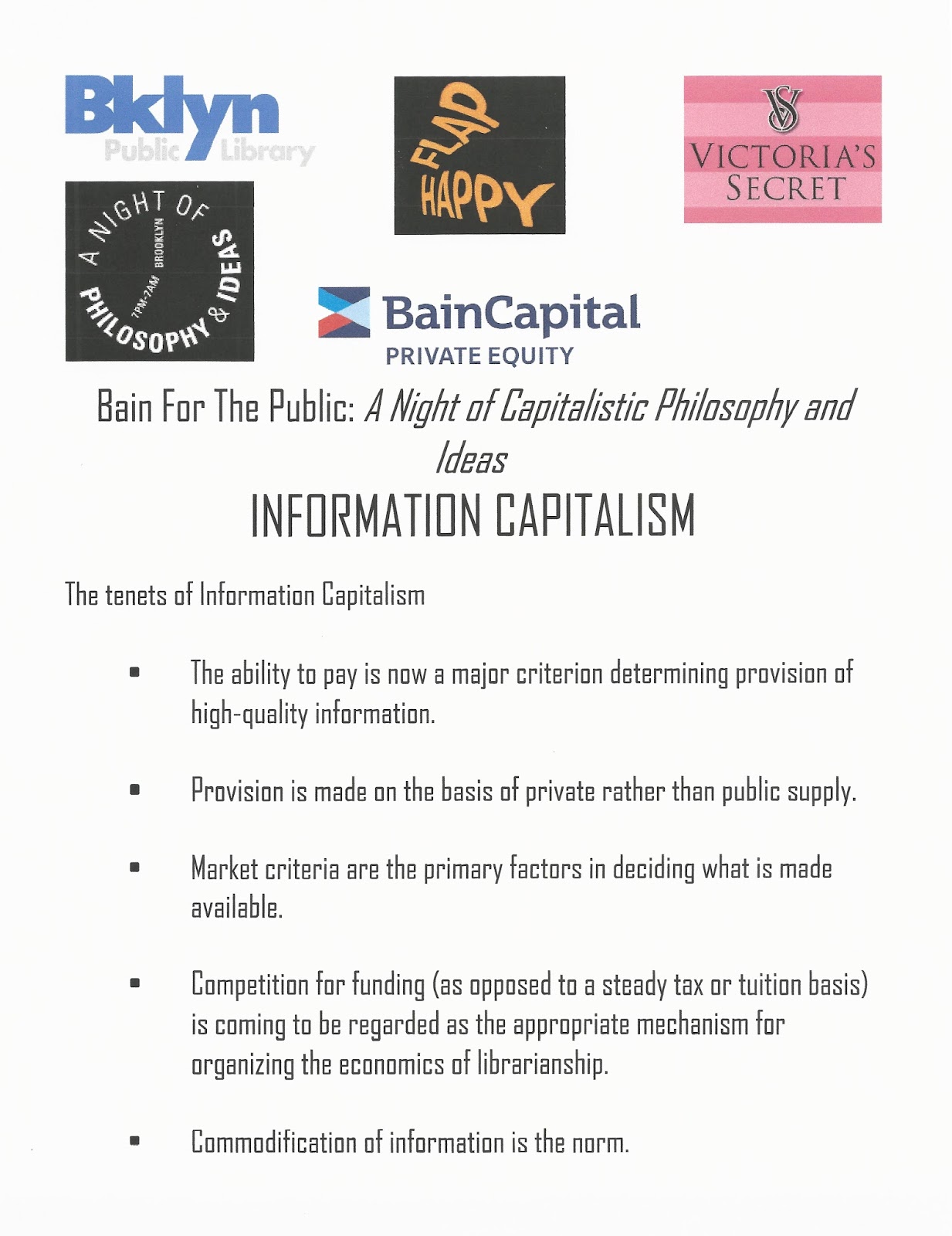
“Previously, we didn’t steer the ideas under discussion so much,” said BPL spokesperson David Woloch, “but in honor of bequeathment of the Romney name we will provide a focus this time.”  Mr. Woloch said that libraries are about “information,” and that being “a `maker’ in a DIY, pull-yourself-up-by-your-bootstraps society is about capitalism” so that putting the two together the focus for the evening would be virtues of “information capitalism.”

Click to enlarge
Mitt Romney’s own Bain Capital has been gathering together some of the suggested reading material.  Included is a selection from John E. Buschman’s “Dismantling the Public Sphere- Situating and Sustaining Librarianship In the Age of the New Public Philosophy” where he summarizes an overview of thinking from Frank Webster setting forth what he sees as the tenets of “Information Capitalism.”  Although what was presented was intended by both those authors to be a critique of “Information Capitalism,” the executives at Bain thought it was a spectacularly well put description of what they believed in and ought to promulgate.  Those tenets were summarized as follows:   
    •    The ability to pay is now a major criterion determining provision of high-quality information.
    •    Provision is made on the basis of private rather than public supply.
    •    Market criteria are the primary factors in deciding what is made available.
    •    Competition for funding (as opposed to a steady tax or tuition basis) is coming to be regarded as the appropriate mechanism for organizing the economics of librarianship.
    •    Commodification of information is the norm.
    •    Private information vs. public is favored.
Makers coming to spend the night to discuss “information capitalism” will be invited to bring and change into their pajamas.  “We think this will help us corral a lot more young people,” says Woloch, “something that’s very important to us.”   In addition, following its new principles the BPL now holds no events without partnering with private sector partners.  In this case it will be partnering with Victoria's Secret and Flap Happy, another pajama manufacturer.  Models from  Victoria's Secret will stroll through the Romping Rooms modeling night lingerie, “which should certainly help with our young male attendance” says Woloch.  The BPL is not breaking any new ground here: Britney Spears unveiled her new lingerie collection in the Celeste Bartos Forum of the NYPL’s sassy SASB in 2014.
In 2014 Britney Spears howed off her new lingerie (right) in the Celeste Bartos Forum of the NYPL’s sassy SASB (center) while the SASB stacks (left) were empty of books
Flap Happy will be donating free pajamas for those who don’t bring their own.  What kind? Rompers with feet of course.  The Rompers will have the Bain Capital Logo embroidered above a (not so vintage?) Romney presidential campaign buttons.  Bain is also partnering in the event and Flap Happy is one of the companies, now manufacturing in China, that has been through a Bain restructuring that stripped out excess value.

“We expect we may start implementing modest charges to use the Romney Romping Rooms,” confessed Ms. Johnson. “Modest charges are a way of testing whether makers are really and truly real makers. . . plus it will serve to reduce the absurd cost and burden on society of maintaining libraries.”  Ms. Johnson says the charges, the kind of thing that was previewed by the BPL when it was turning over library space free of charge to Spaceworks, a private company with good intentions like Bain, “does not mean that we are privatizing the space.”

“Our libraries have always been a public commons,” says Ms. Johnson, “but we are talking about ushering in the future and while the libraries continue as a commons in that future we understand that commons in terms of having evolved and kept pace with the future to become the neo-commons that makes sense today.”

The Times article about the changes in the library tells us that Congressman and former librarian Major Owens was always referred to the “Librarian in Congress” a play on the “Library of Congress.”  The BPL’s David Woloch is frank when he is asked about why the library is being named after Major Owens:
Several reasons: There is the fact that Major Owens was black and we have to cover over and divert attention from how harmful what we are doing to the libraries is, most particularly to people of color and those who are not so very wealthy.  Then there is the felicity of the name `Major.’  When you are consolidating and shrinking libraries it makes those libraries seem bigger if you can call them `Major.’  In fact, where we used to call this particular library the `central’ library, we are revising it to call it the system’s `major’ library, so it will be a `Major Major Library.’
“I know that’s sort of Hellerish thing to do,” Woloch told the Times reporter making sure reporter was “Catch 22ing” that he was making a “literary allusion.”

Chris Owens, son of Major Owens, a musician, singer-song-writer, politically active as a District Leader, former candidate for political office himself, and an activist who fought Atlantic Yards says he is not going to be fooled by the BPL naming anything after his father.  He says:  
Anyone who accepts what they are doing to the libraries by turning them into real estate deals and eliminating books with space conversions is getting `booby prizes.’  It’s unacceptable.  My father was Democrat and nobody is going to allow his name to be wrapped around a bunch of Romney Romping Rooms named after a Republican looking to fleece the public.  Now that the BPL has announced the intention to use my father’s name they’ve booby-trapped this for themselves because come time to cut ceremonial ribbons we will call them out on this.
Chris Owens went on to link it into the Atlantic Yards fight:
We fought Atlantic Yards and we fought Bruce Ratner.  We know that the first two most valuable libraries the BPL wanted to sell, Pacific and Brooklyn Heights were both adjacent to Ratner’s Forest City sites.  We know that the person who prioritized those libraries for the BPL’s sale came from Forest City Ratner. We are not going along with any of this cover-up.
So why did the Times begin its article about what the modernization of a library by recounting a dream about librarian-seeking aliens and robots?  Why were “Robots” referred to in the Times headline for the article?

BPL robot librarians
It was possible to refer to “Robots” in the headline because the article explained how the library makerspaces could now be used by makers to build robots.  The BPL’s Woloch also bluntly explains there was another reason: “We asked the Times to put `robots’ in the title of their article. People were regularly Googling to find a Noticing New York article about how the BPL is on the cutting edge of introducing robot librarians to replace the real ones.  Putting`robots’ in the title of the Times article helps divert attention when people are looking to find out how soon we might really be shifting to robots librarians.”

But to be fair, there is real talk about using library `Romping’ spaces for various sorts of robots to roam.   Architect Francine Houben, working for the NYPL, has suggested that the new central atrium of the soon to be renovated Mid-Manhattan Library will be an excellent place to test fly robotic drones before procuring a license to fly them outside, especially if sight lines are improved by the oft suggested removal of bookstacks.  Such robot drone flying includes test flying swarms of new nano-robotic bees.
New Mid-Manhattan atrium space- According to architect Architect Francine Houben a perfect place to fly drones, even better if the book stacks are removed as suggested.
Yes, it is possible to imagine a future where, when you visit a library, you will be met by a flying drone and, surprise, it will be your librarian ready to serve you.  (Such flying robotic librarians would also solve surveillance challenges in keeping track of what patrons read.)

But why aliens?  Does it seem creepy that everyone these days is suddenly always bringing up extraterrestrial aliens?  Fox News, New York Magazine, Saturday Night Live, even on the front page of the New York Times?  Is everyone having the same dream?  Like in “Close Encounters of the Third Kind”?

Here is the creepy thing.  The NYPL is selling the biggest science library in New York City (SIBL, the Science, Industry and Business Library) to the son of a librarian, a man who became wealthy beyond belief through his knowledge of science.  The man leads a life like he is hell-bent desperate to be written into a James Bond novel, a feet of the world’s largest yachts, a fleet of vintage warplanes, building the largest airplane in the world, building a plane to go into space.  His name is Paul Allen.  Mr. Allen also had a sci-fi sort of dream that could relate to what a landing alien in the future might find if they land: A dying or threatened civilization that can only save itself t it can find the trove of knowledge it needs.

What, additionally, is Mr. Allen spending his money on now besides privately acquiring NYC’s biggest science library?  He is spending muti-millions of dollars on trying to discover the extraterrestrial aliens out there!  And now, just so you know, that is absolutely true, notwithstanding that this article has been an April Fool’s article written satirically for your amusement even as it riffs off far too much else that is unfortunately too, too true.  (If you want to know how real such threats truly are to our libraries, go to Citizens Defending Libraries, of which I am a co-founder, and there you will find facts galore.)
Something more that is true: At the last Brooklyn Public Library trustees meeting on February 27, 2018, where trustees were given copies of the NYPL's the BPL's updated "strategic plan", the creatively titled (but hard to type) "Now➔ Next."   At the same time, the trustees were told that a substantial portion of the Grand Army Plaza, Brooklyn’s biggest library would be closed for a long while the library is “modernized” and, as described by the Times, its stacks eliminated.  What’s more, as was clear with what else the trustees were told the meeting there will be other libraries concurrently off-line: The central downtown Brooklyn Heights Library, once Brooklyn’s second biggest library and the only other central destination library is closed and now a hole in the ground as it is substantially shrunk, pushed more underground and its books largely eliminated as it is replaced by a supertall luxury tower (its Business, Career and Education Library has virtually disappeared), the Sunset Park Library will be shut down as it becomes a real estate project, construction will similarly put the Brower Park Library into the Children’s museum in another consolidating shrinkage, the Greenpoint Library too is getting `modernizing' construction.  Creation of a DUMBO library as an experiment in teeny-weenyness was supposed to pick up some slack, but the trustees were told they haven't yet found the teeny-weeny space for it.  This will be as Mid-Manhattan the city’s largest circulating library is closed for book-eliminating “modernization,” the 42nd Street Central Library where books have been eliminated undergoes work and, as mentioned, SIBL, the city’s largest science library is sold to Mr. Allen, its science library eliminated.

That said, in the spirit of April 1st let’s put just a few more last words in the mouth of BPL spokesperson David Woloch:
In today’s day and age of the internet, the inconvenience of temporarily closed libraries matters less and we’ve steadily removed a lot of the books from the shelves ahead of time in tests that proved our conclusion about this to be true.  These extended concurrent closures of library space will also help people forget what libraries were in the past while letting them get used to not having libraries in the present so that in the 21st Century future people won’t even know what they are missing when we reopen our doors of those spaces we have, for the time being, still kept, to experience our fabulous Romney Romping Rooms.  Besides, in the interim, we are partnering to send our library patrons off to city museums with a new “One-Pass” or "NYC culture Pass" Museum visit program.  This is great because Museums are themselves partnering with profit making partners seeking attention with sensational blockbuster shows.  Moreover, in the future, for greater efficiency and cost reduction we may further meld our infotainment institutions, so who knows what we will then be asking people to get used to or to do without.
For real: Linda John before the BPL trustees on February 27th ad they are told about a "culture pass" to send patrons to museums.

Saturday, June 10, 2017

Stephen A. Schwarzman The Man Making Deals To Privatize The American Public’s Infrastructure?: It’s Unforgivable (And Coming From Trump)

When Trump's visit to the Saudis wound up with Blackstone's Stephen Schwarzman walking away with a huge benefit for Wall Street plutocrats, a number of other deals detrimental to the public were struck at the same time.
Blackstone head Stephen A. Schwarzman is notorious for pocketing the most income of anyone in the world.  So you may very well find it annoyingly disproportionate that in 2016 it was reported that Mr. Schwarzman’s take home for the year in 2015 was $810.6 million.  That’s if that kind of extreme disproportion bothers you.

And if you are already unsettled by that information, consider that huge portions of Mr. Schwarzman’s income are taxed at less than half the usual rate, just 15%, because of the carried interest loophole that he lobbies hard to keep in place for his continued benefit.

Now consider this, which you can learn from Jane Mayer’s 2016 book, “Dark Money, (The Hidden History of the Billionaire Behind the Rise of the Radical Right)”: When asked whether his own taxes should be raised given the dire state of the economy, Mr. Schwarzman said, to the contrary, the poor are the ones needing to pay more in taxes.
Wth a huge part of his $810m 2015 income taxed at less than 1/2 the usual rate Stephen Schwarzman says poor should pay more taxes, not he.- Jane Mayer's "Dark Money."
There is even more to annoy you if you want to acquaint yourself with some of the ways that Mr. Schwarzman reportedly earns his money.

How is it that this man who believes we should take from the poor while simultaneously privileging the rich with such special and unequal advantage should have been given a key role in saying that our NYC libraries should be sold and shrunk, the books banished?  Should we add details about how the wealthy were benefitted by these library sales at the expense of the rest of us?
War as busine$$ tied to $$ flow to Ivanka (like HRC & Clinton foundation) and Schwarzman's Blackstone.
Now consider this about Mr. Schwarzman . . .  it’s news concerning the jeopardy other of our national public assets are likely to be prey to. . . Did you note what was reported when Donald Trump visited Saudi Arabia on weekend late this May?  Deals were made. .
    •    Trump signed arms deals to provide the Saudis a record $110 billion in arms (expected to total more than $350 billion over the next 10 years), which will, among other things help support Saudi Arabia’s continued bombing and decimation of Yemen.

    •    The Saudis pledged:
    •        a $100 million donation—made along with the United Arab Emirates—to a new foundation being proposed by Trump’s daughter Ivanka, a World Bank fund for women, (Does that sound too much like nepotistic crony capitalism an therefore antithetical to the public interest the way that it also sounded when the day that Trump and Ivanka dined with the Chinese President Xi Jinping at Trump’s Mar-a-Lago Florida resort, the Chinese government awarded Ivanka three new exclusive trademarks for her brand of jewelry, bags and spa services - with China, in the background, also granting preliminary approval for another 38 Trump name trademarks?  Or what about the way the China has now locked up three people who were arrested while they were investigating labor conditions at a factory manufacturing Ivanka Trump brand shoes?  Does it also sound uncomfortably like the Saudi donations to the Clinton Foundation that Donald Trump excoriated during the campaign?) AND 
    •        a $20 billion investment in Schwarzman’s private equity firm Blackstone Group firm (along with investment is some other U.S. Companies not apparently worth much mention) that is planned to be used as “cornerstone” seed money for privatizing U.S. infrastructure.
And there are those who believe that it's evident that there was yet one more qui-pro-quo sell out of the public interest was part of the bartering during the visit, another Trump give to the Saudis:
    •        The June 1st Rose Garden announcement by Trump that he was withdrawing the United States from the Paris Climate Accord.
The thinking on this as explained by oil and energy journalist Antonia Juhasz is that (while also pleasing the Russian petrostate):
Saudi Arabia has desperately been trying to stop the climate accord process for years, and does not want, for very obvious reasons, the world to declare its lack of an intent to continue to use carbon-based fuels. And Trump came back from Saudi Arabia and announced that the United States would be eliminating its commitments and pulling out of the Paris climate accord.
Mr. Schwarzman is also the head of Trump’s business advisory group, which the New York Times notes “lists infrastructure work as one of its topics for discussion.”  (He also sat beside Trump for the fanfare when Trump announced that he was deregulating Wall Street.)

The White House has been promoting this past week as “infrastructure week,” some say partly as a hoped for distraction from the James Comey testimony.  But the promotion of the pending infrastructure deals has been criticized for `baffling everybody with the total lack of details.'

The privatization of what are normally publicly owned assets and infrastructure often involves straight out transfer of legal title and ownership of public property into private ownership (sometimes it is a murkier transfer of sets of rights, licenses or leases), but the fashion among those promoting these deals is to call them "partnerships," and increasingly they are now being referred to by the jazzy initials "PPPs" as if they are something new; they are not (their promoters have had some of their plans in the works for decades).

The Wall Street PR is that "PPP" stands for "Public-Private Partnerships."  Those who understand better what the 'arrangements mean from the standpoint of public benefit are more inclined to reverse that and call them "Private-Public Partnerships" because of what happens when the private sector is put in the driver's seat to structure these deals in the way that most benefits the private sector.  "PPP" may also be thought of as standing for "Profit Producing Product": Unless you can contort these deals into producing profit (and immediate extra cost to the public) the private sector walks away from them.  If a deal involves a heavy-lifting challenge, government will be left to do it alone.

"PPP" could also easily mean "Profit Pitted against the Public" or "Profit Pummels the Public."

Private profit and public benefit tend to be focused on different goals and agenda, as apt to be at loggerheads than conveniently aligned for `partnership.'  Exactly who uses a certain road or certain public asset, at what time of day, day of the week or at what costs and with what ease of access and why they do so, is apt to involve all sorts of external public benefit calculations, but for the private sector seeking profit only one bottom-line objective controls: Pleasing the stockholders, building up their bank accounts.

Many, including the New York Times with a requisite quote from an expert in the field, warn that one problem with assuring the public interest is properly balanced and against the private sector’s greed when these deals are struck is that “public officials negotiating these arrangements sometimes lack the financial sophistication and advice to fully understand the deals.”  What is probably the far greater concern is that with all the pay-offs to public officials that come with crony capitalism, those same public officials are heavily pressured to at least pretend they don’t understand the harms to the public or excess benefit to the private sector.

It was unforgivable to make Stephen A. Schwarzman a decision-maker about selling and shrinking our NYC libraries given his expressed priority of soaking the poor while ensuring that his obscenely unfair  collection wealth continues full tilt.  It is highly instructive to see how those kinds of priorities played out with the sale of the Donnell Library, the first major library (a beloved central destination library in Manhattan) sold as an example of one of these "Private-Public Partnership"  See: Priorities To Be Replicated?: Private Luxury Now Abounding Where Former Donnell Library Stood, A "Replacement" Library Is Nowhere In Sight, Saturday, November 7, 2015.

Notably, one of the principal financial private sector beneficiaries of the Donnell Library sale was Jared Kushner, Donald Trump's son-in-law, Ivanka's husband, and now a key advisor/deal maker for Donald Trump as president.  Schwarzman was on one side of the deal pushing the library out of public ownership: Kushner was on the side that benefitted. . .

. . . All of this is worth remembering when we ask what is in store for us as the Saudis put billions of seed money into Schwarzman's hands intended to prime the pump for a wholesale sell off of American public assets to the private sector.