Showing posts with label de Blasio. Show all posts

Wednesday, December 29, 2021

Merry Christmas and a Happy New Year From Our Departing Mayor: NYC Residents Must Check Vax Status Of Babysitters, Housekeepers, Plumbers Under New Mandate

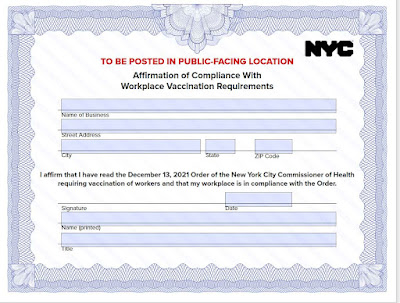
Your home is a workplace! Post this there visibly to attest that you are requiring your nanny and any plumber, or private tutors entering the premises to prove they have been vaccinated.

Jezzum!!!

Talk about scary!!

I am even asking myself of this is true.  If it’s true, why isn’t it a major story in the New York Times? . . . But it does seem to be true!  The Gothamist is reporting it solemnly in a way that doesn’t look like a spoof that would have gotten through holiday-distracted editors.  WNYC is sending the story along in emails, maybe on the air as well.

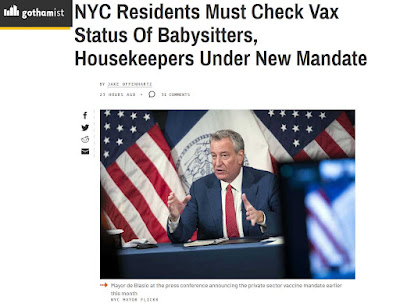
Here is the headline in the Gothamist:

NYC Residents Must Check Vax Status Of Babysitters, Housekeepers Under New Mandate,  by Jake Offenhartz, December 28, 2021.
Gothamist article on de Blasio's Nanny Mandate

This requirement comes from our departing mayor Bill de Blasio days before his administration ends. In a probably obligatory way the NYC Health Commissioner is mentioned as being involved.  The City Council wasn't involved.

Really awful things often get shoved through on the cusp where one administration is exiting and another coming in. That’s true often at the local government level or at top national levels.  It dilutes accountability and blame.  One day, you may not even be able to remember who did it, and where will Mr. De Blasio soon have moved onto by then?

I’ve tried to keep Noticing New York out of the Covidian debate issues, but this is such an authoritarian shift in city governance it can hardly go unnoticed.  You have to ask: What this kind of high-handed intrusion into people’s lives might herald for the future in many areas aside from Covid?

Here is some of the text of the Gothamist article telling the story- escalating fines and penalties starting at $1,000?:
    The mandate, which took effect on Monday, means that city residents who may not think of themselves as traditional employers are now legally required to check the vaccination status of those paid to work in their homes, according to Nicholas Paolucci, a spokesperson for the city Law Department.

    * * * *

    Paying a handyman on TaskRabbit to mount a new flatscreen TV on your wall? Under the city’s latest executive order, the person doing the hiring is technically required to verify the handyman’s proof of vaccination. The same goes for nannies, plumbers, movers, private tutors and just about any other professional not directly employed by an outside entity.
    Those that don’t abide by the rules could face a fine of $1,000 – with escalating penalties on subsequent violations, according to the city’s guidelines.

    * * * *

    . .  Over the weekend, AKAM, a property manager with roughly 50,000 units across the city, informed residents that they would have to obtain vaccine compliance forms from any worker entering their building.

    “Each resident should be able to provide that proof of vaccination to the Management team if requested,” an email sent by AKAM read. “The property reserves the right to revert any fines or other penalties for non-compliance back to the resident if they are determined to be the cause for non-compliance.
All of this with zero reference to the context of the comparable or superior immunity that it is believed unvaccinated people may have from having had Covid already.  At this point, numbers indicate that probably half of New Yorkers or more have already had Covid.  It also seems to have zero acknowledgment of the ineffectiveness and short-term protection of the vaccines, especially when it comes to the newer variants.  The vaccines don’t provide protection immediately (even you can then carry around a card) and a few short months after a “booster” (three?) the protection may have ebbed to as low as 30%. . .

The New York Times has even published on its front page the thinking that: “too many shots may eventually lead to a sort of immune system fatigue, compromising the body’s ability to respond to the virus.”

. . . Meanwhile, a major New York City medical center is sending me repeated emails telling me that children over five should all get the still experimental vaccines.  Is that truly good, reliable advice for a major medical center to be sending out?  What if your doctor has different opinions about all of this?

Do I now have to be fined $1,000+ or fire my parent’s trusted long-term caretaker because her doctor has advised against her getting a “booster,” including because she had bad side effects from previous shots?

Merry Christmas and Happy New Year from our departing Mayor de Blasio.

Thursday, April 1, 2021

Legal Eagle Arthur Schwartz, Attorney Skilled In Opposing Privatization, Says He’ll Stop Mayor de Blasio’s Even Worse Scheme To Leverage“Covid Emergency Streeteries* Declaration” Into More Real Estate Development

Double height streetery - Fifth Avenue in Park Slope- last spring it was single height.

(* Also spelled 'streateries')

Mayor Bill de Blasio, (“Build de Blasio” as he is affectionately known by some in the real estate development community) has an even worse plan with respect to his use of “Covid emergency” declarations for a privatizing takeover of public space to enhance private real estate ownership in New York.  It’s an even worse plan and attorney Arthur Schwartz of Advocates for Justice says that he’s going to fight and defeat it.  Mayor de Blasio's plan is that he wants to turn property owners’ street occupation rights into even more development rights than previously imagined.

Schwartz noted how he had already sued when the City Council unilaterally decreed the Open Restaurants Program permanent and he confidently predicted that he would not let this new, expanded and even worse version of that “Covid emergency” based declaration get one wit further.   Respecting Schwartz’s earlier legal action see: The Village Sun (Real News For The Community)- Locals to sue city over ‘illegal’ Open Restaurants program, by Lincoln Anderson, March 9, 2021

Schwartz previously attacked the de Blasio and the City Council for using the “Covid emergency” as an excuse to make `Open Restaurants Program’ permanent by passing a law (Intro 2127-A), November 15th of last year, that gave the mayor’s Department of Transportation and whatever any other agency the mayor designated unfettered power to create a permanent program to give the streets away for ‘restaurants.’  In the lawsuit Schwartz brought pro bono (representing an ad hoc coalition of community groups under the umbrella name “New Yorkers for Safe Open Streets” a.k.a. S.O.S.) Schwarz pointed out that this extensive delegation of power to the mayor and his agencies  amounted to “unconstitutional” changes to the city’s zoning laws bypassing community input and  “totally ignoring” the City Charter’s Uniform Land Use Review Procedure (ULURP), a process that specifically requires zoning change review by community boards, the borough presidents, the City Planning Commission and the City Council.

Schwartz said that the permanent long-term giveaway of streets to neighboring properties was a privatizing handout to landlords, and that:    

basically, property owners would be able to charge higher rents due to the permanent availability of the parking lane for use for additional seating.
In other words, with higher rents being charged, there would be no benefit to restaurants or restaurant owners.

Ultimately, the community activist attorney* said, the Open Restaurants program post-COVID would not benefit restaurants, only landlord property owners who would be able to charge higher rents due to the permanent availability of the parking lane for use for additional seating.  “You can’t be doing this without any parameters at all,” says Schwartz adding to his objections, “there isn’t even the slightest framework to hem in the mayor and his agencies from doing absolutely anything they want or can imagine.”

(* NOTE: Arthur Schwartz is the same community activist attorney who successfully represented WBAI free speech radio, "Radio for the 99.5%," the only truly listener supported public radio station in New York City, in fending off a potentially privatizing attack on the station that involved the surreptitious and illegal shutdown of the station in October 2019.)                       
The Village Sun article includes this overview analysis by Schwartz, “speaking to The Village Sun,” he said:

what is currently being seen with the Open Restaurants diktat is part of a wider problem of community disenfranchisement perpetrated by City Hall.

“To me,” he said, “it’s part of an approach taken by the city that is also reflected in the recent proposal by [Council Speaker] Corey Johnson to create a ‘zoning czar’ that would shorten the ULURP process, where decision making on land use is getting more and more centralized and less involving the affected communities. This is imposing the will of the mayor on communities without their having a say.”

Those of us who have been watching the effect of Covid on city real estate are worried that this will also compound consolidating ownership: Are we are going to be seeing greater consolidation of property ownership in a city where a limited number of real estate families already dominate excessively given the squeeze of high property high taxes from a stressed city in need of income while store fronts are vacant as Mom and Pops close because of the virus?  Mom and Pops, unlike the big box stores, don’t have a parallel web-sales presence to help carry them through.  Big real estate owners also seem to have an affinity for big-box chain stores where they can replicate deals over swaths of property. . . All this in a city where City Hall has been handing out huge acreage swath to single owners, like the Atlantic Yards (now “Pacific Park”) project, Hudson Yards, Willets Point, the Columbia takeover of West Harlem, etc. often with the aid of eminent domain abuse seizures of property from smaller owners. And now public streets and sidewalks will be consolidated in that ownership.

Mayor de Blasio has defended making the `Open Restaurants Program’  permanent saying that assuring that permanence will induce the construction of sturdier outdoor enclosures to accommodate restaurant patrons.  He notes that many of the streeteries initially built last spring were ramshackle affairs, thrown up often so improvisationally that they constitute unsettling eyesores to the community.  "Knowing that you can keep, rather than quickly scrap what you build, will generate investment in far lovelier enclosures as people think in terms of a future and build with that in mind," said de Blasio.  

Irving Place is one of the streets where sturdy streeteries are expected to be greatly expanded under the new de Blasio permanence program.


Mayor de Blasio’s new edition of the `Open Restaurants Program’ is supposed to be initially be launched mostly by new regulations issued by the mayor. Ideas for it started to get generated when Evan Moore a Department of Transportation Deputy Director was conferring and trading expertise and thoughts with Max Tolstoy of the Department of Buildings.  With the streeteries built last year becoming more permanent and with the continuing need for such legal “outdoor” spaces to accommodate patrons given the prospective bans on indoor restaurant space, a number of the streeteries were informing the city that they were going with the expedient of building second stories to their “outdoor” space.

Moore and Tolstoy quickly realized there were implications to be considered.   For instance: `Should staircases meet any prescribed code standards?’  This led to trying to think through possibilities through on a more integrated basis.  `Should second stories only be permitted for those who had built sturdier structures making use of the outdoors, for instance, those with locking doors, and operable glass windows?’ Then it was realized that with outdoor staircases possible, maybe even lifts and sidewalk elevators being used, especially if wheel chair access is to be nondiscriminatorily provided, why not consider putting some of the new outdoor space structures on the roofs of shorter buildings?

Irving Place is a good small street to see in microcosm many solid doors and sturdy operable windows on streeteries.

Thinking multidimensionally this way, and thinking of building upwards in general, Moore and Tolstoy realized they had a tool to work with that they hadn’t been thinking about, known to those who understand the zoning code and regulations as "FAR," for Floor to Area Ratio.  The FAR concept, already in the code and thus already available, prescribes that how much and how tall you can build in terms of total square footage will be determined as a multiple of the dimensions of the real estate you own absent any structures.  Thus, formally recognizing the right to permanently occupy what was parking lane space as the addition to the owned property that it actually is, means that all building owners with such space attached have additional FAR with which to build higher and more real estate.

Mr. De Blasio, immediately blessed this concept with the caveat that any new space built with the additional FAR coming available would have to be deemed “outdoor” space for a period of time, a period of time that would also have to have some conceptual relation to the period of time that people think that Covid, at least as a crisis, is expected to be around.  Furthermore, the space would also have to be deemed restaurant space throughout that period.  De Blasio further specified that, somewhat along the lines of some of the legal concepts of `adverse possession’ or `possession is nine-tenths of the law,’ the Moore Tolstoy Open Restaurants Program should henceforth start requiring that parking lane street acquisitions and everything built under the program should be built with a certain level of sturdiness and meet certain minimums of protected enclosure in order to be considered certifiably consummated.

On 19th Street and Park Avenue, one of the city's streeteries is now rebuilding in a sturdier fashion planning to take advantage of de Blasio program loans for structures of greater permanence.


“But you can’t just expect that people will be able to do all this building under the program with insufficient resources to do so,” said de Blasio.  That is why eligible owners applying to City Hall for approval will be able to take out loans from the city, “Sturdier Construction Underwriting Motivation” loans.  Modeling the program on the federal Covid program Paycheck Protection Program (PPP) loans, these loans will likewise be forgiven if the structures built are sturdy enough to stand for one year.  The loans will be funded by tax-exempt bonds issued by Goldman Sachs.  The City’s former deputy mayor for housing under de Blasio, Alicia Glen will get a finder's fee for the bond transaction.  Although Glen is not now with Goldman, she came to work for de Blasio as Deputy Mayor for Housing from her previous position with Goldman where she led Goldman Sachs’s Urban Investment Group.  Glen said that it required a lot of thinking, `to whom the loans should go,' but that Goldman was advising that loans should, for logical reasons, go to the property owners, not the restaurant operators.  She said this was the advice the city was going to go with.

Most of the streeteries on Fifth Avenue in Park Slope, the neighborhood from which de Blasio originally hails, are expected to go to two story editions

Because most of the loans are expected to be forgiven rather than repaid, the source of funds for bond repayment will have to come form another source.  Goldman has decided the bonds will be tax-increment bonds.  Instead of any repayment funds having to come from the real property owners acquiring new properties and building rights under the program, the bonds will be paid off by higher taxes (tax-increments) that the rest of each neighborhood’s properties will pay. This is justified, says Glen, by the additional value and overall uplift the new building and dining spots will add to the neighborhoods.  To encourage their acquisitions, the street property acquiring owners will be exempt from real estate taxes for five years.

Arthur Schwartz says he will fight the new Moore Tolstoy Open Restaurants Program for all the same exact reasons he brought his lawsuit against de Blasio’s initial Intro 2127-A version of the program prior to these new expansive interpretations, and he emphasizes that this version has all those same faults, flaws and unconstitutionalities, while at the same time "being ten times worse" . .  Schwartz says he is absolutely confident he will prevail. . .

. . . Nevertheless, mayor de Blasio is set to boldly announce, in a press conference today, the Moore Tolstoy Open Restaurants Program along with Goldman's imminent issuance of its tax-increment bonds for  the“Sturdier Construction Underwriting Motivation” ("SCUM") program loans.  That should make a lot of restaurant landlords happy, this first day of April, April 1st.


Another streeterie in Park Slope that just went to two stories in March.

And one more

Monday, October 16, 2017

Manhattan District Attorney Cyrus Vance Scandals: Jared Kushner and Ivanka Trump- One! Harvey Weinstein- Two! Bill de Blasio Library Pay-To-Play Scandal- Three?

If you have been catching up with the news recently you know about the scandals involving Manhattan District Attorney Cyrus Vance.  . .

Vance's office was ready in 2012 to prosecute Ivanka, the daughter of Donald Trump and her husband Jared Kushner for real estate fraud, “allegedly duping prospective buyers in a failed Manhattan project dubbed Trump Soho” (a violation of the Martin Act).  Reportedly, against his staff's recommendations (and despite some damn good email evidence), Vance did not prosecute.  His receipt of campaign contributions was involved. . .   Now under the spotlight, Vance just gave back money, a $31,000 donation from Father (Donald) Trump's lawyer, Marc Kasowitz, he took in 2013 after dropping the case.  Another $9,000 from employees at Kasowitz’s law firm and $9,000 more raised at a breakfast hosted by Kasowitz was not returned.

That's one scandal!

Then there is the case of movie production mogul Harvey Weinstein whom a slew of women have now accused of sexual assault and harassment.  Vance made a decision not to prosecute Weinstein in 2015.  His decision not to prosecute was despite an very damning police sting audio tape that documented his harassment of an Filipina-Italian model Ambra Battilana Gutierrez in a Manhattan hotel.

Again, Vance's receipt of campaign contributions was involved.  . . The lawyer, Elkan Abramowitz, who helped Harvey Weinstein avoid charges (Vance's former law partner) reportedly donated $26,550 in campaign cash to Manhattan District Attorney Cyrus Vance Jr. (including $2,100 after Vance let Weinstein walk) plus, according to campaign finance records, his law firm gave Vance another $11,500, before Vance's Weinstein decision.

That failure to prosecute is scandal number two!

The media is beginning to notice and connect the two because of the similar behaviors on Vance's part.  The New York Times editorial board issued an editorial saying: "that eyebrows understandably soar skyward when a district attorney pockets cash from a lawyer who may have a client facing charges that could send that client to Attica.. . .  As lawyers might say, res ipsa loquitur. The thing speaks for itself."

Is there one more? 
. . . Now you might remember that until recently Cyrus Vance was working with US. Attorney Preet Bharara to investigate pay-to-play deals by Mayor Bill de Blasio.  And you may remember that one of those pay-to-play deals was the sale of the Brooklyn Heights Library.  Then Donald Trump fired Preet  (March 11, 2013) and just a few days later (March 16, 2013) all these investigations were dropped. . .  And?  We'd love to know more about what was involved.

Preet Bharara has since lifted the curtain to say that he believes that before he Trump fired him Trump was trying to “cultivate” a relationship with him where he'd be asked by Trump to do the wrong thing.

How hard do you think it would be to trace aspects of the Brooklyn Heights Library and other pay-to-play deals being investigated back to campaign contributions to Vance from those close to de Blasio or Democratic party operatives or involved developers wanting de Blasio's real estate favoring reign to continue undisturbed?:  The Times editorial noted that the list of Vance's donor's "is strewn with law firms and individual lawyers" some of whom "may have unsavory motives when they open their wallets."

But we don't even have to get to that kind of extensive cross-checking to bring us full circle to the Vance contributions we have already discussed.  We need only note that the Brooklyn Heights shrink-and-sink-a-public-library scheme replicated the previously executed Donnell shrink-and-sink-a-library and replace it with a luxury tower scheme.  That Donnell deal also involved a woefully lacking excuse for a valid "bid."  For both deals there was a significant overlap of people involved behind the scenes.  And, if you could have flipped people to get them talking, the trail led back to Trump son-in-law Jared Kushner as a principal financial beneficiary from the sale of Donnell . .

. . . It's probably not exactly what Trump supposedly had in mind when trying to "cultivate" a relationship with Bharara unless you want to think generally in terms of privilege exercised by a well-connected elite prone to take advantage of the commoners.

It's been suggested that an excuse for Vance's decision not to prosecute is that it is waste of his office's resources to prosecute the powerful who can fight back and bollix up prosecutions by hiring expensive lawyers and pay for 14 carat obfuscatory PR maneuvers regular folk can't afford.  (Similar to the Weinstein case, in 2011, Vance abandoned a sexual-assault case against Dominique Strauss-Kahn, the former managing director of the International Monetary Fund.). . .

. . .  On the other hand, shouldn't our first priority be to prosecute the powerful whose conduct entrenches corruption at the core of our system and warps our most important institutions?

Coincidentally or not, The New Yorker magazine got the ball rolling with major stories it respectively ran about both the Kushner/Ivanaka Trump and Weinstein failures to prosecute. . .

. . . We could hope that another New Yorker story might get the ball rolling on a third such story about the non-prosecution of de Blasio.  Maybe not: David Remnick, the New Yorker's editor is a trustee of the New York Public Library and investigating the Donnell Library sale or anything leading back to it would be unconformable for the NYPL trustees (and perhaps particularly Trump buddy Stephen Schwarzman).

Or we could hope that another prosecutor with power and authority, most obviously New York State Attorney General Eric Schniederman, could pick up the scent . . . But maybe not: It has been noted that Schneiderman also takes political donations from those he could or should be investigating-  How was it that the Times editorial put it about eyebrows understandably soaring skyward when a prosecutor  pockets cash from a lawyer who may have a client facing charges that could send that client to Attica?

Vance is running for office unopposed in the November 7th election.

Saturday, April 1, 2017

A Giant Leap Forward Into Tiny Benefits: Bloomberg Micro-Apartment Initiative Shrinkage Grows Under de Blasio

The architectural question in a nutshell: With good design, how much space do people really need to live well?
It’s big news about the value that can be crammed into the what’s small.  Saying that good things can come in small packages is a teeny-weeny, really shrunken-down understatement when good creative design is unleashed to run rampant in terms of what it can accomplish.
Coverage of shrinking Micro-Units and their future from Curbed
Bold new design concepts the de Blasio administration is endorsing for adoption via new NYC Department of City Planning regulatory changes will, as a furthering step, grow the micro-apartment initiative launched by the Bloomberg administration that started back in 2013.  Many will remember how good tiny (“squeezy living”) apartment design was being studied by the Bloomberg administration when Mayor Bloomberg, vying with global warming champion David Koch for the title of wealthiest New Yorker, paced off, with uber-wealthy city planning commissioner Amanda Burden, the smallest space that economically challenged New Yorkers looking to be thrifty could live in.

Why wealthy City Planning Commissioner Amanda Burden and mega-billionaire Mayor Michal Bloomberg even have room for company as they searchingly examine to consider the tiniest apartment size fellow New Yorkers might live in.
A design competition held by Bloomberg’s administration led to micro-apartments that have already been built (Monadnock Development’s “Carmel Place”) to receive rave reviews by real estate industry press.   Special permission was given to have apartments of just 275 to 300 square feet ignore what were obviously outmoded tenement-banishing city rules that previously required new apartments built to exceed 400 square feet.  While that was first a trial exception its has been formalized as a new standard.
But shrinking apartments down to 275 or 300 square feet was obviously wasting space when good design can make apartments that are far smaller great fun to occupy while showing off one’s inventiveness.  Having started by thinking of small apartments that were 275 or 300 square feet as the new frontier, officials in the de Blasio administration were profoundly embarrassed to be confronted by the startling elegance of a Paris apartment that was garnering social media attention. That apartment was 8 square meters. . . or, converting from the metric system, it was, in square foot terms, an 86 square foot apartment, not even a third the size of what the Bloomberg set as its goal for what would be a supposedly “micro-apartment.” 
From the viral video of the Paris apartment.  Click if you want to try to enlarge.  It has captions- "Several ways to use the space are possible depending on different needs." "Easy to access"  for the bed in the top cupboard. "Proof that a small space doesn't have to necessarily mean a poor space."
That Paris apartment showed how versatility and good organization can ensure that space that could seem cramped seems humongous instead.  Another advantage: New Yorkers living modern lives and looking to frugally save their money have found that a smart crafty move in many respects is to own less "stuff."

When good design gets unleashed everything with respect to size is relative.  As Shakespear’s Hamlet once told companions Rosencrantz and Guildenstern: “I could be bounded in a nutshell and count myself a king of infinite space.”  Just as the superb ingenuity of the Paris apartment enlarged and made the Paris apartment hugely magnified and spacious, distilled inventiveness the de Blasio administration is fostering is making it possible to make even less space than that seem and and actually be utilized as if it as bigger.

The de Blasio administration decided to advance the achievements of the micro-unit program after the warm reception and good press coverage it got for its continuation of Bloomberg’s shrink-and-sink program for reducing the size of New York City libraries.  That program lets real estate developers willing to work with the de Blasio administration get the benefits of owning most of the real estate previously entrusted to the city for public library use.

Once upon a time, candidate de Blasio running for the office of mayor decried these Bloomberg administration sell offs saying: “once again we see, lurking right behind the curtain, real estate developers who are very anxious to get their hands on these valuable properties.”  More recently, de Blasio has been amplifying his thoughts expressed then saying: “When you think `curtains,' you think theater.  The city is an expectant audience.  What we are doing is raising the curtain dramatically so that the real estate industry can take center stage for us and deliver benefits the way that only the real estate industry can!” 

While these new "minimus-micro-units" will be slightly less expensive than larger apartments, they will, on a square foot basis, charge much higher rents than the higher rents per square foot rents that are being charged for the first micro-units constructed in the city, just as those pioneering small units, charged far higher rents, on a per square foot basis, than for typical larger apartments.  That's partly because the units are, on a square foot basis, more expensive to construct since the reduced general living space, means there is a proportionately higher amount of expensive building infrastructure; HVAC, piping, heating, etc.  However, on the flip side, there will be additional simultaneously costs-saving amenities: Tenants will all have easy access to sumptuous and exquisitely furnished common areas including bathrooms and kitchens with multiple hotplates and microwave ovens.
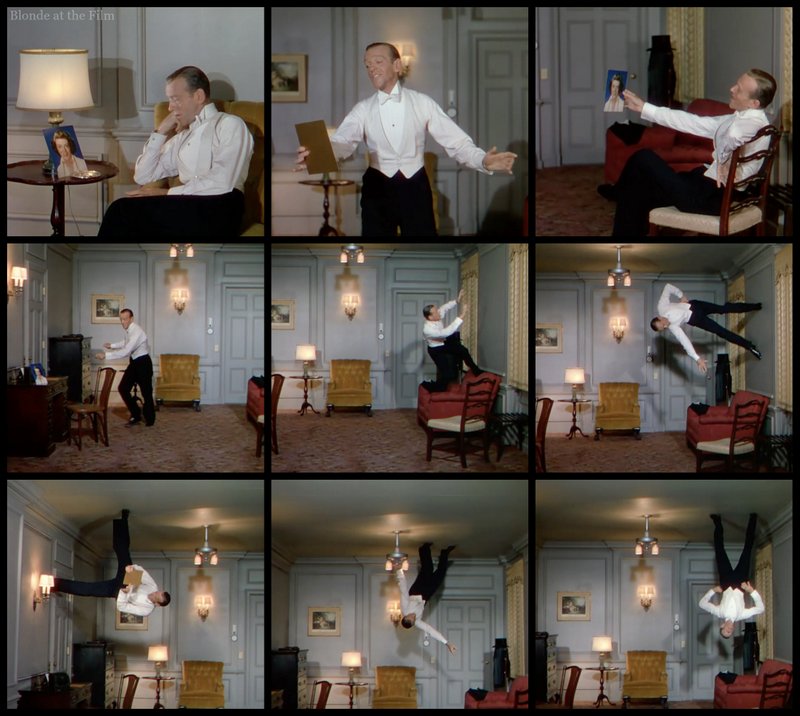
Fred Astaire in "Royal Wedding"- You get the idea: The trick was that the room rotated, which meant that the cealing and walls became more dance floor space for him for his talented footsteps to multiple over.
There is every reason for renters of the new minimus-micro-units to feel “royal” as they occupy them.  The break through enabling their leap forward in fitting people into space came from an architect working at the Marvel Architects firm, Isadore Doonaut Squrlay.  Until recently, working at SHoP Architects, another firm getting a lot of city project related business, Mr. Squrlay signs his correspondence and memos “Izzy,” but is generally referred to around the office as “I.D.”  “I call it my `Royal” idea” said Mr. Squrlay, “because I got my idea from Fred Astaire, more specifically Fred Astaire in `Royal Wedding.’  Probably everybody remembers the famous scene where Fred Astaire dances around a room, first up the walls and then on the ceiling.  Well I was watching that scene and I realized how every which way it flipped the rooms seemed like a different rooms with a whole lot more space we usually don’t think of using.  And I thought: `Why not do this for real? People could be climbing the walls for real!’”
Either Rosencrantz or Guildenstern could come visit Hamlet.
The round rooms unlock and rotate as desired, shifting based on a person’s weight, rolling on ball bearings, “brass balls,” says Mr. Squrlay, “you really have to have brass balls to do something like this.”

Allowing the units this 360 degree flexibility allows for a incredible versatility.  A ceiling becomes a bed, a few angles over it it's a recliner or props you up to read in bed.  If the rotation is left unlocked occupants can get far more (maximus, maximus) exercise walking miles and miles without stopping, never even needing to change the direction of their tread, although that's possible too; you can tread these miles in either direction.  When walking these miles the storage seats become steps like in a step class making the walk a little like the step classes normally available in ritzy gyms.

With the two storage units that also serve as chairs, the denizens of these units can also have visitors although if Hamlet wanted his school chums Rosencrantz and Guildenstern to visit it would probably be best if they came one at a time.  
 
The units will be prefab and easy to produce.  Like the units in the first micro-apartment building launched under Bloomberg those prefab units will be built in the Brooklyn Navy Yard and then stacked by crane at the site.   The round design of the units makes this exceptionally easy, the exact opposite of the problems encountered by Forest City Ratner stacking prefab units to build what was to be its first building at Atlantic Yards (now going by its new alias of “Pacific Park”) where alignment difficulties caused huge problems, interminable construction delays and huge cost overruns.

Because the units are round they can just be dropped into place and then they naturally align taking on a natural hexagonal formation much like a beehive.  “Humans have a lot to learn from nature and the way the insects like bees have organized their living arrangements,” said Mayor Bill de Blasio adding, “It’s no accident that we admiringly refer these as `social insects’.”
Natural hexagonal pattern- Seen in beehive at the right
The units are all required to be precision crafted to uniform size to achieve this perfect hexagonal alignment intended by nature.  That means that different units won't be different sizes for different people, something that has been under discussion as an additional space saver.  In the future different size units could used on an building by building basis, with buildings customized to house differing populations sorted based on the differing stature of individuals in the population.
Units configure an align themselves in a natural pattern
Purnima Kapur, Executive Director of the Department of City Planning, said that the new design presented an intriguing question about calculating the FAR (Floor To Area Ratio) that ordinarily limits building in New York City.  Because the circularity of the units mean that the units technically have no true floor (everything that might be considered floor is also wall and ceiling too) her City Planning department will be able to interpret the regulations that none of these new units need to be counted as using up any of the permitted FAR that normally puts a maximum cap on development although Ms. Kapur did avow that after a period of experiment the department will come up with some restrictions on the maximum size of buildings than can be built containing these units.  Ms. Kapur said that the department’s regulation that the units don’t count against permitted FAR will be a “circular reasoning” regulation.  By the same reasoning, no new laws will be required to launch the program because any laws subjecting units to measurement restrictions don't apply to units that can't be measured (except perhaps by reference to pi- A sort of "pi in the sky program"?).

The city is launching the program with the building of the units in a long list of buildings destined to replace the city’s libraries in all five boroughs. The city’s issuance of Request For Proposals from developers, with specs all detailed by I.D. Squrlay, was issued today, April 1, 2017.

Saturday, December 24, 2016

Noticing New York's Annual Seasonal Reflection


From our Thursday, December 24, 2009, A Christmas Eve Story of Alternative Realities: The Fight Not To Go To Pottersville (Or Ratnerville),

On this cusp of a new year, as Noticing New York returns here today to its annual tradition of offering a seasonal reflection on the world around us, this year seems a little different.


Our practice of, year to year, of presenting something clever involving traditional tales of seasonal spirit and aspiration to make the point how out-of whack what actually surrounds is, strikes us as weakly redundant of what is obvious, especially with what we now see going on nationally.

What seems more important right now is to offer: "We will all get through this."  . .
Union Square Subway Station: The messages of protest wall that sprang up after the November election.

 . . .   Maybe we say that partly as a prayer or expression of hope, but also because, if we don't, there is no first step to getting through this. . . . The winter solstice has arrived and it marks the return of the sun, which with Yuletide, and in a few days, New Year's, we will lead us to proclaim the start of the new year that leads into spring Even today, the sun is already setting about five minutes later in the evening, extending the day, than just days ago.

The truth is we can do what we need to do with a sense fun at the same time we pursue purpose.  Our Citizens Defending Libraries (I am a co-founder of CDL) meeting/holiday celebration this year (video shared on Facebook) was such an event.
CLICK TO ENLARGE (something you can't do with a library)- A gift to developer David Kramer (in suit) under the Brooklyn Heights Promenade XMass tree this year, the Brooklyn Heights Library, sold for less than the price of a vacant lot, courtesy of Mayor Bill de Blasio, The Brooklyn Heights Association, and Councilman Steve Levin.  Others were involved pushing for this sale, like Saint Ann's.  Kramer here was getting some elf-help from the construction union whom he has never treated well.  The union reversed positions of the public good of the sale when Kramer made some feeble work place safety concessions, sad for them and unwise in that unions wanting to reverse waning support from the public should seek to do so by supporting the public. 
Last, year at this time Mayor de Blasio gave a Christmas present to developer David Kramer handing off to him the shrink-and-sale of the Brooklyn Heights central destination library, the second biggest most important library in Brooklyn, for a minuscule fraction of its value to the public.  Now, that deal is the subject of a criminal pay-to-play investigation by Preet Bharara.  If luck wends in the direction of protecting the public, the matters going to the grand jury respecting de Blasio will halt this sale. . .

. . .  Notwithstanding, this year de Blasio is giving permission to the developers to wreck and demolish the library while it is still city owned.
The shrink-and-sink sale of the library means goes along with a huge reduction in available books
The work has been done so carelessly, with so little regard for the public, that shards of loose construction debris have been allowed to fly dangerously off the roof and around the neighborhood.
Flying shards: Story about dangerous construction debris here.
Citizens Defending Libraries outside: Municipal Art Society's Summit on "Public Assets": Who Gets to Decide What They Are & Whether They Matter, Featuring Goldman Sachs and A Library-Shrinking Developer David Kramer
Meanwhile, and this again pertains importantly to what is happening on the national scene, we are focusing more on the subject of surveillance in our New York City libraries, why spy-firm Booz Allen Hamilton was hired in connection with the shrinking sale of our libraries, the elimination of books and the introduction of  more electronics into our reading.  That's something I have testified about this December season before City Council as co-founder of Citizens Defending Libraries with Councilman Jimmy Van Bramer saying that he is quite familiar with the PATRIOT Act, understands the concern we raised, but disagrees with us.
 As mentioned by Van Bramer, if he agreed with us, the concerns we raise would, among other things, affect "hundreds of thousands, if not millions of undocumented folks."  Yes, with national changes there is a lot of thought being given to things like this and related issues, like whether "sanctuary cities" are viable protections.

One thing to realize is that what is going on nationally that now seams so threatening is all related to the kinds of things we have been fighting locally.  In that regard it is ironic that the president-elect that has so many of us legitimately concerned is nominally a New York real estate developer.   . . (BTW: One good turn of events to note this year is that Bruce Ratner has been kicked off the board of his own company, even if his spirit lives on.)

. . .  The other thing to realize about national events is how little we may actually know or understand what really happened, or, in that regard, that we are probably not a nation as "divided" as some some people are telling us right now.

Here are links to the prior Noticing New York ventures into seasonal reflection where you can read (and find some pleasurable visuals- including the de Blasio Grincy-morph-face) about Mayor de Balsio as a Grinch, Bruce Ratner as the grasping Henry Potter in "It's a Wonderful Life" or similar fun comparisons respecting Scrooge in "A Christmas Carol":
•    Thursday, December 24, 2009, A Christmas Eve Story of Alternative Realities: The Fight Not To Go To Pottersville (Or Ratnerville),

•    Friday, December 24, 2010, Revisiting a Classic Seasonal Tale: Ratnerville,

•    Saturday, December 24, 2011, Traditional Christmas Eve Revisit of a Classic Seasonal Tale: Ratnerville, the Real Life Incarnation of the Abhorred Pottersville,

•    Monday, December 24, 2012, While I Tell of Yuletide Treasure,

•    Tuesday, December 24, 2013, A Seasonal Reflection: Assessing Aspirations Toward Alternate Realities- 'Tis A Tale of Two Alternate Cities?.,

Wednesday, December 24, 2014, Seasonal Reflections: No Matter How Fortunate or Not, We Are All Equal, Sharing a Common Journey

•    Thursday, December 24, 2015, Seasonal Reflection: Mayor de Blasio, His Heart Squeezed Grinch-Small, Starts Gifting Stolen Libraries To Developers For The Holidays

Sunday, February 21, 2016

NYS Attorney General Eric Schneiderman Is Taking Political Donations From Those He Could or Should Be Investigating- Despite a (Playboy) Model Being Involved This Is NOT A Model That Serves The Public Well

WNYC and News News 4 New York have partnered to report on Attorney General Eric Schneiderman’s office taking contributions from the potential targets of his investigations
You probably don’t come to read stories at Noticing New York for shallow analysis.

WNYC and News 4 New York have partnered to produce a pair of stories about how New York State Attorney General Eric Schneiderman’s office is often taking political donations from those they are investigating.  Although I don’t know what to think when not-for-profit news organizations increasingly “partner” with for-profit news organizations, these articles ought to grab public attention.  (Note: The more sensationally presented News 4 New York story had to conclude with a disclaimer of ownership relations between NBC and companies mentioned in their investigative story.)
    •    WNYC: Could Some Political Donations to New York's Attorney General Be a Conflict of Interest? Interview by Jami Floyd, February 18, 2016

    •     News 4 New York: I-Team: Why Did Former Playboy Playmate Donate $65K to Attorney General Eric Schneiderman?  By Chris Glorioso and Ann Givens, February 18, 2016
Both stories state that Attorney General Schneiderman isn’t being accused of any wrong doing.  Both stories also note statements from a Schneiderman spokesman that Schneiderman has investigated his own political donors, and in the WNYC report, Chris Glorioso states that the Attorney General’s office says this “evidence that he is unbiased and not swayed by these political contributions.”  According to Glorioso, the spokesman also said that in cases where donors stand to benefit from investigations that “those investigations began from the ground up, they began from New Yorkers who may have been wronged in one way or another, or from whistleblowers who called out wrong doing in the financial sector.”

Is the investigation of an Attorney General of his own donors evidence of a lack of bias, a lack of problems with receipt of the money received?

An uncle of mine was in the public relations business in the 1970s and there is a story I was privy to growing up told as a cautionary tale in my family about a fabled, wealthy publicist of the time.  I found it fascinating.  I won’t use names because I have never been able to find anything anywhere documenting the allegation although I did read that records that might have said something one way or another about the facts were burned after the publicist’s death.

The story was that when clients came to the publicist he told them that it was his job to tell the public everything good about the client, everything the client would want the public to know and everything it was the goal of the client to put out to enhance the client’s name and brand, but that he also needed to know what he would need to steer around. He explained that he needed to know all the client's secrets, the skeletons in the closets.  This man was recognized as being an exceedingly good publicist and did a good job for his clients, but if there ever came a time when a client thought about abandoning the use of his services, or if they began to think his fees verged on being too much, the situation could become uncomfortable. . .

. . . Was there reason for the client’s to be uncomfortable?  Was there ever an instance of private confidences having been breached?   I don’t know that there ever was.  I only know that the feelings of discomfort were part of the story that was told and that everyone knew from his flamboyant life style that the man’s fees were high.

I tell this story because it reminds me of another seeming paradox that might bring people up short when they first think about it.  Campaign finance reform expert and advocate Lawrence Lessig has written about how elected officials across the spectrum, both Democrat and Republican, “have an interest in extending the reach of regulation, because by increasing the range of regulated interest, you increase those who have an interest in trying to influence . .regulation.”  (This quote is from Lessig’s book, “Republic Lost.”)

Why do electeds benefit from regulation?  Is Lessig’s view that they necessarily want to enforce regulation?  No, it is that, as gatekeepers who get to collect political contributions in the money-in-politics “gift economy” that Lessig writes about, it’s good to have lots of “targets for fund-raising.”   Lessig tells us how federal lawmakers seek to be on certain “cash cow” committees which because of their regulatory power “primarily because members of those committees are able to raise large amounts of campaign money with little effort.”

Professor Lawrence Lessig appearing in the documentary, “The Internet's Own Boy: The Story of Aaron Swartz.”  Mr. Lessig's preface to the second edition of "Republic Lost" is a lamentation of our loss of activist Aaron Swartz.
In other words, Lessig quoting the work of Peter Schweizer and his book “Extortion,” describes an “extortion game.”  “What if politics is really largely about fund-rasing and making money,” is one of the quotes Lessig picks up from Schweizer.    

Later in analyzing what causes the campaign contributions, whether it originates with the hopes of the donor, or with the politicians and electeds soliciting contributions, and how much blame to put in the system itself Lessig writes:
Think about a more pedestrian version of this sort of extortion: We wouldn’t look to the failure of a local Mafia to give the victims of its extortion benefits as proof that there is no extortion. The victims are trying to avoid penalties; they’re not seeking special favors.
It’s particularly uncomfortable to apply this analogy to a state attorney general, because as Glorioso stressed in his WNYC interview:
Prosecutors are not just politicians, they are law enforcement officers.  They have subpoena power.  More than a law maker or a governor they can act unilaterally to penalize an entity, or to force an entity to cough up information.  So particularly here in New York where the Attorney general’s Office has been called the “Sherif of Wall Street,” a subpoena or a decision to investigate can have tremendous consequences in the market place.   
While, on one hand, there is a question of how things may turn out when there is competition between various moneyed interests, there is a bigger problem when you are the public with no money to pony up in the game.  Then you lose out entirely, in practical terms dropping off the face of the political earth.

Near the end of the NBC story Lawrence Norden of the Brennan Center Democracy Program says: “As a general matter there is political science out there that says that the donor class has more influence over policy than the general public.”
Bill Maher on his Friday, February 13th Real Time showing speaking about how the average American has "only a minuscule, near zero, statistically non-significant impact upon public policy."
That is essentially what Bill Maher said in far more blunt terms on his last show a week ago:
Bill Maher: I just want to read one thing I read before on the show, it's a study, I am sure you are familiar with it, by two Princeton professors who said this is an oligarchy:
The preferences of the average American appear to have only a minuscule, near zero, statistically non-significant impact upon public policy.
 . . And they wonder why there's a revolution!
The professors Maher referred to are Martin Gilens and Benjamin I. Page (from from Princeton University and Northwestern University) and their report, Testing Theories of American Politics: Elites, Interest Groups, and Average Citizens, uses in some cases some very academic sounding language to say these things; while they speak of “U.S. government policy” you can readily believe that with money in politics the way it is locally and in New York it is also true of New York City politics:
Multivariate analysis indicates that economic elites and organized groups representing business interests have substantial independent impacts on U.S. government policy, while average citizens and mass-based interest groups have little or no independent influence.
A summarizing preview was published (Oligarchy, not democracy: Americans have `near-zero' input on policy - report, April 15, 2014) containing these extracted quotes:
"Despite the seemingly strong empirical support in previous studies for theories of majoritarian democracy, our analyses suggest that majorities of the American public actually have little influence over the policies our government adopts,". . 

While "Americans do enjoy many features central to democratic governance, such as regular elections, freedom of speech and association," the authors say the data implicate "the nearly total failure of 'median voter' and other Majoritarian Electoral Democracy theories [of America]. When the preferences of economic elites and the stands of organized interest groups are controlled for, the preferences of the average American appear to have only a minuscule, near-zero, statistically non-significant impact upon public policy."
If you are involved in a political fight and want something that a considerable portion of the moneyed elite with influence and access also want, you might have a chance of winning it. . .  And there are some good things that the elite might also want to pass.  There are no reasons why the elite shouldn't be almost equally on the same sides of certain social issues such as abortion or gay marriage.  A goodly portion of the moneyed elites might also not want there to be fracking in New York State where the NYC water supply could be poisoned or the environment of vacations homes surrounding the city ruined.

The influence of money has certainly been a problem when it comes to how the fossil fuels industry has frustrated appropriate measures to head off climate change.  That includes all the money spent on climate science denial.  Even so, there must to be a certain portion of the elite, a large one, that don’t want their children and grandchildren to live in world that perishes, ceasing to exist as we know it because of severe climate change.

Notwithstanding, Lessig in his book (where in the updated edition he also writes about the Gilens and Page study) cites issue after issue with documenting polls showing that the policy the government follows is what the elite, the top 1%, want, not what the majority of Americans want.

We normally think in terms of going to our elected officials to get government to do what we want it to.  But maybe that doesn’t make sense at all. Instead of beseeching and lobbying our elected officials, the public probably ought to be at the doorstep of the moneyed elites trying to influence their viewpoints given the documentation (and Lessig includes graphs in his book) that “as the percentage of the elite supporting a proposal goes up, the probability of that proposal raises,” but “as the percentage of average voters show support an idea goes from 0 percent to 100 percent, the probability that idea will be adopted doesn’t change.”
$65,100.00 from 2010 Playboy Playmate of the Year tops Schneiderman's contribution list?
The WNYC and News 4 New York stories pointed out mysteries and lack of public access to information about what was going on with the contributions coming in.  The hook for both the stories was to ask the question why a former Playboy model from Texas, Hope Hope Dworaczyk, now Hope Smith, the 2010 Playboy Playmate of the Year, contributed $65,100.00 to become the largest political donor to Attorney General Schneiderman this January.

Ms. Dworaczyk recently married private equity billionaire Robert Smith who has contributed a lot of money, $150,000.00,  to Schneiderman over the years with much of the cash contributed to Schneiderman after he launched a probe, and then closed that probe, into the fees that private equity firms charge their clients.  The print version of the News 4 report explained that Smith is “the founder of Vista Equity Partners, a private equity fund that has attracted nearly $1 billion in investments from the New York Common Retirement Fund, a public pension, over the last seven years.”

Compounding the problem of mystery and its deepening the appearance of impropriety, News 4 interviewed James Tierney, a former Maine attorney general, now directing Columbia University's National State Attorneys General Program who, News 4 said explained that:
hedge funds and private equity firms are not transparent about their investments. That means the funds can allege some sort of wrongdoing about another company - and it is impossible for prosecutors to know if a resulting investigation could be seen as posing a conflict of interest.
Would you like to consider yet one more layer of complexity?  With all the money and ownership interests affecting the press there is, similar to the situation with elected officials including Attorneys General such as Schneiderman, the question of what gets investigated by the press . . .

Part of the News 4 story related how Schneiderman has investigated and now halted in New York the Fantasy Sports Gambling industry (See the Frontline Report: The Fantasy Sports Gamble,
February 9, 2016).  NBC’s investment in this industry necessitated disclosure in its report, but there is money on both sides of the deal because NBC reported that Schneiderman has also taken money from the local regulated gambling industry which competes with fantasy sports gambling.

As noted, the WNYC and News 4 New York reports both make clear that, when all is said and done, the Attorney General’s office, despite how troubling all of this must necessarily be, is not being accused of any wrong doing.  Indeed, while part of the purpose of this article to deepen the analysis points out that it is simplistically naive to believe the assertion of Attorney General’s office when it says that Scheiderman’s investigation of his own “political donors” is “evidence that he is unbiased and not swayed by these political contributions,” that doesn’t change that fact that nothing written here concludes that Schneiderman doesn’t strive to do the right thing in a troublingly warped and problematic system.

We can note in more detail here the questions about how elected officials including state attorneys general are essentially gatekeepers to benefit that can be politically derived, essentially collecting tolls, but one would expect or hope that, because an attorney general's office is comprised of attorneys with the licenses and personal integrity on the line, it would ensure that the office operates within legal bounds and mostly according to Hoyle.
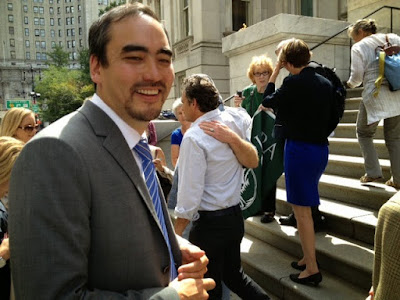
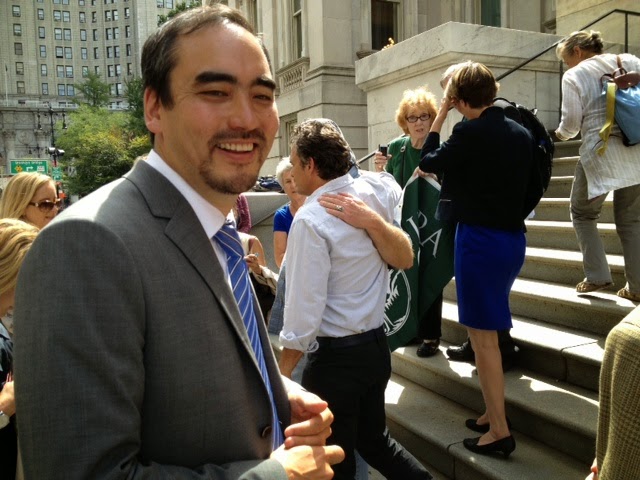
Tim Wu during the Teachout/Wu campaign for Governor and Lieutenant Governor from this Citizens Defending  Libraries gallery of events page.
Further, it must certainly serve as an inherent check and balance on the office that so many attorneys working there have no doubt gone to work in the office precisely because they hope it is a place where they can do the right thing and accomplish idealistic objectives they likely came equipped with.  A recent case in point is that, this fall, Tim Wu, the Columbia Law Professor and highly influential open internet advocate (and Tweeter par excellence), joined the Eric Schneiderman’s office.  Mr. Wu is also recently famous by virtue of his political foray to become lieutenant governor as running mate of Zephyr Teachout.  It was a campaign that was startlingly effective.  Ms. Teachout is a protégée of Lawrence Lessig and a central tenet of the Teachout/Wu campaign was the overriding need for the kind of campaign finance reform that this article is about.

Still, in the final analysis, how does our warped system serve or not serve the public?  When it comes to moneyed interests being on the scene does Schneiderman stand on the side of the public if all the money is on the side of private moneyed interests?   Or does our state attorney general fulfill predictions of professors Gilens and Page that the actual interest of the public will have “only a minuscule, near zero, statistically non-significant impact upon public policy”?

Here is a perfect test case with a now escalating profile.  The New York State Attorney General regulates charities and is supposed to "to police fraud and abuse" and, for instance, the office was recently even given additionally clarified  powers “to bring judicial proceedings to unwind interested-party transactions."
A complaint about such fraud and abuse by the Brooklyn Public Library was recently filed by a newly formed group, Love Brooklyn Libraries, representing the public interest.  There is, however, a lot of private industry money on the other side, particularly real estate interest money that would like to see Brooklyn public libraries sold for a pittance, far less than their value to the public.  Part of the problem is that the composition of the board of the Brooklyn Public Library is extremely ill-suited to upholding the public interest with far too many competing agendas at odds to the public’s.  This is exactly what the Scheiderman’s office is supposed to be regulating.  He is supposed to prevent and insulate the public from exactly that kind of harm.
Read about the composition of the board of the Brooklyn Public Library and competing agendas at odds to the public’s.
Point of disclosure: I am a co-founder of Citizens Defending Libraries which has similarly brought such matters to the attention of the Attorney General’s office, not only with respect to the BPL and its trustees, but also with respect to the NYPL and, for instance, its sale of the Donnell Library.

Now if one were plotting it on one of those professorial graphs we talked about, it is important to know that the public almost universally opposes the sale and shrinkage of our libraries, the elimination of books and librarians and the deliberate underfunding of libraries in a time of plenty being being used as an excuse to do so.
The breaking headline news now escalating the status of this story: The New York Post has just come out with an eviscerating story about the sweetheart details of de Blasio's giveaway of the Brooklyn Heights library.  The developer to whom the de Blasio administration and the BPL trustees regulated by Schneiderman’s office wasn’t the highest bidder; his bid was 20% lower than another of the two bids that surpassed him.  It was an inferior bid in other respects as well.  See:  New York Post: Developer with ties to de Blasio scores job, despite being outbid, By Aaron Short, February 21, 2016.

The new facts in the Post article are further evidence of what Scheiderman needs to be investigating.  But even this needs to be put in context: David Kramer (of the Hudson Companies) was the low bidder for a library that should not even be sold.  Kramer and the other developers were only bidding for the value of the library site as a vacant lot.  There were being asked by the BPL and its trustees to bid only for the “tear-down” value of the library.  These bids were in no way related to the value of the library to the public from the public’s perspective, because de Blasio and the BPL trustees were selling off the library with no appraisal of the value of the library from the public’s perspective.  And it is important to remember that what we are speaking of is a recently enlarged and fully upgraded library that would cost more than $120 million to replace.

So that is the test case that the New York Post has now given an escalating profile: What Schneiderman does in this instance, a matter that the public cares about intensely, will tell us much about exactly how worrisomely warped our system is.
Citizens Defending Libraries on Thursday night outside an event where Mayor de Blasio and economist Paul Krugman were to discuss income inequity in NYC.