Showing posts with label A. Burden. Show all posts

Saturday, April 1, 2017

A Giant Leap Forward Into Tiny Benefits: Bloomberg Micro-Apartment Initiative Shrinkage Grows Under de Blasio

The architectural question in a nutshell: With good design, how much space do people really need to live well?
It’s big news about the value that can be crammed into the what’s small.  Saying that good things can come in small packages is a teeny-weeny, really shrunken-down understatement when good creative design is unleashed to run rampant in terms of what it can accomplish.
Coverage of shrinking Micro-Units and their future from Curbed
Bold new design concepts the de Blasio administration is endorsing for adoption via new NYC Department of City Planning regulatory changes will, as a furthering step, grow the micro-apartment initiative launched by the Bloomberg administration that started back in 2013.  Many will remember how good tiny (“squeezy living”) apartment design was being studied by the Bloomberg administration when Mayor Bloomberg, vying with global warming champion David Koch for the title of wealthiest New Yorker, paced off, with uber-wealthy city planning commissioner Amanda Burden, the smallest space that economically challenged New Yorkers looking to be thrifty could live in.

Why wealthy City Planning Commissioner Amanda Burden and mega-billionaire Mayor Michal Bloomberg even have room for company as they searchingly examine to consider the tiniest apartment size fellow New Yorkers might live in.
A design competition held by Bloomberg’s administration led to micro-apartments that have already been built (Monadnock Development’s “Carmel Place”) to receive rave reviews by real estate industry press.   Special permission was given to have apartments of just 275 to 300 square feet ignore what were obviously outmoded tenement-banishing city rules that previously required new apartments built to exceed 400 square feet.  While that was first a trial exception its has been formalized as a new standard.
But shrinking apartments down to 275 or 300 square feet was obviously wasting space when good design can make apartments that are far smaller great fun to occupy while showing off one’s inventiveness.  Having started by thinking of small apartments that were 275 or 300 square feet as the new frontier, officials in the de Blasio administration were profoundly embarrassed to be confronted by the startling elegance of a Paris apartment that was garnering social media attention. That apartment was 8 square meters. . . or, converting from the metric system, it was, in square foot terms, an 86 square foot apartment, not even a third the size of what the Bloomberg set as its goal for what would be a supposedly “micro-apartment.” 
From the viral video of the Paris apartment.  Click if you want to try to enlarge.  It has captions- "Several ways to use the space are possible depending on different needs." "Easy to access"  for the bed in the top cupboard. "Proof that a small space doesn't have to necessarily mean a poor space."
That Paris apartment showed how versatility and good organization can ensure that space that could seem cramped seems humongous instead.  Another advantage: New Yorkers living modern lives and looking to frugally save their money have found that a smart crafty move in many respects is to own less "stuff."

When good design gets unleashed everything with respect to size is relative.  As Shakespear’s Hamlet once told companions Rosencrantz and Guildenstern: “I could be bounded in a nutshell and count myself a king of infinite space.”  Just as the superb ingenuity of the Paris apartment enlarged and made the Paris apartment hugely magnified and spacious, distilled inventiveness the de Blasio administration is fostering is making it possible to make even less space than that seem and and actually be utilized as if it as bigger.

The de Blasio administration decided to advance the achievements of the micro-unit program after the warm reception and good press coverage it got for its continuation of Bloomberg’s shrink-and-sink program for reducing the size of New York City libraries.  That program lets real estate developers willing to work with the de Blasio administration get the benefits of owning most of the real estate previously entrusted to the city for public library use.

Once upon a time, candidate de Blasio running for the office of mayor decried these Bloomberg administration sell offs saying: “once again we see, lurking right behind the curtain, real estate developers who are very anxious to get their hands on these valuable properties.”  More recently, de Blasio has been amplifying his thoughts expressed then saying: “When you think `curtains,' you think theater.  The city is an expectant audience.  What we are doing is raising the curtain dramatically so that the real estate industry can take center stage for us and deliver benefits the way that only the real estate industry can!” 

While these new "minimus-micro-units" will be slightly less expensive than larger apartments, they will, on a square foot basis, charge much higher rents than the higher rents per square foot rents that are being charged for the first micro-units constructed in the city, just as those pioneering small units, charged far higher rents, on a per square foot basis, than for typical larger apartments.  That's partly because the units are, on a square foot basis, more expensive to construct since the reduced general living space, means there is a proportionately higher amount of expensive building infrastructure; HVAC, piping, heating, etc.  However, on the flip side, there will be additional simultaneously costs-saving amenities: Tenants will all have easy access to sumptuous and exquisitely furnished common areas including bathrooms and kitchens with multiple hotplates and microwave ovens.
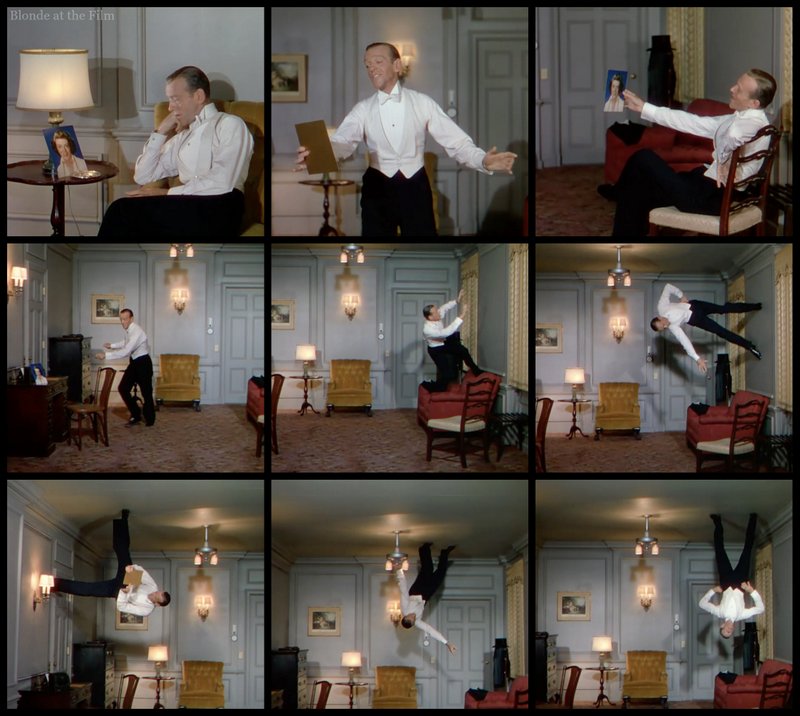
Fred Astaire in "Royal Wedding"- You get the idea: The trick was that the room rotated, which meant that the cealing and walls became more dance floor space for him for his talented footsteps to multiple over.
There is every reason for renters of the new minimus-micro-units to feel “royal” as they occupy them.  The break through enabling their leap forward in fitting people into space came from an architect working at the Marvel Architects firm, Isadore Doonaut Squrlay.  Until recently, working at SHoP Architects, another firm getting a lot of city project related business, Mr. Squrlay signs his correspondence and memos “Izzy,” but is generally referred to around the office as “I.D.”  “I call it my `Royal” idea” said Mr. Squrlay, “because I got my idea from Fred Astaire, more specifically Fred Astaire in `Royal Wedding.’  Probably everybody remembers the famous scene where Fred Astaire dances around a room, first up the walls and then on the ceiling.  Well I was watching that scene and I realized how every which way it flipped the rooms seemed like a different rooms with a whole lot more space we usually don’t think of using.  And I thought: `Why not do this for real? People could be climbing the walls for real!’”
Either Rosencrantz or Guildenstern could come visit Hamlet.
The round rooms unlock and rotate as desired, shifting based on a person’s weight, rolling on ball bearings, “brass balls,” says Mr. Squrlay, “you really have to have brass balls to do something like this.”

Allowing the units this 360 degree flexibility allows for a incredible versatility.  A ceiling becomes a bed, a few angles over it it's a recliner or props you up to read in bed.  If the rotation is left unlocked occupants can get far more (maximus, maximus) exercise walking miles and miles without stopping, never even needing to change the direction of their tread, although that's possible too; you can tread these miles in either direction.  When walking these miles the storage seats become steps like in a step class making the walk a little like the step classes normally available in ritzy gyms.

With the two storage units that also serve as chairs, the denizens of these units can also have visitors although if Hamlet wanted his school chums Rosencrantz and Guildenstern to visit it would probably be best if they came one at a time.  
 
The units will be prefab and easy to produce.  Like the units in the first micro-apartment building launched under Bloomberg those prefab units will be built in the Brooklyn Navy Yard and then stacked by crane at the site.   The round design of the units makes this exceptionally easy, the exact opposite of the problems encountered by Forest City Ratner stacking prefab units to build what was to be its first building at Atlantic Yards (now going by its new alias of “Pacific Park”) where alignment difficulties caused huge problems, interminable construction delays and huge cost overruns.

Because the units are round they can just be dropped into place and then they naturally align taking on a natural hexagonal formation much like a beehive.  “Humans have a lot to learn from nature and the way the insects like bees have organized their living arrangements,” said Mayor Bill de Blasio adding, “It’s no accident that we admiringly refer these as `social insects’.”
Natural hexagonal pattern- Seen in beehive at the right
The units are all required to be precision crafted to uniform size to achieve this perfect hexagonal alignment intended by nature.  That means that different units won't be different sizes for different people, something that has been under discussion as an additional space saver.  In the future different size units could used on an building by building basis, with buildings customized to house differing populations sorted based on the differing stature of individuals in the population.
Units configure an align themselves in a natural pattern
Purnima Kapur, Executive Director of the Department of City Planning, said that the new design presented an intriguing question about calculating the FAR (Floor To Area Ratio) that ordinarily limits building in New York City.  Because the circularity of the units mean that the units technically have no true floor (everything that might be considered floor is also wall and ceiling too) her City Planning department will be able to interpret the regulations that none of these new units need to be counted as using up any of the permitted FAR that normally puts a maximum cap on development although Ms. Kapur did avow that after a period of experiment the department will come up with some restrictions on the maximum size of buildings than can be built containing these units.  Ms. Kapur said that the department’s regulation that the units don’t count against permitted FAR will be a “circular reasoning” regulation.  By the same reasoning, no new laws will be required to launch the program because any laws subjecting units to measurement restrictions don't apply to units that can't be measured (except perhaps by reference to pi- A sort of "pi in the sky program"?).

The city is launching the program with the building of the units in a long list of buildings destined to replace the city’s libraries in all five boroughs. The city’s issuance of Request For Proposals from developers, with specs all detailed by I.D. Squrlay, was issued today, April 1, 2017.

Tuesday, January 22, 2013

October 1963, An Historical Snapshot: Ada Louise Huxtable, Jane Jacobs, Robert Moses, Cars, Density, Bulldozers, Preservation

One of Ada Louise Huxtable's first articles in the Fall of 1963 dealt with Jane Jacobs, car congestion in midtown Manhattan, density, the New Planning Commissioner and a whole lot more
Buckle your seat-belts for a bit of time travel.  I hope we might return from this trip more appreciative of aspects of where we stand in New York City today.  Our embarking point?: Obituaries provide a sense of history absent from the rest of the news dished up for us, especially when the person who has died lived a long and vital life.

I recently read the wonderfully written New York Times obituary for Ada Louise Huxtable (Ada Louise Huxtable, Champion of Livable Architecture, Dies at 91, by David W. Dunlap, January 7, 2013).  It took me back to the beginning of Ms. Huxtable's career, when she was hired by the Times as “the first full-time architecture critic at an American newspaper.”  One thing I found myself immediately wondering was how likely it was that her hiring in September 1963 might have been motivated, at least in some part, by the influence of urbanist Jane Jacobs’ 1961 book, “The Life and Death of Great American Cities.”  Though unmentioned in Dunlap's obituary for Huxtable, Jacobs’ book and activism, particularly in New York, were at that point in time raising the public’s consciousness of how building and development were shaping the city environment surrounding us.

What made me all the more curious about this possibility was that Mr. Dunlap wrote his obituary for Ms. Huxtable almost as if he intended to emphasize characteristics of Ms. Huxtable that were similar to Jacobs.  I wound up writing about this (plus a great deal more, including the social responsibility of artists and architecture) here: Tuesday, January 15, 2013, Andrea Fraser, Frank Gehry, Ada Louise Huxtable, Art, Artists, Urban Renewal, Mega-Monpoly And The “Barclays” Arena.

Doing research to explore the possible interrelationships vis–à–vis Huxtable and Jacobs at the time Huxtable was appointed, I found that Huxtable wrote mentioning Jacobs and her influence in one of her very first columns.  The Times announcement of its appointment of Huxatble ran September 9, 1963. The Times article in which Huxtable wrote about Jacobs appeared October 16, 1963.  It was Huxtable's welcoming interview with William F. R. Ballard, newly appointed as the new chairman of the City Planning Commission.  (See: Planner Defends Cars in Midtown.  . . .  The article shows up with several possible alternative Times titles, including this longest version: “Planner Defends Cars in Midtown; New Chief of Commission, Sworn by Mayor, Backs Municipal Garages Begin Duties Today” and “Planner Defends Cars in Midtown Theories Much Sought Caution on Bulldozers”.)

Hindsight Insight on Urban Renewal

The Ballard interview article provides a wonderfully instructive snapshot of what was going on at a key moment in time, especially as we can now look back at that moment in the context of what we know in hindsight.  In 1963 the city was still several years away from committing itself to a program of historic preservation, several years before establishing Brooklyn Heights as its first historic district (1967), quickly followed by Greenwich Village, and though the tide of public opinion was turning against Robert Moses and his urban renewal and massive road-building programs those programs were still being strongly urged upon the public.  Demolition and destruction were on the public's mind.  Demolition of the original  Beaux Arts Pennsyvania Station (announced July 1961) began in October 1963.  Hot topics under discussion, shades of today, were the desirability of automobiles in Manhattan and the subject of urban density.

Huxtable’s interview with Commissioner Ballard reads like her model for writing might be straight reporting, not the kind of criticism with which we now strongly associate Ms. Huxtable.  Its seemingly neutral bent actually comes across as being the opposite of critical.  Huxtable describes Ballard as “ruggedly handsome” with a demonstrated technical competence and  “optimistic, persuasive, energetic,” equipped with a vision for a “bigger, better, more comfortable New York” based on planning theories that Huxtable characterizes as “safely somewhere to the right of center, involving a new kind of civic-togetherness.”  She finishes off the article on this tritely upbeat note about Ballard’s view of the city:
He summed up his views with a statement few new Yorkers would contest: “This is the greatest City in the World.”
There is in the tone of her writing no whiff of the insight you hear from her in a 2008 interview with Leonard Lopate:
The chairman of almost every commission we have is always a political appointee.
In 2008 she was discussing whether appointees like Chairman Robert B. Tierney of the city Landmarks Preservation Commission should be expected to have professional expertise relevant to their appointments.  Huxtable’s answer was to say she puts her faith in the professional expertise of others such as the actual commission members.  Ballard had a certain amount of expertise relevant to the position to which he had been appointed: He was an architect who had been involved in shaping the zoning code. But in Huxtable’s interview Ballard clearly comes across as a politically conscious individual, apt to dutifully address the pros and cons of both sides of an issue.  I suspect that it is only in retrospect we realize how harsh some of his sentiments sound.

Addressing the subject of Jane Jacobs, Ballard provides counterpoint, arguing for urban renewal even while demonstrating his ability to give lip service to contrasting views.  Here is Ballard on the subject of the increasingly disfavored “bulldozer approach to urban renewal”:
When you destroy an old neighborhood completely, you are wiping out something that, sentimentally, I think should be preserved, if it can.  It may run counter to sensible planning, but that’s one of the things that makes the whole operation of planning fascinating.
More revealingly, Ballard criticizes Jacobs, who had just succeeded in preserving the West Village (1961) from bulldozer urban renewal, defeating efforts by Ballard’s predecessor:
She is unnecessarily negative in wanting to preserve everything exactly as it is. . . This is a lack of imagination.  But she is right about the loss of humanity in acres of identical housing.  The solution is not to freeze things.  You go ahead, enlivening, softening, and humanizing the new plans.  We’re learning as we go along.
Huxtable, who specifically mentions the title of Jacobs "The Death and Life of Great American Cities" book in the article, dubs Jacobs the bête noire of Ballard’s predecessor, James Felt.  Ballard was then the new planning face to the Mayor Robert F. Wagner administration, which might have suggested some softening compromise with Jacobs’ views, but here he still sounds apparently eager to get on with the large-scale, pulverizing churns of neighborhood demolition the real estate industry was backing.  One wonders how far we have come when Amanda Burden, the city’s current city planning commissioner, similarly speaks coyly of blending Jane Jacobs’ style values with a rehabilitated veneration for Moses-scale disruptions:
    . .  our plans therefore have been as ambitious as those of Robert Moses, but we really judge ourselves by Jane Jacobs standards.
(See: Saturday, November 5, 2011, Now Appearing In Gary Hustwit’s New Documentary “Urbanized”: Amanda Burden, New York’s High Line and Community Protest.)

In retrospect, fifty years later, (notwithstanding Amanda Burden's vision of kinder, gentler editions of Moses ambitions) most of us are probably absolutely clear about how incredibly valuable Jacobs’ preservation of the West Village was (as well as the preservation of the rest of Greenwich Village, SoHo and Brooklyn Heights, etc.).  We see, also, the insufficiency of Ballard’s vision of preserving only some things within an overall environment rather than the “rich tapestry of time and style” (Huxtable words in 2008), or saving just some “celebrated monuments” in lieu of retaining “the city’s historic fabric and neighborhood character” (Huxtable words in 1966).

A City For Automobiles?

Library of Congress image of Lower Manhattan Expressway via Wikipedia
In her 1961 book Jane Jacobs had taken on another fight, the primacy of the automobile, arguing for the restoration of space back to the pedestrian use.  In this respect, Jacobs’ battle to save the West Village was intrinsically connected to her fight to defeat Moses's plans for a ten-lane Lower Manhattan Expressway that would have destroyed Greenwich Village, SoHo, Little Italy and Chinatown. - That plan (cancelled in 1962) would have involved a huge ramped clover-leafing midtown access smack-dab in the middle of Greenwich Village.  It would have been just south of Washington Square Park.  Under the Moses plan, the extension of Fifth Avenue through Washington Square Park, fought over by Jacobs and Moses (1955-1956), would, although it was not revealed at that time, have led directly to the clover-leaf acess. (See Jan Gehl's essay "For You Jane" in "What We See: Advancing the Observations of Jane Jacobs.").

In her 2010 book, “The Battle for Gotham: New York in the Shadow of Robert Moses and Jane Jacobs,” Roberta Brandes Gratz, a longtime friend, colleague and disciple of Jane Jacobs, writes about how it was only after she wrote her 1961 book that Jacobs discovered and fully understood that the Moses long-term plans for automobiles in Manhattan (dating back to a 1929 regional plan) involved a network of highways lacing the borough up and down ( a “Los Angelizing” the borough, a“net catching Manhattan”) with a series of crosstown highway crossings connecting a surrounding oval of major roadways.

In a conversation with Roberta Brandes Gratz years afterward, Jacobs explained how the proposed Westway along the Hudson (ultimately defeated) should be considered part of the materialization of this overall scheme.  The multiple highways going across Manhattan under the plan?: The Lower Manhattan Expressway downtown crossing, a crossing at Thirtieth Street (the Mid-Manhattan Expressway), roadway extending “from Forty-second Street north and from Battery south around and up the East Side” and a Cross Harlem Expressway at ground level at 125th street was also proposed, while the Trans-Manhattan Expressway at the very narrow northern tip of Manhattan up at 178th Street was actually built.

1964 Regional Plan Association map of expressways proposed to traverse Manhattan
In close up
In Huxtable's 1963 interview Ballard has some interesting quotes about his view of automobiles.

Even though Commissioner Ballard made it clear when he left office that he still advocated highways in Manhattan, it may be less than fair play to furnish the preceding information prior to supplying you with his 1963 remarks since: 1.) Ballard's most immediate focus when speaking was on parking garages, and 2.) as Jacobs made the point to Ms. Brandes Gratz, Moses always kept the full scale of his plans under wraps;  “only pieces of it” kept “surfacing.”  Commented Jacobs, Moses made his proposals piecemeal because, “Nobody would ever consent to the insanity of doing the whole thing.”

This is what Commissioner Ballard said of the automobile in mid-town Manhattan in that inaugural interview with Huxtable:
The better and fuller life includes the free use of the automobile. . .  Planners who try to discourage its use make me sick.
His standard for whether too many cars are being added?: Whether the traffic still moves.  He says:
I believe in direct transportation.  The apartment house garages required by our new zoning haven’t affected the streets.  Our traffic still moves.
Addressing Density

Our traffic still moves?  Ballard's criteria for evaluating acceptable density sounds remarkably similar: Whether people are trampling each other.  At the time of the interview the giant new Pan Am Building, (now the MetLife Building) was a public concern (a ‘running argument’ says Huxtable). Only months later, April 14, 1963, Huxtable wrote her official Times review negatively critiquing the completed building.  Part of her critique was of the building’s density: Architecture Stumbles on; Recent Buildings Are Nothing Much to Brag About Other Newcomers "Sixth" Avenue Coming Up (Retitled: Pan AM: “The Big, the Expedient, and the Deathlessly Ordinary” in her book of collected essays “On Architecture: Collected Reflections on a Century of Change.”)  But as we will return to in a moment, even before the building’s completion, even before starting as the Times official architectural critic, Huxtable had already participated in the “running argument,” speaking out against the social irresponsibility of the building’s size.

In the interview, Ballard (with little hint of personal contradiction by Huxtable as she is quoting him) defended the density the enormous building would bring to its key location:
I think it’s great.  I can’t think of a better place to have a big building. . .  It’s at the focus of all midtown commutation and transportation; the best place for it.  I don’t think concentration is such an evil. . . It’s the essence of cities; it can be a good thing.  Architects don’t pale at the handling of the problem.  I don’t see the disasters that the weepers and wailers predicted.  A park there would have been an absurd idea.  Rush hour? Nobody’s been trampled yet.
As noted, in April Huxtable weighed in officially when the building was completed, confirming her view as the New York Times critic that the building put too much density on the site:
Of  these new buildings, Pan Am has by far the greatest impact on the city scene. Criticism which has been plentiful since the building’s inception, is directed largely at is physical and sociological implications: the effect of seventeen thousand new tenants and 250,00 daily transients on the already crowded Grand Central area and its services and the unresolved conflicts and responsibilities of the city and private enterprise in control of urban densities and master planning.
She simultaneously assaulted the building's aesthetics: “a colossal collection of minimums. . . minimum good materials of minimum acceptable quality executed with a minimum of imagination. . .” penultimately ending up:
This is a prime example of a New York specialty: the big, the expedient, and the deathlessly ordinary.*
(* Although Ms. Huxtable has said she didn’t change or update her essays for publication of her book, the very last quote above I only find in the version of her essay appearing in  “On Architecture: Collected Reflections on a Century of Change”.)

Previously, before being appointed official Times critic but writing in the Times and perhaps auditioning for that role, she wrote critically of the building while it was still under construction, “it continues to cause consternation among those who believe that such an oversized structure will overtax our already burdened midtown facilities” and she asserted it was a “depressing sight” in contrast to the exceptionally pleasant sight the public had been presented with when the old Grand Central building had been demolished to make way for it: Our New Buildings: Hits and Misses; A survey of the construction that has given New York a new face shows too few departures from the characterless and the imitative, April 29, 1962.

Huxtable's criticism published in the Times at that time was mild compared to what Huxtable wrote in 1961  “In Four Walking Tours of Modern Architecture in New York City” which she put together for the Municipal Art Society (ultimately partly quoted in the Times as part of her Times obituary and quoted more fully in The Pan Am Building and the Shattering of the Modernist Dream):
The erection of such an overwhelming structure— the largest single office building in New York— will radically alter the scale of the buildings along Park Avenue.  It will also add an extraordinary burden to existing pedestrian and transportation facilities, and in these aspects its antisocial character directly contradicts the teachings of Walter Gropius, who has collaborated in its design.
Writing a memoriam piece upon the death of Walter Gropius, Huxtable, a hard taskmaster at least when it came to this building, reiterated her social responsibility criticism:
The final irony was the betrayal of his own teaching of social and urban responsibility in one of his last jobs where he acted as consultant with Peitro Belluschi, for the "smoothing up" of the urban outrages of New York's notorious Pan Am Building.  This still saddens his admirers. 
(See: He Was Not Irrelevant, July 20, 1969.)

The building's aesthetics aside, it can be easily argued that Ballard was more correct in his defense of the building’s density than Ms. Huxtable was in her criticism that the density consigned the building to socially irresponsibility.  The Pan Am now MetLife building has now been up for fifty years and it remains true that no one has yet been “trampled.”   (Although flights to the helicopter pad atop the buildings were discontinued after an accident in which five people were killed.)  Ballard's observation that the building is over a transit hub and making it efficient is correct.

There are caveats, however, before jumping to conclusions about who was right or how right they were. Huxtable was talking in part not just about a single building, but the alternation of the scale of Park Avenue (which the Pan Am building surely did).  When she said it would add an “extraordinary burden” to services and facilities in the area one must also think in terms of the burden that all the bigger buildings add to the area when additional development ensues to match that alteration of scale.  Irrespective of whether Ms. Huxtable was entirely correct that the particular building’s density was unsupportable or burdensome it made sense that she was wary of the density then.   And now?  . .   Recently the Bloomberg administration has unveiled plans to almost double-- starting in 2017-- the density of Manhattan’s already very dense Midtown business district, that entire district surrounding Grand Central and the Pan Am building, from 39th Street to 57th Street on the East Side.

Should we not now wonder if the criteria for Bloomberg officials as to what constitutes the acceptable upper limit for density is literally the standard Commissioner Ballard imagined: That you keep building until people get “trampled.”

Ballard might have been surprised to learn that Jane Jacobs, whom he criticized as too negative when speaking to Ms. Huxtable, considered herself a fan of density.  But Jacobs believed in adding density gradually, not in an overwhelming rush.  If the density of the Pan Am building works reasonably well now, fifty years after the fact, another appropriate test to apply was how well its addition to the neighborhood worked right after it was built, something that we must think back through our foggy memories to assess.

Was Huxtable still finding her footing when she interviewed Ballard?  What should be clear from all of the above is that despite her flattering descriptions of Ballard’s good looks, competence, and altruistic goals she couldn’t have disagreed with him more about the social responsibility of the Pan Am building.  It makes you wonder what else she was reporting of his words she personally disagreed with while not cluing in her audience . . .  although, without speaking specifically for herself, she does inform her readers that Ballard disagreed “with many professional planners not only on automobiles, also on . .  the giant Pan Am Building.”

Huxtable does not often address the issue of density.  “Density,” for instance, is not listed in the index of her collected essays despite that being one of her key criticisms of the Pan Am building.  In other essays in that collection she commented with dismay on how the city strained to keep the Ground Zero site at the same density rather than reduce Silverstein’s financial stake in the site, albeit in one of these mentions she refers to how density can be considered “the soul of the city.”   Her expression of dissatisfaction with another huge multi-acre scheme, Hudson Yards, indicates an impatience with the reflex of maximizing density: “we will get a lot of very, very big buildings that will make someone very, very rich,” she says of the Hudson Yards site proper, controlled by the Related Companies, and then notes that, similarly, the surrounding acres “have already been rezoned in part for the biggest buildings possible.”

The subject of the value of density, qua density, came up in a 2008 interview Phillip Lopate (Leonard's brother) did with Ms. Huxtable that appeared in the Times wherein Huxtable averred that she (like Jacobs) was basically a fan of density:
Lopate: I take it you’re for density but not for overbuilding.

Huxtable: How can I be against density? I’m a New Yorker! I grew up with density.
Interestingly the exchange came out of Huxtable’s commenting negatively about urban renewal (taking us back to the bulldozers we spoke of at the beginning), that:
 . . . urban renewal tried to get rid of density. It was viewed as concentrating poverty and disease. Now there’s the awareness that density is more energy-efficient and less destructive of the environment than urban sprawl.
This is something that many people may not know about old-style urban renewal: It often didn’t increase density.  It often replaced more with less, which might help emphasize the point for those of us looking back, how urban renewal was often most importantly about getting rid of things and often who was being gotten rid of.  (James Baldwin referred to urban renewal as “Negro removal.”*)  Moses’s rebuilding of New York resulted in a slowing of the city’s rate of growth and then its first huge population decline staring in the 60's.  It was partly due to the way the shift to the automobile (discussed above) exported population, but Moses’s urban renewal had to be a contributing factor.  A very important part of this exodus was the city’s middle class.
(* I found Bruce Norris's Pulitzer Prize-winning 2010 play, “Clybourne Park,” disappointingly shallow in terms of the “dissection of race, gentrification and real estate” that it was supposedly about.  Tantalizing though, it briefly raised, without pursuing, the conspiracy theories that virtually all governmentally assisted urban revitalization reflects master planning to further disadvantage racial minorities.  Remember: To dub something a conspiracy theory doesn’t mean that it lacks truth.)
These days we tend to associate the demolition of our existing city fabric with density because so often the death sentence for existing parts of the city comes with sudden changes in zoning (like in Williamsburg, Brooklyn) that include increases in density to induce the turnover of a neighborhood.  Nevertheless, when people are being dispossessed by such zoning changes or by current-day substitutes for old-fashioned bulldozer urban renewal like Atlantic Yards, it is safe to bet, just like the old days, that the people being evicted are mostly on the other side of a social divide from those conceptualizing and deciding upon the implementation of such plans.

Intersection of Traffic and Density In Current-Day Modern New York

New York City is currently reclaiming its streets for pedestrians under Department of Transportation Commissioner Janette Sadik-Khan.  An essay Commissioner Sadik-Khan contributed to “What We See: Advancing the Observations of Jane Jacobs,” a collection of pieces that pays tribute to Jane Jacobs by working to build on her ideas, begins (p. 242) with an expression of how Sadik-Khan sees her work as a continuation of the “epic battle between Robert Moses and Jane Jacobs over the streets of New York.”  Sadik-Khan’s essay is titled: “Think of a City and What Comes to Mind? Its Streets.”

“Our traffic still moves,” was apparently Ballard’s test whereby one would judge whether too much priority had been extended to urban automobiles.  Commissioner Sadik-Khan hews to Jane Jacobs perception that, many might find counter-intuitive, but which is bearing out, that if the conveniences and roadway space for automobiles are removed (“attrited” as in attrition), the traffic “still moves,” with congestion simply evaporating.  That, is in contradistinction to a city like São Paulo, Brazil which, with a street transportation plan that Ms.Sadik-Khan observes was put together by Robert Moses himself, is enduring the concomitant ultimate ramifications of such a plan: It has bumper-to-bumper gridlock and the business elite resorts to getting around by helicopter (here we are back to the kind of midtown helicopter pads discontinued at the Pan Building!).

Serving the demands of cars results in traffic congestion, but when that demand is not served, demand evaporates.  There is a reverse corollary to this: Commissioner Sadik-Khan speaks of “latent demand” for pedestrian space and plazas.  The more such space is supplied, the more pedestrians materialize to fill it.

It’s interesting how this interrelates with density and how exactly that is working out in Time Square, which with upzoning and redevelopment has become an exceptionally dense pedestrian environment.

The closing down of large portions of Broadway to vehicular traffic was, according to the Bloomberg administration, to deal with escalating levels of congestion and because people were “getting pushed out into the streets” and the sidewalks couldn’t handle it.

The Bloomberg administration is now reinforcing that increased dedication of space to pedestrians,  protecting pedestrians from traffic (and possible `terrorists’) by adding bollards and concrete barriers, see: Times Square ‘Bow Tie’ Is to Get Belts of Steel and Granite, by David W. Dunlap, January 13, 2013.

Before the pedestrian areas were expanded in the Broadway Times Square area I used to walk around carsin the streets  to get around the congestion.  The pedestrian areas have now been expanded but the on-foot congestion has grown to fill in those expanded areas so that now, if I am in a hurry and need to move fast, I eschew the experience of the flashing lights and animated screens on Broadway and walk up to 46th Street by the not-very-aesthetically-satisfying, less crowded, mid-block concourses just to the west.

This is what the congestion is like around Time Square’s 42nd Street and the Bloomberg administration wants to almost double the density of the very nearby Grand Central business district?

Historic Preservation

Although Ballard’s expression of what the goals of historic preservation should be are somewhat enigmatic, his words contain a clear recognition that the first historic preservation laws, not yet in force when he was being interviewed by Huxtable, were about to be enacted in the city with strong public support.  As noted, the appalling destruction of Pennsylvania Station was on people’s minds.  Here, from Huxtable's interview, is Ballard again:
On Historic preservation, he said: “Like food and water, I’m all for it.  I’m for landmark’s legislation.  I believe in preserving worthwhile monuments, it’s tricky to decide what’s worthwhile and what’s simply old.  How much is sentimentality and how much is good common sense?  People are more important that old buildings.”
One reason the fight for historic preservation was gaining traction, soon to take hold as official city policy (in legislation) ahead of the then ongoing fights against urban renewal, was that the Times was very actively supporting the first of those two fights.  Writes preservationist and historian Anthony Woods in “Preserving New York: Winning the Right to Protect a City's Landmarks”:
The New York Times would radically increase New York’s preservation consciousness by running well over twenty pro-preservation editorials between December 1961 and the passage of the Landmarks law in the spring of 1965.  This would be in addition to its impressive news coverage of the ceaseless stream of preservation stories marking that turbulent time.

In this period, preservation was blessed to have at the New York Times not only an editor of the editorial page who appreciated the importance of preservation, but a brilliant writer who also embraced its values.  That editor was John Oakes, and the writer was Ada Louise Huxtable.

    * * *

Even before Ada Louise Huxtable made history in 1963 as the first full-time New York Times architecture critic, focusing “public opinion on the city’s built environment as never before,” she was writing in its defense .  As early as 1961, John Oakes had enlisted her to write editorials for the paper.  In this capacity she authored, without attribution, a series of forceful editorials that would keep the cause of preservation front and center until and well beyond the passage of the Landmarks law.
Huxtable, trained as an architectural historian, presented her advocacy for historic preservation as grounded in practically.  In 2008 she said this in a Leonard Lopate Show interview:
This is such a complex subject. You can’t just say save your building when there is no way to save it, when there is no money, when there is no way to keep it and preservationists tend to be very tunnel vision about that. Particularly in new York preservation is a . . it’s a very complicated thing that requires a lot of tradeoffs and a lot of willingness to look at all sides of a problem. We don’t have that now. We have a preservationist movement that really alarms me a little bit because they don’t want to deal with reality. They just want to forge ahead and save buildings and it is not that simple.
But she argued that economic principles tended to favor taking the route of historic preservation  In a May 1999 article for the Wall Street Journal titled “Manhattan’s Landmark Buildings Today” (which is in her book of collected essays) she says at the outset that “Old buildings must earn their way” and then makes the case that they generally do, concluding:
Old Buildings survive because it rarely make sense in bad times to demolish, while in good times there is every incentive to invest.  The city renews and enriches itself when it reuses its landmarks in an economically sound way.  In New York, the art of architecture is inseparable from the art of the deal.
Unlike Huxtable, Jane Jacobs was not, per se, an advocate of historical preservation for its own sake.  Jacobs recognized the value of neighborhood landmarks but did not feel that being historical was a prerequisite to buildings being landmarks.  She was in favor of preserving old buildings but not because they had historical value but because a mix of old and new buildings benefitted neighborhoods in part because the economics of older, less expensive buildings were less costly than those of new buildings.  Jacobs was a preservationist, believing in the preservation of neighborhoods, but what she believed in was the preservation of the fabric of neighborhoods, their dynamics and their social interrelationships.  Seeing neighborhoods as functioning ecosystems replete with valuable street life she was not about preserving neighborhoods frozen in time because she saw them as continually evolving systems.

While there is inevitable overlap to the arguments for preserving beautiful historic old buildings and preserving neighborhoods that include a mix of just plain old buildings, one critical convergence is that both Huxtable and Jacobs would tell you that there is economic benefit to doing what each of them they advocates.  But while Huxtable observes common sensibly that old buildings often survive in economic bad times because it rarely make sense to demolish them then, under the urban renewal that Jacobs fought demolition of old buildings (and their neighborhoods) was precisely what was done when the economy was bad.  It was done on a large scale . .  And  and the buildings demolished were sometimes not replaced for decades.  No wonder that when Commissioner Ballard left office toward the end of the Moses era he was theorizing why all the jobs in a city with a declining population were disappearing.

Is there value to preserving history for history’s sake?: We ought to note that this article that concentrates on looking back to the past is, of course, all about the value of persisting artifacts to spur our memory, together with a sense and appreciation of history.

More About William F. R. Ballard

According to William F. R. Ballard's own Times obituary (appearing September 29, 1993- he died at 88), he was city planning commissioner from 1963 (October 16) to 1966 (November 24).  He was replaced by Donald H. Elliot.

Notwithstanding the negativity Ballard expressed to Huxtable about Jacobs in that first interview, the Times obituary puts Ballard’s fights with Moses, not with Jacobs, front and center in the highlights of his career:
What followed were nearly four years (sic) of political and governmental clashes of competing developmental interests. The stormiest ones involved a continuing conflict between Mr. Ballard and Robert Moses, with Mr. Ballard opposing many of Mr. Moses's most ambitious projects, such as a bridge spanning Long Island. Sound.
There is also this:
A year later, he said a proposal to build public housing in Central Park was "patently absurd."  
Robert Caro’s “The Power Broker: Robert Moses and the Fall of New York”* (1974) has one anecdote concerning Ballard to the effect that under Mayor Wagner the battles he had with Moses were lost:
There were many times when the Mayor announced to friends that he was going to refuse a Moses demand, but the pattern following the announcement was always the same.  William F. R. Ballard, a chairman of the City Planning Commission, recalls vividly Wagner “agreeing to back me— told me he would— and then ended up backing Moses.”  And some version of Ballard’s words are repeated by dozens of officials caught in tugs of war between the two men.
(* Caro’s epic “Power Broker,” a tool often turned to by many to remember and understand much of New York's history, makes no mention of either Jane Jacobs or Ada Louise Huxtable although Jacobs’ seminal 1961 book is mentioned in his bibliography and Caro actually wrote a whole chapter about Jacobs that he ultimately did not include because of the book’s length, one third of which had to be cut.)

Public opinion was mounting against Moses and his development practices and Moses's power was about to end at the hands of the next mayor, John Lindsay, acting in concert with Governor Nelson Rockefeller.

While we remember that Moses was ultimately deposed from power in this era, in 1963 when Ballard took office, demolitions for urban renewal were still lumbering forward sometimes for projects that seemed to continue with life of their own, into the late 70's, well after Moses himself had been officially ousted from power (the key date being his departure from the Triborough Authority in 1968) and even after New York’s sobering fiscal crisis hit in 1975.  For instance, the Schermerhorn-Pacific urban renewal plan, representing a significant prime chuck or Brooklyn real estate, didn’t get underway until 1973.

Unfortunately, the ideas of Robert Moses persisted tenaciously.  While we think of Jane Jacobs’ ideas as ultimately triumphing and being a cause of Moses’s 1968 departure from Triborough, 1968 was the same year Jane Jacobs left New York for Toronto, Canada to ensure that her sons would not have to fight in the Vietnam War,* and even in 1968 with Moses departed, the neighborhood-eviscerating Lower Manhattan Expressway was not entirely dead, the Regional Plan Association urging that it be built even in August of 1969.  Under the Bloomberg administration many of Moses’s ideas were fashionable again (though not the expressways) and there was a concurrent effort to rehabilitate the image of Robert Moses an effort to rehabilitate the image of Robert Moses that included the launching of three separate museum exhibits.
(* Jacobs, in Canada, continued to write books, participate in activism and extend her influence as a thinker and respected theorist.)
Upon his departure in 1966, Mr. Ballard, unhappy that he was requested to leave his office (John Lindsay was now mayor), identified for the Times some “planning questions that remain unresolved.”  Notably these included as his first and last mentioned points:
    •    The “grinding problem” of building desperately needed highways, such as road across lower Manhattan, without displacing hundreds of people.

    •    A more effective distribution of wealth was needed as more and more jobs were eliminated by technology.
The first point makes you wonder how hard Ballard was actually fighting Moses on some of the the things Moses wanted.  The reference to the loss of jobs likely says something about the deleterious effects Moses’s policies were having.

Not everything was seriously grim during Ballard’s tenure in office: His staff gave him a Planning-by-darts game which he played with the new mayor, Lindsay, perhaps hoping to get into his good graces.  One of the game's multiplicity of fictional booby prizes was getting to walk up “six flights of stairs for tea with Jane Jacobs.”

Ballard’s Vision Of Unleashing Energy vs. Jane Jacobs' Vision


Just be before the very ending of the Ballard interview article (where Ballard makes his “greatest City in the World” remark) he offers a thought that juxtaposes weirdly with the thinking of Jane Jacobs:
I would like to promote the interest of the whole community and its future. . [pause for emphasis]  Have you ever thought of the brains and imagination stored up in New York, and what it would mean to get it working in the future?  I think there’s a way to tap it.  I want to bring these people into the planning picture.
The thing about Jane Jacobs is that despite the unnecessary negativity and “lack of imagination” that Ballard attributed to Jacobs, Jacobs had indeed thought a lot about “the brains and imagination stored up in New York” and what it means for it to be activated. Truth to tell, she believed in it more positively than Ballard and had probably thought about it a lot more. All of her work was based on her perceptions and faith that one didn’t need the pseudoscience of “planning” to mobilize that energy, that people were already very much in the picture making cities happen, that the government `city planning' interventions whereby the working fabric of neighborhoods were ripped up and destroyed were antithetical to making use of this energy and represented an expulsion of the people from that same process in which Ballard said he theoretically wanted to involve them.

More About the Hiring of Huxtable

Here is more about the hiring of Huxtable.  The day after the David Dunlap-authored obituary of Ms. Huxtable appeared, Michael Kimmelman, the current architectural critic for the Times, offered an appraisal looking back (See: An Appraisal- A Critic of the Curb and Corner, by Michael Kimmelman, January 8, 2013.)

Mr. Kimmelman does mention Jane Jacobs to put Huxtable’s engagement by the Times in context:
She emerged during the era of Lewis Mumford and Jane Jacobs, with whom she belongs in the pantheon, but as the first full-time critic writing on architecture for an American newspaper, she also had that rare journalistic opportunity to pioneer something of her own, to fill a yawning gap in the public discourse, to carve a path with moral dimensions, “to celebrate the pleasures of this remarkable art,” as she put it.
In my last Noticing New York article went back, to look in depth at a 1958 piece Huxtable did for the Times Magazine to observe that Huxtable, writing there, virtually made her own case for creation of the job the Times eventually hired her to fill by arguing that the “press which regularly reviews art, literature, movies, music and dance, ignores architecture, except for building news on the real estate page” and that “architecture as a standard feature is virtually unknown.”

Mr. Kimmelman went back one year further to note:
Ms. Huxtable’s first publication in The Times seems to be a letter to the editor in 1957, complaining about an art review of photographs of architecture in Caracas, Venezuela, that ignored the deleterious effects of those photogenic but authoritarian buildings on the fabric of the city and its people.
Kimmelman had already declared at the beginning of the article that, “She cared about public standards, social equity, the whole city.”  Even if Huxtable was ghost-writing Times editorials starting in 1961 as  Anthony Woods tells us, these would still seem to be Huxtable's earliest writings for the Times.

In a 2008 interview Phillip Lopate conducted with Ms. Huxtable that appeared in the Times Ms. Huxtable provided the following account of her 1963 hiring.  It elides revelation that she had already been ghost-writing the Times historic preservation editorials:
Aline Saarinen had been The New York Times’s chief art critic, but when she married Eero Saarinen, she thought she should not write about architecture anymore. The Times’s editors were upset; they said they needed to get someone else, and so she recommended me. I went in all dressed up with my clippings, and I remember saying: “All you’ve been doing is printing the developers’ P.R. releases in your real estate section. You have nobody covering this very important field.” So they created the post for me of architecture critic.
(See: Her New York, November 7, 2008.)

That's the end of this tour through history.

In the end, even if some hard-learned lessons are already in danger of fading from our memories, nothing we have covered here is a very far remove from the present day.  Ms. Huxtable, who assumed the role of architectural critic for the Times in 1963, wrote her last column for the Wall Street Journal just last month.  1963 was time of great jeopardy for the city with much hanging in the balance as to whose ideas would prevail.  If we forget, if we again find ourselves distracted and reading just the P.R. releases in the real estate sections, we will probably have to learn many of these lessons all over again.

So I suggest we be on the hunt for good obituaries worth scrutinizing that will allow us to maintain our consciousness of our past.

Tuesday, December 13, 2011

Tough Luck: Heads the Developer Wins, Tails the Public Loses. . Unprincipled Upzoning for Rudin Luxury Apartments at Former St. Vincent’s Site

Below is Noticing New York's testimony furnished yesterday to the City Planning Commission in connection with Rudin Management Company's proposed special upzoning of a portion of the Greenwich Village Historic district so that the company may construct a larger luxury residential condominium tower than otherwise permitted. The testimony concerning the request that involves a history of events that very significantly includes the bankruptcy and ultimate demise of the St. Vincent's Hospital is self-explanatory.

* * * *

December 12, 2011

Amanda Burden
Chair, New York City Planning Commission
22 Reade Street
New York, NY 10007
via e-mail to aburden@planning.nyc.gov

Re: ULURP application for Rudin Management Company’s proposed rezoning of the former St. Vincent’s hospital campus
Dear Ms. Burden:

I am writing with respect to the above referenced proposal before the Commission to allow Rudin Management Company to privately benefit by side-stepping zoning that requires a lower of residential development for its above referenced site and applying to itself instead a special upzoning intended exclusively for the development of hospital buildings because of the public purpose they serve.

This comment is being offered in the name of Noticing New York, dedicated to the insistence on good economic development policies in New York and the proposition that developing New York and appreciating New York must go hand in hand. I offer this testimony as an attorney experienced in real estate, as an urban planner and as former senior government official who worked for more than a quarter of century in the areas of public finance and development for the state’s finance authorities.

For my testimony before the commission I am restating my testimony before the September 15th Community Board 2 hearing, below.

I am also attaching and including as part of my testimony to you the article I wrote about that hearing and my testimony, together with a follow-up article I wrote concerning public hearings for big New York real estate projects:
• Wednesday, November 2, 2011, Big Politically-Connected Real Estate Projects: Ignoring The Public Majority With Futile “Participatory Democracy” Hearing Process.

• Tuesday, November 8, 2011, Public Hearings For Big Real Estate Projects: Refining Your Sense of the Absurd.
I invite you, in order to appreciate the bigger picture, not only to read these articles but also to visit it where it is posted on the web so as to make full use of all the amplifying interior links it makes available. One thing the articles make clear is how completely and rightly opposed to the Rudin proposal the community is although it is acknowledged that there is very little likelihood that the Commission will be listening to the salient points that we or the community make. - - Nevertheless, I invite you to prove me wrong by turning down the Rudin proposal.

This testimony I am furnishing will also appear on the web with links.

I am also expanding my testimony to compare and contrast the testimony furnished in connection with this matter by the Greenwich Village Society for Historic Preservation (consistent with Noticing New York’s) and the testimony furnished by the Municipal Art Society of New York (inadequate as will be discussed). That comparison and contrast follows the restatement of Noticing New York’s Community Board hearing testimony below.

Noticing New York’s September 15th Community Board 2 Hearing Testimony

• Why do we even need to be here to consider this question?

• The Rudin/St. Vincent’s real estate deal was a very complicated shell game designed to cash in using the hospital’s 501 (c) (3) status in order to upzone (and essentially sell off) a portion of historic Greenwich Village for the benefit of a private real estate developer. That was a bad thing and you certainly wouldn’t have wanted other 501(c)(3)s to follow suit notwithstanding that there were some who favored this as a way to subsidize the hospital at the expense of the integrity of the zoning code and landmark preservation law.

• The shell game failed when St. Vincent’s failed. One lesson that can be taken away from that failure is that with all the complicated rigamarole and professional energy being put into that subterfuge the eye had been taken off the ball- - In basic terms, the hospital for whom all this bending of the rules was being done was not being properly managed.

• The moral is to stick to basics, to keep your eye on doing right what needs to be done. In this case, it’s a question of proper and consistent enforcement and administration of the zoning code. You can’t get pulled off course by shenanigans.

• If Greenwich Village needs to be upzoned then thought needs to be given to doing that in a thoughtful way throughout the community as a whole.

• You can’t hand out a special up-zoning as a consolation prize when a developer fails to pull off what was a fairly nefarious deal to begin with.
I believe that the testimony furnished by Andrew Berman as Executive Director of the Greenwich Village Society for Historic Preservation accords significantly with Noticing New York’s criticism of this proposal because it focuses on the “particularly profound” issue of principle that is proposed to be violated if this proposal is approved by your commission. And that is why it quite rightly references the unleashing of the free-for-all, Wild West, open-Pandora’s Box situation we will be in if your commission does not adhere to principle. To quote from the Berman testimony:
Our fundamental, overriding concern with the requested rezoning is that a private developer, seeking to construct luxury housing on the site, is seeking an upzoning, using the current zoning density which was allowed specifically for the construction of a hospital in 1979, as the baseline for the new allowable density. This is wrong, not just for this site, but for the city as a whole. If the increased density granted for the development of public service facilities, such as hospitals, can, in whole or in part, as proposed here, be used by private, for-profit developers in the future, we are opening a deeply troubling Pandora’s Box with profound potential consequences for the entire city. If the City Planning Commission approves such a change, it is in fact putting in place a tremendous incentive to allow greater density of development for public service facilities which can later be exploited by private developers when the facility no longer exists, is forced out, or is bought out.
That issue of principle is really the whole of it: Private developer Rudin should not have conferred upon it private benefit from the extra density which was granted to St. Vincent's in order to meet a public purpose that will now not be met and with which the Rudin development has absolutely NO connection. If there is one respect in which Noticing New York’s testimony perhaps diverges from GVSP’s testimony above it is to be absolutely clear that the bamboozling shell game that was played initially was wrong and unprincipled and would have remained so even had St. Vincent’s Hospital not gone bankrupt in the course of the confused misdirection of focus.

That issue of principle zeroed in upon by the testimony that the Greenwich Village Society for Historic Preservation provided is not only the essential whole of it, it is also the hole in the doughnut of the testimony provided by the Municipal Art Society: Somehow MAS manages to provide testimony that dances around and so doing leaves at its core a void of unaddressed principle. In so doing, it consigns itself to irrelevance by suggesting that everything now is about playing a standard developer’s game of negotiating collateral prettifications when principles are violated to seize the public realm and override basics such as zoning. By engaging in those negotiations everything becomes a matter of mere degree and all track is ultimately lost of what is fair and balanced. In retrospect when all is said and done and some ersatz “compromise” is achieved, who will remember how much MAS “won” of what it “fought” for. All that will be remembered is that MAS simply participated in trotting out a familiar list of things that politically-connected developers like to negotiate about as distracting eyewash when they ride roughshod over rules and protections: affordable housing, a little bit of park space, reduced parking.

This is not to say that the huge amount of parking Rudin is proposing to introduce into Greenwich Village via this single project isn’t ludicrous: It would certainly destroy the neighborhood to introduce it as the norm. Affordable housing and park space are also nice but they shouldn’t be introduced into conversations like this as distractions that disguise the importance of what is going on.

In its testimony MAS invokes its past: “Throughout all of our work, MAS has long history of engagement in Greenwich Village.” But without guts to take on the flouting of principle, is MAS really the same MAS it was in the past?

Here is a clue: Elsewhere in its testimony MAS mentions an earlier fight, partly won and (not acknowledged) partly lost, praising, I think inappropriately, the work of its current Chairman, architect David Childs, brought in to complete both the Time Warner Center and the Freedom Tower:
In 1987, we lead the fight to scale back a proposal for a massive tower on the site of the New York Coliseum at Columbus Circle, thus leading to the creation of one of New York’s most iconic buildings, the Time Warner Center.
The commission may conceive that pragmatism is the thing that is providing the counterweight to principle as it considers this matter. That is not the case. Pragmatism isn’t what is rearing its head here; what we are witnessing is crony capitalism.

After the 2008 financial crisis people were frequently observing that we no longer have functioning capitalism in this society and that we no longer have a level playing field. What we have now instead is crony capitalism. In this regard people noted that with the government bailout of the banks after the risks undertaken by the banks soured, what we got was a privatization of profit with a socialization of risk. The proposed Rudin plan is essentially a version of this page from the crony capitalism game book.

A Rudin masterminded shell game was being played. It was very complicated and not truly defensible. But to recap, the idea was that St. Vincent’s Hospital’s 501 (c) (3) status would be used in order to upzone (and essentially sell off) a portion of historic Greenwich Village for the benefit of a private real estate developer. As inappropriate, unprincipled and unfair as it was, everything was predicated upon a new St. Vincent’s Hospital being created and that hospital being subsidized via an infusion of some of the cash value of selling off a portion of the Greenwich Village Historic District. That plan had certain inherent risks, one of them being the risk that materialized. . . that the hospital would fail. Obviously, our argument is also that the Rudin plan may have contributed to that failure even without that being its intention.

When the risks of the Rudin plan materialized the plan should have ended. Instead, the proposal now before the commission is to rescue Rudin from the materialization of risk inherent in a plan of Rudin’s own design. The private sector will be protected and rescued by the government sector. At the same time there will be no public benefit from a hospital; there will be no government sector rescue of the public in this regard.

The only reason to protect Rudin by salvaging this deal now that the original shell game has collapsed (with no hospital being provided) is that Mr. Rudin is a member of the politically-connected 1% Club. That is the way that crony capitalism works, as will be demonstrated by the commission if it approves this proposal.

Sincerely,


Michael D. D. White

Saturday, November 5, 2011

Now Appearing In Gary Hustwit’s New Documentary “Urbanized”: Amanda Burden, New York’s High Line and Community Protest

(Above, NY city planning chief in “Urbanized” a film in which she defends the Brooklyn's public against harm from a project right next to Atlantic Yards.)

Saturday morning we ventured out in the snowflakes of the October Northeaster to the IFC Center in the Village and saw Urbanized,” Gary Hustwit’s new documentary about city planning. Boy, does the film sure let New York City Planning Commission Chair Amanda Burden get away with a lot! But we won’t.

Cramming Urban Design Into 82 Minutes

First some words about the film in general. I haven’t seen Mr. Hustwit’s much acclaimed first film, “Helvetica.” I’d very much like to. The notion of it appeals to the obsessive side of my personality. How do you make an entire film about a single typeface ? Obviously, you go into the subject much more deeply than anyone would expect you to.

As a film, “Urbanized” has the opposite problem: How do you cover the entire topic of city planning and what shapes cities either for good or for ill in a mere 82 minutes? The film then is sort of a sampler of things that can be learned about urban planning or design, covering a representative variety of ideas and concerns. You may learn from it no matter who you are, but if you know a bit about the thinking of how cities shape themselves you will probably keep noting how so much more than could have been covered. A.O. Scott’s New York Times review says essentially this, calling it a “remarkably concise film — which could easily have sprawled to 15 hours on public television.”

Another Times article discussing the making of the film the day before it came out said that Mr. Hustwit crowd-sourced the making of the film in several respects, tapping “his Twitter followers for suggestions” and quotes Hustwit about the film’s conciseness as follows:
“I had all these Google news alerts set up for, like, ‘city zoning controversies,’ and I got like a hundred a day,” . . . . . “There’s too much to talk about, and after a while, it started to drive me crazy.”
(See: Up Close: Making His Own Mark, Once Again, by David Colman, October 26, 2011.)


(Trailer for Urbanized,” above. The film's site notes that it features the voice, among others, of Ms. Burden who also appears in the footage.)

Respect For Bicycles In Bogotá


The film covers more than a dozen issues in segmented vignettes. There is joyful sparkle to Enrique Peñalosa, the mayor of Bogotá, Colombia (above) as we tour around with him as he shows how the city has reclaimed its roads and sidewalks to give priority to buses and bicycles over cars. His philosophy:
A city needs to show as much respect for a person riding a $30 bicycle as it does for someone driving a $30,000 car.
(And, the point is made people are taking up considerably less room in a bus or on a bike.) Are you listening, Senator Schumer?

Self-Building Communities, Chile: Communities Tossed Into the Cold NYC

New minimalist housing projects in Santiago, Chile get the film’s attention as an example of stretching tight resources by zeroing in on exactly what residents need and want most when they move in and then capitalizing on the residents’ own will, energy and sweat equity to add improvements thereafter to the infrastructure and boiled-down basics. There is innate constructive energy in any community waiting to be tapped. A knowledgeable viewer can make the connection that this approach of capitalizing on a community’s own energy is the converse of what goes on with Bloomberg’s eminent domain abuse mega-projects like Columbia’s takeover of West Harlem, and Atlantic Yards, where the government steps in (or, in truth, assists a private entity to do so) and obliterates what a community has successfully built up over time.

Brasília’s Vastly Separated Sculptural Buildings

(Above, from the trailer.)

The film isn’t visibly grinding any axes and is neutral in most of its presentations, letting those who believe certain things about urban design, including some professionals and academics, say what they will. That means that occasional statements that sound like balderdash or superficial tripe don’t get labeled as such by the film maker. The closest the film comes to calling expressed views into question is a segment with counterpointing viewpoints about Brasília, built from scratch in the 1950s and ’60s when Brazil's capital was transferred from the coast to the Mideastern interior. The city's huge sculpturesque buildings embody the very different thinking of the time about what constituted good urban design. It looks like a Robert Moses’ World’s Fair writ large. And large is a big part of the obvious problem with it. Almost all viewers of the film are going to agree with the counterpointing assessment, driven home by appropriate accompanying footage, that its distances are far too vast to be friendly to human habitation.

Ready consensus on this point is not to say that New Yorkers don’t have to be wary of old ideas of Robert Moses’ ilk being brought back. The developer’s proposed design for the Atlantic Yards mega-monopoly has a lot in common with the design of Moses’ old developments. That's not necessarily because anyone believes it is good design but because the proposed superblocking maximizes the various hidden subsidies the developer packed into that design.

High Line Hijinks

(Above from the trailer, the High Line with Gehry's "dirty iceberg"- our term- governmentally subsidized IAC building in background.)

New York comes up directly in the film a couple of times and the film even ends with a shot of the city. It is New York’s High Line that is featured with the most particular prominence getting justly deserved praise and being spoken of as inspiration for other cities in terms of adaptive reuse of post-industrial relics. No opposing views about the value of the High Line are presented within the film. These days who could find someone to express them?

The film therefore does New York City Planning Commissioner Amanda Burden an enormous favor when it uses the end of High Line segment to introduce her, in no uncertain terms, as its staunch proponent. Says Ms. Burden as we meet her:
We were just passionate about saving the High Line. Zoning was just one piece of it. I only played a role in the zoning, and, being obsessive, I think I spent . . I said if I didn’t think about the High Line every single day it was going to come down. That was my mind set.
Lest we might think that the “zoning” Ms. Burden speaks of is either insignificant or dry stuff, we have the moment before been told (just after a reiteration of the community value of the High Line), “Underneath the design, a lot of what we see here today is a result of the care and attention that went into the zoning.” We are not told what that “zoning” was; it remains abstract, but it sounds pretty good irrespective. If you have come to the theater knowing what the “zoning” was, then you know.

Community Instigated High Line

One thing that is great about the High Line, which the film makes pretty clear, is that its preservation was not an example of top-down planning: The idea for the High Line came from community. As the story is told, and it’s in large part very true, the idea for it came from two men, Joshua David and Robert Hammond, after attending a community hearing and then the enthusiasm for that good idea grew when David and Hammond became its activist proponents. Preservation of the High Line was also not an example of the developer-driven, reactive planning so often practiced by Ms. Burden’s New York City Planning Department where developers tell the city what they want to do, what would be good for them, and then, as the planning department aids them, everyone has to fall in line even if it overrides community plans already in place (e.g. the 197-a plans superseded by the the West Side Columbia neighborhood takeover the huge East Side Solow project).

Development Community and the High Line

The film doesn’t tell you that the development community and property owners actually opposed the High Line. It does tell you that the High Line initially lacked supporters but the film’s one mentioned example is an unidentified someone attending the community hearing where David and Hammond met. Even very late in the game developer Douglas Durst, in some ways a more progressive developer supportive of the Municipal Art Society, was calling for demolition of at least the last third of the High Line that wraps around the proposed Hudson Yards project. At the time Mr. Durst had hopes he would win the competition to develop Hudson Yards and he viewed preservation of the High Line as an unnecessary expense rather than an asset.

But how often in New York do major initiatives like the High Line happen without development community support? That’s where Ms. Burden’s abstractly referred to “zoning” comes in. It would have been much more informative if, in the film,“upzoning” had been the word used. The way that the development community was swung over to support preservation of High Line was that the High Line initiative was used to spearhead an upzoning of the Chelsea neighborhood around the High Line together with the creation of zoning bonuses related to improvements of the High Line and transferable development rights. More density. That’s something the development community almost invariably favors.

Notably, when Mr. Durst was advocating demolition of the last third of the High Line he was almost certainly expecting that the permitted density of the Hudson Yards development would be established independently of whether the High Line was preserved.

Park Improves Community Value

Other than density the development and property-owning community favors something else: improved real estate values. The Times article about Mr. Hustwit that came out the day before the film tells us that Hustwit and his girlfriend live in an apartment “just a block away from the elevated park.” and that the personal downside of the High Line for Mr. Hustwit is that “it has really increased the price of rental space over here.” In other words, just as good parks and amenities should be expected to, the advent of the High Line has improved neighboring property values and increased rents even as the building boom prompted by it has been adding to the square footage available in the neighborhood. Almost any New Yorker aware of the High Line or anyone else who has visited it will be cognizant of the many buildings speedily being erected up around it.

Whether or not the greater density of the upzoning overseen by Ms. Burden should have been exacted as the price for preserving the High Line, it can be convincingly argued that upzoning was a good one for the neighborhood and city and was very appropriate. In addition, because it is helping to pay for the High Line the High Line’s development has thereby been hastened.

Do You Know What City Planning Is?: An Unmentioned Atlantic Yards

Having been so grandly introduced as a proponent of the High Line, the film immediately cuts to a scene of Ms. Burden meeting with representatives of a developer with a project in Brooklyn. Overlaid we hear her voice instructively supplying this city planning primer:
The Department of City Planning is responsible for shaping its neighborhoods, its waterfront, its industrial lands and its business districts, really shaping the form of the city, and where it is going to grow, where it’s going to develop.
Then we see Ms. Burden, in action. As an example of her work she is conspicuously defending the public from overdevelopment. Looking at the plans before her she critically says:
This is a double problem because not only have you lost holding the street wall here, you now have a building that’s very out of scale with the Brooklyn Academy of Music . . . historic building.
“Out of scale with the Brooklyn Academy of Music”? This is almost too clever by half: Clearly visible in the plans Ms. Burden is looking at on the movie screen, and right next to the Brooklyn Academy of Music is the skyline profile of the much more iconic Williamsburg Savings Bank. But the Williamsburg Savings Bank building is not mentioned. Was it just the editing or was Ms. Burden taking intentional care crafting her words?

The scale-establishing reference of the Williamsburg Savings Bank building has been central to very heated discussions about how inappropriately huge and out-of-scale and improperly dense the pending Forest City Ratner mega-monopoly is. Ms. Burden has been a defender of Atlantic Yards and was instrumental in getting its approval through, and yet here she is in this film shown criticizing the scale of another project right next to Atlantic Yards. The film doesn’t explain this but if you go into the film knowing enough it is anger inspiring.


(Above right, the Williamsburg Savings Bank as seen from below. Below, the Williamsburg Savings Bank as seen from behind a proposed Atlantic Yards tower.)

Burden again addresses the audience directly:
We can’t actually design architecture, we can’t design the storefront but at least we can set up these basic parameters that give you the best possibility that this will be a great street.
Not mentioned is that, in the case of the Atlantic Yards mega-project which she helped enable, all these “basic parameters” of zoning that had been set were overridden so the developer could do whatever he wanted to maximize his own best possibilities over those of the community, including his choice to eliminate and absorb into his private ownership formerly public streets, sidewalks and avenues.

(Proposed Atlantic Yards above from the Environmental Simulation Center’s Atlantic Yards plug-in for the Google Earth program and below from the Municipal Art Society’s “Atlantic Yards or Atlantic Lots” slide show.)
Planning Chief Burden And Jane Jacobs Introduced

Working quickly, the film moves on to burnish Ms. Burden’s reputation in yet one more respect. Having introduced her as a key High Line proponent and savior, it then allowed her to authoritatively provide the film’s central primer on the value of zoning, next showing her as a defender against buildings of improper scale in Brooklyn (next to the Williamsburg Savings Bank). The film proceeds to let Ms. Burden introduce the historic struggle between the planning ideas of the Robert Moses’ ilk and those things Jane Jacobs espoused.

A.O. Scott in his Times review of the film says, “there is a distinct bias in favor of Jacobs-influenced new urbanism and against other approaches to city planning.” If it is true, and I think it is, this puts Ms. Burden in a place of enormous honor. It would be a place of enormous honor even if the film were not, itself, so pro-Jane Jacobs in its thinking. And getting this honor also has key implications in some other respects we shall visit momentarily.

Bloomberg Development Mantra: “We Will Grow”

When Ms. Burden begins speaking about the Robert Moses/Jane Jacobs dichotomy (and hinting that it perhaps can somehow even be fused) she dutifully invokes the Bloomberg administration’s mantra about the city needing to grow to quickly accommodate an additional one million people. She is, after all, a Bloomberg administration official.

The city will likely one day grow by the administration’s one million figure but despite the administration’s continued promulgation of inaccurate population graphs, the Bloomberg notion that this was all going to occur in a mere two decades (or less), bringing the city to a population of 9.1 or 9.2 million by 2030 is clearly off base. In fact, the city is apparently currently growing at so slow a rate that the city won’t actually grow to 9.4 million until almost 70 years from now. As Noticing New York has pointed out previously, the reason all this is important is that these projections for enormous population growth have been used as a backdrop to help justify the Bloomberg-style mega-development that begins with tearing things down while not having terrific success at replacing what gets demolished.
(The image above is from Bloomberg’s PlaNYC website.- The graph shown is not up-to-date. If corrected the second green triangle approximately over 2010 should be down more or less level with the blue square over the year 2000, because the city hasn’t actually grown much under Bloomberg.)

For more on this see: Saturday, April 23, 2011, A Post-Earth Day Post: Bloomberg, His PlaNYC 2030, His Environmental Creds (Credentials and Credibility) and Population Projections and Wednesday, April 20, 2011, Fighting His Third Term Curse Bloomberg Now Uses His Own Money To Promote Mega-Projects That Aren’t Happening.

So it is important that Burden begins talking about the tensions between Jane Jacobs’ and Robert Moses’ tenets by invoking the Bloombergian need to grow by one million mantra. Although she does not say by when such growth should be expected it is implicit that it should be in the time period being planned for by her:
Our plans have really redrawn the entire blueprint of the city because we have to grow by over a million people. And our plans therefore have been as ambitious as those of Robert Moses, but we really judge ourselves by Jane Jacobs standards. Robert Moses was the “Master Builder.” He planned, looking at the city from above, and his highway building destroyed entire neighborhoods. He cut off our entire island of Manhattan from the waterfront by building highways down the edges. His impact was profound and his insensitivity, was legendary, to the texture of the city. His downfall came at the same time as the rise of Jane Jacobs.
That’s the intro that Burden gets to deliver. It is left to others to briefly tell us who Jane Jacobs was and why she was so great, including telling us that without Ms. Jacobs most of Greenwich Village would have been knocked down.

Lurking Champions For Moses

There is a reason who is making what seemingly authoritative statements now about what we should believe respecting the calibration of credence for Robert Moses versus Jane Jacobs viewpoints is so important. Once it appeared that the views of Moses were safely dead, particularly after Robert Caro’s Pulitzer Prize-wining book, The Power Broker: Robert Moses and the Fall of New York,” Notwithstanding, during Ms. Burden’s tenure presiding at the City Planning Department a concerted effort was mounted to rehabilitate both Robert Moses and the sort of faith he had in big projects. As Adam Sternbergh observed in his Spring 2007 New York Magazine article about the High Line’s preservation:
As it happens, the High Line arrives at the exact moment when the legacy of Robert Moses—the imperious former New York City parks commissioner who had his own visions for the city—is being rehabilitated, or at least exhumed. Three separate museums this year mounted exhibits asking visitors to revisit his grandly imagined, and subsequently vilified, plans to remake New York into an expressway-laden megaplex, efficiently absorbing the daily swarms of auto-bound commuters.
(See: The High Line: It Brings Good Things to Life: The abandoned railroad that made a park ... that made a neighborhood ... that made a brand, by Adam Sternbergh,
Apr 29, 2007.)

Mr. Sternbergh ventures that the Jane Jacobs defeat of Robert Moses meant that “her theories on lively neighborhoods . . .have been entrenched as conventional wisdom ever since.” Those theories should have stayed unassailably entrenched but with Bloomberg’s penchant for megadevelopments (with Ms. Burden providing cover) the Jacobs theories have both been under attack and ignored.

There are some notable antidotes to the Moses rehabilitation effort. In 2007 while still being led by Kent Barwick, the Municipal Art Society opened its “Jane Jacobs and the Future of New York” exhibit and held many related seminar evenings. In 2010 Roberta Brandes Gratz a longtime friend, colleague and disciple of Jane Jacobs produced her excellent “The Battle for Gotham: New York in the Shadow of Robert Moses and Jane Jacobs.” In his blurb for her book historian and author Mike Wallace (author of "Gotham: A History of New York City to 1898, The History of New York City") says:
The spirit of Robert Moses has climbed from its crypt and again stalks the city. Roberta Gratz— channeling her friend Jane Jacobs— is determined to re-inter him, not with a stake or silver bullet, but with a rigorous accounting of the true historical costs of Moses-style development, and the under appreciated benefits of citizen-led, bottom-up regeneration. Its paean to urban complexity, coupled with its practical policy prescriptions makes the feisty “Battle for Gotham” a compelling inspired read.
Moses Or Jacobs? Whose Side Is Burden Really On?

There is no question that Commissioner Burden knows her stuff. She can and does flaunt her Jane Jacobs credentials. Ms. Burden considers herself a disciple of William H. (“Holly’) Whyte as she once worked at his Project for Public Spaces. Mr. Whyte, renowned in his own right, is famous as Jane Jacobs’ mentor.

The question is whether in the Moses vs. Jacobs debates Ms. Burden is treacherously flying under a false flag, declaring herself to be observant of “Jane Jacobs standards” and eschewing Moses’ “legendary . . . insensitivity . . . to the texture of the city,” while actually working very hard to ensure approval of the destructive mega-projects that the Bloomberg administration wants approved, such as: Atlantic Yards, Columbia University’s take over of West Harlem, the removal of the Willets Point neighborhood via eminent domain abuse, the shrinkage and virtual elimination the historic areas of Coney Island through a zoning plan where the calculated pretext of preposterous postulations prevails over common sense. Even on small one-building deals like the Walentas Dock Street project Ms. Burden has signed on to duplicity and poor planning when the Bloombergian fix was in.

And Ms. Burden has been accused of insensitivity, perhaps the most famous instance of this being that Ms. Burden is reported to have decided that the controversial rezoning of Harlem’s 125th Street was necessary because she and a friend couldn’t find a good restaurant in the neighborhood after a Roberta Flack concert.

The most thorough Noticing New York analysis of Ms. Burden’s involvement in facilitating Atlantic Yards goes into the anomaly of how Ms. Burden, as the city’s planning chief, could have been concerned about the issue of ill-advised superblocking with the relatively very small and necessary aggregation of blocks to create Teardrop Park in Battery Park City when she then, in contrast, let pass without objection the much larger and unnecessary superblock aggregations involved in giving Forest City Ratner its Atlantic Yards mega-monoply. (See: Monday, September 22, 2008, Should a Teardrop be Shed- Considering the Burden?)

(See the images of Teardrop Park overlaid on the Atlantic Yards footprint below.)
Another question is whether Burden’s City Planning Department and Commission side-stepped looking at Atlantic Yards as it should be looked at. Often presented as a 22-acre, 16 towers plus arena mega-project that managed to evade the technical jurisdiction of Ms. Burden’s minions, the building of Atlantic Yards actually involves 30 contiguous acres of Ratner ownership with 19 new towers plus arena, over which Ms. Burden could arguably have asserted jurisdiction. Those 30 acres are only a subset of Ratner’s larger 50+ acre government assisted superblocking mega-monopoly on prime Brooklyn real estate. (See: Wednesday, January 27, 2010, Did New York City Planning Officials Sidestep Looking at the Bigger Atlantic Yards Picture? Below, the Ratner 50+ government assisted acres)

Because she is aware of what she is doing Ms. Burden may sometimes experience a level of discomfort. Ms. Burden normally appears extraordinarily poised and in command but another Noticing New York article about an April 2009 New York Journalism Institute symposium noted the following about her Coney Island presentation:
Ms. Burden seemed to be very nervous during her presentation and we noticed that she left immediately after finishing her remarks so that she was not available to engage with either the evening’s panelists or the audience afterward.
(See: Tuesday, May 12, 2009, The City to the Public: “We’ve Got Your Coney Island: If You Want It Back, Better Do Exactly As We Say. . ” Ms. Burden at that symposium, below.)

In all likelihood Ms. Burden understands all or most of the implications of forcing through these grand scale top-down projects, including that decimation will follow in their wake, initially and for some time afterward. Who knows what she tells herself in her own defense? Perhaps she believes that if she were not doing these deeds it would be somebody else appointed to the planning commission in her place. Perhaps she believes that with her knowledge and good instincts she stands as a buffer against what could be worse. Perhaps she believes that she needs to do what she needs to do when she needs to do it in order to survive to fight another day on other issues of importance.

Perhaps Ms. Burden tells herself some variation of any combination of the above. Perhaps she does and she is wrong. Perhaps honest, open opposition opposition would be the best contribution to society she could make. Ms. Burden doesn’t need the money but she does seem to relish the position she holds.

Not Covered by “Urbanized”: The Negative Influence of Politically Wired Deals On City Design

“Urbanized” never tackles the city-shaping aspects of politically wired deals. That is perhaps the main recurring topic of Noticing New York’s articles. “Urbanized” deals pleasantly with the aftermath post-Katrina malaise of New Orleans by following a local artist who bedecks abandoned buildings with scores of stickers begging to be filled in that read: “I Wish This Was ____. ” It doesn’t ask the question whether much of the rebuilding of New Orleans is being steered by a local elite interested in downsizing and evicting poor blacks from their neighborhoods.

The film shows us the hope of local vegetable gardens tended by local residents on city-owned land in a depressed Detroit neighborhood but it doesn’t mention Jane Jacobs’ analysis that Detroit's company-town monoculture was destined to lead to such depression. It doesn’t mention the events underlying the infamous Poletown Neighborhood Council v. City of Detroit case which ultimately prompted the Michigan Supreme Court to (in 2004) reverse itself and interpret more expansively what constitutes eminent domain abuse. (See: Wednesday, January 21, 2009, Caroline Kennedy, in Our Defense Against Eminent Domain?: The Way it Might be.)

As late as 1981 Detroit was till directing all its subsidy eggs to the motor industry basket. The Poletown case involved the City of Detroit’s judicially sanctioned “quick-removal” eviction of an entire neighborhood, a neighborhood of thirty-five hundred, “mostly elderly, mostly Polish first-generation Americans” who had lived in Poletown for three-quarters of a century, in order to, at the behest of General Motors, turn over the neighborhood’s land for the construction of a new 70-acre automobile manufacturing plant. After pouring in untold additional subsidy General Motors ultimately abandoned what had been built. It was after years of GM's not paying property taxes on the same basis as all other Detroit property owners, including those who had been dispossessed by eminent domain. And then there was the GM bankruptcy.

Public Protest In “Urbanized”

(Above, from the clip promoting fundraising for for the completion of "Urbanized.")

Public protest and outrage over imposed public planning is addressed in “Urbanized.” It is addressed in a segment of the film just before its conclusion that lasts about ten minutes, covering the “S21” or “Stuttgart 21 project” transportation project in Stuttgart, Germany. That involved the building of a new train station to facilitate or enable European bullet trains traveling between Paris, Vienna and Budapest to be routed through Stuttgart. Among other things, the film shows community ire being raised by the destruction of a treasured community park and the felling of huge 200-year-old trees.

The Brasília segment and this one are the only two segments in the film presented counterpointed fashion. Respecting s21, The audience is taken back and forth between the community protesters expressing their views and a representative from the rail company explaining why the project is necessary. Despite a superfluity of German subtitles insufficient information is given to know who might actually be right. The conversation in the men's room right afterwards was between two gents who were utterly at a loss to figure out what options were there to be sorted out.

If you are like me and have participated in activist protests here in New York you will certainly feel sympathy for the German protesters but it was impossible to know from the information presented who was right. Maybe that is the was intentional on Hustwit's part. There are some hints though. We are told that when all was said and done the public's opinions on the project swung from somewhat mixed to nearly universally opposed, resulting in the ouster of local politicians when election time came. Protesters complain that though there was formally a public process it moved forward in fits and starts with dormant periods where the project seemed virtually dead so that it was hard for the public to respond or appropriately engage. We are tantalizingly told that this proposed replacement of an old train station with a new train station somehow also involves the construction of a luxury housing complex in addition to the destruction of the park.

I invite anyone who understands the issues of this particular development better than I do to leave a comment on this post.

What’s To Complain About In NYC vs. Germany

Notwithstanding what I didn’t understand about S21 what I came into the documentary knowing from urban design seminars I’ve attended is this: In Germany, in contradistinction to Bloomberg’s Atlantic Yards, big public design projects are typically designed by government officials, not developers; they are divided up into multiple parcels to be executed by multiple developers and then the parcels are bid out competitively to select the developer for each subdivided site. Most of these principles should also have been followed with respect to other big Bloombergian projects like Hudson Yards as well. The other distinction between S21 and Atlantic Yards that I would note is that S21 is purportedly principally a transportation infrastructure project (not withstanding that tantalizingly quick mention of the luxury housing) but Atlantic Yards just feeds private property (taken from other private owners by eminent domain) to a private developer to further a vast privately owned mega-monopoly. There are a lot of arguments for the public to sacrifice for the former. There are no arguments at all for the latter.

Seeing “Urbanized” Together With a Deep Gap-Filling Movie

I recommend seeing “Urbanized” or, if you miss it, planning to rent the DVD. But you should go knowing that unless you already know enough going into the theater there is much that could elude you about what you will see. If you want one film that, in my opinion, would fill in the most serious gaps in “Urbanized,” see the still regularly playing “Battle For Brooklyn” about fighting off Atlantic Yards. That film, which goes into depth on the subject of good city planning versus rigged deals also necessarily leaves out a few things in order to keep its narrative concise (the misconduct of ACORN in selling out the Brooklyn’s communities had to be left on the cutting room floor) but it contains an impressive amount of what was left out of “Urbanized.” I don’t recall, however, that it had anything to say about New York’s city planning chief, Amanda Burden.

Noticing New York discussions of “Battle For Brooklyn” are available here: Friday, June 17, 2011
I Went To See “Battle For Brooklyn” This Weekend and You Should Too Because . . . .; and here; Sunday, June 26, 2011, “Page One: Inside the New York Times” Reviewed; Plus The “New York Times Effect” on New York’s Biggest Real Estate Development Swindle; and here Thursday, June 30, 2011, “Battle For Brooklyn” Deleted Scene: Bertha Lewis’s Non-Response To Low-Income Tenants Kicked Out Of Affordable Housing At The Atlantic Yards Site.


Here is the trailer (better seen in full screen by going to this link):


PS: If you hurry out to catch “Urbanized” you are like to discover, as we did on our trip, that the subway corridor directly under the IFC Center theater is lined with AIANY (“American Institute of Architects New York”) posters of architectural projects which feature, among the images presented, pictures of the of the Atlantic Yards Prokhorov/Ratner (“Barclays”) basketball arena.