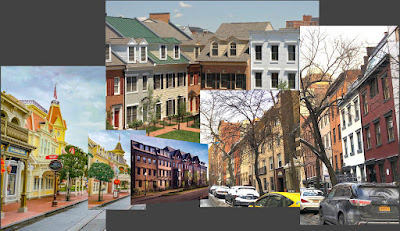
Showing posts with label Landmarks. Show all posts

Friday, April 1, 2022

New Demonstration Program Now Approved By NYC Landmarks Commission: Related Companies and Vornado Will Use Public’s Love of Historic Districts To Spur Development Working With Disney


It’s history in the making!  Not since New York City’s Landmarks laws and programs and Landmarks Commission were ushered in back in the early 1960s has anything new and exciting been done in this area.  Looking back, it’s always be more of the same old, same old, or, put another way, more of the same old, save old.


But that is not to say that the public doesn’t love its landmarks and historic districts; it absolutely does!  And that love of the quaint, the old and the curious that acquaints us with our past and where we came from is about to be harnessed by two giant developers of real estate, Related and Vornado, who have gotten the go ahead from the city’s Landmarks Commission (LPC- Landmarks Preservation Commission) to show what they can do working with another company that is expert about what the public loves and should love about its history and its past.  That company they will be working with is Disney.

The intention of the new demonstration program will be more and better development in the city while the public will, at the same time, be more deeply, efficiently and broadly connected with its sense of history and with the continuity that informs our city populace of where it came from as reflected by the ever evolving range of architecture that has resplendently bedecked NYC over past decades and centuries.

The public loves its landmarks and its historic districts; it’s one of the city’s most terrifically popular programs.  And the way that New York is imbued with a rich history that can still be observed and absorbed by viewing many parts of the city is one thing that attracts tourists. The attraction of tourists drives an important city industry.  However, the real estate professionals appointed by the mayor who serve on New York City’s Landmarks Commission have noted that landmarks and historic districts pose problems for the public.  They, therefore, invited some of New York’s premiere developers to consult and see what could be suggested using some of the industry’s infamously creative cleverness.

One problem with historic districts is who gets to enjoy them. Partly because they are so desired and sought after as places to live, they have a notorious proclivity to become enclaves for the wealthy.  Because they freeze and preclude further development and density, they also preclude expansions to invite additional populations in to enjoy residing there.  Another problem the professionals on the Landmarks Commission were eager to solve is that this locked-in low density is often, due to history, in central areas of the city from out of which other areas of the city grew.  Those central areas are often, in the professionals opinions, exactly the wrong areas to have low density.  Moreover, historic districts such as Brooklyn Heights and Greenwich Village often sit atop transportation hubs and the confluence of subway and bus lines around which it is important to gather greater density and development.

The Related Companies/Vornado demonstration program will address these issues by working with Disney plus, introduce into historic districts and landmarks benefits not possible when creaky old structures cannot be retrofitted with new technology.  The program will involve relocating a number of landmarks and historic districts to more optimal areas.  Actually, a better word for what these relocations will involve is `re-creations’ of what gets moved to new areas.  The programmatic term that Vornado and Related have decided to use to describe the transfers to new locations is “reestablishments.”  The reestablishments will allow leeway for there to be significant improvements integrated into them at the new locations.

“None of what we are talking about is without precedent,” said Landmarks Commission Chair Sarah Carroll, “for instance, in Staten Island, we have the Historic Richmond tourist and visitors museum site.  This involves historic structures brought to that location from all over the island to form the full collection of its 40 structures.”  And she noted that, in practice, with the passage of time, most buildings in historic districts transition from being what was once actually at a site to being de facto recreations of what was previously there: Facades have to be redone (brownstone, while soft and easy to quarry and carve, is an exceptionally short-lived material that is never actually replaced with the same dark sedimentary, often riverbed, sandstone), cornices need to be replaced and such ornamental replacements are most typically done more safely with fiberglass design duplications.  In Brooklyn Heights, 123 Joralemon Street, one of the historic district’s most conspicuous historic buildings, a carriage house, is not historic at all; looking circa 1880, it’s a 1993 replacement (designed as if servicing an adjacent mansion) for a 1952 ranch house that looked like it belonged in Queens.  So, in this case, what’s really historic?  

123 Joralemon Street- The historic 1952 house is on the left

 123 Joralemon is an example and lesson in how tastes change and how the flexibility of new construction can accommodate this.  The exterior of the building fits in exactly the way people currently think it should to comport nicely with the rest of the historic district.  When built it was built in 1993, the interior of the structure felt like it fit in with the district that way too, but since then the entire interior has been extensively renovated by a new owner to be the most modern thing imaginable, lots of glitz and glass that’s straight out of the Jetsons. . . But stick a gaslight outside and who would suspect!

Side by side- Will the real Joralemon Street imposter please stand up?

The demonstration program may start small while thinking big, hoping to get its legs under it and to give the developers a chance to prove to the real estate professionals at Landmarks that they are entertaining the right notions in green lighting this program: The candidate historic real estate location that is up for selection for the first relocation is just one single block length’s worth of buildings, 19th Street’s Block Beautiful in the Gramercy Park neighborhood, between Third Avenue and Irving Place.  Where will it be moved to?– That’s where they are thinking big!: Sunnyside Yards in Queens.  In Sunnyside Yards there will be room for many future additional relocations.

The "Block  Beautiful"

The “Block Beautiful” relocation gives Disney the opportunity to show off a transformational talent for which it thinks it is especially suited in a way that will superbly advantage the new program.  The “Block Beautiful” is cited as one particular example of changing fashions: “destoopification.”    No, that is not a typo for “de-stupefaction,” that is, instead, a name for a phenomena where buildings in New York City with the traditional style of front building stoop, inherited from the old Dutch designs, became déclassé and townhouse owners all over the city modernized by removing the stoops and creating new entrances on the lowest floor.  That also allowed extra flexibility creating more rooms if separate apartments were created in the building.  But with stunning architectural whiplash, things have changed again in areas like Brooklyn Heights were once-removed stoops are being put back again as hedge-funders gussy up purchased buildings that are again owned and occupied by one wealthy family.

In the dusk of architectural history, stoops can sometime be a `sometimes you see it, sometimes you don't' proposition.

What Disney with its technology will be able to do is teach the history of architectural fashion change by having the same established historic section display different era facades on different days of the week. To an extent this can be accomplished by projections overlaying different lighting changes, but it will also require storing things like stoops that will have to be rolled out and locked into place certain days.  In this regard the reestablished areas will have the advantage of large areas that will be in taller back structures that, with clever design, will not be readily observable.  Says Ms. Ona Lott, a Disney executive and representative about its design capabilities, “at our Florida Epcot center, the new modern, futuristic and big, may be cheek by jowl with our ancient Moroccan Casbah, but you don’t notice the former when you are enveloped in and looking at the latter.”

Putting stoops back in place when they are no longer grandfathered normally can raise all sorts of property line issues, but this won’t be an issue in the reestablished areas as the Vornado, Related, Disney joint venture will privately own the entirety of all the land, including all streets, sidewalks, park and green areas.

Another advantage the reestablished areas will have is there will be well thought out technology using the same sort of tunnels and unnoticed passageways that Disney uses at its theme parks for its Disney characters to appear where and only where they are supposed to.  This will make sanitation and garbage removal a far more aesthetic proposition.  Think of the way things are now says Ms. Lott, the Disney exec: “You have a row of buildings all from the 1800s and outside people are throwing away their 50' flat screen TVs as they graduate to bigger 4K, 8K (or soon 16K) models.  That plus a tangle of discarded routers and USB wires and flavored vodka seltzers is just not very historic.”  Now, in reestablished areas, such trash will head out to the landfills via hidden tunnels that nobody thinks about.  In place of the missing trash, Disney will periodically manifest historically appropriate trash depicted on its own ultra-realistic large flat screens.  And there will be no garbage smell to go with it unless you press the accompanying scent button.

Back at 19th Street, between Third and Irving, it will now be possible to put up a series of new towers like those that have been going up on Third Avenue for some time now.  Proving that a good job can be done reestablishing the “Block Beautiful” at its new Sunnyside Yards location will make it possible to move on to the next goal of reestablishing Gramercy Park at Sunnyside.  “The reestablished Gramercy Park will be quite an attraction, so much so that we are thinking we might actually make it just a fraction larger,” say Ms. Lott, “We will surround it, as before, with a hotel and most certainly the Players Club and the National Arts Club (formerly the mansion with enormous library of Samuel Tilden).” Meanwhile, Vornado and Related will have a whole city block to build on where Gramercy Park formerly stood.


Gramercy Park as seen from above at its current location- one whole city block!

Things will lead one to another.  A reverter clause affecting Gramercy Park’s chain of title and deed means that when that park property is built on, Union Square will again be privately owned. “It’s complicated real estate stuff,” Related VP David Chablis explained.  So Union Square will also be reestablished as one of the linked greenways of the Sunnyside Yards history learning center.  Visitors to the reestablished Union Square will again get to visit the old S. Klein’s department store on its border, because, with the restablishments, it will be possible to rewind the historical clock to any time that’s desired. . .

. . .  But, wait, Union Square, wedged between the Greenwich Village and Gramercy Park historic districts is not a historic district, right?  That’s another advantage to the program; how with more flexible modification, historic destructs can be more easily created and expanded, even retroactively.

Nobody living in what are currently historic districts will be required to sell what they now own, but they will be entitled to first dibs discount acquisitions on properties in the reestablishments.  If they do sell, they may make hefty profits.  Moreover, if they exercise their first dibs options, they and the heirs taking reestablishments property from them will all have continual access to the reestablishment areas without ever having to pay a perimeter fee.  For its maintenance and upkeep and the teaching and education that will be provided in the reestablishments Disney will be paid a fee financed with perimeter fees paid using people’s phones much the way that new York metropolitan area drivers have been using E-ZPass® to pay for bridge and highway tolls.  The areas will be designated with barely noticeable circumference wires rather like certain Jewish neighborhoods have set out the eruv perimeters for Jews observant of the Sabbath in this way.

Vornado, Related and Disney will be working with New York’s three public library systems to research historical accuracy.  This can be useful, because, in Brooklyn, for instance, the Brooklyn Library has taken over the Brooklyn Historical Society, and, now having subsumed it, has renamed it the Center for Brooklyn History* (there is thought of adjusting the name further to “The Center of Brooklyn History”).  Vornado and Related said the fact that the boards of the city’s library systems have been filled with people from the real estate industry and people who work for content control companies like Disney will help ensure the needed corporation in adhering to the desired historical narratives to be communicated.

(* The Center for Brooklyn History is currently closed, physically closed, to the public, but is providing virtual access to some history, plus is providing a “grab-and-go” history supply service in its lobby.)

Mixed in with the reestablishments of New York’s well known historic districts, the Disney company will be integrating duplicates of some of its Disney theme park history re-creations like its Disney Main Street (some building may be done by Alexandria, Virginia and Potomac, Maryland Builder/Developer EAY).  The city is expected to benefit terrifically in that the new historical areas that can be visited and the much more efficient way that they can be taken in are expected to be a huge draw from tourists in the future.

Work by Alexandria, Virginia and Potomac, Maryland Builder/Developer EAY
 

Because the reestablishment areas will be evolved with the special Disney touch, thinking and creativity, the areas can be copyrighted.  Said Dr. Kols, Disney’s Director of Historical Affairs, “The old adage that `history is written by the winners’ has the corollary that `those who get to write our history, get to own it, . . ahem, . .  copyright it.’”  “Of course, any such copyright ownership is subject to ‘fair use’ commentary” said Dr. Kols. . . , “as determined by the courts reading our lawyers’ briefs.”

Mayor Eric Adams is exceptionally happy with the proposed demonstration program.  In fact, without Adams the program would not be happening. The program’s legalities would be exceptionally tricky, even likely tripping up on various Constitutional prohibition entanglements, except for the New York State provisions (Executive Law Chapter 18, Article 2-B) that allow Adams, as mayor, to suspend laws and do what he wants pursuant to his declaration of the Covid emergency.  Adams says that if the New York City Public Advocate wants to use his standing to challenge any of his actions, the Advocate will have the opportunity to do so with the statute of limitation for a mandamus challenge commencing with the actions that Adams is taking as of this April 1st.

Tuesday, July 14, 2009

Jane Jacobs Atlantic Yards Report Card #23: Protection Against Self-Destruction of Diversity of Building Use? NO

This is evaluation item #23 (of 47) of the Jane Jacobs Atlantic Yards Report Card

Protection Against Self-Destruction of Diversity of Building Use? NO

(Some of the Buildings that would be demolished to build Atlantic Yards.)

Jane Jacobs describes a problem of the too successful city where diversity is lost when supplanted by crowded uses like banks or insurance companies that lack diversity. Though each is economically successful in its own right, Jacobs feels a dull monotony takes over with the crowding. She recommends counteracting the problem with zoning measures and by creating what she refers to as “staunch”public buildings that would hold their ground and not change their use over time. This has application to Atlantic Yards mainly in that buildings that could have been converted and enlisted for such “staunch” uses, perhaps as schools or libraries, are being torn down instead. Beyond that, it is difficult to foresee that Atlantic Yard will have future problems with the crowding of to too many similar successful enterprises.

(Above: Ward Bakery Building that could have been preserved and turned into a school, museum or central community facility.)

JJ Cites: [. . . . “staunch” “public buildings” with fixed purposes- p. 252. (Z)oning for diversity- - since the deliberate intent is to prevent excess duplication of the most profitable uses. . . p. 253]

(Below: Ward Bakery Building being demolished.)

Sunday, April 26, 2009

Markowitz, McCullough, Me and Other Merry Minions of the Blogosphere

A national news magazine, Newsweek, is on our Noticing New York beat, featuring a story we’ve been covering: Dock Street! And we have Brooklyn Borough President Marty Markowitz’s comment on this, together with other updates on that story. Dock Street, the tower proposed to be built next to the Brooklyn Bridge, is mostly what this post is going to be about.

First, a little about the setting in which Mr. Markowitz commented on Dock Street.

BP’s Bagels for Brooklyn Bloggers

(Marty Markowitz far left. Norman Oder far right.)

Do you want evidence that blogging is becoming a more important part of the local news? Thursday morning Mr. Markowitz held a Bloggers’ Breakfast at Brooklyn Borough Hall to discuss coverage of local events. We were at a conference table full of other bloggers and on-line journalists. The others, including Norman Oder of Atlantic Yards Report, have already reported on the event and there is even some on-line video of part of the morning, courtesy of the Brooklyn Heights Blog. For a fuller account you might want to start with Atlantic Yards Report, which links to the coverage available from the other bloggers, allowing comparison of a few different takes. (Friday, April 24, 2009, Breakfast with Marty: jousting about budget issues and adding urban planners to community boards.) AYR also has made audio availble. We may return to the morning’s discussions in a follow-up report, but right now our focus is mostly on the development issue of Dock Street.

Present besides ourselves were: Atlantic Yards Report’s Norman Oder, Brownstoner's Jonathan Butler; Flatbush Gardener's Chris Kreussling; Ditmas Park Blog's Liena Zagare; Only the Blog Knows Brooklyn's Louise Crawford; Brooklyn Heights Blog (four people), which is announcing the imminent on-line rollout of something called The Brooklyn Bugle, Self-Absorbed Boomer’s Claude Scales; GerritsenBeach.net's Dan Cavanagh; Pardon Me for Asking's Katia Kelly; and the New York Times “The Local” blogger Andy Newman.

What’s “Off” About Restriction What’s “On” the Record

We bristled a bit when we were asked to consent to a segmenting of the morning into on and off the record portions. Crikey, it’s only just recently we wrote about problems we have with this kind of approach (See: (See: Wednesday, April 15, 2009, Permission to Speak Frankly: How We Know More and Less From Breakfast Interviews With Marisa Lago.) In retrospect, we wish we had screwed our courage to the sticking point and pressed for a majority vote to resist this structuring by Mr. Markowitz’s aides. Hindsight convinces us that going off the record didn’t benefit the bloggers present or serve the public. Also, after reading some of the blogged coverage we are not sure that everything that probably never should have been off the record, actually stayed off the record, putting us in a strange position if we want to comment on that published coverage.

Would it be improper to hint at questions the collected bloggers might have been asked? Or what if we extemporized here to say that whatever the differences between print and on-line journalism might be, defining those differences is a rapidly moving target in a world where things are changing fast. It is sobering to think that the renowned and much revered Gowanus Lounge, created by Bob Guskind, a journalist who shifted into on-line journalism, had only existed for two years when Mr. Guskind died. (Noticing New York is coming up on its first birthday. Brownstoner “went live” in late 2004.) And would we be breaking confidences if we were to extemporize about the relative ethics of on-line journalism and the more traditional print media by pointing out that many bloggers and on-line journalists are raising ethical questions about the (increasingly consolidated) ownership of the larger enterprises and whether objectivity and impartiality is adversely affected by such ownership, as well as who their landlords and business partners are? (See: Tuesday, March 31, 2009, Looking at Things From Another Point of View: Do We See Distinctions That Make A Difference?)

Here are some thoughts about being “off the record” parallel to our own from Dan Cavanagh’s GerritsenBeach.net:

They divide the meeting into “Off the Record” and “On the Record” Which in my opinion there is never an “On the Record” or “Off the record”. Its just another way That a way that they are used to dealing with regular reporters, its also a way to control try and control the way their information gets out there, because if you violate the sacred rule and don’t play nice, you don’t get any more information.

The “Off the Record” part just consisted of the bloggers going around the room, saying who they were and what they do, which Marty listened to. Then their staff asking questions to clarify or to expand on what we actually do. They were mainly curious about how we accept advertising and who is a paid employee or just a volunteer.
(See: Brooklyn Borough President Marty Markowitz Invites Brooklyn Bloggers for a Discussion.)
Here is Louise Crawford of OTBKB on the subject of going off the record:
I know whatever Marty said was supposed to be off the record but what about all the interesting things the bloggers said? We talked about journalistic ethics, advertising, and the role that blogs play in Brooklyn.
And

I was impressed and surprised that Marty invited Norman Oder of Atlantic Yards Report to the breakfast. Oder, who describes his blog as "a watch dog blog that offers analysis, commentary, and reportage about Forest City Ratner's planned $4 billion Atlantic Yards project, . . . . Needless to say, there was some tension and even conflict during the event between the two.

But I can't remember if that part was on or off the record.
Face Time

Louise Crawford in OTBKB also offered this observation: “It's always fun to attend blog gatherings because it allows you to put a face to a blogger that you know only on-line.” If you are curious, the collective coverage has quite a few photos of the attendees. The best way to put a face to Noticing New York’s Michael D. D. White is the first photo in the account from Pardon Me for Asking. We can be distinguished by our tie, blue jacket and serious demeanor.

Other On-the-Record Coverage

Atlantic Yards Report has the most thorough coverage of the on-the-record portion of the morning, including Markowitz’s response to an important development issue question: What about endorsing Manhattan Borough President Scott Stringer’s move for more support and resources for community boards. (A related concern discussed by AYR is the independence of individual board members to vote their conscience on a project like Atlantic Yards or Yankee Stadium if it is contrary to what the Borough President wants.) See also AYR’s coverage of the budget for the BBP’s office which relates to the role of the BBP, also discussed by AYR.

As AYR notes, other questions concerned the BP's position on the Gowanus issue, (MM: “I am trying to get a grasp of what it would all mean. Trying to get a handle on it.”), further digitization of the Brooklyn Daily Eagle, and “the funding of Markowitz's charities by Bloomberg L.P,” which AYR described as our NNY focus with a useful link to our:“Charity?” We Begin to Groan (Monday, October 20, 2008). AYR notes we were told that Markowitz and staff would get back to us on this issue.)

Newsweek’s McCullough “Viewpoint” on Brooklyn Bridge Views and Insight from Marty’s View

That brings us to the question we asked which most directly addressed development in New York: It concerned what is unfolding with respect to the Dock Street project, the tall tower that is proposed to go up in DUMBO next to the Brooklyn Bridge. Despite mounting high profile opposition, the City Planning Commission just approved the project on Wednesday (the day before) with only minor modification. (See: April 22, 2009 DUMBO development: Smaller Dock Street project moves forward, by Ben Muessig, The Brooklyn Paper.) Significantly, the commissioners voted 11-2 in favor of the project despite the fact that Shirley McRae, the commissioner representing Brooklyn, (appointed by Marty Markowitz) voted against the project. Karen A. Phillips, the commissioner appointed by Public Advocate Betsy Gottbaum, also voted against the project. (We remember that Ms. Phillips also courageously voted in opposition to the Columbia University expansion plan’s use of eminent domain.)


We asked for Mr. Markowitz’s reaction to the article about the project, just out in Newsweek, by Pulitzer Prize and National Book Award winning, historian David McCullough, author of The Great Bridge: The Epic Story of the Building of the Brooklyn Bridge. We noted that Newsweek’s cover featured a headline lead-in to the double page spread in the magazine’s interior. Mr. Markowitz is meeting with Mr. McCullough next week. (See the Newsweek article: Viewpoint: A Masterpiece in Jeopardy, The biographer of the great Brooklyn Bridge on how a proposed new building could ruin an icon of American ingenuity.)


Mr. Markowitz offered some interesting observations about the process by which the Walentas’s Dock Street had obtained its approval from the City Planning Commission, including saying that opposition by him to the project, had he offered it, “would have been taken and thrown out the window” and he used interesting slang to describe City Planning Commission Chairman Amanda Burden’s next move after he offered his proposed modification of the project: “Then that got her out and then she `walked the streets’ or whatever she did.” The bottom-line message Mr. Markowitz seemed to be communicating was that while he will meet with Mr. McCullough to “hear him out,” this meeting should not be expected to change something that is on an inevitable political course. Mr. Markowitz refereed a New York Post article for its value in that it “illuminates how the next step may go.” We think a look at the Post’s article makes Mr. Markowitz’s reference ominous.

Here is Mr. Markowitz’s answer at length, after which we will discuss what the Post article portends:

Listen, my Dock Street position - We maximized. . . I chose not to say `no development, no residential development’ it would have been irresponsible because residential development is going to happen. We decided. . . This office took, I can’t tell you how many weeks, to come up with, including walking over that bridge and taking photographs. I mean, really, I wish we had the monies to do like some of the big developers have the money to do. And we came up with a decision that maximized the bridge’s view, maximized the `bowl’ . . Because, listen I sat through close to four hours of hearings upstairs. Over a hundred speakers. I don’t mind telling you . . . everyone of them. And there were certain themes that were coming out. I then went to the Brooklyn Heights Association to talk about it as well.

And I know what he [David McCullough] is going to talk with me about it, obviously, and I share a lot of his concerns. But for me, for instance to have said, `Sorry, I’m against the Walentas proposal:’ It would have been taken and thrown out the window.

So what happened was, that when I came out with my position, Amanda Burden, you know, obviously it prompted her to ah. .then revisit. . because she had to certify, to begin with, her agency, then the Brooklyn Office of City Planning. Then that got her out and then she `walked the streets’ or whatever she did. And then she issued a modest modification, is the best way to put it. Nowhere near mine.

But I will be eager to speak with him. I have met him on a number of occasions. Particularly, the last time was in Fort Greene Park, in fact. And when he visits me I’ll hear him out.

Next, battle now goes to the City Council. That’s where it is. And the Post today, (is it today?), but on-line, had a very interesting story* that I read yesterday and I don’t know if you read it, but I think you ought to. I think that it illuminates how the next step may go.
Prompted by one of his aides to speak about whether the real estate site for which the project is proposed has “as of right”development options, Mr. Markowitz continued:

Right, that’s why I say residential development of a hotel or whatever, and there are those who say, `well, he wouldn’t build a hotel:’ I can’t say that! How do I know?
(* Controversial Dumbo Project Gets Ok: Residents: Building Will Block Bridge Views, By Rich Calder, April 22, 2009.)

Benefits of Post Perspective on Predestination

Here (emphasis provided) is reporting from that Post article to which Mr. Markowitz referred.

Councilman David Yassky, who represents DUMBO, is one of the project's biggest critics. But while the council usually backs the wishes of a local councilman on land use issues, it currently appears divided over the project.

Meanwhile, records show the Walentases' firm, Two Trees Management, spent $409,323 lobbying the city since Jan. 2007, with much of the money going towards trying to sway support for the Dock Street project.

Officials for the company -- including the Walentases – have also dished out $29,700 in campaign donations over this period to Councilwoman Melinda Katz and another $19,800 to Council Speaker Christine Quinn.

Katz, a Queens Democrat running for comptroller, heads the council real estate committee, which must eventually decide whether to put Two Trees' request for a necessary zoning change before the full council for final approval.
In other words, it doesn’t look good in terms of the effort to defeat this project.

You can observe from the forgoing a strange alignment that indicates how far the Bloomberg administration is willing to go to honor a deal it has cut with a developer in advance of a public process. Notice that those closest to their local community constituency oppose the project, but they are being overridden by those at a remove who are closer to the Bloomberg administration. A vote from a commissioner purely independent of Bloomberg’s influence like Commissioner Phillips aligns with the community constituency and is in favor of protecting a national monument.

Proof that the Bloomberg administration (at the very highest levels) started its manipulation of the end result far in advance of the public process can be seen in what is coming clearly to light now via FOIL (Freedom of Information Law) requests: the surreptitious coordination by the School Construction Authority to “bundle” the Walentas Dock Street with a school that the community wants but denying the community that school where it wants it and where it should go.

Bloomberg’s Parochial Partiality to Protecting A Special Developer Deal

We believe that there are times when mayoral influence can be appropriately used to override local community opposition to projects, but we think that those situations are confined to times when a greater public good must be served, such as a prison, transportation network or sewage or trash disposal facility that serves the greater public at large. In the case of the Walentas project the mayor is using his enormous power as mayor (and as the city’s richest resident) to fight for something parochial, a single 18-story tower that benefits only a single developer. The only reason to build this building at this particular site is because the developer owns and controls the site.

McCullough’s View of the Greater Public Good: Stewardship For a Monument to Our National Soul

We think the point of nonparochial view as to what best serves the greater good is expressed by Mr. McCullough in Newsweek, where he calls for us to be stewards of the bridge as a national treasure. A few extracts of his eloquence from the article, which should be read in its entirety:

The most long lasting of great American works, the structure destined "to convey some knowledge of us to remote posterity," said a New York writer long ago, was "not a shrine, not a fortress, not a palace, but a bridge." . . .

"The Great Bridge" was news everywhere. It was the moon shot of its time, a brave, surpassing technical triumph, and more. . . . Over the years it has been photographed more than anything ever built by Americans. It has been the inspiration for songs, poems, paintings, no end of personal reminiscences and the setting for scenes in movies. It has remained New York's most famous, best-loved landmark.

Above all it has stood through good times and bad as a majestic symbol of affirmation, still there, still spanning the river for all to see and enjoy,

* * * *

In the 14-year struggle to build the bridge, work in the caissons below the river, accidents of all kinds took the lives of more than a dozen men and left many more crippled for life.

In the years since, its importance has seldom ever been doubted or seriously challenged. The sanctity of its own space has been unviolated by and large. Until lately. . . . To permit such a project so close to the bridge would be a shameful, inexcusable mistake. . .

Would we wish to see an 18-story building go up beside the Statue of Liberty, or next to Independence Hall in Philadelphia, or beside the Washington Monument? Of course not.

Would the city of Paris permit an 18-story building beside the Arc de Triomphe or Notre Dame? Unthinkable.
(BTW: If you are interested in assessing the visual impact of the building in greater depth you might want to look at the readback section comments to the Newsweek article. We think that the developer, uncomfortable with the facts, is attempting to deny them.)

Choreographing the Inevitable

If the process Mr. Markowitz described for the Dock Street project and the ultimate disregard for the Brooklyn Bridge is (like the mayor’s third term race itself) one of Bloombergian inevitability and predestination, then what are we to think about Markowitz’s description of his weeks of work to propose a compromise? However earnestly he describes his efforts, Mr. Markowitz’s proposed compromise was not well received. Coming out just before the City Planning Commission hearings, it tended to confuse things somewhat and while Mr. Markowitz observes that Ms. Burden’s compromise was “Nowhere near mine” it might be said that Mr. Markowitz’s proposed compromise actually paved the way to make “Ms. Burden’s” non-compromising-compromise seem more acceptable. (Notice, in terms of mayoral control by Bloomberg, how the one-story reduction of the project is referred to as Ms. Burden’s rather than the work of the City Planning Commissioners collectively.)

Violins Doing Violence to Process

If the deal with the developer that the School Construction Authority manipulated to put in place in advance is an inevitable result orchestrated by Bloomberg, then the “public process” that precedes it is just a dance. That makes Mr. Markowitz’s proposed compromise just a part of that dance where various functionaries get to play various face-saving roles. Some of the song for that dance is being provided by Amanda Burden herself. Listen for the violin music for this one; according to the Post:

City Planning Director Amanda Burden called the application "one of the most difficult to come before the commission in many years."

We have heard the “agony” theme before. We heard it from Councilman David Yassky when he voted to extend the mayor’s term limits and we heard if from Landmarks Preservation Commissioner Fred Bland when he voted to let the St. Vincent’s proposal go forward. The expression of agony should not be a refuge for an inexcusable vote. The good news is that Councilman Yassky is working hard to defeat Dock Street, including leading the FOIL investigation into the activities of the School Construction Authority. Commissioner Bland’s architectural firm, Beyer Blinder Belle Architects & Planners LLP, is responsible for the design of the Dock Street project so you can see how readily things become tangled.

(City Councilman David Yassky, who is running for Comptroller, testifying against Dock Street project before City Planning Commission.)

There is no reason for Ms. Burden’s agony because there really was no reason for her to approve the Walentas building, putting the interests of the developer ahead of the interests of the greater pubic. And if there was a reason for her agony, why shave off only one story of what the developer proposed? And don’t we know that a part of these dances is for developers to propose more than they expect to get to begin with? (We do not agree one whit with the Brooklyn Paper’s suggestion that the shaving off of the single story from the development was because the commission was “partially swayed by a late push by Brooklyn Bridge historian David McCullough.” We think this was part of the prearranged dance choreographed long ago. See: Saturday, March 14, 2009, At the City Planning Commission Hearings on Proposed Dock Street Project: A Reprise.)

How Inevitable is What Bloomberg Wants?

We would like to think that the Bloombergian plans to push the Dock Street project through City Council are not inevitable and we think the opposition should continue to fight with the assumption they have a chance of winning. How often do you have David McCullough and the rest of the nation on your side? This week’s Brooklyn Heights Courier in a cursory article (Stars Sock Dock!, by Stephen Witt) is reporting that other recognized stars are mobilizing in opposition to Dock Street. The list includes: film maker Ken Burns who did a PBS documentary on the Bridge, Gabriel Byrne of “In Treatment” and “the Usual Suspects,” as well as actors Helen Hunt, Gary Sinise, Ana Gasteyer and Skipp Sudduth.

Perhaps, with attention from a national news magazine like Newsweek, Bloomberg can be swayed from his obstinate fight. He should care: Wednesday morning at a New School forum the Media and the Mayor: Michael Bloomberg's Transformation, (Thursday, April 23, 2009, Debating whether Bloomberg's changed, media panelists offer mixed but critical views of the mayor), Wayne Barrett a reporter who has written for the Village Voice some of the best thoughtful, well researched and deeply considered pieces about the Bloomberg administration, talked about the likelihood that Bloomberg will be running for president in 2012, looking to oust Obama. Bloomberg tried running in 2008 and Barrett says he thinks Bloomberg still “harbors the dream.” We agree.

At that same New School forum, the panel discussed how inevitable Bloomberg’s election to a third term as mayor might be. Right now people are betting the odds are strongly in favor.

Dock Street and Bloomberg third term victories? The fights to stave off these Bloomberg orchestrated seeming inevitabilities are difficult. But just imagine how much more overwhelming the odds will be for those opposing Bloomberg if Bloomberg wins, particularly if he ascends to a third term so that more checks and balances fall away. It is likely that in most future fights the opposition will not have on its side a Pulitzer Prize and National Book Award winning historian like David McCullough. The more one thinks about it, the more one realizes how critical it is to hand Bloomberg the defeats he deserves as quickly and as decisively as possible.

Thursday, April 2, 2009

Jane Jacobs Atlantic Yards Report Card #15: Project Has Building Age Diversity with a Close-Grained Mingling? NO

This is evaluation item #15 (of 47) of the Jane Jacobs Atlantic Yards Report Card

Project Has Building Age Diversity with a Close-Grained Mingling? NO


Jane Jacobs stressed that an essential part of providing diversity successfully was having an environment with a range of rents and choices fostered by having buildings of different ages mingled together in as closely grained fashion as possible. Atlantic Yards misses the opportunity and does the opposite by unnecessarily tearing down worthy and viable old buildings. Its huge density adds to the overpowering and one-sided nature of its mistakes. It tears down buildings which Jacobs points out cannot be recreated, while replacing them with replicated buildings of no special value that could easily be replaced.

JJ Cites: [The district must mingle buildings that vary in age and condition, including a good proportion of old ones so that they vary in the economic yield they must produce. This mingling must be fairly close-grained. P. 150, 151. Old ideas can sometimes use new buildings. New ideas must use old buildings. Even the enterprises that can support new construction in cities need old construction in their immediate vicinity. Otherwise they are part of a total attraction and environment that is economically too limited- - and therefore functionally too limited to be lively, interesting and convenient. Flourishing diversity anywhere in a city means the mingling of high-yield, middling-yield, low-yield and no-yield enterprises. P. 188 large swatches of construction built at one time are inherently inefficient for sheltering wide ranges of cultural, population, and business diversity. They are even inefficient for sheltering much range of mere commercial diversity. P. 191 One-age construction in city areas is sometimes protected nowadays from the threat of more efficient and responsive commercial competition. This protection- - - which is nothing more than commercial monopoly- - -. . .. P. 192 Cities need a mingling of old buildings to cultivate primary diversity mixtures, as well as secondary diversity. In particular, they need old buildings to incubate new primary diversity. P. 195 Neighborhoods built up all at once change little physically over the years as a rule. The little physical change that does occur is for th worse- - gradual dilapidation. P.198 The economic value of new buildings is replaceable in cities. It is replaceable by spending of more construction money. But the economic value of old buildings is irreplaceable at will. It is created by time. P. 199.]

(More to be torn down to build Atlantic Yards.)


Monday, January 19, 2009

A Fable for Our Times: Gehry and the Spirit of the Land

The headlines are flying back and forth faster than you can keep track of them: Gehry is out and isn’t working on Atlantic Yards, - NO- Gehry is in- or NO- Maybe it is something else. . .

. . . Well, this article is about how supremely peculiar it would be if Forest City Ratner’s Atlantic Yards ever happens and if Frank Gehry is involved. It would be extremely peculiar if Gehry is involved even in the slightest residual way. These days it looks as if his role going forward may be just to shill for Forest City Ratner one more time, hoping to collect a small paycheck just to deny that he truly isn’t going to be not involved with the dying project.

This article is about spirit and about the spirit of the land. Why would it be supremely peculiar if this megaproject was built with a Gehry connection? Because perhaps its construction would come with one more spiritual curse than we presently imagine falling on the head of Mr. Ratner and Mr. Gehry.

Bear with us and we will describe a very strange coincidence.

Spirit of the Land?

Does land come with a spirit? We were reading Tom Angotti’s new book, New York for Sale. In the first chapter this subject comes up. Mr. Angotti reminds us that different cultural traditions believe that land has a life of its own to the extent that life may manifest itself through land. He brings up the notion that the holding of land may be viewed as imbued with responsibilities and a “sacred trust.” In other words we may need to view ourselves as servants to what is right for the land rather than vice versa. He points out the idea operative in the case of rebuilding at Ground Zero that land “can have a spiritual value.” To quote a passage from Mr. Angotti’s book:

According to Lakota elder Vine Deloria Jr., there are many different kinds of sacred places, and they all come “out of a lot of experience. The idea is not to pretent to own it, not to exploit it, but to respect it.”* The kind of sacred place that is most difficult for non-Indians to understand teaches and gives to humans, who are in turn obligated to preserve it as a healthy place. “The creed of the Lakotas,” says one observer, “requires not a general reverence for land (though that is a near-certain outgrowth of it) but a particular attentiveness to place”** In such a framework, the very modern term land use seems jolting. If there is an organic tie between land and people, how can it be “used”?
* (Stephen Hendricks, “Promised Land,” Orion (July-August 2005): 65)
** (Ibid.)

When we first read these New York for Sale passages we never thought we would be quoting them here in Noticing New York, but here we are and we are glad for the chance to work in this mention of Mr. Angotti’s book before we, in a future post, get to a discussion of some of the book’s other more major themes. As the book title indicates, much of it is about the selling off of New York’s public realm at the expense of our communities.

Origins of the Story and a Lot of New York Place Names

Why are we writing about the spirit that travels with land? Because of this coincidence that came to our attention: once upon a time a branch of our family married into the Cruger Family. The Crugers are connected in many ways with the history of New York. One Cruger, Nicholas Cruger, raised Alexander Hamilton and is sometimes referred to as his political mentor. (We can thank Alexander Hamilton both for the fact that New York is not the capital of the U.S. government but is its financial capital.) Nicholas had an uncle who was a member of Parliament. Two other Crugers, a father and son both named John, were mayors of the city. One of them was a member of the Stamp Act Congress before the Revolution.

Unfortunately, another Cruger ancestor, John Barker Church, bought the set dueling pistols that killed both Hamilton and Hamilton’s son Phillip (in 1801). Church, himself, used them previously in a 1799 duel with Burr in which neither Church nor Burr were injured.

The Crugers are the family for whom Crugers Avenue in the Bronx is named, the family for whom Crugers, New York is named; their family tree and relations included the Van Cortlands for whom Van Cortland Park is named and the Van Rensselaer family for whom Rensselaer, New York was named. (Rensselaer is where you get off the train when you go to Albany.) The Crugers were also descended from Governor Paterson (not New York’s) but William Paterson, the second Governor of New Jersey, signer of the Constitution, and Supreme Court Justice for whom Paterson, New Jersey is named. Lastly, and important to this story, the Crugers are the family for whom Crugers Island in the Hudson is named. The Crugers were an interesting family, but not everything about them was good. There was some slave trading at one point.

Here’s the First Re-Ward

Why is all of this important? Because of what happened to Crugers Island. The Crugers who lived on Crugers Island fell on hard times. In the end the house on the island was inhabited in a run down state by two old beggered spinster sisters, Catherine Church Cruger and Cornelia Cruger. They died respectively in 1914 and 1922. After that, Crugers Island became the property of the Ward family; in 1926 the property was bought by Robert Boyd Ward.

Ward and Atlantic Yards

Who was Robert Boyd Ward? Does the name seem familiar? He was a bread manufacturer. Yes, this is where we come around to Frank Gehry. The Wards were the same bread manufacturing family who were responsible for the beautiful Ward Bakery Building on the site that Forest City Ratner wants to include within the footprint for its proposed Atlantic Yards megadevelopment. It is the same building that should have been preserved as a landmark and was instead destroyed. It was destroyed for venal reasons, because Forest City Ratner wants a peculiarly shaped footprint for its Atlantic Yards megaproject for eminent domain windfall purposes and because Forest City Ratner wants to destroy the neighborhood’s assets so as to deprive the public of alternatives to proceeding with its project. (See: December 3, 2008
Lessons from the Ward Bakery demo and Tuesday, December 9, 2008, Times Coverage of Landmarks Preservation Commission: The Pieces Needing to Fall Into Place) Now with buildings in the neighborhood leveled Ratner is trying to bait and switch and foist cheaply constructed alternatives upon the public. (See: January 15, 2009, Editorial: Bait and switch, The Brooklyn Paper).

And Gehry? As we know, Gehry has been the architect providing cover and shilling for all this destruction.

Ward’s Divestiture of Land: The Philanthropic Spirit

There is more to tell you. Here is where the irony and the coincidence deepen. The Ward family did not own the island long. It became part of a thousand-acre parcel of land that Mr. Ward conveyed for philanthropic purposes to the New York Society for Improving the Condition of the Poor. For years the land was used for all sorts of good things, the Ward mansion became a home for the aged, there were boys and girls camps, there were bungalows that were rented at exceedingly low rent so that poor families could vacation in the summer. It was a large tract of land. Some things that night have happened didn’t. At one point it was proposed to build a nuclear power plant on a portion of the land. That didn’t happen; a reminder that not everything that an irresponsible government proposes should be built, gets built.


A Conveyance to Bard

Here is what happened to a 90-acre portion of the land, including Crugers Island. It was conveyed to Bard College in the early 1960's. In one way that may bring us back full circle to the Crugers because the Crugers and the Bard family intermarried and one of the Bard family members, an in-law, (Judge Nathaniel Pendleton), was Alexander Hamilton’s second in his fatal duel with Aaron Burr which occurred July 11, 1804. (James ("Jim") Pendleton Cruger, born in 1860, is the member or the Cruger family our relative married.- Here is a picture of our grandmother attending his daughter Amy’s October 26, 1912 wedding. Also in the picture is the Manhattan District Attorney, brother of a U.S. Attorney General and Secretary of State.


Full Circle Back to Gehry

What fascinates us more is that this circle back connects the Ward family and Frank Gehry yet again because on those particular 90 acres (of all the acres the Ward family donated for philanthropic purposes), Bard Collage built a Frank Gehry-designed performance arts center. In 2003 the college built the $62 million Richard B. Fisher Center for the Performing Arts. The center received acclaim when it was built. Architectural critic Paul Goldberger, commenting that it was “Gehry’s first major public building on the East Coast,” wrote in the New Yorker, “Gehry’s Fisher Center is the first great concert hall of our time” and Bard “has ended up with what may be the best small concert hall in the United States.” (See: Two great new cultural centers open out of town, by Paul Goldberger, June 2, 2003.)

Not Fond of Gehry: Does Huxtable Have a Blind Spot?

We ourselves are not fond of Frank Gehry. For instance, we have written previously that though we think that Ada Louise Huxtable has a blind spot for Gehry (she has said “Frank Gehry is a great architect” and “Gehry is legit; what he did at Bilbao is superb”) we disagree with her and noted:

We would rather apply other of Huxtable’s general statements and thinking to Gehry’s work. She says (immediately below speaking about a lot of the modern condominiums):

There’s been all of the “wow” in Architecture that is for effect, and for show, and for status and I have very mixed feeling about it. I frankly don’t care if some of it disappears. (20:30)

* * * *

(Architecture) is the art we must live with. If you want to experience painting or sculpture it’s an option. But there is absolutely nothing optional about your experience of architecture. . . . We see an awful lot of bad buildings and I guess my life has been devoted, or a good part of it, to trying to say, `We have entitlements; we deserve better than this’ (17:10)
But when it comes to explaining her criticisms of architecture as “wow” factor “eye candy” Ms. Huxtable specifically deflects blame leveled at Gehry saying: “The “wow” buildings. Don’t blame it all on Frank Gehry.” (See: Tuesday, December 9, 2008, Times Coverage of Landmarks Preservation Commission: The Pieces Needing to Fall Into Place.)

Ouroussoff Gehry Blindspot? Architecture as Journey of Psychological Revelation

We think that Gehry is appreciated for the wrong things. Another architectural critic whom we think has a blind spot for Gehry is the current New York Times critic Nicolai Ouroussoff. We think his recent review of Gehry’s Art Gallery of Ontario demonstrates how critics can go off track. Ouroussoff writes as if architecture is to be reviewed, like a novel or other art form, as a journey of psychological assessment of the architect’s interior soul. His review opens (emphasis supplied):

Frank Gehry has often said that he likes to forge deep emotional bonds with his architecture projects.

But the commission to renovate the Art Gallery of Ontario here must have been especially fraught for him. Mr. Gehry grew up on a windy, tree-lined street in a working-class neighborhood not far from the museum. His grandmother lived around the corner, where she kept live carp handy in the bathtub for making her gefilte fish.

Given that this is Mr. Gehry’s first commission in his native city, you might expect the building to be a surreal kind of self-reckoning, a voyage through the architect’s subconscious.
Most of the rest of the review is more conventional, but this thread continues:

. . . this may be one of Mr. Gehry’s most gentle and self-possessed designs. . .an ability to balance exuberance with delicious moments of restraint . . Mr. Gehry doesn’t put art on a pedestal . . . The rest of the design unfolds in a meandering, almost childlike narrative. . . . Mr. Gehry shows the most restraint in . . Mr. Gehry seems to have had more fun with . . .
And concludes . .

And suddenly you grasp what’s so moving about this place, despite its flaws. The exuberance is here, of course. But something else tugs at you: the architect’s humility in addressing the past.
(See: Gehry Puts a Very Different Signature on His Old Hometown’s Museum, by Nicolai Ouroussoff, November 14, 2008.)

We can’t help but be reminded that the documentary about Mr. Gehry, (Sketches of Gehry, charitably made by his friend, the late director Sidney Pollack) chose to include scenes of Mr. Gehry's psychotherapist talking about the architect's relationship with his family and how that relates to his creativity. (Friday Movies: 'Sketches of Frank Gehry' by Bob Mondello.)

Architecture as Obligation to the Public

We think that the art of architecture should be about creating something that takes into account how the rest of us will “live with” it as Ms. Huxtable said, and which should be much less about an exploration or working through of the individual artist’s personal psychology and emotions. Architecture is an art that needs to focus on the relationship to the greater public and their lives.
It is not as if Mr. Ouroussoff is entirely clueless on this score; it is just that, like Ms. Huxtable, he seems to have a blind spot for Mr. Gehry. In It Was Fun Till the Money Ran Out, December 19, 2008, Mr. Ouroussoff writes about the end of the era of starchitecture:

But somewhere along the way that fantasy took a wrong turn. As commissions multiplied for luxury residential high-rises, high-end boutiques and corporate offices . . . . more socially conscious projects rarely materialized. . . . Serious architecture was beginning to look like a service for the rich, like private jets and spa treatments.

Nowhere was that poisonous cocktail of vanity and self-delusion more visible than in Manhattan. Although some important cultural projects were commissioned, this era will probably be remembered as much for its vulgarity as its ambition.

Every major architect in the world, it seemed, was designing an exclusive residential building here. . . .

* *

Together these projects threatened to transform the city’s skyline into a tapestry of individual greed.

Now that high-end bubble has popped, and it is unlikely to return anytime soon. . . . . . Even if the economy turns around, the public’s tolerance for outsize architectural statements that serve the rich and self-absorbed has already been pretty much exhausted.
Architecture, When a Turn-around of Values is Engineered

While we believe Mr. Ouroussoff has a blind spot for Frank Gehry, he recognizes, as expressed in this article, the way in which Mr. Gehry signed on to a developer sales pitch when he took the commission for the destructive Atlantic Yards megadevelopment:

Firms like Forest City Ratner and the Related Companies, which once worked exclusively with corporations that were more adept at handling big budgets than at architectural innovation, seized on these innovators as part of a shrewd business strategy. The architect’s prestige would not only win over discerning consumers but also persuade planning boards to accede to large-scale urban projects like, say, Mr. Gehry’s Atlantic Yards in Brooklyn.
Of course, now we know that Gehry’s work may never be used at Atlantic Yards since the kind of “value-engineering” firms referred to by Mr. Ouroussoff as “corporations that were more adept at handling big budgets than at architectural innovation” are now likely, in the end, to replace Mr. Gehry on the project. (See: Saturday, January 10, 2009, Funny story: in "Design by Deception," analysis of megaproject cost overruns, the hero is... Frank Gehry.)

Gehry Reassessment?

We think that Gehry’s overall work is now receiving reassessment. Much of that reassessment has likely come about because of Atlantic Yards and its destructiveness to the community. Many, like ourselves, are inclined to consider that Mr. Gehry has been behaving irresponsibly in connection with Atlantic Yards and the cover he gave to such things as the destruction of the Ward Bakery Building. Therefore, we are probably less inclined to share the charitable opinions Mr. Gehry gets from old friends who knew him on his way up.

Bard Visit and a Question

We visited Bard and when we did so we asked our guide whether she was aware of Gehry’s association with the controversial Atlantic Yards. Our young guide had not heard about Atlantic Yards’ story unfolding a hundred and twenty miles down the Hudson. We gave her the briefest thumbnail of the long saga. Our guide told us that she thought the outside of the performance center was interesting looking but that she found nothing special about it on the inside. However, Mr. Goldberger in his New Yorker review did note that “The sound, crafted by the acoustician Yasuhisa Toyota, has an exceptionally crisp brilliance.”


There and Back Again, Bungee Acrobatics Dance

One story of the performance center’s enjoyment that created quite an image in our mind’s eye especially after seeing the performance center. We had described to us a dance that had been performed on the roof by students using bungee cords. We are great fans of site-specific dance works and commented that we would have liked to see this. It must have been spectacular to behold. It intrigues us that the building inspired the work.

We have written before about the odd urge of humans to conquer through climbing and acrobatics some of our odder new architecture: Philippe Petit's famous 1974 tightrope walk between the Twin Towers, the climbing of buildings including the three climbers (in five weeks) who climbed New York’s new third-tallest building, the New York Times Tower, and George Willig’s climbing of the Twin Towers and (with my brother) his climbing of the Unisphere in Flushing Meadow Park. (See: Tuesday, August 5, 2008, TWO, AND FRO?) We have observed that perhaps in their very oddness many of these buildings pose special problems in our relationships with them such that we now seek to conquer and tame then with performances such as these.

Taxi Cab Conversations

Our taxi driver told us about the bungee-cord dance on the performance center’s roof. He told us another story about the performance center’s roof. He told us that he had been making many trips ferrying building contractors out to the performance center to address the fact that the $62 million performance center’s rook leaks. He said that the engineers explained that there was a problem with the five-year-old roof because Gehry’s design specifications did not take into account the variability of the climate. He said he was told that the building was designed for a more temperate climate where, unlike our own northern climate, wide fluctuations in temperature don’t cause expansion and contraction that needs to be addressed and provided for.

Another Institution of Higher Learning, More Leaks

This, of course, would not be the first time a college has had problems with Gehry-designed buildings leaking. Massachusetts Institute of Technology and Design sued Gehry for leaks, citing flaws in design and construction of the institute’s 2004 $300 million Stata Center of which Mr. Gehry once said it “looks like a party of drunken robots got together to celebrate.” (See: M.I.T. Sues Frank Gehry, Citing Flaws in Center He Designed, by Robin Pogrebin and Katie Zezima, November 7, 2007) According to the Times, the law suit said that within months of the center’s opening, it essentially started coming apart, with “considerable masonry cracking” in the amphitheater’s seating areas. The builder said that the construction was not an issue. Said Mr. Gehry:

“value engineering” — the process by which elements of a project are eliminated to cut costs — was largely responsible for the problems.

In Conclusion: Is it Superstitious to Put These Coincidences Together in the Form of Fable?

What are we to make this? Are we superstitious about coincidences? Do we think that spirits that may travel with the land? There seems a fabulous tale here.

Once upon a time, a philanthropic Mr. Ward gave away land. It was an act of generosity from which Mr. Gehry ultimately benefitted because, through the good graces of fate, Bard College was eventually able to offer, with that land, an opportunity to Mr. Gehry to prove himself. Almost as in a fairy tale, Gehry was acclaimed for his work there. It was almost as if his life was charmed. Wherever he might have earned it, in this or a previous life, he seemed to be followed by good karma. His work was charitably viewed and well received. It seemed as if this good fortune might continue forever.

Then one day there was the opportunity for another legacy to flow through land the Wards had once owned. The spirit of the land could again flow through benefit to the community The magnificent white terra cotta Ward Bakery Building with its fairy tale repeating arches could have been adaptively reused to astonishingly benefit the community of Brooklyn. The building could have stood sturdy and worthwhile as a reminder that we love our history (can you tell we love our history?), and it could have been a vision rising up as one side of a Ward public park that could have a prime feature in the development of the Vanderbilt Railyards. (This rather than the Atlantic Yards plan).

Instead, along comes the villain of the story, an evil Mr. Ratner. He wants to attack and destroy the community out of personal greed. To do so he wants to destroy Mr. Ward’s beautiful bakery. He is unable to do so without an ally to disguise the face of evilness. That is when he approaches Mr. Gehry with a deal: Will Mr. Gehry help disguise his scheme? In exchange he will give Mr. Gehry more money than he ever dreamed.

The Money

We were having a celebratory holiday drink with one of our more amusing friends, who is familiar with Mr. Gehry’s famous method of creation: Crumpling up paper and tossing it on a table for inspiration. It is now easily possible to build things that resemble this haphazard product because of new computer technology and materials. Caveat: It is expensive and sometimes leaks. (See: Saturday, February 09, 2008, Knowing the landscape: how Miralles outpaced Gehry or Sketches of Gehry.)

“I'm tired of Mr. Gehry,” said our friend. “I don’t need to know anything more about him or the way he works. I know how he works. It’s like this. . “ he reached into his pocket “. . . Inspiration!” He held up a twenty dollar bill and waved it in front our face. Then he took the bill, passed his hand over it rather like a magician doing a trick would and, a second later, the bill, crumpled over, was tossed out onto the bar. “Inspiration” he declared triumphantly. The now crumpled bill sat on the bar at Freddy’s (within the proposed Atlantic Yards footprint) looking rather like one of the Gehry buildings Ratner wanted to slam down on that very site.


The End of The Fable

The end of the fable is that Gehry took the money from the evil Mr. Ratner and betrayed the community. He did not listen to the whispering spirit of the land from which he had once received benefit. He did not remember that, as an architect, he had a special charge: He should be thinking about the community for whom he should build. He was under the spell of self-absorption, thinking erroneously that he himself was the source of all his powers. He took the money. And it may be that in so doing he cut off the spirit of land from which generous benefit, good will and luck were flowing to him. It may be that something started on the day of his betrayal. It may be that, as a result of the choice he made that day, Mr. Gehry will be viewed differently, . . . And so it will be forever after.

More than Gehry?

Perhaps the spirit of the land is so strong it goes beyond just Gehry. Politicians considering Atlantic Yards may need to consider tokens of what is imbued in the land as well.

How strong is the magic that is mixed in and now flows with the land? It may be strong indeed: Crugers Island floats in the same Hudson river that Hamilton crossed for his fateful duel and which he thereupon crossed again afterwards mortally wounded. The south of Crugers Island was once inexplicably the site of Mayan sculptures (ultimately passed into the hands of the Natural History Museum) bought from Yucatan Indians in 1688 by Cruger ancestor Peter Schuyler and arranged for rites on the island in the form of ruined church. Politicians beware: If your destination is “Albany,” you arrive there on the other side of the river in Rensselear, land named for Cruger ancestors. The ancestral blood of two New York mayors is connected to the spirit of this land: Should not present-day mayors (and all those who aspire to that office) take heed and make sure to do the right thing when it comes to Atlantic Yards? Should not all politicians take sober heed to honor the legacy of the Wards?

Wednesday, December 10, 2008

Times Coverage of Landmarks Preservation Commission: The Pieces Needing to Fall Into Place


The New York Times has now completed what has turned out to be a four part series on the problems with the workings of the city’s Landmarks Preservation Commission. We previously wrote about this when the Times was two articles into this important series. (See: Sunday, November 30, 2008, Landmarks Preservation Commission: Will Times Special Series Have it All Covered?)

At the Half-Way Point: Our Noticing New York Comments

At that half-way mark, we noted that the series had yet to mention the accountability of the mayor. We also cited the Ward Bakery Building, as of then unmentioned by the Times, as a superlative example of problems with how the selectively of landmarking is controlled by the Bloomberg administration:

Superlative Example of Selectivity Not Mentioned by the Times: The Ward Bakery Building

Not mentioned was the Ward Bakery Building. The selectivity of its nondesignation and the ensuing destruction that resulted would have been well worth writing about to make a number of points. It is our understanding that landmarking protection was specifically not to be made available for the Ward Building. We can only presume that was a decision for which Mayor Bloomberg was responsible. Yes, sometimes developers race with the LPC to destroy landmarks before they can be designated, but Ward Bakery serves as an excellent example of a situation where one side is not even running.
The shoes finally dropped with the publication of the last Times article in its series (Preservation and Development, Engaged in a Delicate Dance, by Robin Pogrebin, December 1, 2008).

The power of the mayor in the process is one of the principal topics of the article and the Ward Bakery Building is mentioned. We have a few ideas of points the Times could, but didn’t, make, but these articles are a critical step in getting people to talk about matters that are very important to the city.

The New Times Article on the Power of the Mayor

The fourth and last Times article was very blunt about the mayor’s power which makes sense and is surprising only given the way that the subject was obliquely left out of the prior articles. Here is some of what they wrote:

Over a decade of whirlwind development, the Landmarks Preservation Commission has repeatedly played dance partner to a potent mix of preservationists, developers and city politicians. It must strike a balance between protecting architecture and accepting economic realities, between a responsibility to history and a knowledge that the city must evolve.

* * * *

. . .some preservationists and politicians assert that, under a mayoral administration that has emphasized new construction — from behemoth stadiums to architecturally bold condo towers — big developers have too often been allowed to lead on the dance floor. Some accuse the landmarks commission, charged with guarding the city’s architectural heritage, of backing off too readily when important developers’ interests are at stake.

“The real estate industry controls the agenda in the city,” said Tony Avella, a city councilman from Queens. “If they don’t want something to happen, it doesn’t happen. They pull the strings from behind the scenes, whether in rezoning reform or landmarking. It’s just incredible how much influence they have.”

“The direction comes from the mayor, and the mayor’s pro-development,” Mr. Avella added.
The New Times Article on the Ward Bakery Building

About the Ward Bakery Building the Times article wrote (in its final corrected edition):

Yet the commission is faulted for refusing to schedule public hearings on some of the most fiercely contested projects, like Ward’s Bakery, an imposing terra-cotta-tiled structure that lay within the 22-acre footprint of the Atlantic Yards project in Brooklyn. In 2006 the commission’s staff determined that the building was not eligible for a hearing on landmark designation. Yet it was ruled eligible for a listing in 2003 on the National Register of Historic Places. Forest City Ratner began demolition in September 2007 and has almost completed it.

“This appears to be a political decision by the landmarks commission,” Daniel Goldstein, a spokesman for the group Develop Don’t Destroy Brooklyn, was quoted as saying at the time. “It is deeply frustrating that they have let politics enter their deliberation on a building that clearly deserves landmark status.”

A commission spokeswoman said of the bakery, “There are many other industrial structures like it around the city, and it had several branches throughout the city.”
Adding In a Little Ward Bakery Building Demolition Confusion

As a correction at the end of the article notes, the Times got a little confused about the status of the bakery building’s demolition. However, it is easy to get confused about the status of the demolition which has lasted an infernally long time, going back to the Spring of 2007 and involves a suspicious parapet collapse. Some of the grand old building still remains. (See: Saturday, December 06, 2008, Correcting the Times's Ward Bakery correction (and my own error), plus a big footnote.)

The fact that it took three tries for the Times to variously report that the building was torn down last year, this year and is still ongoing indicates that mention of the Ward Bakery might have been included in the article late in its writing. If some of us, Noticing New York included, who have “fiercely” objected to the failure to landmark the Ward Bakery Building contributed to getting it mentioned in the article, so much the better. For more of our Noticing New York thoughts on this see: Sunday, October 19, 2008, Building the Right Landmarks Case; Wrong Building and Wednesday, October 29, 2008, Puzzle Pieces: Proposed Prospect Heights Historic District, LPC Public Hearing.

Political Decisions: Ward Bakery Example

As noted in the Times article, the 2006 `determination’ not save Ward Bakery was made by the commission’s staff, which means, as was made clear by the preceding articles, that it was made under the direction of the commission’s chairman. We have noted previously that Chairman Tierney considered his hands tied and was apparently acting under the direction of Mayor Bloomberg. That is why the quote of Daniel Goldstein that it had the appearance of “a political decision” is precisely on the money. We’ll quibble, as we will amplify on shortly, with the second half of Goldstein’s statement that the decision was “by the landmarks commission.”

Lopate/Huxtable Discussion on Qualifications for Making (Political) Decisions

A great thing about the Times series is that it put these issues more prominently into the pubic forum. On Monday, December 1, 2008, before the final article in the Times series was published, the Times articles were discussed on the Leonard Lopate Show in a free ranging discussion with architectural critic Ada Louise Huxtable (available at: Radical Architecture, discussion of the articles starting at 12:13 in the segment). The final Times article was not published in the paper edition of the Times until Tuesday, December 2nd although it was dated the 1st.

Picking up on from what was reported in the first article of the series, Leonard Lopate noted (15:30 in the recording) that “One of the criticisms we have heard about the Landmarks Commission is that the person in charge (by which he meant Chairman Tierney) doesn’t have a hist. . Doesn’t have a background in architecture.” Then he asked ,“Is it necessary to have an architectural background to make these kinds of decisions?” Ms. Huxtable’s response:

But that, that is not true of the commission. That is true of the chairman. The chairman of almost every commission we have is always a political appointee. Where you get your strength, your background is in the members of the commission and the landmarks law absolutely says there must be appropriate representation of the building and the architecture professions.
Ms. Huxtable’s response disregarded one of the main points of the first two articles in the Times series, a point which is key with respect to what was “determined” respecting the Ward Bakery Building: The credentialed and qualified commissioners are not currently taking part in the key commission decisions about what comes before them for a hearing on designation or how promptly it is brought. The decisions are being made exclusively by Chairman Tierney, whom Ms. Huxtable described as a political appointee she seems to regard as unqualified in the profession of architecture. Chairman Tierney works with commission staff, but according to the quote of a commission researcher in the first article “All the final calls are his.”

Final Analysis on Final Calls: They’re Bloombergian

In the final analysis though, final calls are not Chairman Tierney’s to the extent that he follows Mayor Bloomberg’s directives, which he apparently does. So despite Ms. Huxtable’s assurance we have a political appointee making what are apparently political decisions.

Commission Could Be Responsible

It is possible that the Commission could and should rein in the chairman by insisting that decisions the chairman now makes independently be made under the commission’s guidance and direction. That is a typical way for boards and commissions to structure responsibility and accountability. Until that day comes, Ms. Huxtable (with Daniel Goldstein in her company) will not be truly correct about the full commission being responsible for such important decisions. That is, unless one is to hold the commission responsible now by virtue of their inaction in taking any such step to date (a not unreasonable position).

Charitably Delicate Metaphor: Dance Equals Balance?

As its title “Preservation and Development, Engaged in a Delicate Dance” suggests, the final Times article uses the metaphor of a dance to speak in terms of striking “a balance” between the interests of preservation and evolution of the city through development. As the Times fairly intimates when it speaks of “big developers have too often been allowed to lead on the dance floor,” it is hard to strike a “balance” when the weight on one side of the scales is coming from “big” developers.

In judging how the balance is weighted, consider that for its last article the Times interviewed Patricia E. Harris, the First Deputy Mayor, since, as the Times reported, she “oversees the commission.” All indications are that Ms. Harris had a hand in signing the death sentence for Ward Bakery when she and Mayor Bloomberg met with the Atlantic Yards developer Bruce Ratner in a meeting that bore evidence of a quid pro quo exchange of contributions to Bloomberg charities in exchange for project approvals. For more on this see: Are the Atlantic Yards Land Grab and City Official Fraud Being Used to Finance Bloomberg’s Bid for Billionaire Term Limit Exceptionalism? Wednesday, October 22, 2008 and Forest City Ratner Gives to Coney Island Carousel, Other Bloombergian Public Projects, April 1, 2007. The mayor and Ms. Harris met with Ratner in December 2005. The donation to Bloomberg’s charity was six months later in 2006. Note that the LPC `determination’ that Ward Bakery was in 2006 and that the demolition began in early 2007.

As we noted in the above linked article and in other articles (among them Monday, October 20, 2008, “Charity?” We Begin to Groan), Mayor Bloomberg’s mixing of his “charities” with politics and real estate developer relationships is very troubling. Deputy Mayor Harris’s mixing of her involvements with real estate development as in the case of her oversight of the commission and her history as Bloomberg's chief philanthropic advisor at Bloomberg, LP., plus her portfolio including arts organizations, is similarly troubling. Does Deputy Mayor Harris have anything to hide in this area? The Times article noted that “She agreed to reply only to questions submitted in writing.”

Proverbial Balance with Proverbial Heavyweights

Though the headline of the Times last article uses the word “delicate” to describe the dance wherein a balance is struck, it never used the word “delicate” in the article. We submit that the dance is anything but “delicate.” We wound up thinking of Bing Crosby’s and Fred Astaire’s banter when they, in later years, reprised their earlier rendition of Irving Berlin’s “Couple of Song and Dance Men,” with Bing asking Fred if he still taught dancing:

Bing: How would you teach a 300-pound gorilla to do the shimmy?
Fred: Any way he wants. . .
Bing: Just give him the downbeat and duck, huh?
(Keeping pace with the modern world, our proverbial large gorillas are generally now referred to as 800 to 1200 pounds.)

Deputy Mayor Harris Avers Administration Balances Development and Preservation

Deputy Mayor Harris responding to the Times questions which she had required be in writing promoted the idea that the Bloomberg administration performs a balancing of development and preservation.

“We don’t think about development without thinking about preservation . . . During a time of unprecedented growth, preservation has always been front and center.”
Two Buildings in the West Village; Similar Situation Contrasted with Ward Bakery

The Times told another story with parallels to the nonpreservation of Ward Bakery.

The story was about two buildings, the Superior Ink building, and the Whitehall Storage, which despite community requests for their preservation were left out when the Greenwich Village Historic District was expanded to cover the West Village, just the way that the Ward Bakery Building block was conspicuously carved out of the new Prospect Heights Historic District being created. Request for expansion of the Greenwich Village district was made in 2004. The commission approved the extension with the exclusion, sealing the two buildings’ fate in 2006, so the time frame is similar to the failure to save Ward Bakery. The Times writes about how developers lobbied for the exclusion:

Meanwhile, developers made their own efforts in hearings, private meetings and letters to persuade the commission to leave their properties out or not to extend the district at all. The Witkoff Group was planning to build a 15-story residential tower atop Whitehall Storage; Related Companies wanted to raze Superior Ink and build a condo tower and town houses.
The tale of what happened in the West Village diverges from what happened with Ward Bakery. It is easier to claim that in the West Village situation a need for development was being balanced against preservation. For one thing we are talking about development that was about to take place.

Today a 17-story luxury condo tower called Superior Ink and a row of Neo-Classical town houses are rising on the site at West and Bethune Streets.
The Ward Bakery is not replaced now and may not be replaced for 20 or 30 years. No matter what Deputy Mayor Harris might aver, preservation of the Ward Bakery was not weighed “front and center” against the possibility of current development.

Further Contrast: Ward Bakery Demolition a More Hostile-to-the-Community Act

We have made the case that Ward Bakery was destroyed not in order to develop its site at this time but for a more-hostile-to-the-community reason. Destruction is part of strategy to pressure the community to support the Atlantic Yards project by removing the community’s options and creating ongoing blight. In our last post we analogized it to the inverse developer values that cause developers to target and seek to erase a building’s historic and “distinctive features,” obtaining “stripping permits” with the purpose of irreparably damaging exactly those features of buildings that the public values so that the buildings will no longer be landmark-worthy. We also noted that this kind of demolition, driven by Ratner’s inverse values, continues, pointing out the new demolition of three attractive town houses on Dean Street. (See: Friday, December 05, 2008, On Dean Street, a slide show shows blight.)

When plants are stressed and dying they put their last resources into procreative seed production. These final demolitions are similarly last gasp. They come just as Ratner’s stressed and, we hope, finally dying project, is halting work. For more information about the “indefinite suspension of work” see: Saturday, December 06, 2008, With railyard work halted, no answers about the timetable to rebuild the Carlton Avenue bridge (and why is FCR in charge?)

Is this the way the administration weighs development against preservation?

Further Contrast: Ward Bakery Demolition Driven by Developer’s Creation of Its Own Incentives Outside of Proper Public Process

The development that was balanced against preservation in the West Village was normal development. The demise of the Ward Bakery Building cannot be weighed properly against the impetus for development that destroyed it because it is not being driven by the lure of normal development. Under normal development, the leanings of developers would more likely to have been to preserve Ward Bakery.

In the West Village the development side of the scale involved construction in accordance with zoning approved through a proper community process. In the case of Ward Bakery, the development is supposed to occur pursuant to a developer-driven and orchestrated zoning override. It is an override intended to grant the developer huge and unprecedented density. Excluding the public (and legitimate informed objection) from the upzoning process was critical to the developer’s end goal of being granted such unusual rights. The public is still objecting to the fact that it was excluded from the process. The early destruction of the Ward Bakery is intended to make the public more acquiescent toward the zoning override. Rather than the prospect of development incentivized by existing zoning being balanced against preservation, we have, in the case of Ward bakery, destruction and nonpreservation that are intended to incentivize an inappropriate developer-driven upzoning.

Lastly, as the notoriously odd shape of the Atlantic Yard footprint should make clear, the Ward Bakery block is being specially targeted for inclusion in the footprint for another reason connected to the zoning override. The developer is going after eminent domain windfall that it also intends to get by overriding proper public process.

Huxtable: Tough-Minded Moderate Believing in Balance

One thing that one takes away from the Leonard Lopate interview with Ada Louise Huxtable is that when it comes to preservationism, she views herself as we view ourselves: as a tough-minded independent moderate who believes in balance. She agrees with us (at: 14:06) that too much fuss was made over the alteration of Edward Durell Stone’s eccentric building at 2 Columbus Circle that she said she was against saving. Altered, it is now the new home of the Museum of Arts and Design. Mostly, she speaks of required balance not in terms of “development” vs. preservation but in terms of considering the condition of the buildings that might be preserved. In a modulated defense of the LPC that acknowledged it has problems she said (at: 12:44):

This is such a complex subject. You can’t just say save your building when there is no way to save it, when there is no money, when there is no way to keep it and preservationists tend to be very tunnel vision about that. Particularly in new York preservation is a . . it’s a very complicated thing that requires a lot of tradeoffs and a lot of willingness to look at all sides of a problem. We don’t have that now. We have a preservationist movement that really alarms me a little bit because they don’t want to deal with reality. They just want to forge ahead and save buildings and it is not that simple.
(The question of balancing the cost of preservation came up in the Times series, mainly in the third article which focused on preservation of religious buildings with the attendant issues about separation of church and state: Preserving the City: Houses of Worship Choosing to Avoid Landmark Status, by Robin Pogrebin, November 30, 2008)

Huxtable as Celebrant of Change

Ms. Huxtable also celebrates change (5:00):

One thing you learn is how relative it all is and it’s going to be a different skyline and it’s going to be a different skyline again. . . . I think it’s wonderful that things change.
Huxtable: Still a Preservation and Therefore Particularly Against Urban Renewal

As a tough-minded moderate Ms. Huxtable is nevertheless a preservationist and was particularly critical of urban renewal style destruction. Asked by Lopate about the 50's and 60's urban renewal, Ms. Huxtable responded (11:04):

That was the biggest mistake in the history of urban design. That was . . That grew out of the total ignorance of what was being lost. Urban renewal required total clearance. There was no provision for saving anything and that was how we learned how valuable the things were that we lost.
Lopate asked whether this was “the fault of European thinkers like Le Corbusier or because of American bureaucrats who found it more convenient to think that way?” Ms Huxtable:

Oh no, I think we were all guilty. There was no consciousness. That consciousness had to be found and raised; that the environment, the built world was a rich tapestry of time and style. We just didn’t know!
Atlantic Yards: Flying in the face of What We’ve Learned From Urban Renewal Mistakes

In essence, the Atlantic Yards magadevelopement is urban renewal all over again, complete with its mistakes (even old-fashioned superblocks) despite what we have now learned. In fact, part of the way the megaproject is being defended in court is that it is adjacent to, and might be considered an extension of, a 40-year-old urban renewal area (the Atlantic Terminal Urban Area or “ATURA”). That notion involves a substantial stretch of the imagination: Although the developer created the irregular configuration of the project footprint to include the Ward Bakery, for 40 years running the ATURA excluded the bakery and its block.

Can a supposedly knowledgeable and professional developer like Bruce Ratner and his Forest City Ratner development company now be designing a project that is the modern equivalent of an urban renewal project without being aware that urban renewal as Ms. Huxtable says, “was the biggest mistake in the history of urban design”? Without being aware how the destruction of the Ward Bakery especially exemplifies that mistake? This is highly unlikely since through all its initial phases the executive in charge fo the project for Ratner was Jim Stuckey*. Stuckey’s qualifications? He was formerly a city official responsible for city urban renewal projects (including the ATURA).

*(James P. Stuckey is now President of the Arts Commission of the City of New York, very recently renamed the “Public Design Commission of the City of New York.” Designated a “lay member,” he is one of those heads of commissions appointed during the Bloomberg administration that Ms. Huxtable would no doubt refer to as “a political appointee.” We deem that thereby hangs a tale or two.)

What about the obliviousness of our current city officials? There should also be no excuse. The urban renewal of the 50's and 60's was before creation of the Landmarks Preservation Commission. As one might say, the creation of the commission was because the “consciousness” that Ms. Huxtable said “had to be found and raised” was indeed found and raised.

This time it is was not that “we just didn’t know” that “the built world” is “a rich tapestry of time and style.” This time we not only knew; this time we had available the tools of the Landmarks Preservation Commission and yet the LPC did nothing. Do we think this was the result of a weighing process by current city officials or calculated obliviousness?

Leerily, On Gehry We Don’t Agree (A Double-lopate Digression)

Let us digress to say the following.

We respect and listen carefully to Ms. Huxtable’s points of view. We find it more valuable than that of the Times’ current architectural critic Nicolai Ouroussoff, whose focus seems too narrow and adorational of “name” architects. We would suggest that if the Times is going to continue to retain Ouroussoff they should have more than one critic to provide necessary sweep and balance. It would be nice if they had someone on board able and interested to point things out if the city is going to be doing things like repeating the “biggest mistake in the history of urban design” in the 22 acres of Atlantic Yards.

Nevertheless, much as we respect Ms. Huxtable, we warily disagree with her and think she has a blind spot when comes to valuing the work of Frank Gehry. Mr. Lopate asked (22:50) about Gehry, noting that “now we have all these wild-shaped buildings by people like Frank Gehry” and asked “is that just the latest trend or do you see that as architecture’s future.” Ms Huxtable;

Well, you have to really be very careful about not putting it all into the same basket. Frank Gehry is a great architect. He has created an architecture that it is . . it is as much about restudying function, how we live and use buildings as in changing shapes. It works together. Then we have the knock-offs on the shapes. If this is getting publicity, and the press has a great deal to do with this, then that’s what they design.
Later on Ms. Huxtable talks about Gehry designing museums that suitably interplay with large sculptures to which they provide a home. (Richard Serra of “Tilted Arc” fame was mentioned.)

We would rather apply other of Huxtable’s general statements and thinking to Gehry’s work. She says (immediately below speaking about a lot of the modern condominiums):

There’s been all of the “wow” in Architecture that is for effect, and for show, and for status and I have very mixed feeling about it. I frankly don’t care if some of it disappears. (20:30)

* * * *

(Architecture) is the art we must live with. If you want to experience painting or sculpture it’s an option. But there is absolutely nothing optional about your experience of architecture. . . . We see an awful lot of bad buildings and I guess my life has been devoted, or a good part of it, to trying to say, `We have entitlements; we deserve better than this’ (17:10)
We found it amusing to hear Ms. Huxtable speak well of Frank Gehry in a Leonard Lopate interview when we had just read something similar in her Times interview with Phillip Lopate, Leonard’s brother. After Phillip asks her to explain what she meant when speaking critically of architecture as “eye candy” she explained:

The “wow” buildings. Don’t blame it all on Frank Gehry. Gehry is legit; what he did at Bilbao is superb. He showed us how to marry all the arts in our time. But the lesson taken away from it was: We need something that looks “iconic,” that’s going to put our city on the map.
She also likes Gehry’s “Dirty Iceberg” building, the IAC Building on the Hudson River. (See: Her New York, by Phillip Lopate, November 7, 2008)

On the other hand, in her interview with brother Leonard she did say, speaking of the `marvellousness’ of kitsch:

I think that kitsch has it place just as great art has its place. It’s all part of the culture. (19:30)
Even if we could chalk it up to subjective judgement and allow that Ms. Huxtable could be right in thinking that Gehry is a better architect on some projects than we think he is, it is doubtful that he is an appropriate architect to design the 22 acres of Atlantic Yards. There is also a moral component to it: it is not defeasible for him to lend his name to perpetrating a repeat of the “biggest mistake in the history of urban design.” Destruction of Ward Bakery has to be laid partly at his doorstep.

It Is Not All Balancing; There Is Also Principle and Precedent

Beginning the “battle lines were familiar,” the final article of the Times series starts out by talking about the Rudin/St. Vincent’s real estate deal in a way that gives the impression that, like other things being talked about in that final article, it involved a balancing with perhaps a give-and-take:

In the case of St. Vincent’s, the commission initially rejected the hospital’s plan, objecting to the height and bulk of the new buildings and invoking the aesthetic value of the old ones. Then St. Vincent’s reduced the scale of its project and resubmitted an application for permission to demolish the O’Toole building, the likely site for the new 20-story medical tower, citing physical hardship. A distinctive, sawtooth-sided low white 1964 structure on Seventh Avenue between 12th and 13th Streets, the O’Toole is valued by many Village residents and devotees of midcentury Modernism.
What the Times didn’t pick up on was that the commission’s actions in approving the Rudin\St. Vincent’s real estate deal didn’t involve a “balancing,” but a failure to adhere to principle and precedent. This is important because while it is hard for preservationists to counter the heft of big developers when a “balancing” is involved, community interests should fare better in battles when principles and precedent can be invoked.

Principles Should Have Given Greenwich Village Community Victory

In the Rudin/St. Vincent’s situation historic designations were in place. A Historic District already existed. Once designations have occurred, principles and precedent should come into play more readily and fewer “balancings” should be involved. By all rights the community was entitled to a win against the developers.

We have written before (Wednesday, October 8, 2008, The Subsidy Ball: The Rudin/St. Vincent’s Proposal) that the essence of the Rudin/St. Vincent’s real estate deal is that a portion of the Greenwich Village Historic District is being sold off for private real estate profit and to create a special real estate endowment subsidy for St. Vincent’s Hospital. That is not the way that we are supposed to subsidize hospitals, and it is not the way that the landmarks law or its concept of hardship is supposed to work.

Prospect of Creating Density Driving Deal

As with so many real estate megadeals that the Bloomberg administration is ushering through, the fuel for the Rudin/St. Vincent’s deal comes from the creation of a substantial amount of new density that can be created if the protections of the Historic District can be wiped out. Eliminating this corner from the Greenwich Village Historic District is not the end of the road and won’t itself create the extra real estate density now driving the deal. As the Times cryptically notes, “Further approval is still needed from city and state agencies.”

The extra density won’t exist until the City Planning Commission upzones to create it. The gyrations that the St. Vincent’s developers have been willing to go through in getting the LPC to contort itself indicate the developers feel reasonably assured of eventual City Planning Commission approval. (The Times is going to have to do a whole other series on the workings of the City Planning Commission.) The commission is, in fact, probably much more likely to dump the extra inappropriate density into what is still theoretically the historic district now that the LPC has voted to strip away landmark protections.

No Balancing; Just an Unworkable Precedent

A balancing would only have been involved if the LPC had been weighing whether the landmark O’Toole Building was worthy of preservation. Since it had already concluded that it was, the LPC could only consider whether landmarks acquired and in the inventory of charitable organizations can be destroyed if it is cheaper to convert them into higher-density uses than to buy other real estate where similar higher density is already possible. There was no precedent or principle for this. Furthermore, it should be recognized that it will always be cheaper to buy a low-density landmark and covert it to higher density. Therefore, if the LPC’s vote is a new precedent, it is an unworkable one since it amounts to both tool and incentive for all city landmarks and historic districts to be sold off.

Adieu to Landmark Protection

The horrible thought that all landmarks protection might have been eviscerated by the Rudin/St. Vincent’s real estate deal decision is probably the best place to conclude this review. The implications of the Rudin/St. Vincent’s vote and the implications in general of not adhering to principle is something the Times series largely missed, though the last article of the series concluded with a slight nod in this direction:

“They really need to look at a way to be more forthcoming, more explanatory, so you could at least understand their reasoning,”
The fact is the whole Times series was a very good one. It should generate a lot of discussion and raises a multiple issues for people to be talking about. That is what we have been doing here and, as we noted the series provoked worthwhile dialogue between Leonard Lopate and Ada Louise Huxtable even if they were just scratching the surface and we differ with Ms. Huxtable in some respects. There is easily enough material for several more Times articles. The series did raise, just as we said it needed to, the influence of Mayor Bloomberg and gave reasonable clues to how profoundly political his influence can be. As we suggested, the series presented, in brief, the example of Ward Bakery about which there was much more to say. The series also raised, as we think it needed to, the Rudin/St. Vincent’s real estate deal, though not apparently recognizing what we think are some fairly startling implications associated with it.

We see in what happened to the Ward Bakery Building just how poorly the public can fare under the Bloomberg administration when landmarking decisions amount to no more than a political appointee’s balancing test. Its destruction belies the words of the deputy mayor overseeing the commission who says “We don’t think about development without thinking about preservation” and avers that “preservation has always been front and center.” We have further seen in the case of the Rudin/St. Vincent’s real estate deal, that under the Bloomberg administration there is considerable reason to worry even when landmark status protection is officially in place. Protection is illusory when principle and precedent yield to the political power of development interests.

Principles to Be Found

There might be no known landmark-law principle that could have been invoked to save the Ward Bakery Building, but perhaps there ought to be. Should the things of most value to a community be targeted for destruction if only vacant lost will replace them? However, principles written into law mean that some people just look for loopholes or ignore them: Witness Rudin/St. Vincent’s. What we need more than anything else is leadership with an innate and natural sense of principles, leaders who would not need something written to know that the destruction of the Ward Bakery was unjust and that the Rudin/St. Vincent’s power play was unacceptable . . . leaders who would act upon those principles.